Qualification

Marie-Anne Frison-Roche intervenant aux Rencontres de la Haute Autorité de l’Audit (H2A), 2 juillet 2025

Conferences

🎥L’enjeu de la crédibilité des rapports de durabilité. Temps long, Simplicité et Stratégie (The credibility of sustainability reports. Time, Simplicity and Strategy), in 🧮Mise en œuvre de la directive CSRD. Premiers constats et perspectives (Implementation of the CSRD directive. Initial findings and outlook)

► Full Reference: M.-A. Frison-Roche, "L'enjeu de la crédibilité des rapports de durabilité. Temps long, Simplicité et Stratégie" (The credibility of sustainability reports. Time, Simplicity and Strategy), concluding speech, in Rencontres de la Haute Autorité de l'Audit (H2A), 2025,  Mise en œuvre de la directive CSRD. Premiers constats et perspectives (Annual Manifestation of the French Audit Regulatory Body Haute Autorité de l'Audit – H2A, Implementation of the CSRD directive. Initial findings and outlook),, 2 July 2025, La Défense, 1pm-6pm - This manifestation, which takes place face-to-face with simultaneous translation, begins with a presentation by Florence Peybernès, President of the French High Audit Authority ( Haute Autorité de l'Audit -H2A). It is followed by 3 round-table discussions: 🪑🪑🪑 Round table 1: Feedback on the first appointments 🪑🪑🪑 Round table 2: Cross-perspectives between preparers, verifiers and stakeholders 🪑🪑🪑 Round table 3: Perspectives for CSRD   It is following on from this that the more legal, more judicial perspective, in an articulation between Ex Ante and Ex Post, will take shape. - ► English summary of the speech, as prepared : n view of the information available at the time of preparation for this event, the considerable interest aroused by the CSRD, and also its contestation, which led to its modification, is it counter-intuitive in view of the technicality of the remarks, the flood of criticism and the number of pages one reads, the impression of the weight, constraints and uselessness of the thing which would deprive companies of their freedom, but what emerges rather is Simplicity. Why: because the sustainability report is only a tool and it is the goal it serves that needs to be considered (more generally that's how the judge looks at it), a tool that serves a European strategy (Green Deal, sustainable finance). It is this strategy that needs to be identified, and the company has a free hand in it. What we are looking at the company in its contribution to this goal that is simple, a contribution which it can, in information that is admittedly standardised, draw the outlines of Long-term and Strategy: Investors and stakeholders are not hostile to this approach: the key is the credibility of the information made available. Because Long-Term Thinking puts the future at the centre, and we don't know what that future will be. This essential element, which the courts have recalled in relation to Vigilance Obligation, must also be borne in mind, because it is first and foremost a question of providing information about the future. To express the Information they want to give on this subject, companies need to understand the Goal of the European Plan (where Simplicity lies), to adjust their own plan to it (under the more familiar term of "Strategy") the councils and lawyers need to help them with this; to blend their strategies with the European strategy, to rely on the authorities and the auditors so that what they say is credible. Credibility is at the heart of it, which is why auditors are at the heart of it. Because the only obligation they have is to say. Not to do. The CSRD should not be interpreted as imposing obligations on the companies subject to it to do things (such as the obligation of vigilance generates); the CSRD only imposes an obligation on them to say things. The CSRD imposes on them only an obligation to inform. While this may be onerous, standardised and certified, there is no obligation to do or disclose anything. Moreover, that is part of the company's own strategy, a strategy over which the company retains full control. In this respect, although standardised, the information is free and it is the credibility of the information that is crucial, but not participation in a plan whose terms would be written by the Authorities or the stakeholders. Therefore, after learning from each other, it seems that there are three fairly simple things that are sometimes buried under the complication of the details accumulated and the violence of the arguments exchanged around the European Omnibus package. These three points will be developed at the end of the round-tables.   The first is the simplicity of the breadcrumb trail of credible, accessible information imposed by the European Union to put the Green Deal into practice. This breadcrumb trail is held in particular by the various regulators. The second is the existence of a single, simple obligation on the part of the company: to say what it has done, is doing and plans to do, without being obliged to do anything in the European Action Plan (the CRSD does not forcibly enroll companies in the European action plan). This limitation to an obligation to say is essential. Its articulation with obligations to act, arising in particular from texts on Vigilance, or even identical terms, must not lead to confusion in qualifications. The third is the benefit that the company derives from the articulation of a double "singular strategy": that of the European Union, which wants to build its future, a strategy of the Union to which it is free to contribute or not to contribute, and that of its own strategy which is articulated with the first and in which green gives way to many other colours according to the will of the company.   ► English Summary of speech, as made with regard to what effectively was said during the 2 round tables:  During the event itself, I preferred to place myself rather in the direct continuation of what had been said.  In the fifteen minutes allotted, this was the reason for not proceeding in this way, but rather to highlight the fact that what has emerged, all these efforts, uncertainty, trial and error and goodwill to elaborate that went into drawing up the first sustainability reports, runs the risk of being erased because in retrospect, in 2 or 5 years' time, particularly if a lawsuit were be brought, we will have the impression that everything was self-evident, that we knew everything, that everything was clear and decided. And it's that future, which will be the future of the judge who will be called upon by a stakeholder, a regulator, a prosecutor, who always takes the past for granted, that we have to think about. We need to think in terms of evidence. Evidence of uncertainty. And always remember that the sustainability report is also a piece of evidence. Which will fuel liability claims, disputes over information, and so on. Plus encore, parce que le report de durabilité n'est qu'un outil, pour une stratégie, qui est une stratégie d'ensemble, où la CSRD n'est qu'un élément du puzzle, des éléments du rapport de durabilité peuvent être pris pour être utilisés plus tard pour alimenter d'autres documents et rapports, et d'autres litiges. Cela est notamment le cas du plan de vigilance, puisque la cartographie des risques est souvent commune au rapport de durabilité et au plan de vigilance, ce qui est logique puisque la CSRD et la CS3D se font miroir dans le grand plan d'action de l'Union que constitue le Pacte vert. Mais cela est amplifié par les entreprises, qui parfois confondent l'un et l'autre, dans la présentation même au sein du rapport de gestion. Il est pourtant essentielle de distinguer nettement l'obligation de dire (rapport de durabilité) et l'obligation de faire (plan de vigilance). L'ambiguïté des "engagements" accroît cela. Il est essentiel de veiller à un travail ex ante entre expert de la gestion, de la finance, de l'audit et du droit pour éviter que les points de contact ne se transforment en confusions, maintenant et /ou plus tard, confusions qui pourraient être préjudiciables à tous. - 🌐follow Marie-Anne Frison-Roche on LinkedIn 🌐follow Marie-Anne Frison-Roche on Instagram 🌐subscribe to the Newsletter MAFR Regulation, Compliance, Law 🌐subscribe to the Video Newsletter MAFR Surplomb 🌐subscribe to the Newsletter MaFR Droit & Art

Working papers

🚧In Compliance Law, the legal consequences for Entreprises of their commitments and undertakings

► Full Reference: M.-A. Frison-Roche, In Compliance Law, the legal consequences for Entreprises of their commitments and undertakings, June 2024. - 📝 This Working Paper is the basis for the contribution "In Compliance Law, the legal consequences for Entreprises of their commitments and undertakings", in📘Compliance Obligation. - ► Summary of this Working Paper: The innocents might believe, taking the Law and its words literally, that "commitments" are binding on those who make them. Shouldn't they be afraid of falling into the trap of the 'false friend', which is what the Law wants to protect them from (as stated in the prolegomena)? Indeed, the innocent persons think that those who make commitments ask what they must do and say what they will do. Yet, strangely enough, the 'commitments' that are so frequent and common in compliance behaviours are often considered by those who adopt them to have no binding value! Doubtless because they come under disciplines other than Law, such as the art of Management or Ethics. It is both very important and sometimes difficult to distinguish between these different Orders – Management, Moral Norms and Law – because they are intertwined, but because their respective standards do not have the same scope, it is important to untangle this tangle. This potentially creates a great deal of insecurity for companies (I). The legal certainty comes back when commitments take the form of contracts (II), which is becoming more common as companies contractualise their legal Compliance Obligations, thereby changing the nature of the resulting liability, with the contract retaining the imprint of the legal order or not having the same scope if this prerequisite is not present. But the contours and distinctions are not so uncontested. In fact, the qualification of unilateral undertaking of will is proposed to apprehend the various documents issued by the companies, with the consequences which are attached to that, in particular the transformation of the company into a 'debtor', which would change the position of the stakeholders with regard to it (III). It remains that the undertakings expressed by companies on so many important subjects cannot be ignored: they are facts (IV). It is as such that they must be legally considered. In this case, Civil Liability will have to deal with them if the company, in implementing what it says, what it writes and in the way it behaves, commits a fault or negligence that causes damage, not only the sole existence of an undertaking.  - 🔓read the developments below ⤵️ - 🌐follow Marie-Anne Frison-Roche on LinkedIn 🌐follow Marie-Anne Frison-Roche on Instagram 🌐subscribe to the Newsletter MAFR Regulation, Compliance, Law  🌐subscribe to the Video Newsletter MAFR Surplomb

Articles in The Journal of Regulation & Compliance « JoRC »

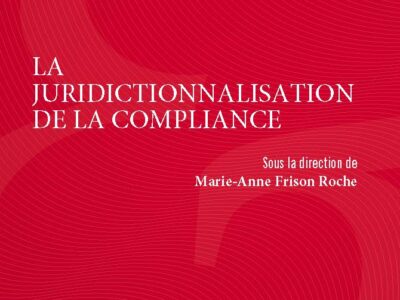
📝Le jugeant-jugé. Articuler les mots et les choses face à l’éprouvant conflit d’intérêts, in 🕴️M.-A. Frison-Roche (ed.), 📕La juridictionnalisation de la Compliance

► Full Reference: M.-A. Frison-Roche, "Le jugeant-jugé. Articuler les mots et les choses face à l'éprouvant conflit d'intérêts" ("The Judge-Judged. Articulating words and things in the face of the testing conflict of interest"), in M.-A. Frison-Roche, (ed.), La juridictionnalisation de la Compliance, coll. "Régulations & Compliance", Journal of Regulation & Compliance (JoRC) and Dalloz, 2023, pp. 59-80.  - 📝read the article (in French) - 🚧read the bilingual Working Paper which is the basis of this article, with additional developments, technical references and hyperlinks - 📕read a general presentation of the book, La juridictionnalisation de la Compliance, in which this article is published - ► Summary of the article (done by the Journal of Regulation & Compliance): Since the topic of this article is part of a chapter devoted to the Company established as Prosecutor and Judge of itself by Compliance Law, chapter aiming to use the relevant qualifications, it is appropriate therefore to worry about the adjustment of words and things, of the way in which the relationship between ones and the others evolve, and of the more particular question of knowing if this evolution is radical or not when one speaks of "judge ". because "judging" is a word that the Law has disputed with other disciplines, but that it has appropriated not so much to confer more powers on those who act in its name, for example that who supervise and punish, but on the contrary to impose limits, since to the one who judges it has put the chains of the procedure under foot, thus making bearable for the other the exercise of such a power. Therefore, those who want the power to judge would often want to not have the title, because having de jure the title of judge is being subject to the correlated regime, it is to be submitted to procedural correctness. It is therefore to better limit that the Law sees who judges, for obliging this so-powerful character to the procedure. But the Law also has the power to appoint a judge and to fix the contours of all the characters in the trial. He usually does it with clarity, distinguishing the ones of the others, not confusing them. This art of distinction has constitutional value. Thus, not only the one who judges must be named "judge" but the procedural apparatus which goes with this character, and which constitutes a way of doing things and fundamental rights, are not "granted" by kindness or in a second step: it is a block. If you didn't want to have to endure procedural rights, you didn't have to want to be a judge. Admittedly, one could conclude that the procedure would therefore have become "substantial"; by this elevation, it is rather a fashion of saying that the procedure would no longer be a "servant": it is a kind of declaration of love for the procedure, as long as one affirms that at the acts of judging , or investigating, or prosecuting, are "naturally" attached the procedural rights for the one who is likely to be the object of these powers. Compliance Law, in search of allies to achieve the Monumental Goals for the aims of which it was instituted, will require, or even demand, private companies to go and seek themselves, in particular through investigations. internal or active vigilance on others, for finding facts likely to be reproached to them. Compliance Law will also require that they prosecute those who have committed these acts. Compliance La will again demand that they sanction the acts that people have committed in their name. This is clearly understood from the point of view of Ex Ante efficiency. The confusion of roles is often very efficient since it is synonymous with the accumulation of powers. For example, it is more efficient that the one who pursues is also the one who instructs and judges, since he knows the case so well… Besides, it is more efficient that he also elaborates the rules, so he knows better than anyone the "spirit" of the texts. This was often emphasized in Regulatory Law. When everything is Information and risk management, that would be necessary … But all this is not obvious. For two reasons, one external and the other internal. Externally, the first reason is that it is not appropriate to "name" a judge who is not. This would be too easy, because it would then be enough to designate anyone, or even to do it oneself to appropriate the regime that goes with it, in particular for obtain a so-called legitimate power for obtaining that others obey even though they are not subordinate or from them they transmit information, even though they would be  competitors: it would then be necessary to remember that only the Law is able to appoint judge ; in this new Compliance era, companies would be judges, prosecutors, investigators!  Maybe, if the Law says it, but if it didn't, it would be necessary to come back to this tautology … But are we in such a radicalism? Moreover, do judges have "the prerogative" of judgment and the Law has not admitted this power for companies to judge for a long time? As soon as the procedure is there in Ex Ante and the control of the judge in Ex Post? The second reason, internal to the company, situation on which the article focuses, is that the company investigates itself, judges itself, sanctions itself. However, the legal person expressing its will only through its organs, we underline in practice the difficulties for the same human being to formulate grievances, as he/she is the agent of the legal person, addressed to the natural person that he/she himself/herself is. The two interests of the two are not the same, are often opposed; how the secrets of one can be kept with respect to the other, represented by the same individual? … It is all the mystery, even the artifice of legal personality that appears and we understand better that Compliance Law no longer wants to use this strange classical notion. Because all the rules of procedure cannot mask that to prosecute oneself does not make more sense than to contract with oneself. This conflict of interest is impossible to resolve because naming the same individual X then naming him/her Y, by declaring open the dispute between them does not make sense. This dualism, which is impossible to admit when it comes to playing these functions with regard to corporate officers, can come back to life by setting up third parties who will carry secrets and oppositions. For example, by the designation of two separate lawyers for the human being agent and the human being representative of the legal person, each lawyer being able to have secrets for each other and to oppose each other. These spaces of reconstitution of the so "natural" oppositions in procedure between the one who judges and the one who is judged can also take the technological form of platforms: where there is no longer anyone, where the process has replaced the procedure, there is no longer any human judgment. We can thus see that the fear of conflicts of interest is so strong that we resign ourselves to saying that only the machine would be "impartial", a derisory conception of impartiality, against which it is advisable to fight. This then leads to a final question: can the company claim to exercise the jurisdictional power to prosecute and judge and investigate without even claiming to be a prosecutor, an investigating judge, or a court? The company's advantage would be to be able to escape the legal regime that classical Law attaches to its words, mainly the rights of the defense and the rights of action for others, the principle of publicity of justice for everyone, which expresses the link between procedure and democracy. When Facebook said on June 12, 2021 "react" to the decision of May 5, 2021, adopted by what would only be an Oversight Board to decide "as a consequence" of a 2-year suspension of Donald Trump's account, the art of qualifications seem to be used in order to avoid any regime constraint. But this art of euphemism is very old. Thus, the States, when they wanted to increase repression, presented the transformation of the system as a softening of it through the "decriminalization" of Economic Law, transferred from the criminal courts to the independent administrative agencies. The efficiency was greatly increased, since the guarantees of the Criminal Procedure ceased to apply. But 20 years later, Words found their way back to Things: under Criminal Law, slept the "criminal matter", which requires the same "Impartiality". In 1996, a judge once affirmed it and everything was changed. Let us therefore wait for what the Courts will say, since they are the masters of qualifications, as Article 12 of the French Code of Civil Procedure says, as Motulsky wrote it in 1972. Law has time. - 🌐 follow Marie-Anne Frison-Roche sur LinkedIn 🌐follow Marie-Anne Frison-Roche on Instagram 🌐 subscribe to the Newsletter MAFR Regulation, Compliance, Law 

Articles in a legal collective publication

HEYMANN, Jérémy🕴️

📝La nature juridique de la “Cour suprême” de Facebook, in 🕴️M.-A. Frison-Roche (ed.), 📕La juridictionnalisation de la Compliance

► Full Reference: J. Heymann, "La nature juridique de la "Cour suprême" de Facebook" ("The legal nature of Facebook's "Supreme court""), in M.-A. Frison-Roche (ed.), La juridictionnalisation de la Compliance, coll. "Régulations & Compliance", Journal of Regulation & Compliance (JoRC) and Dalloz, 2023, pp. 151-167.  - 📕read a general presentation of the book, La juridictionnalisation de la Compliance, in which this article is published - ► The summary below describes an article following the colloquium L'entreprise instituée Juge et Procureur d'elle-même par le Droit de la Compliance , co-organized by the Journal of Regulation & Compliance (JoRC) and the Faculté de Droit Lyon 3. This manifestation was designed under the scientific direction of Marie-Anne Frison-Roche and Jean-Christophe Roda and took place in Lyon on June 23, 2021. In the book, the article will be published in Title I, devoted to: The Entreprise instituted Judge and Prosecutor of itself by Compliance Law. - ► Summary of the article (done by the author): Taking place in the general theme aiming at making “words and things coincide”, the article offers some thoughts on the “conditions of the discourse” – in the sense in which Foucault understood it in his Archéologie des sciences humaines – relating to the phenomenon of “jurisdictionalization” of Compliance.             The thoughts are more specifically focusing on the nature of the so-called “Supreme Court” that Facebook instituted to hear appeals of decisions relating to content on the digital social networks that are Facebook and Instagram. Is this really a “Supreme Court”, designed in order to “judge” the Facebook Group?             A careful examination of the Oversight Board – i.e. the so-called “Supreme Court” created by Facebook – reveals that the latter, in addition to its advisory mission (which consists of issuing policy advisory opinions on Facebook’s content policies), exercises some form of adjudicative function. This is essentially conceived in terms of compliance assessment, of the content published on the social networks Facebook or Instagram with the standards issued by these corporations on the one hand, of content enforcement decisions taken by Facebook with the Law on the other hand. The legal framework of reference is yet rather vague, although its substantial content seems to be per se evolutive, based on the geographical realm where the case to be reviewed is located. An adjudicative function can therefore be characterized, even if the Oversight Board can only claim for a limited one.             The author can ultimately identify the Oversight Board as a preventive dispute settlement body, in the sense that it seems to aim at avoiding any referral to state courts and ruling before any court’s judgement can be delivered. Some questions are thus to be raised, relating with both legitimacy and authority of such a Board. But whatever the answers will be, the fact remains that the creation of the Oversight Board by a private law company already reveals all the liveliness of contemporary legal pluralism. -

Articles

Affaire Generali : la Cour de cassation précise les caractéristiques de l’obligation

Complete reference :  Aranda Vasquez, A., Affaire Generali : la Cour de cassation précise les caractéristiques de l'obligation, in Petites affiches, février 2018, n° 39, pp. 12-15.     "The Generali case is experiencing a new episode. The Court of Cassation has clarified the essential characteristics of the obligation. It is reverting to the position of the judgment of the Paris Court of Appeal of June 21, 2016 (n ° 15 / 00317), by deciding that the reimbursement of the nominal amount is not an essential characteristic of the obligation. The highest court of the judiciary thus sheds light on the matter. "   Sciences-Po students can consult the article via the Drive, "MAFR- Regulation & Compliance" folder        

Articles in The Journal of Regulation & Compliance « JoRC »

What is the nature of the “Economic Regulatory Contract”, open to “consultation” February 19, 2015 by the privatized company “Aéroports de Paris (ADP)”?

February 17, 2015, as the previous "Contrat de Régulation Économique" (Economie Regulatory Contract), the firm Aéroport de Paris (ADP)  has made available on its site to all "for consultation" the draft  "Contrat de Régulation Economique ("Economic Regulatory Contract)  for the period 2016 -2020. Published in the wake of the meeting of the Board of ADP, the text is presented as a tool "for the Paris place", especially for air transport. This shows that the document is primarily intended for investors and financial markets, the document being placed on the company website in the section for the "investors". This illustrates the evolution from the traditional "contrats de plan" (plan contracts). But then, who are the parties to these types of contract? Indeed, the very term "Regulatory contract"  is new in public Law. It appears as a sort of  modernization of "plan contract." The Conseil d'État (French State Council) finally admitted the contractual nature of these planning contracts. In these contracts, are parties were the State and the company in charge of a public service. Because here the contract is an instrument of "economic regulation" the open public consultation draft rather expresses a global conception of  ADP, the company which manages the Paris airports,  for the future of the development of critical infrastructure that is the airport as the heart of global development of air transport. The enterprise manager of the airport in the heart of the contract (rather than the State) in setting objectives for the coming four years is the letter and spirit of the French law of 20 April 2005 about Airports, which put the apparatus of this "Contrat de Régulation Economique" in place. In this, the infrastructure manager is set by law as a "regulator of second degree", as can be a financial market enterprise. The company that manages and develops the Paris airports undoubtedly belongs to the category of " critical firms", as well it manages the future of the sector and helps to keep France a place in the world. More, A.D.P. behaves like a Regulator, since it is carrying out the "public consultation", the consultation paper prepared by it,  being placed on its site and developing its ambitions for the sector and for France. But A.D.P. also expressed as a financial and economic actor, emphasizing the competitive environment,  demanding in passing more stability and clarity in the regulation in which it moves … That is why the consultation mechanism provided by the law must be more complex. Indeed, ADP can not be judge and jury. Therefore if the project raises observations, they must be formuled not to ADP but to the Ministries of Aviation and Economy, within a month. They shall communicate theiir content to ADP . Then the Commission consultative aéroportaire (French Airport Consultative Committee) will be consulted. At the end of this process, the "Contrat de Régulation Economique" will be signed. Seing the end of the process, it remains in line with the plan contracts, since it remains the Economic Regulatory Contract is signed between the State and the essential infrastructure manager. But the consultation process shows firstly investors are the first recipients of the statements made by a privatized company presenting its draft primarily in terms of competitive context and international development and secondly the airlines that use daily services of the airports are also directly involved by theses questions of tarification. Airlines protest against the increase in the money that will be asked. This will be imposed, since it is tarification and princing public policy. We are in unilateral rules. But it is indeed a "price" they feel to pay, they also heard a speech referring to competition in what the mechanism is presented as a "contract". But then, does it take to admit that these "contracts for economic regulation" are not between two parties that are the state and the regulator of second degree that is the infrastructure manager but must be three, the State, the infrastructure manager and "stakeholders" that are mainly airlines? This practical difficulty is much to the fact that the qualification of "contract" is difficult to justify in proceeding in which prevail unilateral mechanisms.