Supervision

🏗️ copublishing and direction of the collection: 📚Régulations & Compliance

📚Forthcoming: 🕴️L. Laref (ed.), 📕Compliance et vigilance bancaire (“Compliance and Banking Vigilance”)

► Full reference: L. Laref (ed.), Compliance et vigilance bancaire. Contribution des acteurs bancaires et financiers à la LCB-FT (Compliance and Banking Vigilance. The Contribution of Banking and Financial Actors to AML/CFT), preface by N. Vasse, “Régulations & Compliance” series, Journal of Regulation & Compliance (JoRC) and Lefebvre-Dalloz, forthcoming. - 🧮This book follows the colloquium Compliance et vigilance bancaire : la participation des acteurs du secteur bancaire et financier à la LCB/FT, at which Marie-Anne Frison-Roche spoke: 🎤“Obligation de compliance et gouvernance bancaire” (Compliance Obligation and Banking Governance). - 📝Contribution by 🕴️Marie-Anne Frison-Roche: « La contribution des banques à la lutte contre le blanchiment de capitaux et le financement du terrorisme, illustration de l’Obligation systémique de Compliance » (The Contribution of Banks to the Fight against Money Laundering and Terrorist Financing, an Illustration of the Systemic Compliance Obligation). - ► Read the presentations of the other books in the series: the following books: 🕴️M.-A. Frison-Roche, 📕Le système juridique de l’adressage de l’Internet. Une structure multi-acteurs, gage de durabilité (The Legal System of Internet Addressing. A Multi-Stakeholder Structure, the Pledge of its Sustainability), forthcoming 🕴️M.-A. Frison-Roche (ed.), 📕Le système probatoire de la Compliance, forthcoming   the previous books: 🕴️M.-A. Frison-Roche (ed.), 📕Compliance et Contrat, forthcoming 🕴️M.-A. Frison-Roche (ed.), 📕L’Obligation de Compliance, 2025 🕴️M.-A. Frison-Roche and M. Boissavy (eds.), 📕Compliance et droits de la défense. Enquête interne – CJIP – CRPC, 2024 🕴️M.-A. Frison-Roche (ed.), 📕La juridictionnalisation de la Compliance, 2023 🕴️M.-A. Frison-Roche (ed.), 📕Les Buts Monumentaux de la Compliance, 2022 🕴️M.-A. Frison-Roche (ed.), 📕Les outils de la Compliance, 2021 🕴️M.-A. Frison-Roche (ed.), 📕Pour une Europe de la Compliance, 2019 🕴️N. Borga, J.-Cl. Marin and J.-Ch. Roda (eds.), 📕Compliance : l’entreprise, le régulateur et le juge, 2018 🕴️M.-A. Frison-Roche (ed.), 📕Régulation, Supervision, Compliance, 2017 🕴️M.-A. Frison-Roche (ed.), 📕Internet, espace d’interrégulation, 2016 📚See all the books of the series. - ► Provisional table of contents: PROVISIONAL TABLE OF CONTENTS (in French) Preface by 🕴️Nicolas Vasse, Executive Director of the Anti-Money Laundering Authority (AMLA) PROPOS INTRODUCTIFS (Introductory Remarks) PERSPECTIVE GÉNÉRALE (General Perspective) ♦️ La contribution des banques à la lutte contre le blanchiment de capitaux et le financement du terrorisme, illustration de l’Obligation systémique de Compliance, by 🕴️Marie-Anne Frison-Roche PREMIÈRE PARTIE (PART ONE) LA DIFFUSION DE LA COMPLIANCE DANS LE SECTEUR BANCAIRE ET FINANCIER (THE DIFFUSION OF COMPLIANCE IN THE BANKING AND FINANCIAL SECTOR) ♦️ Quelques rappels terminologiques utiles…, by 🕴️Jérôme Lasserre Capdeville DEUXIÈME PARTIE (PART TWO) LA RÉCEPTION DE L’OBLIGATION DE COMPLIANCE PAR LES PROFESSIONNELS DU SECTEUR BANCAIRE ET FINANCIER (THE RECEPTION OF THE COMPLIANCE OBLIGATION BY BANKING AND FINANCIAL SECTOR PROFESSIONALS) ♦️ La réception de la compliance LCB-FT par le secteur bancaire et financier. Modalités d’appropriation, dysfonctionnements structurels et éthique comme condition d’effectivité, by 🕴️Jennifer Marchand ♦️ L’obligation de compliance LCB-FT, moteur de transformation des pratiques en matière de crédits et de garanties, by 🕴️Patricia Le Besnerais TROISIÈME PARTIE (PART THREE) LA MODULATION DES OBLIGATIONS DES PROFESSIONNELS DU SECTEUR BANCAIRE ET FINANCIER EN MATIÈRE DE LCB-FT (THE MODULATION OF THE AML/CFT OBLIGATIONS OF BANKING AND FINANCIAL SECTOR PROFESSIONALS) ♦️ Le banquier face au défi de la vigilance : entre exigences contradictoires et responsabilités croissantes, by 🕴️Paula Seixas et 🕴️Romain Ducatez ♦️ L’harmonisation européenne face à la modulation de l’obligation de vigilance : les enseignements de l’AMLR, by 🕴️Cassandre Degrande QUATRIÈME PARTIE (PART FOUR) COMPLIANCE ET PERFORMATIVITÉ : LES ENJEUX AUTOUR DE LA REGTECH DANS LE SECTEUR BANCAIRE ET FINANCIER APPLIQUÉE À LA LCB-FT (COMPLIANCE AND PERFORMATIVITY: THE STAKES OF REGTECH IN THE BANKING AND FINANCIAL SECTOR APPLIED TO AML/CFT) ♦️ Compliance, performativité et RegTech : la reconfiguration des dispositifs de vigilance bancaire en matière de LCB-FT, by 🕴️Gurvan Branellec ♦️ Les observations de l’ACPR sur l’usage de l’IA par les banques et néobanques — entre avancées et nouveaux défis (titre provisoire), by 🕴️Jean-Christophe Cabotte PROPOS CONCLUSIFS (Concluding Remarks) - 🌐follow Marie-Anne Frison-Roche on LinkedIn 🌐follow Marie-Anne Frison-Roche on Instagram 🌐subscribe to the Newsletter MAFR Regulation, Compliance, Law 🌐subscribe to the Video Newsletter MAFR Surplomb 🌐subscribe to the Newsletter MaFR Droit & Art
📝L’arbitre, juge, superviseur, accompagnateur ? (The arbitrator, judge, supervisor, coach?),, in 🕴️M.-A. Frison-Roche (dir.), 📕L’obligation de Compliance

► Full Reference: J.-B. Racine, "L’arbitre, juge, superviseur, accompagnateur ?" (The arbitrator, judge, supervisor, coach?), in [rubrique p="Présentation"]M.-A. Frison-Roche[/rubrique] (dir.), [lien a="lobligation-de-compliance"]L'Obligation de Compliance[/lien], Journal of Regulation & Compliance (JoRC) and Dalloz, coll. "[rubrique p='Responsabilités éditoriales > Direction de la collection "Régulations & Compliance", JoRC & Dalloz']Régulations & Compliance[/rubrique]", 2025, pp. 489-502. - 📕read the general presentation of the book, [lien a="lobligation-de-compliance"]L'Obligation de Compliance[/lien], in which this article is published - ► English Summary of this article (done by the Journal of Regulation & Compliance - JoRC) : From the outset, the author sets out what is at stake in these terms:  "Quel rôle peut ou pourrait jouer l’arbitre dans les dispositifs de compliance ? Selon le rôle qu’il est amené à jouer, il peut ou pourrait venir en renfort de l’obligation de compliance. Poser cette question, c’est poser la question des pouvoirs de l’arbitre et de son office. C’est aussi, d’une certaine manière, renvoyer à la notion même d’arbitrage." (What role can or could the arbitrator play in compliance systems? Depending on the role he/she is called upon to play, he/she can or could reinforce the compliance obligation. Asking this question raises the question of the powers of the arbitrator and his/her office. In a way, it also goes back to the very notion of arbitration).  In practice, arbitrators deal with compliance issues in their office as judges. This is illustrated by disputes involving allegations of corruption, where the arbitrators' ruling obviously cannot give effect to a corrupt practice unless they violate themselves international public order. But in this, the arbitrator is only applying a legal standard, the main issue being then the question of evidence, with compliance tools often serving as indicators of the corruption itself. Leaving behind the strict legal source and coming to the standards issued by the ICC about the fight against corruption, we really enter into the "compliance obligation", in the strict sense, when a contract appears. International business practices standards are emerging, not only in the area of probity but also in the protection of human rights, for which arbitrators can now act as guarantors. Arbitrators can do this, in particular, through the emerging litigation relating to vigilance obligation, either directly when vigilance plans are at issue,, even if a legal rule gives a specific competence to a State court (as the French 2017 law does) or if we imagine that a plan itself includes a system for recourse to arbitration, which would imply a change in culture, or if we consider that soft law is in the process of emerging from the practices of international trade laying down a duty of vigilance that arbitrators could take up. In the second part of his contribution, the author takes a second, bolder approach, namely that of an arbitrator who understands Compliance Law in that he/she would be more than a Judge, i.e. he/she would do more than settle a dispute by applying the law. This would be conceivable given the tendency to consider that the arbitrator could modify contracts and if example is taken from the technique of arbitration practised for concentration disputes in merger law. To give arbitration the required regulatory dimension, this third party would have to be able to exercise a supervisory function, which the notion of "dispute" hardly lends itself to, especially as an arbitrator is only set up to be a judge, and if he/she ceases to be one it is difficult for him/her to remain an arbitrator.... However, it is conceivable that in Ex Post the arbitrator could perform the monitoring function often required in Compliance Law. The technique of disputes boards is inspiring in this respect. The two fields, Arbitration and Compliance, are thus destined to move closer together, as the two traditional limits, arbitrability and litigation, are in the process of evolving so that they no longer stand in the way of such rapprochements. The author can therefore conclude: "C’est aux différents acteurs de la compliance de penser à l’arbitrage, et à la souplesse, la plasticité et la liberté qu’il offre, pour éventuellement le configurer spécialement au service des buts de la compliance." (It is up to the various players in Compliance to think about Arbitration, and the flexibility, plasticity and freedom it offers, in order to configure it specifically to serve the goals of Compliance Law). -

🎤Le Contentieux Systémique Emergent du fait du système numérique (“emerging systemic litigation arising from the digital system”), in 🧮Importance et spécificité du Contentieux Systémique Émergent, cycle de conférences-débats “Contentieux Systémique Émergent”

► Full Reference: [rubrique p="Présentation"]M.-A. Frison-Roche[/rubrique], "Le Contentieux Systémique Emergent du fait du système numérique ("emerging systemic litigation arising from the digital system"), in [lien a="les-techniques-de-supervision-des-contenus-numeriq"]Les contrôles techniques des risques présents sur les plateformes et les contentieux engendrés [/lien][lien a="les-techniques-de-supervision-des-contenus-numeriq"]([/lien][lien a="les-techniques-de-supervision-des-contenus-numeriq"]Technical controls on the risks present on platforms and the disputes that arise[/lien][lien a="les-techniques-de-supervision-des-contenus-numeriq"])[/lien], in [lien a="coordination-du-cycle-de-conferences-de-formation-"]cycle of conferences-debates "Contentieux Systémique Émergent" ("Emerging Systemic Litigation")[/lien], organised on the initiative of the Cour d'appel de Paris (Paris Cour of Appeal), with the Cour de cassation (French Court of cassation), the Cour d'appel de Versailles (Versailles Court of Appeal), the École nationale de la magistrature - ENM (French National School for the Judiciary) and the École de formation des barreaux du ressort de la Cour d'appel de Paris - EFB (Paris Bar School), under the scientific direction of Marie-Anne Frison-Roche, May 27,2024, 9h-10h30, Cour d'appel de Paris, Cassin room - 🧮[lien a="les-techniques-de-supervision-des-contenus-numeriq"]see the full programme of this event[/lien] - 🧮[lien a="coordination-du-cycle-de-conferences-de-formation-"]see the full programme of the entire cycle Contentieux Systémique Émergent (Emerging Systemic Litigation)[/lien] - 🔲see the slides (in French), basis of this conference - 🌐read on  LinkedIn the summary of this conference les slides - 🎤read  the presentation of the second conference in this manifestation: [lien a="un-systeme-systemique-in-vivo-le-cas-dit-des-sites"]"Un contentieux systémique in vivo : le cas dit des sites pornographiques"[/lien] ("a Systemic Litigation in vivo: the case of pornographic prestations platforms") - 🧱[lien a="les-techniques-de-supervision-des-contenus-numeriq"]read the general presentation of this scientific coordination of this manifestation and its various speechs[/lien] - 🌐read on LinkedIn the summary of this manifestation in the Newsletter MAFR Regulation, Compliance, Law - ► Summary of this conference: This speech is a prelude to the three more specific speeches and aims to show how the digital system, by its very nature, produces and will produce "Systemic Litigation".  Systemic Litigation" is defined by "cases" (a procedural notion) brought before judges, who may be judges of first instance, or possibly emergency judges, in which the interests, or even the future, of a system are involved beyond the dispute between the parties.  This Systemic Case may be brought before a specialised judge, including the juridictional body of a Regulatory or Supervisory Authority, but also before a judge of ordinary Law, on the basis of a special text but possibly on the basis of a text of ordinary Law. This can lead to a fragmentation of litigation, even though the unity of the system remains, or even is at stake, in the present and in the future. The "digital system" is an example of the "natural" production of Systemic Litigation which arise as a result of the Digital System alone, in particular because of the systemic risks inherent in this system, and the fact that their prevention and management are internalised in the operators who have built and manage the system (Compliance Law). The issue is therefore one of Interregulation. Platforms in particular give rise to Systemic Litigation because of the specific nature of certain risks, for example disinformation, terrorism, destruction of rights (copyright being just one example), the risk of minors having access to content that is destructive for them, and so on. Digital Systemic Litigation has only just begun. It is essential that judges are prepared for this and that they face up to it together through dialogue.             - 🌐follow Marie-Anne Frison-Roche on LinkedIn 🌐follow Marie-Anne Frison-Roche on Instagram 🌐subscribe to the Newsletter MAFR Regulation, Compliance, Law

🧮Les techniques de supervision des contenus numériques disponibles sur les plateformes (Technical risks controls on platforms and disputes arising from them), in cycle de conférences-débats “Contentieux Systémique Émergent” (“Emerging Systemic Litigation”)

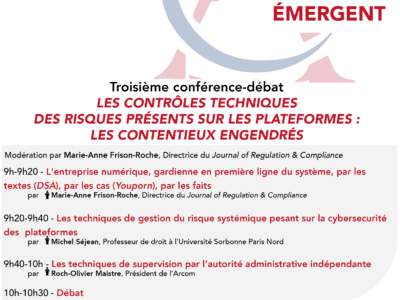
► Full Reference: [lien a="les-techniques-de-supervision-des-contenus-numeriq"]Les contrôles techniques des risques présents sur les plateformes et les contentieux engendrés (Technical risks controls on platforms and disputes arising from them)[/lien], in [lien a="coordination-du-cycle-de-conferences-de-formation-"]cycle of conference-debates "Contentieux Systémique Émergent" ("Emerging Systemic Litigation")[/lien], organised on the initiative of the Cour d'appel de Paris (Paris Cour of Appeal), with the Cour de cassation (French Court of cassation), the Cour d'appel de Versailles (Versailles Court of Appeal), the École nationale de la magistrature - ENM (French National School for the Judiciary) and the École de formation des barreaux du ressort de la Cour d'appel de Paris - EFB (Paris Bar School), under the scientific direction of Marie-Anne Frison-Roche, May 27, 2024, 9h-10h30, Cour d'appel de Paris, Cassin courtroom - 🧮[lien a="coordination-du-cycle-de-conferences-de-formation-"]see the full programme of the cycle Contentieux Systémique Émergent (Emerging Systemic Litigation)[/lien] - 🌐see on LinkedIn the report of this event - 🧱read below the report of this event⤵️ - ► Presentation of the conference: The digital space is full of risks. Some are naturally associated with it, because it is an area of freedom, while others must be countered because they are associated with generally prohibited behaviour, such as money laundering. But the digital space has developed risks which, because of their scale, have been transformed in their very nature: this is particularly true of the distortion permeating certain content and the insecurity that can threaten the entire system itself. Law has therefore entrusted operators themselves with vigilance over what have become ‘cyber-risks’, such as the risk of disinformation, the risk of destruction of communication infrastructures, and the risk of data theft, a systemic prospect that can lead to the collapse of societies themselves.   New legislations has been drafted, in particular the Digital Services Act (DSA), to increase the burdens and powers of firms in this area, with digital companies in the front line, but also supervisory authorities such as the Autorité de régulation de la communication audiovisuelle et numérique - Arcom (French Regulatory Authority for Audiovisual and Digital Communication). The resulting disputes, in which firms and regulators may be allies or opponents, are systemic in nature.   The judge's handling of these "systemic cases", through the procedure and the solutions, must respond to this systemic dimension. The "pornographic websites" case, which is currently unfolding, provides an opportunity to observe in vivo the dialogue between judges when a "systemic case" imposes itself on them.   - 🧮Programme of this event:  Third conference-debate LES CONTRÔLES TECHNIQUES DES RISQUES PRÉSENTS SUR LES PLATEFORMES ET LES CONTENTIEUX ENGENDRÉS (TECHNICAL RISKS CONTROLS ON PLATFORMS AND DISPUTES ARISING FROM THEM) Paris Court of Appeal, Cassin courtroom Moderated by 🕴️Marie-Anne Frison-Roche, Professor of Regulatory and Compliance Law, Director of the Journal of Regulation & Compliance (JoRC) 🕰️9h-9h10. 🎤[lien a="lentreprise-numerique-gardienne-en-premiere-ligne-"]Le contentieux Systémique Emergent du fait du système numériqué (Systemic Litigation Emerging from the Digital System)[/lien], 🕴️Marie-Anne Frison-Roche 🕰️9h10-9h30. 🎤Les techniques de gestion du risque systémique pesant sur la cybersécurité  des plateformes (The Systemic Obligation of Security on Platforms and associated Litigation), 🕴️Michel Séjean, Professor of Law at Sorbonne Paris Nord University 🕰️9h30-9h50. 🎤[lien a="un-systeme-systemique-in-vivo-le-cas-dit-des-sites"]Un cas systémique in vivo : le cas dit des sites pornographiques (An in vivo Systemic Case: the so-called case of pornographic websites)[/lien],🕴️Marie-Anne Frison-Roche 🕰️9h50-10h10. 🎤Les obligations systémiques des opérateurs numériques à travers le Règlement sur les Services Numériques (RSN/DSA) et le rôle des régulateurs (Systemic Obligations of Operators (DSA) and the role of Regulators), 🕴️Roch-Olivier Maistre, Chair of the Autorité de régulation de la communication audiovisuelle et numérique - Arcom (French Regulatory Authority for Audiovisual and Digital Communication) 🕰️10h10-10h30. Debate - 🔴Registrations and information requests can be sent to: inscriptionscse@gmail.com 🔴For the attorneys, registrations have to be sent to the following address: https://evenium.events/cycle-de-conferences-contentieux-systemique-emergent/  ⚠️The conference-debates are held in person only, in the Cour d’appel de Paris (Paris Court of Appeal). - 🧱read below a detailed presentation of this event⤵️ -

🎤Participation in the panel “Vigilance (due diligence)”, in 🧮150th Anniversary Symposium of the ILA/ADI

🌐 follow Marie-Anne Frison-Roche sur LinkedIn 🌐subscribe to the Newsletter MAFR Regulation, Compliance, Law  - ► Full Reference: [rubrique p="Présentation"]M.-A. Frison-Roche[/rubrique], participation in the panel "Vigilance (due diligence)", in International Law Association (ILA), 150th Anniversary Symposium of the ILA/ADI, Paris, 19 June 2023. - 🧮See the full programme of this event -

AMF (French financial markets authority) and AFM (Dutch financial markets authority)

Position paper : Call for a European Regulation for the provision of ESG data, rating, and relate services

Full reference: AMF / AFM, Position paper : Call for a European Regulation for the provision of ESG data, rating, and relate services, 15th of December 2020  Read the press release by AMF In this document, AMF and AFM analyses the perspective to supervise ESG rating agencies and the perspective to make ESMA supervisor of these agencies. 

Financial Stability Board

The Use of Supervisory and Regulatory Technology by Authorities and Regulated Institutions

Full reference: Financial Stability Board, The Use of Supervisory and Regulatory Technology by Authorities and Regulated Institutions. Market Developments and Stability Implications, Report of 9th of October 2020, 36 p.  Read the report Read the presentation of the report by the Financial Stability Board To go further on the question of the use of new technologies in regulatory processes, read Marie-Anne Frison-Roche's working paper: [lien a="la-fonctionnalite-juridique-de-la-blockchain-au-re"]Analysis of blockchains with regards with the uses they can fulfill and the functions that the ministerial officers must ensure[/lien]  

For regulating or supervising, technical competence is required: example of the French creation of the “Pôle d’expertise de la régulation numérique “​

Full reference: Frison-Roche, M.-A., For regulating or supervising, technical competence is required: example of the French creation of the "Pôle d'expertise de la régulation numérique"​, Newsletter MAFR - Law, Regulation, Compliance, 2nd of September 2020 Lire par abonnement gratuit d'autres news de la Newsletter MAFR - Law, Regulation, Compliance   Summary of the news Through a decree of 31st of August 2020, the government created a national service, the "Pôle d'expertise de la régulation numérique" (digital regulation expertise pole). It has to furnish to State services a technical expertise in computer science, data science and algorithm processes in order to assist them in their role of control, investigation and study. The aim is to favor information sharing between researchers and State services in charge of regulating digital space.  As its acronym indicates, this pole of expertise aims to represents constance in a changing world. Moreover, more than being a national service, this organism must adopt a transversal dimension, its creation decree being signed by the Prime Minister, Minister of Economy, Minister of Culture and Minister of Digital Transition. The creation of such a pole shows the awareness of the government of the importance of technical competency in the regulation of digital space and of the necessity to centralize these expertises in one organ.  However, as the decree indicates, this pole of expertise could be consulted only by "State services", that excludes regulators which are independent from the State and which could put the pole in conflict of interest, and courts even if they are supposed to play a central role in the regulation of digital space and even if they are allowed to ask the advice of the regulator about some cases. But if regulators cannot size the pole, to whom does it benefit except the legislator and a few officials?  It would therefore have been better for this pole of expertise to be placed under the direction of regulatory and supervisory bodies, which would have enabled it to be able to be consulted both by regulators and by judges, both of whom are key players in digital regulation.

The practical utility of having a firm definition of “Compliance”​

Full reference : Frison-Roche, M.-A., The practical utility to have a firm definition of "Compliance", Newsletter MAFR - Law, Compliance, Regulation, 10th of August 2020. Read by subscribing the other news in the Newsletter MAFR - Law, Compliance, Regulation   Summary of the news Some says that defining Compliance is a theoretical and non useful exercice that should be left aside to tackle the study of concrete technical cases. However, to be able to use Compliance tools, it is first necessary to have a clear, firm and simple idea of what is Compliance. Moreover, the future of this new branch of law intensely depends on the definition we choose to use.  Compliance Law gives to some crucial private firms new responsibilities such as the one to fight against global dangers or the one of saving the planet. In this, Compliance Law can be perceived as a kind of new deal between the private sector and public authorities, with the only difference that this time the consent of the private sector is not required. Some would say that the concretization of such projects is the duty of the State and that private firms, if they must respect the rules, do not have to find a way to concretize a "monumental goal". However, the world face new and systemic dangers in the face of which the State alone is powerless, technically or geographically, and against which crucial companies can act. It is not about, as some advocate to put human being aside of Compliance Law by letting machines decide. It is about placing the human being and its protection at the heart of Compliance Law. In this, Compliance Law can become a new humanism.    To go further, read Marie-Anne Frison-Roche's working paper, [lien a="le-droit-reve-de-la-compliance"]The Dreamed Compliance Law [/lien]

On June 18, 2019, during its meetings with the banking sector, the Single Resolution Board tells what it expects for it (and its Regulators) for the effectiveness of the Resolution mechanism.

The European Banking Union is based on supervision as much as on regulation: it concerns the operators as much as the structures of the sector, because the operators "hold" the sector. This is why the "regulator - supervisor" holds the operators by the supervision and is close to them. He meets them officially and in "soft law" relations. This is all the more necessary since the distinction between the Ex Ante and the Ex Post must be nuanced, in that its application is too rigid, in that it involves a long time (first of all the rules, then to apply them, then to notice a gap between rules and behaviors, then to repair it) is not appropriate if the system aims at the prevention of systemic crises, whose source is inside the operators. This is why the body in charge of solving the difficulties of the systemic banks for the salvation of the systeme meets the banking sector itself, to ensure that they are permanently "resolvable", so that the hypothesis of their resolution never arises. This is the challenge of this system: that it is always ready, for never be applying. - In the European Banking Union, the Single Resolution Board (SRB) is in charge of "resolve" the difficulties of European systemic banks in difficulty. It is the public body of the second pillar of the Banking Union. The first pillar is the prevention of these difficulties and the third is the guarantee of deposits. The resolution is therefore more like an Ex Post mechanism. But in this continuum through these three pillars between the Ex Ante and the Ex Post, the SRB does not wait passively - as would a traditional judge do - that the file of the troubled bank reaches it. Like a supervisor - which brings it closer to the first public in the system (Single Supervisory Board -SSB), which supervises all the banks, it is in direct contact with all the banks, and it approaches the hypothesis of a bank in trouble by a systemic perspective: it is therefore to the entire banking system that the SRB addresses itself. As such, it organizes meetings, where he is located: in Brussels. Thus, on June 18, 2019, all banks came to discuss with the Single Resolution Board to know what it wants from the banks and for the banks, in what is called a "dialogue meeting". To resolve in Ex Post the difficulties of a bank, it has to present a quality (a little known concept in Bankruptcy Law): "resolvability". How build it? Who build it ? In its very design and in its application, bank by bank. For the resolution body vis-à-vis all players in the banking and financial sector, it's clear: "Working together" is crucial in building resolvability ". In the projection that is made, it is affirmed that there can be a successful resolution only if the operator in difficulty is not deprived of access to what makes to stay it alive, that is to say the banking and financial system itself, and more specifically the "Financial Market Infrastructures", for example payment services. Does the Single Resolution Board expect spontaneous commitments from the FMIs for such a "right of access"? In this case, as the Single Resolution Board says, this right of access corresponds to "critical functions" for a bank, the resolution situation can not justify the closure of the service. By nature, these crucial operators are entities that report to regulators who oversee them. Who enforces - and immediately - this right of access? When one can think that it is everyone, it risks being nobody .... That is why the resolution body, relaying in this a concern of the Financial Stability Board, underlines that it is necessary to articulate the supervisors, regulators and "resolvers" between them. - To read this program, since it is a proposed program of work for the banking sector, four observations can be made: 1. We are moving more and more towards a general "intermaillage" (which will perhaps replace the absence of a global State, but it is an similar nature because it is always to public authorities that it refers and not to self-regulation); 2. But as there is no political authority to keep these guardians, the entities that articulate all these various public structures, with different functions, located in different countries, acting according to different temporalities, these are the companies themselves that internalize the concern that animates those who built the system: here the prevention of systemic risk. This is the definition of Compliance, which brings back to companies, here more clearly those those which manage the Market Infrastructures, the obligations of Compliance (here the management of systemic risk through the obligation of giving access). 3. Even without a  single systemic guard, there is always a recourse. That will be the judge. There are already many, there will probably be more in a system of this type, more and more complex, the articulation of disputes is sometimes called "dialogue". And it is undoubtedly "decisions of principle" that will set the principles common to all of these particular organisms. 4. We then see the emergence of Ex Ante mechanisms for the solidity of the systems, and the solidity of the players in the systems, and then the Ex Post resolution of the difficulties of the actors according to access to the solidity of the infrastructures of these systems, which ultimately depend on judges (throughout the West) facing areas where all of this depends much less on the judge: the rest of the world. -  

JUVIGNY, Benoît de🕴️

📝La compliance, bras armé de la régulation financière, in 🕴️M.-A. Frison-Roche (ed), 📕Régulation, Supervision, Compliance

► Full Reference: B. de Juvigny, "La compliance, bras armé de la régulation financière" ("Compliance, the arm of financial regulation"), in [rubrique p="Présentation"]M.-A. Frison-Roche[/rubrique] (ed.), [lien a="regulation-supervision-compliance-3"]Régulation, Supervision, Compliance[/lien], Dalloz, coll. "Thèmes & Commentaires", "[lien a="regulation-supervision-compliance-3"]Régulations[/lien]" Serie, 2017, pp. 17-28 - 📕read a general presentation of the book, [lien a="regulation-supervision-compliance-3"]Régulation, Supervision, Compliance[/lien], in which this article is published - ► English summary of the article (done by the Journal of Regulation & Compliance - JoRC):  - 🦉This article is available in full text to those registered for Professor Marie-Anne Frison-Roche's courses -

🏗️ copublishing and direction of the collection: 📚Régulations & Compliance

Publication of 🕴️M.-A. Frison-Roche (ed.), 📕Régulation, Supervision, Compliance (Regulation, Supervision, Compliance)

► Full Reference: [rubrique p="Présentation"]M.-A. Frison-Roche[/rubrique] (ed.), [lien a="regulation-supervision-compliance-3"]Régulation, Supervision, Compliance (Regulation, Supervision, Compliance)[/lien], Dalloz, coll. "Thèmes & Commentaires", "[rubrique p='Responsabilités éditoriales > Direction de la collection "Régulations & Compliance", JoRC & Dalloz']Régulations[/rubrique]" Serie, 2017, 148 p. - ► General presentation of the book: Regulation. Supervision. Compliance. Three terms that until recently were virtually unknown in legal systems. Or at least considered to be peculiar to Anglo-American legal systems: Regulation, Supervision, Compliance. These terms are like Trojan horses through which Common Law is taking over our legal traditions to make European companies, especially banks, bend over backwards, take over institutions and impose methods. Three words by which the invasion is carried out. Through the violence of repression and compliance penalties, through the mildness of codes of conduct and corporate social responsibility. By laws as new as they are strange, such as the French so-called "Sapin 2" law or the French law introducing a "duty of vigilance" for companies whose fault would be to have succeeded in expanding internationally. One can have this defensive conception of Compliance, generating a "Compliance Law", produced by the internalisation of Regulatory Law in global economic operators, who are then subject to supervision by Regulators, even though these firms are not regulated, with Compliance extending beyond the supervised sectors (banks and insurance companies). We can (and maybe must) have a more welcoming, and therefore more offensive, conception of Compliance. It can be the crucible of a relationship of trust on a supra-national scale between these operators and the regulators, the former being able to contribute, like the latter, to serving goals that go beyond them all, of which the fight against corruption and money laundering are but a few examples. In this way, the issue is the construction of the European Compliance Law. - 📝read the interview given by Marie-Anne Frison-Roche to the Petites Affiches, "We need to build a European compliance system - that's the future! ire l'entretien donné par Marie-Anne Frison-Roche aux Petites Affiches ,[lien a="il-faut-construire-un-dispositif-europeen-de-compl"]"Il faut construire un dispositif européen de compliance, voilà l'avenir !" ("We need to build a European Compliance System - that's the Future!")[/lien], about the publication of this book (in French) - 🧮This book follow a [lien a="cycle-de-conferences-regulation-supervision-compli"]cycle of conférences organised in 2016 by the Journal of Regulation (JoR) in collaboration with the École d’Affaires Publiques and the Département d’Économie of Sciences Po (Paris), under the scientific direction of Marie-Anne Frison-Roche, Director of the Journal of Regulation (JoR)[/lien] - This volume is the continuation of the books dedicated to Compliance in this collection. ► Read the presentations of the other books in the series: the following books: 🕴️N. Borga, J.-Cl. Marin and J.-Ch. Roda (eds.), 📕Compliance : l’entreprise, le régulateur et le juge, 2018 🕴️M.-A. Frison-Roche (ed.), 📕Pour une Europe de la Compliance, 2019 🕴️M.-A. Frison-Roche (ed.), 📕Les outils de la Compliance, 2021 🕴️M.-A. Frison-Roche (ed.), 📕Les Buts Monumentaux de la Compliance, 2022 🕴️M.-A. Frison-Roche (ed.), 📕La juridictionnalisation de la Compliance, 2023 🕴️M.-A. Frison-Roche and M. Boissavy (eds.), 📕Compliance et droits de la défense. Enquête interne – CJIP – CRPC, 2024 🕴️M.-A. Frison-Roche (ed.), 📕L’Obligation de Compliance, 2025 🕴️M.-A. Frison-Roche (ed.), 📕Compliance et Contrat, forthcoming 🕴️L. Laref (ed.), 📕Compliance et vigilance bancaire, forthcoming 🕴️M.-A. Frison-Roche, 📕Le système juridique de l’adressage de l’Internet. Une structure multi-acteurs, gage de durabilité (The Legal System of Internet Addressing. A Multi-Stakeholder Structure, the Pledge of its Sustainability), forthcoming 🕴️M.-A. Frison-Roche (ed.), 📕Le système probatoire de la Compliance, forthcoming   the previous books: 🕴️M.-A. Frison-Roche (ed.), 📕Internet, espace d’interrégulation, 2016 📚Read the presentations of [rubrique p='Responsabilités éditoriales > Direction de la collection "Régulations & Compliance", JoRC & Dalloz']the other titles of the Serie[/rubrique]. - 🏗️General construction of the book:  Consulter le sommaire de l'ouvrage. - ► Understand the book through the Table of Contents and the summaries of each article:  🕴️M.-A. Frison-Roche, 📝[lien a="du-droit-de-la-regulation-au-droit-de-la-complia-2"]Du droit de la régulation au droit de la compliance[/lien]   I. AUTOUR DE LA NOTION DE COMPLIANCE (AROUND THE NOTION OF COMPLIANCE) 🕴️B. de Juvigny, 📝[lien a="la-compliance-bras-arme-de-la-regulation-financier"]La compliance, bras armé de la régulation[/lien] 🕴️I. Falque-Pierrotin, 📝[lien a="leurope-des-donnees-lindividu-au-coeur-dun-systeme"]L'Europe des données ou l'individu au coeur d'un système de compliance[/lien] 🕴️B. Lasserre, 📝[lien a="concurrence-et-bien-public-a-travers-la-compliance"]Concurrence et bien public[/lien] 🕴️J.-M. Sauvé, 📝[lien a="compliance-droit-public-et-juge-administratif"]Compliance, droit public et juge administratif[/lien] 🕴️J.-Cl. Marin, 📝[lien a="droit-penale-et-compliance"]Droit pénal et compliance[/lien]   II. CHOCS ET ACCLIMATATION DE LA COMPLIANCE DANS LE SYSTÈME JURIDIQUE (SHOCKS AND ACCLIMATISATION OF COMPLIANCE IN THE LEGAL SYSTEM) 🕴️D. Migaud, 📝[lien a="le-nouveau-rapport-entre-letat-et-les-normes-impli"]Le nouveau rapport entre l'État et les normes impliquées dans la compliance[/lien] 🕴️A. C. Bénichou, 📝[lien a="nouvelles-technologies-reflexions-sur-la-complianc"]Nouvelles technologies : réflexions sur la compliance et l'éthique[/lien] 🕴️J.-M. Darrois, 📝[lien a="la-loi-sapin-2-un-defi-pour-les-avocats"]La loi Sapin II : un défi pour les avocats[/lien] 🕴️Y. Perrier, 📝[lien a="une-diplomatie-de-la-compliance-et-de-sa-regulatio"]"Diplomatie" de la compliance et de sa régulation[/lien]   III. LES DIALOGUES OUVERTS PAR LA COMPLIANCE (DIALOGUES OPENED UP BY COMPLIANCE) 🕴️J.-B. Auby, 📝[lien a="le-dialogue-de-la-norme-etatique-et-de-la-complian"]Le dialogue de la norme étatique et de la compliance[/lien] 🕴️L. Donnedieu De Vabres, 📝[lien a="pas-de-compliance-sans-confiance"]Pas de compliance sans confiance[/lien] 🕴️J. Bédier, 📝[lien a="la-compliance-un-outil-de-developpement-de-lentrep"]La compliance, un outil actif de développement de l'entreprise[/lien]  🕴️A. De La Cotardière, 📝[lien a="le-role-de-lavocat-en-matiere-de-compliance"]Le rôle de l'avocat en matière de compliance[/lien] - 🌐follow Marie-Anne Frison-Roche on LinkedIn 🌐follow Marie-Anne Frison-Roche on Instagram 🌐subscribe to the Newsletter MAFR Regulation, Compliance, Law

This Working Paper is the basis for a contribution in the blends offered Michel Germain, whose publication is forthcoming.

10. Designing prudential regulatory Law

Enregistrer