Regulation

Couverture rouge de l'ouvrage de Marie-Anne Frison-Roche, Le système juridique de l'adressage de l'Internet. Une structure multi-acteurs, gage de durabilité

Publication director

🏗️ copublishing and direction of the collection: 📚Régulations & Compliance

📚Forthcoming: 🕴️M.-A. Frison-Roche, 📕Le système juridique de l’adressage de l’Internet. Une structure multi-acteurs, gage de durabilité (The Legal System of Internet Addressing. A Multi-Stakeholder Structure, the Pledge of its Sustainability)

► Full reference: M.-A. Frison-Roche, Le système juridique de l’adressage de l’Internet. Une structure multi-acteurs, gage de durabilité (The Legal System of Internet Addressing. A Multi-Stakeholder Structure, the Pledge of its Sustainability), Journal of Regulation & Compliance (JoRC) and Lefebvre-Dalloz, “Régulations & Compliance” series, forthcoming. - 📘 This book is also published in English, in the “Compliance & Regulation” series: The Legal System of Internet Addressing. A Multi-Stakeholder Structure, the Pledge of its Sustainability, Journal of Regulation & Compliance (JoRC) and Lefebvre-Bruylant, forthcoming. - ► Read the presentations of the other books in the series: the following books: 🕴️M.-A. Frison-Roche (ed.), 📕Le système probatoire de la Compliance, forthcoming   the previous books: 🕴️L. Laref (ed.), 📕Compliance et vigilance bancaire, forthcoming 🕴️M.-A. Frison-Roche (ed.), 📕Compliance et Contrat, forthcoming 🕴️M.-A. Frison-Roche (ed.), 📕L’Obligation de Compliance, 2025 🕴️M.-A. Frison-Roche and M. Boissavy (eds.), 📕Compliance et droits de la défense. Enquête interne – CJIP – CRPC, 2024 🕴️M.-A. Frison-Roche (ed.), 📕La juridictionnalisation de la Compliance, 2023 🕴️M.-A. Frison-Roche (ed.), 📕Les Buts Monumentaux de la Compliance, 2022 🕴️M.-A. Frison-Roche (ed.), 📕Les outils de la Compliance, 2021 🕴️M.-A. Frison-Roche (ed.), 📕Pour une Europe de la Compliance, 2019 🕴️N. Borga, J.-Cl. Marin and J.-Ch. Roda (eds.), 📕Compliance : l’entreprise, le régulateur et le juge, 2018 🕴️M.-A. Frison-Roche (ed.), 📕Régulation, Supervision, Compliance, 2017 🕴️M.-A. Frison-Roche (ed.), 📕Internet, espace d’interrégulation, 2016 📚See all the books of the series. - ► General presentation of the book: The Internet is a space based on a technical system consisting of IP addresses, all of which can reach one another. This simple technical principle is essential because it is the foundation on which the digital space rests, in that it allows anyone to enter it, move within it and reach others. It is this principle of the open Internet that made possible the construction of the digital space in which we live. This technical system of IP addresses was made easily manageable by domain names. This manageability of IP addresses made the open character of the Internet effective and enabled the expansion of a space that was global from the outset, forming the basis of the digital space. These technical elements were directly translated into the addressing system through domain names, which was built by the Law. The resulting legal system of addressing reflects this technical foundation, and no one can either deny or undo this link: indeed, the Law enables the domain name infrastructure to function effectively on a global scale and in an open manner, where everyone can reach the other. Technical architecture and legal architecture are thus inseparable. This freedom for everyone to create and circulate in the digital space is made possible by technology and guaranteed by the legal organisation of the domain name architecture. This study is structured in two parts. Its first part aims to describe the legal framework of the global domain name system. Its second part examines how to improve this system: it first examines the technical effects produced by scenarios involving changes to the legal framework of addressing, namely a high risk of capture and/or fragmentation of the domain name system by regional zone. It then aims to demonstrate that if the legal organisation of the global domain name system were significantly altered, notably through the establishment of legal addressing zones that are autonomous from one another, the technical imperative of globality remaining paramount, interconnection between the different zones would be necessary and would then be ensured by a public or private actor who could thus effectively seize control of the technical system via these proposed new legal structures of the system, thereby taking over the whole. - PROVISIONAL TABLE OF CONTENTS   Putting into Perspective   PART ONE HOW THE GLOBAL LEGAL SYSTEM OF NAMING IS BUILT   CHAPTER I: ICANN: A LEGAL STRUCTURE OF CLASSIC HARD-LAW FORM, REQUIRED BY THE TECHNICAL INFRASTRUCTURE OF THE ADDRESSING SYSTEM, TRANSPOSED THROUGH STATUTES THAT SEPARATE THE POWER TO PROPOSE FROM THE POWER TO ADOPT IN ORDER TO ESTABLISH A “MULTI-STAKEHOLDER” SYSTEM WHOSE PURPOSE AND EFFECT ARE TO PREVENT CAPTURE CHAPTER II: THE EXERCISE BY STATES OF THEIR PREROGATIVES THROUGH NATIONAL PUBLIC LAWS: ARTICULATION BETWEEN THE TWO GEOGRAPHICAL SPACES OF HARD LAW CHAPTER III: INTERNATIONAL SPACES OF HARD AND SOFT LAW: UN, WIPO, ITU, WSIS CHAPTER IV: MIRRORING THE TECHNICAL INFRASTRUCTURE OF THE ADDRESSING SYSTEM, THE INTERMESHED GLOBAL LEGAL STRUCTURE, ARTICULATING THE SPACE OF HARD LAW AND THE SPACE OF SOFT LAW CHAPTER V: INTERNALISATION WITHIN CRUCIAL OPERATORS THROUGH COMPLIANCE TECHNIQUES LINKED TO THE OBLIGATION OF SUSTAINABILITY   PART TWO HOW TO IMPROVE THE GLOBAL LEGAL SYSTEM OF NAMING   CHAPTER I: ASSESSMENT OF THE RADICAL TECHNICAL TRANSFORMATIONS THAT PROPOSALS TO CHANGE THE LEGAL SYSTEM OF ADDRESSING COULD BRING ABOUT Section 1 ♦️ Assessment of the technical consequences of the legal proposal to transfer the current complex and specific system into an ordinary mechanism of Public International Law Section 2 ♦️ Assessment of the technical consequences of the indirect proposal to establish separate blocks of systems by zone CHAPTER II: MAINTAINING THE LEGAL SYSTEM OF ADDRESSING, GLOBAL, PROTECTED FROM CAPTURE AND ABLE TO ENSURE TECHNICAL SUSTAINABILITY? BY FOSTERING AN INCREMENTAL PROCEDURAL IMPROVEMENT TOWARDS BETTER UNDERSTANDING AND THUS BETTER ACCOUNTABILITY Section 1 ♦️ A grievance, factual but central: the legal system of domain names is hard to understand. Causes and consequences Section 2 ♦️ Making the legal system of domain names more easily understandable to the parties concerned Ex Ante Section 3 ♦️ Explaining clearly, starting from the purposes, the share of technical sustainability and the share of societal sustainability, the former firmly preserved, the latter handled as a debated project Section 4 ♦️ Enhancing soft-law instruments for their discursive, that is explanatory, scope regarding the domain name system within the global governance of the Internet Section 5 ♦️ Making the legal system of domain names understandable to the parties concerned Ex Post: thereby increasing the value of accountability   Selected Bibliographical Sources Index - 🌐follow Marie-Anne Frison-Roche on LinkedIn 🌐follow Marie-Anne Frison-Roche on Instagram 🌐subscribe to the Newsletter MAFR Regulation, Compliance, Law 🌐subscribe to the Video Newsletter MAFR Surplomb 🌐subscribe to the Newsletter MaFR Droit & Art

Articles in a non-legal collective publication

article in a non-legal collective publication

📝Le Droit de la compliance, voie royale pour réguler l’espace numérique (Compliance Law as a Royal Road for regulating the Digital Space​), in📚Enjeux numérique,📗Régulation et Compliance

► Full Reference: M.-A. Frison-Roche, "Le Droit de la compliance, voie royale pour réguler l'espace numérique" (Compliance Law as a Royal Road for regulating the Digital Space), in P. Bonis et L. Castex (dir.), Compliance et nouvelles régulation, Annales des Mines, coll. "Enjeux numériques", juin 2025, pp. 69-77. - 📝 read the article (in French)  - 🚧This article is underpinned by a English Working Paper in English, with additional technical developments and hypertext links. : Compliance Law as a Royal Road for regulating the Digital Space - ► English Summary of this article:  In order to describe the role of Compliance Law in regulating the digital space and to conclude that this new branch of Law is the 'royal road' to this end, this study proceeds in 6 stages.  Firstly, at first sight and conceptually, there is a gap between the political idea of Regulating and the ideas (freedom and technology as 'law') on which the digital space has been built and is unfolding.  Secondly, in practice, there is such a huge gap between the ordinary methods of Regulatory Law, which are backed by a State, and the organisation of the Digital Space by these economic operators, that are both American and global.  Thirdly, the political claim to civilise the Digital Space remains and is growing, relying on the very strength of the entities capable of realising this ambition, these entities being the crucial digital operators themselves, seized as Ex Ante.  Fourthly, it corresponds to the conception and practice of a new branch of Law, Compliance Law, which should not be confused with "conformity" and which is normatively anchored in its "Monumental Goals".  Fifthly, Compliance Law internalises Monumental Goals in the digital operators which disseminate them through structures and behaviours in the digital space.  Sixthly, through the interweaving of legislation, court rulings and corporate behaviour, the Monumental Goals are given concrete expression, willingly or by force, in ways that can civilise the digital space without undermining the primacy of freedom. - 🌐follow Marie-Anne Frison-Roche on LinkedIn 🌐follow Marie-Anne Frison-Roche on Instagram 🌐subscribe to the Newsletter MAFR Regulation, Compliance, Law 🌐subscribe to the Video Newsletter MAFR Surplomb 🌐subscribe to the Newsletter MaFR Droit & Art

Articles in a non-legal collective publication

Article in a non-legal collective publication

📝Réguler le numérique, ou Sisyphe heureux (Regulating Digital, or a happy Sisyphus), in 📚Enjeux numérique, 📗Compliance et nouvelles régulations (Compliance and New Regulations)

► Full Reference: P. Bonis & M.-A. Frison-Roche, "Réguler le numérique, ou Sisyphe heureux" (Regulating Digital, or a happy Sisyphus), in P. Bonis & L. Castex (dir.), Compliance et Nouvelles Régulations, Les Annales des Mines, series "Enjeux numériques, June 2025, pp. 5-7. - 📝read the article (in French) - 📗read the table of content of this special issue of Enjeux numérique, Régulation et Compliance (in French), in which this introductory article is published. - ► English Summary of this article: This introduction to the collective publication on Regulation and Compliance, which aims to bring order to the Digital space, takes up the idea expressed by Camus when he referred to 'happy' Sisyphus, and expresses the idea that Regulation and Compliance are applied to this area with difficulty, relentlessness and failure, with texts constantly being adopted, modified and amplified on all sides, while the Digital Space is constantly changing, and the slope is constantly being climbed again. But this should not be seen as a failure, not even a flaw, because it is in the nature of digital regulation to always place the regulatory apparatus on our shoulders. This weight is shared by all, by the Authorities of all countries, because there is something common to all and also because there is something specific for each, because the techniques differ and because the visions of the world that the Politicians print in the texts and project in the Digital will always differ. This weight is also shared by companies, which internalise the rules through Compliance mechanisms, making them necessary agents for the efficiency and sustainability of the digital system, but also players in it, in articulation with Internet users in a permanent and unstable articulation with the local to the finest and this global that the Internet has invented. This presentation opens the series of contributions to the collective publication Régulation et Compliance, which makes up this special issue of Enjeux numériques in Annales des Mines. - 🌐read also the English presentation of:🕴️Marie-Anne Frison-Roche, 📝Le Droit de la compliance, voie royale pour réguler l'espace numérique (Compliance Law as a Royal Road for regulating the Digital Space) - 🌐follow Marie-Anne Frison-Roche on LinkedIn 🌐follow Marie-Anne Frison-Roche on Instagram 🌐subscribe to the Newsletter MAFR Regulation, Compliance, Law 🌐subscribe to the Video Newsletter MAFR Surplomb 🌐subscribe to the Newsletter MaFR Droit & Art

Working papers

Working Paper for a Newsletter

🚧Pour maîtriser la masse réglementaire de la Compliance, la penser comme un puzzle

► Full Reference : M.-A. Frison-Roche, To master the regulatory mass of Compliance, think of it as a jigsaw puzzle,  Working Paper , May 2025 - 📝 This Working Paper underpins the Newsletter MAFR Law -Compliance – Regulation  of 2 June 2025 :  - ► Summary of this Working Paper:  People are rightly complaining that Europe's regulatory and compliance regulations are too numerous, too complicated and too changeable. As a result, they are said to be unmanageable. Three solutions are proposed: specialise lawyers, regulatory corpus by regulatory corpus; deregulate; entrust everything to algorithms. These are inadequate solutions, because regulations cannot be understood unless they are put into perspective with the rest of the legal rules .; we have entered a new world, and these new regulations reflect the need for a new Law (unless we want to destroy the Law itself, which is what some people are dreaming of doing); algorithms reproduce past solutions and do not produce the new legal conception required. For an appropriate solution, we need to move away from a word-by-word understanding of the regulatory and compliance regulations and understand them as a whole, not only in relation to the purpose that gives them meaning, but also in relation to each other. In the positive sense of the term, they form a European 'jigsaw puzzle'. We need to look at the overall picture in which each regulation fits and makes sense. It finds its simplicity in relation to its purpose. It is always a question of working towards the sustainability of systems by asking companies to contribute so that the systems do not crush human beings but benefit them. Thus, in practice, the Monumental Goals of Compliance Law give clarity to the body of regulations which, when seen as a whole, are manageable and practical. Judges interpret them in this way. - 🔓read the Working Paper below⤵️ - 🌐follow Marie-Anne Frison-Roche on LinkedIn 🌐follow Marie-Anne Frison-Roche on Instagram 🌐subscribe to the Newsletter MAFR Regulation, Compliance, Law 🌐subscribe to the Video Newsletter MAFR Surplomb 🌐subscribe to the Newsletter MaFR Droit & Art

Articles in a legal collective publication

article in a collective legal publication

📝100 fois remettre la Compliance sur le métier de la Stratégie (“100 times put Compliance back on the Strategy agenda”)

► Full Reference: M.-A. Frison-Roche, "100 fois remettre la Compliance sur le métier de la Stratégie" (100 times put Compliance back on the Strategy agenda), in Lettre d'information Compliance. Groupe SNCF, 100ième issue, 28 may 2025. - 📝read the article (in French) - ► English presentation of this article: This anniversary article sets out what Compliance is and should be in a large group. It expresses it in 4 points: 1. Actively master regulations by understanding their spirit 2. Improving risk detection without taking away the entrepreneurial spirit 3. Promoting convergence and managing conflict 4. Strengthen the company's identity by focusing on its strategic ambitions     - 🌐follow Marie-Anne Frison-Roche on LinkedIn 🌐follow Marie-Anne Frison-Roche on Instagram 🌐subscribe to the Newsletter MAFR Regulation, Compliance, Law 🌐subscribe to the Video Newsletter MAFR Surplomb

Organisation of events

⚙️Co-organisation of the symposium 🧮Durabilité de l’Internet : le rôle des opérateurs du système des noms de domaine. Compliance et Régulation de l’espace numérique (Sustainability of the Internet: the role of the operators of the domain name system. Compliance and regulation of the digital space)

  - ► Full Reference: M.-A. Frison-Roche & G. Loiseau (dir.), Durabilité de l'Internet : le rôle des opérateurs du système des noms de domaine. Compliance et régulation de l'espace numérique (Sustainability of the Internet: the role of the operators of the domain name system. Compliance and regulation of the digital space), Journal of Regulation & Compliance (JoRC) and Institut de Recherche Juridique de la Sorbonne (André Tunc – IRJS), Paris 1 Panthéon-Sorbonne University, 21 Fabruary 2025 - ► General presentation of this symposium: The digital space has been built on and as a system. Its primary interest is of a negative nature: it consists of to be preserved against the prospect of systemic failure, of not collapsing. Like all other systems, this 'Monumental Goal' specific to the digital system justifies resources that incorporate this concern for the future. As with all systems, it integrates and relies on the specific technical nature of this system. The digital space is largely based on the invention, technology and architecture of domain names. Domain names, as an addressing system, enable users to enter the digital space and find other Internet users. The uniqueness and solidity of the domain name system, entrusted to a single root and decentralisation, makes this community possible for those who use the digital space and ensures the technical durability required, without which the digital space would be compromised. The architecture, operation, operators and what they do under the control of legislators, regulators, judges and legal subjects are therefore examined from a dual technical and legal perspective, in the light of the imperative of sustainability. This allows to progress in 4 stages. Firstly, to examine the permanence in time and space of the domain name system, insofar as it is the foundation of the Internet and the digital system. This technical construction gives rise to legal qualifications, not only for the present but also for the future, since the Web3 offers new technical solutions. Secondly, this technical sustainability is an imperative that is built into the operators of the domain names themselves, which are inter-linked not only at national level but also at global level, this cross-linking being necessary for the security of the system. The State is present through public law techniques that enable surveillance, control and possible recovery. Thirdly, it imposes constraints on the operators subject to them in order to serve this monumental goal of technical sustainability, and these constraints themselves generate as many powers as they need to usefully achieve this mission. This proportionality must be at the heart of the method and the requirements. The relationship between constraints and powers also stems from it. Fourthly, this imperative of technical sustainability, which is global in nature, gives way to imperatives of societal sustainability, more localised in space and time, when domain name operators are called upon by the legitimate authors of binding standards, legislators in the first instance, to express concerns such as the protection of people involved in the digital space and whose rights are compromised or who are in danger. This second type of sustainability, which is more localised and less inherent in the architecture of the Internet, is justified by the available power of the operators concerned and their adherence to social imperatives. The resulting constraints and powers are therefore not the same. The 2 sustainabilities must then be articulated in a conception that is both teleological and pragmatic. - - ► Speakers (they will speak in French, but the book to be published will be in English):  🎤Pierre Bonis, Chief Executive Officer of the Association française pour le nommage Internet en coopération (Afnic) 🎤Lucien Castex, Adviser of the Afnic Chief Executive Officer for Research internet and society and Internet governance 🎤Marie-Anne Frison-Roche, Full Professor of Regulatory and Compliance Law, Director of the Journal of Regulation & Compliance (JoRC) 🎤Claire Leveneur, Senior Lecturer at Paris-Est Créteil University 🎤Grégoire Loiseau, Full Professor at Paris 1 Panthéon-Sorbonne University 🎤Samir Merabet, Full Professor at the University of West Indies 🎤Antoine Oumedjkane, Senior Lecturer at Lille University 🎤Frédéric Sardain, attorney at law, Jeantet law firm - read below a detailed presentation of this event⤵️ - 🌐follow Marie-Anne Frison-Roche on LinkedIn 🌐follow Marie-Anne Frison-Roche on Instagram 🌐subscribe to the Newsletter MAFR. Regulation, Compliance, Law 🌐subscribe to the Newsletter Surplomb, par MAFR

Surplomb - Notion

🎬Regulation and Compliance

Surplomb - Notion

🎬Procedural Law of Regulation and Compliance

Organisation of events

🧮Les techniques de supervision des contenus numériques disponibles sur les plateformes (Technical risks controls on platforms and disputes arising from them), in cycle de conférences-débats “Contentieux Systémique Émergent” (“Emerging Systemic Litigation”)

► Full Reference: Les contrôles techniques des risques présents sur les plateformes et les contentieux engendrés (Technical risks controls on platforms and disputes arising from them), in cycle of conference-debates "Contentieux Systémique Émergent" ("Emerging Systemic Litigation"), organised on the initiative of the Cour d'appel de Paris (Paris Cour of Appeal), with the Cour de cassation (French Court of cassation), the Cour d'appel de Versailles (Versailles Court of Appeal), the École nationale de la magistrature – ENM (French National School for the Judiciary) and the École de formation des barreaux du ressort de la Cour d'appel de Paris – EFB (Paris Bar School), under the scientific direction of Marie-Anne Frison-Roche, May 27, 2024, 9h-10h30, Cour d'appel de Paris, Cassin courtroom - 🧮see the full programme of the cycle Contentieux Systémique Émergent (Emerging Systemic Litigation) - 🌐see on LinkedIn the report of this event - 🧱read below the report of this event⤵️ - ► Presentation of the conference: The digital space is full of risks. Some are naturally associated with it, because it is an area of freedom, while others must be countered because they are associated with generally prohibited behaviour, such as money laundering. But the digital space has developed risks which, because of their scale, have been transformed in their very nature: this is particularly true of the distortion permeating certain content and the insecurity that can threaten the entire system itself. Law has therefore entrusted operators themselves with vigilance over what have become ‘cyber-risks’, such as the risk of disinformation, the risk of destruction of communication infrastructures, and the risk of data theft, a systemic prospect that can lead to the collapse of societies themselves.   New legislations has been drafted, in particular the Digital Services Act (DSA), to increase the burdens and powers of firms in this area, with digital companies in the front line, but also supervisory authorities such as the Autorité de régulation de la communication audiovisuelle et numérique – Arcom (French Regulatory Authority for Audiovisual and Digital Communication). The resulting disputes, in which firms and regulators may be allies or opponents, are systemic in nature.   The judge's handling of these "systemic cases", through the procedure and the solutions, must respond to this systemic dimension. The "pornographic websites" case, which is currently unfolding, provides an opportunity to observe in vivo the dialogue between judges when a "systemic case" imposes itself on them.   - 🧮Programme of this event:  Third conference-debate LES CONTRÔLES TECHNIQUES DES RISQUES PRÉSENTS SUR LES PLATEFORMES ET LES CONTENTIEUX ENGENDRÉS (TECHNICAL RISKS CONTROLS ON PLATFORMS AND DISPUTES ARISING FROM THEM) Paris Court of Appeal, Cassin courtroom Moderated by 🕴️Marie-Anne Frison-Roche, Professor of Regulatory and Compliance Law, Director of the Journal of Regulation & Compliance (JoRC) 🕰️9h-9h10. 🎤Le contentieux Systémique Emergent du fait du système numériqué (Systemic Litigation Emerging from the Digital System), 🕴️Marie-Anne Frison-Roche 🕰️9h10-9h30. 🎤Les techniques de gestion du risque systémique pesant sur la cybersécurité  des plateformes (The Systemic Obligation of Security on Platforms and associated Litigation), 🕴️Michel Séjean, Professor of Law at Sorbonne Paris Nord University 🕰️9h30-9h50. 🎤Un cas systémique in vivo : le cas dit des sites pornographiques (An in vivo Systemic Case: the so-called case of pornographic websites),🕴️Marie-Anne Frison-Roche 🕰️9h50-10h10. 🎤Les obligations systémiques des opérateurs numériques à travers le Règlement sur les Services Numériques (RSN/DSA) et le rôle des régulateurs (Systemic Obligations of Operators (DSA) and the role of Regulators), 🕴️Roch-Olivier Maistre, Chair of the Autorité de régulation de la communication audiovisuelle et numérique – Arcom (French Regulatory Authority for Audiovisual and Digital Communication) 🕰️10h10-10h30. Debate - 🔴Registrations and information requests can be sent to: inscriptionscse@gmail.com 🔴For the attorneys, registrations have to be sent to the following address: https://evenium.events/cycle-de-conferences-contentieux-systemique-emergent/  ⚠️The conference-debates are held in person only, in the Cour d’appel de Paris (Paris Court of Appeal). - 🧱read below a detailed presentation of this event⤵️ -

Articles in a legal collective publication

📝L’usage des puissances privées par le droit de la compliance pour servir les droits de l’homme (Use of private companies by Compliance Law to serve Human Rights), in 🕴️J. Andriantsimbazovina (dir.), 📗Puissances privées et droits de l’Homme. Essai d’analyse juridique

► Full reference: M.-A. Frison-Roche, "L’usage des puissances privées par le droit de la compliance pour servir les droits de l’homme" (Use of private companies by Compliance Law to serve Human Rights) , in J. Andriantsimbazovina (dir.), Puissances privées et droits de l'Homme. Essai d'analyse juridique, Mare & Martin,  coll. "Horizons européens", 2024, pp. 279-295 - 🚧read the  Bilingual Working Paper on which this article is based, with more technical developments, references and hypertext links - ► English Summary of this article: Following the legal tradition, Law creates a link between power with a legitimate source, the State, public power being its prerogative, while private companies exercise their power only in the shadow of this public power exercised ex ante.  The triviality of Economic Law, of which Competition Law is at the heart, consisting of the activity of companies that use their power on markets, relegates the action of the State to the rank of an exception, admissible if the State, which claims to exercise this contrary power, justifies it.  The distribution of roles is thus reversed, in that the places are exchanged, but the model of opposition is shared. This model of opposition exhausts the forces of the organisations, which are relegated to being the exception. However, if we want to achieve great ambitions, for example to give concrete reality to human rights beyond the legal system within which the public authorities exercise their normative powers, we must rely on a new branch of Law, remarkable for its pragmatism and the scope of the ambitions, including humanist ambitions, that it embodies: Compliance Law. Compliance Law is thus the branch of Law which makes the concern for others, concretised by human rights, borne by the entities in a position to satisfy it, that is to say the systemic entities, of which the large companies are the direct subjects of law (I). The result is a new division between Public Authorities, legitimate to formulate the Monumental Goal of protecting human beings, and private organisations, which adjust to this according to the type of human rights and the means put in place to preserve them. Corporations are sought after because they are powerful, in that they are in a position to make human rights a reality, in their indifference to territory, in the centralisation of Information, technologies and economic, human, and financial means. This alliance is essential to ensure that the system does not lead to a transfer of political choices from Public Authorities to private companies; this alliance leads to systemic efficiency. The result is a new definition of sovereignty as we see it taking shape in the digital space, which is not a particular sector since it is the world that has been digitalised, the climate issue justifying the same new distribution of roles (II).  - 📝read the article (in French) - 🌐follow Marie-Anne Frison-Roche on LinkedIn 🌐follow Marie-Anne Frison-Roche on Instagram 🌐subscribe to the Newsletter MAFR Regulation, Compliance, Law 🌐subscribe to the Video Newsletter MAFR Surplomb

Articles in a legal collective publication

📝Le rôle du juge dans le déploiement du droit de la régulation par le droit de la compliance (The role of the Judge in the deployment of Regulatory Law through Compliance Law), synthesis in 🏛️Conseil d’État and 🏛️Cour de cassation, 📗De la régulation à la compliance : quel rôle pour le juge ?

► Full Reference: M.-A. Frison-Roche, "Le rôle du juge dans le déploiement du droit de la régulation par le droit de la compliance" ("Synthesis: The role of the Judge in the deployment of Regulatory Law through Compliance Law"), Synthesis in Conseil d'État (French Council of State) and Cour de cassation (French Court of cassation), De la régulation à la compliance : quel rôle pour le juge ? Regards croisés du Conseil d'État et de la Cour de cassation – Colloque du 2 juin 2023, La Documentation française, "Droits et Débats" Serie, 2024, pp. 173-182 - 🎥this article follows the closing speech of the biannual symposium organised by the Council of State and the Court of cassation, which in 2023 was entitled De la régulation à la compliance : quel rôle pour le juge ? (From Regulation to Compliance, what role for the judge ?) - 🚧read the bilingual Working Paper which is the basis of this article, with additional developments, technical references and hyperlinks - ► Presentation of this concluding article: It is remarkable to note the unity of conception and practice between professionals who tend to work in administrative jurisdictions and professionals who tend to work in judicial jurisdictions: they all note, in similar terms, an essential movement: what Regulatory Law is, how it has been transformed into Compliance Law, and how in one and even more so in the other the Judge is at the centre of it. Judges, as well as Regulators and European officials, explain this and use different examples to illustrate the far-reaching changes it brings to the Law and to the companies responsible for increasing the systemic effectiveness of the rules through the practice and dissemination of a Culture of Compliance. The role of the judge participating in this Ex Ante transformation is renewed, whether he/she is a judge of Public Law or a judge of Private Law, in a greater unity of the legal system. - ► English Summary of this article: The tug-of-war between 'Compliance' and 'conformity', which is exhausting us, obscures what is essential, i.e. the great novelty of a branch of law that assumes a humanist vision expressing the ambition to shape the future so that it is not catastrophic (preventing systems from collapsing), or even better (protecting human beings in these systems). The article begins by describing the emergence of Compliance Law, as an extension of Regulatory Law and going beyond it. This new branch of law takes account of our new world, brings its benefits and seeks to counter these systemic dangers so that human beings could be their beneficiaries and are not crushed by them. This branch of Ex Ante Law is therefore political, often supported by public Authorities, such as Regulatory Authorities, but today it goes beyond sectors, as shown by its cutting edge, the Obligation of Vigilance. The "Monumental Goals" in which Compliance Law is normatively anchored imply a teleological interpretation, leading to an "empowerment" of the crucial operators, not only States but also companies, responsible for the effectiveness of the many new Compliance Tools. The article goes on to show that Judges are increasingly central to Compliance Law. Lawsuits are designed to make companies more accountable. In this transformation, the role of the judge is also to remain the guardian of the Rule of Law, both in the protection of the rights of the defence and in the protection of secrets. Efficiency is not what defines Compliance, which should not be reduced to a pure and simple method of efficiency, which would lead to being an instrument of dictatorship. This is why the principle of Proportionality is essential in the judge's review of the requirements arising from this so powerful branch of Law.  The courts are thus faced with a new type of dispute, of a systemic nature, in their own area, which must not be distorted: the Area of Justice. - 📝read article (in French) - 🌐follow Marie-Anne Frison-Roche on LinkedIn 🌐follow Marie-Anne Frison-Roche on Instagram 🌐subscribe to the Newsletter MAFR Regulation, Compliance, Law

Conferences

🎤Préalable : ce qu’est un engagement (Prerequisite: the Commitment), in 🧮L’arbitrage international en renfort de l’obligation de Compliance

► Full Reference: M.-A. Frison-Roche, "Préalable : ce qu'est un engagement" ("Prerequisite: the Commitment"), in L. Aynès, M.-A. Frison-Roche, J.-B. Racine and E. Silva-Romero (dir.), L'arbitrage international en renfort de l'obligation de Compliance (International Arbitration in support of the Compliance Obligation), Journal of Regulation & Compliance (JoRC) and Institute of World Business Law of the ICC (Institute), Conseil Économique Social et Environnemental (CESE), Paris, February 9, 2024 - 🧮see the full programme of this event - 🌐consult on LinkedIn a general presentation of this event, which links to a presentation of each speech (in French) - 🧱consult the scientific direction sheet of this event, which gives an account of the various speeches made - 🔲see the slides used to support the presentation (in French) - 🎤see a presentation of the conference "Préalable : ce qu'est l'Obligation de Compliance" ("Prerequisite: what is the Compliance Obligation"), given at the same symposium - 🎤see a presentation of the conference "Le renforcement des engagements de Compliance par le renvoi Ex Ante à l'arbitrage international" ("Reinforcing Compliance commitments by referring Ex Ante to International Arbitration") which was finally not pronounced but will be the subject of an 📝article in the forthcoming book 📘Compliance Obligation  - ► Presentation of the conference: Having defined the Compliance Obligation in "Préalable : ce qu'est l'Obligation de Compliance" ("Prerequisite: what is the Compliance Obligation"), I set out to define what a commitment is. No one doubts that commitments, as words, constitute facts that can engage the liability of companies if there are inconsistencies or lies. The question today is whether a commitment can constitute a legal act, binding in ex ante. Companies make commitments either to fulfil their legal Compliance obligations, which is simply obeying the law, or to express their own wishes, either for themselves or for others. The cases are often confused, even though the scope is not the same. If the commitment takes the form of a contract, Compliance is concerned if the contract is used as an Ex Ante Compliance Tool📎1🕴️M.-A. Frison-Roche (ed.), 📘Compliance Tools, 2021., either if the entire contract has this purpose, or if a compliance clause is inserted, and an arbitration clause may be linked to it. The commitment, a concept that comes more from the Economics of Regulation, was conceived between a Regulatory Authority and a Company: it is the unilateral decision of the Authority that gives legal force to the commitment. Case law confirms this (Conseil d'État (French Council of State)📎2🏛️Conseil d'État (French Council of State), 21 April 2023, No. 464349, Sté Orange v. Arcep. and Conseil constitutionnel (French Constitutional Council)📎3🏛️Conseil constitutionnel (French Constitutional Council), 19 March 2021, decision No. 2021-891 QPC, Association Générations futures et autres.) and this is particularly clear in Competition Law, but it is also true of the convention judiciaire d'intérêt public – CJIP (French Judicial Public Interest Agreement). If commitment is central to Compliance, particularly Vigilance, it is because Compliance Law is an extension of Regulatory Law📎4🕴️M.-A. Frison-Roche, 🚧From Regulation Law to Compliance Law ; 🚧Compliance Law loses the ties of Regulation Law but retains its principles: consequences for companies, 2018 ; 🚧The deployment of Regulatory Law through Compliance Law in the European project, 2023.. The company is forcibly instituted by the Compliance regulator, particularly in value chains, or on digital spaces (DSA). In drawing up a plan, the company is fulfilling its legal obligation. But if we were to consider that it is a commitment, then we would also have to consider that the plan is the result of its will, that it must consult the stakeholders in its preparation, but that the source of the plan is its will: the provisions are not stipulations, are not applications of the law, but unilateral voluntary provisions. In this respect, and because its source is the will of the company (which does not prevent its co-construction), a plan could contain a "graduated offer" of arbitration. This offer could be included in commitments that are less regulated by law, such as those made in the context of CSR. - 🌐follow Marie-Anne Frison-Roche on LinkedIn 🌐follow Marie-Anne Frison-Roche on Instagram 🌐subscribe to the Newsletter MAFR Regulation, Compliance, Law

Organisation of events

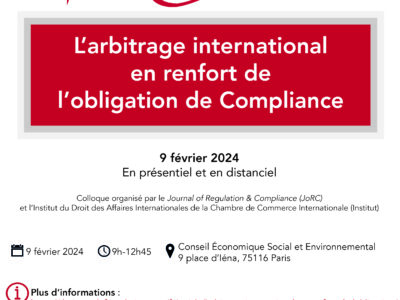
🧱Co-organisation of the Symposium 🧮L’arbitrage international en renfort de l’Obligation de Compliance (International Arbitration in support of the Compliance Obligation)

► Full Reference: L. Aynès, M.-A. Frison-Roche, J.-B. Racine and E. Silva-Romero (dir.), L'arbitrage international en renfort de l'obligation de Compliance (International Arbitration in support of the Compliance Obligation), Journal of Regulation & Compliance (JoRC) and Institute of World Business Law of the ICC (Institute), Conseil Économique Social et Environnemental (CESE), Paris, February 9, 2024 - 🌐consult on LinkedIn a general présentation of this event, which links to a presentation and a report of each speech  - 🏗️This symposium takes place in the cycle of symposiums organised by the Journal of Regulation & Compliance (JoRC) and its partners Universities, focusing in 2023-2024 on the general theme of the Compliance Obligation - 📚The works will then be inserted in the books:  📕L'obligation de Compliance, to be published in the 📚Régulations & Compliance Serie, co-published by the Journal of Regulation & Compliance (JoRC) and Dalloz, published in French. 📘Compliance Obligation, to be published on the 📚Compliance & Regulation Serie, co-published by the Journal of Regulation & Compliance (JoRC) and Dalloz, published in English. - ► General presentation of the symposium: "Compliance Obligation" appears to be far from International Arbitration if Compliance Law is only understood in terms of binding regulations or even Criminal Law. Arbitration would only have contact with Compliance Obligation in a repulsive way, when a person claims to have enforced a contract before an arbitration court that disregards a compliance prohibition, e.g. corruption or money laundering. It is therefore from a negative angle that the cross-over has taken place. The fact that Arbitration Law respects the requisite of Criminal Law is nothing new.  Moreover, the power of Compliance in its detection and prevention tools, particularly in terms of evidence, no doubt increases the global efficiency. But Compliance Obligation is based on Monumental Goals, notably linked to global human rights and active ambitions about environment and climate which, particularly in the value chain economy, take the legal form of compliance clauses, or even compliance contracts, or various commitments and plans, which the parties can ask the international arbitrator to enforce. They will do so even more as arbitrators are often the only international, or even global, judges available. The use they will do of Contract Law, Quasi-Contract Law, Enforcement Law, Tort Law, reinforces Compliance Law in a global dimension. - - ► Interviennent :  🎤 Laurent Aynès, emeritus Professor at Paris 1 Panthéon-Sorbonne University, Attorney, Darrois Villey Maillot Brochier (Paris) 🎤 Marie-Anne Frison-Roche, Professor of Regulatory and Compliance Law, Director of the Journal of Regulation & Compliance (JoRC) 🎤 Jean-François Guillemin, former General Secretary of the Bouygues Group 🎤 Christophe Lapp, Attorney, Advant Altana (Paris) 🎤 Jean-Baptiste Racine, Full Professor at Paris Panthéon-Assas University (Paris 2) 🎤 Eduardo Silva-Romero, President of the Institute of World Business Law of the ICC (Institute), Attorney, Wordstone (Paris) - 🧮Read a detailed presentation of the event below⤵️ - 🌐follow Marie-Anne Frison-Roche on LinkedIn 🌐follow Marie-Anne Frison-Roche on Instagram 🌐subscribe to the Newsletter MAFR Regulation, Compliance, Law

Lessons

Teaching for the École nationale de la magistrature - ENM (French National School for the Judiciary)

⚖️Droit de la compliance (Compliance Law)

► Full Reference: F. Ancel &  M.-A. Frison-Roche, Droit de la compliance (Compliance Law), École nationale de la magistrature – ENM (French National School for the Judiciary), in collaboration with the École de Formation professionnelle des Barreaux du ressort de la cour d'appel de Paris – EFB (Paris Bar School), Paris, February 1 and 2, 2024 This teaching is given in French. - 🌐consult on LinkedIn a general présentation of this event, which links to a presentation and a report of each speech - ► Presentation of the Teaching: The aim of this two-day conference is to enable judges and lawyers to grasp the issues, objectives and methods that define Compliance Law as it is practised in companies. The speakers will illustrate the growing trend towards litigation, which is difficult to reconcile with the supranational dimension, or even indifference to territories, for example when disputes concern systemic climate or digital issues: the result is a renewal of the role of the judge and the role of lawyers. This must be set against the renewal of the role and operation of companies themselves. This is analysed from the perspective of Civil Law, in particular Contract Law and Liability Law. Company Law and Criminal Law are also addressed, as well as the way in which the legal system now integrates governance, regulation, climate and digital issues and the smooth operation of financial markets through Compliance techniques. - ► Organisation of the Teaching: This conference is divided into two parts. The first day is designed as a presentation of the major themes through which Compliance Law crosses the branches of traditional Law. The speakers will be professors of Law who will successively summarise the branches of Law and put into perspective the way in which Compliance imperatives give rise to new situations, new difficulties and new solutions. This enables the second day to focus on practical and topical issues and to debate controversial questions between people of different sensibilities. The participants tend to be judges, members of regulatory authorities, lawyers, members of associations and so on. - ► Enrolment procedure: The course is open to all judicial and consular magistrates, as well as lawyers. Registrations can be made directly with the ENM or with the EFB. - ► Speakers :   🎤François Ancel, Judge at the Première Chambre civile de la Cour de cassation (First Civil Chamber of the French Court of cassation)  🎤Thomas Baudesson, Attorney at the Paris Bar, Partner at Clifford Chance 🎤Guillaume Beaussonie, Full Professor at Toulouse 1 Capitole University 🎤Jacques Boulard, Premier Président de la Cour d’appel de Paris (First President of the Paris Court of Appeal) 🎤Marie Caffin-Moi, Full Professor at Paris Panthéon-Assas University 🎤Malik Chapuis, Judge at the Tribunal judiciaire de Paris (Paris First Instance Civil Court) 🎤Lucie Chatelain, Advocacy and Litigation Manager – Civil Liability of Parent Companies, Sherpa 🎤Jean-Benoît Devauges, Directeur Juridique, Ethique et Gouvernance des entreprises (Legal, Ethics and enterprises governance Director), MEDEF 🎤Marie-Anne Frison-Roche, Professor of Regulatory and Compliance Law, Director of the Journal of Regulation & Compliance (JoRC) 🎤Arnaud Gossement, Attorney at the Paris Bar, Partner at Gossement Avocats 🎤Thibault Goujon-Bethan, Full Professor at Jean Moulin Lyon 3 University 🎤Christophe Ingrain, Attorney at the Paris Bar, Partner at Darrois Villey Maillot Brochier 🎤Isabelle Jegouzo, Director of the Agence française anticorruption – AFA (French Anti-Corruption Agency)  🎤Anne-Valérie Le Fur, Full Professor at Versailles Saint-Quentin-en-Yvelines University 🎤Charlotte Michon, Attorney at the Paris Bar, partner at Charlotte Michon Avocat 🎤Jean-Baptiste Racine, Full Professor at Paris Panthéon-Assas University 🎤 Jean-Christophe Roda, Full Professor at Jean-Moulin Lyon 3 University 🎤Jérôme Simon, 1er Vice-Procureur Financier (First Financial Vice-Prosecutor) - 🧮read below the programme put together and organised by François Ancel and Marie-Anne Frison-Roche, as well as the reports of each presentation⤵️ - 🌐follow Marie-Anne Frison-Roche on LinkedIn 🌐follow Marie-Anne Frison-Roche on Instagram 🌐subscribe to the Newsletter MAFR Regulation, Compliance, Law

Articles in The Journal of Regulation & Compliance « JoRC »

BRUNEAU, Alain🕴️

📝The company judges itself: the Compliance function in the bank, in 🕴️M-A Frison-Roche (ed.), 📘Compliance Jurisdictionalisation

► Full Reference: A. Bruneau, "The company judges itself: the Compliance function in the bank", in M.-A. Frison-Roche, (ed.), Compliance Jurisdictionalisation, Journal of Regulation & Compliance (JoRC) and Bruylant, coll. "Compliance & Regulation", 2024, pp. 127-145 - 📘read a general presentation of the book, Compliance Jurisdictionalisation, in which this article is published - ► Summary of the article: First, it should be remembered that the compliance function was born within finance, and that by being structured, it has evolved to support the transition from regulatory law to compliance law. Through these changes, compliance has gone from an ex-post controlling function to an ex-ante binding function. The LIBOR crisis imperfectly illustrates the primacy of this transition. The evolution of this role is illustrated by concrete examples. Firstly, the management of reputational risk is a fundamental part of the company as prosecutor and judge of itself. Reputational risk is a significant element for a financial institution, because it can have negative consequences on its capitalization, or even culminate in a systemic crisis. Avoiding a large-scale financial crisis is also part of the monumental goals of compliance. In order to avoid complex and inopportune scenarios, compliance law intervenes as early as possible and identifies issues that may impact reputation. The regulations require the implementation of certain ex ante mechanisms. The French law known as "Sapin 2" requires the implementation of tools that concern all companies (and not just banks). Indeed, beyond the risk of reputation, it is essential to consider the risk of corruption. Consideration of reputational risk may justify refusing to execute certain transactions. From this perspective, compliance must assess the potential consequences of entering into a relationship with a new client upstream, sometimes to decline the provision of services. The compliance function therefore unilaterally judges the relationship with a view to managing the company reputational risk. Secondly, the internal sanction mechanism established by compliance law is also discussed in this article, in particular the internal sanctions adopted by compliance in a financial institution. Compliance can act as a prosecutor via management committees set up within the business lines. In addition, compliance can determine and apply sanctions against employees. In this way, there is a dual role of prosecutor and judge for the compliance function within the framework of an extraordinary mechanism of ordinary law. Finally, the analysis deals with the case of the "judge-judged": following a decision by the bank, the regulator may take an even stricter position by believing that the bank is applying its guidelines incorrectly. Thus, the compliance law, which takes hold within the banking enterprise, finds itself under the judgment of its own regulator. The company finds itself judged and comes to be a prosecutor and judge of itself, but also of its clients. - 🦉This article is available in full text to those registered for Professor Marie-Anne Frison-Roche's courses -