ComplianceTech

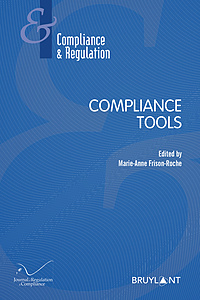
Couverture – Compliance Tools

Publication director

🏗️ copublishing and direction of the collection: 📚Compliance & Regulation

Collection Compliance & Regulation Compliance Tools

► Full Reference: Frison-Roche, M.-A. (ed.), Compliance Tools, series “Régulations & Compliance“, Journal of Regulation & Compliance (JoRC) & Bruylant, 2021. This book in English is the first title of this collection integrally dedicated to Compliance Law, in that it is the extension of Regulation Law. -   Read the titles of this series in English co-published by Bruylant.   This collection in English is articulated with a collection co-published between the Journal of Regulation & Compliance and Dalloz. Thus, in parallel, a book in French, Les Outils de la Compliance is published. - 📅  This book is published after a  cycle of colloquiums organised by the Journal of Regulation & Compliance (JoRC) and Partners Universities. -   ► General Presentation of the collective book: The political dimension of Compliance Law lies in the goals it aims to achieve. To achieve them, the concern for these goals is internalized in “crucial operators”, which may be obliged to concretize “monumental goals” set by public authorities. These public bodies control the Ex Ante reorganization that this implies for these companies and sanction Ex Post the possible inadequacy of the companies, which have become transparent to this end. The effectiveness and efficiency of this internalization, without which the statement of these goals is worth nothing, is based on the Compliance tools that are deployed. These appear to be very diverse but their substantial unity (topic which will be the subject of a forthcoming book) makes it possible to study the tools put in place from a unique perspective, by not isolating them in a particular branch of Law, Criminal law or International Law for example, but by measuring what is common to them, notably Anticipation, Trust, Commitment, Responsibility, Incentive, and so on. If the Compliance tools vary, it is rather not only according to the sectors, finance and banking appearing then as the advanced point of the general Compliance Law, for example in environmental matters, but also according to the countries and the cultures. It is in fact about them that legal cultures seem to oppose. The book aims to understand these “tools” by going beyond the description of each instrument, for which we already have many monographs, for analyzing them through the issues of Risks, required Expertises, Training. Sovereignty claims, Incentives, mechanical aptitude of Technologies. It is through these themes that are analyzed by the authors, experts in the field, what we always want to understand better: Compliance Programs, Whistle blowing, Mapping, Sanctions, Extraterritoriality, etc. -     Read the summary of the book.   Read the foreword, summarizing all the contributions.   Présentation of the book contributions: 📝Amico, Th., Compliance or the passage from ex post to ex ante: A Copernican revolution for the criminal lawyer? 📝Banck, A., The maturity of the Compliance tool’s user, first criterion of the choice of the salient tool 📝Burlingame, Coppens R., Power, N, Lee, D.H., Anti-Corruption Compliance: Global Dimension of Enforcement and Risk Management 📝Calandri, L., Incentive(s) and Self-Regulation(s): which place for Compliance Law in the Audiovisual Sector?  📝Causse, H., Compliance Training: Through and Beyond Traditional Legal Training 📝Frison-Roche, M.-A., Describing, designing and correlating Compliance Tools to have a better use of it 📝Frison-Roche, M.-A., Building by Law the Unicity of Compliance Tools from the Definition of Compliance Law by its “Monumental Goals” 📝Frison-Roche, M.-A., Drawing up Risk Maps as an obligation and the paradox of the “Compliance risks” ​ 📝 Frison-Roche, M.-A., Incentives and Compliance, a couple to propel 📝 Frison-Roche, M.-A., Resolving the contradiction between sanctions and incentives under the fire of Compliance Law 📝 Frison-Roche, M.-A., Rights, primary and natural Compliance tools 📝 Frison-Roche, M.-A., Training: content and container of Compliance Law​ 📝 Galland, M., The Regulator’s Inspection of the Effectiveness of the Compliance Tools Implemented by the Company 📝 Granier, C., The Normative Originality of Compliance by Design 📝 Guillaume, N., Compliance risk mapping: first insights of challenges, limits and good practices 📝Guttierez-Crespin, A., Audit of Compliance Systems​ 📝 Koenigsberg, S. and Barrière, F., The Development of Attorney’s Compliance Expertise 📝 Larouer, M., The Manifestation of Incentives Mechanisms in French Compliance Law 📝 Merabet, S., Morality by Design 📝 Pailler, L., Technological Tools, Compliance by Design and GDPR: the Protection of Personal Data from Design 📝 Racine, J.-B., Geographical dominance in the choice and the use of Compliance Tools. Introductory remarks 📝Rapp, L., Incentive Theory and Governance of Space Activities 📝 Roda, J.-C., Compliance by design in antitrust: between innovation and illusion 📝 Salah, M., Conception and Application of Compliance in Africa 📝 Tardieu, H., Data Sovereignty and Compliance 📝 Thouret, T., Training and Compliance, Two Correlated Information Transmission Tools  
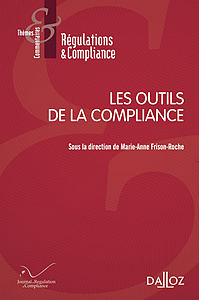
Couverture – Les outils de la Compliance

Publication director

🏗️ copublishing and direction of the collection: 📚Régulations & Compliance

Publication of🕴️M.-A. Frison-Roche (ed.), Collection Régulations & Compliance Les outils de la Compliance (2021)

► Full Reference: M.-A. Frison-Roche (ed.), Les outils de la Compliance, coll. “Régulations & Compliance“, Journal of Regulation & Compliance (JoRC) & Dalloz, 2021, 323 p. - In parallel, the English version of this book, Compliance Tools, is published in the collection co-published by the Journal of Regulation & Compliance (JoRC) and Bruylant. - 📅This book comes after a cycle of colloquia organised by the Journal of Regulation & Compliance (JoRC) and its Academic Partners. - This volume is the continuation of the books dedicated to Compliance in this collection. ► Read the presentations of the other books in the series: the following books: 🕴️M.-A. Frison-Roche (ed.), Les Buts Monumentaux de la Compliance, 2022 🕴️M.-A. Frison-Roche (ed.), La juridictionnalisation de la Compliance, 2023 🕴️M.-A. Frison-Roche and M. Boissavy (eds.), Compliance et droits de la défense. Enquête interne – CJIP – CRPC, 2024 🕴️M.-A. Frison-Roche (ed.), L’Obligation de Compliance, 2025 🕴️M.-A. Frison-Roche (ed.), Compliance et Contrat, forthcoming 🕴️L. Laref (ed.), Compliance et vigilance bancaire, forthcoming 🕴️M.-A. Frison-Roche, Le système juridique de l’adressage de l’Internet. Une structure multi-acteurs, gage de durabilité (The Legal System of Internet Addressing. A Multi-Stakeholder Structure, the Pledge of its Sustainability), forthcoming 🕴️M.-A. Frison-Roche (ed.), Le système probatoire de la Compliance, forthcoming   the previous books: 🕴️M.-A. Frison-Roche (ed.), Pour une Europe de la Compliance, 2019 🕴️N. Borga, J.-Cl. Marin and J.-Ch. Roda (eds.), Compliance : l’entreprise, le régulateur et le juge, 2018 🕴️M.-A. Frison-Roche (ed.), Régulation, Supervision, Compliance, 2017 🕴️M.-A. Frison-Roche (ed.), Internet, espace d’interrégulation, 2016 Read the presentations of the other titles of the collection. - ► General presentation of the book: The political dimension of Compliance Law resides in the monumental goals that it aims for and which define it. These goals are internalized in “crucial operators”, who willingly or by force must structure themselves and act to achieve “monumental goals”, as set by public authorities and which may coincide with the interests of the enterprise. This one designs and controls the Ex Ante reorganization that this implies, under the public authorities supervision. Enterprises, even if their activities are not regulated, thus become transparent and must show the Compliance Tools effectively deployed to effectively achieve these goals. It is a major transformation of economic life in all countries because the Compliance Tools are adopted everywhere and have a global effect. These appear to be very diverse but their unity is profound and bringing it out has the practical benefit of producing a legal regime that is as unified as possible, while allowing their adaptation country by country, sector by sector, enterprise by enterprise. This book aims to understand these Compliance Tools to better anticipate the assessment that will be made by Regulators, Supervisors and Courts, as well as the new conceptions of the authors of legal texts which impose new ones every day, while companies must also imagine the most appropriate Compliance Tools. This collective work specifically apprehends those on which we have few studies when we handle them on a daily basis, such as risk mapping or training or rights, letting more familiar tools shine through more transversal contributions, such as compliance programs, sanctions, whistleblowing or many sorts of settlements, agreements of public interest. A first chapter takes a legal and economic approach. A second chapter emphasizes the role of risk mapping. A third chapter draws the game of incentives. A fourth chapter identifies the expertise required. A fifth chapter insists on geographic significance. A sixth chapter details the measurement of effectiveness. A seventh chapter explores training. The eighth chapter examines technological tools. The concluding article leads to rights. - ► Read the general introduction of the book (in French). - ► Understand the book through the Table of Contents and the summaries of each article:   INTRODUCTION 🕴️M.-A. Frison-Roche, 📝Décrire, concevoir et corréler les outils de la compliance, pour en faire un usage adéquat I. APPROCHES JURIDIQUE ET ÉCONOMIQUE DES OUTILS DE LA COMPLIANCE (LEGAL AND ECONOMIC APPROACHES TO COMPLIANCE TOOLS) 🕴️M.-A. Frison-Roche, 📝Approche juridique des outils de la compliance. Construire juridiquement l’unité des outils de la compliance à partir de la définition du Droit de la compliance par ses “buts monumentaux” 🕴️L. Benzoni et 🕴️B. Deffains, 📝Approche économique des outils de la compliance : finalité, mesure, effectivité de la compliance “subie” et “choisie” II. LA CARTOGRAPHIE DES RISQUES, OUTIL CENTRAL DE LA COMPLIANCE (RISK MAPPING, CENTRAL COMPLIANCE TOOL) 🕴️M.-A. Frison-Roche, 📝Dresser des cartographies des risques comme obligation et le paradoxe des “risques de conformité” 🕴️N. Guillaume, 📝Cartographie des risques de compliance. Premiers aperçus des enjeux, des limites et des bonnes pratiques III. PLACE ET MANIEMENT DES INCITATIONS DANS LES SYSTÈMES DE COMPLIANCE (PLACE AND USE OF INCENTIVES IN COMPLIANCE SYSTEMS) 🕴️L. Rapp, 📝Théorie des incitations et gouvernance des activités spatiales 🕴️M.-A. Frison-Roche, 📝Résoudre la contradiction entre “sanction” et “incitation” sous le feu du Droit de la compliance 🕴️M. Larouer, 📝La manifestation des mécanismes incitatifs dans le droit français de la compliance 🕴️H. Tardieu, 📝Souveraineté des données et compliance 🕴️L. Calandri, 📝Incitation(s) et autorégulation(s) : quelle place pour le droit de la compliance dans le secteur audiovisuel? 🕴️M.-A. Frison-Roche, 📝Compliance et incitations : un couple à propulser IV. LES EXPERTISES REQUISES EN MATIÈRE DE COMPLIANCE (THE REQUIRED EXPERTISES IN TERMS OF COMPLIANCE) 🕴️A. Gutierrez-Crespin, 📝L’audit du dispositif de compliance : un outil clé pour en vérifier la robustesse 🕴️S. Koenigsberg et 🕴️Fr. Barrière, 📝La construction de l’expertise de l’avocat en matière de compliance 🕴️Th. Amico, 📝La Compliance ou le passage de l’ex post à l’ex ante. Une révolution copernicienne pour l’avocat pénaliste ? V. LA PRÉGNANCE GÉOGRAPHIQUE DES OUTILS DE LA COMPLIANCE (THE GEOGRAPHICAL DOMINANCE OF COMPLIANCE TOOLS) 🕴️J.-B. Racine, 📝Propos introductifs. La prégnance géographique dans le choix et l’usage des outils de la compliance 🕴️M. M. Salah, 📝Conception et application de la compliance en Afrique 🕴️R. Burlingame, 🕴️K. Coppens, N. Power et 🕴️D.H. Lee, 📝Compliance : lutte internationale contre la corruption et gestion des risques VI. LA MESURE DE L’EFFECTIVITÉ DES OUTILS DE LA COMPLIANCE (THE MEASURE OF COMPLIANCE TOOLS EFFECTIVITY) 🕴️M. Galland, 📝Le contrôle par le régulateur de l’effectivité des instruments de compliance mis en place par l’entreprise 🕴️A. Banck, 📝La maturité de l’utilisateur d’un outil de compliance, premier critère du choix de l’outil adéquat VII. LA FORMATION, ALPHA ET OMÉGA DE LA COMPLIANCE (TRAINING, ALPHA AND OMEGA OF COMPLIANCE) 🕴️H. Causse, 📝La compliance : par et au-delà de la formation juridique classique 🕴️M.-A. Frison-Roche, 📝La formation : contenu et contenant de la compliance 🕴️Th. Thouret, 📝Formation et compliance : deux outils corrélés de transmission d’information VIII. LES OUTILS TECHNOLOGIQUES ET LA COMPLIANCE BY DESIGN (TECHNOLOGICAL TOOLS AND COMPLIANCE BY DESIGN) 🕴️J.-Ch. ​Roda, 📝La compliance by design en antitrust : entre innovation et illusion 🕴️C. Granier, 📝L’originalité normative de la compliance by design 🕴️L. Pailler, 📝Les outils technologiques, la compliance by design et le RGPD : la protection des données dès la conception 🕴️S. Merabet, 📝La morale by design CONCLUSION 🕴️M.-A. Frison-Roche, 📝Les droits subjectifs, outils premiers et naturels du Droit de la compliance - 🌐 follow Marie-Anne Frison-Roche on LinkedIn 🌐follow Marie-Anne Frison-Roche on Instagram 🌐 subscribe to the Newsletter MAFR Regulation, Compliance, Law 

Articles in a JoRC book

COMPLIANCE: COLLABORATE FULLY, A LITTLE, OR NOT AT ALL? DAIMLER’S CHOICE: NOT AT ALL

 It is often observed, even theorized, even advised and touted, that Compliance is a mechanism by which public authorities internalize political (eg environmental) concerns in big companies, which accept them, in Ex Ante, because they are rather in agreement with these "monumental goals" (eg saving the planet) and that this shared virtue is beneficial to their reputation. It is observed that this could be the most successful way in new configurations, such as digital. But, and the Compliance Mechanism has often been brought closer to the contractual mechanism, this is only relevant if both parties are willing to do so. This is technically true, for example for the Deferred Prosecution, which requires explicit consent. This is true in a more general sense that the company wants to choose itself how to structure its organization to achieve the goals politically pursued by the State. Conversely, the compliance mechanisms work if the State is willing to admit the economic logic of the global private players and / or, if there are possible breaches, not to pursue its investigations and close the file it has opened, at a price more or less high. But just say No. As in contractual matters, the first freedom is negative and depends on the ability to say No. The State can do it. But the company can do it too. And Daimler just said No. -   Publicly, including through an article in the Wall Street Journal of June 28, 2019. The company sets out in a warning to the market that it is the object of a requirement on the part of the German Motor Authority (Kraftfahrt-Bundesamt)  of an allegation of fraud, by the installation of a software, aimed at misleading instruments for measuring emissions of greenhouse gases on cars using diesel. It is therefore an environmental compliance mechanism that would have been intentionally countered. On this allegation, the Regulator both warns the company of what it considers to be a fact, ie compliance fraud, and attaches it to an immediate measure, namely the removal of the circulation of 42,000 vehicles sold or proposed by Daimler with such a device. And the firm answers : "No". -   Which is probably only beginning, since a No ends the dialogue of Ex Ante to project in the Ex Post sanction procedures, calls 6 observations:   1. No doubt Daimler, a German car manufacturing company, has it in mind in this allegation of fraud calculating pollution of its diesel cars what happened to his competitor Volkswagen: namely a multi-billion dollar fine, for lack of compliance in a similar hypothesis (so-called dieselgate). The strategic choice that is then made depends on education through the experience of the company, which benefits as such from a previous case that has had a very significant cost. Thus educated, the question is to measure the risk taken to refuse any cooperation, when the company can anticipate that it will still result in such an amount ….   2. In addition, we find the difficulty of the distinction of Ex Ante and Ex Post. Indeed, saying No will involve for the company a cost of confrontation with the Regulator, then the peripheral jurisdictions or review courts. But in Germany, the Government itself, concerning a bank threatened with compliance proceedings and almost summoned by the US regulator to pay "of its own free will" a transactional fine, felt that this was not normal, because it must be the judges who punish, after a contradictory procedure with due process and after established facts.    3.  However, this is only an allegation, of probable assertions, of what legally allows to continue, but which does not allow to condemn. The confusion between the burden of proof, which presupposes the obligation to prove the facts before being able to sanction, and the burden of the allegation, which only supposes to articulate plausibility before being able to prosecute, is very damaging, particularly if we are committed to the principles of Repressive Law, such as the presumption of innocence and the due process. This distinction between these two probationary charges is at the heart of the probatory system in the Compliance Law. Because Compliance Law always looks for more efficiency, tends to go from the first to the second, to give the Regulator more power, since businesses are so powerful ….   4. But the first question then arises: what is the nature no so much of the future measure to be feared, namely a sanction that could be taken later, against Daimler, if the breach is proven, or which will not be applied to the firm if the breach is not established; but what is the nature of the measure immediately taken, namely the return of 42,000 vehicles?   This may seem like an Ex Ante measurement. Indeed, the Compliance assumes non-polluting cars. The Regulator may have indications that these cars are polluting and that the manufacturer has not made the necessary arrangements for them to be less polluting (Compliance) or even organized so that this failure is not detected ( Compliance fraud).   This allegation suggests that there is a risk that thiese cars will polluting. They must immediately be removed from circulation for the quality of the environment. Here and now. The question of sanctions will arise after that, having its procedural apparatus of guarantees for the company that will be pursued. But see the situation on the side of the company: having to withdraw 42,000 vehicles from the market is a great damage and what is often called in Repressive Law a "security measure" taken while the evidence is not yet met could deserve a requalification in sanction. Jurisprudence is both abundant and nuanced on this issue of qualification.   5. So to withdraw these cars, it is for the company to admit that it is guilty, to increase itself the punishment. And if at this game, taken from the "cost-benefit", as much for the company immediately assert to the market that this requirement of Regulation is unfounded in Law, that the alleged facts are not exacts, and that all this the judges will decide. It is sure at all whether these statements by the company are true or false, but before a Tribunal no one thinks they are true prima facie, they are only allegations.  And before a Court, a Regulator appears to have to bear a burden of proof in so far as he has to defend the order he has issued, to prove the breach which he asserts exists, which justifies the exercise he made of his powers. The fact that he exercises his power for the general interest and impartially does not diminish this burden of proof.   6. By saying "No", Daimler wants to recover this classic Law, often set aside by Compliance Law, classic Law based on burden of proof, means of proof, and prohibition of punitive measures – except imminent and future imminente and very serious damages  – before 'behavior could be sanctioned following a sanction procedure. Admittedly, one would be tempted to make an analogy with the current situation of Boeing whose aircraft are grounded by the Regulator in that he considers that they do not meet the conditions of safety, which the aircraft manufacturer denies , Ex Ante measurement that resembles the retraction measure of the market that constitutes the recall request of cars here operated. But the analogy does not work on two points. Firstly, flight activity is a regulated activity that can only be exercised with the Ex Ante authorization of several Regulators, which is not the case for offering to sell cars or to drive with. This is where Regulatory Law and Compliance Law, which often come together, here stand out.Secundly, the very possibility that planes of which it is not excluded that they are not sure is enough, as a precaution, to prohibit their shift. Here (about the cars and the measure of the pollution by them), it is not the safety of the person that is at stake, and probably not even the overall goal of the environment, but the fraud with respect to the obligation to obey Compliance. Why force the withdrawal of 42,000 vehicles? If not to punish? In an exemplary way, to remind in advance and all that it costs not to obey the Compliance? And there, the company says: "I want a judge".   ​ -  

Analyses

On June 18, 2019, during its meetings with the banking sector, the Single Resolution Board tells what it expects for it (and its Regulators) for the effectiveness of the Resolution mechanism.

The European Banking Union is based on supervision as much as on regulation: it concerns the operators as much as the structures of the sector, because the operators "hold" the sector. This is why the "regulator – supervisor" holds the operators by the supervision and is close to them. He meets them officially and in "soft law" relations. This is all the more necessary since the distinction between the Ex Ante and the Ex Post must be nuanced, in that its application is too rigid, in that it involves a long time (first of all the rules, then to apply them, then to notice a gap between rules and behaviors, then to repair it) is not appropriate if the system aims at the prevention of systemic crises, whose source is inside the operators. This is why the body in charge of solving the difficulties of the systemic banks for the salvation of the systeme meets the banking sector itself, to ensure that they are permanently "resolvable", so that the hypothesis of their resolution never arises. This is the challenge of this system: that it is always ready, for never be applying. - In the European Banking Union, the Single Resolution Board (SRB) is in charge of "resolve" the difficulties of European systemic banks in difficulty. It is the public body of the second pillar of the Banking Union. The first pillar is the prevention of these difficulties and the third is the guarantee of deposits. The resolution is therefore more like an Ex Post mechanism. But in this continuum through these three pillars between the Ex Ante and the Ex Post, the SRB does not wait passively – as would a traditional judge do – that the file of the troubled bank reaches it. Like a supervisor – which brings it closer to the first public in the system (Single Supervisory Board -SSB), which supervises all the banks, it is in direct contact with all the banks, and it approaches the hypothesis of a bank in trouble by a systemic perspective: it is therefore to the entire banking system that the SRB addresses itself. As such, it organizes meetings, where he is located: in Brussels. Thus, on June 18, 2019, all banks came to discuss with the Single Resolution Board to know what it wants from the banks and for the banks, in what is called a "dialogue meeting". To resolve in Ex Post the difficulties of a bank, it has to present a quality (a little known concept in Bankruptcy Law): "resolvability". How build it? Who build it ? In its very design and in its application, bank by bank. For the resolution body vis-à-vis all players in the banking and financial sector, it's clear: "Working together" is crucial in building resolvability ". In the projection that is made, it is affirmed that there can be a successful resolution only if the operator in difficulty is not deprived of access to what makes to stay it alive, that is to say the banking and financial system itself, and more specifically the "Financial Market Infrastructures", for example payment services. Does the Single Resolution Board expect spontaneous commitments from the FMIs for such a "right of access"? In this case, as the Single Resolution Board says, this right of access corresponds to "critical functions" for a bank, the resolution situation can not justify the closure of the service. By nature, these crucial operators are entities that report to regulators who oversee them. Who enforces – and immediately – this right of access? When one can think that it is everyone, it risks being nobody …. That is why the resolution body, relaying in this a concern of the Financial Stability Board, underlines that it is necessary to articulate the supervisors, regulators and "resolvers" between them. - To read this program, since it is a proposed program of work for the banking sector, four observations can be made: 1. We are moving more and more towards a general "intermaillage" (which will perhaps replace the absence of a global State, but it is an similar nature because it is always to public authorities that it refers and not to self-regulation); 2. But as there is no political authority to keep these guardians, the entities that articulate all these various public structures, with different functions, located in different countries, acting according to different temporalities, these are the companies themselves that internalize the concern that animates those who built the system: here the prevention of systemic risk. This is the definition of Compliance, which brings back to companies, here more clearly those those which manage the Market Infrastructures, the obligations of Compliance (here the management of systemic risk through the obligation of giving access). 3. Even without a  single systemic guard, there is always a recourse. That will be the judge. There are already many, there will probably be more in a system of this type, more and more complex, the articulation of disputes is sometimes called "dialogue". And it is undoubtedly "decisions of principle" that will set the principles common to all of these particular organisms. 4. We then see the emergence of Ex Ante mechanisms for the solidity of the systems, and the solidity of the players in the systems, and then the Ex Post resolution of the difficulties of the actors according to access to the solidity of the infrastructures of these systems, which ultimately depend on judges (throughout the West) facing areas where all of this depends much less on the judge: the rest of the world. -  
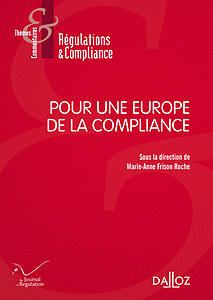
Couverture – Pour une Europe de la Compliance

Books

Collection Régulations & Compliance Pour une Europe de la Compliance (For the Europe of the Compliance)

🌐 follow Marie-Anne Frison-Roche on LinkedIn 🌐 subscribe to the Newsletter MAFR Regulation, Compliance, Law - ► Full Reference: M.-A. Frison-Roche (ed.), Pour une Europe de la Compliance (For the Europe of the Compliance), series “Régulations & Compliance“, Dalloz, 2019, 124 p. - This volume is the continuation of the books dedicated to Compliance in this collection. Read the other books’ presentations of the collection about Compliance: 🕴️M.-A. Frison-Roche (ed.), La juridictionnalisation de la Compliance, 2023 🕴️M.-A. Frison-Roche (ed.), Les Buts Monumentaux de la Compliance, 2022 🕴️M.-A. Frison-Roche (ed.), Les outils de la Compliance, 2021 🕴️N. Borga, 🕴️J.-Cl. Marin &🕴️J.-Ch. Roda (ed.), Compliance : l’Entreprise, le Régulateur et le Juge, 2018 🕴️M.-A. Frison-Roche (ed.), Régulation, Supervision, Compliance, 2017 🕴️M.-A. Frison-Roche (ed.), Internet, espace d’interrégulation, 2016 Read the presentations of the other titles of the collection. - ► General presentation of the book: This book is written in French. The topic is : “For the Europe of the Compliance“. See below its general presentation in English. The political dimension is intrinsic to the Compliance Law. Indeed, compliance mechanisms consist of internalizing in certains companies the obligation to implement goals of general interest set by Public Authorities. These public bodies control the Ex Ante reorganization that implies for these companies and punish Ex Post the possible structural inadequacy of these compagnies, becoming transparent for this purpose. This new mode of governance establishes a continuum between Regulation, Supervision, Compliance (book published in 2017) and renew the links between Companies, Regulators and Judges1Frison-Roche, M.-A., Compliance, see. This political dimension must be increased: the Compliance Law of Compliance must today be used to build Europe. One can observe not only the construction of the European Compliance Law, object-by-object, sector-by-sector, purpose-by-purpose, but also the construction of the European Compliance Law that transcends and unifies them. Becoming independent of American Law and ceasing to be in reaction, even on the defensive, the Compliance Law contributes to the European project, offering it a higher ambition, that Europe can carry and, by this way, can carry the Europe itself, not only to preserve the European economy from corruption or money laundering, but by claiming the protection of nature and human beings. This is why the book describes the “reasons and objectives” of the Europe of the Compliance, which makes it possible to describe, detect and even predict the ways and means. - ► Understand the book through the Table of Contents and the summaries of each article: 🕴️M.-A. Frison-Roche, 📝Avant propos  🕴️K. Lenaerts, 📝Le juge de l’Union européenne dans une Europe de la compliance 🕴️M.-A. Frison-Roche, 📝Un droit substantiel de la compliance, appuyé sur la tradition européenne humaniste I. LES RAISONS ET LES OBJECTIFS D’UNE EUROPE DE LA COMPLIANCE (THE REASONS AND OBJECTIVES OF THE EUROPE OF THE COMPLIANCE)  🕴️X. Musca, 📝Construire une Europe de la compliance en donnant une meilleure place aux entreprises 🕴️P. Vimont, 📝La place de la diplomatie dans l’avancée d’une Europe de la compliance 🕴️P. Sellal, 📝Les vertus de la compliance : une réponse possible aux faiblesses de l’Union européenne ? 🕴️J.-J. Daigre, 📝Compliance, entreprise et Europe II. LES VOIES ET MOYENS D’UNE EUROPE DE LA COMPLIANCE (THE WAYS AND MEANS OF THE EUROPE OF THE COMPLIANCE) 🕴️J.-Cl. Marin, 📝Quels outils pour la construction du droit de la compliance en Europe ? 🕴️M. Canto-Sperber, 📝La compliance et les définitions traditionnelles de la vertu 🕴️T. Bonneau, 📝Compliance et secteur bancaire et financier en Europe 🕴️C. Duchaine, 📝L’Agence française anticorruption, à l’appui de l’Europe de la compliance 🕴️D. Martin, 📝Les contraintes et les vertus de la compliance 🕴️A. de La Cotardière, 📝Construire une Europe de la compliance lisible pour les entreprises -