Food for thoughts

Dec. 31, 2020
Thesaurus : Doctrine
Full reference: Zittrain, J. L., "Gaining Power, Losing Control", Clare Hall Tanner Lecture 2020, 2020
Read the intervention's report
This intervention is divided in two parts:
- Between Abdication and Suffocation: Three Eras of Governing Digital Platforms
- With Great Power Comes Great Ignorance: What’s Wrong When Machine Learning Gets It Right

Dec. 10, 2020
Thesaurus : 03. Conseil d'Etat
Il résulte clairement de l'article 6 du règlement (UE) n° 2016/679 du 27 avril 2016 (dit " RGPD ") qu'un traitement de données à caractère personnel ne satisfait aux exigences du règlement, dès lors qu'il n'est nécessaire ni au respect d'une obligation légale à laquelle le responsable du traitement est soumis, ni à l'exécution d'une mission d'intérêt public ou relevant de l'exercice de l'autorité publique dont est investi le responsable du traitement, ni à la sauvegarde des intérêts vitaux de la personne concernée ou d'une autre personne physique, que si la personne concernée a consenti au traitement de ses données, sauf à ce que le traitement soit nécessaire à l'exécution d'un contrat auquel la personne concernée est partie ou à l'exécution de mesures précontractuelles prises à la demande de celle-ci, ou à ce qu'il soit nécessaire aux fins des intérêts légitimes poursuivis par le responsable du traitement ou par un tiers, à la condition, dans ce dernier cas, que ces intérêts légitimes puissent être regardés comme prévalant sur les intérêts des personnes concernées ou sur leurs libertés et droits fondamentaux.

Dec. 9, 2020
Teachings : Generall Regulatory law

Au sens juridique, la responsabilité désigne le fait de "répondre", mais au sens commun la responsabilité désigne le fait d'avoir du pouvoir et de l'exercer dans les marges que donne la liberté d'action. Les deux sens doivent converger dans un système libéral.
Puisqu'il a été montré que les Régulateurs sont les maîtres des secteurs, ils seraient donc logiques qu'ils sont responsables. Mais, c'est encore un point commun qu'ils ont avec les juges, parce qu'ils sont consubstantiellement indépendants, ils ne peuvent pas voir leur responsabilité engagées. Cependant le droit positif a posé le principe de la Responsabilité de l'Etat du fait de leur Autorités de Régulation, tandis que leur irresponsabilité politique comparée à l'ampleur de leurs pouvoirs a souvent était le ferment de leur contestation.
Par ailleurs, le mécanisme général de la responsabilité est utilisé, notamment parce que les mécanismes du Droit de la Régulation sont eux-mêmes défaillants. En effet, comme l'a montré Alain Supiot, l'on peut "prendre la responsabilité au sérieux" et, si l'on applique cette perspective plus particulièrement à l'espace numérique, cela permettra de pallier les défaillances de la Régulation publique elle-même. En effet, il existe des sortes de "trous noirs régulatoires", dont relève encore notamment le numérique.
Mais cette violence de la responsabilité ainsi conçue ne doit pas s'appliquer à tous les opérateurs économiques. En effet, cette responsabilité "proactive" qui dépasse le mécanisme de l'Ex Post vers l'Ex Ante ne doit s'appliquer qu'aux opérateurs régulés, éventuellement aux "opérateurs cruciaux, pour qu'à travers leur personne, les buts de la régulation soient atteints (mécanisme de compliance). Les opérateurs ordinaires doivent demeurer dans un mécanisme Ex Post, la responsabilité ne devant pas engendrer des "devoirs généraux de prise en charge d'autrui", car l'entreprise ordinaire n'est pas de même nature que l'État.
D'une façon spécifique et au besoin :
D'une façon plus générale et au besoin :
- Accéder au plan général du Cours de Droit Commun de la Régulation.
- Se reporter à la présentation générale du Cours de Droit Commun de la Régulation.
- Consulter le Dictionnaire bilingue de Droit de la Régulation et de la Compliance.
- Consulter la Newsletter MAFR - Law, Compliance, Regulation
Consulter ci-dessous la bibliographie spécifique à cette leçon portant sur la Responsabilité et la Régulation:

Dec. 8, 2020
Thesaurus : Doctrine
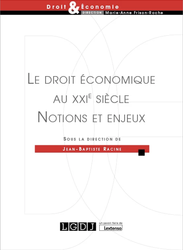
► Référence complète : F. Siiriainen, "La propriété", in J.-B. Racine (dir.), Le droit économique au XXIe siècle. Notions et enjeux, LGDJ, coll. "Droit & Économie", 2020, pp. 591-610
____
📕consulter une présentation générale de l'ouvrage, Le droit économique au XXIe siècle. Notions et enjeux, dans lequel cet article est publié
____
► Résumé de l'article :
____
🦉Cet article est accessible en texte intégral pour les personnes inscrites aux enseignements de la Professeure Marie-Anne Frison-Roche
________
Dec. 8, 2020
Thesaurus : Doctrine
► Référence complète : E. Mouial Bassilana, "Le contrat", in J.-B. Racine (dir.), Le droit économique au XXIe siècle. Notions et enjeux, LGDJ, coll. "Droit & Économie", 2020, pp. 212-235
____
📕consulter une présentation générale de l'ouvrage, Le droit économique au XXIe siècle. Notions et enjeux, dans lequel cet article est publié
____
► Résumé de l'article :
____
🦉Cet article est accessible en texte intégral pour les personnes inscrites aux enseignements de la Professeure Marie-Anne Frison-Roche
________

Dec. 7, 2020
Thesaurus : Doctrine
Full reference: Vergnolle, S., L'effectivité de la protection des personnes par le droit des données à caractère personnel (The effectiveness of the protection of people by personal data Law (our translation)), Passa, J. (dir.), thesis, Law, Panthéon-Assas University (Paris II), 2020, 531 p.
Read directly and only the table of contents (in French)
To go further about regulation of personal data, read:
- Frison-Roche, M.-A., Rethinking the world from the notion of data, 2016
- Frison-Roche, M.-A., The regulatory conséquences of a world redesigned from the concept of data, 2016.

Updated: Dec. 3, 2020 (Initial publication: July 15, 2020)
Publications

Full Reference : Frison-Roche, M.-A., Rights, primary and natural Compliance Tools, Working Paper, July 2020.
This Working paper is the basis for an article published in the collective book Compliance Tools .
____
There was a time when Regulatory techniques were above all only calculations of the best tarifications, taken up by monopolistic companies, while Compliance techniques were only obedience to all rules governing us. All this could therefore only be business of abacus and badine, used by engineers and consisted only of mechanical reflexes of "conformity" to all kinds of rules with the corset ensuring that everyone is bent in front of them
Systems have since evolved to integrate these prerogatives of each person: rights. Is this evolution really acquired? Maybe more effectively in Regulation Law than in its extension which is Compliance Law. This may be surprising since Compliance Law, in that it extends Regulatory Law in enterprises should, on the contrary, promote rights by meeting the enterprise, which is a group of people ....
In addition, if Regulation has long been the subject of a branch of Law in which rights have full place, the presentation of Compliance as "conformity", that is to say the proven assurance of obedience to all the applicable rules, leaves no space for the prerogatives of people, which appear rather as resistance to the obedience that would be expected of them. There again, the expectation of what would be a good ratio of conformity between behaviors and prescriptions would be obtained by a "design", data processing being the new form of calculation, improved by precision tools where the being human is not required
It would therefore be with regret, and probably because some constitutional jurisdictions still attach some value to fundamental rights that the systems of "conformity" of behavior to the rules make some room for the prerogatives of people, their more essential rights. It is sometimes said that this is part of the cost. It would therefore be as by "forcing" that rights would exist in Compliance systems, a kind of price that the effectiveness of Compliance must pay as a tribute to the Rule of Law principle
If in a poor definition Compliance is conceived in this only "conformity", leading to a landscape in which the behaviors of the people adjust to the rules governing the situations, Compliance being only the most "effective way" to ensure the application of the rules, in a mechanical perspective of Law, then it would effectively be necessary to reduce the prerogatives of people to a minimal part, because any "additional cost" is intended to disappear, even if it is produced here by constitutional requirements. In the looming battle between the effectiveness of the application of rules and the concern for the legal prerogatives of people who should above all obey and not claim their rights, especially their right not to obey , or their right to keep secret in Compliance techniques which is based on the centralization of information, the effectiveness of efficiency could only, by the very power of this tautology, prevail
The defeat would not be total, however, collaboration would still be possible and active between people availing themselves of their rights and Compliance Law. Indeed, in many respects, if rights have been recognized in Compliance systems, it is not only because Compliance Law, like any branch of Law, can only be deployed with respect for fundamental rights. kept by fundamental legal texts, but also because of the effectiveness of rights as " Compliance Tools".
Indeed, because they constitute a very effective "tool" to ensure the entire functioning of a system whose goals are so difficult to achieve, because every effort must be made to achieve these goals, the public authorities not only rely on the power of crucial operators, but also distribute prerogatives to people who, thus encouraged, activate the Compliance system and participate in the achievement of the "monumental goals". Rights can prove to be the most effective tools to effectively achieve the goals set, to such an extent that they can be considered as "primary tools" (I).
But it is necessary to be more ambitious, even to reverse the perspective. Indeed because all the Monumental Goals by which Compliance Law is defined can be reduced to the protection of people, that is to say to the effectiveness of their prerogatives, by a mirror effect between rights. given by Law to persons and the rights which constitute the very purpose of all Compliance Law, in particular the protection of all human beings, even if they are in a situation of great weakness, rights become a "natural tool" of Compliance Law (II).
Rights are the Compliance Law future.
Contre cela, la critique radicale, savante et fondée d'Alain Supiot, dans l'ensemble de son oeuvre et plus particulièrement dans La gouvernance par les nombres, 2015.
Sur la définition de l'entreprise comme un groupe de personnes qui se réunissent pour entreprise, v. le travail de référence d'Alain Supiot, par exemple son article d'introduction "L'entreprise...", dans l'ouvrage qu'il a dirigé L'entreprise dans la mondialisation ...., 2015 ...
Si l'entreprise pouvait renaître comme idée de cristallisation d'une idée commune entre des personnes, naturellement titulaires de droits subjectifs, exerçant ensemble leur liberté d'entreprendre pour réaliser un projet commun, ce qui correspond à la définition classique du contrat d'entreprise donnée à l'article 1832 du Code civil, cela renforcerait considérablement la présence des droits subjectifs dans le Droit de la Compliance et conforterait la nature humaniste de celui-ci.
En outre, dans une telle définition la loi de la majorité, qui n'est qu'une loi de fonctionnement d'une catégorie de sociétés que sont les sociétés de capitaux, deviendrait moins puissante, au profit des "droits propres" de tout associé (au-delà du cercle des sociétés de personnes), sans qu'il soit besoin d'aller chercher au-delà du cercle des associés ou titulaires de titres émis par la société ou l'entreprise (dit shareholders) et d'aller donner le "droit à la parole" à des personnes qui, parce qu'elles sont "concernées" (les "parties prenantes", les skateholders) ont désormais de plus en plus le "droit à la parole".
La Compliance by Design reflète ces tensions. Elles sont particulièrement bien décrites par Cécile Granier. V. ....
Contre cette conception de la légalité, qui prévoit tout et à laquelle il faudrait prouver par avance et que l'on se "conforme" entièrement, ce qui est contraire aux principes mêmes du libéralisme dont le principe est la liberté d'agir et non pas l'obéissance, Carbonnier affirme que les règles sont faites ne pas s'appliquer et qu'elles ne sont que le "mince vernis" des choses, qu'il convenait de se méfier de la "passion du Droit". V. not. son dernier ouvrage Droit et passion du droit sous la Vième République, 1995. Carbonnier est considéré comme le plus grand juriste français du XXième siècle. Il rédigea les lois qui réformèrent en profondeur le Code civil et publia des ouvrages sur "l'art législatif".
Au contraire, l'Etat de Droit n'est pas un coût extérieur au système de Compliance efficace, que celui-ci doit internaliser. Il est le fondement même du Droit de la Compliance. Voir dans ce sens la démonstration faite par le président de la Cour de Justice de l'Union européenne, Koen Laearnt, ..., in Pour une Europe de la Compliance, 2019.
Sur la démonstration comme quoi la Constitution, en ce qu'elle contient de l'incalculable, est broyée dans cette façon de faire, v. Alain Supiot, Intervention 2019.

Dec. 1, 2020
Newsletter MAFR - Law, Compliance, Regulation

Full reference: Frison-Roche, M.-A., New SEC Report to Congress about Whistleblower Program: what is common between American and European conception, Newsletter MAFR - Law, Compliance, Regulation, 1st of December 2020
Read by freely subscribing other news of the Newsletter MAFR - Law, Compliance, Regulation
Summary of the news
Like every year since the adoption of the Dodd-Frank Act, the Securities and Exchanges Commission (SEC) and especially its Office of the Whistleblowers (OWB) handed to the Congress of the United-States a report about the success of its program concerning whistleblowers, especially estimated with the amount of financial rewards granted to them during the year. This report especially presents the amount granted to whistleblowers, the quality of the collected information and the efficacy of SEC's whistleblowers' protection process.
If Americans condition the effectiveness of whistleblowing to the remuneration of whistleblowers, Europeans oppose the "ethical whistleblower" who shares information for the love of Law to the "bounty hunter" uniquely motivated by financial reward and favor the former to the later, as it is proven in the French Law Sapin II of 2016 (which do not propose financial reward to whistleblowers) or the British Public Interest Disclosure of 1998 (which just propose a financial compensation of the whistleblower's losses linked to whistleblowing).
However, American and European conceptions are not so far from each other. As United-States, Europe has a real care for legal effectivity, even if, because of their different legal traditions, Americans favor effectivity of rights while European favor effectivity of Law. If it places effectivity at the center of its preoccupations, Europe should conceive with less aversion the possibility to financially incite whistleblowers. Moreover, United-States and Europe share the same common willingness to protect whistleblowers and if rewarding would enable a better protection, then Europe should not reject it, as shows the recent declarations of the French Defenders of Rights. It is not excluded that both systems converges in a close future.
Nov. 25, 2020
Thesaurus : 02. Cour de cassation
Full reference: Cour de Cassation, Chambre criminelle, 25th of November 2020 (18-86.955), Decision n°2333, société Iron mountain France SAS
Read the press release from the Cour de Cassation (in French)
Read the explication note from the Cour de Cassation (in French)
Summary of the decision
In this decision constituting a case law reversal, the Chambre criminelle of the Cour de Cassation decides that the firm which absorbs the one to which are imputable facts which can receive a penal qualification leading to penalties of fines has the aptitude to answer penally.
The decision precises that this reversal is applicable only to future cases, to respect the principle of predicability, except if this merging was operated only to escape from criminal responsibility of moral persons.
This case is an example of the use of Criminal Liability Law as an incentive.
Nov. 25, 2020
Teachings : Generall Regulatory law

Le Droit économique classique repose peu sur les droits subjectifs. Le droit de propriété est le seul droit subjectif nécessaire pour une économie de marché. En effet, la notion de "personne", c'est-à-dire l'aptitude à être titulaire de droits et d'obligations, est un préalable souvent mis de côté au profit de la notion d' "agent" ou d' "institution", et les autres notions juridiques relèvent davantage des "libertés", tandis que la propriété est plutôt définie par les économistes présente la propriété plutôt comme le fait de maîtrise. Cette discrétion des droits subjectifs s'observe aussi bien en Droit de la concurrence qu'en Droit de la Régulation.
Mais l'évolution du Droit de la Régulation se marque d'une part par l'explosion des droits subjectifs de toutes sortes, notamment processuels, et d'autre part par la reconnaissance du maniement de la propriété pour permettre à l'Etat de réguler un secteur, voire au-delà d'un secteur, notamment parce que la propriété du capital d'une société lui donne une puissance que le Droit public ne lui conférerait pas. C'est alors la puissance politique que le droit subjectif de propriété confère à travers la branche du Droit des Sociétés que l'Etat va utiliser, notamment à travers la constitution nouvelle et efficace de Groupe Public Unifié. C'est alors le Droit des sociétés, sur la base duquel il convient de revenir, qui donne à l'Etat un pouvoir de poursuivre un intérêt général, là où le Droit de la concurrence le lui conteste. En effet, basé sur le principe de la "neutralité du capital", la jurisprudence veut contraindre l'Etat à se comporter comme un investisseur normalement diligent..
Il demeure que la propriété privée, parce qu'elle n'exclut pas la qualification d'une entreprise comme "entreprise publique" peut être un moyen "efficace" de régulation. Il en est ainsi de la mutualisation des infrastructures et de la mutualisation des garanties. Dans une époque où l'Etat exprime de moins en moins sa souveraineté sous un mode budgétaire, c'est sans doute de cette façon que la Régulation peut exprimer le Politique.
Le Droit va lui-même accroître cette part politique que l'Etat peut exercer grâce au droit de propriété à travers le statut d'actionnaire ainsi conservé mais aussi à la technique de l'action spécifique. Ce pouvoir de bloquer les cessions dans les "opérateurs cruciaux" aura vocation à se développer d'autant plus que se dégagera la notion juridique d'Europe souveraine. De la même façon les buts d'intérêts collectifs ou d'intérêt général qui caractérisaient l'entreprise publique sont aujourd'hui partagées avec les entreprises à mission, telles que la loi dite PACTE de 2019 les a insérées en Droit français à travers la notion de raison d'être.
D'une façon spécifique et au besoin :
D'une façon plus générale et au besoin :
- Consulter le plan général du Cours de Droit commun de la Régulation
- Consulter la bibliographie générale du Cours de Droit commun de la Régulation
- Consulter le Dictionnaire bilingue de Droit de la Régulation et de Droit de la Compliance
- Consulter la Newsletter MAFR - Law, Compliance, Regulation
Voir ci-dessous la bibliographie spécifique à la leçon sur Droit de propriété privée et Régulation.
Nov. 18, 2020
Thesaurus : 02. Cour de cassation

Nov. 16, 2020
Thesaurus : Soft Law
Full reference: US Securities and Exchanges Commission, Whistleblower Program. 2020 Annual Report to Congress, 16th of November 2020
Read, to go further on the question of whistleblowers:
- Frison-Roche, M.-A., The impossible unicity of the legal category of whistleblowers, working paper, 2019
Nov. 12, 2020
Thesaurus : Doctrine

Full reference: Kessedjian, C., Le tiers impartial et indépendant en droit international. Juge, arbitre, médiateur, conciliateur, Académie de Droit international de La Haye, 2020, 769p.
Read the forth of cover (in French)

Read the table of content (in French)
Nov. 1, 2020
Publications

This working paper served as a basis for an interview organized by Olivia Dufour in French in Actu-juridiques-Lextenso on 11st of January 2021.
Oct. 22, 2020
Interviews

Full reference: Frison-Roche, M.-A., "Health Data Hub est un coup de maître du Conseil d'Etat", interview realized by Olivia Dufour for Actu-juridiques, Lextenso, 22nd of October 2020
Read the news of 19th of October 2020 of the Newsletter MAFR - Law, Compliance, Regulation on which relies this interview: Conditions for the legality of a platform managed by an American company hosting European health data: French Conseil d'Etat decision
To go further, on the question of Compliance Law concerning Health Data Protection, read the news of 25th of August 2020: The always in expansion "Right to be Forgotten": a legitimate Oxymore in Compliance Law built on Information. Example of Cancer Survivors Protection
Oct. 19, 2020
Newsletter MAFR - Law, Compliance, Regulation

Full reference: Frison-Roche, M.-A., Conditions for the legality of a platform managed by an American company hosting European health data: French Conseil d'Etat decision, Newsletter MAFR - Law, Compliance, Regulation, 19th of October 2020
Read by freely subscribing the other news of the Newsletter MAFR - Law, Compliance, Regulation
___
News Summary: In its ordinance of 13th of October 2020, Conseil national du logiciel libre (called Health Data Hub), the Conseil d'Etat (French Administrative Supreme Court) has determined the legal rules governing the possibility to give the management of sensitive data on a platform to a non-europeans firm, through the specific case of the decree and of the contract by which the management of the platform centralizing health data to fight against Covid-19 has been given to the Irish subsidiary of an American firm, Microsoft.
The Conseil d'Etat used firstly CJEU case law, especially the decision of 16th of July 2020, called Schrems 2, in the light of which it was interpreted and French Law and the contract linking GIP and
The Conseil d'Etat concluded that it was not possible to transfer this data to United-Sates, that the contract could be only interpreted like this and that decree and contract's modifications secured this. But it observed that the risk of obtention by American public authorities was remaining.
Because public order requires the maintenance of this platform and that it does not exist for the moment other technical solution, the Conseil d'Etat maintained the principle of its management by Microsoft, until a European operator is found. During this, the control by the CNIL (French Data Regulator), whose the observations has been taken into consideration, will be operated.
We can retain three lessons from this great decision:
- There is a perfect continuum between Ex Ante and Ex Post, because by a referred, the Conseil d'Etat succeed in obtaining an update of the decree, a modification of the contractual clauses by Microsoft and of the words of the Minister in order to, as soon as possible, the platform is managed by an European operator. Thus, because it is Compliance Law, the relevant time of the judge is the future.
- The Conseil d'Etat put the protection of people at the heart of its reasoning, what is compliant to the definition of Compliance Law. It succeeded to solve the dilemma: either protecting people thanks to the person to fight against the virus, or protecting people by preventing the centralization of data and their captation by American public authorities. Through a "political" decision, that is an action for the future, the Conseil found a provisional solution to protect people against the disease and against the dispossession of their data, requiring that an European solution is found.
- The Conseil d'Etat emphasized the Court of Justice of The European Union as the alpha and omega of Compliance Law. By interpreting the contract between a GIP (Public interest Group) and an Irish subsidy of an American group only with regards to the case law of the Court of Justice of European Union, the Conseil d'Etat shows that sovereign Europe of Data can be built. And that courts are at the heart of this.
___________
Read the interview given on this Ordinance Health Data Hub
To go further about the question of Compliance Law concerning health data protection, read the news of 25th of August 2020: The always in expansion "Right to be Forgotten": a legitimate Oxymore in Compliance Law built on Information. Example of Cancer Survivors Protection
Oct. 15, 2020
Thesaurus : Soft Law

Full reference: Serious Fraud Office, Operational Handbook about Deferred Prosecution Agreements, October 2020
Oct. 14, 2020
Thesaurus : Doctrine

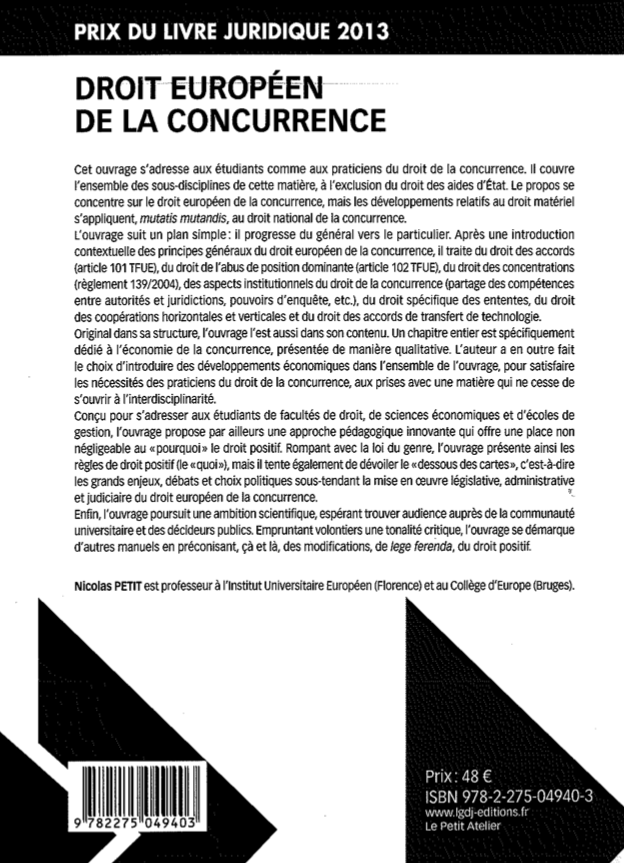
Full reference: Petit, N., Droit européen de la concurrence, 3rd edition, Collection "Précis Domat Droit Public/Droit privé", LGDJ-Lextenso, 2020
Oct. 5, 2020
Thesaurus

Oct. 1, 2020
Thesaurus : Soft Law
Full reference: Baer, B., Proposals to Strengthen the Antitrust Laws and Restore Competition Online, Testimony before the United-States House of Representatives, Committee on Judiciary, Subcommittee on Antitrust, Commercial and Administrative Law, 1st of October 2020
Read Bill Baer's presentation by Brookings Institution of which he is a member
Sept. 29, 2020
Newsletter MAFR - Law, Compliance, Regulation

Full reference: Frison-Roche, M.-A., Judge between Platform and Regulator: current example of Uber case in U.K., Newsletter MAFR - Law, Compliance, Regulation, 29th of September 2020
Read by freely subscribing the other news of the Newsletter MAFR - Law, Compliance, Regulation
Summary of the news:
On 22nd of September 2017, Transport of London (TFL), London Transport Regulator, refused to renew the licence, granted on 31st of May 2012 for 5 years, authorizing Uber to transport people because of criminal offenses committed by Uber's drivers. On 26th of June 2018, The Westminster Court prolonged Uber's licence for 15 months under the condition that the platform prevent the reproachable behaviors of its drivers. After these 15 months, the TFL refused once again to prolonge Uber's licence because of the persistence of aggressions against passengers. Uber, once again, contest this decision before the Westminster Court.
In a decision of 28th of September 2020, the Court observes that during the 15 months, the platform implemented many measures to prevent aggressions, that the level of maturity of these measures has improved over time and that the number of offenses was reduced over the period (passing from 55 in 2018 to 4 in 2020). The Court estimated the the implementation of this actions is sufficient to grant a new licence to Uber.
We can learn three lessons from this decision:
- The Compliance obligation is not a result obligation but a mean obligation, which means that it is not reasonable to expect from a crucial operator (Uber, for instance) that it prevent every cases of agression but that it is salient to judge it on the effort it deploys to try to be closer to this ideal situation. Moreover, the crucial operator must be proactive, that is going away from the figure of passive subject of Law who apply measures enacted by the regulator in terms of fighting against aggressions to be an actor of the research of the best way to fight abusive behaviors, internalizing this "monumental goal.
- The judge appreciates the violation committed by those whose the firm is responsible "in context", that is evaluates the concrete situation in a reasonable way.
- It is the judge who decides in last resort and like the crucial operator, it must be reasonable.
Read to go further:
Sept. 28, 2020
Thesaurus : Soft Law
Full reference: Giuliani-Viallard, A., The Europe of Compliance, at the heart of tomorrow's world. For a transformation of our European businesses and the upturn in their international competitiveness, European Issue, n°572, policy paper from the Robert Schuman Foundation, 28th of September 2020, 3 p.
Sept. 24, 2020
Newsletter MAFR - Law, Compliance, Regulation
The Economic Impact of Law: a new report about it. And what about Regulation & Compliance? 3 lessons

Full reference: Frison-Roche, M.-A., The Economic Impact of Law: a new report about it. And what about Regulation & Compliance? 3 lessons, Newsletter MAFR - Law, Regulation, Compliance, 24th of September 2020
Read by freely subscribing the other news of the Newsletter MAFR - Law, Regulation, Compliance
Summary of the news:
On 18th of September 2020, the European Economic and Social Committee (EESC) published a report about the impact of Rule of Law on Economic Growth.
The EESC defines the Rule of Law as the obligation to "all public powers act within the constraints laid down by law, in accordance with the values of democracy and fundamental rights, and under the control of independent and impartial courts". According to the Committee, the Rule of Law thus defined is favorable and even necessary to a durable economic growth especially because instability of regulations, absence of guarantee of labor and property rights, discrimination or non-application of contracts poorly favors or are detrimental for investments and economic agents' productive activities. The EESC observes by the way that countries which respect the Rule of Law grow more rapidly than those which do not respect it. The Committee also insists on the destructive effect of corruption which destroys public services, public action, public institutions on the long run and confidence, increasing inequalities.
Although EESC approves the actions of European Commission to advance Rule of Law in the Union, it however invites the Commission to continue its efforts by giving a more important place to jurisdictions and by protecting better media freedom in a context of rising autocratic forces in Eastern Europe.
We can learn three lessons from this report:
- The common interest of European Union States to guarantee the Rule of Law. Indeed, Rule of Law is not only written in article 2 of TFEU and has been consecrated by CJEU case law, it is also a condition of economic progress.
- The fight against corruption must be the object of a redoubled effort. In this perspective, Compliance Law is able to offer appropriate innovating legal tools.
- To a definition of Regulation and Compliance Law as a simple process of application of mechanical legal rules, it is necessary to substitute a definition of Regulation and Compliance Law based on the notion of "monumental goals" and people protection. In this perspective, these branches of Law would prove to be powerful tools in the service of the advancement of the rule of law in the European space.
Sept. 21, 2020
Newsletter MAFR - Law, Compliance, Regulation

Full reference: Frison-Roche, M.-A., Regulation, Compliance & Cinema: learning about Internet Regulation with the series "Criminals", Newsletter MAFR - Law, Compliance, Regulation, 21st of September 2020
Read by freely subscribing other news of the Newsletter MAFR - Law, Compliance, Regulation
Summary of the news:
Season 2 Episode 3 of the British version of the series "Criminals" features the character of Danielle. Danielle is a mother which has decided to hunt down pedophiles on social networks in order to trap them and show to the world their acts. Danielle insists on the efficiency of her action with regard to the police and justice that she finds unproductive. In the episode, Danielle is accused of defamation by the police. While policemen try to explain to Danielle the importance of using a regular procedure and to respect the Rule of Law aiming to prove its accusations, she makes efficiency her only principle. According to her, her methods get results (on the contrary of those used by the police which respect procedures) and those she accuses to be pedophiles do not deserve defense rights.
We can learn three lessons from Danielle's story:
- If Compliance Law is just a process of application of mechanical rules, then Rule of Law is not salient face to the principle of efficiency. But, if Compliance Law is defined by its "monumental goals" and that the respect of Rule of Law is erected in "monumental goal", then efficiency and Rule of Law become compatible and congruent.
- The digital space must be disciplined by crucial digital firms supervised by public authorities, like in France or Germany for hate speeches and disinformation.
- Compliance Law, and Law in general, must be pedagogue towards individuals as Danielle which do not understand why their behaviors are reproachable.
Sept. 16, 2020
Publications

🌐follow Marie-Anne Frison-Roche on LinkedIn
🌐subscribe to the Newsletter MAFR Regulation, Compliance, Law
____
Full reference: M.-A. Frison-Roche, Se tenir bien dans l'espace numérique, in Penser le droit de la pensée. Mélanges en l'honneur de Michel Vivant, Lexis Nexis and Dalloz, 2020, pp. 155-168.
____
📝Read the article (in French)
____
English summary of the article: The digital space is one of the scarce spaces not framed by a specific branch of Law, Freedom also offering opportunity to its actors to not "behave well", that is to express and diffuse broadly and immediately hateful thoughts through Hate speechs, which remained before in private or limited circles. The intimacy of Law and of the legal notion of Person is broken: Digital permits to individuals or organizations to act as demultiplied and anonymous characters, digital depersonalized actors who carry behaviors that are hurtful to other's dignity.
Against that, Compliance Law offers an appropriate solution: internalizing in digital crucial operators the mission to disciplinary and substantially hold the digital space. The digital space has been structured by powerful firms able to maintain order. Because Law must not reduce digital space to be only a neutral market of digital prestations, these crucial operators, like social networks or search engines, must be forced to substantially control behaviors. It could be about an obligation of internet users to act with their face uncover, "real identity" policy controlled by firms, and to respect others' rights, privacy rights, dignity, intellectual property rights. In their Regulatory function, digital crucial firms must be supervised by public authorities.
Thus, Compliance law substantially defined is the protector of the person as "subject of law" in the digital space, by the respect that others must have, this space passing from the status of free space to the one of civilized space, in which everyone is obliged to behave well.
______
Read to go further:
- Frison-Roche, M.-A., L'apport du Droit de la Compliance à la gouvernance d'Internet, 2019
- Frison-Roche, M.-A. (dir.), Internet, un espace d'interrégulation, 2016