Mediation

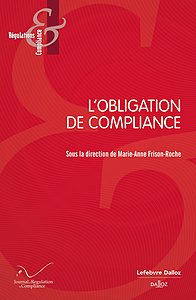
Couverture – L’Obligation de Compliance

Articles in a JoRC book

CHAPUIS, Malik🕴️

📝Le juge de l’amiable et la compliance (The Judge of Amicable Settlement and Compliance), in 🕴️M.-A. Frison-Roche (dir.), 📕L’Obligation de Compliance

► Full Reference: M. Chapuis, “Le juge de l’amiable et la compliance” (The Judge of Amicable Settlement and Compliance), in M.-A. Frison-Roche (dir.), L’Obligation de Compliance, Journal of Regulation & Compliance (JoRC) and Lefebvre-Dalloz, coll. “Régulations & Compliance”, 2025, pp. 721-725. - read the general presentation of the book, L’Obligation de Compliance, in which the contribution is published - ► This article is written in French. English summary of this contribution (done by the Journal of Regulation & Compliance – JoRC): The author shows that the general office of the judge in matters of mediation is particularly welcome in Vigilance proceedings. This is due first of all to the procedural office of the Judge: the injunction to meet a mediator finds its proper place here, as do other measures of judicial administration which, by their non-jurisdictional nature, are well suited to what is at stake, for example the stay of proceedings in the event of negotiations, processes which interpose themselves with the trial proper. This makes it easier to resolve the dispute without having to decide it, the better to satisfy the goals of the law. It is in this respect that Compliance Law, which is structured around its Monumental Goals, particularly calls for its non-jurisdictional techniques of mediation, and this sheds light on the first judicial decisions handed down in matters of Vigilance. Secondly, the author sets out the structuring of amicable settlement. Indeed, it is both delicate and decisive to choose carefully the moments when conciliations, césures (split hearings), ARA (amicable settlement hearings), etc., will have the best effect. Moreover, the choice of the mediator must take into account expertise and acceptability to the parties, the idea of an “internal list”, where there are specialised chambers, being worth exploring. The author can thus conclude: “The litigation arising from the Duty of Vigilance and, more generally, from Compliance Law thus calls for a structuring of amicable methods, a condition of their efficacy. Following the very partial examples above, amicable settlement in Compliance first presupposes respecting the stages of the law as clarified by case law. Next, it will be a matter of identifying those of these litigation stages which are the most opportune for bringing in specialist mediators and conciliators whose expertise is identified and approved by the judge and the parties.” (Free translation of the original text, which alone is authoritative: « Le contentieux naissant du devoir de vigilance et, plus généralement du droit de la compliance appellent ainsi une structuration des modes amiables, condition de leur efficacité. Suivant les exemples, très partiels, qui précèdent, l’amiable dans la compliance suppose d’abord de respecter les étapes de la loi éclairées par la jurisprudence. Ensuite, il s’agira d’identifier celles de ces étapes contentieuses les plus opportunes pour faire intervenir des médiateurs et conciliateurs spécialistes aux compétences identifiées et agréées par le juge et les parties. ») - 🦉This article is available in full text to those registered for Professor Marie-Anne Frison-Roche’s courses -


Videos

🎥Compliance and management: mediation rather than punishment, Interview with 🕴️Marie-Anne Frison-Roche by 🕴️Jean-Philippe Denis,🎬 Series of talks on Compliance Law, in 📺 Open windows on management

► Full reference:  M.-A. Frison-Roche, "Compliance et management : la médiation plutôt que la sanction ?" ("Compliance and management: mediation rather than punishment?"), interview conducted by Jean-Philippe Denis as part of a series of interviews on Compliance Law, in Fenêtres ouvertes sur la gestion (Open windows on management), broadcast by J.-Ph. Denis, Xerfi Canal, recorded December 12, 2023, released on May 22, 2024 - consult the December 2023 presentation of the interview on LinkedIn - 🌐read the MAFR. Law, Compliance, Regulation of April 2024 based on this interview  - 🧱consult the general presentation of this series of interviews on Compliance Law - 🎥view the full interview on Xerfi Canal - ► Starting point: Since 2016, Marie-Anne Frison-Roche has been building Compliance Law, notably through a collection co-published in French with Editions Dalloz and co-published in English with Editions Bruylant:  🧱lire la présentation de la collection en langue française, Régulations & Compliance ➡️click HERE  🧱read the presentation of the series in English, Compliance & Regulation ➡️click HERE - ► Summary of interview: Jean-Philippe Denis. Question: To put it bluntly, isn't Compliance Law expressed by the BNP Paribas fine? Marie-Anne Frison-Roche.  Answer: It is still through this fine that Compliance is often perceived. How regrettable… - Jean-Philippe Denis. Q.: At least, that's how the Politician realised there was a subject…. Marie-Anne Frison-Roche.  A. : This is true, and not just for politicians and firms since this case has had an impact on European public opinion. This matter has therefore become known for the violence of the sanctions, and the intervention of heads of State to reduce their consequences. But we're talking about sanctions. Meanwhile, others talk about compliance through soft law, soft co-regulation, charters and soft commitments, the contours of which are sometimes uncertain. Today, adjustments are made regarding the Monumental Goals of preserving the systems on which this Compliance Law is based, and tools are used on this basis, tools with which lawyers are very familiar: contracts. Through contracts, enterprises structure their compliance obligations. - Jean-Philippe Denis. Q.: You point out that Compliance Law is becoming more civilised and that more people are resorting to mediation. Marie-Anne Frison-Roche.  A.: Yes, Compliance Law is becoming more civilised, and civil law is becoming increasingly important, particularly through Contract Law, with stipulations being inserted to prevent human rights or environmental infringements. As Compliance Law operates on an ex-ante basis, the enterprise will organise dialogue with stakeholders, in particular when vigilance plans are drawn up, Vigilance mechanism being the spear head of Compliance Law. If the situation becomes litigious and the matter is referred to the courts, the civil courts, whose role is growing, will themselves organise mediation. Mediation, which is now part is an instrument for bringing the parties together and finding solutions. -

Organisation of events

🧱Co-organisation of the Symposium 🧮L’arbitrage international en renfort de l’Obligation de Compliance (International Arbitration in support of the Compliance Obligation)

► Full Reference: L. Aynès, M.-A. Frison-Roche, J.-B. Racine and E. Silva-Romero (dir.), L’arbitrage international en renfort de l’obligation de Compliance (International Arbitration in support of the Compliance Obligation), Journal of Regulation & Compliance (JoRC) and Institute of World Business Law of the ICC (Institute), Conseil Économique Social et Environnemental (CESE), Paris, February 9, 2024 - consult on LinkedIn a general présentation of this event, which links to a presentation and a report of each speech - 🏗️This symposium takes place in the cycle of symposiums organised by the Journal of Regulation & Compliance (JoRC) and its partners Universities, focusing in 2023-2024 on the general theme of the Compliance Obligation - 📚The works will then be inserted in the books: 📕L’obligation de Compliance, to be published in the 📚Régulations & Compliance Serie, co-published by the Journal of Regulation & Compliance (JoRC) and Dalloz, published in French. 📘Compliance Obligation, to be published on the 📚Compliance & Regulation Serie, co-published by the Journal of Regulation & Compliance (JoRC) and Dalloz, published in English. - ► General presentation of the symposium: “Compliance Obligation” appears to be far from International Arbitration if Compliance Law is only understood in terms of binding regulations or even Criminal Law. Arbitration would only have contact with Compliance Obligation in a repulsive way, when a person claims to have enforced a contract before an arbitration court that disregards a compliance prohibition, e.g. corruption or money laundering. It is therefore from a negative angle that the cross-over has taken place. The fact that Arbitration Law respects the requisite of Criminal Law is nothing new. Moreover, the power of Compliance in its detection and prevention tools, particularly in terms of evidence, no doubt increases the global efficiency. But Compliance Obligation is based on Monumental Goals, notably linked to global human rights and active ambitions about environment and climate which, particularly in the value chain economy, take the legal form of compliance clauses, or even compliance contracts, or various commitments and plans, which the parties can ask the international arbitrator to enforce. They will do so even more as arbitrators are often the only international, or even global, judges available. The use they will do of Contract Law, Quasi-Contract Law, Enforcement Law, Tort Law, reinforces Compliance Law in a global dimension. - - ► Interviennent : 🎤 Laurent Aynès, emeritus Professor at Paris 1 Panthéon-Sorbonne University, Attorney, Darrois Villey Maillot Brochier (Paris) 🎤 Marie-Anne Frison-Roche, Professor of Regulatory and Compliance Law, Director of the Journal of Regulation & Compliance (JoRC) 🎤 Jean-François Guillemin, former General Secretary of the Bouygues Group 🎤 Christophe Lapp, Attorney, Advant Altana (Paris) 🎤 Jean-Baptiste Racine, Full Professor at Paris Panthéon-Assas University (Paris 2) 🎤 Eduardo Silva-Romero, President of the Institute of World Business Law of the ICC (Institute), Attorney, Wordstone (Paris) - 🧮Read a detailed presentation of the event below⤵️

Working papers

Working Paper

🚧Duty of vigilance: the way forward

► Full Reference: M.-A. Frison-Roche, Duty of vigilance: the way forward, Working Paper, December 2023/July 2024. - 🎤 This working paper has been drawn up to serve as a basis for the conclusions of the colloquium Le devoir de vigilance: l'âge de la maturité? ("The duty of vigilance: the age of maturity?") organised by the University of Montpellier on 25 May 2023. - 📝 Updated and developed, it serves as the basis for the article that concludes the book Le devoir de vigilance des entreprises : l'âge de la maturité? ("The duty of vigilance: the age of maturity?"), Editions Bruylant, 2024.   - ► Working Paper summary: In 2017 in France the so-called Vigilance law expressed great ambition. So did the draft directive. But in 2024 the European institutions moderated this ambition by refusing to increase either the type of companies subject and the constraints to which the duty of vigilance is associated. The directive has essentially halted what was for some the "march of progress". Does the ambition no longer exist? Does the future lie in an extension of the philosophy of the duty of vigilance, i.e. companies that should always be more concerned about others? This would undoubtedly be reaching the "age of maturity", where others see the age of madness, because it would be a contradiction in terms to ask a company to be concerned about anything other than its own development. It is therefore appropriate to consider this very hypothesis of an "age of maturity" as being an ambition maintained despite a European directive which, in its adopted version, is weakened and while the oppositions are intact (I). First of all, it must be admitted that the notion of "maturity" most often conceals a value judgment when applied to a legal concept (I.A.) and that this is blatantly obvious with regard to the duty of vigilance, which is considered by some and by nature by some as a good and by others as an evil (I.B). In order not to remain in what appears to be trench warfare, we must not get too bogged down in the reference French legislation of 2017 and what appears to be a European stutter in 2024, arguing so loudly that we can hear them reasoning in print, by paying attention to less visible and now more promising avenues of progress (II). In fact, the duty of vigilance can progress simply by the passage of time (II.A), by a better definition of the vocabulary (II.B), by the consolidation of the principles of Responsibility and Dialogue (II.C), by the uniqueness of the jurisdictional route (II.D). This last perspective of the progress that will be made possible in France by the uniqueness of the judicial route leads to a final avenue of progress. By their very nature, laws are jolts, all the more violent for being disputed. At the moment, if we want to make progress, these two other sources – the contract and the judge – must be favoured (III). The European directive is rightly concerned with access to the courts and takes a measured view of the effectiveness of contracts as a means of making the duty of vigilance effective, with the courts having to ensure that the contract does not destroy the spirit of the system. This is what the law already organises about the relationship between the contract, the judge and the duty of compliance (III.A). What is new in Europe in 2024 is the introduction of a Supervisor (III.B). Here again, vigilance is the "cutting edge" of Compliance Law, as it is an extension of Regulatory Law.  The result is that, through interpretation and the handling of principles, and to formulate a more general conclusion, it is the judge who holds and will hold the balance of the duty of vigilance.     - 🔓read the Working Paper below⤵️ - follow Marie-Anne Frison-Roche on LinkedIn follow Marie-Anne Frison-Roche on Instagram subscribe to the Newsletter MAFR Regulation, Compliance, Law

Conferences

final speech of a scientific manifestation

🎥 5 leçons en conclusions ouvertes (5 Lessons in Open Conclusions), in 🧮Compliance, vigilance et médiation

► Full Reference: M.-A. Frison-Roche, "Conclusion", in M. Boissavy, H. Dehghani-Azar, and M.-A. Frison-Roche (dir.), Journal of Regulation & Compliance (JoRC) and Conseil national des Barreaux (CNB), Compliance, vigilance et médiation (Compliance, Vigilance and Mediation), Amphitheatre of the Conseil national des Barreaux, November 30, 2023. - 🧮see the full programme of this event - follow Marie-Anne Frison-Roche on LinkedIn follow Marie-Anne Frison-Roche on Instagram subscribe to the Newsletter MAFR Regulation, Compliance, Law

Working papers

🚧Laws, Compliance, Contracts, and Judges: places and alliances

🌐 follow Marie-Anne Frison-Roche on LinkedIn 🌐 subscribe to the Newsletter MAFR Regulation, Compliance, Law  - ► Full Reference: M.-A. Frison-Roche, Laws, Compliance, Contracts, and Judges: places and alliances, Working Paper, March 2023. - . 📝this working paper is the basis for an article published in French (click HERE) in the 📚chronique of Compliance Law held in the Recueil Dalloz. - 📚Read the other articles published by this Compliance Law Chronicle. open since 2018. - ►Summary of this Working Paper: To understand the functioning of compliance systems in the articulation of the legal actors and the legal instruments used, whatever the technical sector considered, it is necessary to put the "law", the "contract" and the "judge" back into the perspective of legitimacy and efficiency regarding what Compliance is.  At the very least, it is a 'conformity' mechanism. In this process of simple obedience, legislators, economic operators, and judges find themselves in the position of having to obey the law in a hierarchical conception. In a more dynamic and ambitious conception, when Compliance Law is not reduced to a more astute method of obedience but draws substantial normativity from the Monumental Goals pursued, legislators and operators enter an alliance. The contract becomes a major instrument, and the Judge becomes a major actor, no longer to punish the non-obedient but to facilitate the links to help a sustainable system.  Faced with issues such as digital, climatic, and technological challenges, where we are each so weak and isolated, we must not limit our conception and practices to the instrument of conformity but choose the substantial Compliance Law, i.e. the alliance of forces, which puts forward the contract and renews the office of the judge, with the Public Authorities remaining legitimate in setting the Monumental Goals since they commit the future of the social group. -   🔓read bellow the developments⤵️

Books

KESSEDJIAN, Catherine

Le tiers impartial et indépendant en droit international. Juge, arbitre, médiateur, conciliateur

Full reference: Kessedjian, C., Le tiers impartial et indépendant en droit international. Juge, arbitre, médiateur, conciliateur, Académie de Droit international de La Haye, 2020, 769p.   Read the forth of cover (in French) Read the table of content (in French)