Food for thoughts

Oct. 2, 2025
Editorial responsibilities : Direction of the collection "Regulations & Compliance", JoRC & Dalloz
🌐follow Marie-Anne Frison-Roche on LinkedIn
🌐subscribe to the Newsletter MAFR Regulation, Compliance, Law
🌐subscribe to the VideoNews MAFR Surplomb
🌐subscribe to the Newsletter MaFR Law & Art
____
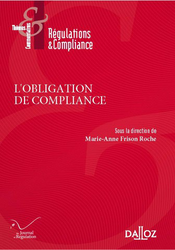
► Full Reference: M.-A. Frison-Roche (dir.), L'Obligation de Compliance, coll."Régulations & Compliance", Journal of Regulation & Compliance (JoRC) and Dalloz, 2025.
____
📘 At the same time, a book in English, Compliance Obligation, is published in the collection copublished by the Journal of Regulation & Compliance (JoRC) and the Éditions Bruylant.
____
🧮the book follows the cycle of colloquia organised by the Journal of Regulation & Compliance (JoRC) and its Universities partners in 2023 and 2024.
____
📚this volume is one of a series of books devoted to Compliance in this collection.
► read the presentations of the other books:
- further books:
🕴️M.-A. Frison-Roche (ed.), 📕Le système probatoire de la Compliance, 2027
🕴️M.-A. Frison-Roche (ed.), 📕Compliance et Contrat, 2026
- previous books:
🕴️M.-A. Frison-Roche & M. Boissavy (eds.), 📕Compliance et droits de la défense. Enquête interne - CJIP - CRPC, 2024
🕴️M.-A. Frison-Roche (ed.), 📕La juridictionnalisation de Compliance, 2023
🕴️M.-A. Frison-Roche (ed.), 📕Les Buts Monumentaux de la Compliance, 2022
🕴️M.-A. Frison-Roche (ed.), 📕Les outils de la Compliance, 2021
🕴️M.-A. Frison-Roche (ed.), 📕Pour une Europe de la Compliance, 2019
🕴️N. Borga, 🕴️J.-Cl. Marin and 🕴️J.-Ch. Roda (eds.), 📕Compliance : l'Entreprise, le Régulateur et le Juge, 2018
🕴️M.-A. Frison-Roche (ed.), 📕Régulation, Supervision, Compliance, 2017
🕴️M.-A. Frison-Roche (ed.), 📕Internet, espace d'interrégulation, 2016
📚see the global presentation of all the books of the collection.
___
► General presentation of this book: Compliance is sometimes presented as something that cannot be avoided, which is tantamount to seeing it as the legal obligation par excellence, Criminal Law being its most appropriate mode of expression. It is sometimes presented as something that the company does out of ethical concern, self-regulation which is the opposite of legal obligation. For the moment, therefore, there is no single vision of the Compliance Obligation. This is all the less the case because of the multitude of texts, themselves constantly evolving and changing, which inject such a wide range of compliance obligations that we give up trying to establish any unity, thinking that, on a case-by-case basis, we will define a regime and a legal constraint of greater or lesser strength, aimed at one subject or debtor or another, for the benefit of one or other.
This lack of unity, due to the absence of a definition of the Compliance Obligation, makes the application of the texts difficult to foresee and therefore makes the Judge fearful, even though he/she is going to take on more and more importance.
This book asks the practical questions: What is Compliance obliging? Who is obliged to comply? and How far are we obliged to comply? and provides answers, Compliance practices, constraints and innovations will be better mastered and anticipated by all those they affect: companies, stakeholders, technicians, lawyers, consultants, institutions and courts.
____
🏗️general construction of this Book: The book opens with a double Introduction. The first, which is freely accessible, consists of a summary of the book, while the second, which is substantial, deals with the unified conception that we can, and indeed should, have, of the "Compliance Obligation", without losing the concrete and active character that characterises this branch of law.
The first Part of the book aims to define the Compliance Obligation. To this end, Chapter I deals with the Nature of this obligation. Chapter II deals with the Spaces of the Compliance Obligation.
The Part II aims to articulate the Compliance Obligation with other branches of Law.
The Part III of the book looks at the way in which the possibility of obliging and the means of obliging are provided. To this end, Chapter I deals with the Convergence of the Sources of the Compliance Obligation. Chapter II considers International Arbitration as a reinforcement of the Compliance Obligation. To this end, Chapter I deals with the Convergence of the Sources of the Compliance Obligation. Chapter II considers International Arbitration as a reinforcement of the Compliance Obligation.
The last Part of the book is devoted to Vigilance, the leading edge of the Compliance Obligation. Chapter I is devoted to a study of the various sectors, and analyses the Intensities of the Vigilance Obligation. Chapter II deals with the Variations in Tension generated by the Vigilance Obligation. Finally, Chapter III deals with the New Modalities of the Compliance Obligation, highlighted by the Vigilance Imperative.
____
TABLE OF CONTENTS
ANCRER LES OBLIGATIONS DE COMPLIANCE SI DIVERSES
DANS LEUR NATURE, LEURS REGIMES ET LEUR FORCE
POUR DEGAGER L'UNITE DE L'OBLIGATION DE COMPLIANCE
LA RENDANT COMPREHENSIBLE ET PRATIQUABLE
(ANCHOR COMPLIANCE OBLIGATIONS, SO DIVERSE
IN THEIR NATURE, THEIR REGIMES AND THEIR FORCE,
TO BRING OUT THE UNITY OF THE COMPLIANCE OBLIGATION
MAKING IT COMPREHENSIBLE AND PRACTICABLE)
TITRE I.
CERNER L’OBLIGATION DE COMPLIANCE
(IDENTIFYING THE COMPLIANCE OBLIGATION)
CHAPITRE I : LA NATURE DE L’OBLIGATION DE COMPLIANCE (THE NATURE OF THE COMPLIANCE OBLIGATION)
Section 1 ♦️ La volonté, le cœur et le calcul, les trois traits cernant l'Obligation de Compliance (Will, Heart and Calculation, the three traits encercling the Compliance Obligation), by 🕴️Marie-Anne Frison-Roche
Section 2 ♦️ De la dette à l’obligation de compliance (From the Debt to the Compliance Obligation), by 🕴️Bruno Deffains
Section 3 ♦️ Obligation de Compliance et droits humains (Compliance Obligation and Human Rights), by 🕴️Jean-Baptiste Racine
Section 4 ♦️ L'Obligation de Compliance et les mutations de la souveraineté et de la citoyenneté (Compliance Obligation and changes in Sovereignty and Citizenship), by 🕴️René Sève
Section 5 ♦️ La définition de l''obligation de compliance confrontée au droit de la cybersécurité (The definition of the Compliance Obligation in Cybersecurity Law) by🕴️Michel Séjean
CHAPITRE II : LES ESPACES DE L’OBLIGATION DE COMPLIANCE (SPACES OF THE COMPLIANCE OBLIGATION)
Section 1 ♦️ Entités industrielles et Obligation de compliance (Industrial entities and Compliance Obligation), by 🕴️Etienne Maclouf
Section 2 ♦️ L'Obligation de Compliance dans les chaînes de valeur (The Compliance Obligation in Value Chains), by 🕴️Lucien Rapp
Section 3 ♦️ Compliance et conflits de lois. Le droit international de la vigilance-conformité à partir de quelques applications récentes sur le continent européen (Compliance and conflict of laws. International Law of Vigilance-Conformity, based on recent applications in Europe), by 🕴️Louis d'Avout
TITRE II.
ARTICULER L’OBLIGATION DE COMPLIANCE AVEC DES BRANCHES DU DROIT
(ARTICULATING THE COMPLIANCE OBLIGATION WITH BRANCHES OF LAW)
Section 2 ♦️ Droit fiscal et obligation de compliance (Tax Law and Compliance Obligation), by 🕴️Daniel Gutmann
Section 3 ♦️ Le droit processuel, prototype de l'Obligation de Compliance (General Procedural Law, prototype of the Compliance Obligation), by 🕴️Marie-Anne Frison-Roche
Section 4 ♦️ Le droit des sociétés et des marchés financiers face à l'Obligation de Compliance (Corporate and Financial Markets Law facing the Compliance Obligation), by 🕴️Anne-Valérie Le Fur
Section 4 ♦️ Transformation de la gouvernance et obligation de vigilance, by 🕴️Véronique Magnier
Section 5 ♦️ Le rapport entre le Droit de la responsabilité civile et l'Obligation de Compliance (The link between Tort Law and Compliance Obligation), by 🕴️Jean-Sébastien Borghetti
Section 6 ♦️ Dimensions environnementales et climatiques de l'Obligation de Compliance (Environmental and Climatic Dimensions of the Compliance Obligation), by 🕴️Marta Torre-Schaub
Section 7 ♦️ Droit de la concurrence et Droit de la Compliance (Competition Law and Compliance Law), by 🕴️Jean-Christophe Roda
Section 8 ♦️ L'Obligation de Compliance en Droit global (The Compliance Obligation in Global Law), by 🕴️Benoît Frydman & 🕴️Alice Briegleb
Section 9 ♦️ Les juges du droit des entreprises en difficulté et les obligations de compliance (Judges of Insolvency Law and Compliance Obligations), by 🕴️Jean-Baptiste Barbièri
TITRE III.
COMPLIANCE : DONNER ET SE DONNER LES MOYENS D’OBLIGER
(COMPLIANCE : GIVE AND TAKE THE MEANS TO OBLIGE)
CHAPITRE I : LA CONVERGENCE DES SOURCES (CONVERGENCE OF SOURCES)
Section 1 ♦️ Obligation sur obligation vaut (Compliance Obligation on Obligation works), by 🕴️Marie-Anne Frison-Roche
Section 2 ♦️ Les technologies disponibles, prescrites ou proscrites pour satisfaire Compliance et Vigilance (Technologies available, prescribed or prohibited to meet Compliance and Vigilance requirements), by 🕴️Emmanuel Netter
Section 3 ♦️ Contrainte légale et stratégie des entreprises en matière de Compliance (Legal Constraint and Company Strategies in Compliance matters), by 🕴️Jean-Philippe Denis & Nathalie Fabbe-Costes
Section 4 ♦️ La loi, source de l’Obligation de Compliance (The Law, source of the Compliance Obligation), by 🕴️Jean-Baptiste Blanc
Section 5 ♦️ Opposition et convergence des systèmes juridiques américains et européens dans les règles et cultures de compliance (Opposition and Convergence of American and European Legal Systems in Compliance Rules and Cultures), by 🕴️Raphaël Gauvain & 🕴️Blanche Balian
Section 6 ♦️ Ce à quoi les engagements engagent qu'est un engagement (What a ), by 🕴️Marie-Anne Frison-Roche
CHAPITRE II : L’ARBITRAGE INTERNATIONAL EN RENFORT DE L’OBLIGATION DE COMPLIANCE (INTERNATIONAL ARBITRATION IN SUPPORT OF THE COMPLIANCE OBLIGATION)
Section 1 ♦️ Comment l'arbitrage international peut être un renfort de l'Obligation de Compliance (How International Arbitration can reinforce the Compliance Obligation), by 🕴️Laurent Aynès
Section 2 ♦️ La considération par l'Arbitrage de l'Obligation de Compliance pour une place d'arbitrage durable (Arbitration' consideration of Compliance Obligation for a Sustainable Arbitration Place), by 🕴️Marie-Anne Frison-Roche
Section 3 ♦️ L’usage de l’arbitrage international pour renforcer l’obligation de Compliance : l’exemple du secteur de la construction (The use of International Arbitration to reinforce the Compliance Obligation: the example of the construction sector), by 🕴️Christophe Lapp
Section 4 ♦️ L’arbitre, juge, superviseur, accompagnateur ? (The Arbitrator, Judge, Supervisor, Support) , by 🕴️Jean-Baptiste Racine
TITRE IV.
LA VIGILANCE, POINTE AVANCÉE DE L’OBLIGATION DE COMPLIANCE
(VIGILANCE, SPEARHEAD OF THE COMPLIANCE OBLIGATION)
Section 1 ♦️ La Vigilance, pointe avancée et part totale de l'Obligation de Compliance (....), by 🕴️Marie-Anne Frison-Roche
CHAPITRE I : LES INTENSITÉS DE L’OBLIGATION DE VIGILANCE, POINTE AVANCÉE DU SYSTÈME DE COMPLIANCE (INTENSITIES OF THE VIGILANCE OBLIGATION, SPEARHEAD OF THE COMPLIANCE SYSTEM)
Section 2 ♦️ L’intensité de l’Obligation de Vigilance selon les secteurs : le cas des opérateurs financiers (Intensity of the Vigilance Obligation by Sectors: the case of Financial Operators), by 🕴️Anne-Claire Rouaud
Section 3 ♦️ L’intensité de l’Obligation de Vigilance selon les secteurs : le cas des opérateurs bancaires et d’assurance (Intensity of the Vigilance Obligation by Sectors: the case of Banking and Insurance Operators), by 🕴️Mathieu Françon
Section 4 ♦️ L’intensité de l’obligation de vigilance selon les secteurs : le cas des opérateurs numériques (Intensity of the Vigilance Obligation by Sectors: the case of Digital Operators), by 🕴️Grégoire Loiseau
Section 5 ♦️ L’Obligation de vigilance des opérateurs énergétiques (The Vigilance obligation of Energy Operators), by 🕴️Marie Lamoureux
CHAPITRE II : LES DISPUTES AUTOUR DE L'OBLIGATION DE VIGILANCE, POINTE AVANCÉE DU SYSTÈME DE COMPLIANCE, DANS SON RAPPORT AVEC LA RESPONSABILITÉ
Section 1 ♦️ Le rapport entre le droit de la responsabilité civile et l'obligation de compliance, by 🕴️Jean-Sébastien Borghetti
Section 2 ♦️ Repenser le concept de responsabilité civile à l’aune du devoir de vigilance, pointe avancée de la compliance (Rethinking the Concept of Civil Liability in the light of the Duty of Vigilance, Spearhead of Compliance), by 🕴️Mustapha Mekki
Section 3 ♦️ Tensions et contradictions entre les instruments relatifs à la vigilance raisonnable des entreprises, by 🕴️Laurence Dubin
Section 4 ♦️ Compliance, Vigilance et Responsabilité civile : mettre en ordre et raison garde (Compliance, Vigilance and Civil Liability: put in order and keep the Reason), by 🕴️Marie-Anne Frison-Roche
CHAPITRE III : LES MODALITÉS NOUVELLES DE L'OBLIGATION DE COMPLIANCE, MISES EN LUMIÈRE PAR L'IMPÉRATIF DE VIGILANCE (NEW MODALITIES OF THE COMPLIANCE OBLIGATION, HIGHLIGHTED BY THE VIGILANCE IMPERATIVE)
Section 1 ♦️ Clauses et contrats, modalités de l’obligation de vigilance (Clauses and Contracts, terms and conditions of implementation of the Vigilance Obligation), by 🕴️Gilles J. Martin
Section 2 ♦️ La preuve de la bonne exécution de la Vigilance au regard du système probatoire de Compliance (Proof that Vigilance has been properly carried out with regard to the Compliance Evidence System), by 🕴️Jean-Christophe Roda
TITRE V.
LE JUGE ET L'OBLIGATION DE COMPLIANCE
(THE JUDGE AND THE COMPLIANCE OBLIGATION)
Section 1 Section 1 ♦️ Devoir de vigilance et litiges commerciaux : une compétence à partager ?, par 🕴️François Ancel
Section 2 ♦️ Les enjeux présents à venir de l’articulation des principes de procédure civile et commerciale avec la logique de compliance (Present and Future Challenges of Articulating Principles of Civil and Commercial Procedure with the Logic of Compliance), by 🕴️Thibault Goujon-Bethan
Section 3 ♦️ Le juge de l’amiable et la compliance (The amicable settlement judge and compliance), by 🕴️Malik Chapuis
Section 4 ♦️ Le Juge requis pour une Obligation de Compliance effective (The Judge required for an Effective Compliance Obligation), by 🕴️Marie-Anne Frison-Roche
L’OBLIGATION DE COMPLIANCE : VISION D’ENSEMBLE
(COMPLIANCE OBLIGATION : OVERVIEW)
♦️ L'obligation de compliance, charge portée par les entreprises systémiques donnant vie au Droit de la Compliance. - lignes de force de l'ouvrage (The Compliance Obligation, a burden borne by Systemic Companies giving life to Compliance Law - key points of the book (free access) by 🕴️Marie-Anne Frison-Roche
________

Oct. 2, 2025
Thesaurus : Doctrine
► Référence complète : M. Mekki, "Peut-on repenser la responsabilité à l’aune du devoir de Vigilance, pointe avancée de la Compliance ?", in M.-A. Frison-Roche (dir.), L'obligation de Compliance, Journal of Regulation & Compliance (JoRC) et Dalloz, coll. "Régulations & Compliance", 2025, pp.599-615.
____
📕lire une présentation générale de l'ouvrage, L'obligation de Compliance, dans lequel cet article est publié
____
► Résumé de l'article (fait par le Journal of Regulation & Compliance - JoRC) : L'auteur développe les tensions que l'Obligation de Vigilance engendre sur le concept même de responsabilité. Répertoriant toutes les manifestations, très diverses, de la Vigilance, selon les domaines, il observe que se forme une logique téléologique de prévention et de gestion des risques systémiques, ce qu'est la compliance, sans doute remède à un État impuissant, s'appuyant sur une grande pluralité des normes.
La question est de savoir si l'on peut passer de ces droits spéciaux mais d'un esprit commun à un droit commun transformé. Les premières décisions rendues à propos de la loi de 2017 répondent par la négative, mais la question est ouverte.
Il faut alors revenir sur le concept même de responsabilité, qui pourrait accueillir un mécanisme général de Vigilance. Ce concept est très flexible et présente l'adaptabilité requise pour accueillir la logique de compliance. En effet, la responsabilité, classiquement ex post peut passer ex ante, à travers la notion de dette, non plus juridique mais éthique, car les entreprises doivent être "dignes de confiance".
La responsabilité préventive vise alors à restaurer l'équilibre des systèmes dans la poursuite des Buts Monumentaux, pour l'efficacité et l'efficience des systèmes. La responsabilité se mixte de subjectivité et d'objectivité, le risque devenant central (par rapport à la faute), le litige dépassant l'intérêt des parties, la remédiation devenant le sujet central dans un procès en responsabilité à repenser : le dialogue doit y être au centre, entre les juridictions, entre les entreprises et les parties prenantes, dans un office du juge adapté.
________
🦉Cet article est accessible en texte intégral pour les personnes inscrites aux enseignements de la Professeure Marie-Anne Frison-Roche

Oct. 2, 2025
Publications
🌐follow Marie-Anne Frison-Roche on LinkedIn
🌐subscribe to the Newsletter MAFR Regulation, Compliance, Law
🌐subscribe to the VideoNews MAFR Surplomb
🌐subscribe to the Newsletter MaFR Law & Art
____
► Full Reference: M.-A. Frison-Roche (dir.), L'Obligation de Compliance, coll."Régulations & Compliance", Journal of Regulation & Compliance (JoRC) and Dalloz, 2025, 816 p.
____
📘 At the same time, a book in English, Compliance Obligation, is published in the collection copublished by the Journal of Regulation & Compliance (JoRC) and the Éditions Bruylant.
____
📚This volume is one of a series of books devoted to Compliance in the series edited by Marie-Anne Frison-Roche.
___
► General presentation of this book: Compliance is sometimes presented as something that cannot be avoided, which is tantamount to seeing it as the legal obligation par excellence, Criminal Law being its most appropriate mode of expression. It is sometimes presented as something that the company does out of ethical concern, self-regulation which is the opposite of legal obligation. For the moment, therefore, there is no single vision of the Compliance Obligation. This is all the less the case because of the multitude of texts, themselves constantly evolving and changing, which inject such a wide range of compliance obligations that we give up trying to establish any unity, thinking that, on a case-by-case basis, we will define a regime and a legal constraint of greater or lesser strength, aimed at one subject or debtor or another, for the benefit of one or other.
This lack of unity, due to the absence of a definition of the Compliance Obligation, makes the application of the texts difficult to foresee and therefore makes the Judge fearful, even though he/she is going to take on more and more importance.
This book asks the practical questions: What is Compliance obliging? Who is obliged to comply? and How far are we obliged to comply? and provides answers, Compliance practices, constraints and innovations will be better mastered and anticipated by all those they affect: companies, stakeholders, technicians, lawyers, consultants, institutions and courts.
____
🏗️general construction of this Book: The book opens with a double Introduction. The first, which is freely accessible, consists of a summary of the book, while the second, which is substantial, deals with the unified conception that we can, and indeed should, have, of the "Compliance Obligation", without losing the concrete and active character that characterises this branch of law.
The first Part of the book aims to define the Compliance Obligation. To this end, Chapter I deals with the Nature of this obligation. Chapter II deals with the Spaces of the Compliance Obligation.
The Part II aims to articulate the Compliance Obligation with other branches of Law.
The Part III of the book looks at the way in which the possibility of obliging and the means of obliging are provided. To this end, Chapter I deals with the Convergence of the Sources of the Compliance Obligation. Chapter II considers International Arbitration as a reinforcement of the Compliance Obligation. To this end, Chapter I deals with the Convergence of the Sources of the Compliance Obligation. Chapter II considers International Arbitration as a reinforcement of the Compliance Obligation.
The last Part of the book is devoted to Vigilance, the leading edge of the Compliance Obligation. Chapter I is devoted to a study of the various sectors, and analyses the Intensities of the Vigilance Obligation. Chapter II deals with the Variations in Tension generated by the Vigilance Obligation. Finally, Chapter III deals with the New Modalities of the Compliance Obligation, highlighted by the Vigilance Imperative.
____
TABLE OF CONTENTS
ANCRER LES OBLIGATIONS DE COMPLIANCE SI DIVERSES
DANS LEUR NATURE, LEURS REGIMES ET LEUR FORCE
POUR DEGAGER L'UNITE DE L'OBLIGATION DE COMPLIANCE
LA RENDANT COMPREHENSIBLE ET PRATIQUABLE
(ANCHOR COMPLIANCE OBLIGATIONS, SO DIVERSE
IN THEIR NATURE, THEIR REGIMES AND THEIR FORCE,
TO BRING OUT THE UNITY OF THE COMPLIANCE OBLIGATION
MAKING IT COMPREHENSIBLE AND PRACTICABLE)
TITRE I.
CERNER L’OBLIGATION DE COMPLIANCE
(IDENTIFYING THE COMPLIANCE OBLIGATION)
CHAPITRE I : LA NATURE DE L’OBLIGATION DE COMPLIANCE (THE NATURE OF THE COMPLIANCE OBLIGATION)
Section 1 ♦️ La volonté, le cœur et le calcul, les trois traits cernant l'Obligation de Compliance (Will, Heart and Calculation, the three traits encercling the Compliance Obligation), by 🕴️Marie-Anne Frison-Roche
Section 2 ♦️ De la dette à l’obligation de compliance (From the Debt to the Compliance Obligation), by 🕴️Bruno Deffains
Section 3 ♦️ Obligation de Compliance et droits humains (Compliance Obligation and Human Rights), by 🕴️Jean-Baptiste Racine
Section 4 ♦️ L'Obligation de Compliance et les mutations de la souveraineté et de la citoyenneté (Compliance Obligation and changes in Sovereignty and Citizenship), by 🕴️René Sève
Section 5 ♦️ La définition de l''obligation de compliance confrontée au droit de la cybersécurité (The definition of the Compliance Obligation in Cybersecurity Law) by🕴️Michel Séjean
CHAPITRE II : LES ESPACES DE L’OBLIGATION DE COMPLIANCE (SPACES OF THE COMPLIANCE OBLIGATION)
Section 1 ♦️ Entités industrielles et Obligation de compliance (Industrial entities and Compliance Obligation), by 🕴️Etienne Maclouf
Section 2 ♦️ L'Obligation de Compliance dans les chaînes de valeur (The Compliance Obligation in Value Chains), by 🕴️Lucien Rapp
Section 3 ♦️ Compliance et conflits de lois. Le droit international de la vigilance-conformité à partir de quelques applications récentes sur le continent européen (Compliance and conflict of laws. International Law of Vigilance-Conformity, based on recent applications in Europe), by 🕴️Louis d'Avout
TITRE II.
ARTICULER L’OBLIGATION DE COMPLIANCE AVEC DES BRANCHES DU DROIT
(ARTICULATING THE COMPLIANCE OBLIGATION WITH BRANCHES OF LAW)
Section 2 ♦️ Droit fiscal et obligation de compliance (Tax Law and Compliance Obligation), by 🕴️Daniel Gutmann
Section 3 ♦️ Le droit processuel, prototype de l'Obligation de Compliance (General Procedural Law, prototype of the Compliance Obligation), by 🕴️Marie-Anne Frison-Roche
Section 4 ♦️ Le droit des sociétés et des marchés financiers face à l'Obligation de Compliance (Corporate and Financial Markets Law facing the Compliance Obligation), by 🕴️Anne-Valérie Le Fur
Section 5 ♦️ Le rapport entre le Droit de la responsabilité civile et l'Obligation de Compliance (The link between Tort Law and Compliance Obligation), by 🕴️Jean-Sébastien Borghetti
Section 6 ♦️ Dimensions environnementales et climatiques de l'Obligation de Compliance (Environmental and Climatic Dimensions of the Compliance Obligation), by 🕴️Marta Torre-Schaub
Section 7 ♦️ Droit de la concurrence et Droit de la Compliance (Competition Law and Compliance Law), by 🕴️Jean-Christophe Roda
Section 8 ♦️ L'Obligation de Compliance en Droit global (The Compliance Obligation in Global Law), by 🕴️Benoît Frydman & 🕴️Alice Briegleb
Section 9 ♦️ Les juges du droit des entreprises en difficulté et les obligations de compliance (Judges of Insolvency Law and Compliance Obligations), by 🕴️Jean-Baptiste Barbièri
TITRE III.
COMPLIANCE : DONNER ET SE DONNER LES MOYENS D’OBLIGER
(COMPLIANCE : GIVE AND TAKE THE MEANS TO OBLIGE)
CHAPITRE I : LA CONVERGENCE DES SOURCES (CONVERGENCE OF SOURCES)
Section 1 ♦️ Obligation sur obligation vaut (Compliance Obligation on Obligation works), by 🕴️Marie-Anne Frison-Roche
Section 2 ♦️ Les technologies disponibles, prescrites ou proscrites pour satisfaire Compliance et Vigilance (Technologies available, prescribed or prohibited to meet Compliance and Vigilance requirements), by 🕴️Emmanuel Netter
Section 3 ♦️ Contrainte légale et stratégie des entreprises en matière de Compliance (Legal Constraint and Company Strategies in Compliance matters), by 🕴️Jean-Philippe Denis & Nathalie Fabbe-Costes
Section 4 ♦️ La loi, source de l’Obligation de Compliance (The Law, source of the Compliance Obligation), by 🕴️Jean-Baptiste Blanc
Section 5 ♦️ Opposition et convergence des systèmes juridiques américains et européens dans les règles et cultures de compliance (Opposition and Convergence of American and European Legal Systems in Compliance Rules and Cultures), by 🕴️Raphaël Gauvain & 🕴️Blanche Balian
Section 6 ♦️ Ce à quoi les engagements engagent qu'est un engagement (What a ), by 🕴️Marie-Anne Frison-Roche
CHAPITRE II : L’ARBITRAGE INTERNATIONAL EN RENFORT DE L’OBLIGATION DE COMPLIANCE (INTERNATIONAL ARBITRATION IN SUPPORT OF THE COMPLIANCE OBLIGATION)
Section 1 ♦️ Comment l'arbitrage international peut être un renfort de l'Obligation de Compliance (How International Arbitration can reinforce the Compliance Obligation), by 🕴️Laurent Aynès
Section 2 ♦️ La considération par l'Arbitrage de l'Obligation de Compliance pour une place d'arbitrage durable (Arbitration' consideration of Compliance Obligation for a Sustainable Arbitration Place), by 🕴️Marie-Anne Frison-Roche
Section 3 ♦️ L’usage de l’arbitrage international pour renforcer l’obligation de Compliance : l’exemple du secteur de la construction (The use of International Arbitration to reinforce the Compliance Obligation: the example of the construction sector), by 🕴️Christophe Lapp
Section 4 ♦️ L’arbitre, juge, superviseur, accompagnateur ? (The Arbitrator, Judge, Supervisor, Support) , by 🕴️Jean-Baptiste Racine
TITRE IV.
LA VIGILANCE, POINTE AVANCÉE DE L’OBLIGATION DE COMPLIANCE
(VIGILANCE, SPEARHEAD OF THE COMPLIANCE OBLIGATION)
Section 1 ♦️ La Vigilance, pointe avancée et part totale de l'Obligation de Compliance (....), by 🕴️Marie-Anne Frison-Roche
CHAPITRE I : LES INTENSITÉS DE L’OBLIGATION DE VIGILANCE, POINTE AVANCÉE DU SYSTÈME DE COMPLIANCE (INTENSITIES OF THE VIGILANCE OBLIGATION, SPEARHEAD OF THE COMPLIANCE SYSTEM)
Section 2 ♦️ L’intensité de l’Obligation de Vigilance selon les secteurs : le cas des opérateurs financiers (Intensity of the Vigilance Obligation by Sectors: the case of Financial Operators), by 🕴️Anne-Claire Rouaud
Section 3 ♦️ L’intensité de l’Obligation de Vigilance selon les secteurs : le cas des opérateurs bancaires et d’assurance (Intensity of the Vigilance Obligation by Sectors: the case of Banking and Insurance Operators), by 🕴️Mathieu Françon
Section 4 ♦️ L’intensité de l’obligation de vigilance selon les secteurs : le cas des opérateurs numériques (Intensity of the Vigilance Obligation by Sectors: the case of Digital Operators), by 🕴️Grégoire Loiseau
Section 5 ♦️ L’Obligation de vigilance des opérateurs énergétiques (The Vigilance obligation of Energy Operators), by 🕴️Marie Lamoureux
Section 2 ♦️ Transformation de la gouvernance et obligation de Vigilance (Transformation of Governance and Vigilance Obligation), by 🕴️Véronique Magniermag
CHAPITRE II : LES DISPUTES AUTOUR DE L'OBLIGATION DE VIGILANCE, POINTE AVANCÉE DU SYSTÈME DE COMPLIANCE, DANS SON RAPPORT AVEC LA RESPONSABILITÉ
Section 1 ♦️ Le rapport entre le droit de la responsabilité civile et l'obligation de compliance, by 🕴️Jean-Sébastien Borghetti
Section 2 ♦️ Repenser le concept de responsabilité civile à l’aune du devoir de vigilance, pointe avancée de la compliance (Rethinking the Concept of Civil Liability in the light of the Duty of Vigilance, Spearhead of Compliance), by 🕴️Mustapha Mekki
Section 3 ♦️ Tensions et contradictions entre les instruments relatifs à la vigilance raisonnable des entreprises, by 🕴️Laurence Dubin
Section 4 ♦️ Compliance, Vigilance et Responsabilité civile : mettre en ordre et raison garde (Compliance, Vigilance and Civil Liability: put in order and keep the Reason), by 🕴️Marie-Anne Frison-Roche
CHAPITRE III : LES MODALITÉS NOUVELLES DE L'OBLIGATION DE COMPLIANCE, MISES EN LUMIÈRE PAR L'IMPÉRATIF DE VIGILANCE (NEW MODALITIES OF THE COMPLIANCE OBLIGATION, HIGHLIGHTED BY THE VIGILANCE IMPERATIVE)
Section 1 ♦️ Clauses et contrats, modalités de l’obligation de vigilance (Clauses and Contracts, terms and conditions of implementation of the Vigilance Obligation), by 🕴️Gilles J. Martin
Section 2 ♦️ La preuve de la bonne exécution de la Vigilance au regard du système probatoire de Compliance (Proof that Vigilance has been properly carried out with regard to the Compliance Evidence System), by 🕴️Jean-Christophe Roda
TITRE V.
LE JUGE ET L'OBLIGATION DE COMPLIANCE
(THE JUDGE AND THE COMPLIANCE OBLIGATION)
Section 1 Section 1 ♦️ Devoir de vigilance et litiges commerciaux : une compétence à partager ?, par 🕴️François Ancel
Section 2 ♦️ Les enjeux présents à venir de l’articulation des principes de procédure civile et commerciale avec la logique de compliance (Present and Future Challenges of Articulating Principles of Civil and Commercial Procedure with the Logic of Compliance), by 🕴️Thibault Goujon-Bethan
Section 3 ♦️ Le juge de l’amiable et la compliance (The amicable settlement judge and compliance), by 🕴️Malik Chapuis
Section 4 ♦️ Le Juge requis pour une Obligation de Compliance effective (The Judge required for an Effective Compliance Obligation), by 🕴️Marie-Anne Frison-Roche
L’OBLIGATION DE COMPLIANCE : VISION D’ENSEMBLE
(COMPLIANCE OBLIGATION : OVERVIEW)
♦️ L'obligation de compliance, charge portée par les entreprises systémiques donnant vie au Droit de la Compliance. - lignes de force de l'ouvrage (The Compliance Obligation, a burden borne by Systemic Companies giving life to Compliance Law - key points of the book (free access) by 🕴️Marie-Anne Frison-Roche
________

Sept. 24, 2025
Thesaurus : 02. Cour de cassation
► Référence complète : Civ. 1ière., 24 sept 2025, n°23-23.869, M c/ société Volkswagen Group France et société Volkswagen Bank Gesellschaft mit Beschraenkter Haftung
____
Sept. 6, 2025
Editorial responsibilities : Direction of the collection "Cours-Série Droit privé", Editions Dalloz (33)
► Référence complète : R. Cabrillac, Introduction générale au droit, 1ière éd. 1995 - 17ième éd., 2026, Dalloz, Coll. "Cours Dalloz-Série Droit privé", 275 p.
____
Le droit est réputé complexe, voire rébarbatif. Pour dépasser cette impression, qui ne correspond pas à sa nature, cet ouvrage, résolument pédagogique, s’adressent aux étudiants qui prennent contact pour la première fois avec la matière.
Il décrit tout d’abord les fondements du droit, ses origines et ses classifications puis il expose les sources du droit, les preuves et le procès.
► Structure du Cours :
- Les fondements du droit contemporain
- Les sources du droit
- La preuve des droits
- Les juridictions civiles
- Le déroulement d'un procès
- La réalisation contentieuses
Il est complété par des tests de connaissances et des tests de compréhension.
____

April 3, 2025
Thesaurus : Doctrine
► Référence complète : M. Trespeuch, "Parents ou clients ? Construire et guider la demande sur le marché transnational de la GPA", in C. Senik (dir.), Enfanter : Natalité, démographie et politiques publiques, La Découverte, pp. 34-54.
____
► Résumé de l'article (fait par le Journal of Regulation & Compliance - JoRC) : L'auteur
________
🦉Cet article est accessible en texte intégral pour les personnes inscrites aux enseignements de la Professeure Marie-Anne Frison-Roche
________

April 3, 2025
Thesaurus : Doctrine
► Référence complète : J.-D. Bretzner & A. Aynès, "Droit de la preuve. janvier 2024 - décembre 2025", D. 2025, panorama, pp. 602-612
____
🦉Cet article est accessible en texte intégral pour les personnes inscrites aux enseignements de la Professeure Marie-Anne Frison-Roche
________

Updated: March 25, 2025 (Initial publication: Feb. 13, 2025)
Hearings by a Committee or Public organisation

🌐follow Marie-Anne Frison-Roche on LinkedIn
🌐subscribe to the Newsletter MAFR Regulation, Compliance, Law
🌐 subscribe to the Video Newsletter MAFR Overhang/Surplomb
____
► Full Reference: M.-A. Frison-Roche, hearing before the French working group on the modernisation of French Arbitration Law, about the issue Arbitrage et Droit de la Compliance : est-il besoin d'un texte ? ("Arbitration and Compliance Law: is a text required?"), Directorate of Civil Affairs' French Ministry of Justice, 13 February 2025.
____
► Result of this presentation and the ensuing discussion, recorded in the working group's report published in March 2025 (published in French, translated her: "This report on the guiding principles would not be complete without mentioning the discussions in the working group on the introduction of a guiding principle requiring the arbitral tribunal to take into account "human, environmental and compliance issues, as well as respect for the fundamental rights and freedoms of the parties".This proposal gave rise to particularly heated discussions. Some saw it as a scarecrow likely to make French Arbitration Law less attractive and to weaken Arbitration awards, opening up cases of recourse on the pretext of bad faith, even though these values would already be taken into account in the review of domestic or international public policy. Others, on the other hand, felt that such a text would have the advantage of enshrining an Arbitration Law connected to values that are not exclusively economically oriented, pointing out, moreover, that such a principle would not be redundant with the control of public policy, which intervenes ex post, whereas this text imposes Ex Ante responsability, and that this principle would allow a noteworthy introduction of Compliance Law in rbitration. They added that the promotion of such values could make it possible to demonstrate a commitment to virtuous arbitration practice. In the light of these differences, after much hesitation, the decision was made not to include it in the draft Code, considering that the final choice was more a question of political dimension that the working group felt it could not decide on its own. ". (p. 36).
____
► English Summary of the presentation: My presentation deals with the relationship between Compliance Law and Arbitration, particularly International Arbitration. It is built around 12 successive points. The work I have carried out on these various points is associated with it. It precedes the answers I shall give to the questions put by the members of the working group and the ensuing discussion.
1. stagnation in the relationship between Arbitration and Compliance Law, due to continuing misunderstandings about Compliance
2. progress towards a better understanding of Compliance and the appropriateness of the arbitrator's role within Compliance Law
3. prospects for the growing relationship between Compliance Law and Arbitration, particularly with regard to the value chains built up by international companies
4. educational issues
5. time required to build a "culture of place" in this matter
6. "Doctrinal" difficulties
7. benefit from the production of a "doctrine of place" on this subject
8. going beyond the continental summa divisio of Public Law and Private Law
9. practical assimilation of Regulatory Contracts in sustainable sectors and chains
10. opening up the Arbitration World to this articulation with Compliance Law
11. Can an official legal text contribute to this?
12. example of the guiding principles of the French Code of Civil Procedure.
____
🔓read the presentation developments below⤵️

Updated: Feb. 25, 2025 (Initial publication: Dec. 2, 2023)
Publications

🌐follow Marie-Anne Frison-Roche sur LinkedIn
🌐subscribe to the Newsletter MAFR Regulation, Compliance, Law
🌐subscribe to the Video Newsletter MAFR Surplomb
____
 ► Full Reference : M.-A. Frison-Roche, Compliance, Vigilance and Civil Liability: put in order and keep the sense of Reason, Working Paper, June 2024
____
📝 In its French version, this Working Paper is the basis of the contribution "Compliance, Vigilance et Responsabilité civile : mettre en l'ordre et raison garder", in 📕L'Obligation de Compliance
____
► Summary of this Working Paper: The descriptions of the Liability incurred by large companies as a result of their compliance obligations are very diverse, even contradictory, going beyond the wishes that may be expressed as to what this liability should be. The first part of this study therefore sets out the various liabilities incurred by companies, which differ in the conditions under which they are implemented and in their scope, so as not to confuse them.
Indeed, as the various laws establish specific legal compliance obligations, they give rise to liabilities of varying conditions and scope, and it is not possible to avail of the regime of one in a situation that falls within the scope of another. It is therefore necessary to review the various bodies of compliance legislation, the GDPR, the ALM-FT regulations, the French so-called Sapin 2 law, the French so-called Vigilance law , the European IA Act , the European European DGA Act, etc., to recall the inflexion that each of these bodies of legislation has made to the liability rules applied to the companies subject to them. Nevertheless, the unicity of the Compliance Obligation, overcoming this necessary diversity of situations, regulations and liability regimes, can provide grouping lines to indicate beyond this diversity the extent of the liability incurred by companies.
Once this classification has been made, the second part of the study develops the observation that none of this can create any principle of general liability on large companies in terms of compliance, and in particular not in terms of vigilance. It is not possible to deduce a general principle of specific obligations of liability or specific obligations to reparation, for example in the area of vigilance, as the texts creating specific vigilance obligation refer to the conditions of commun Tort Law (proof damage and causality), and International Public Law does not have the force to generate a general principle binding companies in this respect.
The third part stresses that it is nevertheless always possible to invoke Tort Law, and companies cannot claim to escape this. This may involve contractual liability, a situation becoming increasingly frequent as companies contractualise their legal compliance obligations, reproducing them but also modifying them, and as Vigilance duty is an obligation that goes beyond the specific situations covered by the regulations.
But it is essential, and this is the subject of the fourth part, not to make companies pure and simple guarantors of the state of the world, present and future. Indeed, if we were to transform sectoral compliances into illustrations of what would then be a new general principle, but one that applied only to them, they would consequently exercise the other side of this coin, namely power over others.
____
🔓read the Working Paper below⤵️
Jan. 20, 2025
Conferences

🌐suivre Marie-Anne Frison-Roche sur LinkedIn
🌐s'abonner à la Newsletter MAFR. Regulation, Compliance, Law
🌐s'abonner à la Newsletter Surplomb, par MAFR
____
► Référence complète : M.-A. Frison-Roche, "Le feu des contentieux de divorce et le froid que le juge doit souffler,", in Association du Collège de Droit de l'Université Jean-Moulin Lyon 3, Rencontre et discussion autour du dernier roman de Eliette Abecassis : un divorce à la française. Manufacture des tabacs, 20 janvier 2025, 17h-19h, Lyon.
____
🪑🪑🪑🪑participent également à cette conférence-débat :
🕴️Eliette Abécassis, Ecrivain
🕴️Vincent Egéa, professeur à l'Université Aix-Marseille
🕴️Hervé de Gaudemar, professeur à l'Université Jean-Moulin Lyon 3
🕴️Jean-Christophe Roda, professeur à l'Université Jean-Moulin Lyon 3
____
► Présentation de mon intervention dans cette conférence-débat : Après avoir écouté la présentation par Vincent Egéa du livre d'Eliette Abécassis, Divorce à la française, publié par celle-ci chez Grasset, puis la description qu'Eliette Abécassis en a faite, dans son choix d'écrire sur cela, dans sa façon de l'écrire, la construction du roman, la distribution des paroles de chacun qui exprime son monde à lui, l'entrechoc de ces mondes et le juge devant lequel de plus en plus ces "vérités" sont racontés dans des rapports personnels et sociaux de plus en plus violents et liquéfiés,
avant qu'un débat ne s'instaure avec l'auditoire d'étudiants très nombreux,
j'ai repris dans ce livre à la fois si beau et si instructif qu'il permet au lecteur d'accéder à la réalité du Droit et de ce contentieux particulier du divorce.
Notamment en ce qu'il est désormais courant, et pour chacun singulier puisque chacun a son histoire et la défend avec flamme et stratégie. Cet enflammement, que les conseils ou la famille peut modérer mais bien souvent attisent, n'est pas propre au Droit de la famille. Même en Droit économique et financier, on trouve cela. Mais c'est bien dans les conflits du divorce que la passion se déchaine, la passion de la vérité pouvant particulier à cet emballement.
L'office du juge est alors de "modérer" cela, s'appuyant sur la froideur du Droit, froideur qu'on lui reproche souvent mais qui est aussi sa distance, son impartialité et qu'il peut à travers notamment le juge apporter pour remettre à une température modérée les rapports parentaux, pour éviter que l'enfant ne s'enflamme à son tour. C'est bien ce que le Législateur lui demanda en 1975. D'ailleurs son auteur, Carbonnier, demandait par ailleurs au Législateur d'être autour comme "étranger" à son objet pour ne pas se laisser aller à la "passion", contre laquelle il mit en garde notamment le juge en 1995.
En lisant ce roman qui nous institue juge et nous amène à manier nous-même le principe du contradictoire au fur et à mesure que, tournant les pages, l'on écoute l'un et l'autre, l'on comprend à quel point la littérature est une voie royale pour accéder à la compréhension du Droit, en ce qu'il traduit l'état d'une société.
_____
📝Lire le compte-rendu de cette conférence-débat
________
Dec. 17, 2024
Thesaurus : Doctrine

► Référence complète : G. Cerqueira & A. Schreiber (dir.), La contractualisation du droit. Approches françaises et brésiliennes, Société de législation comparée (SLC), coll. "Colloques", vol. 61, 2024, 454 p.
____
____
📗lire la table des matières de l'ouvrage
____
Résumé de l'ouvrage (fait par l'éditeur) : "L’ouvrage restitue les actes de deux colloques franco-brésiliens qui ont eu lieu en 2023, d’abord à Rio de Janeiro, puis à Paris, pour discuter du phénomène de la contractualisation du droit dans le cadre d’un partenariat inédit entre la Société de législation comparée et la Procurature générale de l’État de Rio de Janeiro.
Au programme, plusieurs approches et questionnements. L’approche privatiste s’intéresse à la contractualisation des piliers du droit civil : le contrat, la personne et la famille, les biens, auxquels s’ajoute le travail, dans la mesure où il exprime le rapport entre l’homme et l’économie de la cité. L’approche publiciste, quant à elle, examine l’emprise de la technique contractuelle sur des points névralgiques du Léviathan : le droit administratif, la gestion gouvernementale, le fisc, le contrôle des comptes publics et le droit répressif. L’approche procédurale, pour sa part, étudie l’incursion des conventions – lieux de concorde – dans le terrain du contentieux, y compris international. L’approche transversale, enfin, analyse la contractualisation du droit de l’environnement et, dans un domaine connexe, celle de la responsabilité sociale des entreprises. Au-delà des approches, plusieurs questionnements. Pour l’avocat, comment faire face à la contractualisation du droit ? Pour l’universitaire, comment comprendre le phénomène par nos a priori ? Pour le législateur, dans quelles conditions favoriser la contractualisation du droit ?
Dans une double perspective, française et brésilienne, cet ouvrage explore ainsi le chemin contractualiste emprunté par le droit dans sa dimension normative. En investissant les confins de la construction juridique par la technique contractuelle et son ressort volitif, l’ouvrage entend contribuer au débat sur le rôle croissant de la volonté dans la définition des fins et du contenu du droit.".
____
📝lire une présentation de l'article de Marie-Anne Frison-Roche : "Les conditions requises pour favoriser la "contractualisation" du droit"
________

Dec. 11, 2024
Publications
🌐suivre Marie-Anne Frison-Roche sur LinkedIn
🌐s'abonner à la Newsletter MAFR Regulation, Compliance, Law
🌐s'abonner à la Newsletter en vidéos Surplomb, par MAFR
____
► Référence complète : M.-A. Frison-Roche, "Les conditions requises pour favoriser la "contractualisation" du droit", in G. Cerqueira & A. Schreiber (dir.), La contractualisation du droit. Approches françaises et brésiliennes, Société de législation comparée (SLC), coll. "Colloques", vol. 61, 2024, pp. 435-448
____
____
🚧lire le document de travail bilingue sur la base duquel cet article a été élaboré, doté de développements supplémentaires, de références techniques et de liens hypertextes
____
► Résumé de l'article :
_______
Updated: Dec. 4, 2024 (Initial publication: Feb. 6, 2024)
Publications

🌐follow Marie-Anne Frison-Roche on LinkedIn
🌐subscribe to the Newsletter MAFR Regulation, Compliance, Law
🌐subscribe to the Video Newsletter MAFR Surplomb
____
► Full Reference: M.-A. Frison-Roche, In Compliance Law, the legal consequences for Entreprises of their commitments and undertakings, June 2024.
____
📝 This Working Paper is the basis for the contribution "In Compliance Law, the legal consequences for Entreprises of their commitments and undertakings", in📘Compliance Obligation.
____
► Summary of this Working Paper: The innocents might believe, taking the Law and its words literally, that "commitments" are binding on those who make them. Shouldn't they be afraid of falling into the trap of the 'false friend', which is what the Law wants to protect them from (as stated in the prolegomena)?
Indeed, the innocent persons think that those who make commitments ask what they must do and say what they will do. Yet, strangely enough, the 'commitments' that are so frequent and common in compliance behaviours are often considered by those who adopt them to have no binding value! Doubtless because they come under disciplines other than Law, such as the art of Management or Ethics. It is both very important and sometimes difficult to distinguish between these different Orders - Management, Moral Norms and Law - because they are intertwined, but because their respective standards do not have the same scope, it is important to untangle this tangle. This potentially creates a great deal of insecurity for companies (I).
The legal certainty comes back when commitments take the form of contracts (II), which is becoming more common as companies contractualise their legal Compliance Obligations, thereby changing the nature of the resulting liability, with the contract retaining the imprint of the legal order or not having the same scope if this prerequisite is not present.
But the contours and distinctions are not so uncontested. In fact, the qualification of unilateral undertaking of will is proposed to apprehend the various documents issued by the companies, with the consequences which are attached to that, in particular the transformation of the company into a 'debtor', which would change the position of the stakeholders with regard to it (III).
It remains that the undertakings expressed by companies on so many important subjects cannot be ignored: they are facts (IV). It is as such that they must be legally considered. In this case, Civil Liability will have to deal with them if the company, in implementing what it says, what it writes and in the way it behaves, commits a fault or negligence that causes damage, not only the sole existence of an undertaking.
_____
🔓read the developments below ⤵️
Dec. 2, 2024
Thesaurus : Doctrine
► Référence complète : L. d'Avout, "GPA : la première chambre civile couvre la fraude et institue le droit à l'enfant", JCP G, n° 48, 2 décembre 2024, act. 1410, pp. 1974-1978
____
► Résumé de l'article (fait par l'auteur) : "La première chambre civile relance sa jurisprudence en matière de GPA. À travers deux arrêts récents (2 octobre et 14 novembre), elle remet en cause les principes essentiels du droit français de la filiation de la bioéthique, pourtant réaffirmés récemment avec force par le législateur".
____
🦉Cet article est accessible en texte intégral pour les personnes inscrites aux enseignements de la Professeure Marie-Anne Frison-Roche
________

Nov. 28, 2024
MAFR TV : MAFR TV - Overhang

🌐suivre Marie-Anne Frison-Roche sur LinkedIn
🌐s'abonner à la Newsletter MAFR. Regulation, Compliance, Law
🌐s'abonner à la Newsletter Surplomb, par MAFR
____
► Référence complète : M.-A. Frison-Roche, "Compliance et engagement : le juste milieu de l'arrêt rendu par la Cour d'appel de La Haye le 12 novembre 2024", in série de vidéos Surplomb, 28 novembre 2024
____
🌐visionner sur LinkedIn cette vidéo de la série Surplomb
____
____
🎬visionner ci-dessous cette vidéo de la série Surplomb⤵️
____
Surplomp, par mafr
la série de vidéos dédiée à la Régulation, la Compliance et la Vigilance

Nov. 26, 2024
Interviews

🌐follow Marie-Anne Frison-Roche on LinkedIn
🌐subscribe to the Newsletter MAFR Regulation, Compliance, Law
🌐subscribe to the Newsletter Surplomb, par MAFR
____
► Full Reference: M.-A. Frison-Roche, "GPA : "L’interdiction de la GPA posée par le Code civil n’existe plus" ("The French Civil Code ban on surrogacy no longer exists"), interview with Olivia Dufour, Actu-Juridique, 26 November 2024
____
💬read the interview (in French)
____
► Presentation of the interview by the journal: "Un simple arrêt de section rendu par la première civile de la Cour de cassation le 14 novembre 2024 peut-il donner plein effet à une "pure convention de GPA" ? Telle est la question que l’on peut se poser à la suite de cette décision. Éléments de réponse avec le professeur Marie-Anne Frison-Roche. ".
____
🕴️M.-A. Frison-Roche, 📕GPA : dire Oui ou dire Non, 2018
____
► Questions posées, réponses apportées :
Actu-Juridique. Question : Un arrêt de section de la première chambre civile de la Cour de cassation rendu le 14 novembre dernier en matière de gestation pour autrui (GPA) a suscité l’émotion. Est-il exact de dire qu’en pratique, suite à cette décision, la prohibition en France de la GPA n’existe plus ?
Marie-Anne Frison-Roche. Réponse. :
A.J. Q. : Quels étaient les faits de l’espèce et en quoi diffèrent-ils des autres affaires ?
MaFR. R. : O
A.J. Q. : L’Europe avait-elle déjà pris position sur la GPA et si oui, par quels textes et dans quel sens ?
MaFR. R. : En Europe, c'est la jurisprudence de la CEDH qui en 2014 (arrêts Mennesson) est venu briser la jurisprudence française pour imposer que la filiation de l'enfant né d'une GPA réalisée à l'étranger dans un pays où la GPA est licite puisse être établie à l'égard du père dont les gamètes avaient été utilisées. Il ne restait plus alors qu'à procéder à l'adoption par le conjoint de celui-ci. La législation interne ne fût pas pour autant modifiée mais le fonctionnement de l'état-civil permet de rendre inefficace la prohibition. Mais c'était à la fois dire Non et Oui... L'enjeu fût donc de modifier les textes, soit pour exclure la GPA plus fortement, soit pour l'admettre plus ouvertement.
A.J. Q. : En quoi la technique juridique utilisée pour faire reconnaître cette GPA en France était-elle différente de ce que l’on connait usuellement ?
MaFR. R. : C
A.J. Q. : Quelle est la portée de cet arrêt ?
MaFR. R. : I
A.J. Q. : Qu’en est-il du rapport avec l’adoption ?
MaFR. R. : S
A.J. Q. : Le rapporteur n’a-t-il pas évoqué une possibilité de déguiser une adoption illicite à l’étranger sous une GPA ?
MaFR. R. : S
________
Nov. 26, 2024
MAFR TV : MAFR TV - Overhang
🌐suivre Marie-Anne Frison-Roche sur LinkedIn
🌐s'abonner à la Newsletter MAFR. Regulation, Compliance, Law
🌐s'abonner à la Newsletter Surplomb, par MAFR
____
► Référence complète : M.-A. Frison-Roche, "Compliance, Climat, Dommage, Science et Vérité - Cour d'appel de La Haye, 12 novembre 2024", in série de vidéos Surplomb, 26 novembre 2024
____
🌐visionner sur LinkedIn cette vidéo de la série Surplomb
____
____
🎬visionner ci-dessous cette vidéo de la série Surplomb⤵️
____
Surplomp, par mafr
la série de vidéos dédiée à la Régulation, la Compliance et la Vigilance
Nov. 12, 2024
Thesaurus : 09. Juridictions étrangères
► Référence complète : Gerechtshof Den Haag (Cour d'appel de La Haye), 12 novembre 2024, n° 200.302.332/01, Shell Plc c/ Milieudefensie et a.
____
____
🏛️lire la traduction de la décision (en anglais)
____
____
____
________
Oct. 16, 2024
Thesaurus : Doctrine
► Référence complète : F. Girard, La propriété, la terre, les communs Essai d’histoire environnementale de la pensée juridique, E. Editions Peter Lang, 2024, 662 p.
____
🦉Cet ouvrage est accessible en texte intégral pour les personnes inscrites aux enseignements de la Professeur Marie-Anne Frison-Roche
Oct. 2, 2024
Thesaurus : Doctrine

► Référence complète : E. Abécassis, Divorce à la française, Paris, Grasset, 288 p.
____
____
📝lire l'entretien d'Eliette Abécassis sur le rapport avec le droit, la justice, la famille, "Dalloz-Actu", 3 octobre 2024.
____
► Présentation de l'ouvrage : "Le « divorce à la française » n’est pas un « jardin à la française » : c’est une boucherie !
Antoine et Margaux Maurepas se sont aimés et ont eu ensemble deux enfants. Lui est chirurgien, elle est romancière. Voilà qu’au moment de divorcer, ils se déchirent pour la garde de leurs enfants.
Le mari, la femme, le fils, la fille, la mère de l’un, la mère de l’autre, la deuxième épouse de l’un, le frère de l’autre, l’ami de l’un, l’amant de l’autre, l’éditeur de l’une, la comptable de l’autre : plus les témoignages se succèdent auprès de la Juge aux Affaires familiales, plus la vérité se dérobe : Est-elle folle, est-il un pervers manipulateur et violent, qui est infidèle à qui, qui instrumentalise les enfants, qui complote avec sa mère, qui a le pouvoir symbolique et le pouvoir financier, entre l’écrivaine qui invente des fictions et le chirurgien qui opère ses patients ? Qui est le bourreau, qui est la victime ? Un tourbillon de témoignages, auditions, procès-verbaux, qui se contredisent sur les faits comme sur leur interprétation, et autant de versions à démêler, pour la Juge comme pour la lectrice et le lecteur, qui se trouvent exactement dans la même position d’inconfort qu’elle : chacune et chacun est crédible quand on l’écoute ou le lit, et pourtant rien ne s’accorde dans ce puzzle d’une famille éclatée.
Les enfants pourront-ils échapper au jugement de Salomon ? La décision juste devant la loi sera-t-elle la bonne décision?
Ce sont certaines des interrogations qui traversent ces pages vertigineuses, où tous se reconnaîtront et essaieront de démêler le vrai du faux et de sauver ce qu’il reste à sauver.
Le procès impitoyable du couple, de la fiction et de la société. Un huis-clos étourdissant où Eliette Abécassis assoit plus que jamais son talent de romancière.".
________
Oct. 2, 2024
Thesaurus : 02. Cour de cassation
► Référence complète : Civ. 1, 2 octobre 2024, n° 22-20.883 et 23-50.002
____
🏛️lire l'arrêt rendu à la suite du pourvoi n° 22-20.883
🏛️lire l'arrêt rendu à la suite du pourvoi n° 23-50.002
____
🏛️lire le communiqué de presse de la Cour de cassation accompagnant la publication de ces décisions
____
📝Commentaires de ces décisions :
- JCP G, 14 octobre 2024, n° 41, actualité 1185, p. 1970
________
Sept. 12, 2024
Conferences

🌐follow Marie-Anne Frison-Roche on LinkedIn
🌐subscribe to the Newsletter MAFR Regulation, Compliance, Law
____
► Full Reference: M.-A. Frison-Roche, participation to the round table "Le droit à l'enfant : réalité ou faux concept ?" ("The right to a child: reality or false concept?"), in Regards croisés sur les nouvelles filiations, Cour d'appel de Paris (Paris Court of Appeal), September 12, 2024
____
🧮see the full programme of this event
____
► Summary of the conference:
________

April 30, 2024
Interviews
🌐follow Marie-Anne Frison-Roche on LinkedIn
🌐subscribe to the Newsletter MAFR Regulation, Compliance, Law
____
► Full Reference: M.-A. Frison-Roche, "GPA : "Il faut cesser de passer la femme par pertes et profits"" ("Surrogacy: "We have to stop writing off women""), interview with Olivia Dufour, Actu-Juridique, April 30, 2024
____
💬read the interview (in French)
____
► Presentation of the interview by the journal: "Le 23 avril 2024, les députés européens ont adopté une loi élargissant le champ d’application des mesures actuelles pour combattre et prévenir la traite des êtres humains et mieux soutenir ses victimes, par 563 voix pour, 7 contre et 17 abstentions. La maternité de substitution, ou GPA, entre désormais dans le champ de la traite des êtres humains. Mais depuis quelques jours, la polémique fait rage. Le nouveau texte réprime-t-il uniquement la GPA contrainte organisée par une association criminelle, ou toute forme de GPA ? Nous avons demandé au professeur Marie-Anne Frison-Roche, auteur d’un ouvrage intitulé « GPA : dire Oui ou dire Non » publié chez Dalloz en 2018, de nous éclairer sur les enjeux attachés à cette question et sur la position de l’Europe.".
(Free translation: "On April 23, 2024, Members of the European Parliament adopted a law extending the scope of existing measures to combat and prevent human trafficking and provide better support for its victims, by 563 votes to 7 with 17 abstentions. Surrogacy (gestation pour autrui - GPA in French), now falls within the scope of human trafficking. But in recent days, controversy has been raging. Does the new text punish only forced surrogate motherhood organised by a criminal association, or all forms of surrogacy? We asked Professor Marie-Anne Frison-Roche, author of a book entitled "GPA: dire Oui ou dire Non" ("Surrogacy: say Yes or say No") published by Dalloz in 2018, to shed some light on the issues surrounding this question and on Europe's position".)
____
🕴️M.-A. Frison-Roche, 📕GPA : dire Oui ou dire Non (Surrogacy: say Yes or say No), 2018
____
► Questions asked, answers given:
Actu Juridique. Question : La GPA est une pratique ancienne même si elle est longtemps restée marginale, qu’est-ce qui a changé et nécessite aujourd’hui l’attention des pouvoirs publics et du législateur ?
Surrogacy is a long-standing practice, even if it was marginal for a long time. What has changed that now requires the attention of public authorities and legislators?
Marie-Anne Frison-Roche. Answer. : Two things have changed this practice. The first is the possibility of introducing a man's gametes and a woman's oocyte into a woman's body, thus reducing her to being a "carrier" and providing this service, which is very much in demand. The second is the transformation of the desire for a child, an eternal desire shared by many, into a "right to a child". This right to a child would need to be put into practice by any means, for the benefit of any holder who is unable or unwilling to suffer the inconvenience of pregnancy. This is how the practice developed. The legislator intervened, following case law, by declaring, as the Cour de cassation (French Court of cassation) had done, that this practice was contrary to the dignity of the human being, punishable under both the Code civil (French Civil Code) and the Code pénal (French Criminal Code).
A.J. Q. : Autrement dit, les innovations techniques couplées à l’émergence d’un sentiment de droit à l’enfant ont fait exploser la demande de maternité de substitution…
In other words, technical innovations coupled with the emergence of a sense of entitlement to a right to a child have led to an explosion in demand for surrogacy...
MaFR. A. : Yes, but this demand has to be matched by an offer. There are few fertile women prepared to bear children for others. The desire to have children is not matched by a desire to bear them for others without compensation. And the few women who are willing to do so are in countries far removed from the people who want them. The practice has only developed because of the very prosperous agencies on which everything depends. Without this intermediation, towards Ukraine for example, the practice could not have spread.
A.J. Q. : L’Europe avait-elle déjà pris position sur la GPA et si oui, par quels textes et dans quel sens ?
Has Europe already taken a position on surrogacy and, if so, in what texts and in what direction?
MaFR. A. : In Europe, it was the case law of the ECHR which in 2014 (Mennesson judgments) broke with French jurisprudence to impose that the filiation of a child born as a result of a surrogacy carried out abroad in a country where surrogacy is lawful can be established with regard to the father whose gametes had been used. All that remained was for the child to be adopted by the father's spouse. This did not change domestic legislation, but the way civil status works means that the prohibition can be rendered ineffective. But this meant saying Yes and No at the same time... The challenge was therefore to amend the texts, either to exclude surrogacy more strongly, or to admit it more openly.
A.J. Q. : Dans ce contexte, quelle nouveauté apporte le texte adopté par le Parlement européen le 23 avril dernier ?
Against this backdrop, what is new about the text adopted by the European Parliament on 23 April?
MaFR. A. : It depends on how you interpret it. When the text of the directive was being discussed, no one disputed that its adoption would result in the effective prohibition of surrogacy throughout the European Union and the strengthening of the basis of this prohibition in that surrogacy constitutes trafficking in human beings, the woman who carries the child and who legally remains the mother since she gives birth to the child, and that child. But once voted, the text gives rise to another interpretation, supported by some. It is argued that trafficking in human beings is not the "legal category" into which surrogacy falls, but the "condition" under which surrogacy is punishable; So, if surrogacy is practised without "trade" (trafficking is a trade), if there is no money involved, if there is only altruism and concern for the other person, then not only is surrogacy not punished, but what is more, this so-called "altruistic" surrogacy becomes legitimate by the very fact of this directive! The scope is therefore quite simply the opposite... This could give rise to litigation.
A.J. Q. : Dans l’ouvrage que vous avez consacré à la GPA en 2018 chez Lefebvre-Dalloz préfacé par Éliette Abécassis, vous montrez qu’on peut dire Oui ou Non à la GPA, mais qu’il faut répondre et surtout vous mettez en lumière les implications de ces choix. Pourquoi faut-il forcément répondre à cette question ?
In your book on GPA published by Lefebvre-Dalloz in 2018, with a preface by Éliette Abécassis, you show that we can say Yes or No to surrogacy, but that we must answer, and above all you highlight the implications of these choices. Why do we have to answer this question?
MaFR. A. : The question of whether or not to allow surrogacy must be answered (say Yes or say No), because it is a question of society. Not to answer it, to say neither yes nor no, to say yes and no at the same time, is not to choose the society in which we want to live.
A.J. Q. : Imaginons que l’on choisisse le Oui. Qu’implique-t-il sur les valeurs de la société et l’état du droit ?
What does this mean for the values of society and the Rule of Law?
MaFR. A. : If we accept that surrogacy is legal, then it is the will of the people involved that gives birth to the child. The agreement between the person or persons planning to have a child and the woman who agrees to carry the child, with the agent acting as intermediary. It is the society of the contract, because the State is nothing, it is only the scribe who copies the stipulations onto the civil status register. Parentage ceases to be the institution guarded by the State through which the individual is anchored in the social group. Parentage becomes a private matter. This contract-based society is in fact a market society.
A.J. Q. : Et si l’on dit Non à la GPA, on le fait sur quel fondement et pourquoi ?
And if we say No to GPA, on what grounds and why?
MaFR. A. : If we maintain the prohibition of surrogacy and seek to make it effective, in particular by taking action against agencies, we are referring to a society where the State, through public order, watches over human beings and where the law controls power and protects women.
________
April 18, 2024
Thesaurus : Doctrine

► Référence complète : C. Leveneur, Les smart contracts. Étude de droit des contrats à l'aune de la blockchain, préf. C. Pérès, Dalloz, coll. "Nouvelle Bibliothèque de Thèses", vol. 236, 2024, 621 p.
____
____
📗lire le sommaire de l'ouvrage
____
📗lire la table des matières de l'ouvrage
____
► Résumé de l'ouvrage (fait par l'éditeur) : "La recherche menée sur les smart contracts a pour objectif de comprendre et d'analyser une innovation technologique à la lumière du droit des contrats, afin de permettre l'utilisation de ces instruments au service de l'efficacité économique des contrats, grâce à des adaptations à la fois technologiques et juridiques.
Des programmes informatiques auto-exécutants, appelés «smart contracts », peuvent être déployés sur des blockchains afin d'exécuter automatiquement des actions prédéfinies, répondant à des conditions déterminées. Une fois enregistré sur une blockchain, le programme est à la fois vérifiable par tous et immuable, ce qui constitue une véritable garantie pour les parties qui l'utilisent. De plus, le smart contract bénéficie d'une autonomie dans l'exécution dès lors que les conditions prédéfinies sont indiquées comme remplies, chassant l'aléa ou l'erreur humaine.
Dans une blockchain, toutes les transactions sont en réalité opérées par des smart contracts. Le smart contract le plus simple envoie des fonds d'une adresse A vers une adresse B. Des smart contracts plus élaborés permettent de programmer des conditions, et par exemple de proposer des prêts à intérêts, de mettre en place des garanties, etc. C'est ce que l'on appelle la finance décentralisée (DeFi). Un smart contract peut également être programmé pour créer des crypto-actifs, par exemple des jetons numériques (tokens), les vendre, prévoir l'équivalent d'un droit de suite, etc. Les jetons non fongibles (NFT) fonctionnent ainsi grâce à des smart contracts.
Les smart contracts sont les rouages indispensables de cette grande « machine de confiance » qu'est la blockchain.
Parmi tous les smart contracts, une forme est apparue particulièrement intéressante pour une analyse juridique. lI s'agit du cas où le smart contract semble non seulement faire vivre une relation contractuelle, mais aussi matérialiser une offre et un mode d'acceptation. Ainsi, au-delà d'être de simples rouages techniques pour des cas d'usage de al blockchain, les smart contracts peuvent être utilisés au service de l'exécution de contrats déjà formés, voire être le support et l'expression de contrats à part entière. Tele est la thèse soutenue dans cette étude.".
________
March 14, 2024
Thesaurus : Doctrine

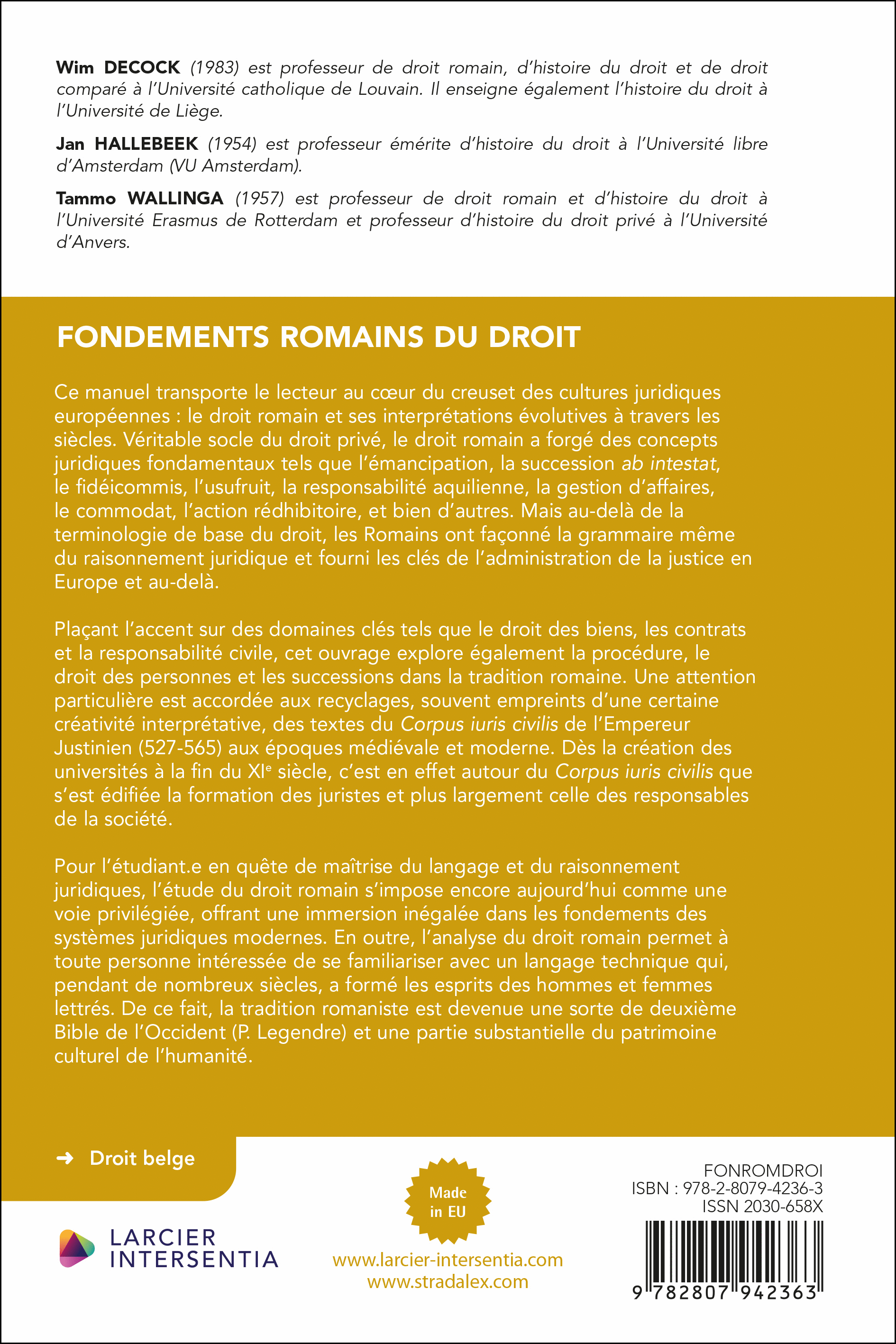
► Référence complète : W. Decock, J. Hallebeek et T. Wallinga, Fondements romains du droit, Larcier Intersentia, coll. "Précis de la Faculté de Droit et de Criminologie de l'Université catholique de Louvain", 2024, 458 p.
____
____
📗lire le sommaire de l'ouvrage
____
📗lire la table des matières de l'ouvrage
____
► Résumé de l'ouvrage (fait par l'éditeur) : "Ce manuel transporte le lecteur au coeur du creuset des cultures juridiques européennes : le droit romain et ses interprétations évolutives à travers les siècles. Véritable socle du droit privé, le droit romain a forgé des concepts juridiques fondamentaux tels que l’émancipation, la succession ab intestat, le fidéicommis, l’usufruit, la responsabilité aquilienne, la gestion d’affaires, le commodat, l’action rédhibitoire, et bien d’autres. Mais au-delà de la terminologie de base du droit, les Romains ont façonné la grammaire même du raisonnement juridique et fourni les clés de l’administration de la justice en Europe et au-delà.
Plaçant l’accent sur des domaines clés tels que le droit des biens, les contrats et la responsabilité civile, cet ouvrage explore également la procédure, le droit des personnes et les successions dans la tradition romaine. Une attention particulière est accordée aux recyclages, souvent empreints d’une certaine créativité interprétative, des textes du Corpus iuris civilis de l’Empereur Justinien (527-565) aux époques médiévale et moderne. Dès la création des universités à la fin du XIe siècle, c’est en effet autour du Corpus iuris civilis que s’est édifiée la formation des juristes et plus largement celle des responsables de la société.
Pour l’étudiant.e en quête de maîtrise du langage et du raisonnement juridiques, l’étude du droit romain s’impose encore aujourd’hui comme une voie privilégiée, offrant une immersion inégalée dans les fondements des systèmes juridiques modernes. En outre, l’analyse du droit romain permet à toute personne intéressée de se familiariser avec un langage technique qui, pendant de nombreux siècles, a formé les esprits des hommes et femmes lettrés. De ce fait, la tradition romaniste est devenue une sorte de deuxième Bible de l’Occident (P. Legendre) et une partie substantielle du patrimoine culturel de l’humanité.".
________