Obligation de Compliance

Documents de travail

document de travail servant de base à un article concluant un ouvrage

🚧Considérer la géographie juridique africaine pour y réussir l’Obligation de Vigilance

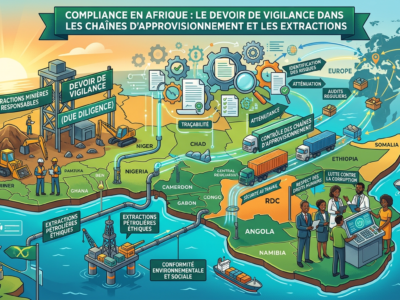
► Référence complète : M.-A. Frison-Roche, Considérer la   géographie juridique africaine pour y réussir  l'Obligation de  Vigilance, document de travail, aout 2025/février 2026 - 🎤Ce document de travail fait suite à l'intervention de clôture du colloque Devoir de vigilance, quelles perspectives africaines ? Regards croisés en droit international, droit comparé et droit OHADA, organisé par la Faculté de Droit de Bordeaux, par son Institut de Recherches en Droit des Affaires et du Patrimoine (IRDAP), qui s'est déroulé le 15 novembre 2024.  - 📝Ce document de travail constitue la base de l'article, "Considérer la géographie juridique africaine pour y réussir l'obligation de vigilance", qui conclut l'ouvrage publié sous la direction d'Eustache Da Allada  en 2026 aux Éditions Lefebvre-Dalloz, dans la collection « Thèmes & Commentaires »,📗Devoir de vigilance, quelles perspectives africaines ? Regards croisés en droit international, droit comparé et droit OHADA. Pour ce faire, après une première écriture en août 2025, il a été repris une seconde fois pour mieux y intégrer les contributions écrites constituant l'ouvrage, puisque l'article dont il est sous-jacent exprime une conception propre et s'appuie sur des travaux extérieurs mais doit aussi faire une synthèse de ceux-ci. - ► Résumé du document de travail : La loi française dite « Vigilance » de 2017 a repris les instruments techniques et l'esprit de la loi « Sapin 2 » de 2016. Elles portent une ambition commune. Elles ont été et demeurent un objet commun de fracas et de passion. Elles ont pour coeur l'instauration d'une « obligation de compliance », dont les techniques de vigilance constituent la « pointe avancée » pour servir une grande ambition : protéger les systèmes des risques au présent et à l'avenir pour protéger les êtres humains qui y sont impliquées. La passion qui continue à entourer la loi Vigilance, qui engendra la directive CS3D, n'est pas bonne, parceque le Droit et la passion ne sont jamais alliés. Certains voudraient avec passion le triomphe de la vigilance par la condamnation des entreprises à faire des miracles, certains voudraient avec passion l'anéantissement de tous les textes qui ont établi l'idée même de ce qui constitue ce Droit de la compliance construit sur ces Buts Monumentaux humanistes. Mais reconnaissons que dans ces affrontements sur l'Obligation de Vigilance qui se déploie juridiquement dans les chaines de valeur,  l'Afrique est souvent prise comme exemple d'un propos général. Elle n'est pas souvent appréhendée comme un objet singulier. L'on ne s'appuie ni sur ses forces ni sur les mécanismes juridiques qui lui sont propres, alors que les chaines de valeur, notamment industrielles, mènent si souvent à elle, maintenant et à l'avenir. A travers les analyses du devoir de vigilance l'Afrique est perçue comme un lieu de revanche ou d'un nouveau paternalisme et lorsque son avenir est envisagé, les perspectives semblent manquer, alors même que l'oblet du Dorit de la Compliance, et donc de la Vigilance, est l'avenir.  Si l'on regarde avec un regard moins combattant et en partant davantage de la « géographie juridique » des pays africains et des structures  sociales et interétatiques, l'on observe que le souci d'autrui, présent et futur, qui constitue in fine le But Monumental du Droit de la Compliance et donc de l'Obligation de la Vigilance, est davantage présent en Afrique qu'il ne l'est en Europe, désormais construite sur l'individualisme juridique. Ce souci d'autrui se reflète dans des mécanismes juridiques proches de la médiation et diverses structures juridiques que nos propres structures gagneraient à entendre , nos législateurs avant d'adopter les textes et nos juges qui pourraient les écouter comme amici curiae avant de toujours trancher. Si l'on revient sur le sol africain exploité par un segment des chaines de valeur et sur les organisations du travail, l'on mesure que là non plus les textes et les sanctions ne font pas tout. Les techniques de compliance qui utilisent le droit souple et le contrat qui bâtit les chaines elles-mêmes peuvent ôter la part d'abstraction qui, par nature, est inhérente aux textes généraux. Progresser par les contrats sous le regard et avec l'appui du juge est une perspective qui pourrait plus fructueuse que les textes bien intentionnés, qui auront été déclencheurs, convergents avec la place privilégiée du Droit des contrats dans l'OHADA.. L'importance du juge s'en trouve accrue. La Juridictionnalisation de la Compliance tient aussi au lien grandissant entre Compliance et Contrat. Or, il apparaît que non seulement les juges européens de la Vigilance peuvent ainsi statuer sur l'Afrique, qu'ils ne peuvent connaître que de loin, mais c'est le sort de tout juge que d'être extérieur, mais les tribunaux africains et interrétatiques, notamment via l'OHADA peuvent parce que les chaines de valeur sont constituése de contrt, se saisir de l'Obligation de Vigilance. En la développant non pas comme une idée étrangère à acculturer, mais comme ce qui exprime le coeur du Droit en Afrique : le souci d'autrui, la solidarité, la recherche des compromis et des solutions pour que le système social et environnemental, c'est-à-dire humain, tienne encore demain. -   🔓lire les développements ci-dessous⤵️ - 🌐suivre Marie-Anne Frison-Roche sur LinkedIn 🌐suivre Marie-Anne Frison-Roche sur Instagram 🌐s'abonner à la Newsletter MAFR Regulation, Compliance, Law 🌐s'abonner à la Newsletter en vidéo MAFR Surplomb 🌐s'abonner à la Newsletter MaFR Droit & Art

Documents de travail

Working Paper sous-jacent à un article publié en français dans une publication collective

🚧Compliance law as a Royal Road for regulating the digital space

► Référence complète : M.-A. Frison-Roche, Compliance law as a Royal Road for regulating the digital space, Working Paper, mai 2025 - 📝 Ce Working Paper est le sous-jacent anglais de l'article "Le Droit de la compliance, voie royale pour réguler l'espace numérique", in 📚Enjeux numériques, 📗Régulation et Compliance", juin 2025. - ► Résumé en français du Working Paper :  Pour décrire la place du Droit de la Compliance afin de réguler l'espace numérique et pour en conclure que cette nouvelle branche du Droit constitue la « voie royale » pour cela, l'étude procède en 6 étapes. Premièrement et à première vue et conceptuellement il existe un fossé entre l'idée politique de Régulation et les idées (liberté et la technologie comme « loi ») sur lesquelles l'espace numérique s'est construit et se déploie. Deuxièmement, en pratique, un fossé aussi immense existe entre les modes ordinaires du Droit de la Régulation, qui s'adosse à un Etat et l'organisation de l'espace numérique tenue par ces opérateurs économiques à la fois américains et globaux. Troisièmement, la prétention, de nature politique, de civiliser l'espace numérique demeure pourtant et s'accroît, se concrétisant en s'appuyant sur la force même des entités en mesurer de concrétiser cette ambition, ces entités étant les opérateurs numériques cruciaux eux-mêmes, saisis en Ex Ante. Quatrièmement, cela correspond à la conception et pratique d'une nouvelle branche du Droit, le Droit de la compliance, qui ne doit pas se confondre avec la « conformité » et qui est normativement ancré dans ses « Buts Monumentaux ». Cinquièmement, ce Droit opère une internalisation des buts monumentaux dans ces opérateurs numériques qui les diffusent en structures et en comportements dans l'espace numérique. Sixièmement, s'articulent alors par un intermaillage entre les législations, les décisions de justice et les comportements des entreprises, des concrétisations de gré ou de force des Buts Monumentaux qui peuvent civiliser l'espace numérique sans que la liberté y perde son primat. - 🔓lire le document de travail ci-dessous (en anglais)⤵️ - 🌐suivre Marie-Anne Frison-Roche sur LinkedIn 🌐suivre Marie-Anne Frison-Roche sur Instagram 🌐s'abonner à la Newsletter MAFR Regulation, Compliance, Law 🌐s'abonner à la Newsletter en vidéo MAFR Surplomb 🌐s'abonner à la Newsletter MaFR Droit & Art

Articles

🏛️ACPR & 🏛️Tracfin

📜Lignes directrices conjointes à l’Autorité de Contrôle Prudentiel et de Résolution et de Tracfin relatives aux obligations de vigilance sur les opérations et aux obligations de déclaration et d’information à Tracfin

► Référence complète : ACPR & Tracfin, Lignes directrices conjointes à l'Autorité de Contrôle Prudentiel et de Résolution et de Tracfin relatives aux obligations de vigilance sur les opérations et aux obligations de déclaration et d'information à Tracfin, 23 avril 2025 - 🔴Lire les lignes directrices -   -

Documents de travail

Document de travail pour 📺Surplomb

🚧Le puzzle du Droit institutionnel de la Compliance et du Droit substantiel de la Compliance : exemple des règlements et de la directive du 31 mai 2024 sur l’AMLA et les obligations de compliance

► Référence complète : M.-A. Frison-Roche, Le puzzle du Droit institutionnel de la Compliance et du Droit substantiel de la Compliance : exemple des règlements et de la directive du 31 mai 2024 sur l'AMLA et les obligations de compliance, document de travail, janvier 2025. - 🎤 Ce document de travail a été élaboré pour servir de base à la vidéo Surplomb👁 du 11 janvier 2024  : cliquer ICI - 🎬🎬🎬Dans la collection des Surplomb👁 Il s'insère dans la catégorie des Actualités. ►Voir la collection complète des Surplombs👁 : cliquer ICI - ► Résumé du document de travail : Le Droit de la Compliance se construit sur 2 jambes, les institutions d'une part, les règles substantielles d'autre part. Par exemple aux Etats-Unis, la loi de 1934 établit en même temps la prohibition et la prévention des abus de marché financier et la SEC. En Europe, en 2013, l'Union bancaire établit des institutions pour construire cette Union et accrut les obligations sur les banques. L'illustre parfaitement les 2 Règlements européen du 31 mai 2024, l'un créant l'AMLA et l'autre renforçant les obligations de compliance des opérateurs assujettis, l'un renvoyant à l'autre.  En effet, Droit institutionnel de la Compliance et Droit substantiel de la Compliance sont comme 2 jambes qui s'articulent. Il faut connaître et faire fonctionner les 2 ensemble. Cela fait partie du « puzzle européen », expression positive qui implique qu'on est toujours en tête dans l'appréciation et l'interprétation d'un texte le fait qu'il n'est qu'un élément d'une image générale, laquelle est colorée par son But Monumental : ici obtenir un espace européen où le blanchiment d'argent est prévenu d'une façon efficiente grâce à l'action des entreprises elles-mêmes sous la supervision et l'appui d'une Autorité de supervision qui coordonne les actions des Etats. Si on ne considère qu'un élément, l'on trouve tout « compliqué », alors que l'image globale est simple, parce que le but est simple et que dans le Droit de la Compliance, branche du Droit téléologique, tout est dans le but. - 🔓lire les développements ci-dessous⤵️ - 🌐suivre Marie-Anne Frison-Roche sur LinkedIn 🌐suivre Marie-Anne Frison-Roche sur Instagram 🌐s'abonner à la Newsletter MAFR Regulation, Compliance, Law  🌐s'abonner à la Newsletter en vidéo MAFR Surplomb

Surplomb - Actualité

Série de vidéos sur la Régulation, la Compliance et la Vigilance 📺Surplomb

🎬SURPLOMB- Le puzzle du Droit institutionnel de la Compliance et du Droit substantiel de la Compliance : exemple des règlements et la directive du 31 mai 2024 sur l’AMLA et les obligations de compliance des entreprises

► Référence complète : M.-A. Frison-Roche, « Le puzzle du Droit institutionnel de la Compliance et du Droit substantiel de la Compliance : exemple des règlements et la directive du 31 mai 2024 sur l'AMLA et les obligations de compliance des entreprises   », in série de vidéos Surplomb, 11 janvier 2025 - ► Résumé de ce Surplomb : Le Droit de la Compliance se construit sur 2 jambes, les institutions d'une part, les règles substantielles d'autre part. Aux Etats-Unis comme en Europe. Ainsi le 31 mai 2024 furent adoptés en même temps un Règlement institutionnel pour créer l'Autorité européenne de lutte contre le blanchiment d'argent (AMLA) et un Règlement substantiel modifiant les obligations de compliance des entreprises assujetties pour contribuer à cette lutte. En effet, il faut penser et connaître ensemble institutionnel, procédural (voire procès) et règles substantielles de compliance (gouvernance, contrôle, gouvernance). N'en connaître qu'un de ces deux aspects, c'est en pratique moins bien manier les techniques de Compliance. Articuler les 2 c'est mieux les maîtriser et les comprendre puisque règles institutionnelles et substantielles se déduisent toutes d'un même « But Monumental » : ici éliminer le blanchiment d'argent des systèmes financier, économique et sociaux. But monumental, mais but simple, qui rend la Compliance facile à comprendre et à manier. - 🌐visionner sur LinkedIn cette vidéo de la série Surplomb - 🌐visionner sur LinkedIn cette vidéo de la série Surplomb, publiée dans la Newsletter Surplomb, par MAFR - 🚧lire le document de travail bilingue sous-jacent à cette vidéo - 🎬visionner ci-dessous ce Surplomb⤵️ - Surplomb, par mafr la série de vidéos dédiée à la Régulation, la Compliance et la Vigilance - 🌐suivre Marie-Anne Frison-Roche sur LinkedIn 🌐suivre Marie-Anne Frison-Roche sur Instagram 🌐s'abonner à la Newsletter MAFR. Regulation, Compliance, Law 🌐s'abonner à la Newsletter Surplomb, par MAFR

Articles dans le « Journal of Regulation & Compliance « JoRC »

SÉJEAN, Michel🕴🏻

📝The Compliance Obligation in the Cybersecurity Field: a web of behavioural requirements to protect the System, in 🕴️M.-A. Frison-Roche (dir.), 📘Compliance Obligation

► Référence complète : M. Séjean, « ​The Compliance Obligation in the Cybersecurity Field: a web of behavioural requirements to protect the System », in M.-A. Frison-Roche (dir.), Compliance Obligation, Journal of Regulation & Compliance (JoRC) et Bruylant, coll. « Compliance & Regulation », à paraître - 📘consulter une présentation générale de l'ouvrage, Compliance Obligation, dans lequel cet article est publié - ► Résumé de l'article (fait par le Journal of Regulation & Compliance – JoRC) :  - 🦉Cet article est accessible en texte intégral pour les personnes inscrites aux enseignements de la Professeure Marie-Anne Frison-Roche -

Articles dans le « Journal of Regulation & Compliance « JoRC »

AYNÈS, Laurent🕴️

📝How International Arbitration can reinforce the Compliance Obligation, in 🕴️M.-A. Frison-Roche (dir.), 📘Compliance Obligation

► Référence complète : L. Aynès, « How International Arbitration can reinforce the Compliance Obligation », in M.-A. Frison-Roche (dir.), Compliance Obligation, Journal of Regulation & Compliance (JoRC) et Bruylant, coll. « Compliance & Regulation », à paraître - 📘consulter une présentation générale de l'ouvrage, Compliance Obligation, dans lequel cet article est publié - ► Résumé de l'article (fait par le Journal of Regulation & Compliance – JoRC) : The author takes as his starting point the observation that International Arbitration and Compliance are a natural fit, since they are both a manifestation of globalisation, expressing an overcoming of borders, with arbitration being able to take on the Compliance Monumental Goals, since it has engendered a substantially global arbitral order. But the obstacle lies in the fact that the source of arbitration remains the contract, with the arbitrator exercising only a temporary jurisdiction whose mission is given by the contract. Yet the advent of the global arbitral order makes this possible, with the arbitrator drawing on norms that may include the Compliance monumental goals and corporate commitments. In so doing, the arbitrator becomes an indirect organ of this emerging compliance law. The contribution then suggests a second development, which could make the arbitrator a direct organ of compliance. For this to happen, the arbitrator must not only compel the fulfillment of an obligation to act, as is already the case with provisional measures, but also have a broader conception of the conflict for which a solution is required, or even free himself somewhat from the contractual source that surrounds it. This may well be taking shape, mirroring the profound transformation of the judge's office. - 🦉Cet article est accessible en texte intégral pour les personnes inscrites aux enseignements de la Professeure Marie-Anne Frison-Roche -

Articles dans le « Journal of Regulation & Compliance « JoRC »

BORGHETTI, Jean-Sébastien🕴️

📝The Relation between Tort Law and Compliance Obligation, in 🕴️M.-A. Frison-Roche (dir.), 📘Compliance Obligation

► Référence complète : J.-S. Borghetti, « The Relation between Tort Law and Compliance Obligation », in M.-A. Frison-Roche (dir.), Compliance Obligation, Journal of Regulation & Compliance (JoRC) et Bruylant, coll. « Compliance & Regulation », à paraître - 📘consulter une présentation générale de l'ouvrage, Compliance Obligation, dans lequel cet article est publié - ► Résumé de l'article (fait par le Journal of Regulation & Compliance – JoRC) : The Author points out that in order to establish civil liability, it is first necessary to find fault, i.e. a deviation from an obligation, which will trigger a secondary obligation, that of reparation. But it can also be argued that it is from liability that this primary obligation arises, civil liability then revealing an obligation which existed only implicitly. That establishes a two-way relationship between liability and obligation. The Compliance Obligation illustrates this, in particular through the Obligation of Vigilance conceived by the French law of 2017. The author therefore devotes the first part of his contribution to civil liability as a result of an Compliance Obligation, especially the Obligation of Vigilance. issued of the French law of 2017. After discussing whether the constraints generated by compliance should be classified as 'obligations', since there is no creditor, which therefore opens the way to liability in tort, he examines the conditions for incurring such liability, which are difficult, particularly with regard to the burden of proof and the demonstration of the causal link. The requirement concerning the latter may evolve in French law towards the admission of proportional causality, as is now accepted in certain cases in German case law. In the second part of his contribution, the author deals with the hypothesis of civil liability as an indicator of a Compliance Obligation. He points out that the claims made, particularly in the cases of TotalOuganda (France) and Milieudefensie v. Shell (Netherlands) seek to obtain from the judge a such « revelation ». The author considers that it is not possible to draw from the  French 2017 law which refers to article 1240 of the French Civil Code on the liability because this article is referred to only in order to organise the consequences of a breach of article L.225-102-4 of the French Commercial Code organising the Obligation of Vigilance (article 1240 being therefore under the secondary obligation described above) and not to feed what this article L.225-102-4 requires under the primary obligation (defined above).  On the other hand, the Shell judgment derives directly from civil liability an obligation to act. This is understandable if one takes the perspective and the measure of the future challenges posed, in this case in the area of climate change. But the author considers that it is up to the legislator to decide on such a development in Liability Law.  - 🦉Cet article est accessible en texte intégral pour les personnes inscrites aux enseignements de la Professeure Marie-Anne Frison-Roche -

Articles dans le « Journal of Regulation & Compliance « JoRC »

MAGNIER, Véronique🕴️

📝The transformation of governance and due diligence, in 🕴️M.-A. Frison-Roche (dir.), 📘Compliance Obligation

► Référence complète : V. Magnier, « The transformation of governance and due diligence », in M.-A. Frison-Roche (dir.), Compliance Obligation, Journal of Regulation & Compliance (JoRC) et Bruylant, coll. « Compliance & Regulation », à paraître - 📘consulter une présentation générale de l'ouvrage, Compliance Obligation, dans lequel cet article est publié - ► Résumé de l'article (fait par le Journal of Regulation & Compliance – JoRC) : The author develops the tensions caused by Compliance Law and the Duty of Vigilance on corporate governance. The French « Sapin 2 » law targets corruption, while the French « Vigilance » law has a broader scope in terms of risks and the entire value chain. It is logical that this should create tensions in terms of governance, given the monumental goals involved. Companies need to take ownership of the powers delegated to them, which means rethinking their governance and the way in which they exercise their corporate mandates, with the corporate interest, the judge's compass, having to be combined with the adoption of new standards of behaviour formalised voluntarily by ethical charters in line with international standards. On this voluntary and supervised basis, the company must adapt its structure and then contractualise these norms. This ethical approach has an impact on the role of corporate organs, not only in terms of transparency and risk prioritisation, but also proactively in terms of the adoption of commitments whose sincerity will be verified, as reflected, for example, in corporate governance codes (cf.in France the AFEP-MEDEF Code), the setting up of ad hoc committees and the presence of stakeholders, who will be consulted when the vigilance plan is drawn up. She stresses that this creates tensions, that dialogue is difficult, that business secrecy must be preserved, but that stakeholders must become Vigilance watchdogs, a role that should not be left to the public authorities alone. - 🦉Cet article est accessible en texte intégral pour les personnes inscrites aux enseignements de la Professeure Marie-Anne Frison-Roche -

Articles dans le « Journal of Regulation & Compliance « JoRC »

MACLOUF, Etienne🕴️

📝Industrial Entities and Compliance Obligation, in 🕴️M.-A. Frison-Roche (dir.), 📘Compliance Obligation

► Référence complète : E. Maclouf, « Industrial Entities and Compliance Obligation », in M.-A. Frison-Roche (dir.), Compliance Obligation, Journal of Regulation & Compliance (JoRC) et Bruylant, coll. « Compliance & Regulation », à paraître - 📘consulter une présentation générale de l'ouvrage, Compliance Obligation, dans lequel cet article est publié - ► Résumé de l'article (fait par le Journal of Regulation & Compliance – JoRC) :  Summary of this article (done by the Journal of Regulation & Compliance – JoRC) : This article looks at the topic Industrial Entities and Compliance Obligation from the perspective of Management Science and sets out to resolve the paradox of industrial organisations expressing the ambition of progress for the benefit of people, a humanist ambition that is contradicted by the effects produced by this industrialisation itself, which are harmful to that same humanity. The Compliance Obligation, insofar as it is based on the Monumental Goals and is anchored in Industrial Organisations, aims to resolve this paradox. The science of human organisations aims to allocate nature's scarce resources as efficiently as possible by getting individuals to cooperate, this engineering producing natural, industrial and social disasters, which are themselves more or less anticipated. The Compliance Obligation holds out the hope of better preventing them (Negative Monumental Goal) and managing them, or even improving people's lives (Positive Monumental Goal) by going beyond traditional disciplines and developing Ex Ante. However, Industrial Organisations may also reject the weight of the constraints that this creates for them, calling for deregulation instead. The debate is currently open. Furthermore, by moving from the mechanical logic of conformity to the dynamic logic of the Compliance Obligation, companies find themselves in a situation of systemic uncertainty and must decide on the strategy to be implemented, resulting in a managerialisation of the Law  and implying many new decisions to be taken. The notion of « project » is therefore back at the heart of Industrial Organisations, and more specifically that of « Humanist Project », as embodied by the Compliance Obligation, in a new Organisation where everyone plays their part in the Value Chain. The author draws on the work of Raymond Aron and the Rueff-Armand report to show that the dynamism and strength of Industrial Organisation can support a Humanist Project that is politically developed and fits in with the Economic Rationality of Industrial Organisations. This is all the more necessary as this Regulatory Framework cannot come from the sum of individual actions alone (employees, consumers, investors), as the interests of the company, of the sector, of society, of nature cannot be served by this addition alone, and the claim that the whole is self-regulated by the expression of a single one of these players (who are themselves both inside and outside the industrial organisation) is unsustainable. The Author shows that new entities are therefore being created to regulate Industrial Entities in the public interest through the Compliance Obligation, which inserts an Obligation into the Industrial Organisation modifying its project: the French so-called « Sapin 2 » law is a perfect example of this, encouraging appropriate strategic responses from Industrial Organisations, which have modified their managerial procedures to integrate new strategic projects and involve stakeholders. Finally, because the Compliance Obligation is anchored in Monumental Goals, it can be the basis of the Company's Project and the Players' Project of the players, which leads us to return to the basis of the Organisations Theory, which entrusts to the corporate bodies the power and the mission of defining such a project through corporate deliberations which will then be, in the aforementioned approach of Industrial Rationality, broken down into Objectives and Plans. This is a reminder that Profit is not a Company's Goal: it is the sine qua non of its survival, which is different. A Rational Organisation determines its Project and for ensuring it,  to achieve it, it must not run the risk of going bankrupt. The Compliance Obligation is developing  between this difference and the link between the Project and this necessity to have some profit which is just a Condition. Furthermore, in order to establish this project, the organisation must resolve oppositions (conflictuality) through the complex interplay of players (Jean-Pierre Dupuy). Industrial organisations must respond to the Compliance Obligation. In particular, they do this by developing norms, or by contributing to the development of public norms, and by themselves expressly aiming Goals such as the fight against suffering in the workplace or equality between men and women as falling within the scope of the Compliance Obligation. This framing work is an essential part of the organisation's strategy, and environmental concerns can thus be integrated to a greater or lesser extent into this or that perspective. All this goes beyond the mere logic of conformity. The Compliance Obligation thus enables the production of what the Author calls « adaptive responses by individuals in the face of Systemic Crises and their causes », countering the Anomie which is also a monumental problem in today's society, which has lost its bearings and is suffering from Uncertainty. This Compliance Obligation enables Industrial Entities to integrate into Society, if necessary by coercion, by becoming the vectors of human rights and social and environmental expectations. But the success of this Compliance Obligation presupposes a certain appropriation of the Goals by the scales companies, which taints the Compliance Obligation itself with Uncertainty. - 🦉Cet article est accessible en texte intégral pour les personnes inscrites aux enseignements de la Professeure Marie-Anne Frison-Roche -

Articles dans le « Journal of Regulation & Compliance « JoRC »

FABBE-COSTES, Nathalie🕴️ & DENIS, Jean-Philippe🕴️

📝Legal Constraints and company Compliance Strategies, in 🕴️M.-A. Frison-Roche (dir.), 📘Compliance Obligation

► Référence complète : J.-Ph. Denis & N. Fabbe-Costes, « Legal Constraints and company Compliance Strategies », in M.-A. Frison-Roche (dir.), Compliance Obligation, Journal of Regulation & Compliance (JoRC) et Bruylant, coll. « Compliance & Regulation », à paraître - 📘consulter une présentation générale de l'ouvrage, Compliance Obligation, dans lequel cet article est publié - ► Résumé de l'article (fait par le Journal of Regulation & Compliance – JoRC) :  - 🦉Cet article est accessible en texte intégral pour les personnes inscrites aux enseignements de la Professeure Marie-Anne Frison-Roche -

Articles dans le « Journal of Regulation & Compliance « JoRC »

📝Will, Heart and Calculation, the three marks surrounding the Compliance Obligation, in 🕴️M.-A. Frison-Roche (dir.), 📘Compliance Obligation

► Référence complète : M.-A. Frison-Roche, « Will, Heart and Calculation, the three marks surrounding the Compliance Obligation », in M.-A. Frison-Roche (dir.), Compliance Obligation, Journal of Regulation & Compliance (JoRC) et Bruylant, coll. « Compliance & Regulation », à paraître - 📝lire l'article (en anglais) - 🚧lire le document de travail bilingue sur la base duquel cet article a été élaboré, doté de développements supplémentaires, de références techniques et de liens hypertextes - 📘consulter une présentation générale de l'ouvrage, Compliance Obligation, dans lequel cet article est publié - ► Résumé de l'article (fait par le Journal of Regulation & Compliance – JoRC) : There is often a dispute over the pertinent definition of Compliance Law, but the scale and force of the resulting obligation for the companies subject to it is clear.  It remains difficult to define. First, we must not to be overwhelmed by the many obligations through which the Compliance Obligation takes shape, such as the obligation to map, to investigate, to be vigilant, to sanction, to educate, to collaborate, and so on. Not only this obligations list is very long, it is also open-ended, with companies themselves and judges adding to it as and when companies, sectors and cases require.  Nor should we be led astray by the distance that can be drawn between the contours of this Compliance Obligation, which can be as much a matter of will, a generous feeling for a close or distant other in space or time, or the result of a calculation. This plurality does not pose a problem if we do not concentrate all our efforts on distinguishing these secondary obligations from one another but on measuring what they are the implementation of, this Compliance Obligation which ensures that entities, companies, stakeholders and public authorities, contribute to achieving the Goals targeted by Compliance Law, Monumental Goals which give unity to the Compliance Obligation.  Thus unified by the same spirit, the implementation of all these secondary obligations, which seem at once disparate, innumerable and often mechanical, find unity in their regime and the way in which Regulators and Judges must control, sanction and extend them, since the Compliance Obligation breathes a common spirit into them.  In the same way that the multiplicity of compliance techniques must not mask the uniqueness of the Compliance Obligation, the multiplicity of sources must not produce a similar screen. Indeed, the Legislator has often issued a prescription, an order with which companies must comply, Compliance then often being perceived as required obedience. But the company itself expresses a will that is autonomous from that of the Legislator, the vocabulary of self-regulation and/or ethics being used in this perspective, because it affirms that it devotes forces to taking into consideration the situation of others when it would not be compelled to do so, but that it does so nonetheless because it cares about them. However, the management of reputational risks and the value of bonds of trust, or a suspicious reading of managerial choices, lead us to say that all this is merely a calculation. Thus, the first part of the contribution sets out to identify the Compliance Obligation by recognising the role of all these different sources. The second part emphasises that, in monitoring the proper performance of technical compliance obligations by Managers, Regulators and Judges, insofar as they implement the Compliance Obligation, it is pointless to limit oneself to a single source or to rank them abruptly in order of importance. The Compliance Obligation is part of the very definition of Compliance Law, built on the political ambition to achieve these Monumental Goals of preserving systems – banking, financial, energy, digital, etc. – in the future, so that human beings who cannot but depend on them are not crushed by them, or even benefit from them. This is the teleological yardstick by which the Compliance Obligation is measured, and with it all the secondary obligations that give it concrete form, whatever their source and whatever the reason why the initial standard was adopted. - 🌐suivre Marie-Anne Frison-Roche sur LinkedIn 🌐suivre Marie-Anne Frison-Roche sur Instagram 🌐s'abonner à la Newsletter MAFR Regulation, Compliance, Law

Articles dans le « Journal of Regulation & Compliance « JoRC »

TORRE-SCHAUB, Marta🕴️

📝Environmental and Climate Compliance, in 🕴️M.-A. Frison-Roche (dir.), 📘Compliance Obligation

► Référence complète : M. Torre-Schaub, « Environmental and Climate Compliance », in M.-A. Frison-Roche (dir.), Compliance Obligation, Journal of Regulation & Compliance (JoRC) et Bruylant, coll. « Compliance & Regulation », à paraître - 📘consulter une présentation générale de l'ouvrage, Compliance Obligation, dans lequel cet article est publié - ► Résumé de l'article (fait par le Journal of Regulation & Compliance – JoRC) : The author starts from the fact that Compliance Law, in that it is not limited to conformity process, and Environmental Law are complementary, both based above all on the prevention of risks and harmful behaviour, environmental crises and the right to a healthy environment involving the strengthening of Environmental Vigilance. It is all the more important to do this because definitions remain imprecise, not least those of Environment and Climate, which are diffuse concepts. Firstly, the contribution sets out the purpose of Environmental Compliance, which is to ensure that companies are vigilant with regard to all kinds of risks: they put in place and follow a series of processes to obtain « progress » in accordance with a standard of « reasonable vigilance ». This requires them to go beyond mere conformity and encourages them to develop their own soft law tools within a framework of information and transparency, so that the climate system itself benefits in accordance with its own objectives. Then the author stresses the preventive nature of Environmental Vigilance mechanisms, which go beyond providing Information to managing risks upstream, in particular through the vigilance plan, which may be unified or drawn up risk by risk, and which must be adapted to the company, particularly in the risk mapping drawn up, with assessment being carried out on a case-by-case basis. Lastly, in the light of recent French case law, the author describes the implementation of the system, which may bring the parties before the Tribunal judiciaire de Paris (Paris Court of First Instance) and then the specialised chamber of the Paris Court of Appeal. The author believes that judges must clarify the obligation of Environmental Vigilance so that companies can adjust to it, and these 2 courts are in the process of doing so. - 🦉Cet article est accessible en texte intégral pour les personnes inscrites aux enseignements de la Professeure Marie-Anne Frison-Roche -

Articles dans le « Journal of Regulation & Compliance « JoRC »

GUTMANN, Daniel🕴️

📝Tax Law and Compliance Obligation, in 🕴️M.-A. Frison-Roche (dir.), 📘Compliance Obligation

► Référence complète : D. Gutmann, « Tax Law and Compliance Obligation », in M.-A. Frison-Roche (dir.), Compliance Obligation, Journal of Regulation & Compliance (JoRC) et Bruylant, coll. « Compliance & Regulation », à paraître - 📘consulter une présentation générale de l'ouvrage, Compliance Obligation, dans lequel cet article est publié - ► Résumé de l'article (fait par le Journal of Regulation & Compliance – JoRC) : The author takes up the hypothesis of a Compliance Law defined by its Monumental Goals, the realisation of which is entrusted to « crucial operators » and confronts it with Tax Law. The link is particularly effective since these operators possess what governments need in this area: relevant Information. Going further, Compliance Law can give rise to two types of obligations on the part of these operators, either towards others operators who need to be monitored, corrected or denounced, or towards themselves, when they need to make amends. In the first part of this contribution, the author shows that Compliance Obligation reproduces the mechanism of a Tax Law which, for large companies, is embroiled in a process of increasing Globalisation. It enables Governments to aspire to the « Monumental Goals » of combating tax optimisation and impoverishing governments, victims of the erosion of the tax base, in the face of the strategies of companies that are more powerful than they are themselves, by using this very power of firms to turn it against them. Companies become the willing or de facto allies of governments, particularly when it comes to recovering tax debts, or assist them in their stated ambition to achieve social justice.  In this way, the State « manages » Tax Law by cooperating with companies. In the second part, the author outlines the contours of this business Compliance Obligation, which is no longer simply a matter of paying tax. Beyond this financial obligation, it is more a question of mastering Information, particularly when multinational companies are subject to specific tax reporting obligations and are required to reveal their tax strategy, presumed to be transparent and coherent within the group : this legal presumption gives rise to obligations to seek information and ensure coherence, since a single tax strategy is not self-evident in a group. The author emphasises that companies have accepted the principles governing these new compliance obligations and are tending to transform these obligations, particularly Transparency, into a communication strategy, in line with the ESG criteria that have been developed and a desire for fruitful relations with stakeholders. Therefore the tax relations developed by major companies are being extended not only to the tax authorities, but also to NGOs, by incorporating a strong ethical dimension. This is leading to new strategies, particularly in the area of Vigilance. The author concludes: "A n’en pas douter, l’obligation de compliance existe bel et bien en matière fiscale." (« There is no doubt that the Compliance Obligation does exist in tax matters »). - 🦉Cet article est accessible en texte intégral pour les personnes inscrites aux enseignements de la Professeure Marie-Anne Frison-Roche -

Articles dans le « Journal of Regulation & Compliance « JoRC »

AVOUT, Louis d'🕴️

📝Compliance and conflict of laws. International Law of Vigilance-Conformity, based on recent applications in Europe, in 🕴️M.-A. Frison-Roche (dir.), 📘Compliance Obligation

► Référence complète : L. d'Avout, « Compliance and conflict of laws. International Law of Vigilance-Conformity, based on recent applications in Europe », in M.-A. Frison-Roche (dir.), Compliance Obligation, Journal of Regulation & Compliance (JoRC) et Bruylant, coll. « Compliance & Regulation », à paraître - 📘consulter une présentation générale de l'ouvrage, Compliance Obligation, dans lequel cet article est publié - ► Résumé de l'article (fait par l'auteur, traduit par le Journal of Regulation & Compliance – JoRC) : In the absence of constraints derived from the real international law, vigilance-compliance laws themselves determine their scope of application in space. They do so generously, to the extent that they often converge on the same operators and 'overlap' on the world stage. The result is a hybridation of the law applicable to the definition of Compliance Obligations; a law possibly written « with four hands » or more, which is not always harmonious and which exposes unilateral legislators to occasional retouching their work and their applied regulations. - 🦉Cet article est accessible en texte intégral pour les personnes inscrites aux enseignements de la Professeure Marie-Anne Frison-Roche -

Articles dans le « Journal of Regulation & Compliance « JoRC »

RAPP, Lucien🕴️

📝Compliance, Value Chains and Service Economy, in 🕴️M.-A. Frison-Roche (dir.), 📘Compliance Obligation

► Référence complète : L. Rapp, « Compliance, Value Chains and Service Economy », in M.-A. Frison-Roche (dir.), Compliance Obligation, Journal of Regulation & Compliance (JoRC) et Bruylant, coll. « Compliance & Regulation », à paraître - 📘consulter une présentation générale de l'ouvrage, Compliance Obligation, dans lequel cet article est publié - ► Résumé de l'article (fait par l'auteur, traduit par le Journal of Regulation & Compliance – JoRC) : Based on an analysis of the value chains of companies in the space sector and their recent evolution, this contribution examine the role, place and current transformations of compliance policies and strategies in the context of an industrial transformation that has become essential: the transition from an industrial economy to a service economy. - 🦉Cet article est accessible en texte intégral pour les personnes inscrites aux enseignements de la Professeure Marie-Anne Frison-Roche -

Articles dans le « Journal of Regulation & Compliance « JoRC »

SÈVE, René🕴️

📝Compliance Obligation and changes in Sovereignty and Citizenship, in 🕴️M.-A. Frison-Roche (dir.), 📘Compliance Obligation

► Référence complète : R. Sève, « Compliance Obligation and changes in Sovereignty and Citizenship », in M.-A. Frison-Roche (dir.), Compliance Obligation, Journal of Regulation & Compliance (JoRC) et Bruylant, coll. « Compliance & Regulation », à paraître - 📘consulter une présentation générale de l'ouvrage, Compliance Obligation, dans lequel cet article est publié - ► Résumé de l'article (fait par le Journal of Regulation & Compliance – JoRC) : The contribution describes "les changements de philosophie du droit que la notion de compliance peut impliquer par rapport à la représentation moderne de l’Etat assurant l’effectivité des lois issues de la volonté générale, dans le respect des libertés fondamentales qui constituent l’essence du sujet de droit." ("the changes in legal philosophy that the notion of Compliance may imply in relation to the modern representation of the State ensuring the effectiveness of laws resulting from the general will, while respecting the fundamental freedoms that constitute the essence of the subject of law"). The contributor believes that the definition of Compliance is due to authors who « jouer un rôle d’éclairage et de structuration d’un vaste ensemble d’idées et de phénomènes précédemment envisagés de manière disjointe.  Pour ce qui nous occupe, c’est sûrement le cas de la théorie de la compliance, développée en France par Marie-Anne Frison-Roche dans la lignée de grands économistes (Jean-Jacques Laffont, Jean Tirole) et dont la première forme résidait dans les travaux bien connus de la Professeure sur le droit de la régulation. » ( "play a role in illuminating and structuring a vast set of ideas and phenomena previously considered in a disjointed manner.  For our purposes, this is certainly the case with the theory of Compliance, developed in France by Marie-Anne Frison-Roche in the tradition of great economists (Jean-Jacques Laffont, Jean Tirole) and whose first form was in her well-known work on Regulatory Law"). Drawing on the Principles of the Law of the American Law Institute, which considers compliance to be a « set of rules, principles, controls, authorities, offices and practices designed to ensure that an organisation conforms to external and internal norms », he stresses that Compliance thus appears to be a neutral mechanism aimed at efficiency through a move towards Ex Ante. But he stresses that the novelty lies in the fact that it is aimed 'only' at future events, by 'refounding' and 'monumentalising' the matter through the notion of 'monumental goals' conceived by Marie-Anne Frison-Roche, giving rise to a new jus comune. Thus, "la compliance c’est l’idée permanente du droit appliquée à de nouveaux contextes et défis." ("Compliance is the permanent idea of Law applied to new contexts and challenges").  So it's not a question of making budget savings, but rather of continuing to apply the philosophy of the Social Contract to complex issues, particularly environmental issues.  This renews the place occupied by the Citizen, who appears not only as an individual, as in the classical Greek concept and that of Rousseau, but also through entities such as NGOs, while large companies, because they alone have the means to pursue the Compliance Monumental Goals, would be like « super-citizens », something that the digital space is beginning to experience, at the risk of the individuals themselves disappearing as a result of « surveillance capitalism ». But in the same way that thinking about the Social Contract is linked to thinking about capitalism, Compliance is part of a logical historical extension, without any fundamental break: "C’est le développement et la complexité du capitalisme qui forcent à introduire dans les entités privées des mécanismes procéduraux d’essence bureaucratique, pour discipliner les salariés, contenir les critiques internes et externes, soutenir les managers en place" ("It is the development and complexity of capitalism that forces us to introduce procedural mechanisms of a bureaucratic nature into private entities, in order to discipline employees, contain internal and external criticism, and support the managers in place") by forcing them to justify remuneration, benefits, and so on. Furthermore, in the words of the author, "Avec les buts monumentaux, – la prise en compte des effets lointains, diffus, agrégés par delà les frontières, de l’intérêt des générations futures, de tous les êtres vivants – ,  on passe, pour ainsi dire, à une dimension industrielle de l’éthique, que seuls de vastes systèmes de traitement de l’information permettent d’envisager effectivement." ("With the Monumental Goals – taking into account the distant, diffuse effects, aggregated across borders, the interests of future generations, of all living beings – we move, so to speak, to an industrial dimension of ethics, which only vast information processing systems can effectively envisage"). This is how we can find a division between artificial intelligence and human beings in organisations, particularly companies, or in decision-making processes. In the same way, individual freedom does not disappear with Compliance, because it is precisely one of its monumental goals to enable individuals to make choices in a complex environment, particularly in the digital space where the democratic system is now at stake, while technical mechanisms such as early warning will revive the right to civil disobedience, invalidating the complaint of « surveillance capitalism ». The author concludes that the stakes are so high that Compliance, which has already overcome the distinctions between Private and Public Law and between national and international law, must also overcome the distinction between Information and secrecy, particularly in view of cyber-risks, which requires the State to develop and implement non-public Compliance strategies to safeguard the future. - 🦉Cet article est accessible en texte intégral pour les personnes inscrites aux enseignements de la Professeure Marie-Anne Frison-Roche -

Articles dans le « Journal of Regulation & Compliance « JoRC »

RACINE, Jean-Baptiste🕴️

📝Compliance Obligation and Human Rights​, in 🕴️M.-A. Frison-Roche (dir.), 📘Compliance Obligation

► Référence complète : J.-B. Racine, « Compliance Obligation and Human Rights​ », in M.-A. Frison-Roche (dir.), Compliance Obligation, Journal of Regulation & Compliance (JoRC) et Bruylant, coll. « Compliance & Regulation », à paraître - 📘consulter une présentation générale de l'ouvrage, Compliance Obligation, dans lequel cet article est publié - ► Résumé de l'article (fait par le Journal of Regulation & Compliance – JoRC) : The author asks whether human rights can, over and above the many compliance obligations, form the basis of the Compliance Obligation. The consideration of human rights corresponds to the fundamentalisation of Law, crossing both Private and Public Law, and are considered by some as the matrix of many legal mechanisms, including international ones. They prescribe values that can thus be disseminated. Human rights come into direct contact with Compliance Law as soon as Compliance Law is defined as "the internalisation in certain operators of the obligation to structure themselves in order to achieve goals which are not natural to them, goals which are set by public authorities responsible for the future of social groups, goals which these companies must willingly or by force aim to achieve, simply because they are in a position to achieve them". These « Monumental Goals » converge on human beings, and therefore the protection of their rights by companies.  In a globalised context, the State can either act through mandatory regulations, or do nothing, or force companies to act through Compliance Law. For this to be effective, tools are needed to enable 'crucial' operators to take responsibility ex ante, as illustrated in particular by the French law on the Vigilance Obligation of 2017. This obligation takes the form of both a « legal obligation », expression which is quite  imprecise, found for example in the duty of vigilance of the French 2017 law, and in a more technical sense through an obligation that the company establishes, in particular through contracts. Legal obligations are justified by the fact that the protection of human rights is primarily the responsibility of States, particularly in the international arena. Even if it is only a question of Soft Law, non-binding Law, this tendency can be found in the Ruggie principles, which go beyond the obligation of States not to violate human rights, to a positive obligation to protect them effectively. The question of whether this could apply not only to States but also to companies is hotly debated. If we look at the ICSID Urbaser v. Argentina award of 2016, the arbitrators accepted that a company had an obligation not to violate human rights, but rejected an obligation to protect them effectively. In European Law, the GDPR, DSA and AIA, and in France the so-called Vigilance law, use Compliance Lools, often Compliance by Design, to protect human rights ex ante. Contracts, particularly through the inclusion of multiple clauses in often international contracts, express the « privatisation » of human rights. Care should be taken to ensure that appropriate sanctions are associated with them and that they do not give rise to situations of contractual imbalance. The relationship of obligation in tort makes it necessary to articulate the Ex Ante logic and the Ex Post logic and to conceive what the judge can order. The author concludes that "la compliance oblige à remodeler les catégories classiques du droit dans l’optique de les adosser à l’objectif même de la compliance : non pas uniquement un droit tourné vers le passé, mais un droit ancré dans les enjeux du futur ; non pas un droit émanant exclusivement de la contrainte publique, mais un droit s’appuyant sur de la normativité privée ; non pas un droit strictement territorialisé, mais un droit appréhendant l’espace transnational" ("Compliance requires us to reshape the classic categories of Law with a view to bringing them into line with the very objective of Compliance: not just a Law turned towards the past, but a Law anchored in the challenges of the future; not a Law emanating exclusively from public constraint, but a Law based on private normativity; not a strictly territorialised Law, but a law apprehending the transnational space". - 🦉Cet article est accessible en texte intégral pour les personnes inscrites aux enseignements de la Professeure Marie-Anne Frison-Roche -

Articles dans le « Journal of Regulation & Compliance « JoRC »

DEFFAINS, Bruno🕴️

📝Debt as the basis of the Compliance Obligation, in 🕴️M.-A. Frison-Roche (dir.), 📘Compliance Obligation

► Référence complète : B. Deffains, « Debt as the basis of the Compliance Obligation », in M.-A. Frison-Roche (dir.), Compliance Obligation, Journal of Regulation & Compliance (JoRC) et Bruylant, coll. « Compliance & Regulation », à paraître - 📘consulter une présentation générale de l'ouvrage, Compliance Obligation, dans lequel cet article est publié - ► Résumé de l'article (fait par le Journal of Regulation & Compliance – JoRC) : The contribution builds on the definition of Compliance in that it requires large companies to contribute to the achievement of Monumental Goals, including the preservation of human rights and systems, e.g. climate system.   This requirement is confronted with the notion of Debt as it results today from classic and new works available in economic science. In fact, in the primitive economy, debt refers not only to exchanges, but also to an ethical and social obligation leading back to the collective. The Economic Analysis of Law has highlighted this situation, where some of the entities involved in a situation benefit from positive externalities, or endure negative externalities on their own, thus creating a situation of debt: this generates an obligation to correct market failure through an obligation to manage risks, as expressed by Compliance Obligation. This implies that economic calculation can be used to quantify this debt, leading to new proposals for biodiversity accounting. The author then highlights the recognition of Debt as the source of an Compliance Obligation. This can be expressed through the classical notion of natural obligation, which can be traced back to the French Civil Code, or through more solidarist or political conceptions of Law, linked to moral responsibility, with the overall moral equilibrium referring to civic duty, superimposed on the accounting equilibrium. The political dimension is very much present, as shown by Grotius and Kant, then Bourgeois (solidarism), Rawls and Sen (social justice), who link the deep commitment of each individual with the group. This sheds light on the essential role played by the State and public institutions in formalising and enforcing the Compliance Obligation, not only to ensure its effectiveness, but also to make everyone aware of its fairness dimension. - 🦉Cet article est accessible en texte intégral pour les personnes inscrites aux enseignements de la Professeure Marie-Anne Frison-Roche -

Documents de travail

document de travail servant de base à un article

🚧Obligation de Compliance : construire une structure de Compliance produisant des effets crédibles au regard des Buts Monumentaux visés par le Législateur

  - ► Référence complète : M.-A. Frison-Roche, Obligation de Compliance :construire une structure de compliance produisant des effets crédibles au regard des buts monumentaux visés par le Législateur, document de travail, mars 2024. - 📝 Ce document de travail est la base de l'article, "Obligation de Compliance : construire une structure de compliance produisant des effets crédibles au regard des Buts Monumentaux visés par le Législateur", in📕L'Obligation de Compliance, 2025. - ► Résumé du document de travail : Cet article dit ce qu'est l'Obligation de Compliance des entreprises. Plongeant dans la masse des très obligations de compliance, il prend comme méthode de classement celles qui relèvent d'une obligation de résultat et celles qui relèvent d'une obligation de moyen. Il justifie le choix de ce critère essentiel, qui change les objets et la charge de preuve des entreprises qui sont assujetties à une obligation de résultat lorsqu'il s'agit de mettre en place des « structures de compliance » et sont assujetties à une obligations de moyens quant au effets produits par ces structures de compliance. Puis dans un deuxième temps l'article analyse une à une les corpus (« Sapins 2 », « Vigilance », CSRD, CS3D, DSA, NIS2, DMA, DORA,AML-FT, Avoir des avoirs,….) et les obligations techniques de compliance qu'elles imposent pour les répartir selon les textes en obligations de résultat ou en obligation de moyens. Ce  tableau du droit positif ainsi dressé, renvoi étant fait à tous les articles des textes permet de montrer qu'en droit positif l'Obligation de Compliance a avant tout une dimension probatoire, ce qui est développée dans le troisième temps de l'article : l'entreprise doit montrer qu'elle a mis en place les structures de compliance (obligations de résultat) requises par les textes et c'est aux tiers qui lui reprochent les effets insatisfaisants que ces structures auraient selon elles produits) de démontrer qu'il y a de la part de l'entreprise une faute ou une négligence (obligation de moyen).  Plutôt que de se plonger dans les disputes de  définitions, en cours du fait que le Droit de la Compliance est lui-même une branche du Droit naissante, l'idée de cette contribution est de partir des différents régimes de si multiples et diverses obligations de compliances auxquelles les lois et réglementations assujettissent les grandes entreprises : elles doivent parfois les appliquer à la lettre et parfois ne sont sanctionner qu'en cas de faute ou négligence. Cela renvoie à la distinction entre obligation de résultat et obligation de moyens. Bien qu'il soit hasardeux de transposer à des obligations légales l'expression et le régime des obligations contractuelles, en partant de ce constat dans le système probatoire de la compliance d'une pluralité d'obligations de moyens et de résultat, suivant qu'il s'agit de telle ou telle obligation technique de compliance, au classement desquelles il faut tout d'abord procéder. Il apparait alors que cette pluralité ne constituera pas un obstacle définitif à la constitution d'une définition unique de ce qu'est l'Obligation de Compliance. Cela permet au contraire de l'éclaircir, de tracer les allées dans ce qui est si souvent qualifié de fatras juridique, de masse réglementaire immaitrisable. En effet, en tant que l'entreprise obligée au titre du Droit de la Compliance participe à la réalisation des Buts Monumentaux qui fondent normativement celui-ci, obligation légale éventuellement relayée par le contrat voire par l'éthique, elle ne peut être qu'une obligation de moyens, en raison même de cette nature téléologique et de l'ampleur des buts visés, par exemple l'heureux dénouement de la crise climatique qui commence ou l'égalité effective  souhaitée entre les êtres humains. Ce principe acquis laisse place au fait que ces comportements demandés sont jalonnés par des process mis en place par des outils structurés, le plus souvent légalement décrits, par exemple l'établissement d'un plan de vigilance ou des formations régulièrement organisées (effectivité), sont des obligations de résultat, tandis que les effets heureux produits par ce plan ou ces formations (efficacité) sont des obligations de moyens. C'est encore plus le cas lorsqu'il s'agit d'obtenir la transformation de l'ensemble du système, c'est-à-dire une solidité acquise du système, une culture d'égalité, un respect de chacun à l'égard de tous, ce qui relève de l'efficience. L'Obligation de Compliance apparaît ainsi unifiée parce que graduellement, et quelles que soient les diverses obligations de compliance dont il s'agit, leur intensité ou leur secteur, ses préalables structurels de process sont n premier lieu des structures à établir auxquelles le Droit, à travers notamment le Juge, demandera qu'elles sont sont mises en place mais ne demandera pas plus, tandis que tendre vers la réalisation des Buts monumentaux précités sera une obligation de moyens, ce qui peut paraître plus léger, mais correspond à une ambition incommensurable, à la hauteur de ces Buts. En outre, parce que ces structures (les plateformes d'alerte, les formation, les audits, les contrats et les clauses, etc.), n'ont de sens que pour produire des effets et des comportements aboutissant à des modifications convergents vers les buts monumentaux, ce sont les obligations de moyens qui ont le plus d'importance et non pas les obligations de résultat. De cela aussi le Juge doit tenir compte. Enfin, l'Obligation de compliance, qui consiste donc par cet intermaillage de multiples obligations de compliance de résultat et de moyens d'utiliser la position  vise in fine à une efficience des systèmes, en Europe à une civilisation des systèmes, ce pour quoi les entreprises doivent montrer non pas tant qu'elles ont bien suivi les process (résultat) mais que cela a produit des effets qui convergent avec les buts recherchés par le Législateur (effets produits selon une trajectoire crédible). C'est ainsi que doit s'organiser et se comporter une entreprise cruciale, responsable Ex Ante. - 🔓lire les développements ci-dessous⤵️📎1Ce document de travail reproduit en note pop-up les textes législatifs et réglementaires, ce qui n'est pas fait dans le document publié. - 🌐suivre Marie-Anne Frison-Roche sur LinkedIn 🌐suivre Marie-Anne Frison-Roche sur Instagram 🌐s'abonner à la Newsletter MAFR Regulation, Compliance, Law 🌐s'abonner à la Newsletter en vidéo MAFR Surplomb 🌐s'abonner à la Newsletter MaFR Droit & Art