Audit

Marie-Anne Frison-Roche au colloque « Clause après clause », Université Jean Moulin Lyon 3, 25 septembre 2026

Conferences

🎤La clause d’audit corrélée à l’Obligation de Compliance (The Audit Clause Correlated with the Compliance Obligation), in 🧮La contractualisation de la Compliance : clause après clause (The Contractualisation of Compliance: Clause by Clause)

► Full reference: M.-A. Frison-Roche, « La clause d’audit corrélée à l’Obligation de Compliance » (The Audit Clause Correlated with the Compliance Obligation), in Journal of Regulation & Compliance (JoRC) and Université Jean Moulin Lyon 3, Centre de recherches Louis Josserand, La contractualisation de la Compliance : clause après clause (The Contractualisation of Compliance: Clause by Clause), Lyon, 25 September 2026. - 🧮view the full programme of the event 🏗️This colloquium is part of the 2026 cycle of colloquia Compliance and Contract. - 🚧This conference is based on a bilingual Working Paper: The Audit Clause, Carousel of the Contractualisation of Compliance. - 🖥️consult the slides supporting this lecture (these slides are in English; the slides projected during the lecture were the original French slides) - 🎤See the presentation of the other lecture given in this colloquium: Unicity and Diversity of Compliance Clauses. - 📘This conference will give rise to an article, “The Audit Clause Correlated with the Compliance Obligation”, to be published in the book 📘Compliance and Contract, in the 📚Compliance & Regulation series, co-published by the Journal of Regulation & Compliance (JoRC) and Bruylant. - ► Presentation of the conference: The audit clause is the most frequently cited and most common Compliance clause: it outsources internal control techniques onto a third party. A distinction must be drawn between the audit clause securing one’s own interests, the audit clause ensuring one’s own conformity and the audit clause carrying out a Compliance project. The audit clause then appears as the “necessary accessory” to the conformity and Compliance clause. It is the “objective reflection” of the legal Compliance Obligation, which requires “detecting” in order to act, and its “subjective reflection”, since the regulated party is in charge of those who, notably in value chains, are “concerned third parties”. In a first part, the conference places itself inside the audit clause. It shows how to draft it in order to obtain the relevant information from the persons who hold it and where it is located: designating in advance the information sought, the persons, documents and places, the event triggering the audit, periodic or linked to an event, who conducts it and its modalities, according to a criterion of proportionality between the extent of the information sought and the objective pursued. It also shows how to integrate from the drafting stage the limits and risks of this audit contractually imposed on others, notably with regard to the rights of the defence and the strategic use of the audit report. In a second part, the conference places itself outside the clause. The audit clause leans on other stipulations, conformity clause or Compliance clause, corporate relationships and governance techniques. Other clauses lean on it, in order to strike (dispute resolution, sanction and termination clauses) or to draw closer (remediation clause). The court will have to interpret it in the light of its purpose, as the “necessary accessory” to the application of Compliance Law. In conclusion, the Compliance audit clause appears as the carousel of the contractualisation of Compliance: where it is knotted, where conformity and Compliance are distinguished, where the judge contributes to the deployment of Compliance Law. - - follow Marie-Anne Frison-Roche on LinkedIn follow Marie-Anne Frison-Roche on Instagram subscribe to the Newsletter MAFR Regulation, Compliance, Law subscribe to the Video Newsletter MAFR Surplomb subscribe to the Newsletter MaFR Droit & Art

Working papers

Working Paper serving as the basis for a conference and an article

🚧The Audit Clause, Carousel of the Contractualisation of Compliance

► Full reference: M.-A. Frison-Roche, The Audit Clause, Carousel of the Contractualisation of Compliance, Working Paper, 10 August 2026, updated on 20 September 2026. - 📝 This Working Paper served as the basis for the conference « La clause d’audit corrélée à l’Obligation de Compliance » (The Audit Clause Correlated with the Compliance Obligation) (in French), given on 25 September 2026 in Lyon at the colloquium 🧮La contractualisation de la Compliance : clause après clause, organised by the Journal of Regulation & Compliance (JoRC) and the Université Jean Moulin Lyon 3, as part of the 🏗️2026 cycle of colloquia Compliance and Contract. 📘 It is the basis of the article to be published in the book 📘Compliance and Contract, in the 📚Compliance & Regulation series, co-published by the Journal of Regulation & Compliance (JoRC) and Bruylant. - ► Summary of the Working Paper: The audit clause is the most frequently cited and most common Compliance clause: it outsources internal control techniques onto a third party. A distinction must be drawn between the audit clause securing one’s own interests, the audit clause ensuring one’s own conformity and the audit clause carrying out a Compliance project. The audit clause then appears as the “necessary accessory” to the conformity and Compliance clause. It is the “objective reflection” of the legal Compliance Obligation, which requires “detecting” in order to act, and its “subjective reflection”, since the regulated party is in charge of those who, notably in value chains, are “concerned third parties”. In a first part, the Working Paper places itself inside the audit clause. It shows how to draft it in order to obtain the relevant information from the persons who hold it and where it is located: designating in advance the information sought, the persons, documents and places, the event triggering the audit, periodic or linked to an event, who conducts it and its modalities, according to a criterion of proportionality between the extent of the information sought and the objective pursued. It also shows how to integrate from the drafting stage the limits and risks of this audit contractually imposed on others, notably with regard to the rights of the defence and the strategic use of the audit report. In a second part, the Working Paper places itself outside the clause. The audit clause leans on other stipulations, conformity clause or Compliance clause, corporate relationships and governance techniques. Other clauses lean on it, in order to strike (dispute resolution, sanction and termination clauses) or to draw closer (remediation clause). The court will have to interpret it in the light of its purpose, as the “necessary accessory” to the application of Compliance Law. In conclusion, the Compliance audit clause appears as the carousel of the contractualisation of Compliance: where it is knotted, where conformity and Compliance are distinguished, where the judge contributes to the deployment of Compliance Law. - 🔓read the developments below⤵️
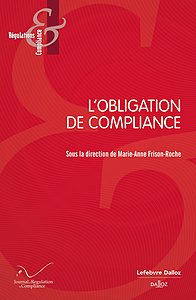
Couverture – L’Obligation de Compliance

Articles in a JoRC book

BARBIÈRI, Jean-Baptiste🕴️

📝Les juges du droit des entreprises en difficulté et les obligations de compliance (Judges of Insolvency Law and Compliance Obligations), in 🕴️M.-A. Frison-Roche (ed.), Collection Régulations & Compliance L’Obligation de Compliance

► Full Reference: , J.-B. Barbièri, “Les juges du droit des entreprises en difficulté et les obligations de compliance (Judges of Insolvency Law and Compliance Obligations), in M.-A. Frison-Roche (ed.), L’Obligation de Compliance, Journal of Regulation & Compliance (JoRC) and Éditions Lefebvre – Dalloz, coll. “Régulations & Compliance“, 2025, pp. 313-323. - read a general presentation of the book, L’Obligation de Compliance, in which this contribution is published - ► English summary of this contribution (done by the Journal of Regulation & Compliance – JoRC): Describing at first sight the intersection of Compliance and Insolvency procedures as the “marriage of the carp and the rabbit”, the Author shows that the logic is in many ways the same, particularly in terms of the role played by the Judge, since it is always a question of the State delegating Monumental Goals, with Insolvency procedures giving concrete expression to the desire to save a company, jobs, an industry, a region, etc., in what is always a “public interest”. In his/her office, the insolvency judge is confronted with compliance clauses, relating to commitments, or information, or organising monitoring. The author begins by examining the cases in which the insolvency judge is confronted with the principle of primacy of the insolvency proceedings over this compliance contractual organisation, either under current contracts, which may contain compliance obligations, in particular because audits and controls will have been strengthened or automatic termination will be provided for (which would then be deactivated?), or because the nullity of the suspect period comes into play, because the compliance clauses are often unbalanced. The second part examines the hypothesis that compliance techniques will support insolvency proceedings themselves and the purpose they serve. Indeed, because they are preventive in nature, contractual compliance mechanisms can also prevent failures, by means of audit and monitoring clauses and the introduction of reporting, if necessary under the supervision of the Judge, associated with conciliation mechanisms. What is more, they should be used to restructure companies in difficulty. The plan, which can be imposed on creditors, must open up the range of instruments, and could perhaps be articulated at this class of parties, which would only be made up of creditors benefiting from compliance clauses, if we consider that they constitute a “sufficient community of economic interest”. They could then also be delegated the task of monitoring the survival of the company, which is the main goal served by the plan. In the case of a disposal plan, an offer including compliance undertakings should not be favoured, since the law expressly states that the sole purpose of such a plan is to ensure the maintenance of activities and to clear the past. But time will tell whether the judge will go beyond this. - 🦉This article is available for people who follow the Professor Marie-Anne Frison-Roche teaching

Organisation of events

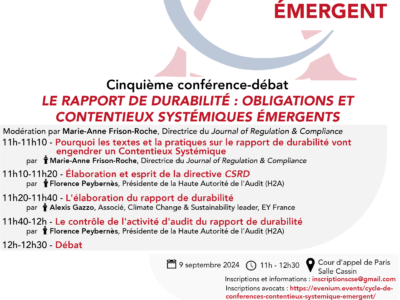
🧱⚙️scientific organisation and moderation of 🧮Le rapport de durabilité : obligation et Contentieux Systémiques Émergents (The Sustainability Report: Emerging Systemic Obligation and Litigation), in cycle of conference-debates “Contentieux Systémique Émergent” (“Emerging Systemic Litigation”)

► Full Reference: M.-A. Frison-Roche, Scientific direction of the conference Le rapport de durabilité : obligation et Contentieux Systémiques Émergents (The Sustainability Report: Emerging Systemic Obligations and Litigation), in cycle of conference-debates "Contentieux Systémique Émergent" ("Emerging Systemic Litigation"), organised on the initiative of the Cour d'appel de Paris (Paris Cour of Appeal), with the Cour de cassation (French Court of cassation), the Cour d'appel de Versailles (Versailles Court of Appeal), the École nationale de la magistrature – ENM (French National School for the Judiciary) and the École de formation des barreaux du ressort de la Cour d'appel de Paris – EFB (Paris Bar School) and MAFR, September 19, 2024, 11h-12h30, Cour d'appel de Paris, Cassin courtroom - ► Presentation of the conférence: Sustainability is a new legal concept, the lineaments of which can be found in certain sectors and branches of Law, and which today has both multiple resulting obligations and a definition that is sufficiently unified to allow it to be grasped through the technique and the requirement of the "Sustainability Report", which translates a requirement linked to the systems themselves. The dual materiality mechanism illustrates this. The Litigation that will ensue shall be imbued with this systemic dimension, since this report was required from this perspective, and the notion of Sustainability itself was conceived in the same way. What is commonly referred to as "ESG" reflects this perspective, which is both structural and long-term: Information is central here, since it is a Report, anchored in  the new conception of Corporate Law that is imbued with Governance, where internal and external stakeholders are present. The various Supervisors and Regulators, who go beyond supervising professionals to regulate activities, are also bound to have a role to play in this Emerging Systemic Litigation. In order to understand and anticipate this, this conference is built around an analysis of the construction of the Sustainability Report and an analysis of the role of the Regulatory and Supervisory Authority, the French Audit Authority, the Haute Autorité de l'Audit – H2A. These analyses are carried out with a view to the Systemic Litigation that will arise from these new requirements and practices, in correlation with Litigation linked to other fields of Systemic Litigation such as Vigilance field. - 🧮Programme of this event:  Fith conference-debate LE RAPPORT DE DURABILITÉ : OBLIGATIONS ET CONTENTIEUX SYSTÉMIQUES ÉMERGENTS (THE SUSTAINABILITY REPORT: EMERGING SYSTEMIC OBLIGATIONS AND LITIGATION) Paris Court of Appeal, Cassin courtroom 🕰️11am.-11.10am. 🎤Pourquoi les textes et la pratiques sur le rapport de durabilité vont engendrer un Contentieux Systémique (Why the texts and practices on sustainability reporting will give rise to Systemic Litigation), by 🕴️Marie-Anne Frison-Roche, Professor of Regulatory Law and Compliance Law, Director of the Journal of Regulation & Compliance (JoRC) ➡️read the presentation of this speech 🕰️11.10am.-11.20am. 🎤Élaboration et esprit de la directive CSRD (Elaboration and spirit of the CSRD), by 🕴️Florence Peybernès, President of the Haute Autorité de l'Audit – H2A (French High Audit Authority) 🕰️11.20am.-11.40am. 🎤Comment construire un rapport de durabilité ? (How to build a sustainability report?), by 🕴️Alexis Gazzo, Partner, Climate Change & Sustainability leader, EY France 🕰️11.40am.-12pm. 🎤Le contrôle de l'activité d'audit du rapport de durabilité (The control of the audit of the sustainability report), by 🕴️Florence Peybernès, President of the Haute Autorité de l'Audit – H2A (French High Audit Authority) 🕰️12pm.-12.30pm. Debate - 🔴Registrations and information requests can be sent to: inscriptionscse@gmail.com 🔴For the attorneys, registrations have to be sent to the following address: https://evenium.events/cycle-de-conferences-contentieux-systemique-emergent/  ⚠️The conference-debates are held in person only, in the Cour d’appel de Paris (Paris Court of Appeal). -

Conferences

📝L’enjeu de la confidentialité des avis juridiques internes au regard des « Buts Monumentaux » de la Compliance

► Full Reference: M.-A. Frison-Roche, "L’enjeu de la confidentialité des avis juridiques internes au regard des « Buts Monumentaux » de la Compliance" ("The issue of confidentiality of in-house legal opinions with regard to the "Monumental Goals" of Compliance"), in L’instauration d’un Legal Privilege à la française. Le temps de l’action au service de la souveraineté et de la compétitivité de nos entreprises, Association française des juristes d'entreprise (AFJE), Association nationale des juristes de banque (ANJB) et Cercle Montesquieu, March 7, 2024, Maison de la Chimie, 28 rue Saint Dominique Paris - 📝On the same topic, read the article of Marie-Anne Frison-Roche "La compliance, socle de la confidentialité nécessaire des avis juridiques élaborés en entreprise" ("Compliance, the cornerstone of the confidentiality required for in-house legal opinions") - follow Marie-Anne Frison-Roche on LinkedIn follow Marie-Anne Frison-Roche on Instagram subscribe to the Newsletter MAFR Regulation, Compliance, Law

Working papers

🚧Duty of Vigilance, Whistleblowing and International Competitiveness

► Full Reference: Frison-Roche, M.-A., Duty of Vigilance, Whistleblowing and International Competitiveness, Working Paper, September 2021. -   🎤 this Working Paper is the basis for a conference , in the colloquium Effectiveness of Compliance and International Competitiveness, co-organised  by the Journal of Regulation & Compliance (JoRC) and the Center for Law and Economics of the Panthéon-Assas University (Paris II),   November 4, 2021 - 📝this Working Paper is also the basis for an article. This article is to be published ⤵ in its French version in the book Les buts monumentaux de la Compliance, in the series 📚Régulations & Compliance  in its English version in the book Compliance Monumental Goals, in the series la collection 📚Compliance & Regulation - ► Working Paper Summary: The "Compliance Tools" are very diverse. If it has been chosen to study more particularly among these the obligation of vigilance and the whistleblower, these rather than others and to study them together, it is because they present in the perspective of the specific topic chosen, namely "international competitiveness", and for companies, and for economic zones considered, and for legal system inseparable from them, a uniqueness: these are mechanisms which release Information.  By order of the law, the company will not only stop ignoring what it covered with the handkerchief that Tartuffe held out to it or that a conception of Company Law legitimately allowed it to ignore. This article does not examine if this revolution made by Compliance Law expresses in the legal system is on the one hand legitimate and on the other hand effective: the article measures what is happening at the regard to "international competitiveness". Compliance Law is therefore be examined here through its instruments, and not in relation to its normativity. In fact, its instruments are intended to provide Information and to make this information available, in its presentation, in its intelligibility and in the hands of those who are able to use Information in perspective of the Compliance Monumental Goals, achieving them.  Regarding this central notion of Information, international competitiveness will be more particularly concerned because Compliance Law will oblige the company itself to seek out, then expose to everyone's eyes, in particular its competitors, its weaknesses, its projects, its alliances, its flaws. This does not pose a problem if its competitors themselves are often subject to this new branch of Law, which goes far beyond transparency, which is already a new mechanism because a company is not a transparent organization and Competition Law that governs ordinary businesses never required this. But if they are not subject to this incredibly special branch of Law that is Compliance Law, then there is a distortion of competitiveness by the very fact of the Law. It is possible to pretend that the markets like virtue, that they give it credit because they are themselves based on the idea of "promise", which is ultimately based on a moral concept, but this provision of Information to others, while others remain opaque, is a major problem of competitiveness, which the legal requirement of "loyal commercial practices" only very partially considers. Therefore, it is necessary to first examine what is the economic and financial power of the information captured by the company on itself thank to Compliance Law making available to all but firstly to the compagny itself through the whistblowing mechanism, organised by the laws, differently in the US and Europe (I). Compliance Law also obliges companies to be accountable not only for what they do but also for what others do for them. Through the obligation of Vigilance, objective Ex Ante obligation and duty, the company obtains a power of Information on others which could well resolve what is often presented as the dispute aporetic of the extraterritoriality of Compliance Law, thus making accountable companies hitherto protected by their "preserved" legal system and thereby affected by the effectiveness of Compliance Law (II). - read below the developments

I.1-35: A regulators perspective on the policies of Audit Regulation

ENGLISH The Financial Reporting Council is the UK’s independent regulator responsible for promoting high quality corporate governance and reporting to foster investment. We set audit standards, conduct audit inspections and run the disciplinary scheme for misconduct. We are responsible for the UK Corporate Governance and Stewardship Codes. ITALIAN Articolo: La prospettiva dei regolatori sulle politiche di regolazione dell’audit Il Financial Reporting Council è l’autorità di regolazione indipendente responsabile della promozione di un corretto governo d’impresa e dell’incoraggiamento degli investimenti nel Regno Unito. Stabiliamo gli standard dell’audit, svolgiamo tutte le operazioni di audit e applichiamo la procedura disciplinare in caso di infrazione. Siamo responsabili del governo d’impresa e dei codici di condotta. SPANISH Artículo: La perspectiva de reguladores en la política de auditas regulatorias.   El “Financial Reporting Council” (FRC – Consejo de Reportaje Financiero) es el regulador independiente británico responsable por asegurar una alta calidad de gobernanza y reportaje corporativo para promover la inversión. Promovemos estándares de auditoría, conducimos inspecciones de auditoría y manejamos el esquema disciplinario para la mala conducta. Somos los responsables para el UK Corporate Governance and Setwardship Codes (la gerencia corporativa británica y los códigos administrativos).     Other translations fortcoming.