Publications

Filtrer par type

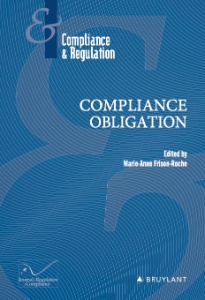
Couverture – Compliance Obligation

Articles dans un ouvrage du JoRC

article dans une publication juridique collective

📝Vigilance, the Cutting Edge and a Full Part of the Compliance Obligation, in 🕴️M.-A. Frison-Roche (dir.), 📘Compliance Obligation,,

► Référence complète : M.-A. Frison-Roche, « Vigilance Obligation, Spearheard and Total Share of the Compliance Obligation », in M.-A. Frison-Roche (dir.), Compliance Obligation, Journal of Regulation & Compliance (JoRC) et Bruylant, coll. « Compliance & Regulation », 2026, à paraître - 📝lire l'article (en anglais) - 📘consulter une présentation générale de l'ouvrage, Compliance Obligation, dans lequel cet article est publié 📚consulter la collection dans laquelle l'ouvrage s'insère :  "Compliance & Regulation"  - 🚧lire le document de travail bilingue sur la base duquel cet article a été élaboré, doté de développements supplémentaires, de références techniques et de liens hypertextes - ► Résumé de l'article: The « obligation of vigilance » unleashes all the more radical and passionate positions, sometimes among Law professors, because it has not been precisely defined. One word is used for another, either inadvertently or deliberately, deliberately if it can attract this or that element from one legal corpus and import it into another.  The very exercise of definition is therefore required in practice. There are specific obligations of vigilance that come under such and such a body of regulations and are imposed on such and such a category of operators to fulfill such and such a function. These are precise circles which are not confused and must not be confused. This is superimposed on what the French 2017 law so-called « Vigilance law », which is much more encompassing since it applies to all large companies in the operation of the value chains they have set up. The European 2024 directive is in the same way. But there is no general duty or obligation of Vigilance. Such a claim would be based on confusing or shifting each of these 3 levels, which must be avoided because no positive law does support this (I). If the duty of vigilance is attracting so much attention, whether or not the European CS3D is fully effective, it is because Vigilance is the « cutting edge » of Compliance Obligation (II). Vigilance requires companies, by consideration of their power and without reproaching them for it or demanding that it be reduced, to detect risks of damage to the environment and climate, but also to human rights, because they are in a position to do so in order to prevent them from turning into disasters. In this respect, the  Vigilance duty makes clearer the exact legal nature of the Compliance Obligation. Moreover, Vigilance appears as the Total Part of the Compliance Obligation (III). Indeed, although it is restricted to one area, the value chain, and to two types of risk, deterioration of the environment and deterioration of human rights, it expresses the totality of the Compliance Obligation by means of tools that the 2017 French « Vigilance law » had itself duplicated from the 2016 so-called « Sapin 2 law »: to preserve systems today, but above all tomorrow, in order they do not collapse (Negative Monumental Goals), or even consolidate them (Positive Monumental Goals), so that the human beings who are willingly or unwillingly involved in them are not crushed by them but benefit from them. This is why large companies are subject to the Obligation of Compliance and Vigilance, particularly in the humanist conception that Europe is developing. The result is a new type of Litigation, of a systemic nature, for which the Courts have spontaneously become specialised, and for which the procedures will have to be adapted and the office  of the Judge shall have to evolve.

Analyses

🧱En recherche, ce n’est pas la quantité qui compte : on le sait depuis toujours, mais l’usage de l’IA pousse à l’accumulation, juste l’accumulation

► Référence complète : M.-A. Frison-Roche, « En recherche, ce n’est pas la quantité qui compte : on le sait depuis toujours, mais l’usage de l’intelligence artificielle pousse à l’accumulation, juste l’accumulation », billet LinkedIn, 14 mai 2026. - lire la publication sur LinkedIn 📝 lire l’article de Sciences et Avenir qui en est le point de départ : « Retrait d’une étude phare sur les bienfaits de ChatGPT dans l’enseignement », 11 mai 2026 🧱 lire la version anglaise de cette publication
Couverture – Compliance Obligation

Articles dans un ouvrage du JoRC

article dans un ouvrage collectif juridique

📝Conceiving the Compliance Obligation: Using its Position to take part in achieving the Compliance Monumental Goals, in 🕴️M.-A. Frison-Roche (dir.), 📘Compliance Obligation

► Référence complète : M.-A. Frison-Roche, « Conceiving the Compliance Obligation: Using its Position to take part in achieving the Compliance Monumental Goals », in M.-A. Frison-Roche (dir.), Compliance Obligation, Journal of Regulation & Compliance (JoRC) et Bruylant, coll. « Compliance & Regulation », à paraître - 📝lire l'article (en anglais) - 🚧lire le document de travail bilingue sur la base duquel cet article a été élaboré, doté de développements supplémentaires, de références techniques et de liens hypertextes - 📘consulter une présentation générale de l'ouvrage, Compliance Obligation, dans lequel cet article est publié - ► Résumé de l'article: This article explains what companies' Compliance Obligation" is. Delving into the mass of compliance obligations, it uses the method of classification of those that are subject to an obligation of result and those that are subject to an obligation of means. It justifies the choice of this essential criterion, which changes the objects and the burden of proof of companies that are subject to an obligation of result when it comes to setting up « compliance structures » and are subject to an obligation of means when it comes to the effects produced by these compliance structures. Indeed, rather than getting bogged down in definitional disputes, given that Compliance Law is itself a nascent branch of Law, the idea of this contribution is to take as a starting point the different legal regimes of so many different compliance obligations to which laws and regulations subject large companies: sometimes they have to apply them to the letter and sometimes they are only sanctioned in the event of fault or negligence. This brings us back to the distinction between obligations of result and obligations of means. Although it would be risky to transpose the expression and regime of contractual obligations to legal obligations put by legislation, starting from this observation in the evidentiary system of compliance of a plurality of obligations of means and of result, depending on whether it is a question of this or that technical compliance obligation, we must first classify them. It would then appear that this plurality will not constitute a definitive obstacle to the constitution of a single definition of the Compliance Obligation. On the contrary, it makes it possible to clarify the situation, to trace the paths through what is so often described as a legal jumble, an unmanageable « mass of regulations ». Indeed, insofar as the company obliged under Compliance Law participates in the achievement of the Monumental Goals on which this is normatively based, a legal obligation which may be relayed by contract or even by Ethics, it can only be an obligation of means, by virtue of this very teleological nature and the scale of the goals targeted, for example the happy outcome of the climate crisis which is beginning or the desired effective equality between human beings. This established principle leaves room for the fact that the behaviour required is marked out by processes put in place by structured tools, most often legally described, for example the establishment of a vigilance plan or regularly organised training courses (effectiveness), are obligations of result, while the positive effects produced by this plan or these training courses (effaciety) are obligations of means. This is even more the case when the Goal is to transform the system as a whole, i.e. to ensure that the system is solidly based, that there is a culture of equality, and that everyone respects everyone else, all of which come under the heading of efficiency. The Compliance Obligation thus appears unified because, gradually, and whatever the various compliance obligations in question, their intensity or their sector, its structural process prerequisites are first and foremost structures to be established which the Law, through the Judge in particular, will require to be put in place but will not require anything more, whereas striving towards the achievement of the aforementioned Monumental Goals will be an obligation of means, which may seem lighter, but corresponds to an immeasurable ambition, commensurate with these Goals. In addition, because these structures (alert mechanisms, training, audits, contracts and clauses, etc.)  have real meaning if they are to produce effects and behaviours that lead to changes converging towards the Monumental Goals, it is the obligations of means that are most important and not the obligations of result. The judge must also take this into account. Finally, the Compliance Obligation, which therefore consists of this interweaving of multiple compliance obligations of result and means of using the entreprise's position, ultimately Goals at system efficiency, in Europe at system civilisation, for which companies must show not so much that they have followed the processes correctly (result) but that this has produced effects that converge with the Goals sought by the legislator (effects produced according to a credible trajectory). This is how a crucial company, responsible Ex Ante, should organise itself and behave.

Rapports

🧱⚙️Mission confiée par le garde des Sceaux, 🏛 Droit de la compliance, souveraineté juridique et attractivité économique

► Référence complète : M.-A. Frison-Roche, Mission confiée par le garde des Sceaux, Droit de la compliance souveraineté juridique et attractivité économique, 2025-2026. - 📜lire la lettre de mission du garde des Sceaux du 5 septembre 2025 saisissant Marie-Anne Frison-Roche - 📑Le rapport de la mission, Déployer le Droit de la Compliance pour renforcer la souveraineté et accroître l’attractivité de la France avec l’Europe, sera remis au garde des Sceaux dans une version française et dans une version anglaise. - ► Présentation méthodologique de la menée de cette mission : À