Articles dans une publication collective juridique

Articles dans une publication collective juridique

Programme de mise en conformité (Compliance)

Référence complète: Frison-Roche, M.-A., Programme de mise en conformité (Compliance), Dictionnaire de droit de la concurrence, Concurrences, Art. N° 12345, 2021 Lire la définition

Articles dans une publication collective juridique

SUDRES, Nelly

📝 Hydro-alcoholic gel, Covid-19 and Compliance: from inadequacies in the « conformity » approach to the emergence of islands of compliance, in Frison-Roche, M.-A. (dir.), « Compliance Monumental Goals »

► Référence complète : Sudres, N.,  Hydro-alcoholic gel, Covid-19 and Compliance: from inadequacies in the « conformity » approach to the emergence of islands of compliance, in Frison-Roche, M.-A. (dir.), Compliance Monumental Goals, Journal of Regulation & Compliance et Bruylant, à paraître.  - ► Résumé de l'article (fait par l'auteur) :  During the Covid-19 Crisis, managing the manufacture, prices, and availability of hydro-alcoholic gel, a key product in the fight against Covid-19 transmission, provides an issue to measure both the limits and resources of Compliance Law. While the Culture of « conformity » with the Antitrust Law was insufficient to counter the surge in the issue of the prices of   hydro-alcoholic gels and masks, implying the use of tools that seem the opposite of Compliance by State (such as price fixation and requisitioning), mechanisms inspired by them have been put in place to deal with other problems linked to the availability of Essential Goods in times of Health Crisis. It remains in question whether these mechanisms should inspire the conception of stable Compliance Standards in the future. - 📘 Voir la présentation de l'ouvrage dans lequel cet article s'insère.    -    
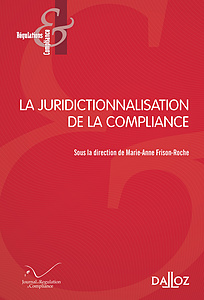
Couverture – La juridictionnalisation de la Compliance

Articles dans une publication collective juridique

SIPROUDHIS, Jean-Baptiste 👤

📝 Le transfert de responsabilité du régulateur et du juge vers l’entreprise : la démonstration par le système d’alerte , in Frison-Roche, M.-A. (dir.), « La juridictionnalisation de la Compliance »

► Référence complète : Siproudhis, J.-B.,, C.,  Le transfert de responsabilité du régulateur et du juge vers l’entreprise : la démonstration par le système d’alerte, in Frison-Roche, M.-A. (dir.), La juridictionnalisation de la Compliance, série "Régulations & Compliance", Journal of Regulation & Compliance (JoRC) et Dalloz, à paraître.  - ► Le résumé ci-dessous décrit un article qui fait suite à une intervention dans le colloque L'entreprise instituée Juge et Procureur d'elle-même par le Droit de la Compliance, coorganisé par le Journal of Regulation & Compliance (JoRC) et la Faculté de Droit Lyon 3. Ce colloque a été conçu par Marie-Anne Frison-Roche et Jean-Christophe Roda, codirecteurs scientifiques, et s'est déroulé à Lyon le 23 juin 2021. Dans l'ouvrage, l'article sera publié dans le Titre I, consacré à  L'entreprise instituée Juge et Procureur d'elle-même par le Droit de la Compliance. - ► Résumé de l'article (fait par l'auteur) : Vue de l’entreprise, l’évolution de la compliance conduit à un transfert progressif de responsabilités du régulateur, mais aussi du juge. Ceci est notamment illustré par le mécanisme de réception et de traitement des alertes internes imposé par les lois dite Sapin 2 et Devoir de vigilance. En pratique, en effet, si l'on prend l'exemple technique du lancement d'alerte, la gestion de ces alertes par les entreprises est séquencée comme une procédure judiciaire : analyse de la recevabilité, lancement d’investigations, décision de non-lieu ou de sanction. L’entreprise « instituée procureur et juge d’elle-même » devra respecter un cadre précis contribuant au respect élémentaire des règles d’un procès équitable, ce qui ne va pas sans soulever plusieurs questions juridiques et sociologiques auquel l’auteur consacre ses développements.   -   📝 Consulter une présentation générale du volume dans lequel l'article est publié. -
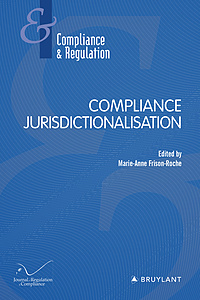
Couverture – Compliance Jurisdictionalisation

Articles dans une publication collective juridique

👤 SIPROUDHIS, Jean-Baptiste

📝 The transfer of responsibility from the regulator and the judge to the company: demonstration by the whistleblowing mechanism, in Frison-Roche, M.-A. (ed.), « Compliance Jurisdictionalisation »

► Référence complète: Siproudhis, J.-B.,, C., The transfer of responsibility from the regulator and the judge to the company: demonstration by the whistleblowing mechanism, in Frison-Roche, M.-A. (ed.), Compliance Jurisdictionalisation, series "Compliance & Regulation", Journal of Regulation & Compliance (JoRC) et Bruylant, à paraître.  -   ► Résumé de l'article (fait par l'auteur) : From the practitioner perspective, compliance is geared towards a gradual transfer of responsibilities from both regulators and judges.   In France, the whistleblowing mechanism imposed by the so-called « Sapin 2 » and « Duty of Vigilance » laws illustrates this evolution. Indeed,  internal alerts management follows key judiciary process milestones : admissibility, investigations, dismissal or sanction. This turns corporations duties into prosecutors or judges’, provided that they respect a specific framework contributing to respect the rules of a fair trial. This requirement raises several legal and sociological challenges to which the author devotes his developments. -   📝 consulter la présentation générale de l'ouvrage dans lequel cet article.  

Articles dans une publication collective juridique

DOUVILLE, Thibault

📝Quel droit pour les plateformes ? in Delpech, X. (dir.), « L’émergence d’un droit des plateformes »

► Référence complète : Douville, T., Quel droit pour les plateformes ?, in Delpech, X. (dir.), L'émergence d'un droit des plateformes, coll. « Thèmes et commentaires », Dalloz, 2021, pp. 217-239. -   ► Lire la présentation générale de l'ouvrage dans lequel est publié cet article. 
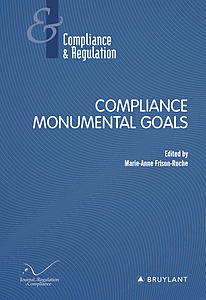
Couverture – Compliance Monumental Goals

Articles dans une publication collective juridique

OUMEDJKANE, A., TEHRANI, A., IDOUX, P..

📝 Public Norms and Compliance in times of Crisis: Monumental Goals tested: Elements for a Problematic, in Frison-Roche, M.-A. (ed.), « Compliance Monumental Goals »

► Référence complète :  Oumedjkane,  A., Tehrani, A. & Idoux, P.,  Public Norms and Compliance in times of Crisis: Monumental Goals tested: Elements for a Problematic,  in Frison-Roche, M.-A. (ed.),  Compliance Monumental Goals, series « Compliance & Regulation », Journal of Regulation & Compliance (JoRC) et Bruylant. -   ► Résumé de l'article (fait par les auteurs): In this paper, compliance refers to the fact that large private firms, through internal procedures designed to abide by public norms, participate in achieving the goals set out by public authorities, as the latter cannot reach those goals without help (proper functioning of financial markets, environment protection, fight against the corruption…). While in times outside a crisis period, the need to maintain a close link between public norms and compliance to achieve those “monumental goals” has been established, the validity of this analysis must be assessed during crisis periods. Indeed, to put an end to the turmoil as soon as possible, it is tempting to rely primarily on public authorities.  Should then be studied, in the light of the health crisis, the possibility that the link between public norms and compliance be altered in times of crisis. Not only is the normative reaction of public authorities very intense during the period, but some features of the compliance could lead one to think that compliance is in no way useful in a context of emergency and instability. This paper nevertheless suggests that to achieve monumental goals, it is necessary to maintain a close link between public norms and compliance. Such a link was maintained indeed, even at the height of the health crisis, and this should probably also be the case beyond this period, as breaking the link involves some risks which are not specific to the current health crisis. In other words, despite its shortcomings, compliance may not lose all its assets in times of crisis. -     📕 lire la présentation générale de l'ouvrage dans lequel l'article est publié

Articles dans une publication collective juridique

Etats-Unis : les lois d’un empire sans frontières

Référence complète : Valluis, B., Etats-Unis : les lois d'un empire sans frontières, in Abis, S., Le Déméter 2021, 2021, pp. 265-280. -   Valluis, Bernard. « États-Unis : les lois d’un empire sans frontières », Sébastien Abis éd., Le Déméter 2021. IRIS éditions, 2021, pp. 265-280.
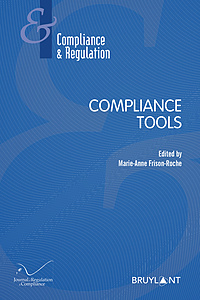
Couverture – Compliance Tools

Articles dans une publication collective juridique

RACINE, Jean-Baptiste

📝 Geographical dominance in the choice and the use of compliance tools Introductory remarks, in Frison-Roche, M.-A. (ed.), 📘Compliance Tools

Référence générale : Geographical dominance in the choice and the use of compliance tools. Introductory remarks, in M.-A. (dir.), Compliance Tools, série "Régulations & Compliance", Journal of Regulation & Compliance et Bruylant, 2021. -   📘Consulter une présentation générale du volume dans lequel l'article a été publié.    - Résumé de l'article (fait par Marie-Anne Frison-Roche) L   📘Consulter les résumés des autres articles composant l'ouvrage.     -      
Couverture – Compliance Tools

Articles dans une publication collective juridique

AMICO, Thomas

Compliance or the passage from ex post to ex ante: A Copernican revolution for the criminal lawyer?, In Frison-Roche, M.A. (ed.), « Compliance Tools »

Référence générale : Amico, Th., Compliance or the passage from ex post to ex ante: a Compernican revolution for the criminal lawyer?, in M.-A. (dir.), Compliance Tools, série "Regulation & Compliance", Journal of Regulation & Compliance et Bruylant, 2021, pp. 165-172   Consulter une présentation générale du volume dans lequel l'article a été publié.    - Résumé en français de l'article publié en anglais (résumé fait par Marie-Anne Frison-Roche) Après s'être référé à diverses définitions du Droit de la Compliance, l'auteur insiste sur l'utilité de l'avocat pénaliste en ce que celui-ci, connaisseur de l'Ex Post que constitue la sanction, peut être de bon conseil dans l'Ex Ante dans lequel se développent de nouveaux mécanismes de compliance, comme la cartographie des risques ou l'évaluation des tiers.  Abordant la dimension punitive du Droit de la Compliance, l'auteur montre que l'avocat pénaliste y a donc naturellement sa place, qu'il s'agisse des pouvoirs exercés par une Autorité administrative ou du Droit pénal proprement dit. En ce qu'il peut « anticiper les procédures pénales », l'avocat pénaliste est donc le mieux à même de faire en sorte que l'entreprise ne s'y expose pas, notamment dans une bonne maîtrise des enquêtes internes, écartant ainsi d'elle le risque pénal.    Consulter les résumés des autres articles composant l'ouvrage.     -      
Couverture – Compliance Tools

Articles dans une publication collective juridique

CALANDRI, Laurence

Incentive(s) and Sefl-Regulation(s): what place for Compliance Law in the Audiovisual Sector?, in Frison-Roche, M.-A., « Compliance Tools »

Full Reference : Calandri, L, Incentive(s) and Self-Regulation(s): what place for Compliance Law in the Audiovisual Sector?, in M.-A. (ed.), Compliance Tools, série "Régulations & Compliance", Journal of Regulation & Compliance et Bruylant, 2021, pp. 131-140.   See the General Presentation of the book   - Article Summary (done by Marie-Anne Frison-Roche) The author has taken the audiovisual sector, « pilot » in the matter, to measure very precisely the way in which in France the jurisprudence of the Conseil d'État (French Council of State) has introduced a logic of Compliance by leaving the operators free to organize themselves, while supervising them. After allowing, by the 2016 decisions Fairvest and Société Numéricable, the judicial control of acts of Soft Law, in particular those issued by the French Audiovisual Regulator, the Conseil d'État has organized a more flexible relation between Sector and Regulator, the author referring the Regulator's declaration that he is not the « gendarme » of this sector. The French Council of State isolates among its acts those which are only incentive and escape the control by the judge, in the same way as acts of soft law adopted by the companies of the sector, expression of a self-regulation, They also escape litigation and are therefore also « unjustifiable ». The author concludes that this completely renovates the governance of the sector, the Regulator by becoming more the arbiter and the supervisor of this new soft law.   Read the other articles summaries.     -    
Couverture – Compliance Tools

Articles dans une publication collective juridique

SALAH, Mahmoud Mohammed

Conception and Application of Compliance in Africa

Full reference : Salah, M. M., Conception and Application of Compliance in Africa , in Frison-Roche, M.-A. (ed.), Compliance Tools, série "Régulations & Compliance", Journal of Regulation & Compliance (JoRC) / Bruylant, 2021, pp. 183-198. Consult an overview of the volume in which the article was published.   - Summary of the article (summary done by Marie-Anne Frison-Roche) The author presents the way in which Compliance, which may seem « insurmountable » in Africa in particular with regard to corruption, even terrorism, a gravity offset by the prevalence of the group's solidarity on the Weberian conception of Law, nevertheless aims to to « deploy » in Africa. It describes the way in which in certain African countries the Compliance mechanisms have been established, under the influence of international institutions requiring first of all the autonomy of economic structures vis-à-vis social structures and then relaxing them so that they are more « human » and therefore more « sustainable ». Under the aegis of the United Nations, anti-corruption programs have been particularly deployed. But the African Union and sub-regional organizations have also helped design and implement anti-corruption programs, for example through the adoption of uniform laws. In addition, the extraterritorial effect of foreign laws, in particular the FCPA, Bribery Act and Sapin2, increases this anchoring of Compliance. The article shows that this anchoring translates legally into a transformation of materials. In the first place, banking and financial law welcomes it more readily, since it tends to be globally standardized, African rights participating in this globalization, and imposes on financial institutions and beyond a general obligation of vigilance, in particular as regards the risk of money laundering and terrorist financing, an obligation to alert and specific criminal liability of legal persons. Secondly, all African legislation is aimed at combating corruption through Compliance, which mainly aims at prevention. But the author measures their effectiveness (« that is to say their ability to produce the desired results » which is often still limited. This is mainly due to the conjunction between the size of the informal sector, notably hampering 'identification of the actors, and the weakness of state structures which, allied to the low level of banking services and the still weak culture of writing and recording, leaves the system without crucial operators who can be entrusted with the realization of Compliance Law. The author concludes that it is not the risk of national sanction that leads operators to respect the Compliance rules but the fear of losing markets by the external threat of international actors and the damage to their local reputation and to abroad. The weakness of state structures affecting the effectiveness of Compliance as it affects everything else, he underlines that they must be strengthened for this to be reinforced for the rest, in particular concerning the effectiveness of judicial control. More specifically, Compliance should be less expensive because African States often cannot bear the cost, only the subsidiaries of large foreign private groups can do so, which leads to abandoning Compliance at the will of the private sector, a phenomenon regrettable, whereas public supervisors do not have the means to exercise their control function. -   Consult the summaries of the other articles composing the book.
Couverture – Compliance Tools

Articles dans une publication collective juridique

GUILLAUME, Nicolas

Risk mapping: first insights of challenges, limits and good practices, in Frison-Roche, M.-A. (ed.), « Compliance Tools »

Full reference : Guillaume, N., Risk mapping: first insights of challenges, limits and good practices, in Frison-Roche, M.-A. (ed.), Compliance Tools, série "Régulations & Compliance", Journal of Regulation & Compliance and Bruylant, 2021, pp. 73-80.   Read a general presentation of the book in which this article was published -   Summary of the article (by Marie-Anne Frison-Roche) The author gives an overview of what is risk mapping for a company, not only an obligation in certain cases, such as corruption, but also and beyond an excellent tool to design and control its strategy. He shows that this is due to the fact that legislation now incorporates the risk-based approach, companies having to use these maps, sometimes demanding to put them at the service of an overall strategy, even if their handling may lead to initiating responsibility of the company and its managers. The author emphasizes that the maps are very diverse because their objectives are themselves different, their users also being different (which implies different insights into the same risks). The author therefore identifies principles common to all maps, which always assess risks according to their probability of occurrence and the severity of their consequences if they materialize. It is also necessary to apprehend the « gross risk », seized in the absolute, and the « net risk » which integrates the company itself in this apprehension of the probability and the gravity, then release an acceptable level of risks for the company. On these common principles are superimposed specificities relating to the various risks, the author taking more particularly the risk of corruption, since Compliance Law gives it a great place. The mapping that is specific to the specific risk then becomes finer to be relevant, while the criteria used here will be abandoned in another mapping. The way of proceeding becomes common again, involving the commitment of the company's management bodies, internal surveys and interviews, benchmarks. If the company thus deploys the art of risk mapping, then they cease to be only a requirement of Law to which the company must comply in order to be a central tool in the overall risk prevention system and strategy design, feeding codes of conduct, design of training and supervision, to finally deploy in the company a « risk culture », which is essential.   -
Couverture – Compliance Tools

Articles dans une publication collective juridique

Drawing up Risk Maps as an Obligation and the paradoxe of the « Compliance Risks », in Frison-Roche, M.-A. (ed.), « Compliance Tools »

Référence générale : Frison-Roche, M.-A., Drawing up Risk Maps as an Obligation and the paradoxe of the « Compliance Risks », in Frison-Roche, M.-A. (dir.), Compliance Tools, série "Régulations & Compliance", Journal of Regulation & Compliance (JoRC) et Bruylant, 2021, pp. 61-72   - Résumé de l'article : There are few synthetic or theoretical studies on Risk Mapping even though it is in fact the Compliance central tool, perhaps because it is more a management tool than a legal one. Risk Mapping is often described but does not receive any other legal qualifications than being a « modality », suffering in this respect from an evil which affects the whole of Compliance, still little understood by Law, attention often so focused on the Ex Post (sanctions) while Compliance is by nature in the Ex Ante. Going from disarray to incomprehension, everyone can note the existence of « compliance risks » among the mapped risks, because if as so many affirm that it would be necessary to speak only of simple conformity as obedience, demonstrated in Ex Ante, to Law, how a sub-set of a tool would therefore have the same object as the set of Law that this tool serves … This aporia can only be resolved if Compliance Law is defined substantially by its « monumental goals » which exceed obedience to regulations. Consequently, Law taking up Risk Mapping, this mechanism may first appear as an ancillary obligation to the main obligation consisting in achieving « monumental goals ». The ancillary obligation to draw up the maps is an obligation of result, while the main obligation to achieve the monumental goals is an obligation of means. These cartographies being very diverse and being only occasionally targeted by specific laws, it can also constitute only a legal fact or, through the play of various charters, a unilateral legal commitment. But it isnbecoming the basis of an autonomous legal obligation incumbent on enterprises in position to know certain risks, obligation referring to the existence of a subjective right tof knowing and measuring them (« right to be worried ») which the third parties who are going to run them would hold, thus allowing them to choose to run them, or not. -   Lire le document de travail bilingue, doté de développements supplémentaires, de références techniques et de liens hypertextes, sur lequel cet article est basé   Consulter une présentation générale du volume dans lequel l'article a été publié.   -
Couverture – Compliance Tools

Articles dans une publication collective juridique

Building by Law the Unicity of Compliance Tools from the Definition of Compliance Law by its « Monumental Goals » in Frison-Roche, M.-A., (ed.) « Compliance Tools »

► Référence complète : Frison-Roche, M.-A., Building by Law the Unicity of Compliance Tools from the Definition of Compliance Law by its « Monumental Goals », in Frison-Roche, M.-A. (ed.), Compliance Tools, series "Compliance & Regulation ", Journal of Regulation & Compliance (JoRC) and Bruylant, 2021, pp. 35-46._   Summary of the article : The « tools of Compliance » do not stack on top of each other. They form a system, thanks to a unity drawn from the goals that all these multiple and different tools serve: the « Monumental Goals » by which Compliance Law is defined. All these tools are configured by these goals and for mastering all these techniques, it is essential to put them all in perspective of what Compliance Law is, which is designed teleologically with regard to its goals. Extension of Regulatory Law and like it, Compliance Law is built on a balance between the principle of competition and other concerns that public authorities claim to take care of. Compliance Law has moreover more « pretensions » in this respect, for example in environmental matters. All the means are then good, the violence of the tools marrying without difficulty with the voluntary commitments since it is the goals which govern this branch of Law. As legal solutions adopted show, a common method of interpretation and common levels of constraint for all Compliance Tools result from this definition. Starting from the goals (in which legal normativity is housed), the interpretation of the different tools is thus unified. Moreover, the different degrees of constraint do not operate according to the consideration of sources (traditional legal criterion) but by the goals, according to the legal distinction between obligations of means and obligations of results which result from the articulation between tools, of which the establishment is an obligation of result, and the goal, of which the achievement is only an obligation of means. -   📝 Read the bilingual working paper on which rely this article.   📝 Read a general presentation of the book in which this article has been published.   -
Couverture – Compliance Tools

Articles dans une publication collective juridique

Rights, primary and natural Compliance Tools, in Frison-Roche, M.-A. (ed.), « Compliance Tools »

Référence générale : Frison-Roche, M.-A.., Rights, primary and natural Compliance Tools, in Frison-Roche, M.-A. (dir.), Compliance Tools, série "Regulation & Compliance", Journal of Regulation & Compliance (JoRC) et Bruylant, 2021, pp. 319-342   - Résumé en français de l'article (publié en anglais) Dans la conception traditionnelle de l'architecture des secteurs régulés par le Droit et dans le Droit de la Compliance qui prolonge les techniques étatiques de Régulation, les droits subjectifs ont peu de place. Mais cette configuration n'a plus lieu, au contraire les droits subjectifs sont aujourd'hui au cœur, et le seront de plus en plus. Ils sont et seront les outils premiers du Droit de la Compliance parce qu'ils constituent un « outil » d'une grande efficacité pour assurer le fonctionnement entier d'un système dont les buts sont si difficiles à atteindre. Parce qu'il faut faire feu de tout bois pour concrétiser ces buts, les Autorités publiques non seulement s'appuient sur la puissance des opérateurs cruciaux, mais encore distribuent des prérogatives aux personnes qui, ainsi incitées, activent le système de Compliance et participent à la réalisation du « but monumental ». Les droits subjectifs peuvent s'avérer les outils les plus efficaces pour atteindre effectivement les buts fixés, à tel point qu'on peut les considérer comme des « outils premiers ». Mais il convient d'avoir plus de prétention et de concevoir les droits subjectifs comme les outils les plus « naturels » du droit de la Compliance. En effet parce que tous les Buts Monumentaux par lesquels le Droit de la Compliance se définit peuvent se ramener à la protection des personnes, c'est-à-dire à l'effectivité de leurs prérogatives, par un effet de miroir entre les droits subjectifs donnés comme moyens par le Droit aux personnes et les droits subjectifs qui constituent le but même de tout le Droit de la Compliance, notamment la protection de tous les êtres humains, même s'ils sont en situation de grande faiblesse, les droits subjectifs devenant un « outil naturel » du Droit de la Compliance. Nous ne sommes qu'à l'orée de leur déploiement et c'est sans doute sur eux que pourra se réguler l'espace digital dans lequel désormais nous vivons, afin que nous n'y soyons pas étouffés et qu'il constitue pour les personnes un espace civilisé.  -   Lire le document de travail bilingue, doté de développements supplémentaires, de références techniques et de liens hypertextes, sur lequel cet article est basé.   Consulter une présentation générale du volume dans lequel l'article a été publié.     -  
Couverture – Compliance Tools

Articles dans une publication collective juridique

Incentives and Compliance, a promising couple to increase the Compliance Law utility, in Frison-Roche, M.-A. (ed.), « Compliance Tools »

Full reference : Frison-Roche, M.-A., Incentives and Compliance, a promising couple to increase the Compliance Law utility, , in Frison-Roche, M.-A. (ed.), Compliance Tools, series "Régulations & Compliance", Journal of Regulation & Compliance and Bruylant, 2021, pp. 141-148   - Summary of the article: The theory of incentives targets the mechanisms which do not use directly constraint (except to present sanctions themselves as incentives) but which leads nevertheless to expected behaviors. To appreciate the links which must or must not be done between incentives and Compliance, we should proceed in two times.  First, the association appears natural between incentive mechanisms and « Compliance Law » since the later is defined in a dynamic way. Indeed, if it is defined placing its legal normativity in its « monumental goals », as the end of corruption, the detection of money laundering in order to underlying criminality disappears, or as the effective protection of environment or the concrete care of human beings, then what matters is not the means in themselves but the effective tension towards these « monumental goals ». In this perspective, what was related to public policies led by States, because they are definitively not able to do it, the charge is internalized in the firms which are able to tend towards this goals: « crucial operators » because they have the geographical, technological, informational and financial means.  In this perspective, the internalization of public willingness provoking a split with the concept of State linked to a territory which deprives Politics of its constraint power, incentive mechanisms appear as the most efficient mean to reach these monumental goals. They appear as this « natural » mean both negatively and positively defined. Negatively in which they do not need in Ex Ante institutional localizable sources and sanction power in Ex Post: it is enough to substitute the interest to obligation. Positively, incentives relay through operators' strategies what was the so critical and joked form of public action: the « plan ». The duration is thus injected thanks to Compliance mechanisms, as we can see it through the development of it in the care for environment (« plan climat ») or through the educational mechanism, which could be conceived only in duration.   However, the opposition seems radical between Compliance Law and Incentives. And this because of three convictions often developed and that we have to overcome. First, the idea that in a general way, there would be a Law only if there is a mechanism of immediate constraint which is associated to the norm. As long as the incentive is not based on obligation, then it will be nothing… Secondly, and as if that were a kind of consolation …, Compliance would not be really Law either … We so often say that it is only about a methodology, a range of processes without sense, procedures to follow without trying to understand, process that algorithms integrate in a mechanic without end and without sense or that on the contrary, Compliance would be full of sense by Ethics and Morality, which are far from Law. While incentives talk to the human spirit which calculate, Compliance would be so a process through which machines will be connected to other machines, so an extra soul, where calculation has no place… Thirdly, solutions would be to be find in Competition Law because it can do without States, submit them and approach what is a-sectorial, especially finance and digital, the world being financialized and digitalized. The violence of Competition Law which comes in Ex Ante thanks to « Compliance sanctions » applying for example to essential infrastructures Law, by continuing to deny the salience of the duration and taking care of the « market power » would be also not compatible with a marriage with incentive mechanisms which rely on duration and power of those to which it is applied, converging towards goals, which are set by what Competition Law ignores: the project. This project which pretends to build the future is the one of politics and of companies, which use their deployed power in time to concretize it. It is without any doubt there that the future of Europe is.  To overcome this triple difficulty, it is thus necessary, in a second time, to modify our conception of Law, especially thanks to Compliance Law, in which this new branch is autonomous from Competition Law, and even sometimes opposed to it, in order to the insertion of incentive mechanisms permit to unknown or against Competition Law organizations to reach « monumental goals » which are imperative to take into consideration. For example, the taking into consideration of climate challenges or the building of a sovereign identity of the data. This is expressly set by European Commission which supervises such initiatives, supervision being what is articulated with Compliance, in a couple that go beyond Regulation, and replaces in Ex Ante Competition Law, salient branch for Ex Post. All the texts which are in the process of expressing it are based on this reformed couple: Compliance and Incentive. This couple supposes that we recognize as such the existence of companies as project carriers, project which is the creation of marketed wealth circulating on a market, which could be an industrial project specific to a geographical zone both economical and political. Regulation is deployed to go away from the notion of sector and to transform itself in supervision of crucial firms in the correspondance between the project and the action, what refers to the notion of « plan ». In this, banking supervision is just the advanced bastion of all thematic, energetic, climatic and health plans, or more broadly industrial and technological that could by incentive be implemented, this conception of Compliance permitting to build zones which are not reduced to immediate market exchange. The incentive corresponds to the fact that Compliance Law relies on the power of the firm to reach its own political goals, for example fighting against disinformation in the digital space or obtaining a healthy environnement. This supposes that Compliance stops to be only conceived as a model of rules effectivity, for example of Competition Law, to be recognized as a substantial branch of Law. A branch which expresses political goals. A branch which is anchored in crucial firms whose it recognizes the autonomy with regards to markets. This makes it possible, in particular through the coupling with incentive mechanisms leading to long-term collaborative operations supervised by public authorities, not to be governed by simple Competition Law, inapt to bring projects to fruition. -   Read the bilingual work paper, with additional developments, technical references and hyperlinks on which this article is based   Read a general presentation of the book in which the article has been published.   -