The recent news

Nov. 6, 2025
Conferences

🌐Subscribe to the Newsletter MAFR Regulation, Compliance, Law
🌐Subscribe to the video newsletter MAFR Overhang
🌐Subscribe to the Newsletter MaFR Law & Art
____
► Full reference : M.-A. Frison-Roche, "Concevoir une Raison d'être et l'explicitre (Conceiving a Raison d'être and explaining it)", speech at the round table discussion "Dire sa Raison d'être (Expressing your Raison d'être)", National Conference of the Géomètres Expert (French Chartered Surveyors), 6 November 2025, Paris.
____
► Presentation of the Round Table : This round table opens two days of work bringing together all the leaders, members of the Council of the Order of Chartered Surveyors and Regional Councils of Chartered Surveyors, in the presence of the relevant Ministry, in specific sessions during which the two Raison d'être that have been developed over several years of work and adopted, the Raison d'être of the profession and the Raison d'être of the Order, are presented.
🪑🪑🪑Other participants in the round table discussion, moderated by Hervé Grélard, General Deputy of the French Order of Chartered Surveyors:
🕴🏻Thomas Bonnel, chartered surveyor
🕴🏻Luc Lanoy, chartered surveyor,
🕴🏻Séverine Vernet, Chairwoman of the French Order of Chartered Surveyors
____
► Summary of my presentation : Firstly, I spoke to remind everyone what a "raison d'être" is, in itself, and why it is particularly important when the entity that embodies it also constitutes a "profession", the raison d'être expressing this hybrid nature that is destined to endure in today's societies. It moves those who uphold the raison d'être – the professional, the profession, the umbrella organisation that is the Order – from the past to the future. To effectively carry this raison d'être, its bearer cannot remain isolated. Unlike the agent who operates in a market and whose strategy is solitary dynamism against others, the bearer of the raison d'être must find allies who share similar or compatible ideas and develop points of contact to carry out a collective project (the "Monumental Goals"). This is why it is just as important to communicate, explain and share the raison d'être with the outside world.
Secondly, as the discussion surrounding the statement of purpose of the French Order of Surveyors and the profession progressed, I was led to point out that the raison d'être is not, or not only, ethical in nature, but also legal in nature, constituting at the very least a legal fact that can become enforceable against those who recognise themselves in it and claim it. This kind of reward, which is the "ex ante responsibility" expressed by the raison d'être and relayed by Compliance Law, anchored in its monumental goals of sustainability and responsibility, justifies that the profession that embraces its raison d'être is not simply an efficient profession in a supply and demand market, but establishes the Order as a regulator. This places both in the long term.
________
⛏️Further reading on the subject: (with English Summaries)
🕴🏻M.-A. Frison-Roche, 💬"Géomètres-experts : une profession qui assume concrètement sa responsabilité territoriale", 2025
🕴🏻M.-A. Frison-Roche, 📝A quoi engagent les engagements, 2025
🕴🏻M.-A. Frison-Roche et 🕴🏻S. Vernet, 📝La profession investit le Droit de la compliance et détermine sa Raison d'être, 2023
🕴🏻M.-A. Frison-Roche, 📧Quels sont les points de contact entre la Raison d'être des entreprises et le Droit de la Compliance ?, 2022
________

Oct. 30, 2025
Publications
►Full Reference: M.A. Frison-Roche, "Droit de la compliance et Contentieux systémique" (Compliance Law and Systemic Litigation), in Chroniques Droit de la Compliance (Compliance Law Chronicles), Recueil Dalloz, 6 November 2025
____
____
►read the English presentation of the previous chronicles:
- "Compliance and conformity: Distinguish them in order to articulate them", 2024
- "Regulations, Compliance, Contracts, and Judges: places and alliances", 2023
- "Contract of compliance, stipulations fo compliance", 2022
- "The Adventure of the Compliance", 2020
- "Compliance and Legal Personality", 2019
- "TLegal Theory of Risk Mapping", 2019
►read the English presentation of the whole chroniques
____
►English summary of this article: Legal systems have changed, and Compliance Law, in its uniqueness, reflects this change and plays a powerful role in it. Through new sets of compliance rules, particularly at European level, in areas such as data protection (GDPR), anti-money laundering (AMLA), climate balance protection (CS3D) and banking and financial system sustainability (Banking Union), techniques (always the same) have been developed and imposed on large companies, which must implement them: alerts, mapping, assessment, sanctions, etc. These new regulatory frameworks only make sense in relation to their ‘Monumental Goals’: to detect systemic risks Ex Ante and prevent crises so that the systems in question do not collapse, but ‘sustain". All the legal instruments in the corpus are normatively rooted in these Monumental Goals, which are the core that unifies Compliance Law (I).
Judges are the guardians (II) of this new and highly ambiguous normative framework, which relies on the practical ability of companies to do just that. They ensure that the technical provisions are applied teleologically in each of these compliance blocks, and that the regulatory frameworks are mutually supportive, for it is always the same systemic goal that all compliance regulations serve: to ensure that systems (banking, financial, climate, digital, energy, etc.) do not collapse, that they are sustainable, and that present and future human beings are not crushed by them but, on the contrary, benefit from them. This unity is still little perceived, as regulations pulverize this profound unity of compliance law in the myriad of changing provisions. Entrusting the "regulatory mass" to algorithms increases this pulverization, making the whole increasingly incomprehensible and therefore impossible to handle. Acknowledging the judge's rightful place, i.e. at the heart of the matter, will enable us to master this new branch of law. But it's not the judge's job alone to restore clarity to a whole covered in the dust of his own technicality.
The systemic object of Compliance Law is transferred to Litigation. Indeed, the Litigation that emerges from the new Compliance Law is also fundamentally new, by transitivity. Indeed, the aim of Compliance Law is to make systems sustainable (or sustainable, or resilient, the vocabulary varies). The result is litigation which is itself "systemic litigation" (III), most often initiated by an organization against a systemic operator. The place and role of each are transformed (IV).
________

Updated: Oct. 26, 2025 (Initial publication: Sept. 4, 2024)
Publications

🌐Follow Marie-Anne Frison-Roche on LinkedIn
🌐Subscribe to the Newsletter MAFR Regulation, Compliance, Law
🌐Subscribe to the video newsletter MAFR Overhang
🌐Subscribe to the Newsletter MaFR Law & Art
____
 ► Full reference : M.-A. Frison-Roche, The invention of the 'right to a child'. The consequences of contractual practice as a source of filiation, working document, Sept. 2024 - Oct. 2025.
____
🎤This working document forms the basis of a presentation entitled, "Le "droit à l'enfant" est-il concevable, pourquoi et avec quelles conséquences" (Is the 'right to a child' conceivable, why and with what consequences", in Les nouvelles filiations. Diifférentes perspectives (New parentage. Different perspectives." held at the Paris Court of Appeal on 12 September 2024.
____
📝Revised, this working document forms the basis of the article published in the dossier "Les nouvelles filiations. Regards croisés" (New parentage. Different perspectives), Act. jur. Dalloz Droit de la famille (in French).
____
► Summary of this working document : Every legal system is built on concepts that form its pillars. Filiation is one such concept. A cas-law solution, presented as pragmatic and casuistic, can overturn this concept. Whether one agrees with it or not, it must first be acknowledged and assessed. Through a series of rulings on surrogacy, notably a ruling by its First Civil Chamber granting exequatur to a judgment recognising the filiation established by surrogacy between a child and persons with no biological link to the child and without recourse to adoption, the French Cour de Cassation has introduced the possibility of creating parentage by contract. This not only changes the concept of filiation but also changes the very structure of the French legal system, which is based on the distinction between persons and things. One may agree or disagree with this, but it must be said. Since the judge gives force to such a contract establishing filiation, with the foreign judge simply recognising it and the French judge ensuring only that the contract is balanced, the prospect opens up of a society in which individuals will be able to contractually create institutions at their disposal, within the private normative space of the contract, with the State's only function being to give effect to their right to legal recognition of their unique "project". Parentage is only a first example. Thus constructed on what was "inconceivable", i.e. a "right to a child", thanks to the contractual power to which the State should lend its force a posteriori, the judge makes parentage resulting from a contract technically "admissible" and opens up a contractually governed society.
_____
🔓read the working document below⤵️

Oct. 23, 2025
Publications
🌐follow Marie-Anne Frison-Roche on LinkedIn
🌐subscribe to the Newsletter MAFR Regulation, Compliance, Law
🌐subscribe to the VideoNews MAFR Surplomb
🌐subscribe to the Newsletter MaFR Law & Art
____
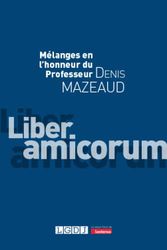
► Full Reference: M.-A. Frison-Roche, "Trio", in Mélanges en l'honneur au Professeur Denis Mazeaud, LGDJ-Lextenso, 2025.
____
📝read the article (in French)
____
Since then, due to editorial deadlines, this text has been modified, since this article deals with the so specific French Concours d'Agrégation de Droit, and François Terré, who prepared me for it, joined Pierre Catala before the overall typescript became final.
At Pierre Catala's funeral, where Rémy recounted their last meeting, I was seated at the back next to Yves Lequette, and at François Terré's funeral I was again seated at the back next to Jacques-Henri Robert.
Yves Lequette and Jacques-Henri Robert, with whom I worked long and hard to prepare the Mélanges in honour of François Terré. Yes, it is indeed the Mélanges that, in a great chain, honour the masters. It doesn't matter that this is incomprehensible to those outside the Alma Mater.
When I read Denis's bibliography, which opens his Mélanges, I discover that Denis, who contributed to so many Mélanges, had his first contribution to this sort of books for the Mélanges conceived for François.
____
► English Summary of this contribution : The contribution pays tribute to Denis Mazeaud as a candidate in the Concours d'Agrégation des Facultés de Droit that we took together. As long as the University benefits from professors instituted in this way, i.e. in a non-competitive relationship with their peers and in a non-financially valued relationship with their knowledge and talent, Alma Mater will remain.
____
📗Read the general presentation of these Mélanges.
________

Oct. 21, 2025
Newsletter MAFR - Law, Compliance, Regulation

🌐follow Marie-Anne Frison-Roche on LinkedIn
🌐subscribe to the Newsletter MAFR Regulation, Compliance, Law
🌐subscribe to the Video Newsletter MAFR Surplomb
🌐subscribe to the Newsletter MaFR Droit & Art
____
► Full Reference: M.-A. Frison-Roche, ""Juge modeste" ou "check and balance" :alternative aux Etats-Unis, alternative en France" ("modest judge" or "check and balance": alternative in the United States, alternative in France), Newsletter MAFR Law, Compliance, Regulation, 21 October 2025..
____
📧Read by free subscription other news from the MAFR Newsletter - Law, Compliance, Regulation
____
► Summary of this article: Recent,
____
📧read below the article published the 6 October dans the Newsletter MAFR - Law, Compliance, Regulation ⤵️
Oct. 17, 2025
Compliance: at the moment

🌐suivre Marie-Anne Frison-Roche sur LinkedIn
🌐s'abonner à la Newsletter MAFR Regulation, Compliance, Law
🌐s'abonner à la Newsletter en vidéo MAFR Surplomb
🌐s'abonner à la Newsletter MaFR Droit & Art
____
► Référence complète : M.-A. Frison-Roche, participation au deuxième Conseil de justice économique de la Cour d'appel de Paris, L'intelligence artificielle au service d'une justice économique plus efficiente : l'usage de l'IA dans les missions judiciaire , 17 octobre 2025.
Je siège dans ce Conseil constitué pour le rayonnement du Droit économique par sa Justice dans une perspective d'attractivité de la Place de Paris en tant qu'universitaire, procédant notamment à la synthèse des travaux et des discussions qui s'y tiennent.
____
🌐Consulter le compte-rendu fait par la Cour d'appel de cette séance du Conseil de justice économique
____
Cette deuxième réunion du Conseil de justice économique de la Cour d'appel de Paris était présidée par Jacques Boulard, Premier Président de la Cour et Thierry Ramonatxo, Premier Avocat générale près la Cour
🪑🪑🪑Autres participants au Conseil de Justice économique ayant participé à la discussion autour de l'usage de l'IA dans les missions judiciaires dont la Cour d'appel de Paris et les juridictions de son ressort sont en charge :
🪑 Carine Chevrier, secrétaire générale du ministère de la justice,
🪑 Thomas Courbe, directeur général des entreprises au ministère de l'Economie et des Finances
🪑 Patrick Sayer, président du Tribunal des activités économiques de Paris
🪑 Benoît Coeuré, président de l'Autorité de la concurrence
🪑 Maxime Delorme, représentant Marie-Anne Barbat-Layani, présidente de l'Autorité des marchés financiers
🪑 Alexandra Bonhonne, représentant Emmanuelle Wargon, présidente de la Commission de régulation de l'Energie
🪑 Thierry Gontard, représentant Pierre Hoffman, bâtonnier de l'Ordre des avocats de Paris
🪑 Brigitte Brun-Lallemand, première présidente de chambre direant le pôle "droit économique" de la Cour d'appel de Paris
🪑 Laure Aldebert, première vice-présidente du Tribunal judiciaire de Parisen en charge du pôle économique
Oct. 16, 2025
Publications
🌐Follow Marie-Anne Frison-Roche on LinkedIn
🌐Subscribe to the Newsletter MAFR Regulation, Compliance, Law
🌐Subscribe to the video newsletter MAFR Overhang
🌐Subscribe to the Newsletter MaFR Law & Art
____
► Full reference : M.-A. Frison-Roche, "De l'obligation de compliance à l'obligation de vigilance : le rôle du juge (From the obligation of compliance to the obligation of vigilance: the role of the judge)", in Round table De la compliance au devoir de vigilance. Une nouvelle responsabilité des entreprises (From Compliance to the Vigilance duty. A new responsibility for businesses," Lettre des juristes d'affaires, Oct. 2025.
____
📝read the article reproducing the entire discussion (in French)
____
► Summary of my contribution: In this debate, the terms of which have been reproduced in the journal, I was asked to explain how the legal system had evolved, first by establishing Compliance Law, built on systemic ambitions to prevent sectoral disasters (banking, finance, energy), ambitions that constitute "Monumental Negative Goals", and then evolving on the one hand "Monumental Positive Goals", namely the protection of human beings involved willingly or unwillingly in these systems, on the other hand, outside even sectors with clearly defined boundaries, such as environmental or digital ambitions. The duty of vigilance extends this regulatory law and gives concrete form to the "compliance obligation" to which companies are subject. It is important to maintain a sense of proportion in the conception of the responsibility attached to it so as not to lose everything. Companies are bound by the goals but must remain free in their choice of means, and in particular be encouraged to use contractual techniques. This measure is entrusted to the judge because, due to the Compliance Jurisdictionalisation, it is at the heart of this new branch of Law, which is developing independently of fluctuations in the regulations.
During the discussion, I was asked for my opinion on the ruling handed down by the Paris Court of Appeal on 17 June 2025, known as La Poste case. I pointed out that the comments had often focused only on the developments regarding risk mapping, whereas this ruling first establishes the principle that the vigilance plan is the work of the company's decision-making bodies and is not co-constructed, as consultation is a process of discussion and taking in consideration, which is not the same thing, with the judge himself pointing out that they must not interfere in management.
In the discussion, I emphasised that if we were to highlight the essence of what would be a "new responsibility", it would primarily concern a new probative dimension that the company must implement in Ex Ante. The implementation of the CSRD, even if it has been excessively standardised, is in line with this, and this probative culture must be developed.
____
⛏️Further reading on the subject :
🕴️M.-A. Frison-Roche (ed.), 📘Compliance Obligation, 2026
🕴️M.-A. Frison-Roche, 📝Vigilance, the front line and integral part of the compliance obligation, 2025
🕴️M.-A. Frison-Roche, 📝Compliance, Vigilance and Civil Liability: put in Order and keep the sense of Reason, 2025
🕴️M.-A. Frison-Roche (ed.), 📘Compliance Jurisdictionalisation, 2024
________
____
____
► Article summary : The
________
Oct. 14, 2025
Conferences

🌐follow Marie-Anne Frison-Roche on LinkedIn
🌐subscribe to the Newsletter MAFR Regulation, Compliance, Law
🌐subscribe to the VideoNews MAFR Surplomb
🌐subscribe to the Newsletter MaFR Law & Art
____
► Full reference: M.-A. Frison-Roche, "Adéquation et inadéquation de la sanction comme outil de régulation financière et sa transformation par la Compliance" (Adequacy and inadequacy of sanctions as a tool of Financial Regulation and its transformation through Compliance)", contribution to the round-table discussion on"Quel rôle pour la sanction dans la régulation ? (What role for sanctions in Regulatory System)", Annual conference of the Commission des sanctions (Enforcement Committee) of the Autorité des marchés financiers - AMF (French Financial Markets Authority), Paris, 14 October 2025.
____
► see the general programme of this manifestation (in French)
The event comprises two round tables. The theme of the first round table is: La preuve des abus de marché entre l’AMF et le juge pénal : vers une convergence ? (Proof of market abuse between the AMF and the criminal courts: towards convergence?)
🪑🪑🪑AutresOther participants in this 2nd round table, moderated by Sophie Schiller, member of the Enforcement Committe on the topic: Quel rôle pour la sanction dans la régulation ? (What role for sanctions in Regulatory System?)
🕴🏻Sébastien Raspiller, Secretary General of the AMF
🕴🏻Martine Samuelian, Partner, Jeantet Law Firm
🕴🏻Vincent Villette, Secretary General of the CNIL (French Personal Data Regulatory Body)
____
► Summary of this intervention : In the round-table discussion on the role of sanctions, a number of contributions will be made, depending on the nature of the discussion itself. They will be brief in nature and will be aimed at an audience with a good knowledge of financial regulation.
It is the occasion for me to insist on 2 things, the first naturely and probably for ever attached to the role of sanctions in all Regulatory Systems, the secund very new. The first is the indissociability between Criminal Law and Sanction, even if sanctions is defined as a regulatory tools. The secund is the conception and the use of sanctions through Compliance Law.
Therefore, in the first idea, my first intervention, aimed more at establishing the subject and describing the Intangible, is on the very idea that sanctions have a role to play in financial regulation. By its very nature. But this does not make it any less difficult. It is not obvious, because if penalties are seen as a 'regulatory tool', then it is the regulatory perspective that predominates and 'colours' the tool that is the penalty. Regulation, of which the texts on the basis which sanctions are issued are only one tool and which is not the set of applicable rules, Regulation which is an apparatus of institutions, rules and decisions aimed at establishing the equilibrium of a sector and maintaining this equilibrium, which is by nature unstable, over time, which the sector could not do by its own efforts alone (Regulatory Law, which is Ex Ante Law, thus distinguishing itself from Competition Law, which is Ex Post Law).
From the perspective of Financial Regulatory System, as in other sectoral regulatory systems, and in the general Regulatory Law, sanctions are a tool (and a tool like any other, simply more powerful than the others.
This is the pragmatic perspective adopted by the State and the Regulatory body itself, which will use it in conjunction with other tools, such as an Information, Education and Incentive mechanism. Moreover, it shall use sanction as informative tool, as educational tool, as incentive tool.
However, the principle of the autonomy of Criminal Law, and the European concept of "Criminal Matters" mean that the sanction can be seen in terms of the autonomous criteria of the seriousness of the act imputed and the sanction imposed on the legal person. In this respect, the penalty is inseparable from the way in which it is imposed (Criminal Law is constitutionally inseparable from Criminal Procedure).
In this respect, the sanction is not a tool coloured by the overall objective served by the Financial Markets Regulatory Body: the sustainability of the financial system. The Enforcement Committee is not the AMF's "armed wing"; it is a "court", as the Oury ruling reminded us.
Therefore, the question is and I would like to ask it directly to the Enforcement Committed: Can you be both?

As they say, could you be both carp and rabbit? Depending on whether you are viewed from one angle or another, you will be seen as the body that makes financial markets effective (a tool among the tools) or as the body that punishes misconduct (a court among the courts).
It is possible, and in practice it is often true.
But if we are honest, we will admit that regulation feeds on information and that the procedure before a criminal court is built on secrecy and the weapons of those who, innocent or guilty, are at risk because they are, or will be, prosecuted.
We've never got out of this difficulty. We always try to strike a balance between the fact that it is in itself a repressive sanction for a person who will suffer and the fact that it is also a systemic tool: there is a 'balance' between the search for systemic benefit (which reduces the protection of individuals for the benefit of the system) and the concern for the people involved (which reduces the present and future protection of the system). The balance goes more or less in one direction. It is often public opinion, the place, the legislator and, even above all, the civil appeal judge (vertical dialogue) and those in dialogue, between the regulator and the criminal judge (horizontal dialogue) which cause the scales of diverse technical solutions.
It is also the way in which the Enforcement Committee, in defining itself as the armed wing of the AMF (carp) or as a repressive court (rabbit), chooses in its procedural behaviour the role of sanctions in Financial Regulatory System, more or less instrumentalised (carp) or jurisdictionalised (rabbit).
____
The second point, if there is to be one, concerns the development of the role of sanctions in Financial Regulatory System .
On the basis of these fundamentals, an evolution in the role of sanctions in financial regulatory system (an evolution that can be observed in all sectoral regulatory systems) consists of internalising sanctions (in their conception by the texts, their elaboration by the Sanctions Committees, their application) in the economic operators sanctioned, in the economic sectors concerned, in the opinion concerned (the figure of Peelmanian circles of the audiences applying).
This internalisation transforms Regulatory mission of the administrative body (which deals with market structures) into Rupervision (which deals directly with market operators) since the sanction penetrates the operator, the operator adopting commitments. This concept corresponds to the new branch of Law known as Compliance Law.
Compliance Law uses sanctions as an "incentive like any other", and (we must be careful on this point), because it is systemic in nature, the concern for the system being internalised in the operator, it is relatively insensitive to procedural rights. With the emphasis on information, it is the principle of adversarial debate (which provides information) rather than the rights of the defence that is valued. The cooperation of the person being prosecuted is highly valued, and non-cooperation becomes incomprehensible.
The internalisation of sanctions by operators has led to two major changes. Firstly, these economic operators themselves must sanction, detect and prevent market abuse. The number of special obligations of vigilance is increasing. The obligation of vigilance of operators themselves is becoming a pillar of Regulation, transformed in Supervision.
The other development is the liberalisation of regulatory system in relation to territory, thank to Compliance Law. As operators are less dependent on borders than are regulators and authors of legal texts (but soft law is spreading, including repression), market abuses can be apprehended in several jurisdictions at the same time, notably through global compliance programmes.
________