Food for thoughts

Sept. 6, 2021
Teachings : Participation à des jurys de thèses

► Référence : Frison-Roche, M.-A., présidente et membre du jury de la thèse de Mamadou Diallo, , La transposition du pouvoir administratif exorbitant en droit de la régulation économique, Université Panthéon-Sorbonne (Paris I) , Salle Duroselle, centre Sorbonne, 6 septembre 2021, 14h30-17h30.
____
🪑🪑🪑Autres membres du jury :
🕴🏻L. Vidal, maître de conférences HDR à l’Université de Paris 1 Panthéon-Sorbonne, directeur de la thèse ;
🕴🏻Th. Perroud, professeur à l’Université Paris II Panthéon-Assas, rapporteur et membre du jury ;
🕴🏻F. Marty, chargé de recherches CNRS, membre du Collège de l’Autorité de la concurrence, Professeur à l’Université de Nice, Rapporteur ;
🕴🏻B. du Marais, conseiller d’État, professeur à l’Université Paris Nanterre.
____
► Résumé de la thèse : la thèse prend la force de deux tomes pour un volume de 708 pages. Sa première partie porte sur l'action particulière de l'Etat dans l'économie, tandis que sa seconde partie porte plus particulièrement sur la façon dont le droit de la régulation, dont le droit de la concurrence n'est pas vraiment distingué, exprime cette puissance de l'Etat par rapport aux entreprises privées, exprime la légitimité de l'Etat à obtenir de celles-ci qu'elles obéissent aux règles. La dimension procédurales des institutions ainsi créées, les autorités de régulation, et leur contrôle, est plus particulièrement développée.
La thèse a été présentée et soutenue publiquement à l'Université Panthéon-Sorbonne (Paris I), au sein de l'Ecole de Droit de la Sorbonne, dans le Département de Droit public et fiscal, le 6 septembre 2021 entre 14h30 et 17h30.
Au terme de la soutenance, le candidat a obtenu le titre de docteur en droit.
____
____

Sept. 2, 2021
Interviews

► Référence complète : Frison-Roche, M.-A.,La nouvelle loi de protection des données en Chine est un « anti-RGPD », entretien avec Olivia Dufour, Actu-Juridique, 2 septembre 2021.
____
Les 3 questions posées étaient :
❓ La Chine a adopté fin août une grande loi de protection des données personnelles. Celle-ci est présenté dans les médias comme un équivalent de notre RGPD. Est-ce le cas ?
La réponse est : non.
(lire la réponse développée dans l'entretien)
____
❓ S'agit-il de simples effets indésirables ou bien du but poursuivi par le Législateur ?
La réponse est : Le but du Législateur n'est pas d'armer l'individu contre le pouvoir de l'Etat, c'est au contraire d'accroître le pouvoir de l'Etat, éventuellement contre lui.
(lire la réponse développée dans l'entretien)
____
❓ Si la compliance peut servir les intérêts d'Etats non-démocratiques, c'est donc qu'elle est potentiellement dangereuse ?
La réponse est : elle n'est dangereuse que définie comme "méthode d'efficacité des règles ; il faut définir le Droit de la Compliance par son "but monumental" qui est la protection des personnes. La contradiction de la loi chinoise nouvelle apparaît alors.
(lire la réponse développée dans l'entretien)
____

Sept. 2, 2021
Compliance: at the moment

Le Droit s'appuie sur des définitions, permettant de classer les mots dans des catégories lesquelles déclenchent des régimes juridiques.
Ainsi le mot "paiement" a pour définition d'être l'exécution d'une obligation.
Il est si usuel que cette exécution s'opère en monétaire que le langage courant associe au "paiement" le transfert d'une monnaie au bénéfice du créancier.
Ce premier raccourci ayant été fait, cela renvoie à l'activité bancaire, la monnaie renvoyant aux émetteurs de monnaie que sont les Banquiers centraux et les banques, lesquelles en tant qu'elles sont aussi Etablissement de crédit accroissant la masse monétaire par l'attribution de crédits.
Mais la pratique du "paiement fractionné" se diffère du crédit en tant qu'elle ne constitue pas une
C'est pourquoi, de la même façon que les entreprises technologiques se sont développées dans les technologies de paiement sans pour autant être soumises aux contraintes régulatoires visant les opérateurs bancaires et financiers, ces entreprises technologiques commencent à se déployer dans la technologie du "paiement fractionné".
Par exemple PayPal, mais également Apple proposent un service technologique de "paiement fractionné" (v. par exemple Apple s'allie à Goldman Sachs pour lancer un service de paiement fractionné).
____
Du point de vue du Droit, la qualification était jusqu'ici considérée comme une alternative à deux branches un paiement fractionné peut être considéré soit comme une modalité de l'exécution (une "facilité") et ne justifie donc pas la lourdeur du Droit du crédit et des monopoles régulés associés, soit comme un crédit, ce qui renvoie au Droit de la Régulation.
I. PAYER, C'EST EXECUTER SON OBLIGATION, SOUVENT PAR L'UTILISATION D'UN FRAGMENT DE LA MASSE MONETAIRE
Parce qu'il est plus simple de prendre des seuils, la législation française a fixé que jusqu'à 90% un "paiement fractionné" n'est qu'une modalité du paiement, ce dispositif entre les parties devenant un crédit (avec la protection de l'emprunteur et la régulation du prêteur) au-delà.
Mais les faits font apparaître une troisième branche dans l'alternative : alors que le paiement immédiat peut s'opérer sans aucun transfert d'information du débiteur vers le créancier (ce qui constitue une des raisons pour lesquels billets et pièces constituent une spécificité, soit louée comme protectrice des libertés soit critiquée comme véhicule d'activités contraire à l'ordre public), le paiement fractionné ne peut s'opérer que par la transmission par le débiteur d'informations personnelles.
Cela peut n'avoir pas d'utilité pour le créancier qui a déjà des informations sur son débiteur ou à tout le moins représente une utilité accessoire par rapport à l'objet principal qu'est l'échange économique lui-même, qui a déclenché l'obligation du débiteur de payer en l'échange du bénéfice de la prestation qui a rendu son cocontractant créancier.
Mais si l'opération du "paiement fractionné" est externalisée vers un prestataire technique, que cela continue de n'être pas un crédit (sans la Régulation qui va avec) est pris en charge par une entreprise dont le seul objet est alors l'organisation technique de cet étirement dans le temps.
L'on pourrait considérer que le seul objet de Régulation est celui de la Régulation du crédit, c'est-à-dire le risque systémique et la protection des consommateurs contre le surendettement.
Mais ici l'on peut considérer que ces très grandes entreprises, comme Apple, s'intéressent à ce service parce que leur objectif est la collecte la plus fine et croisée possible de données : or, les données, ces micro-informations d'un débiteur sont très précieuses.
Parce qu'il faut "repenser le monde à partir de la notion de donnée", ce à quoi nous sommes encore très malhabiles, la définition du paiement peut alors changer dans une troisième branche de l'alternative.
II. PAYER, C'EST DONNER DE L'INFORMATION SUR SOI-MEME : LE "DEBITEUR" APPORTE DE CE FAIT DE LA VALEUR. SI CET APPORT DEVIENT PRINCIPAL, DE QUI EST-IL LE CREANCIER ?
Dans une opération de "paiement fragmenté", si cela est pris en charge non plus par le cocontractant de l'opération économique qui a engendré l'obligation de payer ni par un prestataire choisi par le débiteur mais par un prestataire choisi par le créancier, qui offre ce fragmentation le plus souvent présenté comme "gratuit", la question est alors de savoir si ce prestataire peut s'approprier les données personnelles du débiteur sans limite, puisqu'il ne s'agit pas d'un crédit.
S'il s'agit d'un opérateur numérique par ailleurs très puissant, qui peut connecter ces informations de solvabilité et d'usage, cela donne à la fois une facilité dans les achats dans la vie quotidienne de chacun et un croisement des informations, tel qu'il est autorisé et promu en Chine (où le désir d'achat et l'obtention d'un crédit à la consommation peuvent être exprimés concomitamment).
En France, le Conseil constitutionnel avait invalidé la loi qui avait validé la mise en place d'un "fichier positif" des clients bancaires solvables pour faciliter l'accès au crédit, le Conseil estimant que si le risque systémique justifie la mise en place de fichiers des clients bancaires fragiles, protégés par une interdiction bancaire, l'absence d'un tel risque exclue la mise en place d'un fichier d'informations concernant les personnes.
Mais c'était en France et c'était il y a longtemps.
________
Sept. 1, 2021
Compliance: at the moment

► An article published on July 14, 2021 by The Wall Street Journal, "Brain Implant Lets Man 'Speak' After Being Silent for More Than a Decade", relays the information that it is now possible, on an experimental basis, to implant in the brain a device allowing a person deprived by a neurological accident to speak to be able to express himself again by writing his thoughts directly on a computer screen, on which the words thought are displayed in sentences.
____
Several years of "fundamental" research, notably on the part of Facebook, which, in particular by subsidizing the French professor of neurosciences Stanislas Dehaene, in a comparison between the learning development of the brain and the development of "deep learning", have been successful. to allow people who have lost the use of the voice to write directly on screens without this vocal medium by going directly from thought to writing.
This leads to three reflections, putting Law and Technology at the center:
1. at first glance, speech being only a medium between thought and expression, it would be conceivable to do without it;
2. However, it is required to draw a parallel with the new technology of "emotional recognition" by which thoughts are accessible to third parties, which thwarts the fundamental right to make one's thoughts inaccessible to others;
The news has shown precisely that this technology, making possible to capture the true thoughts of others despite feigned facial expressions, poses a problem with regard to the fundamental right to lie or to remain silent (see in this regard 📧 MaFR, "Compliance and Ethics Technologies may be inadmissible "in themselves" and conceiving of their "ethical use" is therefore not admissible: practical case on the control of workers' emotions ").
3. By anticipating the possible use of this new technology and the legal reaction to this potentiality, the same question raises whether, per se, such an implantation of a tool for "capturing thoughts directly in the brain" to obtain their "direct translation on a screen" should not be considered as the equivalent of capturing thoughts, just as infringing on everyone's fundamental right to keep their thoughts inaccessible.
Here again, the fact that in one or two cases, this made it possible to cure a person does not legitimize the technology in itself.
Likewise, the fact that the person "consents" is not sufficient to legitimize what may be a per se attack on the dignity of the human person if the technology has the effect of capturing thoughts with a loss of control. the person concerned. For the moment, in the description given by the researchers according to the article which relates the innovation, it is the transmitter who controls the technology but the elimination of the medium of speech or writing deserves to be conceptualized, in the loss of isolation of the individual, isolation to which the Western tradition has often associated Freedom.
_____
Aug. 31, 2021
Compliance: at the moment

►Par un article publié le 13 juillet 2021, "Targeted ads isolate and divide us even when they’re not political – new research" des chercheurs ayant mené une étude à propos d'intelligence artificielle et d'éthique , rendent compte des résultats obtenus. Il ressort de cette étude empirique montre que les technologies, mises au point à des fins politiques pour capter les votes afin de faire élire Trump ou pour obtenir un vote positif pour le Brexit, utilisées à des fins commerciales, auraient deux effets sur nous : en premier lieu elles nous isolent ; en second lieu elles nous opposent.
____
Le seul lien social qui a donc vocation à avoir serait donc l'agression.
Certes l'usage ainsi fait de nos informations personnelles, auquel nous "consentons" tous, que cela soit pour obtenir notre adhésion à des discours ou à des produits, casse ce qu'Aristote appelait "l'amitiés" comme socle de la Cité Politique.
L'on mesure que la notion de "consentement", qui est une notion juridique, relativement périphérique dans le Droit des Obligations, que beaucoup voudraient mettre comme l'alpha et l'omega, ne nous protège en rien de cette destruction de nous-même et des autres, de cette perspective de la Cité.
Il est important de penser la régulation de la technologie, sur laquelle est construit l'espace digital sur une autre notion que le "consentement".
C'est pourquoi le Droit de la Compliance, qui n'est pas construit sur le "consentement", est la branche du Droit de l'avenir.
#droit #numérique #amitié #consentement #haine #politique
Aug. 30, 2021
Compliance: at the moment

► An article from March 3, 2021, Smile for the camera: the dark side of China's emotion-recognition tech, then an article from June 16, 2021, "Every smile you fake" - an AI emotion - recognition system can assess how "happy" China's workers are in the office describes how a new technology of emotional recognition is able, through what will soon be out of fashion to call "facial recognition", to distinguish a smile that reflects a mind state of real satisfaction from a smile which does not correspond to it. This allows the employer to measure the suitability of the human being for his or her work. It is promised that it will be used in an ethical way, to improve well-being at work. But isn't it in itself that this technology is incompatible with any compensation through ethical support?
The technology developed by a Chinese technology company and acquired by other Chinese companies with many employees, allows to have information on the actual state of mind of the person through and beyond his or her facial expressions and bodily behavior.
Previously, the technology of emotional recognition had been developed to ensure security, by fighting against people with hostile plans, public authorities using it for example in the controls at airports to detect the criminal plans which some passengers could have.
It is now affirmed that it is not about fighting against some evil people ("dangerousness") to protect the group before the act is committed ("social defense”) but that it is about helping all workers.
Indeed, the use that will be made of it will be ethical, because first the people who work for these Chinese companies with global activity, like Huawaï, do it freely and have accepted the operation of these artificial intelligence tools (which is not the case with people who travel, control being then a kind of necessary evil that they do not have to accept, which is imposed on them for the protection of the group), but even and above all, the purpose is itself ethical: if it turns out that the person does not feel well at work, that they are not happy there, even before they are perhaps aware, the company can assist.
Let’s take this practical case from the perspective of Law and let’s imagine that it is contested before a judge applying the principles of Western Law.
Would this be acceptable?
No, and for three reasons.
1. An "ethical use" cannot justify an unethical process in itself
2. The first freedoms are negative
3. "Consent" should not be the only principle governing the technological and digital space
I. AN "ETHICAL USE" CAN NEVER LEGITIMATE AN UNETHICAL PROCESS IN ITSELF
These unethical processes in themselves cannot be made "acceptable" by an "ethical use" which will be made of them.
This principle was especially reminded by Sylviane Agacinski in bioethics: if one cannot dispose of another through a disposition of his or her body which makes his or her very person available (see not. Agacinski, S., ➡️📗Le tiers-corps. Réflexions sur le don d’organes, 2018).
Except to make the person reduced to the thing that his or her body is, which is not ethically admissible in itself, that is excluded, and Law is there in order to this is not possible.
This is even why the legal notion of "person", which is not a notion that goes without saying, which is a notion built by Western thought, acts as a bulwark so that human beings cannot be fully available to others, for example by placing their bodies on the market (see Frison-Roche, M.-A., ➡️📝To protect human beings, the ethical imperative of the legal notion of person, 2018). This is why, for example, as Sylviane Agacinski emphasizes, there is no ethical slavery (a slave who cannot be beaten, who must be well fed, etc.).
That the human being agrees ("and what about if it pleases me to be beaten?") does not change anything.
II. THE FIRST FREEDOM IS THE ONE TO SAY NO, FOR EXAMPLE BY REFUSING TO REVEAL YOUR EMOTIONS: FOR EXAMPLE HIDING IF YOU ARE HAPPY OR NOT TO WORK
The first freedom is not positive (being free to say Yes); it is negative (being free to say No). For example, the freedom of marriage is having the freedom not to marry before having the freedom to marry: if one does not have the freedom not to marry, then the freedom to marry loses any value. Likewise, the freedom to contract implies the freedom not to contract, etc.
Thus, freedom in the company can take the form of freedom of speech, which allows people, according to procedures established by Law, to express their emotions, for example their anger or their disapproval, through the strike.
But this freedom of speech, which is a positive freedom, has no value unless the worker has the fundamental freedom not to express his or her emotions. For example if he or she is not happy with his or her job, because he or she does not appreciate what he or she does, or he or she does not like the place where he or she works, or he or she does not like people with whom he or she works, his or her freedom of speech demands that he or she have the right not to express it.
If the employer has a tool that allows him or her to obtain information about what the worker likes and dislikes, then the employee loses this first freedom.
In the Western legal order, we must be able to consider that it is at the constitutional level that the infringement is carried out through Law of Persons (on the intimacy between the Law of Persons and the Constitutional Law, see Marais , A., ➡️📕Le Droit des personnes, 2021).
III. CONSENT SHOULD NOT BE THE ONLY PRINCIPLE GOVERNING THE TECHNOLOGICAL AND DIGITAL SPACE
We could consider that the case of the company is different from the case of the controls operated by the State for the monitoring of airports, because in the first case observed people are consenting.
"Consent" is today the central notion, often presented as the future of what everyone wants: the "regulation" of technology, especially when it takes the form of algorithms ("artificial intelligence"), especially in digital space.
"Consent" would allow "ethical use" and could establish the whole (on these issues, see Frison-Roche, M.-A., ➡️📝Having a good behavior in the digital space, 2019).
"Consent" is a notion from which Law is today moving away in Law of Persons, in particular as regards the "consent" given by adolescents on the availability of their body, but not yet on digital.
No doubt because in Contract Law, "consent" is almost synonymous with "free will", whereas they must be distinguished (see Frison-Roche, M.-A., ➡️📝Remarques sur la distinction entre la volonté et le consentement en Droit des contrats, 1995).
But we see through this case, which precisely takes place in China, that "consent" is in Law as elsewhere a sign of submission. It is only in a probative way that it can constitute proof of a free will; this proof must not turn into an irrebuttable presumption.
The Data Regulatory Authorities (for example in France the CNIL) seek to reconstitute this probative link between "consent" and "freedom to say No" so that technology does not allow by "mechanical consents", cut off from any connection with the principle of freedom which protects human beings, from dispossessing themselves (see Frison-Roche, M.-A., Yes to the principle of will, No to pure consents, 2018).
The more the notion of consent will be peripheral, the more human beings will be able to be active and protected.
________
Aug. 25, 2021
Publications


🌐follow Marie-Anne Frison-Roche on LinkedIn
🌐subscribe to the Newsletter MAFR Regulation, Compliance, Law
____
► Full Reference: M.-A. Frison-Roche, M.-A., Monumental Goals, beating heart of Compliance Law, Working Paper, August 2021
____
📝This Working Paper is the basis for the article, "Les buts monumentaux, cœur battant du droit de la compliance", constituting the introduction ⤵
📕in its French version, of the book Les buts monumentaux de la Compliance, in the Series 📚Régulations & Compliance
📘in its English version, of the book, Compliance Monumental Goals, in the Series 📚Compliance & Regulation
____
► Summary of the Working Paper:
Compliance Law can be defined as the set of processes requiring companies to show that they comply with all the regulations that apply to them. It is also possible to define this branch of Law by a normative heart: the "Monumental Goals". These explain the technical new legal solutions, thus made them clearer, accessible and anticipable. This definition is also based on a bet, that of caring for others that human beings can have in common, a universality.
Through the Monumental Goals, appears a definition of Compliance Law that is new, original, and specific. This new term "Compliance", even in non-English vocabulary, in fact designates a new ambition: that a systemic catastrophe shall not be repeated in the future. This Monumental Goal was designed by History, which gives it a different dimension in the United States and in Europe. But the heart is common in the West, because it is always about detecting and preventing what could produce a future systemic catastrophe, which falls under "negative monumental goals", even to act so that the future is positively different ("positive monumental goals"), the whole being articulated in the notion of "concern for others", the Monumental Goals thus unifying Compliance Law.
In this, they reveal and reinforce the always systemic nature of Compliance Law, as management of systemic risks and extension of Regulation Law, outside of any sector, which makes solutions available for non-sector spaces, in particular digital space. Because wanting to prevent the future (preventing evil from happening; making good happen) is by nature political, Compliance Law by nature concretizes ambitions of a political nature, in particular in its positive monumental goals, notably effective equality between human beings, including geographically distant or future human beings.
The practical consequences of this definition of Compliance Law by Monumental Goals are immense. A contrario, this makes it possible to avoid the excesses of a "conformity law" aimed at the effectiveness of all applicable regulations, a very dangerous perspective. This makes it possible to select effective Compliance Tools with regard to these goals, to grasp the spirit of the material without being locked into its flow of letters. This leads to not dissociating the power required of companies and the permanent supervision that the public authorities must exercise over them.
We can therefore expect a lot from such a definition of Compliance Law by its Monumental Goals. It engenders an alliance between the Political Power, legitimate to enact the Monumental Goals, and the crucial operators, in a position to concretize them and appointed because they are able to do so. It makes it possible to find global legal solutions for global systemic difficulties that are a priori insurmountable, particularly in climate matters and for the effective protection of people in the now digital world in which we live. It expresses values that can unite human beings.
In this, Compliance Law built on Monumental Goals is also a bet. Even if the requirement of "conformity" is articulated with this present conception of what Compliance Law is, this conception based on Monumental Law is based on the human ability to be free, while conformity law supposes more the human ability to obey.
Therefore Compliance Law, defined by the Monumental Goals, is essential for our future, while conformity law is not.
________
Read the developments below⤵️
Aug. 16, 2021
Publications

► Full Reference: Frison-Roche, M.-A, Reinforce the judge and the lawyer to impose Compliance Law as a characteristic of the Rule of Law, Working Paper, August 2021.
____
🎤 this working document has been made to prepare some elements of the opening intervention in the symposium Quels juges pour la Compliance) ? (Which judges for Compliance?), co-organized by the Journal of Regulation & Compliance and the Institut Droit Dauphine, held at the Paris Dauphine University on September 23, 2021, constituting the first part of the intervention.
____
📝it has been also the basis for an article:
📕 published in its French version in the book La juridictionnalisation de la Compliance, in the collection📚Régulations & Compliance
📘published in its English version in the book Compliance Jurisdictionalisation, in the collection 📚Compliance & Regulation
____
► Summary of the Working Paper: One can understand that the compliance mechanisms are presented with hostility because they seem designed to keep the judge away, whereas there is no Rule of Law without a judge. Solid arguments present compliance techniques as converging towards the uselessness of the judge (I). Certainly, we come across magistrates, and of all kinds, and powerful ones, but that would be a sign of imperfection: its ex-ante logic has been deployed in all its effectiveness, the judge would no longer be required... And the lawyer would disappear so with him...
This perspective of a world without a judge, without a lawyer and ultimately without Law, where algorithms could organize through multiple processes in Ex Ante the obedience of everyone, the "conformity" of all our behaviors with all the regulatory mass that is applicable to us, supposes that this new branch of Law would be defined as the concentration of processes which gives full effectiveness to all the rules, regardless of their content. But supposing that this engineer's dream is even achievable, it is not possible in a democratic and free world to do without judges and lawyers.
Therefore, it is imperative to recognize their contributions to Compliance Law, related and invaluable contributions (II).
First of all, because a pure Ex Ante never existed and even in the time of the Chinese legists📎
Even more so, Compliance Law only takes its sense from its Monumental Goals📎
____
🔓read the Working Paper developments below⤵️
L’empire chinois n’a semble-t-il jamais apprécié les juges, ne leur faisant place que sous la forme de serviteurs purs de l’Etat, qu’ils soient des enquêteurs, des punisseurs et de gardiens de l’ordre public. Sur cet aspect du Droit chinois, v. … ; sur cette période particulièrement sanglante des légistes, où le principe de « certitude » de la législation a été portée à ses nues, v. …
🕴️Frison-Roche, M.-A. (ed.), 📘Compliance Monumental Goals, 2022.
The topic of this study is general. For a more analytical perspective, s.. 🕴️Frison-Roche, M.-A., « The function of the Judge in Compliance Law », in 🕴️Frison-Roche, M.A. (ed.), 📘Compliance Jurisdictionalisation, 2023.
🕴️Frison-Roche, M.-A. (ed.), 📘Compliance Tools, 2021.
Aug. 10, 2021
Publications

Référence complète : Frison-Roche, M.-A., Le rôle du juge dans le Droit de la Compliance, document de travail, aout 2021.
____
🎤 ce document de travail a été élaboré pour préparer quelques éléments de l'intervention d'ouverture dans le colloque Quels juges pour la Compliance? , se tenant à l'Université Paris-Dauphine le 23 septembre 2021 et pour constituer la base d'un 📝article :
📕 cet article sera publié dans sa version française dans l'ouvrage La juridictionnalisation de la Compliance, dans la collection 📚Régulations & Compliance
📘 dans sa version anglaise dans l'ouvrage Compliance Jurisdictionalisation, dans la collection 📚Compliance & Regulation

July 23, 2021
Publications

Full reference: Frison-Roche, M.-A., Programme de mise en conformité (Compliance), Dictionnaire de droit de la concurrence, Concurrences, Art. N° 12345, 2021
Read the definition (in French)
July 22, 2021
Publications

►Full reference: Frison-Roche, M.-A., Definition of Principe of Proportionality and definition of Compliance Law, Working Paper, July 2021.
____
🎤 this Working Paper is the basis for a conference in the colloquium Compliance and Proportionality. From the control of Proportionality to the proportionality of the control, to be helded in Toulouse, France, on the 14th October 2021.
📝It constitutes the basis for an article:
📕 this article will be published in its French version in the book Les buts monumentaux de la Compliance, in the Series  Régulations & Compliance
📘 in its English version in the book Compliance Monumental Goals, in the Series Compliance & Regulation
____
► Working Paper Summary: Measuring the relationship between the Principle of Proportionality and Compliance Law depends entirely on the Definition chosen for Compliance Law. Let us first take the definition of Compliance Law as a simple "mode of effectiveness" of the rules to which we hold (I). The more we stick to this procedural definition of Compliance Law as a mode of effectiveness of the rules, the less it is easy to detect specificities in the application of the Principle of proportionality in compliance mechanisms. There are certainly many examples of the application of the principle of proportionality, but the addition and variety of examples are not enough to sculpt an original relationship between Proportionality and Compliance.
However, this exercise is not wasted. In fact, in the confusion which still marks the emergence of Compliance Law, the legal nature of the compliance mechanisms remains contested. However, the imposition of Proportionality, not only as it is an obligation but as a limitation of powers in this first definition focusing on Efficiency, recalls that Compliance, conceived as " process ", would then in any case be admissible at the very least as a" Procedure ", anchored in the Rule of Law Principle, therefore self-limititation expression. But Proportionality is then like a cold shower in compliance, since it is defined by self-limitation in a Law which would be defined by effectiveness as its only definition... Ineffectiveness In Efficiency...: it is no longer a relation, it is then an opposition which is established between the two terms ...
In this definition of Compliance Law, there is no other choice than to put process in this sort of squaring circle because in this procedural Compliance Definition, as a method of effectiveness, of effectiveness and efficiency of the rules estimated more important more than others, it must however be admitted that Compliance Law, as any branch of the Law, without denying its very legal nature, must be anchored in the Rule of Law Principle.
By the principle of proportionality, this new branch of Law is forced to anchor classic solutions from Constitutional, Public or Criminal Law, the Principle of Proportionality prohibiting the Compliance of be just a process. The Repression Law has a large part in this conception and the Proportionality Principle reminds it of the part that Criminal Law still takes (with difficulty and for the moment ...) in the admission of ineffectiveness that the Law demands, particularly in the face of Compliance technologies.
In this first definition, the Proportionality Principle thus reminds Compliance, entirely held in the idea of Efficiency that it is a "Law" of Compliance" and anchored in the Rule of Law Principle, it must limit its Effectiveness . It is therefore a kind of "price" that these techniques pay, with regret ..., to the Rule of Law and in particular to the freedoms of human beings. There is a strong temptation not to want to pay this price. For example by affirming that there is a new technological world, which the new system, entirely in algorithms, will promote in a move away from the Law, rejected towards the Old World. Frequently proposed, or set up for instance in China. Others say that we must "do the balance". But when you balance Efficiency performance and Efficiency self-limitation, you know very well who will win ...
But why not look rather on the side of a Definition of Compliance Law where, on the contrary, the two concepts, instead of opposing each other, support each other!
Indeed, Compliance Law is then defined as an extension of Regulatory Law as a set of rules, institutions, principles, methods and decisions taking their meaning and normativity for specific Goals. . In this definition, which is both specific and substantial, these "Monumental Goals" are systemic and require that all means be mobilized for them to be achieved. Future and negative in nature (events that must not happen) but also future and positive in nature (events that must occur), Compliance Law does not apply to all the rules whose effectiveness required, but this specific type of "Monumental Goals", in an alliance between the political authorities in charge of the future of human groups and the entities in a position to mobilize its means. The method is then different. It is no longer a question of entrenching and the prospect of repression fades into the background.
A reversal occurs. Proportionality ceases to be what limits Efficiency to become what increases Efficiency. As soon as Goals have be precised, Proportionality is not the consequence of the limitation (as in the principle of "necessity" of Criminal Law, insofar as the latter is an exception), it is the consequence of the fact that any legal mechanism is a "Compliance Tool", which only has meaning in relation to a "Monumental Goal". It is therefore essential to set the "Goal Monumental Goals". As this is where the legal normativity of Compliance is housed, the control must first and foremost relate to that. Then all the Compliance Tools must adjust in a "proportionate way", that is to say effective to its goals: as much as it is necessary, not more than it is necessary. According to the principle of economy (which is also called the "principle of elegance" in mathematics).
In consequence, the rule contrary to the Principle of Proportionality is: the rule useless to achieve the goal. The unnecessary rule is the disproportionate rule: this is how the judicial review of excessive sanctions should be understood, not by the notion of "the limit" but not by the notion of "the unnecessary".
Everything then depends on the legal quality of the goal. De jure - and this would deserve to be a requirement at constitutional level, the goal must always be clear, understandable, non-contradictory, attainable.
This increases the office of the Judge. This renews the power of the Legislator in a conception which ceases to be discretionary.
But the Legislator retains the prerogative of determining the Monumental Goals, while the Judge controls the quality of the formulation that he makes of them, in order to be able to measure the proportionality of the means which are put in front by the State and the Companies, while Companies can rally to the Monumental Goals of the Politics by making an alliance with them, but certainly not instituting others in an autonomous way because they are not normative political entities, whereas they are free to determine the means necessary to achieve these goals, the Judge controlling the proportionality mechanism that makes this new system work.
The case law of the German Constitutional Court expresses this conception. It is fully consistent with what Compliance Law is in what is the one Monumental Goal containing all the systemic Monumental Goals: the protection of the human being.
_____________

July 8, 2021
Thesaurus : Doctrine
► Référence complète : J.-Ch. Roda, "Le standard de preuve : réflexions à partir du droit de la concurrence", D. 2021, pp.1297-1303
____
► Résumé de l'article (fait par l'auteur) : "Jusqu'à une période récente, le "standard de preuve", traduit de la notion de standard of proof des droits de Common Law, n'était connu que des seuls comparatistes. Aujourd'hui, ce concept a priori étranger a pénétré le système juridique français, par l'intermédiaire du droit européen de la concurrence : les autorités de marché s'y réfèrent régulièrement et, mécaniquement, le juge français aussi. Les "concurrentialistes" sont désormais habitués à croiser la notion, mais elle demeure encore fuyante : on se demande si son émergence n'est pas un trompe-l'oeil. Plus largement, la question se pose de savoir si la notion a un avenir et une réelle utilité en dehors du droit de la concurrence.".
____
🦉Cet article est accessible en texte intégral pour les personnes inscrites aux enseignements de la Professeure Marie-Anne Frison-Roche
____

July 7, 2021
Thesaurus : 11. French Anticorruption Agency

Full reference: AFA, Commission des sanctions (sanctions commission), Société I. SA, Decision n°19-2, July 7, 2021

July 3, 2021
MAFR TV

► Full Reference: Frison-Roche, M.-A., Compliance Law Big Bang, talk show with Jean-Philippe Denis, July 3, 2021.
_____
🎥 watch the emission totally in French
🎥 watch the emission with English subtitles

June 29, 2021
Thesaurus : Soft Law

► Référence complète : Assemblée Nationale, Bâtir et promouvoir une souveraineté numérique nationale et européenne, Rapport d'information, Warsmann, J.-L., (prés.) et Latombe, Ph., (rapp.), 29 juin 2021 (2 t.).
___
____
June 26, 2021
Publications

► Full reference: Frison-Roche, M.-A., Notes taken for the summary report of the colloquium of Droit et Commerce, La concurrence dans tous ses états ("Competition in all its states"), June 26, 2021.
This text is the translation of the notes taken in French (this colloquium was in French.
____
Notes' Summary: The opinions around the "Competition in all its states" highlighted the choices available for what could be this branch of Law tomorrow: choice of a political nature between various possible definitions of Competition Law.
In method, the main thing is that this definition be clear. For this, this definition must be based on a principle and that the goal pursued by competition law is simple, so that in a second step, competition law can be easily articulated on the one hand with other branches of law. (by the care of the judge, in particular), on the other hand with "policies", such as "competition policy", then other policies (by the care of political authorities, especially European).
In essence, two conceptions of principle are opposed: either Competition Law will want to appropriate the goals of other branches, such as those of Regulatory and Compliance Law, or Competition Law will have the modesty to remain anchored in its definition as Market Law. This is the crossroads where we are.
____
► Method: Because of the richness and diversity of the comments made, in order to keep to the time limit, some passages have not been repeated orally.
Because it is a synthesis, the document is only based on what was said and does not include technical references, nor does it refer to personal work.
► Articulation of the notes taken while listening to the different interventions of the successive speakers:
During two days, listening to all the interventions on "Competition Law in all its states" has brought out the choices that are offered for what could be tomorrow this branch of law: they are choices of a political nature between various possible definitions of what should be Competition Law.
The most important thing is undoubtedly that this definition be clear; in order to be clear, it must be based on principle and the goal pursued by Competition Law must be simple, in order to be articulated with other branches of law (by the judge, in particular), and with "policies", such as "competition policy", and then other policies (by political authorities, in particular European ones).
The speakers proposed various, even opposing conceptions of what Competition Law should be, but all agreed on the fact that it has suffered many shocks and that, without a doubt, its recovery requires a common "culture" of Competition.
The evolution has attacked the very pillars of Competition Law in order to better reconstruct it by moving it from a mainly Ex Post perspective to a mainly Ex Ante perspective, by giving relevance to the objects themselves, notably to data, by taking into consideration human beings.
The evolution can take place by internalizing the perspectives of Regulation and Compliance in a Competition Law that becomes hypertrophied and political, which raises the question of the legitimacy of this "holistic" conception; it can also take place by a Competition Law that remains "self-centered" on its technical notions of market, price, etc., but articulates with the other branches of Law, economic or not. This is a political choice
It is in the hands not only of the States and the Parliaments, particularly with regard to the digital space, but also, and above all, in the hands of the supreme courts, a category to which the Court of Justice of the European Union belongs and to which everyone has constantly referred.
- Read the notes below in full

June 26, 2021
Conferences

►Full reference : Frison-Roche, M.-A., Conclusion ("Rapport de synthèse"), in Droit et Commerce, La concurrence dans tous ses états, Deauville, 25th and 26th of June 2021.
____
📅 This event was initially scheduled for June 22 and 23, 2020, then due to the health crisis, it was postponed to March 27 and 28, 2020; it finally takes place a year later.
📝 Read the general presentation of the colloquium and the program. (in French)
________
June 25, 2021
Compliance: at the moment

►Under the scientific direction of Professor Emmanuelle Claudel, the French Association Droit et Commerce devotes its annual conference to ➡️📅 "La concurrence dans tous ses états". In her introduction retracing the entire evolution of this Law, Emmanuelle Claudel underlined that competition Law takes a distance from its basic concepts, such as the notion of "market". The branch of Law is finding more and more points of contact with Regulatory and Compliance Law.
____
In fact, in an economic and social system whose organization needs to be readjusted, the notion of “chain" must find its rightful place in conjunction with the notion of "market". For many objects, it is relevant to think not only in terms of "market" but in terms of chains. Indeed the "chain" gives consistency to the object itself. For example forests or food, as European Commission did (I).
But looking more concretely at the economic space, directly seeing people and things, such as agricultural products and what they are used for, that is to say to feed human beings, then this "Monumental Goal" must be entrusted to Crucial Entreprises the task of achieving it (II). Compliance Law can in the future caring of this, by setting new obligations, but also by loosening the so violent relationship, by its very indifference, between competition and food products.
I. NO LONGER THINK ONLY IN TERMS OF "MARKETS" BUT IN TERMS OF CHAIN: THE EXAMPLE FROM THE FARM TO THE FORK
We are starting to assert this for the forest but also for agriculture that the European Commission now connects with food. So food should not be seen simply as a succession of "markets". In fact, if we only conceive them in this way, the agricultural markets, which should benefit from the financing offered by financial markets, are sometimes grabbed by them, which can literally starve the world rather than helping to feed it.
Today, we agree to think about agriculture as a "chain" and, as the European Commission writes: From farm to fork. Indeed if agriculture is an important "sector" it is because it allows to feed the population. This basic fact has often been forgotten, in particular because competition Law, based on trade in products and not on the products themselves (of which it only measures the substituability, to identify the relevant markets) is not interested in what things are made for. We should not blame it, but in return, it cannot claim to dominate everything, since it is only pertinent for this small part of our life.
European Commission, which is emerging more and more from the neutral notion of the market to move towards the substantive notions of products and of what they are made for, of their results (happy or unhappy), is in the process of setting up an industrial policy and what could be a real agricultural policy, which is not made only of subsidies.
It consists in saying that it is necessary to design a chain which starts from the soil, its agricultural and livestock use to achieve what it is for: feeding the population.
It seems simple, but in a Law dominated by the sole Competition Law, which fought for example by the techniques of price support, it is a new way, because it is concrete, to conceive.
But how to do it ?
Because Economy does not necessarily have to be administered, Compliance Law can be of great help, especially through the wholesale markets.
II. INTERNALIZING THE MONUMENTAL GOALS OF AGRICULTURAL SECTORS IN THEIR CRUCIAL ENTERPRISES
Rather than administering the sectors, it is advisable to internalize in crucial companies the Monumental Goals which concern the future of the social group, for example feeding the population.
It is for this reason that we must conceive "wholesale markets", not only as does Competition Law, which qualifies them as markets between the producers and the resellers, but as companies which are, within vital chains, are in charge of supervising the link between upstream and downstream so that the goal is realized.
This is why these companies are directly concerned by Compliance Law, in its not mechanical definition of Compliance with the legal requirements applicable to them (which is our obligation to all) but in its definition which puts Compliance as something beyond Competition Law (➡️📝Frison-Roche, M.-A., Competition Law and Compliance Law, 2018)
Wholesale markets for food therefore have a decisive role to play, as demonstrated by the French Rungis market company which, during the time of the health crisis, helped to ensure the continuity of supply (see more generally Journal of Regulation & Compliance (JoRC) and Montpellier University, ➡️📅colloquium Public Norms and Compliance in times of crisis: monumental goals put to the test, contributions serving as a basis for a chapter in ➡️📘Compliance Monumental Goals, 2022).
The internalization of these Goals in Companies resolves the aporia with which States are confronted in their intimacy with the notion of borders.
Indeed, il is useful to adopt a definition of "wholesale markets" no longer through the definition of the "market" but through the definition of "the crucial enterprise", which is itself "regulated" (Frison- Roche, M.-A., ➡️📝The Crucial Companies and their Regulation, 2014).
"Wholesale markets" are businesses where retailers go to get their supplies every day, remembering what the market place was like, remembering the time when the market is the place where human beings met, where the exchanges were not between capital and commodities but between people (Supiot, A., ➡️📕Mondialisation ou Globalisation, 2019).
These companies are grouped together in a global association: the World Union of Wholesale Markets. For wholesale companies, it is a question of coming together to ensure that the chains operate from soil maintenance to the mouths of human beings.
Because it is so difficult to find a World Regulator which is at the same time legitimate and effective in agricultural matters.
It is possible that a public regulator is more legitimate but it is for the moment impossible to establish worldwide (see generally ➡️📕Collart-Dutilleul, Fr. and Le Dolley, E., ed., Droit, économie et marchés de matières premières agricoles, 2013).
Therefore, an alliance between the political authorities, which care about public health and crucial companies, of which these "wholesale markets" are an example, by "Compliance Obligations" thus understood, is a concrete prospect.
This then results in an obligation and a power of Vigilance and coordination, which can already be found in banking (a sector where Compliance Law is more mature than elsewhere) which must develop, rather than being the object of the segmentation that, by nature, traditional Competition Law generates, market by market, market against market.
______
► subscribe to the French Newsletter MaFR ComplianceTech®
June 24, 2021
Compliance: at the moment

► Compliance Law is above all a Time Management. This is why it is located in Ex Ante, before disasters happen, with the goal that they do not happen, to intervene at least on time to break the domino effect. This is why the achievement of Monumental Goals has been internalized in companies, this achievement being until now States’ affair. This does not mean that Ex Post is irrelevant. Especially because when the Ex Post entities are the most legitimate. It is the case of Judges. What has just happened to Rudy Giuliani illustrates this perfectly.
____
On June 24, 2021, the Supreme Court of the State of New York published its decision concerning Rudy Giuliani (➡️⚖️Supreme Court of the State of New York Appellate Division, First Judicial Department, June 24, 2021, Giuliani)
Rudy Giuliani, who was federal prosecutor, then mayor of New York, then counsel to President Donald Trump, then lawyer was sentenced to the provisional suspension of his professional license in the State of New York (➡️📝New York Times, Court Suspends Giuliani's Law License, citing Trump Election lies, June 24, 2021).
The judgment evokes the insurrectionary events in the Capitol and relies on an ethics committee for the conduct that lawyers must have. First the convergence is remarkable in the motivation between the decisions made by Facebook with regard to Donald Trump, the professional structure to which Rudy Giuliani belongs and the decision of the state court (I).
The articulation is rather done in time (II). First of all, the company which intervenes as quickly as possible, because it is necessary to act (but for acting, it is also necessary to "judge", even if the entity is not a tribunal ...); then the profession (and here the person concerned belongs to a regulated profession but it is indeed in the name of "the general public interest" that the sanction will be pronounced), nothing that can escape the in fine validation or questioning of the Judge.
I. The articulation of the substantive principles implemented by the Company, the Jurisdiction and the Professional Regulator
In a Rule of Law, fundamental principles are the same for subjects of Law (companies being subjects of Law like others), intermediary bodies (like professional orders), jurisdictions and States.
In a Rule of Law, Truth is elementally kept by Law and Disinformation is sanctioned.
Thus, even if the power of Freedom of Speech in the United States has a constitutional power unlike any other, since "disinformation" is not sanctioned as such, the legal path of defamation action makes it possible to obtain protection against practices of massive disinformation.
Even if historians have worried about the paradoxical weakness of the United States because of its legal system (see 💻Snyder, T., The State of Our Democracy, 2021) Harvard Law professors have intervened to explain that no one could say everything, defamation action allowing a reaction.
This is the path that was used in January 2021 against Rudy Giuliani (➡️📝New York Times, Rudy Giuliani sued by Dominion Voting Systems over False Election Claims, May 4, 2021) for having unleashed a viral campaign of disinformation about what was presented as an incorrect result during the presidential election.
It is therefore "disinformation" which is sanctioned.
It was also prevented by systemic digital companies such as Google, Twitter, Facebook and Instagram, which disabled Donald Trump’s accounts, the other actor.
But besides, Rudy Giuliani is a lawyer.
As such, what he does engages the honor of his profession. It is therefore intended to be the subject of disciplinary procedures.
This is why the jurisdiction of the State of New York took advice from an "ethics committee".
In particular with regard to the conclusions of the latter, the state jurisdiction declared that the false statements "tarnished the entire reputation of the legal profession". This justified his suspension in New York State. This suspension is temporary (disciplinary procedures will begin).
But on the other hand, the Court considers that the deontologically objectionable conduct "directly" increased the tensions which led to the violence of the events in the Capitol.
By taking such a justification, the Court operates the junction on the one hand with the other character that Rudy Giuliani advised, Donald Trump, but especially with the decision taken by the private companies, which suspended Donald Trump’s accounts.
Thus, in the name of the same principles, Public Order and respect for Truth, the Court by connecting, through its motivation, Companies - which had acted before - and Disciplinary Body which will intervene afterwards, has shown the coherence of the American legal system.
II. The articulation over time between crucial companies, jurisdictions and professions
The difficulty comes rather from the articulation in time.
Indeed, in this Donald Trump’s case who, in particular legally advised by Rudy Giuliani, affirmed that the elections had been stolen, which contributed to a start of insurgency and riots in Capitol, the question is the reaction time and the modality of reaction.
The first type of bodies which react were systemic digital companies: Google, Twitter, Facebook.
The modality was the deletion of Donald Trump's accounts, with the justification for inciting destabilization and civil war.
Controlling "hate speech", in Europe in name of Law, in the United States in name of Corporate Social Responsibility (CSR).
Therefore, the company is therefore instituted "Judge and prosecutor of itself" by Compliance Law, because it is in position to act at the right time, that is to say immediately (see ➡️📅 the colloquium, co-organized by the Journal of Regulation & Compliance and Lyon 3 University, The Firm instituted as Judge and Prosecutor of itself, Compliance Juridictionnalization, 2021).
It is remarkable that, despite all the criticisms that can legitimately be made of it (see eg Heymann, J., La nature juridique de la "Cour suprême" de Facebook" (The legal nature of the "so-called" Supreme Court of Facebook), in The Firm instituted as Judge and Prosecutor of itself, already quoted above.) this jurisdictionalization works, as soon as the procedural principles are respected (see ➡️📝Frison-Roche, M.-A., The judge-judged: articulating words and things in face of the impossible conflict of interests, in ➡️📕Compliance Juridictionnalization, 2022).
But in fine, the decision is always to come back to the Courts and systems depend above all on the probity of people, who are most firmly anchored in "professions".
What is remarkable in the present case is that we could "wait" for the time of justice, because the sanction of the adviser - and his neutralization by a ban to practice - is less urgent than the neutralization of Donald Trump on social networks. Their power as an "influencer” is not the same.
It is however remarkable that if the court took care to rely on the opinion of an "ethics committee", it did not wait for the disciplinary sanction itself.
This will come later.
Justice itself, above all sensitive to time, therefore pronounced in advance: a "provisional" suspension. In the same way that it has often been said that closing an account in the digital space was a capital punishment, one can consider that a professional suspension was, even in "temporary" form, a capital punishment for a professional.
We can see here that Professions, here the profession of attorney, are central to Compliance mechanisms. Indeed, the more States are weakened by their natural relationship with the “border”, the more the technical notion of “Profession”, which does not have this natural relationship, will have to be developed.
However, supervised by the Judge, a Profession has ethics at its heart. The same that the Judge, in anticipation, took as a basis to sanction for the future the adviser of a president immediately dismissed by the systemic company.
So as long as crucial businesses, professional and jurisdictional structures adjust in substance, adjustment over time can work, by anticipation and feedback.
____
June 23, 2021
Compliance: at the moment

► Compliance and proof; The company can force employees to return to work. It's way to control. The American Federal Health Agency has confirmed its "right" to require them to be vaccinated to do so, because they thus relay the general health policy. But how can companies monitor the effectiveness of these vaccinations? Because when the company thus becomes "prosecutor and judge" of its employees under Regulation Law (health in this case), there are probative questions that arise.
On May 28, 2021, the American federal agency The US Equal Employment Opportunity Commission - EEOC released a statement on whether employers can compel their employers to be back onsite (➡️📝EEOC Issues Updated Covid-19 Technical Assistance. Provided Additional Information on Vaccination, May 28, 2021).
If the New York Times immediately concluded that companies can immediately bring everyone back (➡️📝New York Times, Employers can require workers to get Covid-19 vaccine, US says, June 16, 2021), the Regulatory Agency is more nuanced because it follows the Anglo-American "balance of rights" method.
And the difficulty will probably lie rather in the probative question ...
I. SUBSTANTIAL DEBATE ON THE BALANCE BETWEEN RIGHTS AND FREEDOMS
The first question is about this debate between “rights and responsibilities” of each other.
On the method, first of all: it is a British and American way which consists in balancing: here the "right" of the company to organize as it wants its operation, here conceived rather like a "right" taken from the employment contract, rather than as a unilateral disciplinary power. We know that legal traditions diverge on this essential point.
On June 10, 2021, BBC News relays the order in this direction from Goldman Sachs bank, on the managerial basis that teleworking for everyone would be an "aberration". It therefore expresses its power to organize the company, expressed moreover in a non-public note (➡️📻BBC News, "Goldman bankers ordered to report vaccine status before office return", June 10, 2021).
But it is in terms of balancing subjective rights that a British academic, quoted by the BBC, analyzes the situation: "Vaccinations create a conflict of legal protections, where the freedom of individual choice is weighed against the health and safety of others. "
"Some employees may have a justifiable reason for not wanting to take the vaccine, and we would always urge employers to discuss an employee's reluctance, whether it be related to a disability or religious reasons.".
As soon as we see Compliance through the contract, the analysis takes its foundations.
But the most important debate will be probative.
II. FORTHCOMING PROBATORY DEBATE ON THE EFFECTIVENESS OF VACCINATION
How can we make sure that people are actually vaccinated?
Companies can organize the vaccination themselves.
But people presenting certifications, the risk is great of falsified certifications. The difficulty is already encountered for crossing borders or entering public places, providers of falsified certifications immediately proliferating.
The stake is therefore the pre-constitution of reliable evidence (on the "probationary culture", inseparable from the "Compliance culture", ➡️📝 see Frison-Roche, M.-A., Training: content and container of Compliance Law, in ➡️📘Compliance Tools, 2021).
However, in Law, preconstituted proofs are more "legal proofs" (which do not have for goal truth but rather security and commitment) while the truth of a fact is freely proven Ex Post. This is here the Ex Ante proof of a fact (the vaccine).
The question of "trusted third parties" (and its dark double that is the falsifier) is at the heart of Compliance Law. As he or she manages the detection of risks and the prevention of crises to protect people, the construction of a reliable system, that is to say probative is central.
Proof of vaccinations is just a first example. However, it is up to companies to build this evidence. To design them structurally? To bear the cost?
Undoubtedly yes, since this power exercised over others is conferred so that companies perform their Compliance obligations.

June 23, 2021
Publications : Doctrine
► Référence complète : Douville, T., Quel droit pour les plateformes ?, in Delpech, X. (dir.), L'émergence d'un droit des plateformes, coll. « Thèmes et commentaires », Dalloz, 2021, pp.217-239.
_____
► Lire la présentation générale de l'ouvrage dans lequel est publié cet article.
June 23, 2021
Conferences

Full reference: Frison-Roche, M.-A., The judge-judged: Articulate words and things face to the difficult conflicts of interest, in L'entreprise instituée Procureur et Juge d'elle-même par le Droit de la Compliance, colloquium co-organized by the Journal of Regulation & Compliance (JoRC) and Lyon 3 Law School, 23rd of June 2021.
____
This conference was in French ; the Working Paper on which this conference was based is in French and in English: The judge-judged: Articulate words and things face to the stressful conflicts of interest
📅 June 23, 2021, 9h30 - 18h30
🧭 Lyon, Lyon 3 Law School, "Salle de la Rotonde" and online
____
📊 Read the slides on which this conference is based (in French)
🎥 See the video of this conference.
📝 Read the general program of this colloquium (in French)
📝 Read the working paper on which this conference is based (in English)
___
📅 This colloquium is part of the cycle of colloquia in 2021 organized by the Journal of Regulation & Compliance (JoRC) and its partners about Compliance Juridictionnalization.
📕 📘 The conference is the first basis for the writing of an article, forthcoming in a book whose the French version is La juridictionnalisation de la Compliance, co-published by the Journal of Regulation & Compliance (JoRC and Dalloz, and whose the English version Compliance Juridictionnalisation, is co-published by the Journal of Regulation & Compliance (JoRC) and Bruylant.
The book in French will be published in the collection "Régulation & Compliance " while the book in English will be published in the same collection "Compliance & Regulation".
____
🔻 Summary of the conference: read below.
June 23, 2021
Thesaurus : Doctrine
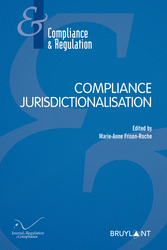
► Full Reference: Siproudhis, J.-B.,, C., The transfer of responsibility from the regulator and the judge to the company: demonstration by the whistleblowing mechanism, in Frison-Roche, M.-A. (ed.), Compliance Jurisdictionalisation, series "Compliance & Regulation", Journal of Regulation & Compliance (JoRC) and Bruylant, to be published.
___
► Article summary (done by the author) : From the practitioner perspective, compliance is geared towards a gradual transfer of responsibilities from both regulators and judges.
In France, the whistleblowing mechanism imposed by the so-called "Sapin 2" and "Duty of Vigilance" laws illustrates this evolution. Indeed, internal alerts management follows key judiciary process milestones : admissibility, investigations, dismissal or sanction.
This turns corporations duties into prosecutors or judges’, provided that they respect a specific framework contributing to respect the rules of a fair trial.
This requirement raises several legal and sociological challenges to which the author devotes his developments.
____
📝 to the general presentation of the book in which this article is published
June 23, 2021
Thesaurus : Doctrine

► Full Reference: Siproudhis, J.-B.,, C., Le transfert de responsabilité du régulateur et du juge vers l’entreprise : la démonstration par le système d’alerte ("The transfer of responsibility from the regulator and the judge to the company: demonstration by the whistleblowing mechanism"), in Frison-Roche, M.-A. (dir.), La juridictionnalisation de la Compliance, série "Régulations & Compliance", Journal of Regulation & Compliance (JoRC) et Dalloz, à paraître.
___
► Article Summary (done by the Author) : From the practitioner perspective, compliance is geared towards a gradual transfer of responsibilities from both regulators and judges.
In France, the whistleblowing mechanism imposed by the so-called "Sapin 2" and "Duty of Vigilance" laws illustrates this evolution. Indeed, internal alerts management follows key judiciary process milestones : admissibility, investigations, dismissal or sanction.
This turns corporations duties into prosecutors or judges’, provided that they respect a specific framework contributing to respect the rules of a fair trial.
This requirement raises several legal and sociological challenges to which the author devotes his developments.
____
📝 go to the general presentation of the book in which this article is published.
__________
This requirement raises several legal and sociological challenges to which the author devotes his developments.
June 22, 2021
Publications

Full Reference: Frison-Roche, M.-A., The Judge-Judge ; articulating words and things in the face of the challenging conflict of interest born by Compliance Law, Working Paper, June 22, 2022.
____
🎤 This Working Paper had been made to prepare a conference (done in French).
This conference took place in the Academic Colloquium, L'entreprise instituée Procureur et Juge d'elle-même par le Droit de la Compliance, in Lyon, the 23rd June 2021.
____
📝this Working Paper is the basis of an article to be published
📕 in its French version in the book La juridictionnalisation de la Compliance, in the Series Régulations & Compliance
📘 in its English version in the book Compliance Juridictionnalisation, in the Series Compliance & Regulation
____
► Working Paper Summary: Puisque le thème de cette réflexion générale sur L'entreprise instituée Juge et Procureur d'elle-même par le Droit de la Compliance porte sur un ensemble d'autres réflexions soucieuses de l’ajustement des mots et des choses, la façon dont le rapport entre les uns et les autres évoluent, ce travail va porter sur la question de savoir si cette évolution est radicale ou pas, lorsqu'on parle de "juge".
Car, "juger" c'est un mot que le Droit a disputé à d'autres discipline
Le Droit repère qui juge et oblige ce si-puissant à la procédure. Mais il a aussi le pouvoir d'instituer juge et tous les personnages du procès. Il le fait d'ordinaire avec clarté en distinguant les uns des choses. C'est si important que ce conseil a valeur constitutionnelle. Ainsi, non seulement celui qui juge doit être nommé ainsi mais l'appareillage procédurale qui va avec le personnage et qui constitue à la façon une façon de faire et des droits fondamentaux, ne sont pas "concédés" par bonté ou dans un second temps : c'est un bloc. Si l'on ne voulait pas avoir à supporter les droits processuels, il ne fallait vouloir être juge. Certes on pu en conclure que la procédure serait donc devenue "substantielle" ; par cette élévation, il s'agit plutôt de dire que la procédure ne serait plus une "matière servante": c'est une sorte de déclaration d'amour pour la procédure, tant qu'on affirme qu'à l'acte de juger, d'enquêter ou de poursuivre, sont "naturellement" attachées les droits pour celui qui risque d'en être l'objet.
Le Droit de la Compliance, à la recherche d'alliés pour atteindre les Buts Monumentaux pour l'atteinte desquels il a été institué, va requérir, voire exiger d'entreprises privées qu'elle aillent elles-mêmes rechercher, c'est-à-dire enquêter, des faits susceptibles de lui être reprochés. Le Droit de la Compliance va aussi exiger qu'elles poursuivent les personnes ayant commis ces faits. Il va encore exiger qu'elles sanctionnent les faits que des personnes ont commis en son nom.
On le comprend bien du point de vue de l'efficacité Ex Ante. La confusion est souvent très efficace. Par exemple il est plus efficace que celui qui poursuit soit aussi celui qui instruise et qui juge, puisqu'il connait bien le dossier. D'ailleurs il est plus efficace qu'il prenne aussi les règles, ainsi il connait mieux que quiconque "l'esprit" des textes. Cela fut souvent souligné en Droit de la Régulation. Mais tout cela ne va pas de soi.
Pour deux raisons, l'une extérieur et l'autre intérieure.
La première raison, extérieure, tient que l'on ne pourrait pas "nommer" juge qui ne l'est pas. Cela serait trop facile, car il suffirait alors de désigner quiconque, voire de le faire soi-même pour s'approprier le régime qui va avec, pouvoir notamment d'obtenir qu'autrui obéisse alors même qu'il n'est pas subordonné ou qu'il transmette des informations, alors même qu'il serait concurrent : il faudrait alors rappeler seul le juge pourrait se nommer juge ! et dans ce temps nouveau, voilà que des entreprises seraient juges, procureurs, enquêteurs ! Les temps seraient donc si graves et en si grand désordre qu'il faudrait en revenir à cette tautologie là...
La seconde raison, interne à l'entreprise, tient à ce que l'entreprise enquête sur elle-même, se juge elle-même, se sanctionne elle-même. Or, la personne morale n'exprimant sa volonté qu'à travers soit ses organes, l'on souligne en pratique les difficultés pour un même être humain de formuler des griefs, en tant qu'il est le mandataire de la personne morale, à la personne physique qu'il est lui-même. Les deux intérêts des deux ne sont pas les mêmes, sont souvent opposés, et comment les secrets de l'un peuvent être tenus à l'égard de l'autre. C'est tout le mystère, voire l'artifice de la personnalité morale qui apparaît et l'on comprend mieux que le Droit de la Compliance ne veut plus utiliser cette notion étrange. Car toues les règles de procédure ne peuvent masquer que se poursuivre soi-même n'a pas plus de sens que de contracter avec soi-même. Ce conflit d'intérêts est impossible à résoudre car nommer un même individu x puis le nommer y, en déclarant ouverte la dispute entre eux n'a pas de sens.
Ce dualisme impossible à admettre dès l'instant qu'il s'agit de faire jouer ces fonctions à l'égard des mandataires sociaux peut retrouver vie en instituant des tiers de confiance qui vont porter les secrets et les oppositions. Par exemple par la désignation de deux avocats distincts par l'être humain mandataire et l'être humain dirigeant, chaque avocat pouvant avoir des secrets l'un pour l'autre et s'opposer l'un à l'autre. Ces espaces de reconstitution des oppositions si "naturelles" en procédure entre celui qui juge et celui qui est jugé peuvent aussi avoir prendre la forme technologique des plateformes : là où il n'y a plus personne, là où le process a remplacé la procédure, il n'y a plus non plus de jugement humain. L'on mesure ainsi que la crainte des conflits d'intérêts est si forte que l'on se résigne à dire que seule la machine serait "impartiale", dérisoire conception de l'impartialité contre laquelle il convient de lutter.
Cela permet alors d'aboutir à une dernière question : l'entreprise peut-elle prétendre exercer le pouvoir juridictionnel de poursuivre et de juger et d'enquêter sans même se prétendre ni procureur, ni juge d'instruction, ni tribunal ? L'avantage serait de pouvoir se soustraire au régime juridique que le Droit classique attache à ses mots-là, principalement les droits de la défense, les droits d'action et le principe de publicité de la justice. Quand Facebook dit "réagir" à la décision du 5 mai 2021 adoptée par ce qui ne serait qu'un Oversight Board pour décider pourtant "en conséquence" une suspension de 2 ans du compte de Donald Trump, l'art des qualifications semble être utilisé afin d'éviter toute contrainte de régime. Mais cet art de l'euphémisme est bien ancien. Ainsi les Etats, lorsqu'ils voulurent accroître la répression, présentèrent la transformation du système comme un adoucissement de celui-ci à travers la "dépénalisation" du Droit économique, transféré des tribunaux correctionnels aux AAI. L'efficacité en fût grandement accrue, puisque les garanties de la procédure pénales ont cessé de s'appliquer. Mais 20 ans plus tard, les mots retrouvèrent leur chemin vers les choses : sous le Droit pénal, dormait la "matière pénale", qui requière la même "impartialité". Un juge un jour l'affirma et tout fut changé. Attendons donc ce qu'en diront les Cours, puisqu'elles sont les maîtres des qualifications, comme le dit l'article 12 du Code de procédure civil, qu'écrivit Motulsky.
Archives de Philosophie du Droit, Le jugement, ...
Kant, etc.
La procédure est ainsi ce qui fonde le procès de Nuremberg, lui-même berceau de la Justice internationale, alors même que l'Ordre juridique international n'existe pas.
Confucius affirmait que la seule mais suffisante façon de rappeler l'ordre dans le Royaume est de nommer "mère" la mère et "fils" le fils.