Internal Investigation

Marie-Anne Frison-Roche au General Counsel Forum Europe (ECLA), Madrid, 15 septembre 2025

Conferences

opening speech

🎥Compliance Law and Systemic Litigation, in 🧮General Counsel Forum Europe 2025

► Full Reference: M.-A. Frison-Roche, "Compliance Law and Systemic Litigation", 15 September 2025, Madrid. - This speech is the opening speech of the event. 🧮 See the general program of the event - 📅See the slides (not used), basis for this speechs - ► Summary of the conference: This  manifestation, made fo many interventions, is about the role and the evolution of the in-house lawyers in the Europe on the move. I opened the event by focusing on the importance of the Compliance which drives the companies now, in the future and for the future. It is quite difficile because currently Compliance Law is quite misunderstund by almost every. Therefore the first part of my intervention has been the explanation of what is the very new branch of Law, built of political Monumental Goals (Compliance Law is not just the obligation to be conform with, just to obey), the specificity of European Compliance Monumental Goals (not only the sustainability of systems, but also the concern for present and future human beins implied in them).  This systemic new branch of Law, humanist branch of Law in Europe put the Judge at its center. Par translation, this is creating a new sort of Litigation : the Compliance Systemic Litigation. Its object is the future (as Compliance Law itselft). Contrary to the "conformity", which might be left to algorithms, Compliance Law, inseparable to Systemic Litigation, are giving new role for Judges, for external lawyers and for internal lawyers.

Articles in a legal collective publication

💬”Les droits de la défense sont au bénéfice de tout le monde, y compris de l’entreprise elle-même” (The rights of defence benefit everyone, including the company itself)

► Full Reference: M.-A. Frison-Roche, "Les droits de la défense sont au bénéfice de tout le monde, y compris de l’entreprise elle-même" (The rights of defence benefit everyone, including the company itself), interview by Chloé Lassel, in Guide Compliance Fraudes Investigations, edition 2024, ed. Décideurs, Oct. 2024, pp. - 💬read the interview (in French) its  présentation on LinkedIn (in French) - ► Presentation of this interview by Décideurs juridiques : "Directrice du Journal of Regulation & Compliance (JoRC) et fondatrice de l’École européenne de droit de la régulation et de la compliance, Marie-Anne Frison-Roche revient sur la révolution du droit de la compliance, son articulation avec les enquêtes internes et les droits de la défense, la place que vont y prendre les contrats et l’arbitrage international." ("Marie-Anne Frison-Roche, Director of the Journal of Regulation & Compliance (JoRC) and founder of the European School of Regulatory and Compliance Law, looks back at the revolution in Compliance Law, its relationship with internal investigations and the rights of the defence, and the role that contracts and international arbitration will play in it. - ► Questions asked, Answers given:  Décideurs. Question : La compliance est au cœur des préoccupations des entreprises depuis plusieurs années. Pouvez-vous expliquer ce que c’est exactement ? (Compliance has been a key concern for companies for several years. Can you explain what it is exactly?) Marie-Anne Frison-Roche. English summary Answer: 'Compliance' should not be confused with 'Compliance', which I defined in 2016. Compliance Law is an extension of Regulatory Law, by freeing the latter from the existence of a sector as a prerequisite and a regulatory authority as an indicator. Internalised in the company, it manifests itself, for example, in Vigilance mechanisms, which are its cutting edge. Through Compliance, the political authority asks companies to help it achieve "Monumental Goals", as I have suggested, standards in which this new branch of Law is anchored (anti-money laundering, anti-corruption, sustainability, etc.).   D. Q. : Les entreprises doivent désormais être enquêtrices et juges de ce qu’il leur arrive. Voire transmettre aux autorités, lorsqu’il le faut, des informations pouvant les incriminer. Comment concilier ces obligations avec les droits de la défense ? (Companies must now be investigators and judges of what happens to them. When necessary, they can even pass on incriminating information to the authorities. How do you reconcile these obligations with the rights of the defence?) MaFR. English summary A.: In 2023, I proposed this expression of companies as "prosecutors and judges of themselves", and the place that this should give to the rights of the defence, and in 2024 I will work out the right balance between internal investigations and the rights of the defence. For the moment, this balance has not been achieved.   D. Q. : Dans l’un de vos ouvrages, François Ancel, conseiller à la première chambre civile de la Cour de cassation, écrit que la compliance renouvelle l’office du juge. Comment concilier cette idée avec l’office habituel du juge qui est celui de se prononcer sur des faits avérés et non pas futurs ? (In one of your books, François Ancel, judge in the First Civil Chamber of the French Court of Cassation, writes that Compliance is renewing the role of the judge. How do you reconcile this idea with the judge's usual role, which is to rule on proven facts rather than future ones?) MaFR. English summary A.: Indeed, In this book La juridictionnalisation de la compliance (Compliance Jurisdictionalisation), he stresses that the role of the civil and commercial courts is being profoundly renewed, in particular because they must deal with what I described in 2021 as "Systemic Litigation" and must rule on the future. From then on, the ordinary courts will take centre stage.   D. Q. : Le recours aux clauses de compliance est-il une solution pour être à la hauteur des ambitions de la compliance et de ses exigences ? (Is the use of compliance clauses a solution for living up to the ambitions and requirements of compliance?) MaFR. English summary A.: Indeed, in 2022, I developed the concepts of 'Compliance Contract' and 'Compliance clauses', by which companies implement their legal compliance obligations. This gives rise to Regulatory Contracts, particularly in business chains. This gives a great deal of leeway and power, but also Responsibility, to the companies that invent them.   D. Q. : Le recours aux arbitrages doit-il être privilégié ? (D. Q. Should recourse to arbitration be preferred?) MaFR. English summary A.: It has to be. Because there is a contract. Even though Compliance is closely bound up with the legal obligations and public order, and possibly international public order. Even if this is not yet apparent, Compliance and International Arbitration are natural allies.

Conferences

📝L’enjeu de la confidentialité des avis juridiques internes au regard des « Buts Monumentaux » de la Compliance

► Full Reference: M.-A. Frison-Roche, "L’enjeu de la confidentialité des avis juridiques internes au regard des « Buts Monumentaux » de la Compliance" ("The issue of confidentiality of in-house legal opinions with regard to the "Monumental Goals" of Compliance"), in L’instauration d’un Legal Privilege à la française. Le temps de l’action au service de la souveraineté et de la compétitivité de nos entreprises, Association française des juristes d'entreprise (AFJE), Association nationale des juristes de banque (ANJB) et Cercle Montesquieu, March 7, 2024, Maison de la Chimie, 28 rue Saint Dominique Paris - 📝On the same topic, read the article of Marie-Anne Frison-Roche "La compliance, socle de la confidentialité nécessaire des avis juridiques élaborés en entreprise" ("Compliance, the cornerstone of the confidentiality required for in-house legal opinions")
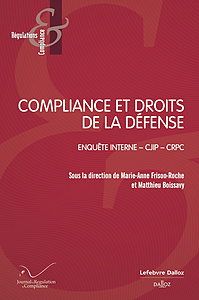
Couverture – Compliance et droits de la défense

Articles

📧📕Compliance et droits de la défense. Enquête interne – CJIP – CRPC : les lignes de force de l’ouvrage (Compliance and rights of the defence. Internal investigation – French Judicial Public Interest Agreement – French guilty plea procedure : the main themes of the book)

► Full Reference: M.-A. Frison-Roche, Compliance et droits de la défense. Enquête interne – CJIP – CRPC : les lignes de force de l'ouvrage (Compliance and rights of the defence. Internal investigation – French Judicial Public Interest Agreement – French guilty plea procedure : the main themes of the book), Newsletter MAFR Law, Compliance, Regulation, March 5, 2024 - 📧Read by freely subscribing other news of the Newsletter MAFR – Law, Compliance, Regulation - 🧱Compliance and rights of defense: a book to design them together to improve practices   The book Compliance et droits de la défense (Compliance and rights of the defence), co-published by the Journal of Regulation & Compliance (JoRC ) and Dalloz, takes as its starting point practices ranging from internal investigations to convention judiciaire d’intérêt public – CJIP (Judicial Public Interest Agreement) and comparution sur reconnaissance préalable de culpabilité – CRPC (French guilty plea procedure), to measure the way in which Compliance makes room, or not, for the rights of the defense.   📧read the general presentation of the book and, in a very detailed presentation of the book's main points, the presentation of each of the contributions, published on March 5, 2024 in the Newsletter MAFR – Law, Compliance, Regulation
Couverture – Compliance et droits de la défense

Articles in a JoRC book

📝Circuler dans le temps pour l’efficience des droits de la défense dans les systèmes de compliance (“Moving through Time to align Compliance with the rights of the defence”), in 🕴️M.-A. Frison-Roche et 🕴️M. Boissavy (dir.), 📕Compliance et droits de la défense. Enquête interne – CJIP – CRPC

► Full reference : M.-A. Frison-Roche, « Circuler dans le temps pour mettre en phase Compliance et droits de la défense » (Moving through Time to Bring Compliance and the Rights of the Defence into Phase), in M.-A. Frison-Roche and M. Boissavy (eds.), Compliance et droits de la défense. Enquête interne – CJIP – CRPC, Journal of Regulation & Compliance (JoRC) and Dalloz, coll. “Régulations & Compliance“, 2024, pp. 33-58. - ► Full Reference: M.-A. Frison-Roche "Circuler dans le temps pour mettre en phase Compliance et droits de la défense ("Moving through Time to align Compliance with the rights of the defence")", in M.-A. Frison-Roche et M. Boissavy (dir.), Compliance et droits de la défense. Enquête interne – CJIP – CRPC, Journal of Regulation & Compliance (JoRC) and Dalloz, coll. "Régulations & Compliance",  2024, pp. 33-58. - 📝read the article (in French) - 🚧read the bilingual Working Paper on which this article is based, with additional developments, technical references and hyperlinks - 📕read the general presentation of the book, Compliance et droits de la défense. Enquête interne – CJIP – CRPC, in which this article is published (in French) - 📝read also the presentation of the other article published par Marie-Anne Frison-Roche in this book : "Connaitre les pratiques pour redessiner les frontières et accroître les points de contact entre Compliance et droits de la défense dans l’enquête interne, la CJIP et la CRPC" (Understanding practices to redraw the boundaries and increase the points of contact between Compliance and the rights of the defense in Internal Investigation, Judicial Public Interest Agreement and French guilty plea procedure) - ► English Summary of this article: the subject of Compliance & rights of the defence is difficult to pin down because it often gives rise to totally opposing presentations, which express the initial confrontation between Compliance and rights of the defence, which seems irreducible. This initial confrontation must be acknowledged, and this is even more necessary to prevent it from becoming definitive(I) But in a society governed by the Rule of Law, the rights of the defence are central, and the hierarchy of norms dictates that they remain the privilege of all those who risk being punished in the future. Admittedly, if we look at the course of events in a linear way, the Compliance mechanisms come in Ex Ante, whereas the rights of the defence would only be activated when the repressive procedures would later come to bear on the moral or natural person. The question would therefore not even arise, or not in a central way. But this reasoning creates a false compatibility between Compliance and the rights of the defence (II. Indeed, it is the perspective of punishment in the future that forms the basis for the attribution of rights of the defence in the present. This consideration of the future not only allows but obliges the Law to "move in time", to always think in advance about what might happen tomorrow: this is how we must think about the Compliance methods of Internal Investigation, the DPA (or in the French legal system the Convention judiciaire d'intérêt public and the French Guilty plea procedure (CRPC) (III). As soon as these Compliance Tools are being used in practice, at the time they are being used, we must already think about how their results will be used, results which they have often been used for, because the Internal Investigation is a formidable piece of Evidence for obtaining a conviction and/or a DPA, etc. : therefore, the rights of the defence must shift over time, from the future to the present of the Information collect. Two ambiguities that affect Compliance Law itself, ambiguities which the rights of the defence help to clarify, now appear more clearly.  The first concerns the place occupied by the consent of the person who could have been protected by the rights of defence but //who exercises his/her will to renounce them (IV). Consent, in relation to the will of which it is the expression, is also linked with the future and allows Compliance once again to take precedence over the prerogatives of the individual who chooses not to benefit from it. The omnipresence of 'consent' in Compliance is enlightening here… The second ambiguity concerns the place of secrecy (V). Secrecy seems to be the prerogative of the rights of the defence. But it can also be an effective Compliance Tool when Confidentiality enables the company to detect and prevent breaches. It may even constitute the very Monumental Goal of Compliance Law. This happens when the Goal of Compliance Law, in which legal normativity is placed, becomes the protection of the individual, as is the case for personal information. That guides the European Judge, in line with the humanism that underpins European Compliance Law, in finding the right balance, this protection and effectiveness, depending on whether the information must be given or must be not.
Couverture – Compliance et droits de la défense

Articles in a JoRC book

📝Les conditions de réussite de l’enquête interne dans les rapports entre le parquet national financier et l’entreprise mise en cause – l’enquête interne au soutien de la défense de l’entreprise, in 🕴️M.-A. Frison-Roche et 🕴️M. Boissavy (dir.), Collection Régulations & Compliance Compliance et droits de la défense. Enquête interne – CJIP – CRPC

► Full reference : J.-Fr. Bohnert, « Les conditions de réussite de l’enquête interne dans les rapports entre le parquet national financier et l’entreprise mise en cause – l’enquête interne au soutien de la défense de l’entreprise » (The Conditions for a Successful Internal Investigation in Relations between the National Financial Prosecutor’s Office and the Company Concerned – the Internal Investigation in Support of the Company’s Defence), in M.-A. Frison-Roche and M. Boissavy (eds.), Compliance et droits de la défense. Enquête interne – CJIP – CRPC, Journal of Regulation & Compliance (JoRC) and Dalloz, coll. “Régulations & Compliance“, 2024, pp. 77-82. - ► English Summary of this article (made by the Journal of Regulation & Compliance – JoRC) : In a presentation very close to the 2023 guidelines of the National Financial Prosecutor’s Office (PNF) and to the soft law produced with the French Anti-Corruption Agency (AFA), the author sets out how the company must act in a climate of trust and cooperation. The company must objectively investigate what could engage its criminal liability, in a transparent and fair manner, bearing in mind the possible cooperation with the PNF with a view to a CJIP and the credit the PNF gives to the company’s diligence in conducting an internal investigation, just as contrary attitudes are logically considered as opposite factors in the calculation.
Couverture – Compliance et droits de la défense

Articles in a JoRC book

📝L’enquête interne au cœur des enjeux de conformité et de justice négociée : analyse de la position de l’AFA et du PNF, in 🕴️M.-A. Frison-Roche et 🕴️M. Boissavy (dir.), 📕Compliance et droits de la défense. Enquête interne – CJIP – CRPC

► Full reference : E. Russo, « L’enquête interne au cœur des enjeux de conformité et de justice négociée : analyse de la position de l’AFA et du PNF » (The Internal Investigation at the Heart of Compliance and Negotiated Justice Issues: an Analysis of the Position of the AFA and the PNF), in M.-A. Frison-Roche and M. Boissavy (eds.), Compliance et droits de la défense. Enquête interne – CJIP – CRPC, Journal of Regulation & Compliance (JoRC) and Dalloz, coll. “Régulations & Compliance“, 2024, pp. 123-129. - ► English Summary of this article (made by the Journal of Regulation & Compliance – JoRC) : The author takes up and relies on the publications by the National Financial Prosecutor’s Office (PNF) and the French Anti-Corruption Agency (AFA) of updated guidelines on the judicial public interest agreement (CJIP) and of a practical guide on internal investigations, which show the continuum between the two and express a willingness to cooperate with companies, in an international context and on an Anglo-Saxon model. The author stresses that the investigation is at the heart of Compliance for companies, in that it ensures the effectiveness of many requirements of the so-called “Sapin 2” law, such as whistleblowing, and strengthens the whole. Regarding the rights of the defence, both those of the persons interviewed and those of the company, which must not remain passive, the author stresses that the legislator could frame internal investigations more closely and considers that, when the investigation reaches a certain scale, the company has an interest in entrusting its conduct to a lawyer. Moreover, he clearly takes the view that it is desirable for the lawyer to combine the role of investigator with that of defender of the company, contrary to the recommendation of the AFA and the PNF, which see them as incompatible.
Couverture – Compliance et droits de la défense

Articles in a JoRC book

📝La lutte anti-corruption : l’emprunt au modèle américain et à ses récentes évolutions, in 🕴️M.-A. Frison-Roche et 🕴️M. Boissavy (dir.), 📕Compliance et droits de la défense. Enquête interne – CJIP – CRPC

► Full reference : S. L. Dreyfuss, « La lutte anti-corruption : l’emprunt au modèle américain et à ses récentes évolutions » (The Fight against Corruption: Borrowing from the American Model and Its Recent Developments), in M.-A. Frison-Roche and M. Boissavy (eds.), Compliance et droits de la défense. Enquête interne – CJIP – CRPC, Journal of Regulation & Compliance (JoRC) and Dalloz, coll. “Régulations & Compliance“, 2024, pp. 253-258. - ► English Summary of this article (made by the Journal of Regulation & Compliance – JoRC) : Relying on the relevance of paying particular attention to American mechanisms, since they so strongly inspire European and French legislators, for example between the DPA and the CJIP, the author describes the features of the new system introduced in 2022 and 2023 by the DoJ: the Declination and the Presumption of Declination. Without requiring any authorisation or approval by a judge, the DoJ grants the benefit of a guarantee of non-prosecution, a guarantee given to the company through what the author presents as a “contract”, in exchange for which the company provides its full cooperation, in particular all the evidence at its disposal, first and foremost against itself. Unlike France, where the investigation is conducted by the company itself, the DoJ thus feeds the investigation which it directs and over which it retains full control, having moreover the material and human resources to conduct it.
Couverture – Compliance et droits de la défense

Articles in a JoRC book

📝Enquêtes internes, enquêtes pénales et droits de la défense : que nous disent les jurisprudences américaine et anglaise (l’affaire Connolly et l’affaire ENRC) ?, in 🕴️M.-A. Frison-Roche et 🕴️M. Boissavy (dir.), 📕Compliance et droits de la défense. Enquête interne – CJIP – CRPC

► Full reference : V. Chatelin, « Enquêtes internes, enquêtes pénales et droits de la défense : que nous disent les jurisprudences américaine et anglaise (l’affaire Connolly et l’affaire ENRC) ? » (Internal Investigations, Criminal Investigations and the Rights of the Defence: What Do American and English Case Law Tell Us (the Connolly and ENRC Cases)?), in M.-A. Frison-Roche and M. Boissavy (eds.), Compliance et droits de la défense. Enquête interne – CJIP – CRPC, Journal of Regulation & Compliance (JoRC) and Dalloz, coll. “Régulations & Compliance“, 2024, pp. 163-169. - ► English Summary of this article (made by the Journal of Regulation & Compliance – JoRC) : The article justifies its focus on American and British case law by the fact that internal investigations are an older practice there and that cases show that, when they are conducted in connection with the authorities – the DoJ in the United States, the SFO in the United Kingdom – they can endanger the rights of the defence of those interviewed, and then the relationship between the company that wrongly cooperates and the law firm that assisted it. In support, the article describes in detail the American cases Gavin, Coburn & Schwartz and Tournant, then the British ENRC case, which gave rise to several decisions in the United Kingdom and illustrates the dangers created by the failure of lawyers in charge of the internal investigation to respect professional secrecy.
Couverture – Compliance et droits de la défense

Articles in a JoRC book

📝Garantir la valeur probatoire d’un rapport dans le cadre d’une enquête interne opérée dans une entreprise internationale, in 🕴️M.-A. Frison-Roche et 🕴️M. Boissavy (dir.), 📕Compliance et droits de la défense. Enquête interne – CJIP – CRPC

► Full reference : M. Figueiredo, « Garantir la valeur probatoire d’un rapport dans le cadre d’une enquête interne opérée dans une entreprise internationale » (Ensuring the Probative Value of a Report in an Internal Investigation Conducted within an International Company), in M.-A. Frison-Roche and M. Boissavy (eds.), Compliance et droits de la défense. Enquête interne – CJIP – CRPC, Journal of Regulation & Compliance (JoRC) and Dalloz, coll. “Régulations & Compliance“, 2024, pp. 149-155. - ► English Summary of this article (made by the Journal of Regulation & Compliance – JoRC) : The article explains why producing an internal investigation report is a major issue for a company, all the more so if it is of international dimension. In producing it, the company must design it from the outset for what constitutes its value: a probative instrument (I). Through this report, the company establishes that it makes its best efforts to comply with local and international laws, that it observes the rights of the defence and the adversarial principle in its inquiries and that it develops a culture of impartiality in conducting these investigations. To that end, the report must keep track of the rigorous investigative methodology followed and of compliance with the various data laws, traceability in matters of evidence being ensured by the report. Moreover, because the case considered here is that of an international company, drawing up an internal investigation report comes up against many specific difficulties, for which solutions are proposed. These difficulties are of several kinds: the diversity of the legal systems involved, the diversity of languages and modes of communication, the diversity of corporate cultures reflected in the applicable local standards, the need for global coordination of the investigation and the need to respect rights of the defence that may be rejected in their very principle in certain parts of the world. Solutions are proposed for each of these difficulties.
Couverture – Compliance et droits de la défense

Articles in a JoRC book

📝L’apport de la psychologie pour l’effectivité des droits de la défense dans l’enquête interne, in 🕴️M.-A. Frison-Roche et 🕴️M. Boissavy (dir.), 📕Compliance et droits de la défense. Enquête interne – CJIP – CRPC

► Full reference : N. Leroy & D. Zucker, « L’apport de la psychologie pour l’effectivité des droits de la défense dans l’enquête interne pour harcèlement au travail » (The Contribution of Psychology to the Effectiveness of the Rights of the Defence in Internal Investigations into Workplace Harassment), in M.-A. Frison-Roche and M. Boissavy (eds.), Compliance et droits de la défense. Enquête interne – CJIP – CRPC, Journal of Regulation & Compliance (JoRC) and Dalloz, coll. “Régulations & Compliance“, 2024, pp. 107-113. - ► English Summary of this article (made by the Journal of Regulation & Compliance – JoRC) : The authors, one a lawyer and the other a clinical psychologist, first underline the specific features, and in particular the difficulties, of the internal investigations required within companies when sexual or moral harassment is at stake. The aim of the article is to show the fruit of a close collaboration between the lawyer and the psychologist in such a case, in particular so that a dialogue is established in which everyone can express themselves and be protected, which is a way of bringing the rights of the defence to life. In what they call “cross perspectives”, required by the fact that harassment is a “psychological concept” to which the Law attaches legal consequences, one should not limit oneself to a strictly factual and organisational approach. A command of psychology makes it possible to give relevance to attitudes that are not legally reprehensible. An adequate methodology must therefore be developed, through an analysis complementary to the factual and legal analysis, integrating personality indicators, taking post-traumatic stress into account and decoding what may be a system of harassment. In addition, a method must strengthen the reliability of interviews so that everyone’s voice can find its place (interview techniques, strengthening of personal skills).
Couverture – Compliance et droits de la défense

Articles in a JoRC book

📝Regards critiques sur les droits de la défense dans l’enquête interne, in 🕴️M.-A. Frison-Roche et 🕴️M. Boissavy (dir.), 📕Compliance et droits de la défense. Enquête interne – CJIP – CRPC

► Full reference : M. Durand-Poincloux, D. Apelbaum et P. Sardi-Antasan, « Regard critique : La place des droits de la défense dans l’enquête interne selon le guide AFA/PNF » (A Critical Look: the Place of the Rights of the Defence in Internal Investigations According to the AFA/PNF Guide), in M.-A. Frison-Roche and M. Boissavy (eds.), Compliance et droits de la défense. Enquête interne – CJIP – CRPC, Journal of Regulation & Compliance (JoRC) and Dalloz, coll. “Régulations & Compliance“, 2024, pp. 69-75. - ► English Summary of this article (made by the Journal of Regulation & Compliance – JoRC) : The authors present the guide published in 2023 by the French Anti-Corruption Agency (AFA) and the National Financial Prosecutor’s Office (PNF), Anti-corruption internal investigations. Practical guide, considering that the rights of the defence do not have in it the place that general principles would imply. They consider that the procedural guarantees are insufficient for the person prosecuted. Moreover, because the lawyer would not have the means he could legitimately expect, it is the rights of the company conducting the internal investigation that are thereby disregarded. The authors conclude that this guide thus amounts to a kind of “step backwards” in relation to the principles governing punitive law, in particular in that the report resulting from the investigation is protected by no secrecy.
Couverture – Compliance et droits de la défense

Articles in a JoRC book

📝La responsabilité de l’entreprise dans la conception et la menée de l’enquête interne, in 🕴️M.-A. Frison-Roche et 🕴️M. Boissavy (dir.), 📕Compliance et droits de la défense. Enquête interne – CJIP – CRPC

► Full reference : L. Meziani, « La responsabilité de l’entreprise dans la conception et la menée de l’enquête interne » (The Company’s Responsibility in Designing and Conducting the Internal Investigation), in M.-A. Frison-Roche and M. Boissavy (eds.), Compliance et droits de la défense. Enquête interne – CJIP – CRPC, Journal of Regulation & Compliance (JoRC) and Dalloz, coll. “Régulations & Compliance“, 2024, pp. 157-162. - ► English Summary of this article (made by the Journal of Regulation & Compliance – JoRC) : The author sets out her conception of the “responsibility of the company” in internal investigations. She considers that it is a tool for steering risk management and that, legislation and case law being unclear in formulating the many requirements and specifying the procedures, the company must act to avoid incurring liability, preserve its reputation and manage its risks. It does so in a unified way and organises itself freely, as long as the investigative methods are not unlawful, the author considering that the rights of the defence do not apply there as principles. The company reproduces its “vertical” system there, applying a unified method throughout the group. The author highlights the “virtues” of the internal investigation for the company, in that the company constitutes a legal order in itself, thus carrying the values of French law throughout the world, through internal investigations with a unified methodology and through active cooperation with the public authorities. The author nevertheless considers that its practice may be “inconsistent”, the law of internal investigations being still “immature”.
Couverture – Compliance et droits de la défense

Articles in a JoRC book

📝La spécificité des enquêtes internes pratiquées par les groupes internationaux, in 🕴️M.-A. Frison-Roche et 🕴️M. Boissavy (dir.), 📕Compliance et droits de la défense. Enquête interne – CJIP – CRPC

► Full reference : O. Catherine, « La spécificité des enquêtes internes pratiquées par les groupes internationaux » (The Specific Features of Internal Investigations Conducted by International Groups), in M.-A. Frison-Roche and M. Boissavy (eds.), Compliance et droits de la défense. Enquête interne – CJIP – CRPC, Journal of Regulation & Compliance (JoRC) and Dalloz, coll. “Régulations & Compliance” , 2024, pp. 141-148. - ► English Summary of this article (made by the Journal of Regulation & Compliance – JoRC) : The article describes how an internal investigation unfolds when it is carried out within a company of international dimension. In-house lawyers are particularly experienced in doing so, having followed the evolution of large companies, transformations which involve the dynamics of global internal investigations. To carry it out, the in-house lawyer must not only turn into an “investigator” but must also first establish a legitimate and robust Compliance programme, global and integrating local particularities. This framework, set out in a common body of standards, covers in particular the whistleblowing system and the conduct of internal investigations. This transparent system must generate trust throughout the group. Investigations are often international or take place abroad, the French particularity lying in the fragility of the confidentiality of correspondence with lawyers and the absence of confidentiality of legal opinions, which may make it difficult for the company to run the system properly, even as the rules for attributing criminal liability are being relaxed with regard to groups. The author then describes the operational conduct of internal investigations carried out by an international group.
Couverture – Compliance et droits de la défense

Articles in a JoRC book

FIORINI, Benjamin🕴️

📝Approche doctrinale de l’enquête interne et de l’enquête pénale privée, in 🕴️M.-A. Frison-Roche & 🕴️M. Boissavy (eds.), 📕Compliance et droits de la défense. Enquête interne – CJIP – CRPC

► Full reference : B. Fiorini, « Approche doctrinale de l’enquête interne et de l’enquête pénale privée » (A Doctrinal Approach to Internal Investigations and Private Criminal Investigations), in M.-A. Frison-Roche and M. Boissavy (eds.), Compliance et droits de la défense. Enquête interne – CJIP – CRPC, Journal of Regulation & Compliance (JoRC) and Dalloz, coll. “Régulations & Compliance“, 2024, pp. 63-68 - ► English Summary of this article (made by the Journal of Regulation & Compliance – JoRC) : The author sets out the two deeply distinct, even opposed, cultures of inquisitorial and adversarial punitive procedural systems. The former give trust and power to public officers to find the truth, the latter give trust and power to the parties opposed in the dispute. Investigations conducted privately develop naturally in the second system and not in the first. This second way of thinking is rooted in the United States, which therefore naturally welcomes internal investigations conducted by companies and associates with them procedural principles such as the rights of the defence, the adversarial principle and the right to a lawyer. The first system, characteristic of Continental Law systems, is reluctant towards the very idea of a private criminal investigation. This is why, when the mechanism of internal investigation develops within companies, these procedural mechanisms are less naturally associated with it. - ► Full Reference: B. Fiorini, "Approche doctrinale de l’enquête interne et de l’enquête pénale privée" ("Doctrinal approach to internal investigations and private criminal investigations"), in M.-A. Frison-Roche & M. Boissavy (eds.), Compliance et droits de la défense. Enquête interne – CJIP – CRPC, Journal of Regulation & Compliance (JoRC) and Dalloz, coll. "Régulations & Compliance", 2024, pp. 63-68 - 📕read a general presentation of the book, Compliance et droits de la défense. Enquête interne – CJIP – CRPC, in which this article is published - ► English Summary of the article (done by the Journal of Regulation & Compliance – JoRC): The author sets out the two profoundly distinct, even opposing, cultures of inquisitorial and adversarial repressive procedural systems. The former gives confidence and power to public officials to find the truth, while the latter gives confidence and power to the opposing parties in the dispute. Private investigations naturally develop in the second system and not in the first. This second system of thought is rooted in the United States, which naturally welcomes internal investigations carried out by companies and associates procedural principles such as the rights of the defence, adversarial proceedings and the right to a lawyer. The first system, characteristic of Continental Law systems, is resistant to the very idea of a private criminal investigation. This is why, when the internal investigation mechanism develops within a company, the procedural mechanisms mentioned above are less naturally associated with it. - 🦉This article is available in full text to those registered for Professor Marie-Anne Frison-Roche's courses -
Couverture – Compliance et droits de la défense

Articles in a JoRC book

📝Le rapport d’enquête interne à l’épreuve des droits de la défense, in 🕴️M.-A. Frison-Roche et 🕴️M. Boissavy (dir.), Collection Régulations & Compliance Compliance et droits de la défense. Enquête interne – CJIP – CRPC

► Full reference : S. Sauphanor, « Le rapport d’enquête interne à l’épreuve des droits de la défense » (The Internal Investigation Report Put to the Test of the Rights of the Defence), in M.-A. Frison-Roche and M. Boissavy (eds.), Compliance et droits de la défense. Enquête interne – CJIP – CRPC, Journal of Regulation & Compliance (JoRC) and Dalloz, coll. “Régulations & Compliance“, 2024, pp. 131-138. - ► English Summary of this article (made by the Journal of Regulation & Compliance – JoRC) : For the author, the internal investigation still constitutes an “immense blind spot”. It is nevertheless an essential subject, since it constitutes a quasi-criminal procedure and may lead to a criminal sanction. The principles of criminal procedure should therefore be fully applied to it. This is not the case. The author first states that the investigation crystallises an imbalance, which can only become entrenched later, between those who conduct the investigation and those who must cooperate, thus constituting an intrinsic dysfunction, the rights of the defence being little present during the investigations, which crystallises in the report and hinders the defence of the persons concerned. But because the investigation report is not a record of the truth but rather the major piece of evidence in a broader mechanism, for example the prospect of a CJIP, the persons concerned, legal but also natural, must think of it as an element of defence: it must have been drawn up fairly, its annulment must be possible otherwise, and it may prove the diligence of each party, in an anticipated defence strategy designed in particular by the legal person later exposed to sanctions, with the risk that it sacrifices the specific interests of employees. The result is a difficult role for the lawyer of the person who commissioned the investigation report, who must discern which interests to defend and how. Likewise, the confidentiality of communications with the client is difficult to claim for the investigation report, since it must be designed as a piece of evidence intended to be produced, the author considering on the contrary that it should be designed from the outset as not secret but as intended to be communicated to the authorities and in subsequent proceedings.
Couverture – Compliance et droits de la défense

Articles in a JoRC book

📝 L’enquête interne façonnée par la déontologie de l’avocat, in 🕴️M.-A. Frison-Roche et 🕴️M. Boissavy (dir.), Collection Régulations & Compliance Compliance et droits de la défense. Enquête interne – CJIP – CRPC

► Full reference : S. de Navacelle, J. Zorrilla et L. Ragazzi, « L’enquête interne façonnée par la déontologie » (The Internal Investigation Shaped by the Lawyer’s Professional Ethics), in M.-A. Frison-Roche and M. Boissavy (eds.), Compliance et droits de la défense. Enquête interne – CJIP – CRPC, Journal of Regulation & Compliance (JoRC) and Dalloz, coll. “Régulations & Compliance“, 2024, pp. 183-198. - ► English Summary of this article (made by the Journal of Regulation & Compliance – JoRC) : The authors explain that the lawyer to whom the company decides to entrust an internal investigation thus becomes a “lawyer-investigator”, this dual capacity shaping the investigation, since, as he remains a lawyer, it is imbued with his professional ethics. Relying mainly on the texts issued by the legal profession, for example the Vademecum on internal investigations, extracts of which are reproduced, they stress that the lawyer’s values are thus imported into the internal investigation, but they dispute that professional secrecy, a cardinal principle of the profession, should be challenged there by the National Financial Prosecutor’s Office and the French Anti-Corruption Agency, even though the Bar’s tradition of good faith could reconcile the interests at stake. Going through the internal investigation in chronological order, the article describes how the lawyer accepts his mission. The strength of his ethics is such that this should not prevent him from later defending the company if it is prosecuted, in particular on the basis of that same internal investigation. The authors describe how the lawyer defines its framework, in particular the stakeholders involved, then conducts the investigations, in particular interviews with persons likely to be implicated, up to the drafting of the investigation report, which must draw the consequences of the investigation. The authors regret that the confidentiality of this report is challenged, whereas, its author being a lawyer, it should not be.
Couverture – Compliance et droits de la défense

Publication director

🏗️ copublishing and direction of the collection: 📚Régulations & Compliance

Publication of 🕴️M.-A. Frison-Roche & 🕴️M. Boissavy (eds.), 📕Compliance et droits de la défense. Enquête interne – CJIP – CRPC (Compliance and rights of the defence. Internal investigation – French Judicial Public Interest Agreement – French guilty plea procedure)

► Full Reference: M.-A. Frison-Roche & M. Boissavy (eds.), Compliance et droits de la défense. Enquête interne – CJIP – CRPC (Compliance and rights of the defence. Internal investigation – French Judicial Public Interest Agreement – French guilty plea procedure), Journal of Regulation & Compliance (JoRC) and Dalloz, “Régulations & Compliance” Serie, 2024, 362 p. - ► General presentation of the book:  We do not have an overall view of the relationship between Compliance and the rights of the defence in the continuum of internal investigations and DPA, or in the French legal system the convention judiciaire d’intérêt public (CJIP) and the comparution immédiate avec reconnaissance de culpabilité (CRPC), in particular because the texts, whether hard law or soft law, decisions and academic analyses segment them, making it difficult to build a pertinent appreciation of each one. This is made all the more difficult by the fact that we know little about how each of them is applied in practice, both within each of them and in relation to each other.  As a result, it is difficult to express overall satisfaction, or total rejection, or to suggest some specific reforms and to precise on what points, to identify the appropriate source of these improvements, legislation, case law, professions, or spontaneous ways of doing. The first ambition of this book is therefore to restore an overall vision, because this is the vision of practice. If shortcomings are found to exist, then they can be more easily denounced. However, some of the situations described may be described as flawed, or even dramatic, by some, while others may consider that they should be approved as they stand. This applies, for example, to the question of whether or not the investigation report should be secret from the prosecuting authority, which may propose a DPA (or in the French legal system a CJIP), whether or not this CJIP should be extended to individuals, whether or not a lawyer should be present from the internal investigation stage onwards, whether or not the lawyer should support the interests of the company he/she is investigating and continue to do so before the regulator or the prosecutor, whether or not the investigation is delegated from the public authorities to the company, whether or not the lawyer-investigator and then the lawyer-defendant are both lawyers, whether or not the victims are represented in the the CIPC process, etc. Depending on what one thinks the relation between Compliance and due process should be in principle and in practice, one expresses a more or less approving or severe judgement on the state of the texts, the soft law nature of most of them making the exercise complicated, and then if there is a gap between them and what one thinks should be the right standard, one asserts that in practice things happen differently from what the texts say, or one considers that the texts should be changed. From point to point, a veritable kaleidoscope emerges in this book. Indeed, the result is a series of contributions that sometimes clash with one another, with a sort of contradictionary principle creeping into the very structure of this book, thus establishing the readesr as a sort of judges themselves , that character who is so absent. He/she will be able to do so, since the book lists texts, describes practices and gives an illustration of everything that can be thought of, in visions that are sometimes analytical and sometimes global, with proposals of reforms of texts, jurisprudence or conduct. The aim of the book is to enable readers to form their own opinions and to take part in what is undoubtedly being strongly debated today: the confrontation between Compliance and rights of the defence. - 🧮this book follows a conference organised by the Conseil national des barreaux – CNB (French National Council of Lawyers), which took place on 20 and 21 April 2023: Avocats et droits de la défense dans les enquêtes internes et la justice négociée. - This volume is the continuation of the books dedicated to Compliance in this collection. ► Read the presentations of the other books in the series: the following books: 🕴️M.-A. Frison-Roche (ed.), 📕L’Obligation de Compliance (Compliance Obligation), 2025 🕴️M.-A. Frison-Roche (ed.), 📕Compliance et Contrat (Compliance and Contract), forthcoming 🕴️L. Laref (ed.), 📕Compliance et vigilance bancaire (Compliance and Banking Vigilance), forthcoming 🕴️M.-A. Frison-Roche, 📕Le système juridique global des noms de domaine. Structure multi-acteurs et durabilité de l’Internet (The Global Legal System of Domain Names. Multi-Stakeholder Structure and Sustainability of the Internet), forthcoming 🕴️M.-A. Frison-Roche (ed.), 📕Le système probatoire de la Compliance, forthcoming   the previous books: 🕴️M.-A. Frison-Roche (ed.), 📕La juridictionnalisation de la Compliance (Compliance Jurisdictionalisation), 2023 🕴️M.-A. Frison-Roche (ed.), 📕Les Buts Monumentaux de la Compliance (Compliance Monumental Goals), 2022 🕴️M.-A. Frison-Roche (ed.), 📕Les outils de la Compliance (Compliance Tools), 2021 🕴️M.-A. Frison-Roche (ed.), 📕Pour une Europe de la Compliance (For the Europe of the Compliance), 2019 🕴️N. Borga, J.-Cl. Marin and J.-Ch. Roda (eds.), 📕Compliance : l’entreprise, le régulateur et le juge (Compliance: the Company, the Regulator and the Judge), 2018 🕴️M.-A. Frison-Roche (ed.), 📕Régulation, Supervision, Compliance (Regulation, Supervision, Compliance), 2017 🕴️M.-A. Frison-Roche (ed.), 📕Internet, espace d’interrégulation (Internet, Space of Interregulation), 2016 📚Read the presentations of the other titles of the collection. - ► Summary of the book: The rights of the defence are one of the pillars of our Rule of Law. On the face of it, compliance techniques are not concerned with this under the pretext of efficiency. This would be particularly true in a trilogy that unfolds over time: internal investigation, convention judiciaire d’intérêt public – CJIP (French Judicial Public Interest Agreement) and comparution sur reconnaissance préalable de culpabilité – CRPC (French guilty plea procedure). However, because Compliance Law is also the expression of the Rule of Law, in that its ambition is to detect and prevent systemic risks in order to protect present and future human beings, we must go beyond this opposition and articulate Compliance and rights of the defence. The Monumental Goals of Compliance, which justify its power, for example to obtain information, and the fundamental rights of the defence, which for example impose the presumption of innocence, must be adjusted to each other; by interpreting texts, or even adopting new ones. The book analyses each of these three techniques, in particular the still largely unregulated internal investigation, and sheds light on them in relation to each other, in order to formulate proposals. - 🏗️General construction of the book: The book opens with an overview divided into three sections. The first Title compares the challenges of the internal investigation with the rights of the defence. The second Title compares the issues at stake in the convention judiciaire d’intérêt public – CJIP (French Judicial Public Interest Agreement) and the comparution sur reconnaissance préalable de culpabilité – CRPC (French guilty plea procedure) with these same rights of the defence. -   TABLE OF CONTENTS   COMPLIANCE ET DROITS DE LA DÉFENSE : VISION D’ENSEMBLE (COMPLIANCE AND RIGHTS OF THE DEFENCE : OVERVIEW) Section 1 ♦️ Connaître les pratiques pour redessiner les frontières et accroître les points de contact entre Compliance et droits de la défense dans l’enquête interne, la CJIP et la CRPC. Lignes de force de l’ouvrage Compliance et droits de la défense (Understanding practices to redraw the boundaries and increase the points of contact between Compliance and the rights of the defense in internal investigation, French Judicial Public Interest Agreement and French guilty plea procedure. Main Aspects of the Book Compliance and rights of the defence), by🕴️Marie-Anne Frison-Roche   Section 2 ♦️  Compliance et droits de la défense : toujours pour le respect des droits humains (Compliance and rights of the defence: always for the respect of human rights), by🕴️Matthieu Boissavy Section 3 ♦️ Circuler dans le temps pour mettre en phase Compliance et droits de la défense (Moving through Time to align Compliance and rights of the defence), by🕴️Marie-Anne Frison-Roche   TITRE I.  LES ENJEUX PROCÉDURAUX DE L’ENQUETE INTERNE CONFRONTÉE AUX DROITS DE LA DÉFENSE (TITLE I.  PROCEDURAL CHALLENGES OF THE INTERNAL INVESTIGATION IN RELATION TO THE RIGHTS OF THE DEFENCE)   CHAPITRE I : VISION GÉNÉRALE DES DROITS DE LA DÉFENSE DANS L’ENQUÊTE INTERNE  (CHAPTER I: OVERVIEW OF THE RIGHTS OF THE DEFENCE IN INTERNAL INVESTIGATION) Section 1 ♦️ Approche doctrinale de l’enquête interne et de l’enquête pénale privée (Doctrinal approach to internal investigation and private criminal investigation), by 🕴️Benjamin Fiorini Section 2 ♦️ Regard critique : La place des droits de la défense dans l’enquête interne selon le guide AFA/PNF (A critical look: The place of the rights of the defence in the internal investigation according to the AFA/PNF Guide), by 🕴️Margaux Durand-Poincloux, 🕴️David Apelbaum and 🕴️Paola Sardi-Antasan Section 3 ♦️ Les conditions de réussite de l’enquête interne dans les rapports entre le Parquet national financier et l’entreprise mise en cause – l’enquête interne au soutien de la défense de l’entreprise (The conditions for a successful internal investigation in the relationship between the French Financial Public Prosecutor’s Office and the accused company – the internal investigation in support of the company’s defence), by🕴️Jean-François Bohnert   CHAPITRE II : LES DROITS DE LA DÉFENSE À CHAQUE ÉTAPE DE L’ENQUÊTE INTERNE (CHAPTER II: THE RIGHTS OF THE DEFENCE AT EACH STAGE OF THE INTERNAL INVESTIGATION)   Section 1 ♦️ La réception des alertes par l’avocat (Reception of alerts by the lawyer), by🕴️Maria Lancri Section 2 ♦️ Collecte et traitement des informations dans les enquêtes internes à l’ère numérique : processus et enjeux (Collecting and processing information for internal investigations in the digital age: processes and challenges), by🕴️Uriel Goldberg Section 3 ♦️ L’apport de la psychologie pour l’effectivité des droits de la défense dans l’enquête interne pour harcèlement au travail (The contribution of psychology to the effectiveness of the rights of the defence in internal investigation for harassment in the workplace), by🕴️Nathalie Leroy & 🕴️Danièle Zucker Section 4 ♦️ Le respect des droits de la défense lors des auditions des enquêtes internes : un gage d’efficacité (Respecting the rights of the defence during hearings in internal investigations: a guarantee of efficacy), by 🕴️Emmanuel Daoud & 🕴️Ghita Khalid Rouissi Section 5 ♦️ L’enquête interne au cœur des enjeux de conformité et de justice négociée : analyse de la position de l’AFA et du PNF (The internal investigation at the heart of conformity and negotiated justice issues: analysis of the position of the AFA and the PNF), by🕴️Éric Russo Section 6 ♦️ Le rapport d’enquête interne à l’épreuve des droits de la défense (The internal investigation report put to the test of defence rights), by🕴️Samuel Sauphanor   CHAPITRE III : LA SPÉCIFICITÉ DES ENQUÊTES INTERNES DANS LES ENTREPRISES INTERNATIONALES ET LA PLACE DES DROITS DE LA DÉFENSE (CHAPTER III : SPECIFICITY OF INTERNAL INVESTIGATIONS IN INTERNATIONAL COMPANIES AND THE PLACE OF THE RIGHTS OF THE DEFENCE) Section 1 ♦️ La spécificité des enquêtes internes pratiquées par les groupes internationaux (Specificity of internal investigations carried out by international groups), by 🕴️Olivier Catherine Section 2 ♦️ Garantir la valeur probatoire d’un rapport dans le cadre d’une enquête interne opérée dans une entreprise internationale (Guaranteeing the evidential value of a report in an internal investigation carried out in an international company), by 🕴️Monique Figueiredo Section 3 ♦️ La responsabilité de l’entreprise dans la conception et la menée de l’enquête interne (The company’s responsibility in designing and conducting an internal investigation), by 🕴️Lydia Meziani Section 4 ♦️ Enquêtes internes, enquêtes pénales et droits de la défense : que nous disent les jurisprudences américaine et anglaise (l’affaire Connolly et l’affaire ENRC) ? (Internal investigations, criminal investigations and rights of the defence: what do the US and UK case law tell us (the Connolly case and the ENRC case)?), by 🕴️Victoire Chatelin   CHAPITRE IV : LE RÔLE SINGULIER DE L’AVOCAT DANS L’ENQUÊTE INTERNE (CHAPTER IV: THE SPECIAL ROLE OF THE LAWYER IN THE INTERNAL INVESTIGATION) Section 1 ♦️ La méthodologie propre à l’avocat enquêteur (The investigating lawyer’s own methodology), by 🕴️William Feugère Section 2 ♦️ L’enquête interne façonnée par la déontologie de l’avocat (The internal investigation shaped by the lawyer’s deontology), by 🕴️Stéphane De Navacelle, 🕴️Julie Zorrila and 🕴️Laura Ragazzi Section 3 ♦️ Préserver le secret professionnel de l’avocat dans l’enquête interne et son résultat (Preserving the lawyer’s professional secrecy in the internal investigation and its outcome), by 🕴️Bénédicte Graulle & 🕴️Yanis Rahim Section 4 ♦️ L’avocat-enquêteur en droit du travail : un janséniste au milieu du Far West (The lawyer-investigator in employment law: a Jansenist in the Wild West), by 🕴️Richard Doudet Section 5 ♦️ La défense des personnes physiques dans les enquêtes internes (Defending individuals in internal investigations), by 🕴️Dorothée Hever     TITRE II. LES ENJEUX PROCÉDURAUX DE LA CJIP ET DE LA CRPC CONFRONTÉES AUX DROITS DE LA DÉFENSE (TITLE II. PROCEDURAL CHALLENGES OF THE FRENCH JUDICIAL PUBLIC INTEREST AGREEMENT AND THE FRENCH GUILTY PLEA PROCEDURE  IN RELATION TO THE RIGHTS OF THE DEFENCE)   CHAPITRE I : VISION GÉNÉRALE DES DROITS DE LA DÉFENSE DANS LA CJIP ET LA CRPC (CHAPTER I: OVERVIEW OF THE RIGHTS OF THE DEFENCE IN THE FRENCH JUDICIAL PUBLIC INTEREST AGREEMENT AND THE FRENCH GUILTY PLEA PROCEDURE) Section 1 ♦️ Théorie et pratique de la négociation dans la justice pénale (Theory and practice of negotiation in criminal justice), by 🕴️Sarah-Marie Cabon Section 2 ♦️ La lutte anti-corruption : l’emprunt au modèle américain et à ses récentes évolutions (The fight against corruption: borrowing from the American model and its recent developments), by 🕴️Stephen L. Dreyfuss Section 3 ♦️ Justice pénale négociée : avantages présents, risques à venir (Negotiated criminal justice: curent benefits, future risks), by 🕴️Alexis Bavitot   CHAPITRE II : FORMES ACTIVES DES DROITS DE LA DÉFENSE, LES DIALOGUES À L’OEUVRE OU À PARFAIRE DANS LA CJIP ET LA CRPC (CHAPTER II: ACTIVE FORMS OF THE RIGHTS OF THE DEFENCE, DIALOGUES AT WORK OR TO BE PERFECTED IN THE FRENCH JUDICIAL PUBLIC INTEREST AGREEMENT AND THE FRENCH GUILTY PLEA PROCEDURE) Section 1 ♦️ Combinaison des CRPC et des CJIP : le cas particulier des affaires de fraude fiscale (Combination of the French guilty plea procedure and the French Judicial Public Interest Agreement: the special issue of tax fraud cases), by 🕴️Marion David Section 2 ♦️ Pour une justice pénale négociée plus équitable (For a fairer negotiated criminal justice), by🕴️Astrid Mignon Colombet Section 3 ♦️ Les impacts, sur les droits de la défense, des disparités de la justice pénale négociée dans l’Union européenne (The impact on the rights of the defence of the disparities in negotiated criminal justice in the European Union), by 🕴️Emmanuel Moyne Section 4 ♦️ L’évolution des rapports entre avocats et autorités de poursuites depuis l’introduction de la CJIP (Developments in relations between lawyers and prosecuting authorities since the introduction of the French Judicial Public Interest Agreement), by 🕴️Thomas Baudesson   CHAPITRE III : LE RÔLE SINGULIER DE L’AVOCAT DANS LA CJIP ET LA CRPC  (CHAPTER III: THE SINGULAR ROLE OF THE LAWYER IN THE FRENCH JUDICIAL PUBLIC INTEREST AGREEMENT AND THE FRENCH GUILTY PLEA PROCEDURE) Section 1 ♦️ Quand se justifie et quand s’arrête la collaboration ? À propos de la CJIP (When is collaboration justified and when does it end? About the French Judicial Public Interest Agreement), by 🕴️Philippe Goossens Section 2 ♦️ Le dialogue de l’avocat et de son client, chef d’entreprise, face à la proposition d’une CRPC et d’une CJIP (The dialogue between the lawyer and his client, a company director, faced with the proposal of a French guilty plea procedure or a French Judicial Public Interest Agreement), by 🕴️François Saint-Pierre Section 3 ♦️ Le dilemme de l’avocat pénaliste face à la CRPC (The criminal lawyer’s dilemma when faced with the French guilty plea procedure), by 🕴️Jean Boudot Section 4 ♦️ Défendre les intérêts de la personne physique confrontée à la justice négociée : préserver l’effectivité des droits de la défense et le respect de la présomption d’innocence (Defending the interests of individuals faced with negotiated justice: preserving the effectiveness of the rights of the defence and respect for the presumption of innocence), by 🕴️Capucine Lanta de Bérard & 🕴️Pauline Dufourq Section 5 ♦️ Défendre les intérêts des victimes dans la justice pénale économique négociée (Defending victims’ interests in negotiated economic criminal justice), by 🕴️Jérôme Karsenti
Couverture – Compliance et droits de la défense

Books

Collection Régulations & Compliance Compliance et droits de la défense. Enquête interne – CJIP – CRPC (Compliance and rights of the defence. Internal investigation – French Judicial Public Interest Agreement – French guilty plea procedure)

► Full Reference: M.-A. Frison-Roche & M. Boissavy (eds.), Compliance et droits de la défense. Enquête interne – CJIP – CRPC (Compliance and rights of the defence. Internal investigation – French Judicial Public Interest Agreement – French guilty plea procedure), Journal of Regulation & Compliance (JoRC) and Dalloz, “Régulations & Compliance” Serie, 2024, 362 p. - ► General presentation of the book: We do not have an overall view of the relationship between Compliance and the rights of the defence in the continuum of internal investigations and DPA, or in the French legal system the convention judiciaire d’intérêt public (CJIP) and the comparution immédiate avec reconnaissance de culpabilité (CRPC), in particular because the texts, whether hard law or soft law, decisions and academic analyses segment them, making it difficult to build a pertinent appreciation of each one. This is made all the more difficult by the fact that we know little about how each of them is applied in practice, both within each of them and in relation to each other. As a result, it is difficult to express overall satisfaction, or total rejection, or to suggest some specific reforms and to precise on what points, to identify the appropriate source of these improvements, legislation, case law, professions, or spontaneous ways of doing. The first ambition of this book is therefore to restore an overall vision, because this is the vision of practice. If shortcomings are found to exist, then they can be more easily denounced. However, some of the situations described may be described as flawed, or even dramatic, by some, while others may consider that they should be approved as they stand. This applies, for example, to the question of whether or not the investigation report should be secret from the prosecuting authority, which may propose a DPA (or in the French legal system a CJIP), whether or not this CJIP should be extended to individuals, whether or not a lawyer should be present from the internal investigation stage onwards, whether or not the lawyer should support the interests of the company he/she is investigating and continue to do so before the regulator or the prosecutor, whether or not the investigation is delegated from the public authorities to the company, whether or not the lawyer-investigator and then the lawyer-defendant are both lawyers, whether or not the victims are represented in the the CIPC process, etc. Depending on what one thinks the relation between Compliance and due process should be in principle and in practice, one expresses a more or less approving or severe judgement on the state of the texts, the soft law nature of most of them making the exercise complicated, and then if there is a gap between them and what one thinks should be the right standard, one asserts that in practice things happen differently from what the texts say, or one considers that the texts should be changed. From point to point, a veritable kaleidoscope emerges in this book. Indeed, the result is a series of contributions that sometimes clash with one another, with a sort of contradictionary principle creeping into the very structure of this book, thus establishing the readesr as a sort of judges themselves , that character who is so absent. He/she will be able to do so, since the book lists texts, describes practices and gives an illustration of everything that can be thought of, in visions that are sometimes analytical and sometimes global, with proposals of reforms of texts, jurisprudence or conduct. The aim of the book is to enable readers to form their own opinions and to take part in what is undoubtedly being strongly debated today: the confrontation between Compliance and rights of the defence. - ► Summary of the book: The rights of the defence are one of the pillars of our Rule of Law. On the face of it, compliance techniques are not concerned with this under the pretext of efficiency. This would be particularly true in a trilogy that unfolds over time: internal investigation, convention judiciaire d’intérêt public – CJIP (French Judicial Public Interest Agreement) and comparution sur reconnaissance préalable de culpabilité – CRPC (French guilty plea procedure). However, because Compliance Law is also the expression of the Rule of Law, in that its ambition is to detect and prevent systemic risks in order to protect present and future human beings, we must go beyond this opposition and articulate Compliance and rights of the defence. The Monumental Goals of Compliance, which justify its power, for example to obtain information, and the fundamental rights of the defence, which for example impose the presumption of innocence, must be adjusted to each other; by interpreting texts, or even adopting new ones. The book analyses each of these three techniques, in particular the still largely unregulated internal investigation, and sheds light on them in relation to each other, in order to formulate proposals. - 🏗️General construction of the book: The book opens with an overview divided into three sections. The first Title compares the challenges of the internal investigation with the rights of the defence. The second Title compares the issues at stake in the convention judiciaire d’intérêt public – CJIP (French Judicial Public Interest Agreement) and the comparution sur reconnaissance préalable de culpabilité – CRPC (French guilty plea procedure) with these same rights of the defence. - TABLE OF CONTENTS   COMPLIANCE ET DROITS DE LA DÉFENSE : VISION D’ENSEMBLE (COMPLIANCE AND RIGHTS OF THE DEFENCE : OVERVIEW) Section 1 ♦️ Connaître les pratiques pour redessiner les frontières et accroître les points de contact entre Compliance et droits de la défense dans l’enquête interne, la CJIP et la CRPC. Lignes de force de l’ouvrage Compliance et droits de la défense (Understanding practices to redraw the boundaries and increase the points of contact between Compliance and the rights of the defense in internal investigation, French Judicial Public Interest Agreement and French guilty plea procedure. Main Aspects of the Book Compliance and rights of the defence), by🕴️Marie-Anne Frison-Roche   Section 2 ♦️  Compliance et droits de la défense : toujours pour le respect des droits humains (Compliance and rights of the defence: always for the respect of human rights), by🕴️Matthieu Boissavy Section 3 ♦️ Circuler dans le temps pour mettre en phase Compliance et droits de la défense (Moving through Time to align Compliance and rights of the defence), by🕴️Marie-Anne Frison-Roche   TITRE I.  LES ENJEUX PROCÉDURAUX DE L’ENQUETE INTERNE CONFRONTÉE AUX DROITS DE LA DÉFENSE (TITLE I.  PROCEDURAL CHALLENGES OF THE INTERNAL INVESTIGATION IN RELATION TO THE RIGHTS OF THE DEFENCE) CHAPITRE I : VISION GÉNÉRALE DES DROITS DE LA DÉFENSE DANS L’ENQUÊTE INTERNE  (CHAPTER I: OVERVIEW OF THE RIGHTS OF THE DEFENCE IN INTERNAL INVESTIGATION) Section 1 ♦️ Approche doctrinale de l’enquête interne et de l’enquête pénale privée (Doctrinal approach to internal investigation and private criminal investigation), by 🕴️Benjamin Fiorini Section 2 ♦️ Regard critique : La place des droits de la défense dans l’enquête interne selon le guide AFA/PNF (A critical look: The place of the rights of the defence in the internal investigation according to the AFA/PNF Guide), by 🕴️Margaux Durand-Poincloux, 🕴️David Apelbaum and 🕴️Paola Sardi-Antasan Section 3 ♦️ Les conditions de réussite de l’enquête interne dans les rapports entre le Parquet national financier et l’entreprise mise en cause – l’enquête interne au soutien de la défense de l’entreprise (The conditions for a successful internal investigation in the relationship between the French Financial Public Prosecutor’s Office and the accused company – the internal investigation in support of the company’s defence), by🕴️Jean-François Bohnert CHAPITRE II : LES DROITS DE LA DÉFENSE À CHAQUE ÉTAPE DE L’ENQUÊTE INTERNE (CHAPTER II: THE RIGHTS OF THE DEFENCE AT EACH STAGE OF THE INTERNAL INVESTIGATION) Section 1 ♦️ La réception des alertes par l’avocat (Reception of alerts by the lawyer), by🕴️Maria Lancri Section 2 ♦️ Collecte et traitement des informations dans les enquêtes internes à l’ère numérique : processus et enjeux (Collecting and processing information for internal investigations in the digital age: processes and challenges), by🕴️Uriel Goldberg Section 3 ♦️ L’apport de la psychologie pour l’effectivité des droits de la défense dans l’enquête interne pour harcèlement au travail (The contribution of psychology to the effectiveness of the rights of the defence in internal investigation for harassment in the workplace), by🕴️Nathalie Leroy & 🕴️Danièle Zucker Section 4 ♦️ Le respect des droits de la défense lors des auditions des enquêtes internes : un gage d’efficacité (Respecting the rights of the defence during hearings in internal investigations: a guarantee of efficacy), by 🕴️Emmanuel Daoud & 🕴️Ghita Khalid Rouissi Section 5 ♦️ L’enquête interne au cœur des enjeux de conformité et de justice négociée : analyse de la position de l’AFA et du PNF (The internal investigation at the heart of conformity and negotiated justice issues: analysis of the position of the AFA and the PNF), by🕴️Éric Russo Section 6 ♦️ Le rapport d’enquête interne à l’épreuve des droits de la défense (The internal investigation report put to the test of defence rights), by🕴️Samuel Sauphanor CHAPITRE III : LA SPÉCIFICITÉ DES ENQUÊTES INTERNES DANS LES ENTREPRISES INTERNATIONALES ET LA PLACE DES DROITS DE LA DÉFENSE (CHAPTER III : SPECIFICITY OF INTERNAL INVESTIGATIONS IN INTERNATIONAL COMPANIES AND THE PLACE OF THE RIGHTS OF THE DEFENCE) Section 1 ♦️ La spécificité des enquêtes internes pratiquées par les groupes internationaux (Specificity of internal investigations carried out by international groups), by 🕴️Olivier Catherine Section 2 ♦️ Garantir la valeur probatoire d’un rapport dans le cadre d’une enquête interne opérée dans une entreprise internationale (Guaranteeing the evidential value of a report in an internal investigation carried out in an international company), by 🕴️Monique Figueiredo Section 3 ♦️ La responsabilité de l’entreprise dans la conception et la menée de l’enquête interne (The company’s responsibility in designing and conducting an internal investigation), by 🕴️Lydia Meziani Section 4 ♦️ Enquêtes internes, enquêtes pénales et droits de la défense : que nous disent les jurisprudences américaine et anglaise (l’affaire Connolly et l’affaire ENRC) ? (Internal investigations, criminal investigations and rights of the defence: what do the US and UK case law tell us (the Connolly case and the ENRC case)?), by 🕴️Victoire Chatelin CHAPITRE IV : LE RÔLE SINGULIER DE L’AVOCAT DANS L’ENQUÊTE INTERNE (CHAPTER IV: THE SPECIAL ROLE OF THE LAWYER IN THE INTERNAL INVESTIGATION) Section 1 ♦️ La méthodologie propre à l’avocat enquêteur (The investigating lawyer’s own methodology), by 🕴️William Feugère Section 2 ♦️ L’enquête interne façonnée par la déontologie de l’avocat (The internal investigation shaped by the lawyer’s deontology), by 🕴️Stéphane De Navacelle, 🕴️Julie Zorrila and 🕴️Laura Ragazzi Section 3 ♦️ Préserver le secret professionnel de l’avocat dans l’enquête interne et son résultat (Preserving the lawyer’s professional secrecy in the internal investigation and its outcome), by 🕴️Bénédicte Graulle & 🕴️Yanis Rahim Section 4 ♦️ L’avocat-enquêteur en droit du travail : un janséniste au milieu du Far West (The lawyer-investigator in employment law: a Jansenist in the Wild West), by 🕴️Richard Doudet Section 5 ♦️ La défense des personnes physiques dans les enquêtes internes (Defending individuals in internal investigations), by 🕴️Dorothée Hever TITRE II. LES ENJEUX PROCÉDURAUX DE LA CJIP ET DE LA CRPC CONFRONTÉES AUX DROITS DE LA DÉFENSE (TITLE II. PROCEDURAL CHALLENGES OF THE FRENCH JUDICIAL PUBLIC INTEREST AGREEMENT AND THE FRENCH GUILTY PLEA PROCEDURE  IN RELATION TO THE RIGHTS OF THE DEFENCE) CHAPITRE I : VISION GÉNÉRALE DES DROITS DE LA DÉFENSE DANS LA CJIP ET LA CRPC (CHAPTER I: OVERVIEW OF THE RIGHTS OF THE DEFENCE IN THE FRENCH JUDICIAL PUBLIC INTEREST AGREEMENT AND THE FRENCH GUILTY PLEA PROCEDURE) Section 1 ♦️ Théorie et pratique de la négociation dans la justice pénale (Theory and practice of negotiation in criminal justice), by 🕴️Sarah-Marie Cabon Section 2 ♦️ La lutte anti-corruption : l’emprunt au modèle américain et à ses récentes évolutions (The fight against corruption: borrowing from the American model and its recent developments), by 🕴️Stephen L. Dreyfuss Section 3 ♦️ Justice pénale négociée : avantages présents, risques à venir (Negotiated criminal justice: curent benefits, future risks), by 🕴️Alexis Bavitot CHAPITRE II : FORMES ACTIVES DES DROITS DE LA DÉFENSE, LES DIALOGUES À L’OEUVRE OU À PARFAIRE DANS LA CJIP ET LA CRPC (CHAPTER II: ACTIVE FORMS OF THE RIGHTS OF THE DEFENCE, DIALOGUES AT WORK OR TO BE PERFECTED IN THE FRENCH JUDICIAL PUBLIC INTEREST AGREEMENT AND THE FRENCH GUILTY PLEA PROCEDURE) Section 1 ♦️ Combinaison des CRPC et des CJIP : le cas particulier des affaires de fraude fiscale (Combination of the French guilty plea procedure and the French Judicial Public Interest Agreement: the special issue of tax fraud cases), by 🕴️Marion David Section 2 ♦️ Pour une justice pénale négociée plus équitable (For a fairer negotiated criminal justice), by🕴️Astrid Mignon Colombet Section 3 ♦️ Les impacts, sur les droits de la défense, des disparités de la justice pénale négociée dans l’Union européenne (The impact on the rights of the defence of the disparities in negotiated criminal justice in the European Union), by 🕴️Emmanuel Moyne Section 4 ♦️ L’évolution des rapports entre avocats et autorités de poursuites depuis l’introduction de la CJIP (Developments in relations between lawyers and prosecuting authorities since the introduction of the French Judicial Public Interest Agreement), by 🕴️Thomas Baudesson CHAPITRE III : LE RÔLE SINGULIER DE L’AVOCAT DANS LA CJIP ET LA CRPC  (CHAPTER III: THE SINGULAR ROLE OF THE LAWYER IN THE FRENCH JUDICIAL PUBLIC INTEREST AGREEMENT AND THE FRENCH GUILTY PLEA PROCEDURE) Section 1 ♦️ Quand se justifie et quand s’arrête la collaboration ? À propos de la CJIP (When is collaboration justified and when does it end? About the French Judicial Public Interest Agreement), by 🕴️Philippe Goossens Section 2 ♦️ Le dialogue de l’avocat et de son client, chef d’entreprise, face à la proposition d’une CRPC et d’une CJIP (The dialogue between the lawyer and his client, a company director, faced with the proposal of a French guilty plea procedure or a French Judicial Public Interest Agreement), by 🕴️François Saint-Pierre Section 3 ♦️ Le dilemme de l’avocat pénaliste face à la CRPC (The criminal lawyer’s dilemma when faced with the French guilty plea procedure), by 🕴️Jean Boudot Section 4 ♦️ Défendre les intérêts de la personne physique confrontée à la justice négociée : préserver l’effectivité des droits de la défense et le respect de la présomption d’innocence (Defending the interests of individuals faced with negotiated justice: preserving the effectiveness of the rights of the defence and respect for the presumption of innocence), by 🕴️Capucine Lanta de Bérard & 🕴️Pauline Dufourq Section 5 ♦️ Défendre les intérêts des victimes dans la justice pénale économique négociée (Defending victims’ interests in negotiated economic criminal justice), by 🕴️Jérôme Karsenti