The JoRC Review

Articles

The Law of Compliance unleashes the moorings of the Law of Regulation but retains its principles: consequences on companies

The Law of Compliance is a branch of law so recent that some still doubt its very existence. This paper does not take up this question again, nor that so often evoked of the "definition" of the Compliance and the Law that goes, nor the issue of the translation which is appropriate for it. The purpose of the reflection is rather to observe the movement that started from the requirements of specific sectoral Law, such as Financial Law and Banking Law, which undeniably correspond to "sectors", the Law of Compliance being the extension of the Law of Regulation, an extension that metamorphoses it, extending beyond the regulated sectors.   THE CONSEQUENCES ON COMPANIES OF THE COMPLIANCE LAW  BEYOND THE REGULATION LAW Read below

Articles

The challenge of qualification for the application of regulatory regimes. For example, what is a bitcoin?

Qualification is the key operation in Law. For example, if one says what a bitcoin is, then one assigns to it the regime which corresponds to this "nature" that one has thus said; One could say that the "token" that it constitutes corresponds to nothing of what it existed before. In this case, their creation, storage, management, sale, loan, purchase does not correspond to any particular category that pre-existed. They therefore come under what is called "the category unnamed". It is then in a liberal system the vacuum of liberty that applies to it. In a system of liberty, it is contractual freedom, freedom which attaches to the property right, the articulation between the contract and the property being sufficient. Technology can establish such a qualification, because the risk inherent in a system of freedom is also borne by the blockchain mechanism. Indeed, by the spread of risk on the one hand, and the safety of machines on the other, there would be no need to worry, and the principle of freedom could give credence to the idea that the "token" would be a sui generis category. But central banks and financial regulators are probably not convinced and prefer to qualify by bringing the "token" to a pre-existing category, which automatically triggers the legal regime. It is well known that the art of qualification consists in choosing from among the attainable qualifications the one which will allow the application of the regime which is the most adequate to satisfy the aim which one wishes to attain. In terms of regulation, governed entirely by goals, qualification is therefore primarily a matter of strategy. Now, to affirm that the bitcoin is a sui generis object amounts to not regulating its emission, usages and intermediations, not to control those who make use of it. It amounts to taking away the merits of self-regulation. This was excluded. First of all by the Central Banks. Bitcoins and other tokens, based on the mechanical security of the blockchain, can be described as "money" when it is a matter of their acquisition to allow people to  access other goods. The central bankers retained the qualification of "currency", which does not prohibit their issuance but which justifies the application of banking Regulation. Then by the Financial Regulators. Indeed, the same tokens of securities and financial instruments can be described when they are issued by persons who issue them to raise funds, buyers bringing money not to acquire other things but in consideration of  the future value of the undertaking which issued them. On July 25, 2017, the SEC therefore classified them as securities and applied all of the financial law in order to protect these investments and the capital markets. Once again, we measure that the norm of the Regulation resides in these aims and that on the other hand its main tool is in the qualification of the various activities which are "new" only if the Regulator wants it

Books

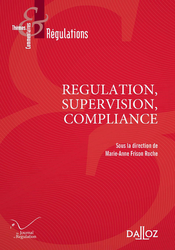
Régulation, Supervision, Compliance (Regulation, Supervision, Compliance)

General reference : Frison-Roche, M.-A. (ed.), Régulation, Supervision, Compliance (english translation: "Regulation, Supervision, Compliance"), Paris, collection "Régulations", Dalloz, 2017, to be published. This collective book is published in French but summaries of every article are available in English Acces to book purchase order Book presentation in English : Regulation. Supervision. Compliance. Three terms almost unknown to legal systems. Or at least considered as peculiar to Anglo-American legal systems: Regulation, Supervision, Compliance. So many expressions that would constitute Trojan horses by which the Common Law and american mechanisms would seize the other legal traditions to better bend European companies, especially banks, appropriating institutions, imposing strange methods. Three words by which the invasion is carried out. Through the violence of repression and penalties of compliance, by the mildness of codes of conduct and corporate social responsibility. By laws as new as strange such as in France the law known as "Sapin 2" or the law instituting a "duty of vigilance" to companies whose failure would be to have successfully deployed internationally their activities. One can have this defensive conception of Compliance, generating a "Compliance Law", produced by internalization in global economic operators of the Regulation Law, which are then subject to Supervision by Regulators, even though these firms are not regulated, as the Compliance does extend beyond supervised sectors (banks and insurance companies). We can (and maybe must) have a more welcoming, and therefore more offensive, concept of Compliance. This can be the crucible of a relationship of supra-national Trust between these operators and regulators, the former being able to contribute as the latter to serving goals that all exceed them and whose fight against corruption and money laundering are only examples. In this way, the issue is the construction of the European Compliance Law.   Authors : Jean-Bernard Auby, Jérôme Bédier, Alain Bénichou, Jean-Michel Darrois Isabelle Falque-Pierrotin, Marie-Anne Frison-Roche, Benoît de Juvigny, Jacques de Larosière, Bruno Lasserre, Arnaud de La Cotardière, Jean-Claude Marin, Didier Migaud,, Yves Perrier, Jean-Marc Sauvé.   Voir la présentation du cycle de conférences sur lesquelles s'est construit l'ouvrage.   Voir la présentation générale de la collection dans laquelle l'ouvrage est publié.   Utiliser le bon pour commander l'ouvrage.

I-0.2 Débats autour de l’évolution de la régulation bancaire et ses impacts

ENGLISH After a video recording of his first conference devoted to the relations between Regulation and Supreme Courts, The Journal of Regulation published a book on the future of the audit, based on another conference. This present document, written in French worked with KPMG, from conference co-hosted with this company and the “Ecole de Droit de la Sorbonne”, is devoted to the debates around banking regulation and its impacts. The challenge is to enable the persons concerned, that is to say to all citizens to express their opinion on an issue that concerns them directly, but whose technical dimensions, real or serviced, stand them aloof.   FRENCH Après sa vidéo retraçant sa première conférence consacrée aux relations entre la régulation et les Cours suprêmes, le Journal of Regulation a publié un libre sur L’avenir de l’audit, consacré sur la conférence suite. La présente publication, écrite en française, élaborée avec KPMG, à partir de la conférence organise avec celle-ci et l’Ecole de Droit de la Sorbonne, est consacrée aux Débats autour de la régulation bancaire et ses impacts. L’enjeu est de rendre les personnes concernées, c’est-à-dire tous les citoyens, aptes à exprimer leurs opinion sur un sujet qui les concerne tous directement mais dont la technicité, réelle ou entretenue, les tient à l’écart.

I-2.0: Is there a compelling need for neutral action in regulated economic sectors ? ?

TRANSLATED SUMMARIES ENGLISH “Acting in a neutral way” is an oxymoron. “Companies often require however that States use their powers in a neutral way (eg tax neutrality). In regulated sectors, some are right or even duty , of not being neutral. Firstly, it is the State, which requires the market for other purposes, other temporalities and other values​​. Secondly, they are also the “crucial operators”, which are sort of regulators of second degree, such as transmission system operators or companies capital markets firms. The difficulty increases when the systeme requires neutrality of regulators and judges, when first build economic policy and the second create jurisprudence. Their consistency, impartiality and rationality can create an objectifiable neutralitys FRENCH «Agir de façon neutre» est un oxymoron. «Les entreprises ont souvent besoin, cependant, que les États utilisent leurs pouvoirs de manière neutre (neutralité fiscale par exemple). Dans les secteurs réglementés, certains ont le droit ou même le devoir de ne pas être neutre. Tout d’abord, c’est l’État, qui insère le marché à d’autres fins, d’autres temporalités et d’autres valeurs. En second lieu, ils sont aussi les «opérateurs crucial», qui sont des sortes de régulateurs du second degré : par exemple les opérateurs de réseaux de transport ou de entreprises de marchés financiers. La difficulté augmente lorsque le systeme économique et politique exige la neutralité des autorités de régulation et des juges, alors que les premiers construisent la politique économique et les seconds construisent la jurisprudence. Le respect qu’ils doivent avoir de l’impartialité et d’une rationalité suffisamment objectivables pourra permettre cette objectivité requise.

1-2.8: Prudential banking regulation: selective activism or neutrality?

Translated Summaries The translated summaries are done by the Editors and not by the Authors. ENGLISH Prudential regulation applied to banks is caught swinging back and forth between two objectives. FRENCH La réglementation prudentielle appliquée aux banques oscille constamment d’un objectif à l’autre.

I-1.43: Market Homogenisation or Regulation Harmonisation? The Welfare Cost of a European Mobile Market without the Later Entrant Operators.

Translated summaries The translated summaries are done by the Editors and not by the Authors. ENGLISH The European Commission’s initiatives towards a Single Market in energy, transport and electronic communications should aim to further regulatory transparency and not market homogenisation. The article provides a quantitative and qualitative assessment of indiscriminating homogenisation of the mobile telecommunications market. The potential impacts on market power and the loss of consumer welfare are by no means negligible and imply important policy considerations FRENCH Les initiatives de la Commission européenne en vue d’un marché unique des communications de l’énergie, de transport et électroniques devraient viser à une plus grande transparence réglementaire et non pas à l’homogénéisation du marché. Le présent article fournit une évaluation quantitative et qualitative de l’homogénéisation inconsidérée du marché des télécommunications mobiles. Les impacts potentiels sur le pouvoir de marché et la perte de bien-être des consommateurs ne sont nullement négligeables et impliquent des considérations politiques importantes.

1-2.7: Confronting the FCC Net Neutrality Order with European Regulatory Principles

Translated summaries ENGLISH The FCC’s 2010 “open Internet” (net neutrality) order went into effect on November 20, 2011. Verizon Communications and Metro PCS have challenged the FCC Order in court, alleging that the FCC lacked statutory power to impose net neutrality rules in connection with Internet access services. FRENCH L’ordonnace 2010 de la FFC (le régulateur nord-américain des communications) “open Internet” est entrée en vigueur le 20 novembre 2011. Les sociétés Verizon Communications et Metro PCS ont contesté devant le juge cette ordonnance, alléguant que la FCC n’avait pas le pouvoir légal d’imposer des règles sur la neutralité du net concernant  l‘accès aux services d’Internet.

I-1.40: Where should the regulatory intervention of the French Competition Authority in the credit/debit card sector end?

Translated Summaries In The Journal of Regulation the summaries’ translation are done by the Editors and not by the authors ENGLISH Interchange fees set by the main credit/debit card associations play an important role in the retail banking sector, however they remain largely invisible to consumers.   FRENCH Les frais d’interchange fixés par les principales associations de cartes de crédit jouent un rôle important dans le secteur des services bancaires de détail, mais ils restent largement invisibles pour les consommateurs. SPANISH Tasas de intercambio establecidas por las asociaciones principales de tarjetas de crédito/débito juegan un rol importante en el sector de negocio de bancario minorista. No obstante, permanecen por la mayor parte invisibles a los consumidores. ITALIAN Le commissioni interscambio su carte di credito/debito fissate dalle principali associazioni giocano un ruolo importante nel settore dell’attività bancaria al dettaglio, tuttavia sono ancora poco visibili ai consumatori. ARABIC  رُسوم التبادُل التي وُضِعت مِن طرفِ جمعيات بطاقة الائتمان لها دورُ أساسي في مَجال المصرفية للخدمات الافرادية, لكِنَّ بقِيت هذِهِ الرُّسُوم غيرُ ظاهِرة لِكثِير المُستهلِكين.  ……………… Other translations forthcoming.  

I-2.6: Does a legal principle regarding net neutrality exist?

Translated Summaries In The Journal of Regulation the summaries’ translation are done by the Editors and not by the authors ENGLISH The debate on Net Neutrality faces a major difficulty, namely that of its legal status: does there exist a “legal principle”—meaning a rule somewhere within the entire body of law—with mandatory force that could be used to counter infrastructure operators’ discriminatory practices?   FRENCH Le débat sur la neutralité du Net fait face à une difficulté majeure, à savoir son statut juridique: existe-t-il un «principe juridique», qui exprime une règle dans l’ensemble du système juridique – avec une force obligatoire qui pourrait être utilisée pour contrer les pratiques discriminatoires des opérateurs d’ infrastructure ? SPANISH El debate sobre la Neutralidad de la Red se enfrenta a una gran dificultad, primordialmente en cuanto a su estatus legal: ¿realmente existe un “principio legal” – es decir, una regla que se encuentra dentro de la disciplina del derecho – con fuerza mandataria que podría ser usado para enfrentar a las prácticas discriminatorios que practican los operadores de infraestructura? ITALIAN Il dibattito sulla neutralità della rete si trova di fronte ad una difficoltà rilevante dal punto di vista del suo fondamento giuridico: esiste una norma giuridica obbligatoria – intesa come una norma legale – che possa essere utilizzata contro le pratiche discriminatorie degli operatori? ……………….. Other translations forthcoming.

2. Thematic Reports

1. Transports 2. Telecom & Post 3. Media 4. Internet 5. Energy 6. Finance, Banking & Insurance 7. Innovation 8. […]

1. Articles

Isolated Articles   Thematic Issues

I-1.39: An illustration of regulation’s irony: how Moody’s downgraded 12 German banks after regulatory change.

Translated Summaries In The Journal of Regulation the summaries’ translation are done by the Editors and not by the authors ENGLISH While financial regulation aims at achieving market stability, regulating markets can sometimes take an ironic turn when regulations end up having consequences that differ from their original regulatory purpose. The article provides such an example of regulation’s irony: how a regulatory change in Germany led Moody’s to downgrade 12 banks, therefore weakening such institutions and consequently enhancing the current issues of market volatility and credit cost.   FRENCH Bien que la réglementation financière vise à assurer la stabilité du marché, la régulation des marchés peut parfois prendre une tournure ironique quand la régulation finit par avoir des conséquences qui diffèrent de son objectif de régulation d’origine. L’article fournit un exemple de l’ironie de la régulation : comment un changement de réglementation en Allemagne a conduit Moody’s à déclasser 12 banques allemandes,, donc à affaiblir ces institutions et par conséquent à accroître les problèmes actuels de la volatilité du marché et le coût du crédit. ITALIAN Quando la regolazione è volta ad ottenere la stabilità del mercato, l’evoluzione di questi mercati oggetto di tale regolazione può essere particolarmente ironica quando la regolazione ha delle conseguenze ben differenti da quelle originariamente prepostesi. Questo articolo cerca quindi di mettere in evidenza un esempio di questa ironia: in effetti, un cambio di regolatore in Germania ha portato Moody’s a tagliare il rating di 12 banche, indebolendo ancora di più tali istituzioni ed aumentando si conseguenza le questioni relative alla volatilità del mercato e del costo del credito. ………………….. Other translations forthcoming

I-1.38: Transmission unbundling as ex ante instrument of structural Regulation of the energy market

Translated Summaries In The Journal of Regulation the summaries’ translation are done by the Editors and not by the authors ENGLISH : In order to establish a competitive energy market, the distribution infrastructure, as a monopolistic segment of energy networks, should be demonopolized. Instruments of economic regulation, which are often attributed ex ante character, are put in place to open the market and enable competitive forces. Unbundling is specific for it may also represent an ex post measure of a structural nature, exerted by competition protection authorities.   FRENCH Afin d’établir un marché énergétique compétitif, l’infrastructure de distribution, en tant qu’il est un segment monopolistique des réseaux d’énergie, devrait être libéralisé. Les instruments de régulation économique, qui sont souvent attribués d’une façon ex ante, sont mises en place pour ouvrir le marché et rendent possibles les forces concurrentielles. Le dégroupage est spécifique, car il peut aussi représenter une mesure ex post de nature structurelle, exercée par les autorités de protection de la concurrence. ITALIAN Per costruire un mercato concorrenziale dell’energia, le infrastrutture di distribuzione, in quanto segmento monopolistico delle reti di energia, dovrebbero essere liberalizzate. A tal fine, sono applicati dei meccanismi di regolazione economica, spesso previsti ex ante, per aprire il mercato e permettere le forze concorrenziali. L’unbundling è particolare, in quanto potrebbe anche costituire un provvedimento ex post di natura strutturale, utilizzato dalle autorità di tutela della libera concorrenza. ……………….. Other translations forthcoming.