Food for thoughts

Sept. 9, 1994
Publications
► Référence complète : Frison-Roche, M.-A., Les pouvoirs normatifs en jeu dans le droit de la concurrence, recherches menées et rapport rédigé pour le Laboratoire de sociologie juridique, Université Panthéon-Assas (Paris 2), 1994, 213 pages.
____
____

Aug. 31, 1994
Thesaurus : Doctrine
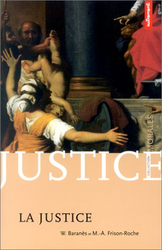
Référence complète : Canto-Sperber, M., in Baranès, W. et Frison-Roche, M.-A., La justice. L'obligation impossible, coll. " Nos valeurs", Éditions Autrement, 1994, p. 28-41.
L'accomplissement moral de l'individu n'est possible que dans l'ordre politique, et cet ordre doit promouvoir un ensemble de réalités morales inaccessibles à l'individu isolé ou au groupe familial. L'idée est partagée par Platon et Aristote, mais le premier a, dans La République, fait de la justice une réalité substantielle structurant l'ordre politique.
Consulter la présentation générale de l'ouvrage.
« Les étudiants de Sciences po peuvent lire l’article via le Drive de Sciences po en allant dans le dossier « MAFR – Régulation ».

Aug. 31, 1994
Publications
► Référence complète : M.-A. Frison-Roche, "2+1 : la procédure", in W. Baranès et M.-A. Frison-Roche (dir.), La justice. L'obligation impossible, éd. Autrement, coll."Morales", 1994, pp.193-207.
_____
► Lire l'article.
📕Consulter la présentation générale de l'ouvrage.
« Les étudiants de Sciences po peuvent lire l’article via le Drive de Sciences po en allant dans le dossier « MAFR – Régulation ».

June 23, 1994
Publications
June 23, 1994
Publications

June 1, 1994
Thesaurus : Doctrine
► Référence complète : B. Edelman, "Restons sauvages !", in M. Vacquin (dir.) La responsabilité. La condition de notre humanité, éd. Autrement, Série Morales, p. 132-144, 1994.
____
► Résumé de l'article :
May 14, 1994
Publications

April 14, 1994
Publications
Référence complète : FRISON-ROCHE, Marie-Anne, Les difficultés méthodologiques d’une réforme du droit des faillites, D.1994, chron., p.17 s.
April 5, 1994
Publications
Référence complète : M.-A. Frison-Roche, "Le sort des engagements non-financiers des plans", Rev. proc. coll. 1994, p.339 s. (rectificatif p.433).
_____
Cet article a pris appui sur une recherche de sociologie juridique menée à partir de l'analyse des plans de redressement et de leur suivi, pratiqués par le Tribunal de commerce de Paris. Cette recherche, menée avec Michel Germain, a donné lieu à un rapport de recherche, remis au Tribunal de commerce de Paris en 1993.
______

Jan. 31, 1994
Publications
► Référence complète : Baranès, W. et Frison-Roche, M.A. (dir.), La Justice. L’obligation impossible, série "Morales", éditions Autrement, 1994 ; réédition au Seuil, collection « Point », 1999 ; réédition aux Éditions Autrement, 2002 ; reprint Éditions Autrement, 2009.
____
► Présentation de l'ouvrage : La justice est une obligation au sens étymologique puisqu'elle constitue un lien entre les individus. Mais c'est cette obligation impossible dans la mesure où il faudrait, pour être juste, tout connaître et combattre toutes les injustices, en ne se contentant pas de réfréner la sienne propre. On ne peut jamais être certain d'avoir été tout à fait juste.
Dans l'expérience, c'est l'injustice qui est première, la justice vient après, par réaction. Encore faut-il pouvoir donner un contenu à cette vertu. Peut-on prendre pour modèle l'ordre naturel des choses ou bien ce modèle ne peut-il être que divin ? Il s'agit, en fait, de constituer un monde de justes rapports de soi à soi, de soi aux autres, des hommes et des choses. La justice est une harmonie, elle est le gage du lien social.
Que ces questions relatives au contenu soient résolues ou non, la justice apparaît comme une impérieuse nécessite, un évident progrès social, dès lors qu'à la vengeance privée se substitue le procès. L'institution juridique, le législateur, les juges ont à leur charge de réaliser la justice, ainsi entendue. Il n'est pas sans signification que seule cette vertu ait son ministère.
____
- Lire la préface de l'ouvrage, rédigée par William Baranès et Marie-Anne Frison-Roche
- Consulter le sommaire, contenant le résumé de chacun des articles composant le volume.
- Consulter la présentation de chacun des auteurs ayant contribué à l'ouvrage.
____
Parmi les contributions de cet ouvrage, consulter la présentation des articles suivant :
🕴️M. Canto-Sperber, 📝La vertu individuelle, modèle politique
🕴️M.-A. Frison-Roche, 📝2+1 = La procédure
🕴️S. Lebovici, 📝C'est pas juste
________

Jan. 19, 1994
Teachings : Participation à des jurys de thèses
Dec. 20, 1993
Publications
Dec. 20, 1993
Publications

Nov. 17, 1993
Organization of scientific events
Nov. 11, 1993
Publications

🌐follow Marie-Anne Frison-Roche on LinkedIn
🌐subscribe to the Newsletter MAFR Regulation, Compliance, Law
____
► Full Reference: M.-A. Frison-Roche, in collaboration with Serge Bories, "La jurisprudence massive" ("The Massive Jurisprudence"), D. 1993, chron., pp. 287-330
____
📝read the article (in French)
____
► English Summary of the article: The term "jurisprudence" is likely to have several meanings: on the one hand, jurisprudence stricto sensu, that emanating from the High Courts; on the other hand, "massive jurisprudence", designating all legal decisions rendered by the courts. This study of "mass case law" is divided into two parts: the first sets out the advantages of analysing mass judgments (I.), and the second develops the method that should be used to study these judgments (II.).
The analysis of massive jurisprudence is of threefold interest: educational, scientific and practical. Educational, in that it provides a more concrete, comprehensive and detailed view of the subject being taught. Scientific, in that it provides a global perspective, making it possible to take a closer look at reality and thus analyse the phenomena of pluralism in case law and anticipate 'elite case law' or legislative developments. And lastly, it is practical, in that it enables legislators to learn as quickly as possible about the practical application of the law and its consequences, so that they can potentially react to counter any perverse effects and/or use this information to adapt their legal policy decisions.
The analysis method involves 3 stages. Firstly, a prior qualitative analysis of the banal judgment must be carried out, based on the extraction of key words and concepts contained in the decision, in order to transform the raw information into data. Next, categories of analysis need to be established, based on the structure of the data collected and the research hypotheses, in order to process the mass of refined data collected. It is also essential to have access to all the data used to adopt the decision. In the final stage, complementary methods, such as studying the case file or interviewing magistrates, should be added to the textual analysis.
________
Oct. 27, 1993
Publications
Oct. 23, 1993
Publications
Référence complète :BARANES, William, FRISON-ROCHE, Marie-Anne, ROBERT, Jacques-Henri, Pour le droit processuel, D.1993, chron., p.9-11.
Il est nécessaire de construire et d'enseigner le "droit processuel", que commença à concevoir Henri Motulsky. En effet, le droit processuel est autonome des droits substantiels que les parties revendiques et des trois contentieux, procédure civile, procédure pénale et contentieux administratif, en ce qu'il exprime les principes communs et inhérents à tous procès : le droit d'action et l'intérêt à agir, le contradictoire et les droits de la défense, le jugement et sa motivation. Le droit processuel relève d'un droit comparé interne qui recherche l'esprit propre à chaque procédure et permet les emprunt de l'une à l'autre. Il pose surtout un droit commun de la procédure, dont désormais la Convention européenne des droits de l'homme et les droits constitutionnels sont la principale source.
Lire le résumé de l'article ci-dessous.

April 26, 1993
Publications
Référence complète : FRISON-ROCHE, Marie-Anne, "Le droit comme tradition", Magazine littéraire, février 1993.
Article rédigé dans le numéro spécial consacré à la parution des "Lieux de mémoire", dirigé par Pierre Nora.
April 26, 1993
Publications
Référence complète : FRISON-ROCHE, Marie-Anne, "L’utilisation de l’outil sociologique dans l’élaboration de la jurisprudence", Revue de recherche juridique, 1993/4, p.1271 s.

April 8, 1993
Conferences
Référence complète : FRISON-ROCHE, Marie-Anne, L’utilisation de l’outil sociologique dans l’élaboration de la jurisprudence, in La jurisprudence, Colloque de l’association internationale de Méthodologie juridique, 8 avril 1993, Rabat, Maroc.
April 7, 1993
Thesaurus : Doctrine
► Référence complète : G. Teubner, Le droit, un système autopoïétique, PUF, coll. "Les voies du droit", 1993, 296 pages.
(traduction en français de l'ouvrage initialement publié en allemand : Recht als autopoietisches System).
________
Broché, 296 pages
Paru le 1ᵉʳ avril 1993 chez Puf
2130450539
9782130450535
384 grammes
March 27, 1993
Conferences
► Référence complète : : M.-A. Frison-Roche, "Sociologie de l’éthique des affaires", in L’éthique des affaires, Colloque de l’association des étudiants du D.E.A. de droit des affaires de l’Université de Paris II, 27 mars 1993, Paris.
____
Feb. 9, 1993
Publications

Jan. 25, 1993
None