Food for thoughts

Dec. 20, 1992
Publications
Dec. 20, 1992
Publications

Oct. 3, 1992
Thesaurus : Doctrine
► Full reference : J. Carbonnier, "Toute loi est-elle un mal ? (Is every law a bad thing?), in Essais sur les lois (Essays on Legisation), 2nd ed., Répertoire du notariat Defrénois, 1992, pp. 317–334.
____
► Summary : Jean Carbonnier takes as his starting point the coincidence in time between the announcement of Christ’s birth and the proclamation of the census by Caesar Augustus’s edict, and goes on to ask whether, in legal matters as in religious ones, the advent of the new law might be good news.
It is accepted that many new laws were bad, but is the new law bad ‘in itself’?
The author does not wish to let the distinction between favourable and unfavourable laws (a sociological criterion of interest) or the distinction between old and new laws (a psychological criterion of the clash between novelty and habit) interfere, so as to address the subject as neutrally as possible: is the law an evil in itself? This pits the law against case law, custom or equity, which might be superior, but then again the author takes a broader view and prefers to contrast law with non-law and pose the question even more radically: is law in itself an evil?
To begin with, Carbonnier demonstrates the necessity, the advantages and the beneficial effects of the law, which was particularly revered by the French Revolution and, above all, by the people because of the ‘benevolence of the law’. France remains steeped in this favourable legalistic prejudice. This stems from the sense of security it affords the people, because it is clear, precise and uncompromising, permanent, and because it serves as a means of communication between people.
In the second part of the article, Carbonnier refers to Lacan, who, in relation to the law, invoked the figure of the father and predicted a future society without a father. Carbonnier wonders whether a lawless society is not about to emerge, or whether psychoanalysis, seeing castration in the law, still identifies it as an evil. In any case, he sees in this an opposition to freedom and liberalism, the rejection of the law being associated with the rejection of the state. Quoting Maurice Barrès and his 1892 work, L'ennemi des lois, he shows that for Barrès, all law is an evil, because the world must organise itself spontaneously. For liberalism, which is less romantic, every law is an evil because it hinders the spontaneous emergence of the general interest of the social group. Thus, to take Hayek as an example, the individual knows his own interest better than the law, and the sum of these interests gives rise to the general interest. Moreover, not only is the law pernicious, but, according to liberalism, it corrupts human nature, atrophies the will and diminishes responsibility, in a perverse pedagogy.
In the third part of the article, Dean Carbonnier goes on to argue that the law acts more as a safeguard and is therefore a good thing, provided the legislator remains modest. He believes that the law is necessary because man is a sinner (in a nation of righteous people, the law would be unnecessary), citing Luther and Saint Augustine. The law is therefore indispensable insofar as it wields the sword. Indeed, the law must strike because the world is inhabited by evil.
The Dean states: “It is in this sense that the law appears as an evil: not because it causes harm or does harm, but because it is linked to the existence of evil. It is the revealer of sin...”.
He concludes: "Knowing that the law was given to curb evil, lawyers will use it without hesitation. Knowing that it is a source of evil, they will use it with restraint."
It is in this self-imposed limitation that lawlessness emerges.
____

Sept. 15, 1992
Conferences
June 25, 1992
Publications

June 24, 1992
Thesaurus : Doctrine
► Référence complète : B. Oppetit, Le droit international privé, droit savant, recueil des cours de l'Académie de Droit international de La Haye, vol. 234, 1992.
_____

May 7, 1992
Publications
Nov. 16, 1991
Thesaurus : Doctrine
Référence complète : Lyon-Caen, G., Une vieillesse sans droit, Recueil Dalloz, 1991, p.111 s.
Cet article a été écrit avant que n'intervienne la réforme de la loi de 2007 sur le droit des incapables majeurs, mais il conserve toute sa pertinence puisque celle-ci n'a pas remis en question cette appréhension du droit qui distingue simplement parmi les êtres humains entre les "mineurs" et les "majeurs" et non pas être les "jeunes" et les "vieux". Ainsi, l'idée-force de cet article demeure : la vieillesse est un fait que le droit ne connaît pas.
Lire le résumé de l'article ci-dessous.
Oct. 16, 1991
Conferences
July 10, 1991
Thesaurus : Doctrine
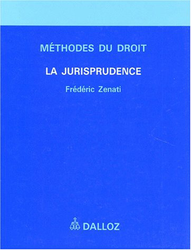
Référence complète : Zénati, F., La jurisprudence, coll. " Méthodes du droit" , Éditions Dalloz, 1991, 282 p.
Consulter la table des matières.

June 24, 1991
Thesaurus : Jurisprudence
Full reference: Cour d'Appel de Paris, 24th of June 1991, Devanlay SA c/ Société des Galeries Lafayette et autres
June 20, 1991
Publications
June 20, 1991
Publications
June 20, 1991
Publications
May 15, 1991
Thesaurus : Doctrine
► Référence complète ; N. Zanon, "La polémique entre Hans Kelsen et Carl Schmitt sur la justice constitutionnelle", in Principe d'égalité et droit au suffrage, Annuaire international de justice constitutionnelle, 5-1989, 1991, pp.177-189.
____
________
April 23, 1991
Thesaurus : 05. CJCE - CJUE
Full reference: CJUE, 6th chamber, 23rd of April 1991, judgment C-41/90, Klaus Höfner and Fritz Elser versus Macotron GmbH

April 20, 1991
Organization of scientific events
July 3, 1990
Publications
June 21, 1990
Publications
June 21, 1990
Publications
June 21, 1990
Publications
June 13, 1990
Thesaurus : Doctrine
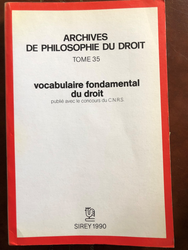
Complète reference : Archives de Philosophie du Droit (APD), Vocabulaire fondamental du droit, tome 35, ed. Sirey, 1990, 437 p.
Read the forth of cover.
Read the summaries of the articles in English.
See the presentation of other volumes of Archives de Philosophie du Droit.

Jan. 1, 1990
Publications
Dec. 20, 1989
Publications
June 1, 1986
Thesaurus : Doctrine