Amicus curiae

📝Antitrust, natural field of Systemic Litigation

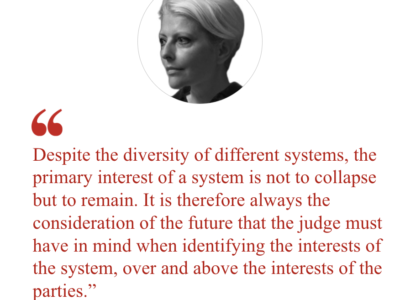
► Full Reference: [rubrique p="Présentation"]M.-A. Frison-Roche[/rubrique], "Antitrust, natural field of Systemic Litigation", Concurrences, November 2024, No. 4, Art. No. 120776. - 📝read the article (in English) - 🚧[lien a="antitrust-natural-field-of-systemic-litigation"]read the bilingual Working Paper which is the basis of this article[/lien], with additional developments, technical references and hyperlinks - ► English Summary of this article: Systemic Litigation is a specific category of Litigation in which beyond the dispute between the parties the interest of a System is involved, in particular its future. Competition Law is a natural and long-standing field for this category, which is now emerging strongly for information, climate and energy systems.  It should be remembered that a market is not self-regulating and cannot continue to function in the long term unless it has the benefit of a judge, a figure who is specific in that he/she is both external to it and yet apprehends its specific interest. In order to satisfy this double requirement, liberal legal organisations often entrust the competition authority with jurisdiction over this Systemic Litigation. Ordinary courts will also hear such cases, either on appeal or in other proceedings, and it cannot be claimed that courts are excluded, the systemic dimension of the dispute being expressed by the presence of the competition authority in the proceedings. This explains the procedural rules that are hard to justify otherwise. The Authority, the European Commission for example, must be able to develop and express the specific interests of the competition system. This special role of the competition authority in this type of litigation, because it is systemic, has been in place for decades and should serve as a model for Systemic Litigation, which is being developed for other systems whose sustainability is now referred to the courts. - 🌐follow Marie-Anne Frison-Roche on LinkedIn 🌐follow Marie-Anne Frison-Roche on Instagram 🌐subscribe to the Newsletter MAFR Regulation, Compliance, Law 🌐subscribe to the Newsletter Surplomb, par MAFR
CAYROL, Nicolas🕴️

📝L’amicus curiae, mesure d’instruction ordinaire

► Full reference: N. Cayrol, "L'amicus curiae, mesure d'instruction ordinaire", Chronique de Procédure civile, D. 2022, pp. 2181-2183. - ► Summary of the article (done by the author, in French) : Les mesures d'instruction sont généralement présentées comme des mesures tendant uniquement à l'administration de la « preuve de faits dont dépend la solution du litige ». À cette conception stricte, on préfère une conception large, englobant toutes les mesures tendant à instruire le tribunal. Cela présente l'intérêt de donner un cadre procédural connu à la désignation d'un amicus curiae par les juges, aidant ainsi à lever les ambiguïtés qui entourent encore ce procédé. -

🎤Audition as amica curiae by the Paris First Instance Civil Court, in summary proceedings, on the Compliance System and the place of the duty of vigilance in it

► Full Reference: [rubrique p="Présentation"]M.-A. Frison-Roche[/rubrique], Audition as amica curiae by the Paris First Instance Civil Court, in summary proceedings, on the Compliance System and the place of the duty of vigilance in it, 26 October 2022 - The hearing was held in the presence of two other amici curiae, also appointed by the Court: Professors Jean-Baptiste Racine and Bruno Deffains. The hearing was requested by and on the initiative of the Paris First Instance Civil Court in connection with a dispute between associations and TotalEnergie, the former alleging breaches of due diligence by the latter, and the Court asking highly qualified individuals to shed light on the Compliance System and its implications. - 📝read the hearing report published on 27 October 2022 by Olivia Dufour (Actu-juridique) 📝read the article reporting on the hearing of 7 December 2022, representing the presentation of Compliance Law by MaFR, published on 7 December 2022 by Mathilde Golla (Les Echos) 📝read the [lien a="lamicus-curiae-mesure-dinstruction-ordinaire"]article on the use of amicus curiae, starting with the use made in this case, published on 8 December 2022 by Nicolas Cayrol[/lien] (Recueil Dalloz) - 🌐follow Marie-Anne Frison-Roche on LinkedIn 🌐follow Marie-Anne Frison-Roche on Instagram 🌐subscribe to the Newsletter MAFR. Regulation, Compliance, Law

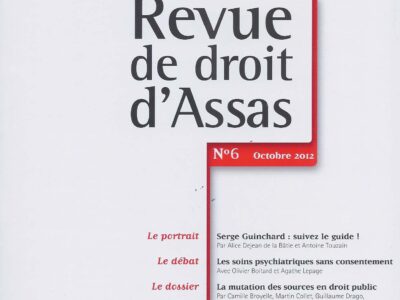
📝Experts et procédure : l’amicus curiae (Experts and procedure: the amicus curiae)

► Référence complète : [rubrique p="Présentation"]M.-A. Frison-Roche[/rubrique], "Experts et procédure : l'amicus curiae" ("Experts and procedure: the amicus curiae"), Revue de droit d'Assas, october 2012, pp. 91-94 - 📝read the article (in French) - ► English Summary of the article: A recent thesis has argued that amicus curiae is becoming a common principle of Procedural Law. This shows its importance. The fact that the mechanism, the character, is designated by a Latin formula leads us to suspect that something is being concealed that legal technique ordinarily forbids: it is the legal expert and the party's expert, which is what the amicus curiae most often is, either one or the other, or both at the same time. Therefore, removing the prudish cloak of Latin, it is these two difficulties that must be addressed. If we exclude the legal expert, it is because "jura novit curia" ("the court knows Law". But this rule, which recalls the principle that "no one is supposed to be ignorant of the law", merely indicates a sharing of the burden of evoking facts and Law between the parties and the judge (Motulsky) and not a presumption of knowledge. Consequently, the modest, and therefore self-confident, judge has no reason, either psychological or legal, to shy away from a legal expertise. As for the party's expert, or the judge's expert who is highly influenced by a party, a profession, a social group, in short, a judge's expert who is in fact an expert held by a party, this can only be a problem if the judge cannot keep his distance from this expert whose opinion is biased by the weight of the party. But first of all, any opinion is biased. Whether it is given in bad faith or good faith, it is biased, and in rhetoric we know that an opinion biased in good faith is more dangerous than a bought opinion, because the latter is known to be twisted by self-interest. In this respect, the person who listens to it, the judge, knows the difference. Indeed, the legal system that recognises the party's expert and the amicus curiae, i.e. North American Law or European Union Law, draws the necessary procedural consequence: they include the party's expert opinion in the adversarial debate. It is the principle of adversarial debate, the principle of principles in the conduct of proceedings, that makes amicus curiae acceptable and welcome, since it provides the judge with a scientific input that the latter does not have. -