Publications Related to Justice and Procedure

Working papers

Au coeur du droit, du cinéma et de la famille : la vie (“At the heart of Law, Cinema and Family: Life”)

This working paper served as a basis for the preface of the book: Magalie Flores-Lonjou and Estelle Épinoux (ed.),  La famille au cinéma. Regards juridiques et esthétiques ("Family in Cinema. Legal and Aesthetic Perspectives"), pref. Marie-Anne Frison-Roche, coll. "Droit et Cinéma", Éditions Mare et Martin, 2016. Since the transmission of the text, this working paper has been updated many times.  It contains links towards approximatively 90 movies which appears relevant to me for this topic. 

Books

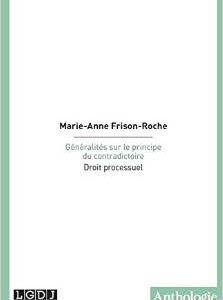
📕Généralités sur le principe du contradictoire. Étude de droit processuel (Generalities about the principle of contradictory. Study of procedural Law)

Full reference: Frison-Roche, M.A., Généralités sur le principe du contradictoire. Étude de droit processuel, coll. "Anthologie du Droit", Lextenso – LGDJ éditions, 2014, 221 p. - Republished from Généralités sur le principe du contradictoire », Étude de droit processuel, Th. Paris II, 1988.  This book is the publication of a thèse d'Etat (French official thesis) written under the direction of Jean Foyer and defended in the Panthéon-Assas University (Paris II) face to a jury made up among others of François Terré, René Chapus, Gérard Cornu, Geneviève Viney.  The main idea is to defend that the principle of contradictory is a simple and fundamental principle, without which there is no Law. It is the reason it is obvious to study it as in civil procedure as in criminal, administrative or arbitrary procedures, to take back a "Procedural Law" perspective conceived by Motulsky. Indeed, without a judge listening without having already decided the facts and Law versions that presents who's the situation will be affected by the decision that the judge will make, there is no rule of Law.  The main beneficiary of the principle of contradictory, it is not really the person, and it is in this that the contradictory is detached from the rights of the defense, it is the judge. Indeed, emphasizing contradictory versions of Law and facts which collide in front of him or her, the judge perceives more exactly and more fairly the world and the use of Law that he or she should favor. Thus, Law is better used. In this, we can consider that the principle of contradictory is consubstantial to Law. Read the summary (in French) Read the introduction (in French) Read the table of contents (in French)


Breaking news

The “Conseil d’État” (French Council of State) transmits July 23, 2014 a “Question prioritaire de constitutionnalité – QPC” on any non-compliance with the Constitution of concurrent sanctions under the Non bis in idem principle, about the French Court of budgetary and financial discipline

In its judgment of 23 July 2014, MM. B., A. et C., the Conseil d'État (French Council of State) shall transmit a  Question prioritaire de constitutionnalité – QPC (Priority Question of Constitutionality) to the Conseil constitutionnel  (French Constitutional Council) about the compliance of the procedural organization of the Cour de discipline budgétaire et financière – CDBF (French Court of fiscal and financial discipline) in terms of constitutional principle impartiality. Indeed, the jurisprudence of the Constitutional Council has incorporated in the constitutional corpus the principle of impartiality, objectively designed   as judicial jurisprudence and the jurisprudence of the European Court of Human Rights have done and have imposed the organs exercising power sanction must give to see their impartiality (definition of the "objective impartiality") to third parties who must have confidence in this body which has power to impose sanctions.

Breaking news

In France, a decree of 1st August 2014 finally reorganizes the sanction procedure before the French telecommunication Regulator (ARCEP), after the condemnation by the French Constitutional Council for partiality

Political power has often difficulties, or takes a long time to admit the principles of law, such as express the judges. So it was quite certain that the penalty proceedings held before the Autorité de Régulation des Communications Electroniques et de la Poste -ARCEP  (French Regulatory Authority for Electronic Communications and Post, as the investigation body and the judgment body were not sufficiently distinct crumpled the constitutional principle of impartiality. It was acquired about 15 years. Yet the organization has continued. It has been enough that an operator has been sanctioned. He used the procedure of Question Prioritairre de Constitutionnalité -Q.P.C.  Priority Question of Constitutionality) and Numéricable July 5, 2013 decision by the Constitutional Council came to declare that any sanction proceedings before ARCEP unconstitutional, because of objective procedural partialité, thus causing difficulty to the regulator. It took until the 0rdonnance of March 12, 2014 and finally the decree of 1st August 2014 to organize an efficient sanctions procedure, making this time an intern wall within the ARCEP between the services responsible for the instruction and those which are responsible for judging. The great judge Pierre Drai used to say: "Ne pas respecter le droit coûte cher (Do not respect the law is expensive)". We see here that this is true also for the Government which writes laws and regulations. So, for months, the regulator has been without power, to the delight of the operators, who often are tacticians or turbulent.

Articles in a legal collective publication

📝Les décisions des juges et des régulateurs favorisent-elles la compétitivité des entreprises françaises ?

📝Les décisions des juges et des régulateurs favorisent-elles la compétitivité des entreprises françaises ?, in 📗La compétitivité de la règle de droit

Documents decisions_des_juges.pdf 4em_de_couv.pdf programme_22_11_2013.pdf