
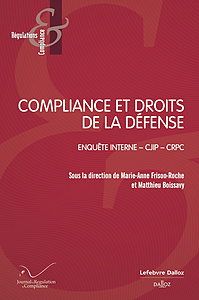
► Full reference : Th. Baudesson, « L’évolution des rapports entre avocats et autorités de poursuites depuis l’introduction de la CJIP » (The Evolution of Relations between Lawyers and Prosecuting Authorities since the Introduction of the CJIP), in M.-A. Frison-Roche and M. Boissavy (eds.), Compliance et droits de la défense. Enquête interne – CJIP – CRPC, 
____
► English Summary of this article (made by the Journal of Regulation & Compliance – JoRC) : The author considers that the CJIP, the most striking development in criminal procedure, brings the Bar and the prosecuting authorities into dialogue, moving from a logic of confrontation to one of cooperation. This is a new type of relationship. The prosecutor concerned is above all the PNF, which has expertise in this area, disseminates it through its soft law and provides more legal certainty to companies.
He illustrates his remarks in particular with the so-called Airbus CJIP, in which there was a confrontation with English and American practices in “cooperation investigations” which require mutual trust. But he acknowledges the progress that remains to be made, both on the side of lawyers, who in France seem to remain as a matter of principle in opposition to magistrates and little attentive to what could be their role in the search for truth, and on the side of magistrates, who seem to perceive lawyers as a kind of “mercenaries” to be distrusted as a matter of principle. This is why, in their guide on internal investigations, the AFA and the PNF require that the lawyer who conducts the investigation and the one who ensures the criminal defence of the company cannot be the same, which the author explains by this distrust, presuming investigations of convenience, a suspicion of principle that the author regrets. Likewise, the refusal of magistrates to recognise the professional secrecy covering the investigation report seems to the author archaic in comparison with Anglo-Saxon conceptions, since the DoJ and the SFO readily accept the legal privilege attached to this report. As a result, France would not be at the same level of Rule of Law as the United States and the United Kingdom.
The author concludes that progress remains to be made for France to complete its evolution and become fully attractive, so that companies confronted with reprehensible practices are effectively led to undertake a self-reporting approach.