All news

Breaking news

🧱One always learns from Jean-Michel Darrois

► Full reference: M.-A. Frison-Roche, “One always learns from Jean-Michel Darrois”, LinkedIn post, 6 October 2026. -

Organisation of events

🏗️Cycle of colloquia 2026: Compliance and Contract

🧮 Compliance et Droit commun des contrats (Compliance and General Contract Law), in 🏗️Compliance and Contract

► Full reference: Journal of Regulation & Compliance (JoRC) and Université Paris 1 Panthéon-Sorbonne, Institut de recherche juridique de la Sorbonne (IRJS) (Sorbonne Legal Research Institute), Compliance et Droit commun des contrats (Compliance and General Contract Law), 7 October 2026. - 🏗️ This symposium is part of the series of symposiums organised by the Journal of Regulation & Compliance (JoRC) and its partner universities, focusing in 2026 on the general theme of Compliance and Contract. - The symposium is under the scientific responsibility of 🕴️Nicolas Bargue, Senior Lecturer (maître de conférences) at the Sorbonne Law School (Université Paris 1 Panthéon-Sorbonne), co-director of the Contract, Civil Liability and Insurance Department of the IRJS, 🕴️Marie-Anne Frison-Roche, Professor of Law (agrégée des Facultés de Droit), Director of the Journal of Regulation & Compliance (JoRC) and of the European School of Regulation and Compliance (EeRC), and 🕴️Julia Heinich, Professor at the Sorbonne Law School (Université Paris 1 Panthéon-Sorbonne). - Registration with the IRJS: Registration for the symposium « Compliance et droit commun des contrats » of 7 October 2026 | Labo – IRJS - 🧮The symposium, organised by the Journal of Regulation & Compliance (JoRC) and the Institut de recherche juridique de la Sorbonne (IRJS), will take place on Wednesday 7 October 2026, from 9:15 am to 1 pm, at Université Paris 1 Panthéon-Sorbonne, Room 6 of the Centre Panthéon, 12 place du Panthéon, 75005 Paris. It will be held in French. - Presentation of the topic: While Contract Law, in its common rules expressed by the “general theory of contracts”, is often considered to be the most developed branch of Law in practice and the most studied at university, at first glance it seems to be given little consideration when it comes to Compliance. The relationship between the contract and the documents, standards and ethical acts so numerous in Compliance techniques, to which is added the soft law produced by courts, regulators, supervisors and companies themselves, is an open question. Thus the “commitments” that punctuate the techniques and behaviours making up the “compliance culture” have a central place in Compliance Law; but their place, if not their equivalence with the Contract, is not established. To gain a firmer footing in the analysis of the practices of companies that insert compliance clauses into multiple contracts, to observe that Compliance can be the very subject of a specific contract — the “compliance contract” —, or even to assist in the conception that judges develop of their office when they hear contractual litigation involving Compliance, we must return to general Contract Law. If we stop viewing Compliance Law solely through the prism of repression, the Contract does not have the same place: the compliance obligation can be conceived as also having the contract as a legitimate source, a contract which, under general law, has its source in the autonomy of the will and all its consequences — contractual freedom, binding force, effect on third parties. This is the subject of this symposium which, following the classic diptych of formation and performance, takes up the contractual thread from the founding principles of autonomy and freedoms, binding force and its relativity, the meeting of wills, groups of contracts and regulatory contracts often drawn up to implement compliance policies. Specific performance and contractual liability under general law are themselves coloured in a singular way when a compliance concern has been inserted into the contract. - The proceedings of this symposium will form the basis of a specific chapter in the following publications: 📕Compliance et Contrat, forthcoming in the series 📚Régulations & Compliance, co-published by the Journal of Regulation & Compliance (JoRC) and Lefebvre-Dalloz. 📘Compliance and Contract, forthcoming in the 📚Compliance & Regulation Series, co-published by the Journal of Regulation & Compliance (JoRC) and Lefebvre-Bruylant. 🔻 See the programme below
Des étudiants perplexes autour d’une table, deux ouvrages rouges posés devant eux, la chatte Nobelle au premier plan

Videos

Series of drawn videos on Compliance Law — Compliance in Motion

🎭The Mystery of the Monumental Goals

▶ click on the image to watch the episode on YouTube - ► Full reference: M.-A. Frison-Roche, “The Mystery of the Monumental Goals”, in series of drawn videos Compliance in Motion, episode 2, 2 October 2026 - ► Summary of this episode of Compliance in Motion: Students sit around a table; on the table, two books. Three words are given to them — Compliance Monumental Goals — and nobody really sees what that means. The Compliance Ogre, of course, is certain: “Me, me, me! I know what the Monumental Goals are!” And yet, it is no riddle. A Monumental Goal is an edifice: protecting the climate, stopping corruption, respecting others. Compliance Law does not merely forbid, it aims; and because the goal is monumental, no one builds it alone — the judge, the lawyer, the company, the teacher, each brings a stone. That is where Compliance Law draws its normativity, and that is what separates it from mere conformity. They are not decreed. They are built. At the end, the Ogre: “Yes, yes, yes — I said so!” He had not said so. Less than a minute, not a word spoken. One episode every two weeks, in French and in English. - 🌐 watch this episode of the series on YouTube: Compliance in Motion 🌐 watch this episode of the series on Instagram: Compliance in Motion 🎬 watch this episode of the series below Compliance in Motion ⬇️ - Compliance in Motion, by mafr the series of drawn videos devoted to Compliance Law ComplianceTech® - 🌐follow Marie-Anne Frison-Roche on LinkedIn 🌐follow Marie-Anne Frison-Roche on Instagram 🌐subscribe to the Newsletter MAFR Regulation, Compliance, Law 🌐subscribe to the Video Newsletter MAFR Surplomb 🌐subscribe to the Newsletter MaFR Droit & Art

Conferences

🏗️2026 conferences series: "Compliance & Contracts"

🧮 La contractualisation de la compliance : clause après clause (Compliance contractualisation: clause by clause)

► Full reference: Journal of Regulation & Compliance (JoRC) and University Jean Moulin – Lyon 3, Centre de recherche Louis Josserand : La contractualisation de la compliance : clause après clause (Compliance and Contracts: clause by clause), 25 September 2026 - 🏗️ This symposium is part of the series of symposiums organised by the Journal of Regulation & Compliance (JoRC) and its partner universities, focusing in 2023 on the general theme of Compliance and Contracts. - The symposium is under the scientific responsibility of Marie-Anne Frison-Roche and Jean-Christophe Roda. Il will be held in French. - To register: 🧮The event will take place at the University of Jean Moulin – Lyon 3. - Presentation of the topic:  There are numerous compliance clauses. Surprisingly little research has been done on them, which hinders the development of this practice. However, the Compliance Obligation that is so often emphasised in relation to civil liability no doubt because Compliance Law is excessively associated with sanctions, can just as easily originate from contracts and multiple clauses, since this is another way of being bound, without it being anything more than a means for the persons thus bound to fulfil their regulatory obligation. It is therefore practice that has developed compliance clauses, the very existence of which is the subject of this symposium. By highlighting these provisions, their originality can be revealed, as well as the uniqueness conferred on them by Compliance Law and the diversity that may be required depending on criteria related to the purpose of the clauses, but also to the sector of activity or the identity of the contracting parties themselves.  From this already established practice, it is certainly the Judge who will determine its uniqueness and specificity. This case law is in its infancy because this practice is the result of compliance requirements arising from an emerging branch of Law, which is still under development. Furthermore, the clauses examined here are not conceived from scratch, but are often adaptations of clauses familiar to lawyers, and as such may be reproduced, regulated, or even restricted or prohibited by rules that fall not only under general Contract Law, but also, clause by clause under Competition Law, Distribution Law, Consumer Law, Judicial and Procedural Law, or Private International law. The logic of Compliance Law, when it takes contractual form, does not always prevail and, in the same way that Compliance Law as a branch of Law is linked to other branches, compliance clauses, if they are to multiply and become more sophisticated, must be subject to this link. x - The proceedings of this symposium will form the basis of a specific chapter in the following publications: 📕Compliance et Contrat, to be published in French in the collection 📚Regulations & Compliance, co-published by the Journal of Regulation & Compliance (JoRC) and Lefebvre-Dalloz. 📘Compliance and Contract, to be published in English in the 📚Compliance & Regulation  Serie, co-published by the Journal of Regulation & Compliance (JoRC) and Bruylant (Larcier-Intersentia).   🔻 Read the schedule for the event below ⤵️  

Publication director

🏗️ copublishing and direction of the collection: 📚Régulations & Compliance

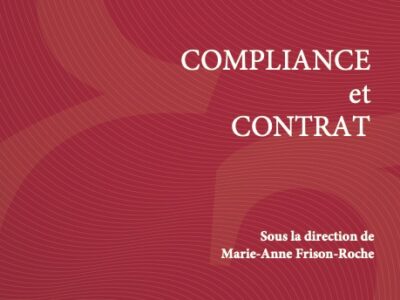
📚Forthcoming: 🕴️M.-A. Frison-Roche (ed.), 📕Compliance et Contrat (“Compliance and Contract”)

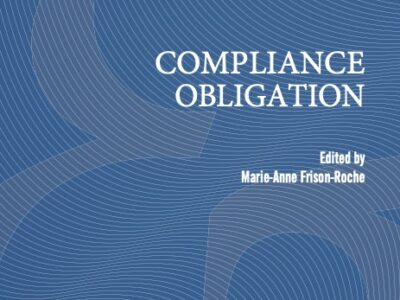
- ► Full Reference: M.-A. Frison-Roche (ed.), Compliance et Contrat (“Compliance and Contract”), “Régulations & Compliance” series, Journal of Regulation & Compliance (JoRC) and Editions Lefebvre-Dalloz, to be published. - 📘 At the same time, a book in English, Compliance & Contract, is published in the collection copublished by the Journal of Regulation & Compliance (JoRC) and the Editions Lefebvre-Bruylant. - 🧮the book follows the cycle of colloquia organised in 2026 by the Journal of Regulation & Compliance (JoRC) and its partner Universities - 📚this volume is one of a series of books devoted to Compliance in this collection. ► Read the presentations of the other books in the series: the following books: 🕴️M.-A. Frison-Roche (ed.), 📕Le système probatoire de la Compliance, forthcoming   the previous books: 🕴️L. Laref (ed.), 📕Compliance et vigilance bancaire, forthcoming 🕴️M.-A. Frison-Roche, 📕Le système juridique de l’adressage de l’Internet. Une structure multi-acteurs, gage de durabilité (The Legal System of Internet Addressing. A Multi-Stakeholder Structure, the Pledge of its Sustainability), forthcoming 🕴️M.-A. Frison-Roche (ed.), 📕L’Obligation de Compliance, 2025 🕴️M.-A. Frison-Roche and M. Boissavy (eds.), 📕Compliance et droits de la défense. Enquête interne – CJIP – CRPC, 2024 🕴️M.-A. Frison-Roche (ed.), 📕La juridictionnalisation de la Compliance, 2023 🕴️M.-A. Frison-Roche (ed.), 📕Les Buts Monumentaux de la Compliance, 2022 🕴️M.-A. Frison-Roche (ed.), 📕Les outils de la Compliance, 2021 🕴️M.-A. Frison-Roche (ed.), 📕Pour une Europe de la Compliance, 2019 🕴️N. Borga, J.-Cl. Marin and J.-Ch. Roda (eds.), 📕Compliance : l’entreprise, le régulateur et le juge, 2018 🕴️M.-A. Frison-Roche (ed.), 📕Régulation, Supervision, Compliance, 2017 🕴️M.-A. Frison-Roche (ed.), 📕Internet, espace d’interrégulation, 2016 📚see the global presentation of all the books of the collection. - ► General presentation of this book: The book, published in 2025 in the same series “Regulations & Compliance” series, demonstrates that the Obligation of Compliance—which falls upon crucial operators and those concerned with the future of systems and the present and future individuals involved in them—derives from laws and regulations, and is upheld by these operators themselves, regulators and judges. The role played by contracts is discussed therein. This book specifically examines the role that contracts play and will play in the conception, development and implementation of Compliance Law. This aspect is underestimated because Compliance Law is often analysed through the prism of laws and regulations designed to achieve Monumental Goals set by states and public authorities, to the realisation of which systemic economic operations contribute through compliance tools, rather than through the actors themselves. When they do act, this is referred to outside the realm of Law, generally to Ethics. However, the Contract, the binding legal instrument par excellence, will play an increasingly significant role within global and interconnected compliance systems. In the European construction of Compliance Law, which places human beings at the heart of efforts to ensure the sustainability of systems, the Contract serves not only as the means by which the entity fulfils its legal obligations, forges relationships with stakeholders and implements the necessary innovations, but also as the means by which it exercises its autonomy to contribute to the realisation of the systemic ambitions in question. To describe and anticipate the practice and rules that link Compliance Law and Contracts, the book first examines how this new branch of Law, insofar as it draws on the political ideas of the Social Contract, renews Contract Law by embedding it within the strategy of economic operators, a task made all the easier for them as they have built value chains through contracts. These are ‘regulatory contracts’. This demonstrates that Public Law Contracts exemplify the incorporation by General Contract Law of the overarching perspective of compliance, normatively anchored in the Monumental Goals (Title I). That explained, the book examines how General Contract Law interfaces with the techniques and objectives of Compliance Law. Whether through mandatory requirements, incentives or support, Compliance Law plays a role in contracts, helping to shape them in part, whether they relate to regulated or unregulated activities, with the points of contact with the principle of liberalism – and the limits to it – being determined by the courts. Conversely, however, General Contract Law contributes to Compliance Law and will do so increasingly. This applies equally to the stages of formation, execution, and sanctions, which may take the form of consolidations (Title II). In practical terms, the Contract itself serves as a Compliance Tool. As such, the company may choose to outsource the compliance function, which it is free to do provided it remains accountable for its performance to the legislator and the persons concerned: this is the concept of the ‘Compliance Contract’, which appears as a specific contract. Furthermore, compliance can be incorporated into multiple contracts—contractual arrangements through which the contracting parties establish one or more obligations that will facilitate or enhance their legal obligations. In doing so, legal entities exercise their freedom, as permitted by general law, and this is also recognised by the Regulator, Supervisor and/or Judge in light of the normative Monumental Goals of Compliance Law (Title III). Precisely, a new field of ‘contractual compliance litigation’ is emerging. The primary topic here is to examine contractual judicial disputes in which an element of Compliance Law features in the proceedings. Indeed, a dispute concerning a claim for mandatory execution, termination or contractual liability may involve, in the claim itself or in an procedural exception or defence raised, an element of compliance law, ranging from an allegation of lack of jurisdiction to a request for the court to take into account a systemic teleological norm that the contract judge should consider. Secondly, in certain emerging systemic compliance litigation, because the role of the judge is transformed and the procedure must be adapted, the contract appears as a particularly suitable tool, either as a ‘procedural framework’ through the contractualisation of the whole, or as a technique used in the strict sense, its ex ante nature allowing, in disputes concerning the future, the development of new adequate techniques (Title IV). - ► First presentation of the provisional Table of Contents  : - PROVISIONAL TABLE OF CONTENTS RENDRE COMPTE DES PRATIQUES CONTRACTUELLES DANS LE SYSTÈME DE COMPLIANCE ET ACCROÎTRE L’EFFICACITÉ ET L’HUMANISME DE CELUI-CI (REPORTING ON CONTRACTUAL PRACTICES WITHIN THE COMPLIANCE SYSTEM AND ENHANCING ITS EFFECTIVENESS AND HUMANITY) ♦️ Compliance et Contrat : étrangers, puis ennemis, de fait et droit alliés dans une conception dynamique et de l’Obligation de Compliance (Compliance and Contract: strangers, then enemies, in fact and in law allies within a dynamic conception of the Compliance Obligation), by 🕴️Marie-Anne Frison-Roche TITRE I. CONTRAT SOCIAL, DROIT DE LA COMPLIANCE ET STRATÉGIE DES OPÉRATEURS ÉCONOMIQUES (SOCIAL CONTRACT, COMPLIANCE LAW AND THE STRATEGY OF ECONOMIC OPERATORS) CHAPITRE I : CONTRAT SOCIAL ET DROIT DE LA COMPLIANCE (SOCIAL CONTRACT AND COMPLIANCE LAW) Section 1 ♦️ Les Buts Monumentaux de la Compliance, guide d’action pour des opérateurs économiques au service d’une politique globale (The Monumental Goals of Compliance, a guide to action for economic operators serving a global policy), by 🕴️Marie-Anne Frison-Roche Section 2 ♦️ sss, by 🕴️René Sève CHAPITRE II : AMBITIONS POLITIQUES ET STRATÉGIES D’ENTREPRISE DANS L’ORGANISATION CONTRACTUELLE DES CHAÎNES DE VALEUR (POLITICAL AMBITIONS AND CORPORATE STRATEGIES IN THE CONTRACTUAL ORGANISATION OF VALUE CHAINS) Section 1 ♦️ sss Section 2 ♦️ sss, by CHAPITRE III : LES CONTRATS PUBLICS, PARANGONS DE L’ACCUEIL DES AMBITIONS POLITIQUES DANS LES STRATÉGIES ET L’ALLIANCE DES INSTITUTIONS (PUBLIC CONTRACTS, PARAGONS OF THE INCORPORATION OF POLITICAL AMBITIONS INTO STRATEGIES AND OF THE ALLIANCE OF INSTITUTIONS) Section 1 ♦️ Les instruments contractuels facilitant l’insertion de l’obligation de compliance (Contractual instruments facilitating the insertion of the compliance obligation), by 🕴️Marion Ubaud-Bergeron Section 2 ♦️ Les obligations d’évaluation des tiers dans les contrats publics (Third-party assessment obligations in public contracts), by 🕴️Valentin Lamy Section 3 ♦️ L’exemplarité dans les contrats publics (Exemplarity in public contracts), by 🕴️Ugo Assouad and 🕴️Léon Boijout Section 4 ♦️ Le devoir de vigilance est-il soluble dans le droit des contrats administratifs ? (Is the duty of vigilance soluble in the law of administrative contracts?), by 🕴️Antoine Oumedjkane TITRE II. LE DROIT COMMUN DES CONTRATS CONFRONTÉ AU DROIT DE LA COMPLIANCE (GENERAL CONTRACT LAW FACED WITH COMPLIANCE LAW) CHAPITRE I : DISTINGUER LE CONTRACTUEL DE CE QUI S’EN RAPPROCHE DANS LE SYSTÈME DE COMPLIANCE (DISTINGUISHING WHAT IS CONTRACTUAL FROM WHAT RESEMBLES IT IN THE COMPLIANCE SYSTEM) Section 1 ♦️ Autonomie de la volonté, Engagements et Compliance (Autonomy of the will, Commitments and Compliance), by 🕴️Marie-Anne Frison-Roche CHAPITRE II : L’EMPRISE DU DROIT DE LA COMPLIANCE SUR LE DROIT COMMUN DES CONTRATS (THE HOLD OF COMPLIANCE LAW OVER GENERAL CONTRACT LAW) Section 1 ♦️ Les contrats de régulation engendrés par la compliance (Regulatory contracts generated by compliance), by 🕴️Jean-Baptiste Barbieri Section 2 ♦️ Les tiers aux contrats comprenant une dimension de compliance (Third parties to contracts that include a compliance dimension), by 🕴️Philippe Stoffel-Munck CHAPITRE III : L’APPORT DU DROIT COMMUN DES CONTRATS AU DROIT DE LA COMPLIANCE (THE CONTRIBUTION OF GENERAL CONTRACT LAW TO COMPLIANCE LAW) Section 1 ♦️ La portée des contrats traduisant l’impératif de compliance (The scope of contracts expressing the compliance imperative), by 🕴️Laurent Aynès TITRE III. CONTRAT DE COMPLIANCE, CLAUSES DE COMPLIANCE (COMPLIANCE CONTRACT, COMPLIANCE CLAUSES) CHAPITRE I : LE « CONTRAT DE COMPLIANCE » (THE “COMPLIANCE CONTRACT”) Sous-chapitre 1 : L’ÉMERGENCE DU « CONTRAT DE COMPLIANCE » ET DU MARCHÉ DE LA COMPLIANCE (THE EMERGENCE OF THE “COMPLIANCE CONTRACT” AND OF THE COMPLIANCE MARKET) Section 1 ♦️ L’industrialisation et l’externalisation par le « contrat de compliance » d’une fonction essentielle par l’entreprise (The industrialisation and outsourcing by the company of an essential function through the “compliance contract”), by 🕴️Étienne Maclouf and 🕴️Bruno Deffains Section 2 ♦️ Définition juridique du « contrat de compliance » (Legal definition of the “compliance contract”), by 🕴️Marie-Anne Frison-Roche Sous-chapitre 2 : EXEMPLES DE « CONTRATS DE COMPLIANCE » (EXAMPLES OF “COMPLIANCE CONTRACTS”) Section 3 ♦️ Les contrats d’enquête interne (Internal investigation contracts), by 🕴️Dominique de la Garanderie Section 4 ♦️ Les contrats passés avec les structures d’audit (Contracts concluded with audit firms), by 🕴️Antoinette Gutierrez-Crespin Sous-chapitre 3 : LA RÉACTION PAR LE DROIT À L’INDUSTRIALISATION ET LA STANDARDISATION DU « CONTRAT DE COMPLIANCE » (THE LAW’S RESPONSE TO THE INDUSTRIALISATION AND STANDARDISATION OF THE “COMPLIANCE CONTRACT”) Section 5 ♦️ L’appréhension de la standardisation et l’industrialisation du « contrat de compliance » par le droit de la concurrence afin de réguler (How competition law grasps the standardisation and industrialisation of the “compliance contract” in order to regulate), by 🕴️Jean-Christophe Roda Section 6 ♦️ Les aspects internationaux du « contrat de compliance » (The international aspects of the “compliance contract”), by 🕴️Jean-Baptiste Racine CHAPITRE II : LES CLAUSES DE COMPLIANCE (COMPLIANCE CLAUSES) Section 1 ♦️ Unicité et Diversité des clauses de Compliance (Uniqueness and Diversity of Compliance Clauses), by 🕴️Marie-Anne Frison-Roche Section 2 ♦️ Utilité comparée des clauses de conformité et des clauses de Compliance (Compared usefulness of conformity clauses and Compliance clauses), by 🕴️Jean-Christophe Roda Sous-chapitre 1 : LES CLAUSES DE COMPLIANCE VISANT L’INFORMATION (COMPLIANCE CLAUSES CONCERNING INFORMATION) Section 3 ♦️ Les clauses de compliance relatives à la transmission de l’information (Compliance clauses relating to the transmission of information), by 🕴️Thibault Duchesne Section 4 ♦️ Les clauses de compliance relatives à la confidentialité et à la non-transmission d’information (Compliance clauses relating to confidentiality and the non-transmission of information), by 🕴️Jean-Christophe Roda Section 5 ♦️ Les clauses de compliance relatives à l’audit (Compliance clauses relating to audit), by 🕴️Marie-Anne Frison-Roche Sous-chapitre 2 : LES CLAUSES DE COMPLIANCE VISANT L’EXÉCUTION DU CONTRAT (COMPLIANCE CLAUSES CONCERNING THE PERFORMANCE OF THE CONTRACT) Section 6 ♦️ Les clauses de compliance relatives à l’évolution des circonstances (Compliance clauses relating to changes in circumstances), by 🕴️Julia Heinich Section 7 ♦️ Les clauses de compliance visant à obtenir des comportements adéquats (exemple des relations sociales) (Compliance clauses aimed at obtaining appropriate behaviour (the example of labour relations)), by 🕴️Joseph-Antoine Morin Section 8 ♦️ Les clauses de compliance visant à obtenir l’efficacité des plans de gestion des risques (Compliance clauses aimed at ensuring the effectiveness of risk management plans), by 🕴️Grégoire Leray Section 9 ♦️ Les clauses de robustesse (Robustness clauses), by 🕴️Ludovic Pailler Sous-chapitre 3 : LES CLAUSES DE COMPLIANCE VISANT LA PRÉVENTION ET LA GESTION ANTICIPÉE DES CONFLITS (COMPLIANCE CLAUSES CONCERNING THE PREVENTION AND ANTICIPATED MANAGEMENT OF DISPUTES) Section 10 ♦️ Les clauses de compliance relatives aux sanctions (Compliance clauses relating to sanctions), by 🕴️Laura Sautonie-Laguionie Section 11 ♦️ Les clauses de compliance relatives à la remédiation (Compliance clauses relating to remediation), by 🕴️Morgane Tirel Section 12 ♦️ Les clauses de compliance relatives à la procédure, à l’expertise et à la mise en état (Compliance clauses relating to procedure, expert evidence and pre-trial case management), by 🕴️Thibault Goujon-Béthan TITRE IV. LE CONTENTIEUX CONTRACTUEL IMPLIQUANT LE DROIT DE LA COMPLIANCE (CONTRACTUAL LITIGATION INVOLVING COMPLIANCE LAW) CHAPITRE I : CERNER LE CONTENTIEUX CONTRACTUEL IMPLIQUANT LA COMPLIANCE (IDENTIFYING CONTRACTUAL LITIGATION INVOLVING COMPLIANCE) Section 1 ♦️ L’émergence du contentieux contractuel impliquant la Compliance par la convergence des matières (The emergence of contractual litigation involving Compliance through the convergence of fields), by 🕴️Marie-Anne Frison-Roche Section 2 ♦️ La singularité du contentieux contractuel impliquant la Compliance (The singularity of contractual litigation involving Compliance), by 🕴️Thibault Goujon-Béthan CHAPITRE II : JUGES SAISIS ET JUGES NATURELS DU CONTENTIEUX CONTRACTUEL IMPLIQUANT LA COMPLIANCE (COURTS SEISED AND NATURAL JUDGES OF CONTRACTUAL LITIGATION INVOLVING COMPLIANCE) Section 1 ♦️ Juge de droit commun et juge spécialisé dans le contentieux contractuel impliquant la Compliance (Ordinary courts and specialised courts in contractual litigation involving Compliance), by 🕴️Romain Raine Section 2 ♦️ Du juge répressif au juge civil dans le contentieux contractuel impliquant la Compliance (From the criminal court to the civil court in contractual litigation involving Compliance), by 🕴️Alex Nicollet Section 3 ♦️ Le juge d’appui dans le contentieux contractuel impliquant la Compliance (The supporting judge in contractual litigation involving Compliance), by 🕴️Fabrice Vert Section 4 ♦️ L’arbitre dans le contentieux contractuel impliquant la Compliance (The arbitrator in contractual litigation involving Compliance), by 🕴️Cyril Nourissat CHAPITRE III : LES PARTIES AU CONTENTIEUX CONTRACTUEL IMPLIQUANT LA COMPLIANCE (THE PARTIES TO CONTRACTUAL LITIGATION INVOLVING COMPLIANCE) Section 1 ♦️ Parties originaires et intervenantes, parties nécessaires, parties prenantes : qui sont les parties légitimes ? (Original and intervening parties, necessary parties, stakeholders: who are the legitimate parties?), by 🕴️Liza Veyre CHAPITRE IV : LE TRAITEMENT PROCÉDURAL DU CONTENTIEUX CONTRACTUEL IMPLIQUANT LA COMPLIANCE (THE PROCEDURAL HANDLING OF CONTRACTUAL LITIGATION INVOLVING COMPLIANCE) Section 1 ♦️ Le maniement du temps dans le contentieux contractuel impliquant la Compliance : de l’urgence au temps long (Handling time in contractual litigation involving Compliance: from urgency to the long term), by 🕴️Marie-Anne Frison-Roche Section 2 ♦️ La contractualisation de la mise en état, outil naturel du contentieux contractuel impliquant la Compliance (Contractualising pre-trial case management, a natural tool of contractual litigation involving Compliance), by 🕴️Thibault Goujon-Béthan Section 3 ♦️ La contractualisation de la preuve dans le contentieux contractuel impliquant la Compliance (Contractualising evidence in contractual litigation involving Compliance), by 🕴️Nicolas Ida Section 4 ♦️ L’audience dans le contentieux contractuel impliquant la Compliance (The hearing in contractual litigation involving Compliance), by 🕴️Anaïs Danet CHAPITRE V : LE JUGEMENT DU CONTENTIEUX CONTRACTUEL IMPLIQUANT LA COMPLIANCE (THE JUDGMENT IN CONTRACTUAL LITIGATION INVOLVING COMPLIANCE) Section 1 ♦️ Le jugement adéquat dans le contentieux contractuel impliquant la Compliance et son exécution efficace (The appropriate judgment in contractual litigation involving Compliance and its effective enforcement), by 🕴️Marie-Anne Frison-Roche and 🕴️Thibault Goujon-Béthan ​ - 🌐follow Marie-Anne Frison-Roche on LinkedIn 🌐follow Marie-Anne Frison-Roche on Instagram 🌐subscribe to the Newsletter MAFR Regulation, Compliance, Law 🌐subscribe to the VideoNews  MAFR Surplomb 🌐subscribe to the Newsletter MaFR Law & Art

Publication director

🏗️ copublishing and direction of the collection: 📚Régulations & Compliance

📚Forthcoming: 🕴️L. Laref (ed.), 📕Compliance et vigilance bancaire (“Compliance and Banking Vigilance”)

► Full reference: L. Laref (ed.), Compliance et vigilance bancaire. Contribution des acteurs bancaires et financiers à la LCB-FT (Compliance and Banking Vigilance. The Contribution of Banking and Financial Actors to AML/CFT), preface by N. Vasse, “Régulations & Compliance” series, Journal of Regulation & Compliance (JoRC) and Lefebvre-Dalloz, forthcoming. - 🧮This book follows the colloquium Compliance et vigilance bancaire : la participation des acteurs du secteur bancaire et financier à la LCB/FT, at which Marie-Anne Frison-Roche spoke: 🎤“Obligation de compliance et gouvernance bancaire” (Compliance Obligation and Banking Governance). - 📝Contribution by 🕴️Marie-Anne Frison-Roche: « La contribution des banques à la lutte contre le blanchiment de capitaux et le financement du terrorisme, illustration de l’Obligation systémique de Compliance » (The Contribution of Banks to the Fight against Money Laundering and Terrorist Financing, an Illustration of the Systemic Compliance Obligation). - ► Read the presentations of the other books in the series: the following books: 🕴️M.-A. Frison-Roche, 📕Le système juridique de l’adressage de l’Internet. Une structure multi-acteurs, gage de durabilité (The Legal System of Internet Addressing. A Multi-Stakeholder Structure, the Pledge of its Sustainability), forthcoming 🕴️M.-A. Frison-Roche (ed.), 📕Le système probatoire de la Compliance, forthcoming   the previous books: 🕴️M.-A. Frison-Roche (ed.), 📕Compliance et Contrat, forthcoming 🕴️M.-A. Frison-Roche (ed.), 📕L’Obligation de Compliance, 2025 🕴️M.-A. Frison-Roche and M. Boissavy (eds.), 📕Compliance et droits de la défense. Enquête interne – CJIP – CRPC, 2024 🕴️M.-A. Frison-Roche (ed.), 📕La juridictionnalisation de la Compliance, 2023 🕴️M.-A. Frison-Roche (ed.), 📕Les Buts Monumentaux de la Compliance, 2022 🕴️M.-A. Frison-Roche (ed.), 📕Les outils de la Compliance, 2021 🕴️M.-A. Frison-Roche (ed.), 📕Pour une Europe de la Compliance, 2019 🕴️N. Borga, J.-Cl. Marin and J.-Ch. Roda (eds.), 📕Compliance : l’entreprise, le régulateur et le juge, 2018 🕴️M.-A. Frison-Roche (ed.), 📕Régulation, Supervision, Compliance, 2017 🕴️M.-A. Frison-Roche (ed.), 📕Internet, espace d’interrégulation, 2016 📚See all the books of the series. - ► Provisional table of contents: PROVISIONAL TABLE OF CONTENTS (in French) Preface by 🕴️Nicolas Vasse, Executive Director of the Anti-Money Laundering Authority (AMLA) PROPOS INTRODUCTIFS (Introductory Remarks) PERSPECTIVE GÉNÉRALE (General Perspective) ♦️ La contribution des banques à la lutte contre le blanchiment de capitaux et le financement du terrorisme, illustration de l’Obligation systémique de Compliance, by 🕴️Marie-Anne Frison-Roche PREMIÈRE PARTIE (PART ONE) LA DIFFUSION DE LA COMPLIANCE DANS LE SECTEUR BANCAIRE ET FINANCIER (THE DIFFUSION OF COMPLIANCE IN THE BANKING AND FINANCIAL SECTOR) ♦️ Quelques rappels terminologiques utiles…, by 🕴️Jérôme Lasserre Capdeville DEUXIÈME PARTIE (PART TWO) LA RÉCEPTION DE L’OBLIGATION DE COMPLIANCE PAR LES PROFESSIONNELS DU SECTEUR BANCAIRE ET FINANCIER (THE RECEPTION OF THE COMPLIANCE OBLIGATION BY BANKING AND FINANCIAL SECTOR PROFESSIONALS) ♦️ La réception de la compliance LCB-FT par le secteur bancaire et financier. Modalités d’appropriation, dysfonctionnements structurels et éthique comme condition d’effectivité, by 🕴️Jennifer Marchand ♦️ L’obligation de compliance LCB-FT, moteur de transformation des pratiques en matière de crédits et de garanties, by 🕴️Patricia Le Besnerais TROISIÈME PARTIE (PART THREE) LA MODULATION DES OBLIGATIONS DES PROFESSIONNELS DU SECTEUR BANCAIRE ET FINANCIER EN MATIÈRE DE LCB-FT (THE MODULATION OF THE AML/CFT OBLIGATIONS OF BANKING AND FINANCIAL SECTOR PROFESSIONALS) ♦️ Le banquier face au défi de la vigilance : entre exigences contradictoires et responsabilités croissantes, by 🕴️Paula Seixas et 🕴️Romain Ducatez ♦️ L’harmonisation européenne face à la modulation de l’obligation de vigilance : les enseignements de l’AMLR, by 🕴️Cassandre Degrande QUATRIÈME PARTIE (PART FOUR) COMPLIANCE ET PERFORMATIVITÉ : LES ENJEUX AUTOUR DE LA REGTECH DANS LE SECTEUR BANCAIRE ET FINANCIER APPLIQUÉE À LA LCB-FT (COMPLIANCE AND PERFORMATIVITY: THE STAKES OF REGTECH IN THE BANKING AND FINANCIAL SECTOR APPLIED TO AML/CFT) ♦️ Compliance, performativité et RegTech : la reconfiguration des dispositifs de vigilance bancaire en matière de LCB-FT, by 🕴️Gurvan Branellec ♦️ Les observations de l’ACPR sur l’usage de l’IA par les banques et néobanques — entre avancées et nouveaux défis (titre provisoire), by 🕴️Jean-Christophe Cabotte PROPOS CONCLUSIFS (Concluding Remarks) - 🌐follow Marie-Anne Frison-Roche on LinkedIn 🌐follow Marie-Anne Frison-Roche on Instagram 🌐subscribe to the Newsletter MAFR Regulation, Compliance, Law 🌐subscribe to the Video Newsletter MAFR Surplomb 🌐subscribe to the Newsletter MaFR Droit & Art
Couverture rouge de l'ouvrage de Marie-Anne Frison-Roche, Le système juridique de l'adressage de l'Internet. Une structure multi-acteurs, gage de durabilité

Publication director

🏗️ copublishing and direction of the collection: 📚Régulations & Compliance

📚Forthcoming: 🕴️M.-A. Frison-Roche, 📕Le système juridique de l’adressage de l’Internet. Une structure multi-acteurs, gage de durabilité (The Legal System of Internet Addressing. A Multi-Stakeholder Structure, the Pledge of its Sustainability)

► Full reference: M.-A. Frison-Roche, Le système juridique de l’adressage de l’Internet. Une structure multi-acteurs, gage de durabilité (The Legal System of Internet Addressing. A Multi-Stakeholder Structure, the Pledge of its Sustainability), Journal of Regulation & Compliance (JoRC) and Lefebvre-Dalloz, “Régulations & Compliance” series, forthcoming. - 📘 This book is also published in English, in the “Compliance & Regulation” series: The Legal System of Internet Addressing. A Multi-Stakeholder Structure, the Pledge of its Sustainability, Journal of Regulation & Compliance (JoRC) and Lefebvre-Bruylant, forthcoming. - ► Read the presentations of the other books in the series: the following books: 🕴️M.-A. Frison-Roche (ed.), 📕Le système probatoire de la Compliance, forthcoming   the previous books: 🕴️L. Laref (ed.), 📕Compliance et vigilance bancaire, forthcoming 🕴️M.-A. Frison-Roche (ed.), 📕Compliance et Contrat, forthcoming 🕴️M.-A. Frison-Roche (ed.), 📕L’Obligation de Compliance, 2025 🕴️M.-A. Frison-Roche and M. Boissavy (eds.), 📕Compliance et droits de la défense. Enquête interne – CJIP – CRPC, 2024 🕴️M.-A. Frison-Roche (ed.), 📕La juridictionnalisation de la Compliance, 2023 🕴️M.-A. Frison-Roche (ed.), 📕Les Buts Monumentaux de la Compliance, 2022 🕴️M.-A. Frison-Roche (ed.), 📕Les outils de la Compliance, 2021 🕴️M.-A. Frison-Roche (ed.), 📕Pour une Europe de la Compliance, 2019 🕴️N. Borga, J.-Cl. Marin and J.-Ch. Roda (eds.), 📕Compliance : l’entreprise, le régulateur et le juge, 2018 🕴️M.-A. Frison-Roche (ed.), 📕Régulation, Supervision, Compliance, 2017 🕴️M.-A. Frison-Roche (ed.), 📕Internet, espace d’interrégulation, 2016 📚See all the books of the series. - ► General presentation of the book: The Internet is a space based on a technical system consisting of IP addresses, all of which can reach one another. This simple technical principle is essential because it is the foundation on which the digital space rests, in that it allows anyone to enter it, move within it and reach others. It is this principle of the open Internet that made possible the construction of the digital space in which we live. This technical system of IP addresses was made easily manageable by domain names. This manageability of IP addresses made the open character of the Internet effective and enabled the expansion of a space that was global from the outset, forming the basis of the digital space. These technical elements were directly translated into the addressing system through domain names, which was built by the Law. The resulting legal system of addressing reflects this technical foundation, and no one can either deny or undo this link: indeed, the Law enables the domain name infrastructure to function effectively on a global scale and in an open manner, where everyone can reach the other. Technical architecture and legal architecture are thus inseparable. This freedom for everyone to create and circulate in the digital space is made possible by technology and guaranteed by the legal organisation of the domain name architecture. This study is structured in two parts. Its first part aims to describe the legal framework of the global domain name system. Its second part examines how to improve this system: it first examines the technical effects produced by scenarios involving changes to the legal framework of addressing, namely a high risk of capture and/or fragmentation of the domain name system by regional zone. It then aims to demonstrate that if the legal organisation of the global domain name system were significantly altered, notably through the establishment of legal addressing zones that are autonomous from one another, the technical imperative of globality remaining paramount, interconnection between the different zones would be necessary and would then be ensured by a public or private actor who could thus effectively seize control of the technical system via these proposed new legal structures of the system, thereby taking over the whole. - PROVISIONAL TABLE OF CONTENTS   Putting into Perspective   PART ONE HOW THE GLOBAL LEGAL SYSTEM OF NAMING IS BUILT   CHAPTER I: ICANN: A LEGAL STRUCTURE OF CLASSIC HARD-LAW FORM, REQUIRED BY THE TECHNICAL INFRASTRUCTURE OF THE ADDRESSING SYSTEM, TRANSPOSED THROUGH STATUTES THAT SEPARATE THE POWER TO PROPOSE FROM THE POWER TO ADOPT IN ORDER TO ESTABLISH A “MULTI-STAKEHOLDER” SYSTEM WHOSE PURPOSE AND EFFECT ARE TO PREVENT CAPTURE CHAPTER II: THE EXERCISE BY STATES OF THEIR PREROGATIVES THROUGH NATIONAL PUBLIC LAWS: ARTICULATION BETWEEN THE TWO GEOGRAPHICAL SPACES OF HARD LAW CHAPTER III: INTERNATIONAL SPACES OF HARD AND SOFT LAW: UN, WIPO, ITU, WSIS CHAPTER IV: MIRRORING THE TECHNICAL INFRASTRUCTURE OF THE ADDRESSING SYSTEM, THE INTERMESHED GLOBAL LEGAL STRUCTURE, ARTICULATING THE SPACE OF HARD LAW AND THE SPACE OF SOFT LAW CHAPTER V: INTERNALISATION WITHIN CRUCIAL OPERATORS THROUGH COMPLIANCE TECHNIQUES LINKED TO THE OBLIGATION OF SUSTAINABILITY   PART TWO HOW TO IMPROVE THE GLOBAL LEGAL SYSTEM OF NAMING   CHAPTER I: ASSESSMENT OF THE RADICAL TECHNICAL TRANSFORMATIONS THAT PROPOSALS TO CHANGE THE LEGAL SYSTEM OF ADDRESSING COULD BRING ABOUT Section 1 ♦️ Assessment of the technical consequences of the legal proposal to transfer the current complex and specific system into an ordinary mechanism of Public International Law Section 2 ♦️ Assessment of the technical consequences of the indirect proposal to establish separate blocks of systems by zone CHAPTER II: MAINTAINING THE LEGAL SYSTEM OF ADDRESSING, GLOBAL, PROTECTED FROM CAPTURE AND ABLE TO ENSURE TECHNICAL SUSTAINABILITY? BY FOSTERING AN INCREMENTAL PROCEDURAL IMPROVEMENT TOWARDS BETTER UNDERSTANDING AND THUS BETTER ACCOUNTABILITY Section 1 ♦️ A grievance, factual but central: the legal system of domain names is hard to understand. Causes and consequences Section 2 ♦️ Making the legal system of domain names more easily understandable to the parties concerned Ex Ante Section 3 ♦️ Explaining clearly, starting from the purposes, the share of technical sustainability and the share of societal sustainability, the former firmly preserved, the latter handled as a debated project Section 4 ♦️ Enhancing soft-law instruments for their discursive, that is explanatory, scope regarding the domain name system within the global governance of the Internet Section 5 ♦️ Making the legal system of domain names understandable to the parties concerned Ex Post: thereby increasing the value of accountability   Selected Bibliographical Sources Index - 🌐follow Marie-Anne Frison-Roche on LinkedIn 🌐follow Marie-Anne Frison-Roche on Instagram 🌐subscribe to the Newsletter MAFR Regulation, Compliance, Law 🌐subscribe to the Video Newsletter MAFR Surplomb 🌐subscribe to the Newsletter MaFR Droit & Art
Couverture bleue de l'ouvrage de Marie-Anne Frison-Roche, The Legal System of Internet Addressing. A Multi-Stakeholder Structure, the Pledge of its Sustainability

Publication director

🏗️ copublishing and direction of the collection: 📘Compliance & Regulation

📚Forthcoming: 🕴️M.-A. Frison-Roche, 📘The Legal System of Internet Addressing. A Multi-Stakeholder Structure, the Pledge of its Sustainability

► Full reference: M.-A. Frison-Roche, The Legal System of Internet Addressing. A Multi-Stakeholder Structure, the Pledge of its Sustainability, Journal of Regulation & Compliance (JoRC) and Lefebvre-Bruylant, “Compliance & Regulation” series, forthcoming. - 📕 This book is published in English. It is also published in French, in the “Régulations & Compliance” series: Le système juridique de l’adressage de l’Internet. Une structure multi-acteurs, gage de durabilité (The Legal System of Internet Addressing. A Multi-Stakeholder Structure, the Pledge of its Sustainability), Journal of Regulation & Compliance (JoRC) and Lefebvre-Dalloz, forthcoming. - ► Read the presentations of the other books in the “Compliance & Regulation” series - ► General presentation of the book: The Internet is a space based on a technical system consisting of IP addresses, all of which can reach one another. This simple technical principle is essential because it is the foundation on which the digital space rests, in that it allows anyone to enter it, move within it and reach others. It is this principle of the open Internet that made possible the construction of the digital space in which we live. This technical system of IP addresses was made easily manageable by domain names. This manageability of IP addresses made the open character of the Internet effective and enabled the expansion of a space that was global from the outset, forming the basis of the digital space. These technical elements were directly translated into the addressing system through domain names, which was built by the Law. The resulting legal system of addressing reflects this technical foundation, and no one can either deny or undo this link: indeed, the Law enables the domain name infrastructure to function effectively on a global scale and in an open manner, where everyone can reach the other. Technical architecture and legal architecture are thus inseparable. This freedom for everyone to create and circulate in the digital space is made possible by technology and guaranteed by the legal organisation of the domain name architecture. This study is structured in two parts. Its first part aims to describe the legal framework of the global domain name system. Its second part examines how to improve this system: it first examines the technical effects produced by scenarios involving changes to the legal framework of addressing, namely a high risk of capture and/or fragmentation of the domain name system by regional zone. It then aims to demonstrate that if the legal organisation of the global domain name system were significantly altered, notably through the establishment of legal addressing zones that are autonomous from one another, the technical imperative of globality remaining paramount, interconnection between the different zones would be necessary and would then be ensured by a public or private actor who could thus effectively seize control of the technical system via these proposed new legal structures of the system, thereby taking over the whole. - PROVISIONAL TABLE OF CONTENTS   In Perspective   PART ONE HOW THE GLOBAL LEGAL SYSTEM OF NAMING IS BUILT   CHAPTER I: ICANN: A LEGAL STRUCTURE OF CLASSIC HARD-LAW FORM, REQUIRED BY THE TECHNICAL INFRASTRUCTURE OF THE ADDRESSING SYSTEM, TRANSPOSED THROUGH STATUTES THAT SEPARATE THE POWER TO PROPOSE FROM THE POWER TO ADOPT IN ORDER TO ESTABLISH A “MULTI-STAKEHOLDER” SYSTEM WHOSE PURPOSE AND EFFECT ARE TO PREVENT CAPTURE CHAPTER II: THE EXERCISE BY STATES OF THEIR PREROGATIVES THROUGH NATIONAL PUBLIC LAWS: ARTICULATION BETWEEN THE TWO GEOGRAPHICAL SPACES OF HARD LAW CHAPTER III: INTERNATIONAL SPACES OF HARD AND SOFT LAW: UN, WIPO, ITU, WSIS CHAPTER IV: MIRRORING THE TECHNICAL INFRASTRUCTURE OF THE ADDRESSING SYSTEM, THE INTERMESHED GLOBAL LEGAL STRUCTURE, ARTICULATING THE SPACE OF HARD LAW AND THE SPACE OF SOFT LAW CHAPTER V: INTERNALISATION WITHIN CRUCIAL OPERATORS THROUGH COMPLIANCE TECHNIQUES LINKED TO THE OBLIGATION OF SUSTAINABILITY   PART TWO HOW TO IMPROVE THE GLOBAL LEGAL SYSTEM OF NAMING   CHAPTER I: ASSESSMENT OF THE RADICAL TECHNICAL TRANSFORMATIONS THAT PROPOSALS TO CHANGE THE LEGAL SYSTEM OF ADDRESSING COULD BRING ABOUT Section 1 ♦️ Assessment of the technical consequences of the legal proposal to transfer the current complex and specific system into an ordinary mechanism of Public International Law Section 2 ♦️ Assessment of the technical consequences of the indirect proposal to establish separate blocks of systems by zone CHAPTER II: MAINTAINING THE LEGAL SYSTEM OF ADDRESSING, GLOBAL, PROTECTED FROM CAPTURE AND ABLE TO ENSURE TECHNICAL SUSTAINABILITY? BY FOSTERING AN INCREMENTAL PROCEDURAL IMPROVEMENT TOWARDS BETTER UNDERSTANDING AND THUS BETTER ACCOUNTABILITY Section 1 ♦️ A grievance, factual but central: the legal system of domain names is hard to understand. Causes and consequences Section 2 ♦️ Making the legal system of domain names more easily understandable to the parties concerned Ex Ante Section 3 ♦️ Explaining clearly, starting from the purposes, the share of technical sustainability and the share of societal sustainability, the former firmly preserved, the latter handled as a debated project Section 4 ♦️ Enhancing soft-law instruments for their discursive, that is explanatory, scope regarding the domain name system within the global governance of the Internet Section 5 ♦️ Making the legal system of domain names understandable to the parties concerned Ex Post: thereby increasing the value of accountability   Selected Bibliographical Sources Index - 🌐follow Marie-Anne Frison-Roche on LinkedIn 🌐follow Marie-Anne Frison-Roche on Instagram 🌐subscribe to the Newsletter MAFR Regulation, Compliance, Law 🌐subscribe to the Video Newsletter MAFR Surplomb 🌐subscribe to the Newsletter MaFR Droit & Art
Marie-Anne Frison-Roche au colloque « Clause après clause », Université Jean Moulin Lyon 3, 25 septembre 2026

Conferences

🎤La clause d’audit corrélée à l’Obligation de Compliance (The Audit Clause Correlated with the Compliance Obligation), in 🧮La contractualisation de la Compliance : clause après clause (The Contractualisation of Compliance: Clause by Clause)

► Full reference: M.-A. Frison-Roche, « La clause d’audit corrélée à l’Obligation de Compliance » (The Audit Clause Correlated with the Compliance Obligation), in Journal of Regulation & Compliance (JoRC) and Université Jean Moulin Lyon 3, Centre de recherches Louis Josserand, La contractualisation de la Compliance : clause après clause (The Contractualisation of Compliance: Clause by Clause), Lyon, 25 September 2026. - 🧮view the full programme of the event 🏗️This colloquium is part of the 2026 cycle of colloquia Compliance and Contract. - 🚧This conference is based on a bilingual Working Paper: The Audit Clause, Carousel of the Contractualisation of Compliance. - 🖥️consult the slides supporting this lecture (these slides are in English; the slides projected during the lecture were the original French slides) - 🎤See the presentation of the other lecture given in this colloquium: Unicity and Diversity of Compliance Clauses. - 📘This conference will give rise to an article, “The Audit Clause Correlated with the Compliance Obligation”, to be published in the book 📘Compliance and Contract, in the 📚Compliance & Regulation series, co-published by the Journal of Regulation & Compliance (JoRC) and Bruylant. - ► Presentation of the conference: The audit clause is the most frequently cited and most common Compliance clause: it outsources internal control techniques onto a third party. A distinction must be drawn between the audit clause securing one’s own interests, the audit clause ensuring one’s own conformity and the audit clause carrying out a Compliance project. The audit clause then appears as the “necessary accessory” to the conformity and Compliance clause. It is the “objective reflection” of the legal Compliance Obligation, which requires “detecting” in order to act, and its “subjective reflection”, since the regulated party is in charge of those who, notably in value chains, are “concerned third parties”. In a first part, the conference places itself inside the audit clause. It shows how to draft it in order to obtain the relevant information from the persons who hold it and where it is located: designating in advance the information sought, the persons, documents and places, the event triggering the audit, periodic or linked to an event, who conducts it and its modalities, according to a criterion of proportionality between the extent of the information sought and the objective pursued. It also shows how to integrate from the drafting stage the limits and risks of this audit contractually imposed on others, notably with regard to the rights of the defence and the strategic use of the audit report. In a second part, the conference places itself outside the clause. The audit clause leans on other stipulations, conformity clause or Compliance clause, corporate relationships and governance techniques. Other clauses lean on it, in order to strike (dispute resolution, sanction and termination clauses) or to draw closer (remediation clause). The court will have to interpret it in the light of its purpose, as the “necessary accessory” to the application of Compliance Law. In conclusion, the Compliance audit clause appears as the carousel of the contractualisation of Compliance: where it is knotted, where conformity and Compliance are distinguished, where the judge contributes to the deployment of Compliance Law. - - 🌐follow Marie-Anne Frison-Roche on LinkedIn 🌐follow Marie-Anne Frison-Roche on Instagram 🌐subscribe to the Newsletter MAFR Regulation, Compliance, Law 🌐subscribe to the Video Newsletter MAFR Surplomb 🌐subscribe to the Newsletter MaFR Droit & Art
Marie-Anne Frison-Roche au colloque « Clause après clause », Université Jean Moulin Lyon 3, 25 septembre 2026

Conferences

🎤Unicité et Diversité des clauses de Compliance (Unicity and Diversity of Compliance Clauses), in 🧮La contractualisation de la Compliance : clause après clause (The Contractualisation of Compliance: Clause by Clause)

► Full reference: M.-A. Frison-Roche, « Unicité et Diversité des clauses de Compliance » (Unicity and Diversity of Compliance Clauses), in Journal of Regulation & Compliance (JoRC) and Université Jean Moulin Lyon 3, Centre de recherches Louis Josserand, La contractualisation de la Compliance : clause après clause (The Contractualisation of Compliance: Clause by Clause), Lyon, 25 September 2026. - 🧮read the full programme of the event (in French) 🏗️This colloquium is part of the 2026 cycle of colloquia Compliance and Contract. - 🚧This lecture is based on a bilingual Working Paper: Unicity and Diversity of Compliance Clauses: towards a Contractual Compliance System. - 🖥️consult the slides supporting this lecture (these slides are in English; the slides projected during the lecture were the original French slides) - 🎤See the presentation of the other lecture given in this colloquium: The Audit Clause Correlated with the Compliance Obligation. - 📝This lecture will give rise to an article, « Unicité et Diversité des clauses de Compliance », to be published in the book 📕Compliance and Contract, in the series 📚Compliance & Regulation, co-published by the Journal of Regulation & Compliance (JoRC) and Bruylant. - ► Presentation of this lecture : Practitioners insert into a wide variety of contracts clauses that are expressly designated as “Compliance clauses”. We lack a definition, so their legal regime is uncertain. To consolidate this practice and ensure that its development produces satisfactory effects, these clauses must be classified, named and distinguished from one another. This is what this lecture sets out to do. In a first stage, a strong unicity of Compliance clauses appears. But this unicity is somewhat misleading. It proceeds from a confusion between contract and statute: whether the clause, as a block, obliges the other contracting party to comply with all the regulations, or borrows its unity from the particular corpus of which it claims to be the tool of application, the clause copies the legislation. This is the unified but rather archaic conception to which the Regulator has itself lent credence, by designating the Compliance clause only as a delegation within a normative power that would remain first and foremost its own. So as not to stop there, in a second stage, the lecture shows the great diversity of Compliance clauses, a de jure diversity born of the principle of contractual freedom and a de facto diversity resulting from the porosity of the clause to the activities concerned, the country and the persons. To be mastered, this diversity must be channelled by a nomenclature. It must also be preserved in a lasting way, because it stems from the general policy of the company and the project it wishes to develop, for example in the value chains it has chosen to build through regulatory contracts. Nevertheless, and this is the subject of the third stage of the lecture, there is a deep and programmatic unicity of Compliance clauses, which lies in the systemic goals they serve. In practice, this unicity is built through an interlinked system of clauses, precisely described and specific to each undertaking. At the level of a large company, this can give rise to a Contractual Compliance System, which is articulated and allied with the regulatory system. - 🌐follow Marie-Anne Frison-Roche on LinkedIn 🌐follow Marie-Anne Frison-Roche on Instagram 🌐subscribe to the Newsletter MAFR Regulation, Compliance, Law 🌐subscribe to the Video Newsletter MAFR Surplomb 🌐subscribe to the Newsletter MaFR Droit & Art

Videos

Series of drawn videos on Compliance Law — Compliance in Motion

🎭Leaving Conformity Behind

▶ click on the image to watch the episode on YouTube - ► Full reference: M.-A. Frison-Roche, “Leaving Conformity Behind”, in series of drawn videos Compliance in Motion, episode 1, 25 September 2026 - ► Summary of this episode of Compliance in Motion: Less than a minute, not a word spoken. A man is buried under files: he complies, with every regulation, every one of them. Then the machine takes his place and does better than he can — it files, it drafts, it will write the contracts, the judgments, the law. Above him stands the Compliance Ogre, who knows only one sentence: “Obey, or I will punish you!” If conformity were the goal of Compliance Law, the matter would be settled: the algorithm would achieve it better than we can. But that is not the goal. Compliance Law was invented to preserve the systems in which human beings live. Its Monumental Goals are its legal foundation; it is through them that it is distinguished from conformity, which is only its instrument. Leaving conformity behind is therefore not leaving Law behind: it is entering it. One episode every two weeks, in French and in English. The series also has its Instagram account: mafr.compliancetech. - 🌐 watch this episode of the series on YouTube: Compliance in Motion 🌐 watch this episode of the series on LinkedIn: Compliance in Motion 🎬 watch this episode of the series below Compliance in Motion ⬇️ - Compliance in Motion, by mafr the series of drawn videos devoted to Compliance Law ComplianceTech® - 🌐follow Marie-Anne Frison-Roche on LinkedIn 🌐follow Marie-Anne Frison-Roche on Instagram 🌐subscribe to the Newsletter MAFR Regulation, Compliance, Law 🌐subscribe to the Video Newsletter MAFR Surplomb 🌐subscribe to the Newsletter MaFR Droit & Art

Working papers

Working Paper serving as the basis for a conference and an article

🚧The Audit Clause, Carousel of the Contractualisation of Compliance

► Full reference: M.-A. Frison-Roche, The Audit Clause, Carousel of the Contractualisation of Compliance, Working Paper, 10 August 2026, updated on 20 September 2026. - 📝 This Working Paper served as the basis for the conference « La clause d’audit corrélée à l’Obligation de Compliance » (The Audit Clause Correlated with the Compliance Obligation) (in French), given on 25 September 2026 in Lyon at the colloquium 🧮La contractualisation de la Compliance : clause après clause, organised by the Journal of Regulation & Compliance (JoRC) and the Université Jean Moulin Lyon 3, as part of the 🏗️2026 cycle of colloquia Compliance and Contract. 📘 It is the basis of the article to be published in the book 📘Compliance and Contract, in the 📚Compliance & Regulation series, co-published by the Journal of Regulation & Compliance (JoRC) and Bruylant. - ► Summary of the Working Paper: The audit clause is the most frequently cited and most common Compliance clause: it outsources internal control techniques onto a third party. A distinction must be drawn between the audit clause securing one’s own interests, the audit clause ensuring one’s own conformity and the audit clause carrying out a Compliance project. The audit clause then appears as the “necessary accessory” to the conformity and Compliance clause. It is the “objective reflection” of the legal Compliance Obligation, which requires “detecting” in order to act, and its “subjective reflection”, since the regulated party is in charge of those who, notably in value chains, are “concerned third parties”. In a first part, the Working Paper places itself inside the audit clause. It shows how to draft it in order to obtain the relevant information from the persons who hold it and where it is located: designating in advance the information sought, the persons, documents and places, the event triggering the audit, periodic or linked to an event, who conducts it and its modalities, according to a criterion of proportionality between the extent of the information sought and the objective pursued. It also shows how to integrate from the drafting stage the limits and risks of this audit contractually imposed on others, notably with regard to the rights of the defence and the strategic use of the audit report. In a second part, the Working Paper places itself outside the clause. The audit clause leans on other stipulations, conformity clause or Compliance clause, corporate relationships and governance techniques. Other clauses lean on it, in order to strike (dispute resolution, sanction and termination clauses) or to draw closer (remediation clause). The court will have to interpret it in the light of its purpose, as the “necessary accessory” to the application of Compliance Law. In conclusion, the Compliance audit clause appears as the carousel of the contractualisation of Compliance: where it is knotted, where conformity and Compliance are distinguished, where the judge contributes to the deployment of Compliance Law. - 🔓read the developments below⤵️

Working papers

Working Paper serving as the basis for a conference and an article

🚧Unicity and Diversity of Compliance Clauses: towards a Contractual Compliance System

► Full reference: M.-A. Frison-Roche, Unicity and Diversity of Compliance Clauses: towards a Contractual Compliance System, Working Paper, 10 August 2026, updated on 20 September 2026. - 📝 This Working Paper served as the basis for the conference « Unicité et Diversité des clauses de Compliance » (Unicity and Diversity of Compliance Clauses) (in French), given on 25 September 2026 in Lyon at the colloquium 🧮La contractualisation de la Compliance : clause après clause, organised by the Journal of Regulation & Compliance (JoRC) and the Université Jean Moulin Lyon 3, as part of the 🏗️2026 cycle of colloquia Compliance and Contract. 📘 It is the basis of the article to be published in the book 📘Compliance and Contract, in the 📚Compliance & Regulation series, co-published by the Journal of Regulation & Compliance (JoRC) and Bruylant. - ► Summary of the Working Paper: Practitioners insert into a wide variety of contracts clauses that are expressly designated as “Compliance clauses”. We lack a definition, so their legal regime is uncertain. To consolidate this practice and ensure that its development produces satisfactory effects, these clauses must be classified, named and distinguished from one another. In a first stage, a strong unicity of Compliance clauses appears. But this unicity is somewhat misleading. It proceeds from a confusion between contract and statute: whether the clause, as a block, obliges the other contracting party to comply with all the regulations, or borrows its unity from the particular corpus of which it claims to be the tool of application, the clause copies the legislation. This is the unified but rather archaic conception to which the Regulator has itself lent credence, by designating the Compliance clause only as a delegation within a normative power that would remain first and foremost its own. So as not to stop there, in a second stage, the study shows the great diversity of Compliance clauses, a de jure diversity born of the principle of contractual freedom and a de facto diversity resulting from the porosity of the clause to the activities concerned, the country and the persons. To be mastered, this diversity must be channelled by a nomenclature. It must also be preserved in a lasting way, because it stems from the general policy of the company and the project it wishes to develop, for example in the value chains it has chosen to build through regulatory contracts. Nevertheless, and this is the subject of the third stage, there is a deep and programmatic unicity of Compliance clauses, which lies in the systemic goals they serve. In practice, this unicity is built through an interlinked system of clauses, precisely described and specific to each undertaking. At the level of a large company, this can give rise to a Contractual Compliance System, which is articulated and allied with the regulatory system. - 🔓read the developments below⤵️ - 🌐follow Marie-Anne Frison-Roche on LinkedIn 🌐follow Marie-Anne Frison-Roche on Instagram 🌐subscribe to the Newsletter MAFR Regulation, Compliance, Law 🌐subscribe to the Video Newsletter MAFR Surplomb 🌐subscribe to the Newsletter MaFR Droit & Art

Articles in a legal collective publication

📝Si l’heureux stratagème probatoire du Roi Salomon n’avait pas fonctionné (If King Solomon’s probationary strategy hadn’t worked), in📗Liber Amicorum, Mélanges en l’honneur de Pierre Crocq,

► Full reference: M.-A. Frison-Roche, “Si l'heureux stratagème probatoire du Roi Salomon n'avait pas fonctionné (If King Solomon's probationary strategy hadn't worked)”, in Collective Book dedicated to Professor Pierre Crocq, Liber Amicorum, Lextenso – LGDJ, 2026, pp. 713-723. - 📝Read the article (in French) - 🚧Read the bilingual working document on which this article is based - ► Introduction to the article: As renowned and significant in biblical scholarship as it is in legal culture and imagination, Solomon’s Judgement is a procedural measure, an evidential stratagem (I). But even a King cannot be certain of the success of an investigative measure that his authority allows him to impose; nothing guarantees the success of the evidential stratagem he has devised, that is to say, the discovery of the truth. The investigative measure he devised presupposes a maternal love that leads the woman – who might prefer to continue disputing – to choose instead not to keep the child and to leave him in a state of death, a mere inert prey to the claim of appropriation made by the plaintiff. It is the woman’s virtue that enables the Judge’s wisdom. The evidence stratagem might not have worked (II). This is scarcely considered, as King Solomon is always portrayed as wise and the mother as preferring the child to herself. But if we step outside the Book of Kings, where virtue reigns – that of the mother as well as that of the judge – to confront the passion of the woman who smothered her newborn in the night and now seeks the force of justice to seize the second, one might reflect, whilst wandering through the lobby of a courthouse, that it is all too often the case that adults put themselves before children. What if the second mother had put herself before the child? What would have happened if the judge’s order, already being carried out, had not been halted by the virtue of the defendant? (III). What would the King then have done to exercise his office as Judge justly, since the truth would not have been accessible to him? (IV). If one changes an element of the narrative, because justice is human, because passions drive the parties, because children are often the silent victims on both sides, is justice still possible? - 🌐Follow Marie-Anne Frison-Roche on LinkedIn 🌐follow Marie-Anne Frison-Roche on Instagram 🌐subscribe to the Newsletter MAFR Regulation, Compliance, Law 🌐Subscribe to the Video Newsletter MAFR Surplomb 🌐Subscribe to the MaFR Law & Art Newsletter

Articles in a legal collective publication

📝Considérer la géographie juridique africaine pour y réussir l’obligation de vigilance (Taking into account the legal landscape in Africa to fulfil the Vigilance Obligation), in📗Devoir de vigilance, quelles perspectives africaines (The Vigilance Duty: what African perspectives?)?

► Full reference: M.-A. Frison-Roche, “Considérer la géographie juridique africaine pour y réussir l'obligation de vigilance" (Taking into account the legal landscape in Africa to fulfil the Vigilance Obligation), in E. Da Allada (ed.), Devoir de vigilance, quelles perspectives africaines ? (The Vigilance Duty: what African perspectives?), Lefebvre-Dalloz, “Thèmes et Commentaires” series, 2026, pp. 235-235. - 📝Read the article (in French) - 🚧read the bilingual working document on which this article is based - 🎤read the presentation of the conference  which summarised this topic - ► Summary of the article: The French ‘Vigilance’ Act of 2017 incorporated the technical provisions and the spirit of the ‘Sapin 2’ Act of 2016. They share a common ambition. They have been, and remain, a source of both controversy and fervour. At their heart lies the establishment of a “compliance obligation”, for which vigilance techniques form the “vanguard” in serving a grand ambition: to protect systems from present and future risks in order to safeguard the people involved in them. The passion that continues to surround the Vigilance Act – which gave rise to the CS3D Directive – is not a good thing, because the law and passion are never allies. Some are passionately committed to the triumph of vigilance by forcing companies to perform miracles, whilst others are passionately committed to the destruction of all the legislation that has established the very concept of this compliance law, built upon these monumental humanist goals. But let us recognise that in these debates on the Duty of Care, which is being legally implemented across value chains,  Africa is often cited as an example in a general discussion. It is not often considered as a distinct case in its own right. No account is taken of its strengths or its own legal mechanisms, even though value chains – particularly industrial ones – so often lead to it, both now and in the future. Through analyses of the duty of care, Africa is perceived as a place of retribution or of a new form of paternalism, and when its future is considered, prospects seem to be lacking, even though the very purpose of compliance – and therefore of due diligence – is the future.  If we take a less confrontational view and focus more on the ‘legal geography’ of African countries and their social and inter-state structures  social and inter-state structures, we can see that concern for others – both present and future – which ultimately constitutes the Monumental Aim of Compliance Law and thus of the Duty of Vigilance – is more prevalent in Africa than it is in Europe, which is now built upon legal individualism. This concern for others is reflected in legal mechanisms akin to mediation and various legal structures that our own institutions would do well to take on board – our legislators before adopting legislation, and our judges, who could listen to them as amici curiae before always reaching a decision. If we turn our attention to the African continent, where a segment of the value chains operates, and to the way work is organised, it becomes clear that here too, legislation and sanctions are not the whole story. Compliance techniques that make use of soft law and the contractual arrangements underpinning the chains themselves can remove the element of abstraction that is, by its very nature, inherent in general legislation. Making progress through contracts, under the scrutiny and with the support of the courts, is an approach that could prove more fruitful than well-intentioned legislation – which served as a catalyst – given the prominent role of Contract Law within OHADA. This serves to enhance the judge’s importance. The judicialisation of compliance is also linked to the growing connection between compliance and contracts. However, it appears that not only can European judges specialising in due diligence thus rule on matters concerning Africa – a continent they can only know from a distance (though it is the lot of every judge to be an outsider) – but African and inter-state courts, notably through OHADA, can address the duty of care because value chains are constituted by contracts. By developing it not as a foreign concept to be assimilated, but as something that expresses the very heart of the law in Africa: concern for others, solidarity, and the search for compromises and solutions to ensure that the social and environmental – that is to say, human – system continues to thrive tomorrow. - 🌐Follow Marie-Anne Frison-Roche on LinkedIn 🌐follow Marie-Anne Frison-Roche on Instagram 🌐subscribe to the Newsletter MAFR Regulation, Compliance, Law 🌐Subscribe to the Video Newsletter MAFR Surplomb 🌐Subscribe to the MaFR Law & Art Newsletter

Articles in a legal collective publication

📝La part du gracieux dans le traitement juridictionnel de la compliance (The role of Discretionary Jurisdictio in the judicial treatment of Compliance cases), in📗Liber Amicorum, Mélanges en l’honneur de Dominique d’Ambra

► Full Reference: M.-A. Frison-Roche, "La part du gracieux dans le traitement juridictionnel de la compliance (The role of Discretionary Jurisdictio in the judicial treatment of Compliance cases)", in Mélanges Dominique d'Ambra, Liber Amicorum, Lefebvre-Dalloz, 2026, pp. 175-196. - 📝read this article (in French)  - 🚧read the bilingual Working Paper, base of this article - ► English summary of this article: Based on the definition of Judicial Office, the procedural principles that derive from it and the consequent powers that judges exercise, the objet of this study is to measure the degree of discretion that exists in the judicial treatment of compliance, without direct consideration for the dispute between litigants. This part is very ignored, when it should be given top priority. Indeed, because Systems are involved in compliance cases brought before civil or commercial judges, we are seeing a development of this discretionary element in judicial fonction. Discretionary matters differ from unilateral discretionary procedures, and this discretionary element relates to what the judge examines, possibly in the context of a dispute. The first part of this contribution therefore aims to describe the natural development of the discretionary power of the judge to deal with compliance cases brought before them. This role stems from the fact that, even when triggered by a dispute, what is submitted to the judge is a situation composed of a system, which cannot defend its interests before the civil or commercial judge in this Systemic Litigation arising from the very nature of Compliance Law and the Compliance Obligations it engenders on systemic entites. Moreover, it is the Future whose interests must be considered and protected, which the judge must do directly. This leads to the second part of the contribution, calling for a rethinking of the procedure and the role of the Compliance Judge, so that ex gratia matters can be dealt with. The judge must therefore verify that there are no conflicts of interest between the litigants, including hidden ones, and must learn about the systems involved. The inquisitorial principle must therefore be strengthened. But at the same time, since the primary aim is not to settle a dispute but to resolve a systemic problematic situation, the judge must facilitate the movements of the parties, and the adversarial principle must also be strengthened. Must be encouraged this activation of a powerful and discretionary approach, not as an exception but as a principle fully articulated with a contentious principle, with the dispute being only a means used by the necessary parties to enable systemic compliance situations to be resolved. - 🌐 follow Marie-Anne Frison-Roche on LinkedIn 🌐follow Marie-Anne Frison-Roche on Instagram 🌐subscribe to the Newsletter MAFR Regulation, Compliance, Law 🌐subscribe to the Video Newsletter MAFR Surplomb 🌐subscribe to the Newsletter MaFR Droit & Art

Conferences

🎤La définition juridique du Contrat de compliance (The legal definition of the Compliance contract”), in 🧮Le “Contrat de compliance” (The “Compliance contract”)

► Full reference: M.-A. Frison-Roche, "La définition juridique du Contrat de compliance (The legal definition of the compliance contract)", in Journal of Regulation & Compliance (JoRC) published by the Centre for Research on Justice and Conflict Resolution (CRJ) and the Centre for Research in Economics and Law (CRED) at Panthéon-Assas University (Paris II), Le "Contrat de compliance" (The "Compliance Contract"),  Paris II Lecture Theatre –  82 Rue Notre Dame des Champs, Paris, 12 June  2026. - 🧮view the full programme for the event - 📶view the slides (in French) - 🌐read the presentation made on LinkedIn - 🚧Read the bilingual working paper on which this conference is based   - 📝This lecture will form the basis of a contribution to the book, 📕Compliance et Contrat (Compliance and Contracts),  To be published in the 📚Regulations & Compliance series, a book co-published by the Journal of Regulation & Compliance (JoRC) and Lefebvre-Dalloz. - ► Overview of this lecture : The lecture is divided into three parts. In the first part, the aim is to describe the reality of the “Compliance Contract”, which can be defined as the decision taken by an entity subject to a “Compliance Obligation” (most often a company, but it may also be a administrative organisation) to entrust the fulfilment of that obligation to a third party. This does not diminish the entity’s obligation to be accountable for the compliance structure, nor for its ability to produce the expected outcomes, in particular the behaviours that will contribute to achieving the Monumental Systemic Goals for which the compliance frameworks were adopted. This outsourcing is lawful; its contractual form falls under Contract Law and the principle of contractual freedom. Even if one considers that, since the subject matter of the contract is Compliance itself, it would constitute a ‘Systemic Contract’—just as Compliance Litigation is ‘Systemic Litigation’—its fundamental nature is indeed a bilateral relationship between a client and a professional (who is often subject to professional rules and codes of conduct). Indeed, there are legal consequences to this practice of “Compliance Contracts”, because it is the Compliance System that is thereby served: on the one hand, “regulatory clauses” will be inserted, whilst others will be removed (“deemed unwritten”). Contractual freedom remains the guiding principle, however. In Contract Law, it would be appropriate for the contracting parties to refer to this contribution to the Monumental Goals, which constitute the  fundamental legal norm of the Compliance System, if only to guide the contract Judge who may be called upon in the event of a dispute, as the interpretation of the parties’ intentions must be carried out in a teleological manner. In the second part, the relationship between this "Compliance Contract" and the various "Compliance Clauses" is analysed. The two should certainly not be confused, since, quite apart from these highly specific contracts through which the various compliance techniques are entrusted, in their drafting and management, to third parties, who thus become the experts, there are also clauses inserted into numerous contracts (sales, distribution, manufacturing, service, etc.), clauses which aim, amongst many other clauses serving different purposes, to incorporate compliance considerations into the contract. But first and foremost, the Compliance Contract contains numerous clauses specific to it, which often derive from compliance system, since Compliance concretisation is the very purpose of this specific contract, et nothing else: it is therefore logical that, by way of a ‘transparency effect’, the legal Compliance Systemic requirements should be incorporated into the isolated contract. Secondly, and more significantly, many various contracts contain clauses that provide for the triggering of a “Compliance Ccontract”. For example, when an audit clause is linked to a specific event and the provision stipulates that a contract will then be entered into with a particular expertal body or person, this will generate a Compliance Contract in a second time. The link between the two may give one of the contracting parties control over the other, notably if the expert is close to them. If the links between Compliance Contracts and Compliance Clauses are developping, this could lead to a return to vertical integration. Competition Law may be justified in looking into this.  It appears that, once we have distinguished between Compliance Contracts and Compliance Clauses, and then linked them together, we can arrive at a Contractual Compliance Strategy that is both legitimate and effective, provided that it contributes to the achievement of the Compliance Monumental Goals set by the political and public authorities.  Indeed, as soon as we distinguish between “conformity” – which is intended solely to compel the operator to obey all applicable regulations blindly and mechanically – and “Compliance Law”, which is legally guided by Monumental Systemic Goals, this contractual strategy becomes essential.   Part Three sets out to clarify the scope of this Compliance Contract. The first implication concerns the Compliance System itself, of which it forms a part; the Compliance Contract having the welcome effect of increasing the operator’s contribution to the achievement of the Monumental Systemic Goals (ensuring that systems – banking, financial, transport, energy, climate, digital, etc.—do not collapse and do not crush human beings, but rather benefit the human beings who are involved in them, whether willingly or not). To this end, the contract must enable the operator – where necessary by means of express provisions – to demonstrate its credibility in contributing to the achievement of these Monumental Goals. Reliable pathways and credible structures must be established. In the cas of technical implementation is outsourced by a Compliance Contract, this obligation to provide evidence may be undermined. To compensate for this, the Compliance Contract may itself include provisions relating to portable technical information, support available through the client's accountability mechanism, or even in the event of legal proceedings. The second aspect concerns the contractors themselves, who adapt their intentions and are bound, above all, by this “little law” which is any contract for the parties. This perspective is surprisingly underdeveloped in practice, no doubt because in Law, when considering Compliance, reference is made to unilateral “regulations” and the vertical relationship of obedience that it engenders in the operator.  This changes with the transformation of "conformity" (which is that) in "Compliance Law" (which is based on Monumental Systemic Goals and justifies contracts). The third aspect concerns third parties, namely the stakedholders (and competitors…). These third parties benefit from Compliance Contracts because they are integrated into the Compliance System and because of the transparency between this system and the Compliance Contracts. In fact, and more technically speaking, this specific Cgreement provides them not only with a accountable(the company, the public body, the State), but also with a contractual debtor. Stakeholders may assert rights against the latter. However, because the contracts themselves are also enforceable against third parties, they can anticipate these relationships with third parties – not only the competitors of the entity subject to the Compliance Obligation, but also its own relationship with stakeholders, and even its relationship with public authorities. Indeed, the object (and effect) of the Compliance Contract is to produce and build up Information that is of interest to everyone. The result is a ‘treasure trove of evidence’. A key question is how, and whether, this treasure trove can remain within the circle of the contracting parties or not. Indeed, the fourth area concerns Public Authorities. As the bodies that “uphold” the compliance system, they consider the Compliance Contract to be legitimate and one of the most effective means of ensuring that regulations are effective, efficient and properly enforced; however, they also wish to benefit from the outcome of the contract’s implementation: to access the systemic information it generates. The contracting parties do not always share this view, but the Compliance Contract is not a means of “obeying” regulations. It is the Judge who will certainly address this question of principle, which relates to the very definition of Compliance Law. This brings us to the fifth area of application, which concerns the Courts. Indeed, a number of courts are responsible for hearing such cases: the contract courts, the competition courts, the courts overseeing the various systems whose sustainability is thus safeguarded, and the courts specialising in vigilance legal duty  (which is the cutting edge of Compliance Law).  The issue of the “natural judge” was examined at the symposium held on 29 May 2026 on: Contractual litigation involving compliance: procedural and jurisdictional aspects. The judge hearing the contract case (civil or commercial judge) will tend to refer first and foremost to the contract. This is also why the Compliance Contract conceptor would be well advised to include provisions in its terms regarding its relationship with the Compliance System, so that it is not the authorities of that system who do so in a too much discretionary manner. In understanding the "Compliance Contract", as Iit was emphasised in 2022, in the judge’s interpretation of the contract, the judge is required to reconcile the parties’ intentions with a teleological approach, that is to say, to establish that the parties intended to serve the purpose of the expertise thus requested and developed (for the operator and ultimately for the stakeholders and for the system itself).  By establishing this convergence, the judge gives full effect to the Cmpliance Contract. Rather than framing the issue, as is so often done when reasoning in terms of ‘conformity’, as a conflict between contractual freedom and public policy (conformity serving a public policy that would be contrary to the contract, inferior norm in the vertical normative hiercharchy).  It must be accepted as a fundamental principle that contractual freedom, freedom of contract and a competitive market for compliance expertise are the most effective means of developing a Compliance System that will safeguard interconnected  different systems and protect the people involved in them. - ⛏️Find out more  : 🕴🏻M.-A. Frison-Roche, 📝Compliance contract, compliance clauses, 2022 🕴🏻M.-A. Frison-Roche, ⚙️Compliance and Contracts, - 🌐Follow Marie-Anne Frison-Roche on LinkedIn 🌐follow Marie-Anne Frison-Roche on Instagram 🌐s'abonner à la Newsletter MAFR Regulation, Compliance, Law 🌐Subscribe to the video newsletter MAFR Overhang 🌐Subscribe to the MaFR Law & Art newsletter

Publication director

🏗️ copublishing and direction of the collection: 📚Compliance & Regulation

Publication of :🕴️ M.-A. Frison-Roche (ed.),📘 Compliance Obligation

► Full Reference: M.-A. Frison-Roche (ed.), Compliance Obligation, Journal of Regulation & Compliance (JoRC) and Bruylant, "Compliance & Regulation" Serie, 2026, to be published - 📕In parallel, a book in French L'Obligation de compliance, is published in the collection "Régulations & Compliance" co-published by the Journal of Regulation & Compliance (JoRC) and Lefebvre-Dalloz.  - 📚This book is inserted in this series created by Marie-Anne Frison-Roche for developing Compliance Law.  read the presentations of the other books of this Compliance Series: further books: 🕴️M.-A. Frison-Roche (ed.), 📘Compliance Evidential System, 2027 🕴️M.-A. Frison-Roche (ed.), 📘Compliance and Contract, 2027   previous books: ​🕴️M.-A. Frison-Roche (ed), 📘Compliance Juridictionnalisation, 2023 🕴️M.-A. Frison-Roche (ed), 📘Compliance Monumental Goals, 2022 🕴️M.-A. Frison-Roche (ed.), 📘Compliance Tools, 2021 - ► go to the general presentation of this 📚Series ​Compliance & Regulation, conceived, founded et managed by Marie-Anne Frison-Roche, co-published par the Journal of Regulation & Compliance (JoRC) and Bruylant.  - 🧮the book follows the cycle of colloquia organised by the Journal of Regulation & Compliance (JoRC) and its Universities partners. - ► general presentation of the book: Compliance is sometimes presented as something that cannot be avoided, which is tantamount to seeing it as the legal obligation par excellence, Criminal Law being its most appropriate mode of expression. However, this is not so evident. Moreover, it is becoming difficult to find a unity to the set of compliance tools, encompassing what refers to a moral representation of the world, or even to the cultures specific to each company, Compliance Law only having to produce incentives or translate this ethical movement. The obligation of compliance is therefore difficult to define. This difficulty to define affecting the obligation of compliance reflects the uncertainty that still affects Compliance Law in which this obligation develops. Indeed, if we were to limit this branch of law to the obligation to "be conform" with the applicable regulations, the obligation would then be located more in these "regulations", the classical branches of Law which are Contract Law and Tort Law organising "Obligations" paradoxically remaining distant from it. In practice, however, it is on the one hand Liability actions that give life to legal requirements, while companies make themselves responsible through commitments, often unilateral, while contracts multiply, the articulation between legal requirements and corporate and contractual organisations ultimately creating a new way of "governing" not only companies but also what is external to them, so that the Monumental Goals, that Compliance Law substantially aims at, are achieved.  The various Compliance Tools illustrate this spectrum of the Compliance Obligation which varies in its intensity and takes many forms, either as an extension of the classic legal instruments, as in the field of information, or in a more novel way through specific instruments, such as whistleblowing or vigilance. The contract, in that it is by nature an Ex-Ante instrument and not very constrained by borders, can then appear as a natural instrument in the compliance system, as is the Judge who is the guarantor of the proper execution of Contract and Tort laws. The relationship between companies, stakeholders and political authorities is thus renewed. - 🏗️general construction of the book The book opens with a substantial Introduction, putting the different sort of obligations of compliance in legal categories for showing that companies must build structures of compliance (obligation of result) and act to contribute with states and stakeholders to reach Monumental Goals (obligation of means).  The first part is devoted to the definition of the Compliance Obligation.  The second part presents the articulation of Compliance obligation with the other branchs of Law, because the specific obligation is built by Compliance Law, as new substantial branch of Law but also by many other branchs of Law. The third part develops the pratical means established to obtained the Compliance Obligation to be effective, efficace and efficient. The fourth part takes the Obligation  of Vigilance as an illustration of all these considerations and the discussion about the future of this sparehead fo the Compliance Obligation .  The fifth part refers to the place and the role of the judges, natural characters for any obligation.  - TABLE OF CONTENTS    ANCHORING THE SO DIVERSE COMPLIANCE OBLIGATIONS IN THEIR NATURE, REGIMES AND FORCE TO BRING OUT THE VERY UNITY OF THE COMPLIANCE OBLIGATION, MAKING IT COMPREHENSIBLE AND PRACTICABLE    🔹 Compliance Obligation: building a compliance structure that produces credible results withe regard to the Monumentals Goals targeted by the Legislator, by 🕴️Marie-Anne Frison-Roche   TITLE I. IDENTIFYING THE COMPLIANCE OBLIGATION   CHAPTER I: NATURE OF THE COMPLIANCE OBLIGATION Section 1 🔹 Will, Heart and Calculation, the three marks surrounding the Compliance Obligation, by 🕴️Marie-Anne Frison-Roche Section 2 🔹 Debt, as the basis of the compliance obligation, by 🕴️Bruno Deffains Section 3 🔹 Compliance Obligation and Human Rights, by 🕴️Jean-Baptiste Racine Section 4 🔹 Compliance Obligation and changes in Sovereignty and Citizenship, by 🕴️René Sève Section 5 🔹 The definition of the Compliance Obligation in Cybersecurity, by 🕴️Michel Séjean   CHAPTER II: SPACES OF THE COMPLIANCE OBLIGATION Section 1 🔹 Industrial Entities and Compliance Obligation, by 🕴️Etienne Maclouf Section 2 🔹 Compliance, Value Chains and Service Economy, by 🕴️Lucien Rapp Section 3 🔹 Compliance and conflict of laws. International Law of Vigilance-Conformity, based on applications in Europe, by 🕴️Louis d'Avout    TITLE II. ARTICULATING THE COMPLIANCE OBLIGATION WITH OTHER BRANCHES OF LAW   Section 1 🔹 Tax Law and Compliance Obligation, by 🕴️Daniel Gutmann Section 2 🔹 General Procedural Law, prototype of the Compliance Obligation, by 🕴️Marie-Anne Frison-Roche Section 3 🔹 Corporate and Financial Markets Law facing the Compliance Obligation, by 🕴️Anne-Valérie Le Fur Section 4 🔹 Transformation of Governance and Vigilance Obligation, by 🕴️Véronique Magnier Section 5 🔹 The Relation between Tort Law and Compliance Obligation, by 🕴️Jean-Sébastien Borghetti Section 6 🔹 Environmental and Climate Compliance, by 🕴️Marta Torre-Schaub Section 7 🔹 Competition Law and Compliance Law, by 🕴️Jean-Christophe Roda Section 8 🔹 The Compliance Obligation in Global Law, by 🕴️Benoît Frydman & 🕴️Alice Briegleb Section 9 🔹 Environmental an Climatic Dimensions of the Compliance Obligation, by 🕴️Marta Torre-Schaub Section 10 🔹 Judge of Insolvency Law and Compliance Obligations, by 🕴️Jean-Baptiste Barbièri   TITLE III. COMPLIANCE: GIVE AND TAKE THE MEANS TO OBLIGE   CHAPTER I: COMPLIANCE OBLIGATION: THE CONVERGENCE OF SOURCES Section 1 🔹 Compliance Obligation upon Obligation works, by 🕴️Marie-Anne Frison-Roche Section 2 🔹 Conformity technologies to meet Compliance Law requirements. Some examples in Digital Law, by 🕴️Emmanuel Netter Section 3 🔹 Legal Constraint and Company Strategies in Compliance matters, by 🕴️Jean-Philippe Denis & 🕴️Nathalie Fabbe-Coste Section 4 🔹 Opposition and convergence of American and European legal systems in Compliance Rules and Systems, by 🕴️Raphaël Gauvain & 🕴️Blanche Balian Section 5 🔹 In Compliance Law, the legal consequences for Entreprises of their Commitments and Undertakings, by 🕴️Marie-Anne Frison-Roche   CHAPTER II: INTERNATIONAL ARBITRATION IN SUPPORT OF THE COMPLIANCE OBLIGATION Section 1 🔹 How International Arbitration can reinforce the Compliance Obligation, by  🕴️Laurent Aynès Section 2 🔹 Arbitration consideration of Compliance Obligation for a Sustainable Arbitration Place, by 🕴️Marie-Anne Frison-Roche Section 3 🔹 The Arbitral Tribunal's Award in Kind, in support of the Compliance Obligation, by 🕴️Eduardo Silva Romero Section 4 🔹 The use of International Arbitration to reinforce the Compliance Obligation: the example of the construction sector, by 🕴️Christophe Lapp  Section 5 🔹 The Arbitrator, Judge, Supervisor, Support, by 🕴️Jean-Baptiste Racine   TITLE IV. VIGILANCE, SPEARHEAD OF THE COMPLIANCE OBLIGATION Section 1 🔹 Vigilance Obligation, Spearheard and Total Share of the Compliance Obligation, by 🕴️Marie-Anne Frison-Roche   CHAPTER I: INTENSITIES OF THE VIGILANCE OBLIGATION, SPEARHEAD OF THE COMPLIANCE SYSTEM Section 2 🔹 Intensity of the Vigilance Obligation by Sectors: the case of Financial Operators, by 🕴️Anne-Claire Rouaud Section 3 🔹 Intensity of the Vigilance Obligation by Sectors: the case of Digital Operators, by 🕴️Grégoire Loiseau Section 4 🔹 Intensity of the Vigilance Obligation by Sectors: the case of Energy Operators, by 🕴️Marie Lamoureux   CHAPTER II: GENERAL EVOLUTION OF THE VIGILANCE OBLIGATION Section 1 🔹 Rethinking the Concept of Civil Liability in the light of the Duty of Vigilance, Spearhead of Compliance, by 🕴️Mustapha Mekki Section 2 🔹 Contracts and clauses, implementation and modalities of the Vigilance Obligation, by 🕴️Gilles J. Martin Section 3 🔹 Proof that Vigilance has been properly carried out with regard to the Compliance Evidence System, by 🕴️Jean-Christophe Roda Section 4 🔹 Compliance, Vigilance and Civil Liability: put in order and keep the Reason, by 🕴️Marie-Anne Frison-Roche   Title V. THE JUDGE AND THE COMPLIANCE OBLIGATION Section 1 🔹 Present and Future Challenges of Articulating Principles of Civil and Commercial Procedure with the Logic of Compliance, by 🕴️Thibault Goujon-Bethan Section 2 🔹 The Judge required for an Effective Compliance Obligation, by 🕴️Marie-Anne Frison-Roche - CONCLUSION THE COMPLIANCE OBLIGATION: A BURDEN BORNE BY SYSTEMIC COMPANIES GIVING LIFE TO COMPLIANCE LAW   (conclusion and key points of the books, free access) - 🌐Follow Marie-Anne Frison-Roche on LinkedIn 🌐follow Marie-Anne Frison-Roche on Instagram 🌐Subscribe to the Newsletter MAFR Regulation, Compliance, Law 🌐Subscribe to the video newsletter MAFR Overhang 🌐Subscribe to the Newsletter MaFR Law & Art

Articles in The Journal of Regulation & Compliance « JoRC »

article in a legal collective book

📝General Procedural Law, prototype of the Compliance Obligation, in 🕴️M.-A. Frison-Roche (dir.), 📘Compliance Obligation

► Full Reference: M.-A. Frison-Roche, "General Procedural Law, prototype of the Compliance Obligation", in M.-A. Frison-Roche (ed.), Compliance Obligation, Journal of Regulation & Compliance (JoRC) and Bruylant, "Compliance & Regulation" Serie, 2026, forthcoming. - 📝read the article - 🚧read the bilingual Working Paper on the basis this article has been written, with more developments, technical references and hyperlinks - 📘read a general presentation of the book, Compliance Obligation, in which this article is published - ► Summary of this article: At first glance, General Procedural Law seems to be the area the least concerned by the Compliance Obligation, because if the person is obliged by it, mainly large companies, it is precisely, thanks to this Ex Ante, in order to never to have to deal with proceedings, these path that leads to the Judge, that Ex Post figure that in return for the weight of the compliance obligation they have been promised they will never see: any prospect of proceedings would be seeming to signify the very failure of the Compliance Obligation (I). But not only are the legal rules attached to the Procedure necessary because the Judge is involved, and increasingly so, in compliance mechanisms, but they are also rules of General Procedural Law and not a juxtaposition of civil procedure, criminal procedure, administrative procedure, etc., because the Compliance Obligation itself is not confined either to civil procedure or to criminal procedure, to administrative procedure, etc., which in practice gives primacy to what brings them all together: General Procedural Law (II). In addition to what might be called the "negative" presence of General Procedural Law, there is also a positive reason, because General Procedural Law is the prototype for "Systemic Compliance Litigation", and in particular for the most advanced aspect of this, namely the duty of vigilance (III). In particular, it governs the actions that can be brought before the Courts (IV), and the principles around which proceedings are conducted, with an increased opposition between the adversarial principle, which marries the Compliance Obligation, since both reflect the principle of Information, and the rights of the defence, which do not necessarily serve them, a clash that will pose a procedural difficulty in principle (V). Finally, and this "prototype" status is even more justified, because Compliance Law has given companies jurisdiction over the way in which they implement their legal Compliance Obligations, it is by respecting and relying on the principles of General Procedural Law that this must be done, in particular through not only sanctions but also internal investigations (VI). - 🌐Follow Marie-Anne Frison-Roche on LinkedIn 🌐follow Marie-Anne Frison-Roche on Instagram 🌐Subscribe to the Newsletter MAFR Regulation, Compliance, Law 🌐Subscribe to the video newsletter MAFR Overhang 🌐Subscribe to the Newsletter MaFR Law & Art