Resources

Articles in The Journal of Regulation & Compliance « JoRC »

RACINE, Jean-Baptiste🕴🏿

📝Compliance and arbitration. An attempt at problematisation, in 🕴️M.-A. Frison-Roche (ed.), 📘Compliance Jurisdictionalisation

► Full Reference: J.-B. Racine, "Compliance and arbitration. An attempt at problematisation", in M.-A. Frison-Roche (ed.), Compliance Jurisdictionalisation, Journal of Regulation & Compliance (JoRC) and Bruylant, coll. "Compliance & Regulation", to be published.  - 📘read a general presentation of the book, Compliance Jurisdictionalisation, in which this article is published - ► The summary below describes an article that follows an intervention in the scientific manifestation Compliance et Arbitrage, co-organised by the Journal of Regulation & Compliance (JoRC) and the University Panthéon-Assas (Paris II). This conference was designed by Marie-Anne Frison-Roche and Jean-Baptiste Racine, scientific co-directors, and took place in Paris II University on March 31, 2021.  In the book, the article will be published in Title II, devoted to: Compliance et Arbitrage. - ► Summary of the article: Under the consideration of the "Compliance Jurisdictionalisation", it is necessary to study in the links between Compliance and Arbitration. The arbitrator is a judge, he is even the natural judge of international trade. Arbitration is therefore naturally intended to meet compliance which transforms the action of companies in an international context. However, the links between compliance and arbitration are not obvious. It is not a question of providing firm and definitive answers, but rather, and above all, of asking questions. We are at the start of reflection on this topic, which explains why there is, for the time being, little legal literature on the subject of the relationship between Compliance and Arbitration. It doesn't mean there aren't connections.  Quite simply, these relations may not have come to light, or they are in the making. We should research  the existing or potential bridges between two worlds that have long gravitated separately: Compliance on the one hand, Arbitration on the other. The central question is: is or can the arbitrator be a compliance judge, and, if so, how? In any event, the Arbitrator is thus in contact with matters requiring the methods, tools and logic of Compliance. In addition to the prevention and suppression of corruption, three examples can be given. Arbitration has been facing economic sanctions (notably embargoes) for several years. The link with Compliance is obvious, insofar as texts providing for economic sanctions are often accompanied by compliance mechanisms, as in the United States. The arbitrator is concerned as to the fate he reserves in the treatment of the dispute with the measures of economic sanctions. Competition Law is a branch that came into contact with Arbitration from the end of the 1980s. The arbitrability of this type of dispute is now established and arbitrators apply it regularly. At the same time, Compliance has also entered Competition Law, admittedly more strongly in the United States than in France. The existence, absence or insufficiency of a compliance program aimed at preventing violations of the competition rules are thus circumstances which may assist the arbitrator in the assessment of anti-competitive behavior. Environmental Law is also concerned. There is environmental Compliance, for example with regard to the French law of March 27, 2017 on the duty of vigilance. Companies are thus responsible for participating in the protection of the environment, by internalizing these concerns in their internal and external operations (in their sphere of influence). As soon as an arbitrator is in charge for settling a dispute relating to Environmental Law, the question of the relationship to Compliance, from this angle, naturally arises. It is therefore the multiple interactions between Compliance and Arbitration, actual or potential, which are thus open. - 🦉This article is available in full text to those registered for Professor Marie-Anne Frison-Roche's courses -

Articles in a legal collective publication

AUDIT, Mathias🕴️

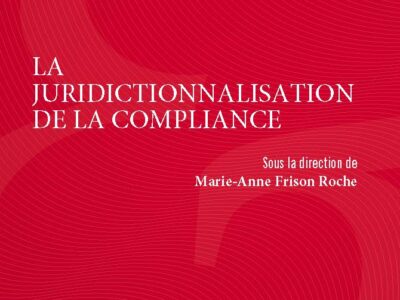
📝La position de l’arbitre en matière de compliance, in 🕴️M.-A. Frison-Roche (ed.), 📕La juridictionnalisation de la Compliance

► Full Reference: M. Audit, "La position de l'arbitre en matière de compliance" ("The position of the arbitrator in matters of compliance"), in M.-A. Frison-Roche (ed.), La juridictionnalisation de la Compliance, coll. "Régulations & Compliance", Journal of Regulation & Compliance (JoRC) and Dalloz, 2023, pp. 303-315.  - 📕read a general presentation of the book, La juridictionnalisation de la Compliance, in which this article is published - ► The summary below describes an article that follows an intervention in the scientific manifestation Compliance et Arbitrage, co-organised by the Journal of Regulation & Compliance (JoRC) and the University Panthéon-Assas (Paris II). This conference was designed by Marie-Anne Frison-Roche and Jean-Baptiste Racine, scientific co-directors, and took place in Paris II University on March 31, 2021.  In the book, the article will be published in its Title III, devoted to: Compliance et Arbitrage. - ► Summary of the article (done by the Journal of Regulation & Compliance): For the arbitrator to intervene in matters of Compliance, a "Compliance Obligation" must exist. The identification of this specific obligation is tricky because it cannot generally be identified per se, if it is grasped only through Criminal Law, which does not enter directly into the field of Arbitration, which has developed an autonomous conception of the facts, in particular facts of corruption, which are also criminally reproachable. But because the obligation of compliance is itself autonomous, since it is a question of detecting and preventing various offenses and breaches, the arbitrators rely on the detection and prevention mechanisms as such, distinct from the possible behaviors that the Law wants they don't happen. But the question of the source of this compliance obligation is central because it must arise from a standard that can lead to Arbitration. This is the case of the contract, for example an intermediary contract which not only prohibits any corrupt practice but also provides for audit or control, or even the case of national laws, in particular the UK Bribery Act or the so-called French "Sapin 2" law, or even decisions imposing compliance programs or the unconstrained adoption of these by the company. According to its source, the arbitrator will take the Compliance obligation into account. If a Compliance obligation, having a source giving its significance in an Arbitration proceeding, is considered by the arbitrator to be breached, the consequences often depend on this source. The solution is classic if it is the lex contractus, more difficult if it is a Law which has inserted this obligation in the lex societatis, the requirements of compliance being generally considered as mandatory laws. If the arbitrators cannot apply the sanctions attached by the repressive law, they can support their decision in consideration of the breach found to assess the legality of a behavior or the validity of a contract, the ICC Rules for combating corruption being able to serve them as an analysis guide. -

Articles in The Journal of Regulation & Compliance « JoRC »

SILVA-ROMERO, Eduardo🕴🏿 and LEGRU, Raphaëlle🕴🏿

📝Quelle place pour la Compliance dans l’arbitrage d’investissement ?, in🕴🏿M.-A. Frison-Roche (ed.), 📕La juridictionnalisation de la Compliance

► Full Reference: E. Silva-Romero and R. Legru, "Quelle place pour la Compliance dans l'arbitrage d'investissement ?" ("What place for Compliance in investment arbitration?"), in M.-A. Frison-Roche (dir.), La juridictionnalisation de la Compliance, coll. "Régulations & Compliance", Journal of Regulation & Compliance (JoRC) and Dalloz, 2023, pp. 281-293.  - 📕read a general presentation of the book, La juridictionnalisation de la Compliance, in which this article is published - ► The summary below describes an article that follows an intervention in the scientific manifestation Compliance et Arbitrage, co-organised by the Journal of Regulation & Compliance (JoRC) and the University Panthéon-Assas (Paris II). This conference was designed by Marie-Anne Frison-Roche and Jean-Baptiste Racine, scientific co-directors, and took place in Paris II University on March 31, 2021.  In the book, the article will be published in Title II, devoted to: Compliance et Arbitrage. - ► Summary of the article (done by the Journal of Regulation & Compliance): The authors emphasize the new and growing place of Compliance in International Arbitration, particularly in the requirement of respect for ethical values, since arbitrators can implement Ethics, sometimes lacking in international trade, or even must put their power only at the service of investors who respect the Rule of Law. Thus, Compliance is deployed through the classic control by the arbitrators of the legality of the investment, which applies both to the establishment of the treaty itself and to the investor. In a more recent way, the arbitrator can control about an investment project a sort of "social license to operate" of the investor, concept related to the social responsibility of the companies, appeared for the protection of the peoples indigenous. Moreover, Compliance can justify a substantial assessment by the arbitrator of the effective respect of the human rights and the environment protection via an investment treaty, the State party remaining able to act for the effectiveness of these concerns. -

Articles in The Journal of Regulation & Compliance « JoRC »

TRAIN, François-Xavier🕴🏿

📝Arbitrage et procédures parallèles exercées au titre de la compliance, in🕴🏿M.-A. Frison-Roche (ed.), 📕La juridictionnalisation de la Compliance

► Full Reference: F.-X. Train, "Arbitrage et procédures parallèles exercées au titre de la compliance" ("Arbitration and parallel proceedings exercised in Compliance Procedure"), in M.-A. Frison-Roche (ed.), La juridictionnalisation de la Compliance, coll. "Régulations & Compliance", Journal of Regulation & Compliance (JoRC) and Dalloz, 2023, pp. 355-368.  - 📕read a general presentation of the book, La juridictionnalisation de la Compliance, in which this article is published - ► The summary below describes the article that follows an intervention in the scientific manifestation Compliance et Arbitrage, co-organised by the Journal of Regulation & Compliance (JoRC) and the University Panthéon-Assas (Paris II). This conference was designed by Marie-Anne Frison-Roche and Jean-Baptiste Racine, scientific co-directors, and took place in Paris II University on March 31, 2021.  In the book, the article will be published in the Chapter III, devoted to: Compliance et Arbitrage international. - ► Summary of the article (done by the Journal of Regulation & Compliance): Firstly, the article insists on the principle of the autonomy of the international arbitration procedure, in relation to which parallel procedures remain watertight, whether they are criminal or done under Compliance Law. In the arbitral proceedings taking place independently, the arbitrators before whom the facts also referred to in these parallel proceedings, in particular the facts of corruption, are alleged before them as facts through their unlawful nature: it is at this title that they can and must apprehend them, using the standard of proof which is the bundle of clues. Secondly, the article highlights the limits of the autonomy of international arbitration. These may be de facto limits because in the search for evidence by arbitrators, red flags are often insufficiently consistent evidence to establish a sentence, especially since this sentence may be subject to control by the judge of its conformity to international public order, the annulment by the judge being able to be based on external elements, even after the arbitration procedure. It may then be wise for the arbitrators, who are not forced to do so, to suspend their proceedings to wait the results of the parallel proceedings initiated under Compliance Law, so that the procedures and their results could be harmonious. -

Articles

LUGURI, Jamie and STRAHILEVITZ, Lior Jacob

Shining a Light on Dark Patterns

Full reference: Luguri, J. and Strahilevitz, L. J., Shining a Light on Dark Patterns, Journal of Legal Analysis, Vol. 13, Issue 1, 2021, 67p.  Sciences Po's students can read this article via Sciences Po's Drive in the folder MAFR – Regulation & Compliance. 

Reports

BAYROU, François

Électricité: le devoir de lucidité (Electricity: the duty of lucidity)

Full reference: Bayrou, F., Electricité: le devoir de lucidité (Electricity: the duty of lucidity), note n°4 from the Haut-Commissariat au Plan (French government planification agency), 23rd of March 2021, 37 p.   Read the note (in French) Read the summary of the note done by the Haut-Commissariat au Plan on is official website (in French)

Jurisprudence

Tribunal administratif de Paris (Paris administrative court)

Judgment Oxfam France, Notre Affaire à tous, Fondation pour la Nature et l’Homme et Greenpeace France of 3rd of February 2021

Full reference: Tribunal administratif de Paris (Paris administrative court), 4th section, 1st Chamber, Oxfam France, Notre Affaire à tous, Fondation pour la Nature et l’Homme et Greenpeace France, 3rd of February 2021, n°1904967, 1904968, 1904972, 1904976/4-1   Read the judgment (in French) Read the press release from Tribunal administratif de Paris (in French)

Jurisprudence

Autorité de Contrôle Prudentiel et de Résolution (French Banking Regulator), Commission des sanctions (Commission of sanctions)

Decision of 24th of February 2021 2021, ING France

Full reference: Autorité de Contrôle Prudentiel et de Résolution (French Banking Regulator), Commission des sanctions (Commission of sanctions), 24th of February 2021, ING Bank France, procedure n°2020-02   Read the decision (in French)   In this decision, the ACPR Sanctions Commission condemns IGN Bank France to a reprimand and a financial penalty of 3 million euros because of the inadequacy of its measures to fight corruption, money laundering and financing of terrorism.   Extract from the decision summarizing ING France's breaches of its Compliance obligations to fight against corruption, money laundering and financing of terrorism: "At the time of the on-site check, ING France's risk classification was incomplete and ineffective (grievance 1) and its system for monitoring its business relations (complaint 2) and their operations (grievance 4) presented serious deficiencies, as well as its organization and procedures for fund transfers (grievance 3). The updating of customer knowledge was insufficient (grievance 5), as were the detection of PEPs and the implementation of measures due diligence for this category of clientele (grievance 6). For the implementation of its due diligence obligations, numerous shortcomings were noted, whether these were breaches of the obligation to carry out a reinforced examination (grievance 7) or breaches of the obligation to send Tracfin a DS, initial (grievance 8) or additional (grievance 9). Finally, the detection of persons subject to an asset freezing measure was not fully effective (grievance 10) " (our translation of the decision which is only available in French).

Jurisprudence

Court of Justice of the European Union (CJEU)

Decision of 2 of February 2021 consecrating right to remain silent and to avoid self-incrimination in a procedure concerning a insider trading

Full reference: CJEU, 2nd of February 2021, DB v. Commissione Nazionale per le Società e la Borsa (Consob), case C‑481/19 Read the decision Read the opinion of advocate general   Summary of the decision by CJEU:  "Natural persons who are subject to an administrative investigation for insider dealing have the right to remain silent when their answers might establish their liability for an offence that is punishable by administrative sanctions of a criminal nature, or their criminal liability".    To go further, read: Frison-Roche, M.-A., Resolve the contradiction between "incentive" and "sanction" under the fire of Compliance Law, 2021 Frison-Roche, M.-A., Rights, primary and natural Compliance tools, 2021

Reports

Agence française anticorruption - AFA (French Anti-corruption Agency)

📜The French Anti-Corruption Agency Guidelines. Notice on the French Anti-corruption Agency Guidelines to help public and private sector entities to prevent and detect bribery, influence peddling, extorsion by public officials, illegal taking of interest, misappropriation of public funds and favoritism

► Full Reference: Agence française anticorruption – AFA (French Anti-corruption Agency), The French Anti-Corruption Agency Guidelines. Notice on the French Anti-corruption Agency Guidelines to help public and private sector entities to prevent and detect bribery, influence peddling, extorsion by public officials, illegal taking of interest, misappropriation of public funds and favoritism, January 12, 2021 - 📜Read the guidelines -

Conferences

Jonathan L. ZITTRAIN

Gaining Power, Losing Control

Full reference: Zittrain, J. L., "Gaining Power, Losing Control", Clare Hall Tanner Lecture 2020, 2020 See the intervention Read the intervention's report   This intervention is divided in two parts:  Between Abdication and Suffocation: Three Eras of Governing Digital Platforms  With Great Power Comes Great Ignorance: What’s Wrong When Machine Learning Gets It Right 

Texts

French Parliament

Loi du 24 décembre 2020 relative au Parquet européen, à la justice environnementale et à la justice pénale spécialisée (Law of 24 December 2020 on the European Public Prosecutor’s Office, environmental justice and specialized criminal justice)

Full reference: Loi n° 2020-1672 du 24 décembre 2020 relative au Parquet européen, à la justice environnementale et à la justice pénale spécialisée (Law of 24 December 2020 on the European Public Prosecutor's Office, environmental justice and specialized criminal justice) Read the law (in French)