Publications

Filter by type

MAFR Chronicles Compliance Law

🔄Chronique MAFR Compliance Law

📝Compliance et conformité : les distinguer pour les articuler (Compliance and conformity: distinguish them in order to articulate them)

► Full Reference: M.-A. Frison-Roche, "Compliance et conformité : les distinguer pour les articuler" ("Compliance and conformity: distinguish them in order to articulate them"), D. 2024, chron., pp. 497-499 - 📝read the article (in French) - 🚧read the bilingual Working Paper which is the basis of this article, with additional developments, technical references and hyperlinks - ► English Summary of the article: "Compliance" and "conformité" ("conformity") are sometimes presented as synonyms, with "conformité" simply being the translation of "compliance". On the contrary, they are two opposing concepts. "Conformity" refers to the obligation to obey all applicable regulations, regardless of their content. A godsend for the regulator… Compliance Law is quite different! Political and public authorities set systemic 'Monumental Goals' to ensure that systems do not collapse tomorrow, or even improve, and then entrust large companies with the task of activating the means to achieve these goals. Conformity then resumes its place in Compliance Law: being one of its tools. - 📚read the other articles published in this chronique of Compliance Law published in the Recueil Dalloz   - follow Marie-Anne Frison-Roche on LinkedIn follow Marie-Anne Frison-Roche on Instagram subscribe to the Newsletter MAFR Regulation, Compliance, Law
Working papers

Working Paper, basis for an article

🚧Compliance Obligation: build a compliance structure producing credible effects in the perspective of the Monumental Goals targeted by the Legislator

► Full Reference: M.-A. Frison-Roche, Compliance Obligation: build a compliance structure producing credible effects in the perspective of the Monumental Goals targeted by the Legislator, Working Paper, March 2024. - 📝 This Working Paper is the basis of the article "Compliance Obligation: build a compliance structure producing credible effects in the perspective of the Monumental Goals targeted by the Legislator", in📘 Compliance 'Obligation de Compliance,   - ► Summary of this Working Paper: This article explains what companies' Compliance Obligation" is. Delving into the mass of compliance obligations, it uses the method of classification of those that are subject to an obligation of result and those that are subject to an obligation of means. It justifies the choice of this essential criterion, which changes the objects and the burden of proof of companies that are subject to an obligation of result when it comes to setting up "compliance structures" and are subject to an obligation of means when it comes to the effects produced by these compliance structures. Indeed, this article goes on to analyse each body of regulations ("Sapins 2", "Vigilance", CSRD, CS3D, DSA, NIS2, DMA, DORA, AML-FT, ….) and the technical compliance obligations they impose, dividing them into obligations of result or obligations of means, depending on the text. This table of positive law thus drawn up, with reference to all the articles of the texts, shows that in positive law the Compliance Obligation has above all an evidential dimension, which is developed in the third part of the article: the company must show that it has put in place the compliance structures (obligations of result) required by the texts and it is up to third parties who criticise it for the unsatisfactory effects that these structures would have produced, according to them, to show that there is a fault or negligence on the part of the company (obligation of means). Indeed, rather than getting bogged down in definitional disputes, given that Compliance Law is itself a nascent branch of Law, the idea of this contribution is to take as a starting point the different legal regimes of so many different compliance obligations to which laws and regulations subject large companies: sometimes they have to apply them to the letter and sometimes they are only sanctioned in the event of fault or negligence. This brings us back to the distinction between obligations of result and obligations of means. Although it would be risky to transpose the expression and regime of contractual obligations to legal obligations put by legislation, starting from this observation in the evidentiary system of compliance of a plurality of obligations of means and of result, depending on whether it is a question of this or that technical compliance obligation, we must first classify them. It would then appear that this plurality will not constitute a definitive obstacle to the constitution of a single definition of the Compliance Obligation. On the contrary, it makes it possible to clarify the situation, to trace the paths through what is so often described as a legal jumble, an unmanageable "mass of regulations". Indeed, insofar as the company obliged under Compliance Law participates in the achievement of the Monumental Goals on which this is normatively based, a legal obligation which may be relayed by contract or even by ethics, it can only be an obligation of means, by virtue of this very teleological nature and the scale of the goals targeted, for example the happy outcome of the climate crisis which is beginning or the desired effective equality between human beings. This established principle leaves room for the fact that the behaviour required is marked out by processes put in place by structured tools, most often legally described, for example the establishment of a vigilance plan or regularly organised training courses (effectiveness), are obligations of result, while the positive effects produced by this plan or these training courses (effaciety) are obligations of means. This is even more the case when the Goal is to transform the system as a whole, i.e. to ensure that the system is solidly based, that there is a culture of equality, and that everyone respects everyone else, all of which come under the heading of efficiency. The Compliance Obligation thus appears unified because, gradually, and whatever the various compliance obligations in question, their intensity or their sector, its structural process prerequisites are first and foremost structures to be established which the Law, through the Judge in particular, will require to be put in place but will not require anything more, whereas striving towards the achievement of the aforementioned Monumental Goals will be an obligation of means, which may seem lighter, but corresponds to an immeasurable ambition, commensurate with these Goals. In addition, because these structures (alert mechanisms, training, audits, contracts and clauses, etc.)  have real meaning if they are to produce effects and behaviours that lead to changes converging towards the Monumental Goals, it is the obligations of means that are most important and not the obligations of result. The judge must also take this into account. Finally, the Compliance Obligation, which therefore consists of this interweaving of multiple compliance obligations of result and means of using the entreprise's position, ultimately Goals at system efficiency, in Europe at system civilisation, for which companies must show not so much that they have followed the processes correctly (result) but that this has produced effects that converge with the Goals sought by the legislator (effects produced according to a credible trajectory). This is how a crucial company, responsible Ex Ante, should organise itself and behave. - 🔓read the developments below⤵️ - follow Marie-Anne Frison-Roche on LinkedIn follow Marie-Anne Frison-Roche on Instagram subscribe to the Newsletter MAFR Regulation, Compliance, Law subscribe to the video Newsletter MAFR Surplomb

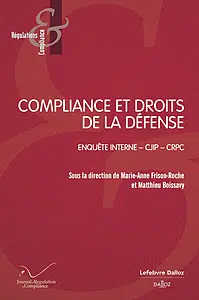
Couverture – Compliance et droits de la défense

Books

Collection Régulations & Compliance Compliance et droits de la défense. Enquête interne – CJIP – CRPC (Compliance and rights of the defence. Internal investigation – French Judicial Public Interest Agreement – French guilty plea procedure)

► Full Reference: M.-A. Frison-Roche & M. Boissavy (eds.), Compliance et droits de la défense. Enquête interne – CJIP – CRPC (Compliance and rights of the defence. Internal investigation – French Judicial Public Interest Agreement – French guilty plea procedure), Journal of Regulation & Compliance (JoRC) and Dalloz, "Régulations & Compliance" Serie, 2024, 362 p. - ► General presentation of the book:  We do not have an overall view of the relationship between Compliance and the rights of the defence in the continuum of internal investigations and DPA, or in the French legal system the convention judiciaire d'intérêt public (CJIP) and the comparution immédiate avec reconnaissance de culpabilité (CRPC), in particular because the texts, whether hard law or soft law, decisions and academic analyses segment them, making it difficult to build a pertinent appreciation of each one. This is made all the more difficult by the fact that we know little about how each of them is applied in practice, both within each of them and in relation to each other.  As a result, it is difficult to express overall satisfaction, or total rejection, or to suggest some specific reforms and to precise on what points, to identify the appropriate source of these improvements, legislation, case law, professions, or spontaneous ways of doing. The first ambition of this book is therefore to restore an overall vision, because this is the vision of practice. If shortcomings are found to exist, then they can be more easily denounced. However, some of the situations described may be described as flawed, or even dramatic, by some, while others may consider that they should be approved as they stand. This applies, for example, to the question of whether or not the investigation report should be secret from the prosecuting authority, which may propose a DPA (or in the French legal system a CJIP), whether or not this CJIP should be extended to individuals, whether or not a lawyer should be present from the internal investigation stage onwards, whether or not the lawyer should support the interests of the company he/she is investigating and continue to do so before the regulator or the prosecutor, whether or not the investigation is delegated from the public authorities to the company, whether or not the lawyer-investigator and then the lawyer-defendant are both lawyers, whether or not the victims are represented in the the CIPC process, etc. Depending on what one thinks the relation between Compliance and due process should be in principle and in practice, one expresses a more or less approving or severe judgement on the state of the texts, the soft law nature of most of them making the exercise complicated, and then if there is a gap between them and what one thinks should be the right standard, one asserts that in practice things happen differently from what the texts say, or one considers that the texts should be changed. From point to point, a veritable kaleidoscope emerges in this book. Indeed, the result is a series of contributions that sometimes clash with one another, with a sort of contradictionary principle creeping into the very structure of this book, thus establishing the readesr as a sort of judges themselves , that character who is so absent. He/she will be able to do so, since the book lists texts, describes practices and gives an illustration of everything that can be thought of, in visions that are sometimes analytical and sometimes global, with proposals of reforms of texts, jurisprudence or conduct. The aim of the book is to enable readers to form their own opinions and to take part in what is undoubtedly being strongly debated today: the confrontation between Compliance and rights of the defence. - ► Summary of the book: The rights of the defence are one of the pillars of our Rule of Law. On the face of it, compliance techniques are not concerned with this under the pretext of efficiency. This would be particularly true in a trilogy that unfolds over time: internal investigation, convention judiciaire d'intérêt public – CJIP (French Judicial Public Interest Agreement) and comparution sur reconnaissance préalable de culpabilité – CRPC (French guilty plea procedure). However, because Compliance Law is also the expression of the Rule of Law, in that its ambition is to detect and prevent systemic risks in order to protect present and future human beings, we must go beyond this opposition and articulate Compliance and rights of the defence. The Monumental Goals of Compliance, which justify its power, for example to obtain information, and the fundamental rights of the defence, which for example impose the presumption of innocence, must be adjusted to each other; by interpreting texts, or even adopting new ones. The book analyses each of these three techniques, in particular the still largely unregulated internal investigation, and sheds light on them in relation to each other, in order to formulate proposals. - 🏗️General construction of the book: The book opens with an overview divided into three sections. The first Title compares the challenges of the internal investigation with the rights of the defence. The second Title compares the issues at stake in the convention judiciaire d'intérêt public – CJIP (French Judicial Public Interest Agreement) and the comparution sur reconnaissance préalable de culpabilité – CRPC (French guilty plea procedure) with these same rights of the defence. -   TABLE OF CONTENTS   COMPLIANCE ET DROITS DE LA DÉFENSE : VISION D'ENSEMBLE (COMPLIANCE AND RIGHTS OF THE DEFENCE : OVERVIEW) Section 1 ♦️ Connaître les pratiques pour redessiner les frontières et accroître les points de contact entre Compliance et droits de la défense dans l’enquête interne, la CJIP et la CRPC. Lignes de force de l'ouvrage Compliance et droits de la défense (Understanding practices to redraw the boundaries and increase the points of contact between Compliance and the rights of the defense in internal investigation, French Judicial Public Interest Agreement and French guilty plea procedure. Main Aspects of the Book Compliance and rights of the defence), by🕴️Marie-Anne Frison-Roche   Section 2 ♦️  Compliance et droits de la défense : toujours pour le respect des droits humains (Compliance and rights of the defence: always for the respect of human rights), by🕴️Matthieu Boissavy Section 3 ♦️ Circuler dans le temps pour mettre en phase Compliance et droits de la défense (Moving through Time to align Compliance and rights of the defence), by🕴️Marie-Anne Frison-Roche   TITRE I.  LES ENJEUX PROCÉDURAUX DE L'ENQUETE INTERNE CONFRONTÉE AUX DROITS DE LA DÉFENSE (TITLE I.  PROCEDURAL CHALLENGES OF THE INTERNAL INVESTIGATION IN RELATION TO THE RIGHTS OF THE DEFENCE)   CHAPITRE I : VISION GÉNÉRALE DES DROITS DE LA DÉFENSE DANS L'ENQUÊTE INTERNE  (CHAPTER I: OVERVIEW OF THE RIGHTS OF THE DEFENCE IN INTERNAL INVESTIGATION) Section 1 ♦️ Approche doctrinale de l’enquête interne et de l’enquête pénale privée (Doctrinal approach to internal investigation and private criminal investigation), by 🕴️Benjamin Fiorini Section 2 ♦️ Regard critique : La place des droits de la défense dans l'enquête interne selon le guide AFA/PNF (A critical look: The place of the rights of the defence in the internal investigation according to the AFA/PNF Guide), by 🕴️Margaux Durand-Poincloux, 🕴️David Apelbaum and 🕴️Paola Sardi-Antasan Section 3 ♦️ Les conditions de réussite de l'enquête interne dans les rapports entre le Parquet national financier et l’entreprise mise en cause – l’enquête interne au soutien de la défense de l’entreprise (The conditions for a successful internal investigation in the relationship between the French Financial Public Prosecutor's Office and the accused company – the internal investigation in support of the company's defence), by🕴️Jean-François Bohnert   CHAPITRE II : LES DROITS DE LA DÉFENSE À CHAQUE ÉTAPE DE L'ENQUÊTE INTERNE (CHAPTER II: THE RIGHTS OF THE DEFENCE AT EACH STAGE OF THE INTERNAL INVESTIGATION)   Section 1 ♦️ La réception des alertes par l'avocat (Reception of alerts by the lawyer), by🕴️Maria Lancri Section 2 ♦️ Collecte et traitement des informations dans les enquêtes internes à l'ère numérique : processus et enjeux (Collecting and processing information for internal investigations in the digital age: processes and challenges), by🕴️Uriel Goldberg Section 3 ♦️ L’apport de la psychologie pour l'effectivité des droits de la défense dans l'enquête interne pour harcèlement au travail (The contribution of psychology to the effectiveness of the rights of the defence in internal investigation for harassment in the workplace), by🕴️Nathalie Leroy & 🕴️Danièle Zucker Section 4 ♦️ Le respect des droits de la défense lors des auditions des enquêtes internes : un gage d’efficacité (Respecting the rights of the defence during hearings in internal investigations: a guarantee of efficacy), by 🕴️Emmanuel Daoud & 🕴️Ghita Khalid Rouissi Section 5 ♦️ L’enquête interne au cœur des enjeux de conformité et de justice négociée : analyse de la position de l'AFA et du PNF (The internal investigation at the heart of conformity and negotiated justice issues: analysis of the position of the AFA and the PNF), by🕴️Éric Russo Section 6 ♦️ Le rapport d’enquête interne à l’épreuve des droits de la défense (The internal investigation report put to the test of defence rights), by🕴️Samuel Sauphanor   CHAPITRE III : LA SPÉCIFICITÉ DES ENQUÊTES INTERNES DANS LES ENTREPRISES INTERNATIONALES ET LA PLACE DES DROITS DE LA DÉFENSE (CHAPTER III : SPECIFICITY OF INTERNAL INVESTIGATIONS IN INTERNATIONAL COMPANIES AND THE PLACE OF THE RIGHTS OF THE DEFENCE) Section 1 ♦️ La spécificité des enquêtes internes pratiquées par les groupes internationaux (Specificity of internal investigations carried out by international groups), by 🕴️Olivier Catherine Section 2 ♦️ Garantir la valeur probatoire d’un rapport dans le cadre d’une enquête interne opérée dans une entreprise internationale (Guaranteeing the evidential value of a report in an internal investigation carried out in an international company), by 🕴️Monique Figueiredo Section 3 ♦️ La responsabilité de l'entreprise dans la conception et la menée de l'enquête interne (The company's responsibility in designing and conducting an internal investigation), by 🕴️Lydia Meziani Section 4 ♦️ Enquêtes internes, enquêtes pénales et droits de la défense : que nous disent les jurisprudences américaine et anglaise (l’affaire Connolly et l’affaire ENRC) ? (Internal investigations, criminal investigations and rights of the defence: what do the US and UK case law tell us (the Connolly case and the ENRC case)?), by 🕴️Victoire Chatelin   CHAPITRE IV : LE RÔLE SINGULIER DE L'AVOCAT DANS L'ENQUÊTE INTERNE (CHAPTER IV: THE SPECIAL ROLE OF THE LAWYER IN THE INTERNAL INVESTIGATION) Section 1 ♦️ La méthodologie propre à l'avocat enquêteur (The investigating lawyer's own methodology), by 🕴️William Feugère Section 2 ♦️ L'enquête interne façonnée par la déontologie de l'avocat (The internal investigation shaped by the lawyer's deontology), by 🕴️Stéphane De Navacelle, 🕴️Julie Zorrila and 🕴️Laura Ragazzi Section 3 ♦️ Préserver le secret professionnel de l'avocat dans l'enquête interne et son résultat (Preserving the lawyer's professional secrecy in the internal investigation and its outcome), by 🕴️Bénédicte Graulle & 🕴️Yanis Rahim Section 4 ♦️ L’avocat-enquêteur en droit du travail : un janséniste au milieu du Far West (The lawyer-investigator in employment law: a Jansenist in the Wild West), by 🕴️Richard Doudet Section 5 ♦️ La défense des personnes physiques dans les enquêtes internes (Defending individuals in internal investigations), by 🕴️Dorothée Hever     TITRE II. LES ENJEUX PROCÉDURAUX DE LA CJIP ET DE LA CRPC CONFRONTÉES AUX DROITS DE LA DÉFENSE (TITLE II. PROCEDURAL CHALLENGES OF THE FRENCH JUDICIAL PUBLIC INTEREST AGREEMENT AND THE FRENCH GUILTY PLEA PROCEDURE  IN RELATION TO THE RIGHTS OF THE DEFENCE)   CHAPITRE I : VISION GÉNÉRALE DES DROITS DE LA DÉFENSE DANS LA CJIP ET LA CRPC (CHAPTER I: OVERVIEW OF THE RIGHTS OF THE DEFENCE IN THE FRENCH JUDICIAL PUBLIC INTEREST AGREEMENT AND THE FRENCH GUILTY PLEA PROCEDURE) Section 1 ♦️ Théorie et pratique de la négociation dans la justice pénale (Theory and practice of negotiation in criminal justice), by 🕴️Sarah-Marie Cabon Section 2 ♦️ La lutte anti-corruption : l’emprunt au modèle américain et à ses récentes évolutions (The fight against corruption: borrowing from the American model and its recent developments), by 🕴️Stephen L. Dreyfuss Section 3 ♦️ Justice pénale négociée : avantages présents, risques à venir (Negotiated criminal justice: curent benefits, future risks), by 🕴️Alexis Bavitot   CHAPITRE II : FORMES ACTIVES DES DROITS DE LA DÉFENSE, LES DIALOGUES À L'OEUVRE OU À PARFAIRE DANS LA CJIP ET LA CRPC (CHAPTER II: ACTIVE FORMS OF THE RIGHTS OF THE DEFENCE, DIALOGUES AT WORK OR TO BE PERFECTED IN THE FRENCH JUDICIAL PUBLIC INTEREST AGREEMENT AND THE FRENCH GUILTY PLEA PROCEDURE) Section 1 ♦️ Combinaison des CRPC et des CJIP : le cas particulier des affaires de fraude fiscale (Combination of the French guilty plea procedure and the French Judicial Public Interest Agreement: the special issue of tax fraud cases), by 🕴️Marion David Section 2 ♦️ Pour une justice pénale négociée plus équitable (For a fairer negotiated criminal justice), by🕴️Astrid Mignon Colombet Section 3 ♦️ Les impacts, sur les droits de la défense, des disparités de la justice pénale négociée dans l’Union européenne (The impact on the rights of the defence of the disparities in negotiated criminal justice in the European Union), by 🕴️Emmanuel Moyne Section 4 ♦️ L'évolution des rapports entre avocats et autorités de poursuites depuis l'introduction de la CJIP (Developments in relations between lawyers and prosecuting authorities since the introduction of the French Judicial Public Interest Agreement), by 🕴️Thomas Baudesson   CHAPITRE III : LE RÔLE SINGULIER DE L'AVOCAT DANS LA CJIP ET LA CRPC  (CHAPTER III: THE SINGULAR ROLE OF THE LAWYER IN THE FRENCH JUDICIAL PUBLIC INTEREST AGREEMENT AND THE FRENCH GUILTY PLEA PROCEDURE) Section 1 ♦️ Quand se justifie et quand s'arrête la collaboration ? À propos de la CJIP (When is collaboration justified and when does it end? About the French Judicial Public Interest Agreement), by 🕴️Philippe Goossens Section 2 ♦️ Le dialogue de l’avocat et de son client, chef d’entreprise, face à la proposition d’une CRPC et d’une CJIP (The dialogue between the lawyer and his client, a company director, faced with the proposal of a French guilty plea procedure or a French Judicial Public Interest Agreement), by 🕴️François Saint-Pierre Section 3 ♦️ Le dilemme de l'avocat pénaliste face à la CRPC (The criminal lawyer's dilemma when faced with the French guilty plea procedure), by 🕴️Jean Boudot Section 4 ♦️ Défendre les intérêts de la personne physique confrontée à la justice négociée : préserver l’effectivité des droits de la défense et le respect de la présomption d’innocence (Defending the interests of individuals faced with negotiated justice: preserving the effectiveness of the rights of the defence and respect for the presumption of innocence), by 🕴️Capucine Lanta de Bérard & 🕴️Pauline Dufourq Section 5 ♦️ Défendre les intérêts des victimes dans la justice pénale économique négociée (Defending victims' interests in negotiated economic criminal justice), by 🕴️Jérôme Karsenti - follow Marie-Anne Frison-Roche on LinkedIn follow Marie-Anne Frison-Roche on Instagram subscribe to the Newsletter MAFR Regulation, Compliance, Law
Working papers

Working Paper

🚧Compliance and conformity: distinguishing them to articulate them

► Full Reference: M.-A. Frison-Roche, Compliance and conformity: distinguishing them to articulate them, Working Paper, February 2024. - 📝 this working paper was drawn up to serve as a basis for the article published in French in the Chronique MAFR –  Compliance Law, published in the Recueil Dalloz.   - ► Summary of this Working Paper: The words "conformité" and "compliance" are sometimes used interchangeably, presenting "conformité" as the translation into good legal French vocabulary of "compliance", which would come from the American system. This is not true, however, because each of these terms refers to two distinct and even opposing concepts.  "conformity"' would require companies to show that they are actively obeying all the 'regulations' applicable to them, regardless of their content. "Compliance Law" is a new substantial branch of Law that derives its normativity from the "Monumental Goals" targeted by the political and public authorities: these monumental goals are intended to ensure that systems do not collapse in the future (Negative Monumental Goals), or even improve (Positive Monumental Goals). The systems concerned are banking, finance, energy, health, transport, digital and climate systems. The scope of Compliance Law is therefore both much more limited and more ambitious. Distinguishing between the two allows us to put conformity back where it belongs, as a tool of Compliance Law. As such, conformity justifies the collation and correlation of information, with the algorithmic system playing a major role in this. On the other hand, the human concern that underpins Compliance Law justifies making training and the actions of in-house lawyers, attorneys and judges, central to it. The evidentiary system of Compliance that is currently being developed is based on evidentiary techniques rooted on the one hand in the tool of conformity and on the other in the culture of Compliance, which can be articulated as soon as they are no longer confused. -   🔓read the working paper below⤵️ -  follow Marie-Anne Frison-Roche on LinkedIn follow Marie-Anne Frison-Roche on Instagram subscribe to the Newsletter MAFR Regulation, Compliance, Law

Working papers

🚧In Compliance Law, the legal consequences for Entreprises of their commitments and undertakings

► Full Reference: M.-A. Frison-Roche, In Compliance Law, the legal consequences for Entreprises of their commitments and undertakings, June 2024. - 📝 This Working Paper is the basis for the contribution "In Compliance Law, the legal consequences for Entreprises of their commitments and undertakings", in📘Compliance Obligation. - ► Summary of this Working Paper: The innocents might believe, taking the Law and its words literally, that "commitments" are binding on those who make them. Shouldn't they be afraid of falling into the trap of the 'false friend', which is what the Law wants to protect them from (as stated in the prolegomena)? Indeed, the innocent persons think that those who make commitments ask what they must do and say what they will do. Yet, strangely enough, the 'commitments' that are so frequent and common in compliance behaviours are often considered by those who adopt them to have no binding value! Doubtless because they come under disciplines other than Law, such as the art of Management or Ethics. It is both very important and sometimes difficult to distinguish between these different Orders – Management, Moral Norms and Law – because they are intertwined, but because their respective standards do not have the same scope, it is important to untangle this tangle. This potentially creates a great deal of insecurity for companies (I). The legal certainty comes back when commitments take the form of contracts (II), which is becoming more common as companies contractualise their legal Compliance Obligations, thereby changing the nature of the resulting liability, with the contract retaining the imprint of the legal order or not having the same scope if this prerequisite is not present. But the contours and distinctions are not so uncontested. In fact, the qualification of unilateral undertaking of will is proposed to apprehend the various documents issued by the companies, with the consequences which are attached to that, in particular the transformation of the company into a 'debtor', which would change the position of the stakeholders with regard to it (III). It remains that the undertakings expressed by companies on so many important subjects cannot be ignored: they are facts (IV). It is as such that they must be legally considered. In this case, Civil Liability will have to deal with them if the company, in implementing what it says, what it writes and in the way it behaves, commits a fault or negligence that causes damage, not only the sole existence of an undertaking.  - 🔓read the developments below ⤵️ - follow Marie-Anne Frison-Roche on LinkedIn follow Marie-Anne Frison-Roche on Instagram subscribe to the Newsletter MAFR Regulation, Compliance, Law  subscribe to the Video Newsletter MAFR Surplomb

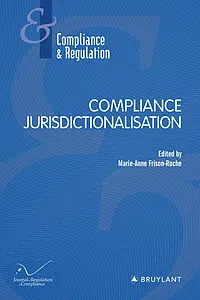
Couverture – Compliance Jurisdictionalisation

Books

📘Compliance Jurisdictionalisation

► Full Reference: M.-A. Frison-Roche (ed.), Compliance Jurisdictionalisation, Journal of Regulation & Compliance (JoRC) and Bruylant, "Compliance & Regulation" Serie, 2024, 464 p. - ► General presentation of the book: Sanctions, controls, appeals, deals: judges and lawyers are everywhere in the Compliance mechanisms, creating unprecedented situations, sometimes without a solution yet available.  Even though Compliance was designed to avoid the judge and produce security by avoiding conflict. This jurisdictionalisation is therefore new. Forcing companies to prosecute and judge, a constrained role, perhaps against their nature. Leading to the adaptation of major procedural principles, with difficulty. Confronting arbitration with new perspectives. Putting the judge at heart, in mechanisms designed so that he is not there. How in practice to organize these opposites and anticipate the solutions? This is the challenge taken up by this book. - ► Summary of the book: There have always been Judges and Lawyers in Compliance Law, in particular because this branch of Law is an extension of Regulatory Law in which they have a core place. This results from the fact that the decisions taken in respect of Compliance are contestable in Court, including Arbitration, those issued by the Company, such as those of States or Authorities, the Judge in turn becoming what Compliance Law is effective. The novelty lies more in the phenomenon of "jurisdictionalisation", that is to say that the trial model penetrates all Compliance Law, and not only the Ex Post part that it includes. Moreover, it seems that this jurisdictionalisation influences the non-legal dimension of Compliance. This movement has effects that must be measured and causes that must be understood. Advantages and disadvantages that must be balanced. If only to form an opinion vis-à-vis Companies that have become Prosecutors and Judges of themselves and others …: encourage this "Jurisdictionalisation of Compliance", fight it, perhaps influence it? In any case, understand it! - 🏗️General construction of the book:The book opens with a double Introduction. The first, which is freely accessible, consists of a summary of the book, while the second, which is substantial, deals with the need to bring the Judge and the Lawyer into line if Compliance Law is to be the hallmark of States governed by the Rule of Law. The first Chapter is devoted to what is specific to Compliance Law: the transformation of companies into Prosecutors and Judges of themselves, and even of others. The second Chapter examines the interference between General Procedural Law and Compliance techniques. The third Chapter measures the influence of the reasoning and requirements of Compliance Law in methods of dispute resolution where it has not, with a few exceptions, been present, but where it has a great future: arbitration. Because trials and judgements are indissociable, because legal techniques and the Rule of Law must not be dissociated, and because Compliance techniques could paradoxically be the weapon used to dissociate them, because the power to judge and the procedures surrounding it must not be dissociated, because Compliance and the Rule of Law must therefore be conceived and practised together, the rise in power of one being a sign of the rise in power of the other, and not the price of the weakening of the Rule of Law, the fourth Chapter deals with the role of the Judge in Compliance. - TABLE OF CONTENTS   DOUBLE INTRODUCTION 🕴️​M.-A. Frison-Roche, 📝Main Aspects of the book Compliance Jurisdictionalisation 🕴️​M.-A. Frison-Roche, 📝Reinforce the Judge and the Lawyer to impose Compliance Law as a characteristic of the Rule of Law    I. THE COMPANY ESTABLISHED PROSECUTOR AND JUDGE OF ITSELF BY COMPLIANCE LAW 🕴️M.-A. Frison-Roche, 📝The "Judge-Judged". Articulating Words and Things in the face of Conflicts of Interest 🕴️C. Granier, 📝Reflections on the existence of companies’ jurisprudence through Compliance matters 🕴️L.-M. Augagneur, 📝The jurisdictionalisation of reputation by platforms 🕴️A. Bruneau, 📝The compagny judges itself: the Compliance function in the bank 🕴️J.-M. Coulon, 📝Compliance Law in the construction industry and the contradictions, impossibilities and. deadlocks that companies face 🕴️Ch. Lapp, 📝Compliance in companies: the statues of process 🕴️J. Heymann, 📝The Legal Nature of the Facebook "Supreme Court" 🕴️D. Latour, 📝Internal investigations within companies 🕴️A. Bavitot, 📝Shaping the company through negotiated Criminal Justice Agreements. French perspective 🕴️S. Merabet, 📝Vigilance, being a judge and not judge   II. PROCEDURAL LAW IN COMPLIANCE LAW 🕴️​N. Cayrol, 📝Procedural Principles in Compliance Law 🕴️F. Ancel, 📝Compliance Law, a new guiding principle for the Trial? 🕴️B. Sillaman, 📝Taking the Compliance U.S. Procedural Experience globally 🕴️A. Linden, 📝Motivation and publicity of the decisions of the Restricted formation of the French Personal Data Protection Authority (Commission nationale de l'informatique et des libertés – CNIL) in a compliance perspective 🕴️S. Scemla, & 🕴️D. Paillot, 📝The difficulty for Compliance Enforcement Authorities to comprehend the Rights of the Defence in compliance matters 🕴️M.-A. Frison-Roche, 📝Adjusting General Procedural Law to Compliance Law by the nature of things   III. ARTICULATION BETWEEN COMPLIANCE LAW AND INTERNATIONAL ARBITRATION 🕴️J.-B. Racine, 📝Compliance and arbitration. An attempt at problematisation 🕴️E. Silva-Romero & 🕴️R. Legru, 📝What place is there for compliance in investment arbitration? 🕴️​M. Audit, 📝The arbitrator's position on compliance 🕴️E. Kleiman, 📝The objectives of compliance confronted with the actors of arbitration   IV. THE JUDGE IN COMPLIANCE LAW 🕴️M.-A. Frison-Roche, 📝The Judge, the Compliance Obligation and the Company. The Compliance Evidence System 🕴️J. Morel-Maroger, 📝The application of compliance standards by European Union judges  🕴️S. Schiller, 📝A single judge in the event of an international breach of compliance obligations? 🕴️O. Douvreleur, 📝Compliance and Judge of the Law 🕴️F. Raynaud, 📝The Administrative Judge and Compliance 🕴️E. Wennerström, 📝Some Reflections on Compliance and the European Court of Human Rights - follow Marie-Anne Frison-Roche on LinkedIn follow Marie-Anne Frison-Roche on Instagram subscribe to the Newsletter MAFR Regulation, Compliance, Law

Working papers

Working Paper

🚧Duty of vigilance: the way forward

► Full Reference: M.-A. Frison-Roche, Duty of vigilance: the way forward, Working Paper, December 2023/July 2024. - 🎤 This working paper has been drawn up to serve as a basis for the conclusions of the colloquium Le devoir de vigilance: l'âge de la maturité? ("The duty of vigilance: the age of maturity?") organised by the University of Montpellier on 25 May 2023. - 📝 Updated and developed, it serves as the basis for the article that concludes the book Le devoir de vigilance des entreprises : l'âge de la maturité? ("The duty of vigilance: the age of maturity?"), Editions Bruylant, 2024.   - ► Working Paper summary: In 2017 in France the so-called Vigilance law expressed great ambition. So did the draft directive. But in 2024 the European institutions moderated this ambition by refusing to increase either the type of companies subject and the constraints to which the duty of vigilance is associated. The directive has essentially halted what was for some the "march of progress". Does the ambition no longer exist? Does the future lie in an extension of the philosophy of the duty of vigilance, i.e. companies that should always be more concerned about others? This would undoubtedly be reaching the "age of maturity", where others see the age of madness, because it would be a contradiction in terms to ask a company to be concerned about anything other than its own development. It is therefore appropriate to consider this very hypothesis of an "age of maturity" as being an ambition maintained despite a European directive which, in its adopted version, is weakened and while the oppositions are intact (I). First of all, it must be admitted that the notion of "maturity" most often conceals a value judgment when applied to a legal concept (I.A.) and that this is blatantly obvious with regard to the duty of vigilance, which is considered by some and by nature by some as a good and by others as an evil (I.B). In order not to remain in what appears to be trench warfare, we must not get too bogged down in the reference French legislation of 2017 and what appears to be a European stutter in 2024, arguing so loudly that we can hear them reasoning in print, by paying attention to less visible and now more promising avenues of progress (II). In fact, the duty of vigilance can progress simply by the passage of time (II.A), by a better definition of the vocabulary (II.B), by the consolidation of the principles of Responsibility and Dialogue (II.C), by the uniqueness of the jurisdictional route (II.D). This last perspective of the progress that will be made possible in France by the uniqueness of the judicial route leads to a final avenue of progress. By their very nature, laws are jolts, all the more violent for being disputed. At the moment, if we want to make progress, these two other sources – the contract and the judge – must be favoured (III). The European directive is rightly concerned with access to the courts and takes a measured view of the effectiveness of contracts as a means of making the duty of vigilance effective, with the courts having to ensure that the contract does not destroy the spirit of the system. This is what the law already organises about the relationship between the contract, the judge and the duty of compliance (III.A). What is new in Europe in 2024 is the introduction of a Supervisor (III.B). Here again, vigilance is the "cutting edge" of Compliance Law, as it is an extension of Regulatory Law.  The result is that, through interpretation and the handling of principles, and to formulate a more general conclusion, it is the judge who holds and will hold the balance of the duty of vigilance.     - 🔓read the Working Paper below⤵️ - follow Marie-Anne Frison-Roche on LinkedIn follow Marie-Anne Frison-Roche on Instagram subscribe to the Newsletter MAFR Regulation, Compliance, Law
Working papers

Working Paper for an article

🚧Compliance, Vigilance and Civil Liability: put in order and keep the sense of Reason

► Full Reference : M.-A. Frison-Roche, Compliance, Vigilance and Civil Liability: put in order and keep the sense of Reason, Working Paper, June 2024 - 📝 In its French version, this Working Paper is the basis of the contribution "Compliance, Vigilance et Responsabilité civile : mettre en l'ordre et raison garder", in 📕L'Obligation de Compliance - ► Summary of this Working Paper:  The descriptions of the Liability incurred by large companies as a result of their compliance obligations are very diverse, even contradictory, going beyond the wishes that may be expressed as to what this liability should be. The first part of this study therefore sets out the various liabilities incurred by companies, which differ in the conditions under which they are implemented and in their scope, so as not to confuse them. Indeed, as the various laws establish specific legal compliance obligations, they give rise to liabilities of varying conditions and scope, and it is not possible to avail of the regime of one in a situation that falls within the scope of another. It is therefore necessary to review the various bodies of compliance legislation, the GDPR, the ALM-FT regulations, the French so-called Sapin 2 law, the French so-called Vigilance law , the European IA Act , the European European DGA Act, etc., to recall the inflexion that each of these bodies of legislation has made to the liability rules applied to the companies subject to them. Nevertheless, the unicity of the Compliance Obligation, overcoming this necessary diversity of situations, regulations and liability regimes,  can provide grouping lines to indicate beyond this diversity the extent of the liability incurred by companies. Once this classification has been made, the second part of the study develops the observation that none of this can create any principle of general liability on large companies in terms of compliance, and in particular not in terms of vigilance. It is not possible to deduce a general principle of specific obligations of liability or specific obligations to reparation, for example in the area of vigilance, as the texts creating specific vigilance obligation refer to the conditions of commun Tort Law (proof damage and causality), and International Public Law does not have the force to generate a general principle binding companies in this respect. The third part stresses that it is nevertheless always possible to invoke Tort Law, and companies cannot claim to escape this. This may involve contractual liability, a situation  becoming increasingly frequent as companies contractualise their legal compliance obligations, reproducing them but also modifying them, and as Vigilance duty is an obligation that goes beyond the specific situations covered by the regulations.  But it is essential, and this is the subject of the fourth part, not to make companies pure and simple guarantors of the state of the world, present and future. Indeed, if we were to transform sectoral compliances into illustrations of what would then be a new general principle, but one that applied only to them, they would consequently exercise the other side of this coin, namely power over others. - 🔓read the Working Paper below⤵️ - follow Marie-Anne Frison-Roche sur LinkedIn follow Marie-Anne Frison-Roche on Instagram subscribe to the Newsletter MAFR Regulation, Compliance, Law subscribe to the Video Newsletter MAFR Surplomb

Working papers

Working Paper basis for an article

🚧Births of a new branch of Law: Compliance Law

► Full Reference: M.-A. Frison-Roche, Births of a branch of Law: Compliance Law, Working Paper, November 2023. - 📕This Working Paper was drawn up as a basis for a contribution to the collective book given to Professor Louis Vogel, published in 2024 - ► Summary of this Working Paper: The study looks at the various movements that have given birth to Compliance Law, with particular emphasis on Competition Law. After a preliminary reflection on the construction of the legal system into branches of Law, their classification in relation to each other, the difficulty encountered in this respect by Economic Law, and the various movements that give birth to one of them, the diversity of which the branch subsequently keeps track of, the study is constructed in 4 parts. To find out what gave rise to Compliance Law, the first part invites us to reject the narrow perspective of a definition that is content to define it by the fact of "being conform" with all the applicable regulations. This has the effect of increasing the efficacy of the regulations, but it does not produce a branch of Law, being just a set of tools like others. The second part of the study aims to shed some light on what appears to be an "enigma", as it is often claimed that this is the result of a soft method, or of an American political decision, or of as many regulations as there are occasions to make. Instead, it appears that in the United States, in the aftermath of the 1929 crisis, it was a decision of establishing an authority and rules to prevent another atrocious collapse of the system, while in Europe in 1978, in memory of the use of files of personal and racial information, it was a question of establishing an authority and rules to prevent an atrocious attack on human rights. A common element that aims for the future ("never again") but not the same object of preventive rejection. This difference between the two births explains the uniqueness and diversity of the two Compliance Laws, the tensions that can exist between the two, and the impossibility of obtaining a global Law. The third part analyses the way in which Competition Law has given rise to conformity: a secondary branch which is a guarantee of conformity with competition rules. Developed in particular through the soft law issued by the competition authorities, the result is a kind of soft obedience, a well-understood collaboration of the procedural type through which the firm educates, monitors and even sanctions, without leaving  the cercle of Competition Law, of which conformity is an appendix. The distance between a culture of conformity and the substantial Compliance Law can be measured here. The fourth part aims to show that Competition Law and Compliance Law are two autonomous and articulated branches of Law. Since Compliance Law is a branch of Law built on Monumental Goals, in particular the sustainability of systems and the preservation of the human beings involved so that they are not crushed by them but benefit from them, the current challenge of European integration is to build the pillar of Compliance Law alongside the competitive pillar. Jurisdictions are in the process of doing this and of linking the two.   - 🔓read the Working Paper below⤵️ - follow Marie-Anne Frison-Roche on LinkedIn follow Marie-Anne Frison-Roche on Instagram subscribe to the Newsletter MAFR Regulation, Compliance, Law  subscribe to the Video Newsletter MAFR Surplomb

Articles in a legal collective publication

article in a collective publication

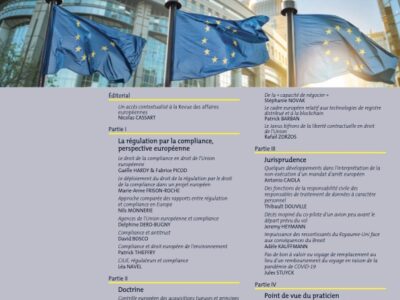
📝The deployment of Regulatory Law through Compliance Law in the European project

► Full Reference: M.-A. Frison-Roche, "The deployment of Regulatory Law through Compliance Law in the European project", in G. Hardy & F. Picod, Compliance Regulation from a European Perspective, Law and European Affairs (L.E.A.), 2023/2, pp. 345-352. - 🚧read the bilingual Working Paper which is the basis of this article, with additional developments, technical references and hyperlinks  - ► English Summary of the article: Compliance Law is neither a method of obeying regulations, nor a simple neutral method of ensuring the effectiveness of norms, nor a means of enforcement displaced from Ex Post to Ex Ante. It is an extension of Regulatory Law and goes beyond it. Like it, it aims to build spaces according to a political project specific to an area, such as Europe. Branch of Law looking to the future as Regulatory Law does, it constructs and maintains, in a systemic way, sustainable, albeit unstable, balances to achieve the ‘Monumental Goals’ in which its normativity resides: security, sustainability, probity, truth, and dignity. By internalising these Monumental Goals in the companies that are in a position to achieve them, the “crucial companies”, Compliance Law preserves the logic of Regulatory Law, offering it a prodigious expansion since it frees it from the condi- tion of a sector and territorial borders, which seemed tautological, by associating private powers and public will, which remains primary. In this way, Compliance can regulate the digital space and climate issue through political choices made by a sovereign Europe. - follow Marie-Anne Frison-Roche on LinkedIn follow Marie-Anne Frison-Roche on Instagram subscribe to the Newsletter MAFR Regulation, Compliance, Law

Monographs

📝La compliance, socle de la confidentialité nécessaire des avis juridiques élaborés en entreprise

► Full Reference: M.-A. Frison-Roche, "La compliance, socle de la confidentialité nécessaire des avis juridiques élaborés en entreprise" ("Compliance, the cornerstone of the confidentiality required for in-house legal opinions"), D. 2023, p. - 📝read the article (in French) - ► English Summary of the article: The French Law about the Ministry of Justice's 2023-2027 Orientation and Programming  ("loi d'orientation et de programmation du ministère de la justice 2023-2027") had introduced into the French legal system the confidentiality of in-house lawyers' opinions (before the  French Constitutional Council, on a question of parliamentary procedure, annulled this disposition, thus leaving the question still open).  This development is necessary in order to respond to the injunction for companies to comply more and more with the regulations, which is itself only one of the tools of a wider movement: Compliance Law. This branch of the law, notably through the French so-called Sapin 2 Act of 2016, the French Vigilance Act of 2017 and the European Digital Services Act (DSA), requires companies to implement the necessary means to satisfy the Monumental Goals contained in the laws or regulations. This presupposes, firstly, that companies have information (via alerts, risk mapping, vigilance, sustainability reports, etc.), enabling them to identify their conformity and non-conformity, so that they can, secondly, take effective action to put an end to current breaches, prevent future breaches and achieve the goals set by the Legislator. This Compliance System requires that the information made available to managers is reliable and honest. However, if non-conformity is not analysed and communicated in a way that is protected by confidentiality, the company will prefer not to know about it and will therefore be unable to take appropriate action, which will deprive the social community of its power to act in the future. This is why the confidentiality of in-house lawyers' opinions is based on the very definition of Compliance Law itself. - follow Marie-Anne Frison-Roche on LinkedIn follow Marie-Anne Frison-Roche on Instagram subscribe to the Newsletter MAFR Regulation, Compliance, Law
Monographs

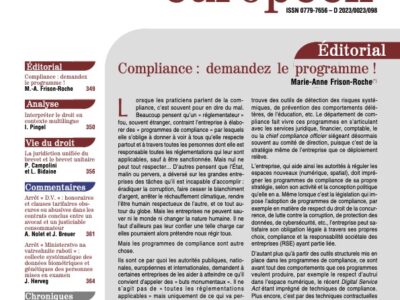
📝Compliance : demandez le programme ! (Compliance: ask for the programme!)

► Full Reference: M.-A. Frison-Roche, "Compliance : demandez le programme !" ("Compliance: ask for the programme!), J.D.E., 2023/7, No. 301, p. 349. - 📝read the article (in French) - 🌐see the LinkedIn post presenting this article - ► Summary of the article: Compliance programmes are neither constraints imposed by a 'mad regulator' forcing companies to show in advance that they comply with all the regulations applicable to them, nor are they a delegation by the State of tasks it is incapable of accomplishing, such as eradicating corruption or stopping global warming. On the contrary, they are a tool in the service of the alliance between public authorities and companies in the pursuit of the Monumental Goals of Compliance Law. Through them, the company implements actions to prevent the systemic risks associated with its activity. It thus assists the authorities in regulating new areas (digital, space) while adopting a sustainable strategy. As a result, it does not suffer from regulations, but participates in shaping the future. In this future, the judge plays a central role in shaping the compliance programmes that will be raised or challenged in 'systemic cases'. - follow Marie-Anne Frison-Roche on LinkedIn follow Marie-Anne Frison-Roche on Instagram subscribe to the Newsletter MAFR Regulation, Compliance, Law

Articles in a legal collective publication

📝Droit de la compliance et climat. Pour prévenir le risque et construire l’équilibre climatiques, in 🕴️M. Torre Schaub, 🕴️A. Stevignon et 🕴️B. Lormeteau (ed.), 📗Les risques climatiques à l’épreuve du droit

► Full Reference: M.-A. Frison-Roche, "Droit de la compliance et climat. Pour prévenir le risque et construire l'équilibre climatiques" ("Compliance Law and climate. Prevent the climate risk and build the climate balance"), in M. Torre Schaub, A. Stevignon and B. Lormeteau (ed.), Les risques climatiques à l'épreuve du droit, Mare & Martin, coll. "Collection de l'Institut des sciences juridique et philosophique de la Sorbonne", 2023, pp. 73-83 - 📝read the article (in French) - 🚧read the bilingual Working Paper which is the basis of this article, with additional developments, technical references and hyperlinks - ► Summary of the article: Compliance Law is beginning to emerge in climate topic, through the expression  "Climate Compliance Law", but the climate issue itself is the most perfect example of why General Compliance Law is made for.  It is indeed a new branch of Law, a global Law claiming to provide Ex Ante solutions here and now for global issues, so that in the future systemic catastrophies will not occur, will not happen: it is these "Monumental Goals" that give meaning, coherence, and simplicity to Compliance Law. Compliance Law, linked to the Rule of Law principle, makes it possible to go beyond the choice often presented between the effectiveness of the protection of the planet and the renunciation of freedoms, in particular the freedom to do business and the freedom of individuals, especially the protection of their data. Climate is thus exemplary of the object of Monumental Goals of Compliance Law (I). The systemic risk that it now constitutes is analogous to Banking or Digital Systemic Risks and therefore calls for the application of identical legal Compliance Tools, formerly put in place for Banking Regulatory and Compliance Law, recently invented for Digital. Compliance Law, extending Regulation Law, itself from the precondition of the Sector and the Territory, is therefore the branch which makes it possible to put in place new legal solutions, either by force (judicial agreements, compliance programs, etc.), or by will (commitments, global charters, etc.). Therefore, an alliance can exist between political and public authorities, and crucial economic operators (II), that the rise in power of the "raison d'être" is the sight and whose technical challenge is the collection of information that must be put in correlation. Scientists pooling Information, this public good, provided by public and private entities. The courts are at the center of this articulation between Compliance Law and Climate, which object is the Future. - follow Marie-Anne Frison-Roche on LinkedIn follow Marie-Anne Frison-Roche on Instagram subscribe to the Newsletter MAFR Regulation, Compliance, Law
Monographs

📝Le cas Petrobras, une juste adéquation de la responsabilité pour protéger les personnes impliquées dans des systèmes globaux (The Petrobras case: the right balance of responsibility to protect those involved in global systems)

► Full Reference: M.-A. Frison-Roche & Arnoldo Wald, "Le cas Petrobras, une juste adéquation de la responsabilité pour protéger les personnes impliquées dans des systèmes globaux" ("The Petrobras case: the right balance of responsibility to protect those involved in global systems"), RIDC, July-September 2023, No. 3, pp. 563-582. - ► Summary of the article: This article briefly outlines the main aspects of corporate liability in the capital market under Brazilian law, arising from the company’s duty to inform shareholders and investors, followed by a commentary on the recent partial award in an arbitration brought by minority shareholders against Petrobras, which underlines the legitimacy of the minority shareholders to engage the company’s liability. - follow Marie-Anne Frison-Roche on LinkedIn follow Marie-Anne Frison-Roche on Instagram subscribe to the Newsletter MAFR Regulation, Compliance, Law

Working papers

Working Paper

🚧Moving through Time to align Compliance with the rights of the defence

► Full Reference: M.-A. Frison-Roche, Moving through Time to align Compliance with the rights of the defence, Working Paper, September 2023. - 📕This working paper has been drawn up as the second part of the book Compliance et droits de la défense (Compliance and the rights of the defence), a first section summarising this book. - 📝This Working Paper was drawn up to serve as a basis for this second section, which sets out the general way in which the rights of the defence and the compliance system can be articulated, thank to this movement of moving back in time. - ► Summary of this Working Paper: The subject of Compliance & rights of the defence is difficult to pin down because it often gives rise to totally opposing presentations, which express the initial confrontation between Compliance and rights of the defence, which seems irreducible. This initial confrontation must be acknowledged, and this is even more necessary to prevent it from becoming definitive(I) But in a society governed by the Rule of Law, the rights of the defence are central, and the hierarchy of norms dictates that they remain the privilege of all those who risk being punished in the future. Admittedly, if we look at the course of events in a linear way, the Compliance mechanisms come in Ex Ante, whereas the rights of the defence would only be activated when the repressive procedures would later come to bear on the moral or natural person. The question would therefore not even arise, or not in a central way. But this reasoning creates a false compatibility between Compliance and the rights of the defence (II. Indeed, it is the perspective of punishment in the future that forms the basis for the attribution of rights of the defence in the present. This consideration of the future not only allows but obliges the Law to "move in time", to always think in advance about what might happen tomorrow: this is how we must think about the Compliance methods of Internal Investigation, the DPA (or in the French legal system the Convention judiciaire d'intérêt public and the French Guilty plea procedure (CRPC) (III). As soon as these Compliance Tools are being used in practice, at the time they are being used, we must already think about how their results will be used, results which they have often been used for, because the Internal Investigation is a formidable piece of Evidence for obtaining a conviction and/or a DPA, etc. : therefore, the rights of the defence must shift over time, from the future to the present of the Information collect. Two ambiguities that affect Compliance Law itself, ambiguities which the rights of the defence help to clarify, now appear more clearly.  The first concerns the place occupied by the consent of the person who could have been protected by the rights of defence but //who exercises his/her will to renounce them (IV). Consent, in relation to the will of which it is the expression, is also linked with the future and allows Compliance once again to take precedence over the prerogatives of the individual who chooses not to benefit from it. The omnipresence of 'consent' in Compliance is enlightening here… The second ambiguity concerns the place of secrecy (V). Secrecy seems to be the prerogative of the rights of the defence. But it can also be an effective Compliance Tool when Confidentiality enables the company to detect and prevent breaches. It may even constitute the very Monumental Goal of Compliance Law. This happens when the Goal of Compliance Law, in which legal normativity is placed, becomes the protection of the individual, as is the case for personal information. That guides the European Judge, in line with the humanism that underpins European Compliance Law, in finding the right balance, this protection and effectiveness, depending on whether the information must be given or must be not. - 🔓read the Working Paper developments below ⤵️ - follow Marie-Anne Frison-Roche on LinkedIn follow Marie-Anne Frison-Roche on Instagram subscribe to the Newsletter MAFR Regulation, Compliance, Law 

Articles in a legal collective publication

📝Penser et manier la vigilance par ses buts monumentaux de compliance (Thinking and using Vigilance through its Compliance Monumental Goals), in 📙La société vigilante

follow Marie-Anne Frison-Roche on LinkedIn subscribe to the Newsletter MAFR Regulation, Compliance, Law - ► Full Reference: M.-A. Frison-Roche, "Penser et manier la vigilance par ses buts monumentaux de compliance" ("Thinking and using Vigilance through its Compliance Monumental Goals"), in I.Grossi (ed.), La société vigilante, JCP E, No. 31-35, 3 August 2023, pp. 16-20. - 📙this article is the introduction of this special issue. It is linked to the concluding article of this special issue: 📝La vigilance, pièce d'un puzzle européen (Vigilance, a piece of the European puzzle) - 🧮the 2 articles follow on from the introductory and concluding speeches in the colloquium La Société vigilante, held at the University of Aix Marseille on 24 March 2023 - 🚧read the bilingual Working Paper which is the basis of this article, with additional developments, technical references and hyperlinks - ► Summary of the article: The concept of "Vigilance" is difficult to define. Probably because even as it is becoming a standard, it has just entered the legal systems. And what a splash it is! To understand it, it must not be isolated. Neither in the only French law attracting all the attention, all the fears, all the hopes, the so-called Loi Vigilance ("Vigilance Law"), nor in the only technical mechanisms that make Vigilance a reality. Vigilance is itself only a part of a deeper movement, of which it is the advanced point, allowing us to anticipate the evolution of the whole: Compliance Law. In this light and for not getting lost in it, because the stakes are so high that one quickly loses the measure of things, with each party lashing out at the others, so Vigilance, the key element of Compliance, requires above all alliances,  that we can first examine the entry of Vigilance into the legal system and then understand it through the Monumental Goals which give the measure of it, i.e. both the scope and the limit, each one having to act within the margins that are theirs, States, companies, stakeholders, and judges. A Will for tomorrow can then emerge today, carried by Europe. - 📝read the article (in French) -

Articles in a legal collective publication

📝La vigilance, pièce d’un puzzle européen (Vigilance, a piece of the European puzzle), in 📙La société vigilante

follow Marie-Anne Frison-Roche on LinkedIn subscribe to the Newsletter MAFR Regulation, Compliance, Law - ► Full Reference: M.-A. Frison-Roche, "La vigilance, pièce d'un puzzle européen" ("Vigilance, a piece of the European puzzle"), in I.Grossi (ed.), La société vigilante, JCP E, No. 31-35, 3 août 2023, pp. 57-58. - 📙this article is the conclusion of this special issue. It is linked to the introductory article of this special issue: 📝Penser et manier la vigilance par ses buts monumentaux de compliance (Thinking and using Vigilance through its Compliance Monumental Goals) - 🧮the 2 articles follow on from the introductory and concluding speeches in the colloquium La Société vigilante, held at the University of Aix Marseille on 24 March 2023 - 🚧read the bilingual Working Paper which is the basis of this article, with additional developments, technical references and hyperlinks - ► Summary of the article: The contributions form a contrasted whole. It should not be concluded that some of them are correct and others false: through the reading that each one makes of the so-called French 2017 "Vigilance law," it is a vision of the world as it should be that each author proposes. Because Compliance Law, which Vigilance is a part, claims to draw the future, it is normal that each author should draw the present Law with a hand that bends in one direction or the other, following their conception of the future world. The whole contributions must be seen as a dialogue. A lively dialogue, with this French 2017 law receiving a lot of "glory" and a lot of "indignity" on both sides, from which it is necessary to emerge in order to find solutions, because it is a fundamental movement of which this law is only a gateway (I).  Whatever one thinks of it, it is all the branches of law that are used, affected, and transformed by Vigilance (II). To master this profound transformation, we must turn to Europe, to the great puzzle of texts recently adopted or in the process of being adopted in the European Union, of which Vigilance is the hallmark (III). - 📝read the article (in French) -

Working papers

🚧The deployment of Regulatory Law through Compliance Law in the European project

follow Marie-Anne Frison-Roche on LinkedIn subscribe to the  Newsletter MAFR Regulation, Compliance, Law - ► Full Reference: M.-A. Frison-Roche, The deployment of Regulatory Law through Compliance Law in the European project, Working Paper, July 2023. - 📝this Working Paper is the basis for the article "Le déploiement du Droit de la Régulation par le Droit de la Compliance dans le projet européen" ("The deployment of Regulatory Law through Compliance Law in the European project"), which is part of the special issue La régulation par la compliance, perspective européenne, published in French by the Revue des affaires européennes (Law and European Affairs). - ► Summary of this Working Paper: Compliance Law is neither a method of obeying regulations, nor a simple neutral method of ensuring the effectiveness of norms, nor a means of enforcement displaced from Ex Post to Ex Ante.  It is an extension of Regulatory Law and goes beyond it. Like it, it aims to build spaces according to a political project specific to an area, such as Europe. Branch of Law looking to the future as Regulatory Law does, it constructs and maintains, in a systemic way, sustainable, albeit unstable, balances to achieve the 'Monumental Goals' in which its normativity resides: : security, sustainability, probity, truth, and dignity. By internalising these Monumental Goals in the companies in a position to achieve them, the "crucial companies", Compliance Law preserves the logic of Regulatory Law, offering it a prodigious expansion since it frees it from the condition of a sector and territorial borders, which seemed tautological, by associating private powers and public will, which remains primary. In this way, Compliance can regulate the digital space and climate issue through political choices made by a sovereign Europe. -   🔓read the developments below⤵️

Working papers

Working Paper

🚧Conditions required to promote the “contractualisation” of the Law

follow Marie-Anne Frison-Roche on LinkedIn subscribe to the Newsletter MAFR Regulation, Compliance, Law - ► Full Reference: M.-A. Frison-Roche, Conditions required to promote the "contractualisation" of the Law, Working Paper, June 2023. - 🎤This Working Paper has been done as a basis for the closing conference of the colloquia La contractualisation du droit. Acte II, organised by the Société de législation comparée (SLC) and the Procuradoria Geral do Estado do Rio de Janeiro (PGE-RJ), on 19, 20 and 21 June 2023. - 📝It is also the basis of the article "Les conditions requises pour favoriser la "contractualisation" du droit" ("Conditions required to promote the "contractualisation" of Law"), published in the book 📗La contractualisation du droit. Approches françaises et brésiliennes (Contractualisation of Law. French and Brazilian approaches). - ► English Summary of the Working Paper :  - 🔓read the Working Paper⤵️