Publications

Filter by type

Working papers

Working Paper

🚧 Obligation upon Obligation is valid and useful

► Full Reference: M.-A. Frison-Roche, The role of will in the Compliance Obligation: Obligation upon Obligation is valid and useful, Working Paper, June 2023. - 🎤  This working paper was originally drawn up as a basis for the talk, Obligation on Obligation is worth, on the first day of the conference I co-organised:🧮Compliance : Obligation, devoir, pouvoir, culture (Compliance: Obligation, duty, power, culture), on 13 June 2023. - It was subsequently used as the basis for a forthcoming article: 📝La part de la volonté dans l’obligation de compliance : Obligation sur Obligation vaut". in📕L'obligation de compliance, in the collection 📚Régulations & Compliance 📝The role of will in the Compliance Obligation: Obligation upon Obligation is valid and useful, in📘Compliance Obligation, in the collection 📚Compliance & Regulation - ► Summary of this Working Paper: The demonstration of the part played by the entreprises' Will in the Compliance Obligation incumbent on them is carried out in 3 stages. The first stage of the demonstration consists in finding the part played by the free will of companies in their Compliance Obligation by putting an end to two confusions: the first which, within the Law of Contract and Tort itself but also within Compliance Law, splits and confuses "free will" and "consent", which would no longer require freely expressed acceptance; the second, specific to Compliance Law, which confuses "Compliance" and "conformity", reducing the former to mechanical obedience which could exclude any free Will. Having clarified this, the rest of the study focuses on the 2 ways in which a company subject to a Compliance Obligation by compulsory regulations expresses a part of its free Will, which the study expresses in this proposed adage: Obligation upon Obligation is valid, since the legal obligation to which the company responds by the obedience owed by all those subject to the regulations may be superimposed by its free Will, which will then oblige it. The first case of Obligation upon Obligation, studied in a second part, concerns the means by which the compulsory Compliance Obligation is implemented, the company subject to the Monumental Goals set by the Legislator remaining free to choose the means by which the company will contribute to achieving them. Its free Will will thus be exercised over the choice and implementation of the means. This can take two legal forms: Contracts on the one hand and "Commitments" on the other. In the third part, the second case of Obligation upon Obligation, which is more radical, is that in which, in addition to Compliance's legal compulsory Obligation, the company draws on its free Will to repeat the terms of its legal Obligation (because it is prohibited from contradicting it), a repetition which can be far-reaching, because the legal nature (and therefore the legal regime) is changed. The judgment handed down by the The Hague Court of Appeal on 12 November 2024, in the so-called Shell case, illustrates this. What is more, the company's free Will can play its part in the Compliance Obligation by increasing the legal Obligation. This is where the alliance is strongest. The interpretation of the specific and diverses obligations that result must remain that of the Monumental Goals in a teleological application that gives coherence to the whole. - 🔓read the developments below⤵️ - follow Marie-Anne Frison-Roche on LinkedIn follow Marie-Anne Frison-Roche on Instagram subscribe to the Newsletter MAFR Regulation, Compliance, Law  subscribe to the Video Newsletter MAFR Surplomb
MAFR Chronicles Compliance Law

📚chronique MAFR Compliance Law

📝La loi, la compliance, le contrat et le juge : places et alliances (Regulations, Compliance, Contracts, and Judges: places and alliances”)

🌐 follow Marie-Anne Frison-Roche on LinkedIn 🌐 subscribe to the Newsletter MAFR Regulation, Compliance, Law - ► Full Reference: M.-A. Frison-Roche, "La loi, la compliance, le contrat et le juge : places et alliances" ("Regulations, Compliance, Contracts, and Judges: places and alliances"), Chronique of Compliance Law, D. 2023, pp. 906-908. - 📝read the article (in French) - ► English summary of this article: Compliance Law brings together the forces of regulations, contracts, and judges' decisions to achieve monumental goals so that in the future human beings will not be crushed by systems but will instead benefit from them. In this teleological and systemic branch of Law, legislators, regulators, companies, stakeholders, and judges must find their place. This can lead to bonds of obedience, a vision of 'conformity'. But conformity is only a tool of compliance, whose vigilance is the advanced point of this new branch of Law in which the alliance makes it possible to find solutions, the contract being then a usual mode of elaborating means under the control of the judge. - 🚧read the bilingual Working Paper which is the basis of this article, with additional developments, technical references and hyperlinks - 📚read the other articles published in this chronique of Compliance Law published in the Recueil Dalloz -

Working papers

Working Paper

🚧Use of private companies by Compliance Law to serve Human Rights

► Full reference: M.-A. Frison-Roche, Use of private companies by Compliance Law to serve Human Rights, Working Paper, May 2023. - This Working Paper is the basis of: 🎤a conference done in French in Toulouse on June 16, 2023 📝an article previously written before and for this conference, and subsequently published in the book Puissances privées et droits de l'homme ("Private Powers and Human Rights") - ►Summary of this Working Paper: Following the legal tradition, Law creates a link between power with a legitimate source, the State, public power being its prerogative, while private companies exercise their power only in the shadow of this public power exercised ex ante.  The triviality of Economic Law, of which Competition Law is at the heart, consisting of the activity of companies that use their power on markets, relegates the action of the State to the rank of an exception, admissible if the State, which claims to exercise this contrary power, justifies it.  The distribution of roles is thus reversed, in that the places are exchanged, but the model of opposition is shared. This model of opposition exhausts the forces of the organisations, which are relegated to being the exception. However, if we want to achieve great ambitions, for example to give concrete reality to human rights beyond the legal system within which the public authorities exercise their normative powers, we must rely on a new branch of Law, remarkable for its pragmatism and the scope of the ambitions, including humanist ambitions, that it embodies: Compliance Law. Compliance Law is thus the branch of Law which makes the concern for others, concretised by human rights, borne by the entities in a position to satisfy it, that is to say the systemic entities, of which the large companies are the direct subjects of law (I). The result is a new division between Public Authorities, legitimate to formulate the Monumental Goal of protecting human beings, and private organisations, which adjust to this according to the type of human rights and the means put in place to preserve them. Corporations are sought after because they are powerful, in that they are in a position to make human rights a reality, in their indifference to territory, in the centralisation of Information, technologies and economic, human, and financial means. This alliance is essential to ensure that the system does not lead to a transfer of political choices from Public Authorities to private companies; this alliance leads to systemic efficiency. The result is a new definition of sovereignty as we see it taking shape in the digital space, which is not a particular sector since it is the world that has been digitalised, the climate issue justifying the same new distribution of roles (II).  -   🔓read the full developments below⤵️ - 🌐 follow Marie-Anne Frison-Roche on LinkedIn 🌐follow Marie-Anne Frison-Roche on Instagram 🌐 subscribe to the Newsletter MAFR Regulation, Compliance, Law 

Working papers

Working Paper

🚧The role of the Judge in the deployment of Regulatory Law through Compliance Law

► Full Reference: M.-A. Frison-Roche, The role of the Judge in the deployment of Regulatory Law through Compliance Law, Working Paper, April  2023. - 🎤 This working paper was drawn up to serve as the basis for the concluding summary session of the colloquium organised by the Conseil d'État (French Administrative Supreme Court) and the Cour de cassation (French Judicial Supreme Court), De la régulation à la compliance: quel rôle pour le juge? ("From Regulation to Compliance: what role for the Judge?") held on 2 June 2023 at the Conseil d'État.  - 📝 This working paper also served as the basis for the article that concludes the book De la régulation à la compliance : quel rôle pour le juge, published by the La Documentation Française, 2024. - ► Working Paper Summary: It is remarkable to note the unity of conception and practice between professionals who tend to work in administrative jurisdictions and professionals who tend to work in judicial jurisdictions: they all note, in similar terms, an essential movement: what Regulatory Law is, how it has been transformed into Compliance Law, and how in one and even more so in the other the Judge is at the centre of it. Judges, as well as regulators and European officials, explain this and use different examples to illustrate the profound transformation this has brought about for the law and for the companies responsible for increasing the systemic effectiveness of the rules through the practice and dissemination of a culture of compliance. The role of the judge participating in this Ex Ante transformation is renewed, whether he is a public law judge or a private law judge, in a greater unity of the legal system.   - 🔓read the Working Paper below⤵️ - 🌐follow Marie-Anne Frison-Roche on LinkedIn 🌐follow Marie-Anne Frison-Roche on Instagram 🌐subscribe to the Newsletter MAFR Regulation, Compliance, Law

Working papers

Working Paper

🚧Vigilance, a piece of the European puzzle

► Full reference: M.-A. Frison-Roche, Vigilance, a piece of the European puzzle, Working Paper, March 2023. - 🎤This Working Paper has been done as was made the  conclusion of the colloquiul La société vigilante ("Vigilant Company") at the Aix-Marseille University on March 24, 2023 (conference given in French)  - 📝It is also the basis of the article that introduces a special issue on La société vigilante - ► Summary of this Working Paper: The contributions form a contrasted whole. It should not be concluded that some of them are correct and others false: through the reading that each one makes of the so-called French 2017 "Vigilance law," it is a vision of the world as it should be that each author proposes. Because Compliance Law, which Vigilance is a part, claims to draw the future, it is normal that each author should draw the present Law with a hand that bends in one direction or the other, following their conception of the future world. The whole contributions must be seen as a dialogue. A lively dialogue, with this French 2017 law receiving a lot of "glory" and a lot of "indignity" on both sides, from which it is necessary to emerge in order to find solutions, because it is a fundamental movement of which this law is only a gateway (I).  Whatever one thinks of it, it is all the branches of law that are used, affected, and transformed by Vigilance (II). To master this profound transformation, we must turn to Europe, to the great puzzle of texts recently adopted or in the process of being adopted in the European Union, of which Vigilance is the hallmark (III). - 🔓read the Working Paper⤵️ - 🌐 follow Marie-Anne Frison-Roche on LinkedIn 🌐follow Marie-Anne Frison-Roche on Instagram 🌐subscribe to the Newsletter MAFR Regulation, Compliance, Law  🌐subscribe to the Video Newsletter MAFR Surplomb

Working papers

Working Paper

🚧Thinking and using Vigilance through its Compliance Monumental Goals

🌐 follow Marie-Anne Frison-Roche on LinkedIn 🌐 subscribe to the Newsletter MAFR Regulation, Compliance, Law  - ► Full reference: M.-A. Frison-Roche, Thinking and using Vigilance through its Compliance Monumental Goals, Working Paper, March 2023. - 🎤 This Working Paper has been done as basis for the  introduction of the colloquia La société vigilante ("Vigilant Company") at the Aix-Marseille University on March 24, 2023 (conference given in French)  - 📝It is also the basis of the article that introduces a special issue on La société vigilante - ► Summary of the Working Paper: The concept of "Vigilance" is difficult to define. Probably because even as it is becoming a standard, it has just entered the legal systems. And what a splash it is! To understand it, it must not be isolated. Neither in the only French law attracting all the attention, all the fears, all the hopes, the so-called Loi Vigilance ("Vigilance Law"), nor in the only technical mechanisms that make Vigilance a reality. Vigilance is itself only a part of a deeper movement, of which it is the advanced point, allowing us to anticipate the evolution of the whole: Compliance Law. In this light and for not getting lost in it, because the stakes are so high that one quickly loses the measure of things, with each party lashing out at the others, so Vigilance, the key element of Compliance, requires above all alliances,  that we can first examine the entry of Vigilance into the legal system and then understand it through the Monumental Goals which give the measure of it, i.e. both the scope and the limit, each one having to act within the margins that are theirs, States, companies, stakeholders, and judges. A Will for tomorrow can then emerge today, carried by Europe. - 🔓read the Working Paper⤵️

Working papers

🚧Laws, Compliance, Contracts, and Judges: places and alliances

🌐 follow Marie-Anne Frison-Roche on LinkedIn 🌐 subscribe to the Newsletter MAFR Regulation, Compliance, Law  - ► Full Reference: M.-A. Frison-Roche, Laws, Compliance, Contracts, and Judges: places and alliances, Working Paper, March 2023. - . 📝this working paper is the basis for an article published in French (click HERE) in the 📚chronique of Compliance Law held in the Recueil Dalloz. - 📚Read the other articles published by this Compliance Law Chronicle. open since 2018. - ►Summary of this Working Paper: To understand the functioning of compliance systems in the articulation of the legal actors and the legal instruments used, whatever the technical sector considered, it is necessary to put the "law", the "contract" and the "judge" back into the perspective of legitimacy and efficiency regarding what Compliance is.  At the very least, it is a 'conformity' mechanism. In this process of simple obedience, legislators, economic operators, and judges find themselves in the position of having to obey the law in a hierarchical conception. In a more dynamic and ambitious conception, when Compliance Law is not reduced to a more astute method of obedience but draws substantial normativity from the Monumental Goals pursued, legislators and operators enter an alliance. The contract becomes a major instrument, and the Judge becomes a major actor, no longer to punish the non-obedient but to facilitate the links to help a sustainable system.  Faced with issues such as digital, climatic, and technological challenges, where we are each so weak and isolated, we must not limit our conception and practices to the instrument of conformity but choose the substantial Compliance Law, i.e. the alliance of forces, which puts forward the contract and renews the office of the judge, with the Public Authorities remaining legitimate in setting the Monumental Goals since they commit the future of the social group. -   🔓read bellow the developments⤵️
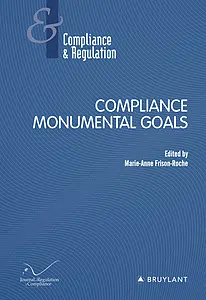
Couverture – Compliance Monumental Goals

Books

📘 Compliance Monumental Goals

🌐 follow Marie-Anne Frison-Roche on LinkedIn 🌐subscribe to the Newsletter MAFR Regulation, Compliance, Law  - ► Full Reference: M.-A. Frison-Roche (ed.), Compliance Monumental Goals, series "Compliance and Regulation", Journal of Regulation & Compliance (JoRC) and Bruylant, 2023, 518 p. - ► This book in a few words: Seize Compliance by its mind: its Monumental Goals. The notion of "monumental goals" of Compliance was proposed in 2016 by Marie-Anne Frison-Roche1🕴️M.A. Frison-Roche, 📝Compliance Law, 2016.. It has become explicit in the texts and the resolution of cases, for example to fight against climate change, make human beings effectively equal, force to be extraterritorially vigilant about suppliers.  Compliance Monumental Goals are targeted ex ante by regulations, contracts, CSR, and international treaties. Creating an alliance between business and political authorities, aiming for a new form of sovereignty. The presence in litigation of these Monumental Goals of global dimension renews the responsibilities and the Judge office. Describing and conceiving these Monumental Goals makes it possible to anticipate Compliance Law, which is more powerful every day. - 📕 In parallel, a book in French Les Buts Monumentaux de la Compliance, is published in the collection "Régulations & Compliance" co-published by the Journal of Regulation & Compliance (JoRC) and Dalloz.  - 📅 This book follows a cycle of colloquia 2021 organized by the Journal of Regulation & Compliance (JoRC) and its universities partners.  - 📚   This book is inserted in this series created by Marie-Anne Frison-Roche for developing Compliance Law. 📚   read the presentations of the other books of this Compliance Series:  📘M.-A. Frison-Roche (ed), Compliance Juridictionnalisation, 2022 📘M.-A. Frison-Roche (ed.), Compliance Tools, 2020 - ► go to the general presentation of this 📚Series ​Compliance & Regulation, conceived, founded et managed by Marie-Anne Frison-Roche, co-published par the Journal of Regulation & Compliance (JoRC) and Bruylant.  - ► General construction of the book:  The book opens with an Introduction, ​which proposes the Monumental Goals as definition of Compliance Law putting them at its "beating heart", giving this new branch of law its originality and specificity, explaining what, in the History of the United States and Europe, gave birth to this singular corpus and justifies a substantial definition of Compliance Law. The concept of Monumental Goals is explained, justifying both systemic and political nature of Compliance Law, the practical consequences of which legal specific rules are thus better identified and limited, since Compliance Law does not lead to all-obedience. We can then determine what we can expect from this Law of the Future that is Compliance Law. From there, the book unfolds in 5 chapters. A first chapter is devoted to the "radioscopy" of this notion, in itself and branch of Law by branch of Law. A second chapter aims to measure how the Monumental Goals are questioned by a crisis situation, for example in a health situation, but not in that example, if they aggravate it and must be discarded, or if, on the contrary, they are exactly conceived for this hypothesis. of crisis, risks, catastrophes and that it is advisable to exploit them, in particular in order, in this "test", to benefit from the alliance between the political authorities, public powers and crucial operators. Once made explicit and tested, the Monumental Goals must find a sure way to be taken into account. This is why a third chapter aims to measure in principle and in practice how the Proportionality method can help the integration of Compliance, thus giving a new dimension to the Law without dragging it into insecurity and illegitimate grabbing of powers. But because Compliance Monumental Goals express a very great ambition, the question of a bearable, even beneficial relationship with the international competitiveness of companies, standards and systems must be opened. This is the object of the fourth chapter.   Finally, because the Monumental Goals express by nature a new ambition of the Law in a world which must not give up in what could be the prospect of its abyss, the fifth chapter has for object the relationship between the Monumental Goals of Compliance and Sovereignty. - ► Table of Content : INTRODUCTION 🕴️Frison-Roche, M.-A., 📝Compliance Monumental Goals, beating heart of Compliance Law   CHAPTER I. THE VERY IDEA OF MONUMENTAL GOALS, THE BEATING HEART OF COMPLIANCE LAW 🕴️Maistre, R.-O., 📝What monumental goals for the Regulator in a rapidly changing audiovisual and digital landscape? ; 🕴️Le Fur, A.-V., 📝Interest and “raison d’être” of the company: how do they fit with the Compliance Monumental Goals? ;; 🕴️Malaurie, M., 📝Monumental goals of Market Law. Reflection on the method 🕴️Peicuti, C. & 🕴️Beyssade, J.,📝The Feminization of Responsability positions in Companies as a Compliance Goal. Example of the banking sector 🕴️Petit, B., 📝The Arrangement of the Monumental Goals of Labor Law: a Moving and Often Paradoxical Whole 🕴️Vaquieri, J.-F.,📝 The "Monumental Goals" perceived by the company. The example of Enedis. 🕴️Huglo, Ch., 📝Under what conditions could Climate Law constitute a priority Monumental Goal?   CHAPTER II. IMPLEMENTATION OF COMPLIANCE MONUMENTAL GOALS IN ARTICULATION OF THE MAJOR PRINCIPLE OF PROPORTIONALITY 🕴️Rapp, L., 📝Proportionality and Normativity 🕴️Bär-Bouyssière, B., 📝Practical obstacles to the effective place of Proportionality in Compliance 🕴️Meziani, L., 📝Proportionality in Compliance, the guarantee of public order in companies 🕴️Segonds, M., 📝Compliance, Proportionality and Sanction. The example of the sanctions taken by the French Anticorruption Agency  🕴️Frison-Roche, M.-A., 📝Definition of Proportionality and Definition of Compliance   CHAPTER III. COMPLIANCE MONUMENTAL GOALS TESTED BY CRISIS SITUATIONS 🕴️Oumedjkane, A., 🕴️Tehrani, A. & Idoux, P., 📝Public Norms and Compliance in times of Crisis: Monumental Goals tested: Elements for a Problematic 🕴️Bonnet, J., 📝The Crisis, an opportunity to seize Compliance as a Mode of Communication by Public Authorities 🕴️Frison-Roche, M.-A., 📝Role and Place of Companies in the Creation and Effectiveness of Compliance Law in Crisis    CHAPTER IV. EFFECTIVENESS OF COMPLIANCE MONUMENTAL GOALS AND INTERNATIONAL COMPETITIVENESS 🕴️Deffains, B., 📝The economic challenge of international competitiveness of Compliance 🕴️Marty, F., 📝The Case for Compliance Programs in International Competitiveness: A Competition Law and Economics Perspective 🕴️Frison-Roche, M.-A., 📝Assessment of Whistleblowing, and the obligation of Vigilance   CHAPTER V. COMPLIANCE SUPPORTED BY MONUMENTAL GOALS AND NEW WAY FO SOVEREIGNY 🕴️Bismuth, R., 📝Compliance and Sovereignty: ambiguous relationships 🕴️Pottier, S., 📝In favour of European compliance, a vehicle of economic and political assertion 🕴️André, Ch., 📝State sovereignty, popular sovereignty: what social contract for compliance?  🕴️Frison-Roche, M.-A., 📝The Principle of Active Systemic Proximity, a corollary of the renewal of the Principle of Sovereignty by Compliance Law -
Couverture – Compliance Monumental Goals

Articles in a legal collective publication

📝Assessment of Whistleblowing and Vigilance Obligation with regard to International Competitiveness, in 🕴️M.-A. Frison-Roche (ed.), 📘Compliance Monumental Goals

► Full Reference: M.-A. Frison-Roche, " Assessment of Whistleblowing and Vigilance Obligation with regard to International Competitiveness", in M.-A. Frison-Roche (ed.), Compliance Monumental Goals, series "Compliance & Regulation", Journal of Regulation & Compliance (JoRC) et Bruylant, 2023, pp. 401-429. - ► Article Summary: Taking up the legal tools of Compliance and confronting them with the concern that Law must have for the Competitiveness of companies, it is necessary that these legal instruments not harm it because Compliance Law, because of its immense ambitions, can only function through an alliance between political wills with great pretensions (save the planet) and the entities which are able to achieve these goals (the crucial economic operators : the political drawing on the compagnies" power, it would be contradictory for the legal instruments put in place by Law to harm the ability of companies to face global economic competition, or worse to favor international competitors acting under legal systems which do not integrate Compliance obligations.   From this principle, it is possible to assess these two legal techniques of whistleblowing and vigilance obligation: both consist in capturing Information, which gives them a strong uniqueness and fits them into the global competition for Information. Taking the whistleblowing, its first beneficiary is the company itself since the firm discovers a weakness and can therefore remedy it. Therefore, beyond the principle of protection of the whistleblower by their access to the legal statute, for instance the one conceived by the French 2016 law known as "Sapin 2", it is questionable that all the incentives are not put in place so that the holder of such information transmits it to the manager. It is not the European solution, even after the European Directive of 2019, national legal systems continuing to require the absence of financial compensation, the "heroic figure of the whistleblower and the refusal of their remuneration depriving the company of Information and improvement. First to the manager, with external transmission taking place if the latter does nothing, the internal manager is thus encouraged to act and put an end to the dysfunction, which increases the competitiveness of the company. But the French legislation has on the contrary developed the right incentive as to the person to whom the information is transmitted because by obliging to transmit first to the manager, the external transmission intervening if the internal management does nothing, the incentive is thus made to the internal manager to act and put an end to the dysfunction, this legal solution increasing the competitiveness of the company. Even more, and even if it seems counter-intuitive, the obligation of vigilance increases the competitiveness of the obliged companies. Indeed, Law by obliging them to prevent and fight against violations of human rights and the environment has tacitly given them all the necessary powers to do so, notably the power to collect Information on third-party companies, including (and even above all) those which are not subject to transparency obligations. In this respect, companies, as far as they are personally responsible, hold supervisory power over others, a power which allows to globalize Compliance Law and which, in the process, increases the Companies' own power. Therefore, the obligation of vigilance is in many respects a boon for the companies which are subject to it. The resumption of the mechanism by the next European Directive, itself indifferent to the territory, will only strengthen this global power of vigilant companies over possibly foreign companies which become its passive subjects. - 🚧 read the bilingual Working Paper, basis for this article  - 📘​ read the general presentation of the book, Compliance Monumental Goals, in which this article is published - ► read the presentations of the other Marie-Anne Frison-Roche's contributions in this book:  📝Compliance Monumental Goals, beating heart of Compliance Law,  📝Definition of Principe of Proportionality and Definition of Compliance Law, 📝 Role and Place of Companies in the Creation and Effectiveness of Compliance Law in Crisis,  -    

Articles in a legal collective publication

📝Instaurer l’insécurité juridique comme principe, outil de prévention des crises systémiques catastrophiques totales, in 🕴️G. Gerqueira, 🕴️H. Fulchiron & 🕴️N. Nord (eds.), 📗”Insécurité juridique” : l’émergence d’une notion ?

► Full Reference: M.-A. Frison-Roche, "Instaurer l'insécurité juridique comme principe, outil de prévention des crises systémiques catastrophiques totales" ("Establishing legal uncertainty as a principle and a tool for preventing total catastrophic systemic crises"), in G. Gerqueira, H. Fulchiron et N. Nord (eds.), Insécurité juridique : l'émergence d'une notion ?, Société de législation comparée, coll. "Colloques", vol. 53, 2023, pp. 153-167.  - 📝read the article (in French) - 🚧read the bilingual Working Papier which is the basis of the conference and this article - 🎤watch the conference of March 22, 2021 that took place in the Cour de cassation (French Court de cassation) and for which this reflection was globally led - ► English Summary of the article: "whatever it takes". In 2015, Mario Draghi used this formula to aim for the defence of the European currency, when the Euro was in danger of collapsing under the dance of the speculators who would be enriched by its collapse. Rarely has a formula been more violently political and more strongly prescriptive. It contributed to his being dubbed "Super Mario", as in the video game. The formula was used again in 2020 by the Président de la République Française (President of the French Republic) in the face of the financial turmoil caused by the health crisis that led to similar calculations. It goes beyond the mere "financial cost". With this formula, the President of the European Central Bank stated that the economic crisis in Europe was such that the institution would do everything in its power to put an end to it, without any limits; that all those who, by their behaviour, even supported by their legal prerogatives, in this case the speculators, because they were destroying the economic and financial system, would come up against this and would themselves be swept away by the Central Bank because the latter's mission, in that it is absolutely to safeguard the Euro itself, would prevail "quoi qu'il en coûte" ("whatever the cost"). At one point, the master stood up. If the royal position is the seated position, when he listens and judges, it is by rising that he shows his acceptance of also being the master, because he is in charge of more and will use everything to win. More broadly, we might consider drawing up a positive concept of legal uncertainty (which is bound to please the Hegelians), increasing legal certainty: this would make it possible to associate a clearer legal regime with the hypotheses of legal uncertainty. Indeed, rather than sweeping Law under the carpet, which explains many of the tensions between the Conseil constitutionnel (French Constitutional Council) and the Conseil d'État (Council of State) on the one hand, and the legislator and the government on the other, concerning the "État d'urgence" ("State of emergency"), we could set out the conditions in which legal uncertainty makes it possible to set aside or limit rules. The idea proposed is therefore that in "extraordinary situations", legal uncertainty would be a dimension, or even a principle which would be admissible. And developing this first point, it is proposed that the hypothesis of an "economic crisis" justifies a dimension, or even a principle of "legal uncertainty". But this first assertion needs to be tested. Is an economic crisis, a concept that needs to be defined, if it is to have such a major reversal effect, such an extraordinary 'situation'? Furthermore, to deal with this extraordinary situation constituted by an 'economic crisis', how much legal uncertainty would be legally acceptable, or even legally claimed? Could we even conceive of a reversal of principle that would bring applicable Law to an economic crisis under the aegis of legal uncertainty? In such a case, the question that then arises is to determine the conditions and criteria for emerging from the economic crisis, or even to determine the elements of perspective of an economic crisis, which could justify in advance the admission of an injection of legal uncertainty. Above all, Law has control over the future. The economic crisis should therefore be legally defined as an exceptional situation, before stressing that Regulation and Compliance Law, because on the one hand we move from crisis to crisis and on the other hand the whole system aims to avoid and manage the future crisis in advance or to exclude it; this is particularly true of health and climate issues (the way the health crisis was managed was to 'decree' that the State should initiate an economic crisis), which means that legal insecurity is no longer seen as a distant exception, a failure to be combated, but as a lever that can be used to influence the future. - 🌐follow Marie-Anne Frison-Roche on LinkedIn 🌐follow Marie-Anne Frison-Roche on Instagram 🌐subscribe to the Newsletter MAFR Regulation, Compliance, Law
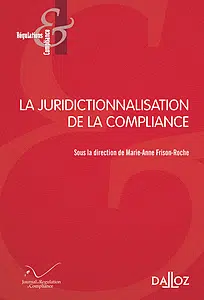
Couverture – La juridictionnalisation de la Compliance

Books

Collection Régulations & Compliance La Juridictionnalisation de la Compliance

► Full Reference: M.-A. Frison-Roche (ed.), La juridictionnalisation de la Compliance, série "Régulations & Compliance", Journal of Regulation & Compliance (JoRC) and Dalloz, 2023, 490 p.  - ► Presentation of this book: Sanctions, controls, appeals, deals: judges and lawyers are everywhere in the Compliance mechanisms, creating unprecedented situations, sometimes without a solution yet available.  Even though Compliance was designed to avoid the judge and produce security by avoiding conflict. This jurisdictionalisation is therefore new. Forcing companies to prosecute and judge, a constrained role, perhaps against their nature. Leading to the adaptation of major procedural principles, with difficulty. Confronting arbitration with new perspectives. Putting the judge at heart, in mechanisms designed so that he is not there. How in practice to organize these opposites and anticipate the solutions? This is the challenge taken up by this book. - 📘 In parallel, the English version of this book, Compliance Jurisdictionalisation, is published in the series co-published by the Journal of Regulation & Compliance (JoRC) and Bruylant.  - 🧮 This book comes after a cycle of colloquia organised in 2021 by the Journal of Regulation & Compliance (JoRC) and its Academic Partners. - This volume is the continuation of the books dedicated to Compliance in the collection "Régulations & Compliance", founded and managed by Marie-Anne Frison-Roche, copublished by the Journal of Regulation & Compliance (JoRC) and Dalloz. - 🏗️ General construction of this book: The book begins by a double Introduction, the first (in free access) summarizing the book, the second, substantial, relating to the need to reinforce the Judge and the Lawyer to impose the Compliance Law as a characteristic of the Rule of Law.  The first Part is devoted to what is specific to Compliance Law. of Compliance: the transformation of companies into Prosecutors and Judges of themselves, even of others. The second Part relates to Compliance general procedural Law, the procedure being the way between the dispute and the judgement.  The third Part continues this journey to the judge and aims to measure the influence of the reasoning and requirements of Compliance Law in dispute resolution methods where it was not, with some exceptions, present, but where it has a great future: Arbitration. Because trial and judicial decision are inseparable, because legal techniques and the Rule of Law should not be divided but compliance techniques could paradoxically be the weapon of their dissociation, because the power to judge and the procedures surrounding the latter must not be dissociated, because therefore Compliance mechanisms and the Rule of Law must be thought out and practiced then, the rise in power of one must be the sign of the rise in power of the other, and not the price of the 'weakening of the Rule of Law, the fourth Part relates to the Judges in the Compliance mechanisms and culture.  - ► Read in free access the article: M.-A. Frison-Roche, "Lignes de force de l'ouvrage La Juridictionnalisation de la Compliance" (Lines of Forces of the book La juridictionnalisation de la Compliance). - ►Read below the summaries of each contribution of the book⤵️ - 🌐 follow Marie-Anne Frison-Roche on LinkedIn 🌐follow Marie-Anne Frison-Roche on Instagram 🌐 subscribe to the Newsletter MAFR Regulation, Compliance, Law 

MAFR Chronicles Compliance Law

📝Contrat de compliance, clauses de compliance

► Full Reference: M.-A. Frison-Roche, "Contrat de compliance, clauses de compliance", Chronique of Compliance Law, D. 2022, pp. 2115-2117. - 📝reac the article (this article is written in French) - ► English summary of the article: Compliance Law is often seen only as an obligation to comply with regulations. Contract Law is masked by the study of texts and sanctions. Civil liability cases are beginning to highlight the commitments of companies, acts of will. It remains to discern the importance of contracts. First, there is a specific contract: the "compliance contract". Its purpose is to provide a third party with a service, the means for the company to "comply" with the legal systems requirements ("contract of conformity"), and/or to enable the company to achieve the monumental goals that characterize Compliance Law (contract of compliance). The interpretation and the regime of these compliance contracts must be marked by the Compliance Law that permeates it. Secondly, there are a multitude of stipulations aimed at conformity and Compliance. - 🚧read the working paper written in English: Compliance contract, Compliance stipulations - 📚read the other articles published in this chronique of Compliance Law published in the Recueil Dalloz. - 🌐 follow Marie-Anne Frison-Roche sur LinkedIn 🌐follow Marie-Anne Frison-Roche on Instagram 🌐subscribe  to the Newsletter MAFR Regulation, Compliance, Law