Publications

Filter by type

Breaking news

📧 In China, Compliance Law deploys without, and even against, democracy, China considering Compliance only as a “procedure of efficiency” ; in Europe, it deploys with and even for democracy

► Do Compliance and Democracy have a relationship? China replies: no. Europe responds and must respond: they are intimate. The definition of Compliance Law is therefore essential. In an interview of great clarity  given in French to the Newspaper Les Echos on June 2, 2021, about Brexit, China and Russia (➡️📝 "Brexit, Chine, Russie : les confidences de la diplomate Sylvie Bermann"), Sylvie Bermann reminds the evolution of China. She sums up the situation as follows: « La Chine ne veut pas dominer le monde, elle veut être la première et surtout qu'on ne puisse pas lui imposer un système, la démocratie » ("China does not want to dominate the world, it wants to be the first and above all that no one can impose on it a system, Democracy,"). This is reflected in China's conception of Compliance Law. If one defines Compliance Law only as a "method" for the effectiveness of rules, consisting of a kind of "Ex Ante enforcement process" leading to 100% effectiveness of regulations by subjects who must show to everyone the respect they have for these regulations and who are rewarded by this proof thus given, then China, in its current use of Law, illustrates exactly this definition: subjects, individuals and companies, prove their "obedience" to rules – whatever the rules" substantial content -, which is evaluated ("rating") and rewarded, in a mechanical reign of the Ex Ante, served by technologies. Democratic mechanisms are not required; they are even disturbed, because they interfere with the efficiency of the system. The technological and purely technocratic conception of Compliance ("Regulation by data", for example) uses the same definition of Compliance Law, which leads to choose algorithms’ efficiency. Europe must keep going to make another choice: European Compliance was born out of the Court of Justice of the European Union’s case law, in the 2014 judgment, Google Spain (➡️📝CJEU, Google Spain, May 13, 2021), to protect the person by inventing a subjective right: the right to be forgotten, in a digital space with infinite memory. Based on the Rule of Law, Compliance Law is then defined by its Monumental Goals, which are the protection of people and puts the judge at the center. It is the reverse of Chinese mechanics. Therefore, they are definitions that lead the world: about the definition of Compliance Law by "Monumental Goals", see ➡️📅 the 2021 cycle of colloquia co-organized by the Journal of Regulation & Compliance (JoRC) and its university partners on Monumental Goals; on the technical influence of this definition on "Compliance tools" ➡️📕see Frison-Roche, M.-A., Legal Approach to Compliance Tools: Building by Law the unity of Compliance Tools from the definition of Compliance Law by its "Monumental Goals", 2021.   ►subscribe to the MaFR ComplianceTech® Newsletter

Breaking news

📧 Compliance Law is about the future and assumes that there is no fatality: the environmental crisis will not take place, democracy will not be burged in the digital, child labor will stop

►"Fatality" is now disputed. Compliance Law is the effective concretization of its challenge.  Until recently, as in the Middle Ages, the idea of ​​fatality was present everywhere. "Fatality" is a future fact, already acquired in the present, already seen and against which it is useless to act. It was "fatal" that children were slaves; it was "fatal" that we were dominated by platforms which amuse us "for free"; it was "fatal" that pollution increases. This fatality brings us to the "catastrophe" but we did not want to do anything right here and right now. No doubt because it mainly concerns others. Child slaves are not ours, the dispossession operated by digital platforms is painless for us, pollution will make future generations disappear. This has changed for some time, perhaps because we now care about "other people". We would therefore like to stop the fatality for facts that concern others: children far away, creators, future generations. Or the abstractions which sum up this: the “Person”, Creation and Democracy, Sovereignty, Humanity. But what to do ? When we presented Law as not deserving its capital letter, a simple technique of maximizing particular projects between two operators in order to secure them, the particular contract being therefore the model of everything, in an efficient way of doing things (the "procedure "). We must build a new Law on these abstract notions: it is Compliance Law which aims these concrete goals, which are Monumental Goals. Imposing them on economic operators and rejoice in their power because the more powerful they are, the more productive the internalization of these goals and the obligation to achieve them will be. Under the direct control of the public supervisory authorities.   ► subscribe to the MaFR ComplianceTech® Newsletter

Breaking news

📧The G7 establishes how to tackle the global health crisis and to prevent the potential next one: lessons from Compliance Law

►Compliance Law, alliance between political authorities and systemic private operators: we are getting it there.    Crises are also times when reality appears more clearly. Thus said "health crisis" makes it appear more clearly what the "financial crises" had done: Compliance Law is the way in which political authorities, faced with a major global problem, form an alliance with companies which are in a position to resolve it (➡️📝Frison-Roche, M.-A., Place and Role of companies in the creation and effectiveness of Compliance Law in crisis, 2021). The G7 has just formulated it by deciding on the principle of distributing vaccines to the whole world made with money from the richest countries and the more or less forced cooperation of systemic operators, in particular pharmaceutical laboratories. G7 is thinking about the next health crises. In fact, Compliance Law is an Ex Ante Law which aims to prevent a potential crisis. The following problems are twofold. First, the very challenging next crisis should be the environmental crisis. Its "prevention" is a "monumental goal". An "Environmental Compliance Law" begins to set up, for example through the "public interest judicial agreement" (law of December 2020), or the internalization of goals into companies. But if in terms of health it is already difficult to designate companies "in position" (because there are not only laboratories …), it is even more difficult in environmental matters because environment is not a "sector". "Ex Ante responsibility" is more difficult to establish, but it is also more vital too (➡️📝Frison-Roche, M.-A., Environmental Compliance Law, as Ex Ante Responsibility, 2020). Moreover, in Compliance Law so that the private companies which maintain the system are not the masters of it, they are supervised by public supervisory authorities which control them in Ex Ante, inspect them, etc., according to the banking model. It has been taken up in the digital space, an essential role fulfilled for example by the CSA (French media regulator) or the CNIL (French personal data regulator). But in terms of protection of environment, there stil is no Authority, which will operate in Ex Ante (and therefore continuously) this supervision. This is not irrelevant. We could entrust this to the European Central Bank: since finance is already green, we can ask it. Perhaps even without a specific text (in this sense, see ➡️📝Frison-Roche, M.-A., Compliance Law, Health Crisis and Future, 2020,) And the main thing is to move forward in this dazzling Compliance Law, by which, to avoid collapse, a new Law is born, leaving there borders and distinctions, allowing unprecedented alliances, to save human lives in far countries.

Breaking news

📧 In Compliance Law, the political authority must clearly tell to the firm the extent of its power; if not the company will pass from the status of executive to the one of legislator

► Compliance: being in principle clear in the powers that the political authority gives or refuses to companies On May 28, 2021, the Federal Agency published guidelines on how companies could or could not compel their employees with regard to vaccination, with regard to civil rights and freedoms, especially religious freedoms, of workers, especially those who say they don't want to be (➡️📝EEOC, EEOC Issues Updated COVID-19 Technical Assistance, May 28, 2021). The question is to strike a balance between the two. It is often said that "Common Law" is casuistic and that Civil Law lays down principles. In this health crisis, we can see rather the opposite. American Law, which is very different from British Law, arises from "agencies", which speak clearly and quickly. The assertion is clear and plain. The document is two pages long. The principle is fixed: it is the principle of a power for the company to force to the vaccination. With one exception: the right for a person to request accommodations (undoubtedly teleworking) if this does not place too heavy a burden on the employer. As a result, on June 9, 2021, The New York Times headlines directly and simply on the principle: "yes, your employer can require you to be vaccinated" (➡️📝New York Times, Yes, your employer can require you to be vaccinated, June 9, 2021). Isn't this always how the "qualities" of "Continental Law" are praised? In times of crisis, proceeding in principle: "authorized / prohibited" then (because any principle supports exceptions) say one or two exceptions, simple and the mode of operation. No more. More generally, because the public authority must keep the normative authority for itself, it must clearly state what the company has the power to do in principle: yes or no. It is in a second level that it can deploy "Compliance tools", in the political decision thus adopted. In "Compliance by Design", this is essential, because otherwise the company will only be able to invent, under cover of technical casuistry, principles (on this dimension, see Cécile Granier, ➡️📝The normative originality of Compliance by Design, in ➡️📕"Compliance Tools", 2021). And the company, thus left to itself, will have great pleasure and interest in doing so. Who doesn't appreciate to become a Legislator?
Couverture – Compliance Tools

Books

Compliance Tools

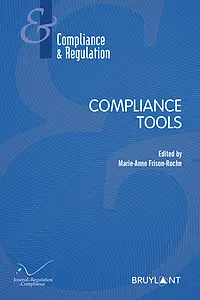
Full Reference: Frison-Roche, M.-A. (ed.), Compliance Tools, serie "Régulations & Compliance", Journal of Regulation & Compliance (JoRC) & Bruylant, 2021. This book in English is the first title of this collection integrally dedicated to Compliance Law, in that it is the extension of Regulation Law.  Read the titles of this series in English co-published by Bruylant. This collection in English is articulated with a collection co-published between the Journal of Regulation & Compliance and Dalloz. Thus, in parallel, a book in French, Les Outils de la Compliance is published.  Read the titles of the series in French co-published with Dalloz.  This book is published after a  cycle of colloquiums organised by the Journal of Regulation & Compliance (JoRC) and Partners Universities. - General Presentation of the collective book The political dimension of Compliance Law lies in the goals it aims to achieve. To achieve them, the concern for these goals is internalized in "crucial operators", which may be obliged to concretize "monumental goals" set by public authorities. These public bodies control the Ex Ante reorganization that this implies for these companies and sanction Ex Post the possible inadequacy of the companies, which have become transparent to this end. The effectiveness and efficiency of this internalization, without which the statement of these goals is worth nothing, is based on the Compliance tools that are deployed. These appear to be very diverse but their substantial unity (topic which will be the subject of a forthcoming book) makes it possible to study the tools put in place from a unique perspective, by not isolating them in a particular branch of Law, Criminal law or International Law for example, but by measuring what is common to them, notably Anticipation, Trust, Commitment, Responsibility, Incentive, and so on. If the Compliance tools vary, it is rather not only according to the sectors, finance and banking appearing then as the advanced point of the general Compliance Law, for example in environmental matters, but also according to the countries and the cultures. It is in fact about them that legal cultures seem to oppose. The book aims to understand these "tools" by going beyond the description of each instrument, for which we already have many monographs, for analyzing them through the issues of Risks, required Expertises, Training. Sovereignty claims, Incentives, mechanical aptitude of Technologies. It is through these themes that are analyzed by the authors, experts in the field, what we always want to understand better: Compliance Programs, Whistle blowing, Mapping, Sanctions, Extraterritoriality, etc.   -     Read the summary of the book.    Read the foreword, summarizing all the contributions.     Présentation of the book contributions:   Amico, Th., Compliance or the passage from ex post to ex ante: A Copernican revolution for the criminal lawyer? Banck, A., The maturity of the Compliance tool’s user, first criterion of the choice of the salient tool Burlingame, Coppens R., Power, N, Lee, D.H., Anti-Corruption Compliance: Global Dimension of Enforcement and Risk Management Calandri, L., Incentive(s) and Self-Regulation(s): which place for Compliance Law in the Audiovisual Sector?  Causse, H., Compliance Training: Through and Beyond Traditional Legal Training Frison-Roche, M.-A., Describing, designing and correlating Compliance Tools to have a better use of it Frison-Roche, M.-A., Building by Law the Unicity of Compliance Tools from the Definition of Compliance Law by its "Monumental Goals" Frison-Roche, M.-A., Drawing up Risk Maps as an obligation and the paradox of the "Compliance risks" ​ Frison-Roche, M.-A., Incentives and Compliance, a couple to propel Frison-Roche, M.-A., Resolving the contradiction between sanctions and incentives under the fire of Compliance Law Frison-Roche, M.-A., Rights, primary and natural Compliance tools Frison-Roche, M.-A., Training: content and container of Compliance Law​ Galland, M., The Regulator's Inspection of the Effectiveness of the Compliance Tools Implemented by the Company Granier, C., The Normative Originality of Compliance by Design Guillaume, N., Compliance risk mapping: first insights of challenges, limits and good practices Guttierez-Crespin, A., Audit of Compliance Systems​ Koenigsberg, S. and Barrière, F., The Development of Attorney's Compliance Expertise Larouer, M., The Manifestation of Incentives Mechanisms in French Compliance Law Merabet, S., Morality by Design Pailler, L., Technological Tools, Compliance by Design and GDPR: the Protection of Personal Data from Design Racine, J.-B., Geographical dominance in the choice and the use of Compliance Tools. Introductory remarks Rapp, L., Incentive Theory and Governance of Space Activities Roda, J.-C., Compliance by design in antitrust: between innovation and illusion Salah, M., Conception and Application of Compliance in Africa Tardieu, H., Data Sovereignty and Compliance Thouret, T., Training and Compliance, Two Correlated Information Transmission Tools  
Couverture – Compliance Tools

Articles in a legal collective publication

Drawing up Risk Maps as an Obligation and the paradoxe of the “Compliance Risks”, in Frison-Roche, M.-A. (ed.), “Compliance Tools”

General reference : Frison-Roche, M.-A., Drawing up Risk Maps as an Obligation and the paradoxe of the "Compliance Risks", in Frison-Roche, M.-A. (ed.), Compliance Tools, serie "Régulations & Compliance", Journal of Regulation & Compliance (JoRC) and Bruylant, 2021, pp. 61-72   - Summary of the article : There are few synthetic or theoretical studies on Risk Mapping even though it is in fact the Compliance central tool, perhaps because it is more a management tool than a legal one. Risk Mapping is often described but does not receive any other legal qualifications than being a "modality", suffering in this respect from an evil which affects the whole of Compliance, still little understood by Law, attention often so focused on the Ex Post (sanctions) while Compliance is by nature in the Ex Ante. Going from disarray to incomprehension, everyone can note the existence of "compliance risks" among the mapped risks, because if as so many affirm that it would be necessary to speak only of simple conformity as obedience, demonstrated in Ex Ante, to Law, how a sub-set of a tool would therefore have the same object as the set of Law that this tool serves … This aporia can only be resolved if Compliance Law is defined substantially by its "monumental goals" which exceed obedience to regulations. Consequently, Law taking up Risk Mapping, this mechanism may first appear as an ancillary obligation to the main obligation consisting in achieving "monumental goals". The ancillary obligation to draw up the maps is an obligation of result, while the main obligation to achieve the monumental goals is an obligation of means. These cartographies being very diverse and being only occasionally targeted by specific laws, it can also constitute only a legal fact or, through the play of various charters, a unilateral legal commitment. But it isnbecoming the basis of an autonomous legal obligation incumbent on enterprises in position to know certain risks, obligation referring to the existence of a subjective right tof knowing and measuring them ("right to be worried") which the third parties who are going to run them would hold, thus allowing them to choose to run them, or not. -   Read the bilingual working paper, with additional developments, technical references and hyperlinks, on which this article is based    Read a general presentation of the book in which the article is published   -
Couverture – Compliance Tools

Articles in a legal collective publication

Building by Law the Unicity of Compliance Tools from the Definition of Compliance Law by its “Monumental Goals” in Frison-Roche, M.-A., (ed.) “Compliance Tools”

► Full reference : Frison-Roche, M.-A., Building by Law the Unicity of Compliance Tools from the Definition of Compliance Law by its "Monumental Goals", in Frison-Roche, M.-A. (ed.), Compliance Tools, serie "Régulations & Compliance", Journal of Regulation & Compliance (JoRC) and Bruylant, 2021, pp. 35-46   Summary of the article : The "tools of Compliance" do not stack on top of each other. They form a system, thanks to a unity drawn from the goals that all these multiple and different tools serve: the "Monumental Goals" by which Compliance Law is defined. All these tools are configured by these goals and for mastering all these techniques, it is essential to put them all in perspective of what Compliance Law is, which is designed teleologically with regard to its goals. Extension of Regulatory Law and like it, Compliance Law is built on a balance between the principle of competition and other concerns that public authorities claim to take care of. Compliance Law has moreover more "pretensions" in this respect, for example in environmental matters. All the means are then good, the violence of the tools marrying without difficulty with the voluntary commitments since it is the goals which govern this branch of Law. As legal solutions adopted show, a common method of interpretation and common levels of constraint for all Compliance Tools result from this definition. Starting from the goals (in which legal normativity is housed), the interpretation of the different tools is thus unified. Moreover, the different degrees of constraint do not operate according to the consideration of sources (traditional legal criterion) but by the goals, according to the legal distinction between obligations of means and obligations of results which result from the articulation between tools, of which the establishment is an obligation of result, and the goal, of which the achievement is only an obligation of means. -   📝 Read the bilingual working paper on which rely this article. 📝 Read a general presentation of the book in which this article has been published.   -
Couverture – Compliance Tools

Articles in a legal collective publication

Rights, primary and natural Compliance Tools, in Frison-Roche, M.-A. (ed.), “Compliance Tools”

Full Reference : Frison-Roche, M.-A..,Rights, primary and natural Compliance Tools, in Frison-Roche, M.-A. (ed.), Compliance Tools, series "Régulations & Compliance", Journal of Regulation & Compliance (JoRC) and Bruylant, 2021, pp. 319-342   -   Article Summary: In the traditional conception of the architecture of the sectors regulated by Law, and in Compliance Law which extends the regulatory techniques, rights have little place. But this configuration no longer takes place; on the contrary, rights are at the center of Regulatory and Compliance systems, and will be more and more so. They are and will be the primary tools of Compliance Law because they constitute a very effective "tool" to ensure the entire functioning of a system whose goals are so difficult to achieve. Because every effort must be done to achieve these goals, the public authorities not only rely on the power of crucial operators, but also distribute prerogatives to people and organizations who, thus encouraged, activate the Compliance system and participate in the achievement of the "monumental goal". Rights can prove to be the most effective tools for actually achieving the goals set, so much so that they can be seen as "primary tools". But it is pertinent to have more pretension and to conceive rights as the most "natural" tools of Compliance Law. Indeed because all the Monumental Goals by which Compliance Law is defined can be expressed by the protection of persons, that is to say to the effectiveness of their prerogatives, by a mirror effect between rights. given as tools by Law by to persons and rights which constitute the very goal of all Compliance Law, in particular the protection of all human beings, even if they are in a situation of great weakness, rights becoming a "natural tool" of Compliance Law. We are only at the beginning of their deployment and it is undoubtedly on them that Digital space in which we now live would be regulated, so that we will not suffocated there and that it will constitute for people a civilized space. -   Read the bilingual working paper, with additional developments, technical references and hyperlinks, on which this article is based    Read the General Presentation of the book in which this article has been published   -
Couverture – Compliance Tools

Articles in a legal collective publication

Incentives and Compliance, a promising couple to increase the Compliance Law utility, in Frison-Roche, M.-A. (ed.), “Compliance Tools”

Full reference : Frison-Roche, M.-A., Incentives and Compliance, a promising couple to increase the Compliance Law utility, in Frison-Roche, M.-A. (ed.), Compliance Tools, series "Régulations & Compliance", Journal of Regulation & Compliance and Bruylant, 2021, pp. 141-148   - Summary of the article: The theory of incentives targets the mechanisms which do not use directly constraint (except to present sanctions themselves as incentives) but which leads nevertheless to expected behaviors. To appreciate the links which must or must not be done between incentives and Compliance, we should proceed in two times.  First, the association appears natural between incentive mechanisms and "Compliance Law" since the later is defined in a dynamic way. Indeed, if it is defined placing its legal normativity in its "monumental goals", as the end of corruption, the detection of money laundering in order to underlying criminality disappears, or as the effective protection of environment or the concrete care of human beings, then what matters is not the means in themselves but the effective tension towards these "monumental goals". In this perspective, what was related to public policies led by States, because they are definitively not able to do it, the charge is internalized in the firms which are able to tend towards this goals: "crucial operators" because they have the geographical, technological, informational and financial means.  In this perspective, the internalization of public willingness provoking a split with the concept of State linked to a territory which deprives Politics of its constraint power, incentive mechanisms appear as the most efficient mean to reach these monumental goals. They appear as this "natural" mean both negatively and positively defined. Negatively in which they do not need in Ex Ante institutional localizable sources and sanction power in Ex Post: it is enough to substitute the interest to obligation. Positively, incentives relay through operators' strategies what was the so critical and joked form of public action: the "plan". The duration is thus injected thanks to Compliance mechanisms, as we can see it through the development of it in the care for environment ("plan climat") or through the educational mechanism, which could be conceived only in duration.   However, the opposition seems radical between Compliance Law and Incentives. And this because of three convictions often developed and that we have to overcome. First, the idea that in a general way, there would be a Law only if there is a mechanism of immediate constraint which is associated to the norm. As long as the incentive is not based on obligation, then it will be nothing… Secondly, and as if that were a kind of consolation …, Compliance would not be really Law either … We so often say that it is only about a methodology, a range of processes without sense, procedures to follow without trying to understand, process that algorithms integrate in a mechanic without end and without sense or that on the contrary, Compliance would be full of sense by Ethics and Morality, which are far from Law. While incentives talk to the human spirit which calculate, Compliance would be so a process through which machines will be connected to other machines, so an extra soul, where calculation has no place… Thirdly, solutions would be to be find in Competition Law because it can do without States, submit them and approach what is a-sectorial, especially finance and digital, the world being financialized and digitalized. The violence of Competition Law which comes in Ex Ante thanks to "Compliance sanctions" applying for example to essential infrastructures Law, by continuing to deny the salience of the duration and taking care of the "market power" would be also not compatible with a marriage with incentive mechanisms which rely on duration and power of those to which it is applied, converging towards goals, which are set by what Competition Law ignores: the project. This project which pretends to build the future is the one of politics and of companies, which use their deployed power in time to concretize it. It is without any doubt there that the future of Europe is.  To overcome this triple difficulty, it is thus necessary, in a second time, to modify our conception of Law, especially thanks to Compliance Law, in which this new branch is autonomous from Competition Law, and even sometimes opposed to it, in order to the insertion of incentive mechanisms permit to unknown or against Competition Law organizations to reach "monumental goals" which are imperative to take into consideration. For example, the taking into consideration of climate challenges or the building of a sovereign identity of the data. This is expressly set by European Commission which supervises such initiatives, supervision being what is articulated with Compliance, in a couple that go beyond Regulation, and replaces in Ex Ante Competition Law, salient branch for Ex Post. All the texts which are in the process of expressing it are based on this reformed couple: Compliance and Incentive. This couple supposes that we recognize as such the existence of companies as project carriers, project which is the creation of marketed wealth circulating on a market, which could be an industrial project specific to a geographical zone both economical and political. Regulation is deployed to go away from the notion of sector and to transform itself in supervision of crucial firms in the correspondance between the project and the action, what refers to the notion of "plan". In this, banking supervision is just the advanced bastion of all thematic, energetic, climatic and health plans, or more broadly industrial and technological that could by incentive be implemented, this conception of Compliance permitting to build zones which are not reduced to immediate market exchange. The incentive corresponds to the fact that Compliance Law relies on the power of the firm to reach its own political goals, for example fighting against disinformation in the digital space or obtaining a healthy environnement. This supposes that Compliance stops to be only conceived as a model of rules effectivity, for example of Competition Law, to be recognized as a substantial branch of Law. A branch which expresses political goals. A branch which is anchored in crucial firms whose it recognizes the autonomy with regards to markets. This makes it possible, in particular through the coupling with incentive mechanisms leading to long-term collaborative operations supervised by public authorities, not to be governed by simple Competition Law, inapt to bring projects to fruition. -   Read the bilingual work paper, with additional developments, technical references and hyperlinks on which this article is based   Read a general presentation of the book in which the article has been published.   -

Couverture – Compliance Tools

Articles in a legal collective publication

Resolving the contradiction between “sanction” and “incentive” under the fire of Compliance Law, in Frison-Roche, M.-A. (ed.), “Compliance Tools”

Full reference: Frison-Roche, M.-A., Resolving the contradiction between "sanction" and "incentive" under the fire of Compliance Law, in Frison-Roche, M.-A. (ed.), Compliance Tools, series "Regulations & Compliance", Journal of Regulation & Compliance (JoRC) and Bruylant, 2021, pp. 101-112   -   Summary of the article: Compliance and Incentives appear at first glance to be totally opposite. For two major reasons. Firstly, because sanctions have a central place in Compliance Law and that the incentives suppose an absence of constraint on the operators. Secondly, because the incentives are linked to self-regulation and that Compliance Law assumes a strong presence of public authorities. Thus, one should choose: either Compliance or Incentives! Either the effectiveness of one or the effectiveness of the others; either the techniques of one, or the techniques of others; either the philosophy of one or the philosophy of the other. Resign oneself to the waste that such a necessary choice would imply. But to put the terms in this way amounts to thinking poorly about the situations and reducing the fields of the solutions they call for. If we take a rich definition of Compliance Law, we can on the contrary articulate Compliance and Incentives. From this perspective, sanctions can no longer become what blocks the use of incentives but, on the contrary, what constitutes them. Even more, the coupling between the Incentives and the requirements of Compliance Law must be strongly encouraged, as soon as the public authorities supervise in Ex Ante all the initiatives taken by the "crucial operators". This working document deals with the first issue. Indeed, the so-called incentive theory targets mechanisms which do not directly resort to constraint. They would therefore have little place in Compliance Law. But it seems saturated with sanction procedures. We can even say that it seems to put them at the center, the public authorities presenting the number of sanctions as a sign of success, while the companies seem obsessed with their prospects, the two concerns ending in such a strange convergence that are the Convention Judiciaire d'Intérêt Public (non-prosecution agreement). The honest observer cannot help but be immediately uneasy. Indeed, it can only raise the definition of the sanction as a "constraint" triggered Ex Post, at the very heart of a Compliance Law which is presented as a set of Ex Ante mechanisms. Based on this contradiction in terms, should we give up the association and think that it would be wrong against the spirit to think of the sanction as an incentive? It is undoubtedly in this connection that one perceives most clearly the clash of two cultures, which do not communicate, while technically they apply to the same situations. Indeed, because Compliance was designed by Finance, everything is a tool for it. Therefore, the tendency to think of the sanction only as an incentive is very strong in Compliance Law, manifests itself continuously and will not stop (I). But whatever the reasons for conceiving it this way, the principles of the rule of law cannot disappear and if we do not want them to be erased, then they must be articulated (II). This is an essential game (II). This is why we can literally say that Compliance has set Criminal Law on fire by its conception, logical but closed in on itself, of sanctions as simple incentives. In order for Law to remain, however, we must hold a very firm definition of Compliance Law centered on its Monumental Goal, which is the protection of the person. -   Read the bilingual working paper, with additional developments, technical references and hyperlinks, on which this article is based.   Read a general presentation of the book in which this article is published.   -
Couverture – Compliance Tools

Articles in a legal collective publication

Describing, conceiving and correlating compliance tools, in order to use them adequately, in Frison-Roche, M.-A. (ed.), “Compliance Tools”

Full reference: Frison-Roche, M.-A., Describing, conceiving and correlating compliance tools, in order to use them adequately, in Frison-Roche, M.-A. (ed.), Compliance Tools, series Regulation & Compliance, Journal of Regulation & Compliance (JoRC) and Bruylant, 2021, pp. 9-32.   -   Summary of the article: The article is the general introduction to the book on Compliance tools. In its first part it develops the overall problematic. In its second part, it presents each of the contributions, placed in the overall construction of the work.   -   Read a general presentation of the book in which this article has been published.    
Couverture – Compliance Tools

Articles in a legal collective publication

Training: content and container of Compliance Law, in Frison-Roche, M.-A. (ed.) “Compliance Tools”

Full Reference: Frison-Roche, M.-A., Training: content and container of Compliance Law, in Frison-Roche, M.-A. (ed.), Compliance tools, series "Régulations & Compliance", Journal of Regulation & Compliance (JoRC) and Bruylant, 2021, pp. 245-264   -   Summary of the article Firstly, as Training is a specific Compliance tool, it is supervised by Regulators. It becomes mandatory when it is contained in Compliance programs or sanction decisions. Since effectiveness and efficiency are legal requirements, what is the margin of companies to design them and how to measure the result? Secondly, as long as each Compliance tool includes, more and more, an educational dimension, we can take each of them to identify this perspective. So even condemnations and prescriptions are so many lessons, lessons given, lessons to be followed. The question is then to know who, in this so pedagogical Compliance Law, are the "teachers"?   -   This article is based on a bilingual Working Paper, including additional technical developments, pop-up notes and hypertext links.   Consult an overview of the volume in which the article was published.     -