All news

Glossary

Goal

The goal for which a mechanism, a solution an institution or a rule is adopted, instituted or elaborated, is in principle external to them. Knowledge of this goal is a tool to better understand them and is only that. On the contrary, in Regulation Law, the goal is the heart itself. By definition, Regulation Law is a set of instruments that articulate to take their meaning in relation to a goal. Moreover, these instruments are legitimate to represent a constraint only because they realize a goal which is itself legitimate. The interpretation of Regulation Law is based on the aims pursued: the reasoning is teleological. This teleological nature explains that efficiency is no longer merely a concern – as for ordinary legal mechanisms, but rather a principle of Regulation Law. It explains the welcome, especially through the European Union Law of the theory of the useful effect. This link between rules, which are only means, and aims, refers to the principle of proportionality, which requires that constraints and exceptions be applied only when they are necessary, proportionality being the form off the classic principle of necessity. Because the aim is the center, it must be expressed by the author of the Regulation standards, and this is all the more so if they are of a political nature, being not limited to mitigating technical failures of markets. This goal can be varied: the management of systemic risks, but also the consideration of the fundamental rights of people, the preservation of the environment, public health, civilization, education, etc. The silence of the legislature, which limits itself to the making of rules whereas these are merely instruments, without explicating the goal whereas the latter is a political decision, is a fault in the legislative art. Moreover, in order that the person who applies the Regulation norm, in particular the Regulator and the Judge, has no excessive margin for interpretation and does not substitute for political power, the author of the Regulation norm needs to aim specifically for one goal : in this way, the one who applies the norm will be constrained. Or, if the author targets several purposes, then he must articulate them in relation to each other, by hierarchizing them for example. If he fails to do so, the institution which applies the regulatory standards will itself have to choose the purpose and exercise a power which he does not possess. This express designation of purpose has been made for the European Banking Union,  this Regulation and Supervision construction, whose primary aim is to prevent systemic risks and resolve crises. Similarly, the purpose of the Regulation of essentiel infrastructures is to provide third parties access to the network. Similarly, in the case of a transitional regulation introduced following liberalization, the aim is to establish competition, the principle of which has been declared by the liberalization law. When this is not clearly stated, there is a lapse in the legislative art.    

Conferences

Is the contract the optimal instrument of CSR?

Reference : Frison-Roche, M.-A., Le contrat est-il l'instrument optimal de la RSE ? ("Is the Contract the optimal instrument of CSR?")  in Trébulle, F.-G. (modérateur), Les instruments de la RSE : le contrat (The instruments of CSR"), cycle of conferences organized by the Cour de cassation (French Civil Supreme Court and the Universities of Paris-Dauphine, Paris VIII and Paris I),Cour de cassation, Paris, 11 mai 2017. Read the slides (in French) as served as the basis of the conference les slides Read the program on the Cour de cassation  wesite (in French). Read the program of the whole cycle of conferences in which this conference enters (in French)   Corporate Social Responsibility belongs to Economic Law. It thus enters into its logic of efficiency, leading to apprehend any legal mechanism as an instrument, the contract as the others. This does not mean that everything is only an instrument, on the contrary. Economic Law, when it takes the form of Regulation Law, places the principles in the aims pursued. It is in these principles that it can meet CSR if the goals are the same. In view of these aims, everything is an instrument. On the scale of goals which are "monumental"1On this notion of "Monumental Goal", see Frison-Roche, M-A., Compliance Law, 2016 ; From Regulation Law to Compliance Law, 2017., in that they are global, in that they seem unattainable, such as the fight against child labor, such as the end of corruption or the sale of human beings, all legal instruments become interchangeable, from the Constitution to the contract, from the hard law to the soft law. The only criterion becomes efficiency to achieve the goal. We then reach the efficiency, criterion of the Regulation Law. New laws, such as in France in 2016 the Sapin 2 law or in 2017 the law establishing a "duty of vigilance" with uncertain contours, may use the contract only as a vehicle for legal obligations to be performed by the company2For a whole demonstration, see Frison-Roche, M.-A.,From Regulation Law to Compliance Law, 2017.. The contract becomes an instrument of the Compliance Law, chosen as the optimal instrument of the Internalized Regulation Law in the company. But the contract can also be chosen as an instrument by the company in that it pursues the same goals of general interest, becoming global3On this notion of "global general interest", and maybe of "global public service", see Frison-Roche, M.A., From Regulation Law to Compliance Law, 2017 .. The contract is then chosen as an Ex Ante tool, which will be refined to the specificity of the company, exceeded the generality of the law and which will be able to resolve the diversity of national laws by more comprehensive contractual relations. Moreover, the contract can integrate active Ex Post mechanisms, such as the warning launcher or the controller, audits, or even form an ecosystem by training clauses to disseminate a CSR culture. By these contractual provisions, the contract operates the mixing of times, the Ex-Ante and the Ex Post, which the legislation can not do, refines it to what the particular enterprise is . In this, the contract converges towards what is being constructed: a Compliance Law.

Analyses

Hayao Miyazaki explains that the drawings of video games made by machines are “insults to life”

Through the Open Culture website, it is possible to listen to Hayao Miyazaki who, in March 2017, claimed that video games whose drawings are made on Artificial Intelligence basis are "insults to life". Read below the history, the words that the Master has held, his conception of what is creation and "truly human" work, which is echoed by the definitions given by Alain Supiot, who also reflected on what robots do. This brings us back to the very notion of "creation" and creative work.   - Read below

Glossary

State

Legally, the State is a public law subject defined by territory, people and institutions. It acts in the international space and emits norms. Politically, it has the legitimacy required to express the will of the social body and to exercise the violence of which it deprives the other subjects of law. It is often recognizable by its power: its use of public force, its budgetary power, its jurisdictional power. These three powers, declining or being challenged by private, international and more satisfying mechanisms, some predicted the disappearance of the State, to deplore it or to dance on its corpse. With such a background, in current theories of Regulation, primarily constructed by economic thought and at first sight one might say that the State is above all the enemy. And this for two main reasons. The first is theoretical and of a negative nature. The advocates of the theory of regulation deny the State the political qualities set out above. The State would not be a "person" but rather a group of individuals, civil servants, elected officials and other concrete human beings, expressing nothing but their particular interests, coming into conflict with other interests, and using their powers to serve the former rather than the latter as everyone else. The Regulation theory, adjoining the theory of the agency, is then aimed at controlling public agents and elected representatives in whom there is no reason to trust a priori. The second reason is practical and positive. The State would not be a "person" but an organization. Here we find the same perspective as for the concept of enterprise, which classical lawyers conceive as a person or a group of people, while economists who conceive of the world through the market represent it as an organization. The state as an organization should be "efficient" or even "optimal". It is then the pragmatic function of the Regulation Law. When it is governed by traditional law, entangled by that it would be an almost religious illusions of the general interest, or even the social contract, it is suboptimal. The Regulation purpose is about making it more effective. To this end, as an organization, the State is divided into independent regulatory agencies or independent administrative authorities that manage the subjects as close as possible, which is fortunate in reducing the asymmetry of information and in reviving trust in a direct link. The unitary, distant and arrogant State is abandoned for a flexible and pragmatic conception of a strategic state (without capital …) that would finally have understood that it is an organization like any other … Competition law adopts this conception of the State, which it posed from the beginning that it was an economic operator like any other. This is how this conception which would be  more "neutral" of the world is often presented. Successive crises, whether sanitary or financial, have produced a pendulum effect. Now, the notions of general interest or common goods are credited of an autonomous value, and the necessity of surpassing immediate interests and of finding persons to bear superior interests or to take charge of the interests of others, even a non-immediate one, emerged. Thus, the State or the public authority, reappears in the globalization. The Compliance Law or the Corporal Social Responsibility of the crucial companies are converging towards a consideration of the State, which can not be reduced to a pure and simple organization receptacle of externalities.  

Working papers

🚧 From Regulation Law to Compliance Law

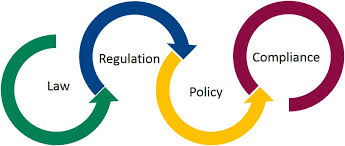
This working paper is the basis for an article written in French to be published in the French publication RÉGULATION, SUPERVISION, COMPLIANCEE, to be published in the RÉGULATIONS series at Éditions Dalloz. This work uses the Compliance and Regulation Law bilingual Dictionnary. - This Working Paper aims to show the movement that starts from Regulation Law to Compliance Law, now in the process of being born. In order to explain this movement, in order to anticipate the near future, in what it should not be and in what it should be, it is necessary to reconstruct how the Compliance Law was born of the Regulation Law, which has thus found the sources of the Public Services Law of which it had at first cut the roots (I). Indeed Regulation Law has in a happy way renewed the Law but also narrowed its perspective. Today, the phenomenon of globalization and the need for public authority that States can not satisfy according to traditional legal methods implies the establishment of a sort of "global public service". This is done by the Law of Compliance which revolutionizes all legal systems, both Common Law and Civil Law (II). Indeed, Compliance Law internalizes in some companies, the "crucial operators", the duty to make effective the "monumental goals" that the regulatory authorities have formulated and of which these companies must render globally effective. In this respect, the Law of Compliance is the extension of the Law of Regulation, which makes a new scope and in its aims and in its space. It is the whole of Law that is transformed. The near future will tell if it is reflected in clashes, between companies and regulators, between Europe and the United States, or on the contrary by a pact of trust between the crucial operators and the Regulators. If this is achieved, the Law of Compliance, expressing the political dimension of the Law of Regulation, expressing the share of companies that ceases to be neutralized by the mechanics of the markets, will be an advancement of the Law. It is in this perspective that we must build the European Compliance Law.      

Glossary

Compliance

"Compliance" is the typical example of a translation problem. Indeed and for example, the term "Compliance" is most often translated by the French term "Conformité". But to read the texts, notably in Financial Law, "Conformité" is aimed rather at professional obligations, mainly aimed at the ethics and conduct of market professionals, especially service providers of investment. It is both a clearer definition in its contours (and in this more certain) and less ambitious than that expressed by the "Compliance". It is therefore, for the moment, more prudent to retain, even in French, the expression "Compliance". The definition of Compliance is both contentious and highly variable, since according to the authors, it goes solely from the professional obligations of financial market participants to the obligation to comply with laws and regulations. In this latter sense, that is, the general obligation that we all have to respect the Law. To admit that, Compliance would be Law itself. Viewed from the point of view of Law, Compliance is a set of principles, rules, institutions and general or individual decisions, corpus of which the primary concern is efficiency, in space and in time. The purpose is to put into practice general interest goal targeted by these gathered techniques. The list of these goals, whether negative ("fighting": corruption, terrorism, embezzlement of public funds, drug trafficking, trafficking in human beings, organ trafficking, trafficking in poisonous and contagious goods – medicines, financial products, etc.) or positive ("fighting for": access to essential goods for everyone, preservation of the environment, fundamental human rights, education, peace , transmission of the planet to future generations) shows that these are political goals. These goals correspond to the political definition of the Regulatory Law. These political goals require means which exceed the forces of the States, which are also confined within their borders. These monumental goals have therefore been internalized by public authorities in global operators. The Compliance Law corresponds to a new structuring of these global operators. This explains why the new laws put in place not only objective but structural repressions, as in France the "Sapin 2 Law" (2016) or the "obligation of vigilance Law" (2017) . This internationalization of the Regulatory Law  in companies implies that the public authorities now supervise the latter, even if they do not belong to a supervised sector, or even to a regulated sector, but participate, for example, in international trade. The Law of Compliance thus expresses a global political will relayed by this violent new Law, most often repressive, on companies. But it can also express on the part of the operators, in particular the "crucial operators" a desire to have themselves concern for these monumental global goals, whether of a negative or a positive nature. This ethical dimension, expressed in particular by the Corporate Social Responsibility, is the continuation of the spirit of the public service and the concern for the general interest, raised world-wide.

Working papers

🚧 Compliance and Trust

Compliance. Trust. Two words that come more and more often than before at our readers' eyes or listeners' ears. And yet they do not seem to match well. They even seem to repel each other. Indeed, Compliance is the way in which Public Authorities trust certain private operators, not in themselves, but with their structural capacities to mechanically capture the information that these authorities need (I). This presupposes a vision of the world in which Companies are powerful and powerful alone but are not virtuous, while Public Authorities, such as the Public Prosecutor's Office or Regulators, are weak but virtuous alone. Such a conception of Compliance transforms companies into automata. Such a vision of the world has no future: only human beings can be trusted, whose fallibility must be accepted, as Compliance is then the expression of a relationship built on trust that is to be seen between non-mechanical operators, namely public Institutions and private Operators, who can both have in common concern for an interest which goes beyond them and which was formerly called the general interest (II). From this reality, no new doubt for private companies, but which explains the strange intimacy between the violent Compliance Law and the new spontaneous order of Corporate Social Responsibility, it is up to them to demonstrate this concern Cf others that it shares with the Public Authorities, except to fall in Compliance reduced to costly procedures, empty endless staked out of sanctions without control. It is thus for Companies to make this branch of Compliance Law emerging become what can be the best, when it is possible that it becomes what would be the worst.

Jurisprudence

Autorité de la concurrence (French Competition Authority)

Decision n°17-D-06 of 21st of March 2017 relating to practices implemented in natural gas, electricity and energy services supply sector

Full reference: Autorité de la concurrence (French Competition Authority), Decision relating to practices implemented in natural gas, electricity and energy services supply sector, Engie vs Direct Energie/UFC que choisir, 21st of March 2017, n°17-D-06 Read the decision (in French) Read the press release Read the press release of the decision of 9th of September 2014 on which this decision is based