All news

Working papers

🚧Drawing the Circles of Compliance Law

This working paper is the support for the article to appear in the collective book  dedicated to our very dear friend and colleague Philippe Néau-Leduc. It uses the Bilingual Dictionary of the Regulatory and Compliance Law. Compliance Law has the same teleological functioning as the Economic Law to which it belongs, which consists in placing the normativity of rules, decisions and reasoning in the aims pursued. Once we know what the goals of compliance techniques are, then we know who should be responsible for them, who must be subject to them, who must activate the rules: compliance rules must be activated by those who are in the best position to achieve the outcome in order to achieve the goal sought by the authority which designed the compliance mechanism. The "circles" are thus plotted in a rational and pragmatic way. That, all of it ("useful effect"), but not beyond that. The notion of efficiency does not always imply balancing: on the contrary, it can involve drawing circles which designate those who are "placed" to carry the burden of the rules because they are capable of producing them the desired effects. Within these circles, the rules must apply without restriction and without compromise, but they must not apply beyond these circles. Drawing such circles requires defining the Law of Compliance itself, since on the one hand the choice of those who must implement the Compliance depends on the aims of the Compliance and on the other hand the definition of the Law of Compliance is itself teleological in nature. This is why, contrary to the assertion that the exercise of definition would be useless in these matters, which would be above all on a case-by-case basis, this effort to define and determine the purposes is, on the contrary, necessary in practice to show which enterprise must bear the obligations of compliance and which must not. But it is enough to have posed this to reveal the major difficulty of the Compliance, that explains resistances, and even gives the impression that one is confronted with an aporia. If, as a matter of principle, what is expected of the "users" of the Compliance mechanisms must be articulated to the aim that is affected by the authors of the compliance mechanisms to them, we must have a minimum correspondence between the aims of these authors (Legislators and Regulators) and the aims pursued by those who are responsible for implementing them: companies. However, this correspondence does not exist at first sight, because the compliance mechanisms are found to be uniquely based on "monumental goals" which the public authorities have a legitimate concern, whereas companies have for their own interest . The two circles do not match. The internationalization of concern for these aims in companies would therefore be only a mechanism of violence of which enterprises are the object, violence felt as such. (I). To resolve this violence, it is better to stop confusing the State and enterprises, whose goals are not the same, and draw the circle of subjects of law "eligible" for Compliance. It is highly legitimate to target certain entities, in particular this category of companies, which are the "crucial operators", in a binding way, as it is legitimate to govern companies that have expressed a desire to surpass their own interests. These circles of a different nature can overlap on a concrete operator: for example, if a bank – alway a crucial operator that is structural because it is systemic – is also international – a crucial operator because of its activity – decides to worry about others by commitments verified by the authorities to overcome their own interest (social responsibility), but these different circles are not confused. In any case, companies may belong to only one circle, or even belong to none. In the latter case, they must therefore remain beyond the reach of the pressure and cost of Compliance Law, in particular because they are not objectively required to realize the "monumental goals" aimed at effectiveness and do not want it: in a liberal system, it is for the public authorities to aim at the general interest, the ordinary people indirectly participating in it by paying the tax. (II). It is by making these "Compliance Circles" of eligible subjects of this specific Law to implement the heavy but justified and controlled burden of Compliance with regard to the monumental goals that this new system  aims, that then opens a royal way in order to find a uniqueness and to increase the "monumental function" of the Compliance Law by a relation of Trust towards the global general interest, rather than the mechanical application of rules whose meaning is not understood and whose perception is no longer perceived than violence.

Glossary

Public Law / Private Law

The distinction between "Public Law" and "Private Law" is important. In the systems of Continental Law, or still called under Roman-Germanic Law, or even called Civil Law systems, it is even around it that legal systems are built: it can be a basic distinction, a summa divisio, as it it in the Civil Law systems. In the so-called Common Law or Anglo-American systems, the distinction is less fundamental, but it remains, justifying in particular that the rules and disputes concerning the administration call for special rules and are apprehended by special tribunals. In principle, this distinction is based on the nature of the persons whose legal situation is examined. Under"Public Law" a legal situation involving a person who is itself a public-law entity: the State, a local authority, a public undertaking, etc. That is why, for example, the contract which may be concluded will be of public law, and the judge who may be seized of it will be an administrative court. If the situation does not involve a person governed by public law, then it will be governed by "Private Law". There are a thousand exceptions, but this is the starting and basic and fondamental principle. Two essential remarks, bearing a system of values, explaining that the systems of Civil Law and Common Law are in fact confronting each other. The two bodies of rules and institutions are not of equal strength because one of the categories is "closed", corresponding to one criterion (the "public person"), while the other is open: Public Law is a closed category; on the contrary, Private law becomes "active" as soon as there is no public person (a "private person" who or which must define himself or itself as a "non-public person"). One can consider this articulation between Public Law and Private Law in two ways, radically opposed. It may express a mark of inferiority in disfavour of private law: we are all "ordinary" persons in "ordinary" situations with "ordinary" activities (this will be the French conception ….). On the contrary, Public Law is the mark of the State, of Public Order, of Sovereignty, of public power, of the general will, in the interstices of which individuals slip in to act and satisfy their small particular interests On the contrary, Private Law can be considered as the expression of the "common law": people are free and do what they want, through ownership and contract. As an exception and because they have elected people to do so, the rulers (whom they control), by exception, enact norms that constrain them. But this is an exception, since repression – public law and criminal law, which has the same status in this respect – is only a tribute to the freedom of persons, since this freedom remains wholly in the form of the private enterprise on the market. It is then measured that the articulation between Public and Private Law profoundly reflects a philosophy and a political position. If it is considered that Regulation is the underlying order by which the Sovereign allows the deployment of his subjects who also benefit from a long-term policy constructed by the autonomous and measured political will, then Public Law in Is the master, the Regulation Law expressing a renewed search for efficiency, this but only this. If we believe that Regulation is whereby economic rationality manages to protect persons and companies from risks and to compensate for market failures, a market whose liberal principle remains the ideal, then Private Law is the core, whith contract and private property as basis tools. France and the Latin countries adhere rather to this metaphysics of values which entrusts to the Public Authorities and the State the legitimacy and the power to express the general interest by Public Law, Regulators and Constitutional Courts, expressing it on a technical form renewed by the Regulatory tools: incitations, soft law, etc. The legal systems whose history draws on British history put more trust in the person of the entrepreneur and conceive of Regulation Law as an efficient outsourcing of functions to administrations that are efficient, informed and impartial. Certainly, in the technical daily of the Law of Regulation and following the different sectors, Public and Private Law mix up:  public companies take the form of publicly traded companies under private law or private companies will be entrusted with missions of public service, instituting them as second-level regulators as are the infrastructure network operators. But the fundamental conception of systems (rooted in the history of the people) and practice marry. In the silence of regulations (and the more they are gossiping and the more the judge must interpret them, which amounts to a "silence"), what sense to give to the system? To take only a few questions, frequent in practice:      What judge to seize? The administrative judge or the civil judge? What is the "natural judge" of the Regulatory Law?      What standard to apply? The contractual will? The implicit will of the legislator? What is the "natural author" of the Law of Regulation?      Does the silence of the text prohibit action for operators or on the contrary does silence mean their freedom to act? The absence of a firm and shared definition of what is the Law of Regulation does not facilitate practice. Hesitations in translations from one language to another increase confusion. For the time being, there is a tendency to refer to Public Law in the sectors where whe take precedence over public operators' monopolies, such as telecommunications, energy, railways, air and postal services, and to refer to Private Law in the sectors which have long been the subject of competition between operators, namely banking, finance and insurance. It should be recognized that the criterion of distinction has little economic rationale. The notion of risk would be a clearer and more manageable criterion. But it would then lead to a greater challenge to the distinction between Public and Private Law. Because the Law of Regulation, impregnated with Economy and Economic Analysis of Law, has sometimes little basis of legal tradition, it put in question of this summa divisio. If this were to be the case, it would be the totality of the legal systems which would be upset, especially in its judicial organization, since the judicial civil and commercial system is so distinctly distinguished (that of "ordinary" persons, that of "common law ) and the administrative judge (the "natural judge" of the State). It is then realized that the Law of Regulation challenges the whole Law, especially in the Latin countries and the Civil Law systems.
Conferences

Conference cycle : Regulation, Supervision, Compliance

Organised by the Journal of Regulation (JoR) in partnership with Sciences Po School of Public Affairs and Economics Department, under the scientific supervision of Marie-Anne Frison-Roche, economic law professeur at Sciences Po, director of the Journal of Regulation (JOR). The sessions will be held at the Conseil Economique, Social et Environnemental (CESE). Each session, which will be held (in French) from 5pm to 7pm, will give the stage to a panel of 3 to 4 speakers and will be concluded by a Q&A session with the audience.  The sessions will be held for seven weeks in a row, from October 5th to November 30th, 2016. Read the common question to all the sessions of the conference cycle (English translation coming soon) In parallel, a book will be elaborated from these sessions. It will be issued as part of the Régulations book series, published by Dalloz, which had already published the book Internet, espace d'interrégulation. Read the detailed description of each session (French version only).  

Publication director

🏗️ copublishing and direction of the collection: 📚Régulations & Compliance

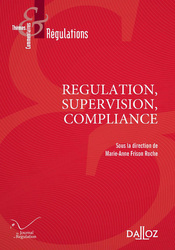
Publication of 🕴️M.-A. Frison-Roche (ed.), 📕Régulation, Supervision, Compliance (Regulation, Supervision, Compliance)

► Full Reference: M.-A. Frison-Roche (ed.), Régulation, Supervision, Compliance (Regulation, Supervision, Compliance), Dalloz, coll. “Thèmes & Commentaires”, “Régulations” Serie, 2017, 148 p. - ► General presentation of the book: Regulation. Supervision. Compliance. Three terms that until recently were virtually unknown in legal systems. Or at least considered to be peculiar to Anglo-American legal systems: Regulation, Supervision, Compliance. These terms are like Trojan horses through which Common Law is taking over our legal traditions to make European companies, especially banks, bend over backwards, take over institutions and impose methods. Three words by which the invasion is carried out. Through the violence of repression and compliance penalties, through the mildness of codes of conduct and corporate social responsibility. By laws as new as they are strange, such as the French so-called “Sapin 2” law or the French law introducing a “duty of vigilance” for companies whose fault would be to have succeeded in expanding internationally. One can have this defensive conception of Compliance, generating a “Compliance Law”, produced by the internalisation of Regulatory Law in global economic operators, who are then subject to supervision by Regulators, even though these firms are not regulated, with Compliance extending beyond the supervised sectors (banks and insurance companies). We can (and maybe must) have a more welcoming, and therefore more offensive, conception of Compliance. It can be the crucible of a relationship of trust on a supra-national scale between these operators and the regulators, the former being able to contribute, like the latter, to serving goals that go beyond them all, of which the fight against corruption and money laundering are but a few examples. In this way, the issue is the construction of the European Compliance Law. - 📝read the interview given by Marie-Anne Frison-Roche to the Petites Affiches, “We need to build a European compliance system – that’s the future! ire l’entretien donné par Marie-Anne Frison-Roche aux Petites Affiches ,“Il faut construire un dispositif européen de compliance, voilà l’avenir !” (“We need to build a European Compliance System – that’s the Future!”), about the publication of this book (in French) - 🧮This book follow a cycle of conférences organised in 2016 by the Journal of Regulation (JoR) in collaboration with the École d’Affaires Publiques and the Département d’Économie of Sciences Po (Paris), under the scientific direction of Marie-Anne Frison-Roche, Director of the Journal of Regulation (JoR) - This volume is the continuation of the books dedicated to Compliance in this collection. ► Read the presentations of the other books in the series: the following books: 🕴️N. Borga, J.-Cl. Marin and J.-Ch. Roda (eds.), 📕Compliance : l’entreprise, le régulateur et le juge, 2018 🕴️M.-A. Frison-Roche (ed.), 📕Pour une Europe de la Compliance, 2019 🕴️M.-A. Frison-Roche (ed.), 📕Les outils de la Compliance, 2021 🕴️M.-A. Frison-Roche (ed.), 📕Les Buts Monumentaux de la Compliance, 2022 🕴️M.-A. Frison-Roche (ed.), 📕La juridictionnalisation de la Compliance, 2023 🕴️M.-A. Frison-Roche and M. Boissavy (eds.), 📕Compliance et droits de la défense. Enquête interne – CJIP – CRPC, 2024 🕴️M.-A. Frison-Roche (ed.), 📕L’Obligation de Compliance, 2025 🕴️M.-A. Frison-Roche (ed.), 📕Compliance et Contrat, forthcoming 🕴️L. Laref (ed.), 📕Compliance et vigilance bancaire, forthcoming 🕴️M.-A. Frison-Roche, 📕Le système juridique de l’adressage de l’Internet. Une structure multi-acteurs, gage de durabilité (The Legal System of Internet Addressing. A Multi-Stakeholder Structure, the Pledge of its Sustainability), forthcoming 🕴️M.-A. Frison-Roche (ed.), 📕Le système probatoire de la Compliance, forthcoming   the previous books: 🕴️M.-A. Frison-Roche (ed.), 📕Internet, espace d’interrégulation, 2016 📚Read the presentations of the other titles of the Serie. - 🏗️General construction of the book:  Consulter le sommaire de l’ouvrage. - ► Understand the book through the Table of Contents and the summaries of each article:  🕴️M.-A. Frison-Roche, 📝Du droit de la régulation au droit de la compliance   I. AUTOUR DE LA NOTION DE COMPLIANCE (AROUND THE NOTION OF COMPLIANCE) 🕴️B. de Juvigny, 📝La compliance, bras armé de la régulation 🕴️I. Falque-Pierrotin, 📝L’Europe des données ou l’individu au coeur d’un système de compliance 🕴️B. Lasserre, 📝Concurrence et bien public 🕴️J.-M. Sauvé, 📝Compliance, droit public et juge administratif 🕴️J.-Cl. Marin, 📝Droit pénal et compliance   II. CHOCS ET ACCLIMATATION DE LA COMPLIANCE DANS LE SYSTÈME JURIDIQUE (SHOCKS AND ACCLIMATISATION OF COMPLIANCE IN THE LEGAL SYSTEM) 🕴️D. Migaud, 📝Le nouveau rapport entre l’État et les normes impliquées dans la compliance 🕴️A. C. Bénichou, 📝Nouvelles technologies : réflexions sur la compliance et l’éthique 🕴️J.-M. Darrois, 📝La loi Sapin II : un défi pour les avocats 🕴️Y. Perrier, 📝“Diplomatie” de la compliance et de sa régulation   III. LES DIALOGUES OUVERTS PAR LA COMPLIANCE (DIALOGUES OPENED UP BY COMPLIANCE) 🕴️J.-B. Auby, 📝Le dialogue de la norme étatique et de la compliance 🕴️L. Donnedieu De Vabres, 📝Pas de compliance sans confiance 🕴️J. Bédier, 📝La compliance, un outil actif de développement de l’entreprise  🕴️A. De La Cotardière, 📝Le rôle de l’avocat en matière de compliance - 🌐follow Marie-Anne Frison-Roche on LinkedIn 🌐follow Marie-Anne Frison-Roche on Instagram 🌐subscribe to the Newsletter MAFR Regulation, Compliance, Law

Articles in The Journal of Regulation & Compliance « JoRC »

JUVIGNY, Benoît de🕴️

📝La compliance, bras armé de la régulation financière, in 🕴️M.-A. Frison-Roche (ed), 📕Régulation, Supervision, Compliance

► Full Reference: B. de Juvigny, "La compliance, bras armé de la régulation financière" ("Compliance, the arm of financial regulation"), in M.-A. Frison-Roche (ed.), Régulation, Supervision, Compliance, Dalloz, coll. "Thèmes & Commentaires", "Régulations" Serie, 2017, pp. 17-28 - 📕read a general presentation of the book, Régulation, Supervision, Compliance, in which this article is published - ► English summary of the article (done by the Journal of Regulation & Compliance – JoRC):  - 🦉This article is available in full text to those registered for Professor Marie-Anne Frison-Roche's courses -

Articles in a legal collective publication

📝From Regulation Law to Compliance Law, in 📕Regulation, Supervision, Compliance

Complete reference: Frison-Roche, M.-A., Du Droit de la régulation au Droit de la compliance, in Frison-Roche, M.-A. (dir.), Régulation, Supervision, Compliance, Série Régulations, Dalloz, 2017, pp. 1-14. This article was published in the book Régulation, Supervision, Compliance, published in the Régulations.  Series. (Dalloz-Journal of Regulation and Compliance -JoRC) It is based on a working paper, available in French and English. Read the article. Summary: It is a question of showing the movement which starts from Regulation Law, today constituted, to Compliance Law, today in the process of being born. To explain this movement, making it possible to anticipate the near future, in what it should not be and in what it should be, it is necessary to restore how the Compliance Law was born from a Law of Regulation which has thus found the sources of a Law of public services whose roots it had first cut (I). In fact, the Law of Regulation has happily renewed the Law but has also narrowed its perspective. Today, the phenomenon of globalization calls for a need for public authority 1 that States cannot be satisfied by traditional legal methods, even when it is necessary to set up a sort of "global public service". This then takes place through Compliance Law which revolutionizes all legal systems, both Common Law and Civil Law (II). In fact, the Compliance Law internalizes in certain companies, the "crucial operators", the duty to make effective the "monumental goals" that the regulatory authorities have formulated and which these companies must make effective worldwide. In this respect, Compliance Law is an extension of Regulation Law, which is taking on a new dimension both in its aims and in its space. It is the whole of the Law which is transformed. The near future will say whether it results in confrontations, between companies and regulators, between Europe and the United States, or on the contrary by a pact of confidence between crucial operators and Regulators. If this is achieved, the Compliance Law, expressing the political dimension of the Law of regulation, expressing the share of companies ceasing to be neutralized by the mechanics of the markets, will be an advance in Law. It is in this perspective that European Compliance Law must be constructed.    

Texts

European Parliament and Council

Regulation Prospectus III of 14th of June 2017

Full reference: Regulation (EU) 2017/1129 of the European Parliament and of the Council of 14 June 2017 on the prospectus to be published when securities are offered to the public or admitted to trading on a regulated market, and repealing Directive 2003/71/EC Read the regulation 

Conferences

The functions of Compliance. A political choice to do

Reférence complète : Frison-Roche, M.-A., Les fonctions de la Compliance. Un choix politique à faire ("The functions of Compliance. A political choice to do"), in  Borga, N. et Roda, J.-Ch. (dir.), La compliance : nouveaux enjeux pour les entreprises, nouveaux rôles pour les juristes ? ("Compliance: new challenges for companies, new roles for lawyers?"), Centre du Droit de l'entreprise Louis Josserand, Université Lyon IIII Jean Moulin, France, Lyon, 2 juin 2017. Read the program (in French) Summary of the conference : Compliance mechanisms are being constituted in "Compliance Law", new branch of Economic Law. Its functions are determined by the goals. But the goals are "monumental", since it is nothing less than the end of corruption, trading in influence, arms trafficking, international terrorism, trafficking in human beings, selling of human organs, the effective safeguard of environmental protection, safeguarding the planet, access to culture for all, preservation of civilization, the effectiveness of human rights … The goals of a company are not a priori of this order, even if every firm understands that it is clever to appear amiable. By comparing the two types of goals, a difference of nature is measured. By the Compliance Law, companies are therefore invited to "get out of themselves. Consequently, the functions that shape the contours of Compliance Law transform those who are the "subjects of law", the enterprises: these are the subjects, insofar as they are agents of legality. But this can not be the case for all companies. If the effect of Compliance were to be generalized to all companies, this would be catastrophic and would make no sense. However, who firmly and precisely drew the circle of "legal subjects eligible to be the legality agent" of Compliance? With the considerable costs and responsibilities that go with it? If it has not been the Legislator, it will have to be the Judge. Because the judge is guardian of the spirit of Law and guardian of legal orders. Especially if it is a global legal order. - Moreover, companies are not only passive subjects of Compliance Law – which would be the case of a misunderstood Compliance Law – but are also active subjects of Compliance Law. Indeed, these "monumental goals" which draw the functions of the Compliance are exactly the same as those of the Corporate Social Responsibility. Thus, if the Compliance is conceived of only as an immense and empty submission of all undertakings to total regulation, the result will be an opposition between the regulatory power and the will of undertakings, a concrete opposition between public authorities and companies. If, on the other hand, we conceive Compliance Law as that by which "crucial enterprises" like the Regulators are moving towards the realization of "monumental goals, then Compliance Law crystallizes a" Trust Pact""between the two, Which goes beyond the borders and becomes a means of regulating globalization. This second conception is the future of European Law. -   See the slides (in French). Read the working paper on which the conference is based (working paper in English)