All news

Organisation of events

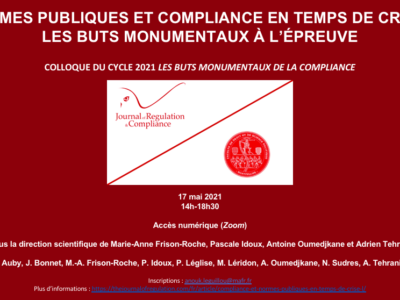
Co-organization of the colloquium “Public norms and Compliance in time of crisis : monumental goals put to a test” (“Normes publiques et Compliance en temps de crise : les buts monumentaux à l’épreuve”)

This scientific manifestation is placed under the scientific direction of Marie-Anne Frison-Roche, Pascale Idoux, Antoine Oumedjkane and Adrien Tehrani. It is organized by the Journal of Regulation & Compliance (JoRC) and by the Faculté de Droit et de Science Politique de l'Université de Montpellier (Centre de Recherches et d'Etudes Administratives de Montpellier and Centre du Droit de l'Entreprise). This manifestation is part of the cycle of colloquia organized in 2021 around the general topic of Compliance Monumental Goals.        The interventions will give rise to the production of articles which will be part of the books Les bus monumentaux de la Compliance and Compliance Monumental Goals which will be published in the Series Regulations & Compliance, coedited by the JoRC and Dalloz for the French version and by the JoRC and Bruylant for the English version.  This manifestation will take place on Zoom on 17th of May 2021.  Registrations: anouk.leguillou@mafr.fr  Assistance to this event may be validated as part of the continuing education of lawyers. In addition, scientific videos will be extracted and disseminated later.   Presentation of the topic: In the overall problematic of "Monumental goals", this conference retains a particular case: that of the crisis and the emergency situation that it generates. First of all, in general, does the importance of public norms in the emergency context engendered by a crisis situation imply a marginalization of Compliance? Don't private actors also have their place in these circumstances, at the service of the "monumental goals" that the public authorities want to maintain, or even which appear specifically? Secondly, more concretely, we have been living for many months in a health crisis. By taking it as a framework and, within it from particular cases, how public and private actors react, act, adjust? and how do the courts assess these movements? Going from the most general to the most specific, this conference aims to identify criteria, limits, of what could be specific rules when the emergency of a crisis meets Compliance, and will examine specific situations.   Working method: The conference is therefore built on a general issue, which was the subject of a "working paper", written by Antoine Oumedjkane, Adrien Tehrani and Pascale Idoux, on which the speakers will have thought in advance and from which they are intended to study the question from their particular perspective. The conference, which is essentially interactive, therefore begins with an outline of the main lines of this general work. It is followed by the examination of concrete practical cases. They are as follows: 1️⃣ hydroalcoholic gel, its manufacture, price, availability, 2️⃣ information and regulation on all media in Covid period 3️⃣ the use of the bicycle during the state of health emergency A first conclusion, thematically limited, will relate to Revealed by the crisis situation, the place of private initiative in Compliance Law. A second, more general, undoubtedly open-ended conclusion is drawn from this confrontation between general reflection and concrete cases which must be resolved in a particular crisis.   Will speak:    Jean-Bernard Auby, Emeritus Professor of Sciences po (Paris)   Julien Bonnet, Professor at Montpellier University and member of the CERCOP   Guylain Clamour, Dean of Montpellier Law School   Marie-Anne Frison-Roche, agrégée des Facultés de droit, Professor of Regulation and Compliance Law at Sciences Po (Paris) and Director of the Journal of Regulation & Compliance (JoRC)   Pascale Idoux, Professor at Montpellier University    Pascale Léglise, adjointe au directeur des libertés publiques et des affaires juridiques (Deputy Director of Civil Liberties and Legal Affairs) of the Ministère de l'intérieur (Home Ministry)   Michèle Léridon, Member of the Conseil supérieur de l'audiovisuel (French Media Regulator), President of the working group Pluralisme, déontologie, supervision des plateformes en ligne (Pluralism, Deontology, Supervision of Online Platforms)   Antoine Oumedjkane, Researcher of the Centre de recherche et d'études administratives (Research and Administrative Studies Center) of Montpellier University   Nelly Sudres, Maître de conférences at Montpellier University and member of the Centre de Recherches et d'Etudes Administratives (Research and Administrative Studies Center) of Montpellier University   Adrien Tehrani, Professor at Montpellier University and member of the Centre du Droit de l'Entreprise (Company Law Center)   Xavier Vallad, Group Legal Director, Intermarché   ⤵️Read a more detailed presentation of the manifestation below:

Conferences

📅 Cycle of colloquia 2021 around Compliance monumental goals

📅 Public norms and Compliance in time of crisis : monumental goals put to a test (Normes publiques et Compliance en temps de crise : les buts monumentaux à l’épreuve)

This scientific manifestation is placed under the scientific direction of Marie-Anne Frison-Roche, Pascale Idoux, Antoine Oumedjkane and Adrien Tehrani. It is organized by the Journal of Regulation & Compliance (JoRC) and by the Faculté de Droit et de Science Politique de l'Université de Montpellier (Centre de Recherches et d'Etudes Administratives de Montpellier and Centre du Droit de l'Entreprise). 📅 This manifestation is part of the cycle of colloquia organized in 2021 around the general topic of Compliance Monumental Goals.        The interventions will give rise to the production of articles which will be part of  📕  Les bus monumentaux de la Compliance,    to be published in the Series Regulations & Compliance , co-published par the Journal of Regulation & Compliance (JoRC) and Dalloz. 📘Compliance Monumental Goals,    dans la Série Compliance & Regulation , co-published by par le Journal of Regulation & Compliance (JoRC) and Bruylant.   This manifestation took place on Zoom on 17th of May 2021.  Registrations: anouk.leguillou@mafr.fr  Assistance to this event may be validated as part of the continuing education of lawyers. In addition, scientific videos will be extracted and disseminated later.   Presentation of the topic: In the overall problematic of "Monumental goals", this conference retains a particular case: that of the crisis and the emergency situation that it generates. First of all, in general, does the importance of public norms in the emergency context engendered by a crisis situation imply a marginalization of Compliance? Don't private actors also have their place in these circumstances, at the service of the "monumental goals" that the public authorities want to maintain, or even which appear specifically? Secondly, more concretely, we have been living for many months in a health crisis. By taking it as a framework and, within it from particular cases, how public and private actors react, act, adjust? and how do the courts assess these movements? Going from the most general to the most specific, this conference aims to identify criteria, limits, of what could be specific rules when the emergency of a crisis meets Compliance, and will examine specific situations.   Working method: The conference is therefore built on a general issue, which was the subject of a "working paper", written by Antoine Oumedjkane, Adrien Tehrani and Pascale Idoux, on which the speakers will have thought in advance and from which they are intended to study the question from their particular perspective. The conference, which is essentially interactive, therefore begins with an outline of the main lines of this general work. It is followed by the examination of concrete practical cases. They are as follows: 1️⃣ hydro-alcoholic gel, its manufacture, price, availability, 2️⃣ information and regulation on all media in Covid period 3️⃣ the use of the bicycle during the state of health emergency A first conclusion, thematically limited, will relate to Revealed by the crisis situation, the place of private initiative in Compliance Law. A second, more general, undoubtedly open-ended conclusion is drawn from this confrontation between general reflection and concrete cases which must be resolved in a particular crisis.   speakers:  🎤 Jean-Bernard Auby, Emeritus Professor of Sciences po (Paris) 🎤 Julien Bonnet, Professor at Montpellier University and member of the CERCOP 🎤 Guylain Clamour, Dean of Montpellier Law School 🎤 Marie-Anne Frison-Roche, agrégée des Facultés de droit, Professor of Regulation and Compliance Law at Sciences Po (Paris) and Director of the Journal of Regulation & Compliance (JoRC) 🎤 Pascale Idoux, Professor at Montpellier University  🎤 Pascale Léglise, adjointe au directeur des libertés publiques et des affaires juridiques (Deputy Director of Civil Liberties and Legal Affairs) of the Ministère de l'intérieur (Home Ministry) 🎤 Michèle Léridon, Member of the Conseil supérieur de l'audiovisuel (French Media Regulator), President of the working group Pluralisme, déontologie, supervision des plateformes en ligne (Pluralism, Deontology, Supervision of Online Platforms) 🎤 Antoine Oumedjkane, Researcher of the Centre de recherche et d'études administratives (Research and Administrative Studies Center) of Montpellier University 🎤 Nelly Sudres, Maître de conférences at Montpellier University and member of the Centre de Recherches et d'Etudes Administratives (Research and Administrative Studies Center) of Montpellier University 🎤 Adrien Tehrani, Professor at Montpellier University and member of the Centre du Droit de l'Entreprise (Company Law Center) 🎤Xavier Vallad, Group Legal Director, Intermarché   ⤵️Read a more detailed presentation of the manifestation below:
Working papers

🚧 Place and Role of Companies in the Creation and Effectiveness of Compliance Law in Crisis

Full Reference: Frison-Roche, M.-A. Place and Role of Companies in the Creation and Effectiveness of Compliance Law in Crisis, Working Paper, May 2021.  -   This Working Paper has been elaborated as basis for a conference in the colloquium of Mai 17, 2021 (done in French: Normes publiques et Compliance en temps de crise : les buts monumentaux à l'épreuve. This video is made with English substitutes.  It is also the basis for an article in the book Compliance Monumental Goals, the English version of which is co-published by the Journal of Regulation & Compliance (JoRC) and Bruylant. Summary: This article has a very topic: the place of private Companies, with regard to the chapter's issue: "the ordeal of a crisis". The crisis constitutes a "test", that is to say, it brings evidence. Let us take it as such. Indeed, during the health crisis, it appears that Companies have helped the Public Authorities to resist the shock, to endure and to get out of the Crisis. They did so by force, but they also took initiatives in this direction. From this too, we must learn lessons for the next crisis that will come. It is possible that this has already started in the form of another global and systemic crisis: the environmental crisis. In view of what we have been able to observe and the evolution of the Law, of the standards adopted by the Authorities but also by the new case law, what can we expect from Companies in the face of this next Crisis, willingly and strength    Lire ci-dessous les développements.

Articles

The horror series “Industry” is just a documentary; as was “The Wolf of Wall Street”; watch a series or read a thesis, it’s the same

Academics did a study on how people who work in investment banks kill themselves on the job. The death of a 21-year-old intern, having worked three days without sleeping, in the Goldman Sachs bank, the testimonies of young people explaining that they work non-stop, undoubtedly contributed to testimonies, relayed in the press, specialized or generalist, but also university studies. Indeed, two academics published a research no longer on the rules applicable within investment banks, which took measures to force their employees and their interns (since the victim was an intern) to rest on Sundays but on journeys based on data accessible by taxi companies. As a result, the reaction of the people was not to rest: it was to increase the daily working time, to leave even later after dark. Research shows that this phenomenon increases during the summer, that is to say precisely when the people who work are more trainees, that is to say those who want to "prove themselves": As the authors say: "Cette analyse, menée avec mon ex-collègue de doctorat de la Aalto University School of Business (Finlande), montre que, lorsque les banques ont mis en place des politiques de travail sans samedi, cela a incité les employés à travailler tard le soir en semaine pour compenser. Ces résultats sont plus marqués pendant les semaines de stages d’été, lorsque les banques d’investissement emploient un grand nombre d’étudiants désireux de faire leurs preuves en travaillant dur." (“This analysis, conducted with my ex-doctoral colleague from Aalto University School of Business (Finland), shows that when banks implemented work policies without Saturday, it prompted employees to work late nights on weekdays to compensate. These results are most marked during the summer internship weeks, when investment banks employ large numbers of students eager to prove themselves by working hard. ") -   Let's go back to the Industry series. An expert has shown all the points on which it does not correspond to "reality", on such and such a point. The cinema is reality — not even in the reconstitution of such or such a point, it reproduces it by throwing on the screen what is the idea which moves in the facts. This series begins with the death of a trader, who died of work. It tells exactly the life, how to qualify it …, let's say "the crazy life" of those who work there. It is hardly bearable to watch. In any case, it is exactly the image of what these two academics are saying.    

Publication director

🏗️ copublishing and direction of the collection: 📚Régulations & Compliance

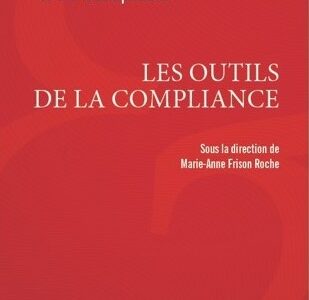
Publication of🕴️M.-A. Frison-Roche (ed.), 📕Les outils de la Compliance (2021)

► Full Reference: M.-A. Frison-Roche (ed.), Les outils de la Compliance, coll. “Régulations & Compliance“, Journal of Regulation & Compliance (JoRC) & Dalloz, 2021, 323 p. - 📘In parallel, the English version of this book, Compliance Tools, is published in the collection co-published by the Journal of Regulation & Compliance (JoRC)  and Bruylant.  - 📅This book comes after a cycle of colloquia organised by the Journal of Regulation & Compliance (JoRC) and its Academic Partners.  - This volume is the continuation of the books dedicated to Compliance in this collection.   ► Read the presentations of the other books in the series: the following books: 🕴️M.-A. Frison-Roche (ed.), 📕Les Buts Monumentaux de la Compliance, 2022 🕴️M.-A. Frison-Roche (ed.), 📕La juridictionnalisation de la Compliance, 2023 🕴️M.-A. Frison-Roche and M. Boissavy (eds.), 📕Compliance et droits de la défense. Enquête interne – CJIP – CRPC, 2024 🕴️M.-A. Frison-Roche (ed.), 📕L’Obligation de Compliance, 2025 🕴️M.-A. Frison-Roche (ed.), 📕Compliance et Contrat, forthcoming 🕴️L. Laref (ed.), 📕Compliance et vigilance bancaire, forthcoming 🕴️M.-A. Frison-Roche, 📕Le système juridique de l’adressage de l’Internet. Une structure multi-acteurs, gage de durabilité (The Legal System of Internet Addressing. A Multi-Stakeholder Structure, the Pledge of its Sustainability), forthcoming 🕴️M.-A. Frison-Roche (ed.), 📕Le système probatoire de la Compliance, forthcoming   the previous books: 🕴️M.-A. Frison-Roche (ed.), 📕Pour une Europe de la Compliance, 2019 🕴️N. Borga, J.-Cl. Marin and J.-Ch. Roda (eds.), 📕Compliance : l’entreprise, le régulateur et le juge, 2018 🕴️M.-A. Frison-Roche (ed.), 📕Régulation, Supervision, Compliance, 2017 🕴️M.-A. Frison-Roche (ed.), 📕Internet, espace d’interrégulation, 2016 📚Read the presentations of the other titles of the collection. - ► General presentation of the book: The political dimension of Compliance Law resides in the monumental goals that it aims for and which define it. These goals are internalized in “crucial operators”, who willingly or by force must structure themselves and act to achieve “monumental goals”, as set by public authorities and which may coincide with the interests of the enterprise. This one designs and controls the Ex Ante reorganization that this implies, under the public authorities supervision. Enterprises, even if their activities are not regulated, thus become transparent and must show the Compliance Tools effectively deployed to effectively achieve these goals. It is a major transformation of economic life in all countries because the Compliance Tools are adopted everywhere and have a global effect. These appear to be very diverse but their unity is profound and bringing it out has the practical benefit of producing a legal regime that is as unified as possible, while allowing their adaptation country by country, sector by sector, enterprise by enterprise.  This book aims to understand these Compliance Tools to better anticipate the assessment that will be made by Regulators, Supervisors and Courts, as well as the new conceptions of the authors of legal texts which impose new ones every day, while companies must also imagine the most appropriate Compliance Tools. This collective work specifically apprehends those on which we have few studies when we handle them on a daily basis, such as risk mapping or training or rights, letting more familiar tools shine through more transversal contributions, such as compliance programs, sanctions, whistleblowing or many sorts of settlements, agreements of public interest. A first chapter takes a legal and economic approach. A second chapter emphasizes the role of risk mapping. A third chapter draws the game of incentives. A fourth chapter identifies the expertise required. A fifth chapter insists on geographic significance. A sixth chapter details the measurement of effectiveness. A seventh chapter explores training. The eighth chapter examines technological tools. The concluding article leads to rights. - ► Read the general introduction of the book (in French). - ► Understand the book through the Table of Contents and the summaries of each article:   INTRODUCTION  🕴️M.-A. Frison-Roche, 📝Décrire, concevoir et corréler les outils de la compliance, pour en faire un usage adéquat   I. APPROCHES JURIDIQUE ET ÉCONOMIQUE DES OUTILS DE LA COMPLIANCE (LEGAL AND ECONOMIC APPROACHES TO COMPLIANCE TOOLS) 🕴️M.-A. Frison-Roche, 📝Approche juridique des outils de la compliance. Construire juridiquement l’unité des outils de la compliance à partir de la définition du Droit de la compliance par ses “buts monumentaux” 🕴️L. Benzoni et 🕴️B. Deffains, 📝Approche économique des outils de la compliance : finalité, mesure, effectivité de la compliance “subie” et “choisie”   II. LA CARTOGRAPHIE DES RISQUES, OUTIL CENTRAL DE LA COMPLIANCE (RISK MAPPING, CENTRAL COMPLIANCE TOOL) 🕴️M.-A. Frison-Roche, 📝Dresser des cartographies des risques comme obligation et le paradoxe des “risques de conformité” 🕴️N. Guillaume, 📝Cartographie des risques de compliance. Premiers aperçus des enjeux, des limites et des bonnes pratiques   III. PLACE ET MANIEMENT DES INCITATIONS DANS LES SYSTÈMES DE COMPLIANCE (PLACE AND USE OF INCENTIVES IN COMPLIANCE SYSTEMS) 🕴️L. Rapp, 📝Théorie des incitations et gouvernance des activités spatiales 🕴️M.-A. Frison-Roche, 📝Résoudre la contradiction entre “sanction” et “incitation” sous le feu du Droit de la compliance 🕴️M. Larouer, 📝La manifestation des mécanismes incitatifs dans le droit français de la compliance 🕴️H. Tardieu, 📝Souveraineté des données et compliance 🕴️L. Calandri, 📝Incitation(s) et autorégulation(s) : quelle place pour le droit de la compliance dans le secteur audiovisuel? 🕴️M.-A. Frison-Roche, 📝Compliance et incitations : un couple à propulser   IV. LES EXPERTISES REQUISES EN MATIÈRE DE COMPLIANCE (THE REQUIRED EXPERTISES IN TERMS OF COMPLIANCE) 🕴️A. Gutierrez-Crespin, 📝L’audit du dispositif de compliance : un outil clé pour en vérifier la robustesse 🕴️S. Koenigsberg et 🕴️Fr. Barrière, 📝La construction de l’expertise de l’avocat en matière de compliance 🕴️Th. Amico, 📝La Compliance ou le passage de l’ex post à l’ex ante. Une révolution copernicienne pour l’avocat pénaliste ?   V. LA PRÉGNANCE GÉOGRAPHIQUE DES OUTILS DE LA COMPLIANCE (THE GEOGRAPHICAL DOMINANCE OF COMPLIANCE TOOLS) 🕴️J.-B. Racine, 📝Propos introductifs. La prégnance géographique dans le choix et l’usage des outils de la compliance 🕴️M. M. Salah, 📝Conception et application de la compliance en Afrique 🕴️R. Burlingame, 🕴️K. Coppens, N. Power et 🕴️D.H. Lee, 📝Compliance : lutte internationale contre la corruption et gestion des risques   VI. LA MESURE DE L’EFFECTIVITÉ DES OUTILS DE LA COMPLIANCE (THE MEASURE OF COMPLIANCE TOOLS EFFECTIVITY) 🕴️M. Galland, 📝Le contrôle par le régulateur de l’effectivité des instruments de compliance mis en place par l’entreprise 🕴️A. Banck, 📝La maturité de l’utilisateur d’un outil de compliance, premier critère du choix de l’outil adéquat   VII. LA FORMATION, ALPHA ET OMÉGA DE LA COMPLIANCE (TRAINING, ALPHA AND OMEGA OF COMPLIANCE) 🕴️H. Causse, 📝La compliance : par et au-delà de la formation juridique classique 🕴️M.-A. Frison-Roche, 📝La formation : contenu et contenant de la compliance 🕴️Th. Thouret, 📝Formation et compliance : deux outils corrélés de transmission d’information   VIII. LES OUTILS TECHNOLOGIQUES ET LA COMPLIANCE BY DESIGN (TECHNOLOGICAL TOOLS AND COMPLIANCE BY DESIGN) 🕴️J.-Ch. ​Roda, 📝La compliance by design en antitrust : entre innovation et illusion 🕴️C. Granier, 📝L’originalité normative de la compliance by design 🕴️L. Pailler, 📝Les outils technologiques, la compliance by design et le RGPD : la protection des données dès la conception 🕴️S. Merabet, 📝La morale by design   CONCLUSION 🕴️M.-A. Frison-Roche, 📝Les droits subjectifs, outils premiers et naturels du Droit de la compliance - 🌐 follow Marie-Anne Frison-Roche on LinkedIn 🌐follow Marie-Anne Frison-Roche on Instagram 🌐 subscribe to the Newsletter MAFR Regulation, Compliance, Law 

Articles in The Journal of Regulation & Compliance « JoRC »

RACINE, Jean-Baptiste🕴️

📝Propos introductifs. La prégnance géographique dans le choix et l’usage des outils de la Compliance, in 🕴️M.-A. Frison-Roche (ed.), 📕Les outils de la Compliance

► Full Reference : J.-B. Racine, "Propos introductifs. La prégnance géographique dans le choix et l'usage des outils de la Compliance" ("Introductory remarks. Geographical dominance in the choice of Compliance Tools"), in M.-A. Frison-Roche (ed.), Les outils de la Compliance, coll. "Régulations & Compliance", Journal of Regulation & Compliance (JoRC) and Dalloz, 2021, p. 157-164. - 📕read a general presentation of the book, Les outils de la Compliance, in which this article is published - ► Summary of the article (done by the Journal of Regulation & Compliance): The author correlates Compliance Law and "Global Law" and underlines the balance of power that the former expresses, in particular on the part of the United States and even if it therefore "tends to become universal" , the particularities remain, if only in the implementation. Focusing more particularly on "Compliance Tools", a comparison is made between several contributions of the volume, to establish that, in a definitive and desirable way, the Compliance mechanisms include both a global dimension and a local dimension. -