All news

Books

Le droit souple

Documents scan0009-3.pdf scan0008.pdf scan0010.pdf

Conferences

Doing the Right Thing: Compliance That Works for Investors

Complete reference: Aguilar, L., Doing the Right Thing: Compliance That Works for Investors, transcript of a conference by this Commissioner of the US Securities and Exchange Commission (SEC) before the Regulatory Compliance Association (ROC), which is a professional association which offers training programs to thousands of people on the subject of 78,000 Compliance. The conference was held in New York, April 18, 2013. Validation of the transcription in 2014. The conference author, SEC Commissioner, refers to Roosevelt's statement that the best thing to do is to do the right thing. In this matter, when things get too complex, compliance is for the company to protect investors.

Articles

Mauvaise foi et prérogative contractuelle

Full reference : AYNES, Laurent, Mauvaise foi et prérogative contractuelle, in Les prérogatives contractuelles, Revue des contrats, LGDJ, 2011/2, pp. 687-690.

Articles in a legal collective publication

📝Experts et procédure : l’amicus curiae (Experts and procedure: the amicus curiae)

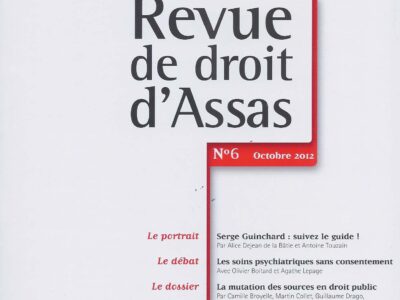
► Référence complète : M.-A. Frison-Roche, "Experts et procédure : l'amicus curiae" ("Experts and procedure: the amicus curiae"), Revue de droit d'Assas, october 2012, pp. 91-94 - 📝read the article (in French) - ► English Summary of the article: A recent thesis has argued that amicus curiae is becoming a common principle of Procedural Law. This shows its importance. The fact that the mechanism, the character, is designated by a Latin formula leads us to suspect that something is being concealed that legal technique ordinarily forbids: it is the legal expert and the party's expert, which is what the amicus curiae most often is, either one or the other, or both at the same time. Therefore, removing the prudish cloak of Latin, it is these two difficulties that must be addressed. If we exclude the legal expert, it is because "jura novit curia" ("the court knows Law". But this rule, which recalls the principle that "no one is supposed to be ignorant of the law", merely indicates a sharing of the burden of evoking facts and Law between the parties and the judge (Motulsky) and not a presumption of knowledge. Consequently, the modest, and therefore self-confident, judge has no reason, either psychological or legal, to shy away from a legal expertise. As for the party's expert, or the judge's expert who is highly influenced by a party, a profession, a social group, in short, a judge's expert who is in fact an expert held by a party, this can only be a problem if the judge cannot keep his distance from this expert whose opinion is biased by the weight of the party. But first of all, any opinion is biased. Whether it is given in bad faith or good faith, it is biased, and in rhetoric we know that an opinion biased in good faith is more dangerous than a bought opinion, because the latter is known to be twisted by self-interest. In this respect, the person who listens to it, the judge, knows the difference. Indeed, the legal system that recognises the party's expert and the amicus curiae, i.e. North American Law or European Union Law, draws the necessary procedural consequence: they include the party's expert opinion in the adversarial debate. It is the principle of adversarial debate, the principle of principles in the conduct of proceedings, that makes amicus curiae acceptable and welcome, since it provides the judge with a scientific input that the latter does not have. -


Books

Jean Carbonnier : Un juriste dans la cité

Complete reference : ARNAUD, André-Jean, Jean Carbonnier : Un juriste dans la cité, préface de Jacques Commaille, Coll. Droit et Sociétés Classics, […]

Reports

📓Le transfert de la compétence normative d’édiction des lois et réglements en matière de droit civil, de la métropole aux institutions propres à la Nouvelle-Calédonie

► Full Reference: M.-A. Frison-Roche, Le transfert de la compétence normative d'édiction des lois et règlements en matière de droit civil, de la métropole aux institutions propres à la Nouvelle-Calédonie. Étude pour le Congrès de Nouvelle-Calédonie (The transfer of the normative power to enact laws and decrees in the field of civil law from metropolitan France to institutions specific to New Caledonia. Study for the Congress of New Caledonia), 2012, 88 p. - La confection de ce rapport a été faite à partir des travaux sur les textes, des lectures et des réflexions, mais aussi de nombreuses rencontres avec les parties prenantes sur place. Le séjour et la remise du rapport ont donné lieu à de nombreuses interventions publiques. L'on peut notamment se référer à la conférence Le transfert du droit civil, une opportunité pour la Nouvelle-Calédonie, donnée au Congrès de Nouvelle-Calédonie. En outre, de nombreuses interviewes ont été données à la télévision, dans le presse écrite et à la radio.   Lire la table des matière du rapport. Lire le rapport dans son intégralité. Lire un interview dans la presse à propos de ce travail. Voir la conférence donnée en métropole à ce propos.   Lire le résumé du rapport ci-dessous.