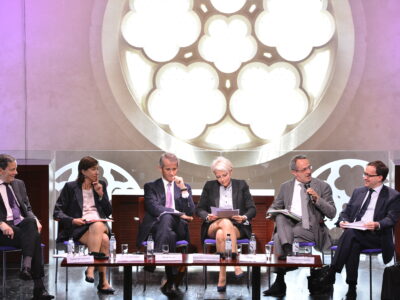
ENGLISH After a video recording of his first conference devoted to the relations between Regulation and Supreme Courts, The Journal of Regulation published a book on the future of the audit, based on another conference. This present document, written in French worked with KPMG, from conference co-hosted with this company and the “Ecole de Droit de la Sorbonne”, is devoted to the debates around banking regulation and its impacts. The challenge is to enable the persons concerned, that is to say to all citizens to express their opinion on an issue that concerns them directly, but whose technical dimensions, real or serviced, stand them aloof. FRENCH Après sa vidéo retraçant sa première conférence consacrée aux relations entre la régulation et les Cours suprêmes, le Journal of Regulation a publié un libre sur L’avenir de l’audit, consacré sur la conférence suite. La présente publication, écrite en française, élaborée avec KPMG, à partir de la conférence organise avec celle-ci et l’Ecole de Droit de la Sorbonne, est consacrée aux Débats autour de la régulation bancaire et ses impacts. L’enjeu est de rendre les personnes concernées, c’est-à-dire tous les citoyens, aptes à exprimer leurs opinion sur un sujet qui les concerne tous directement mais dont la technicité, réelle ou entretenue, les tient à l’écart.
Read more
KPMGÉcole de Droit de la Sorbonne, Paris 1 (Sorbonne Law School)
Full reference: Regulation (EU) No 648/2012 of the European Parliament and the Council of 4 July 2012 on OTC derivatives, central counterparties and trade repositories Read the Regulation This regulation has been updated : by the Regulation n°648/2012 of 20th of May 2019 (Emir Refit) (in order to improve its efficiency and proportionnality) by the Regulation n°2019/2099 of 23rd of October 2019 (modifying supervision system of compensation rooms of Union and third countries).
TRANSLATED SUMMARIES ENGLISH “Acting in a neutral way” is an oxymoron. “Companies often require however that States use their powers in a neutral way (eg tax neutrality). In regulated sectors, some are right or even duty , of not being neutral. Firstly, it is the State, which requires the market for other purposes, other temporalities and other values. Secondly, they are also the “crucial operators”, which are sort of regulators of second degree, such as transmission system operators or companies capital markets firms. The difficulty increases when the systeme requires neutrality of regulators and judges, when first build economic policy and the second create jurisprudence. Their consistency, impartiality and rationality can create an objectifiable neutralitys FRENCH «Agir de façon neutre» est un oxymoron. «Les entreprises ont souvent besoin, cependant, que les États utilisent leurs pouvoirs de manière neutre (neutralité fiscale par exemple). Dans les secteurs réglementés, certains ont le droit ou même le devoir de ne pas être neutre. Tout d’abord, c’est l’État, qui insère le marché à d’autres fins, d’autres temporalités et d’autres valeurs. En second lieu, ils sont aussi les «opérateurs crucial», qui sont des sortes de régulateurs du second degré : par exemple les opérateurs de réseaux de transport ou de entreprises de marchés financiers. La difficulté augmente lorsque le systeme économique et politique exige la neutralité des autorités de régulation et des juges, alors que les premiers construisent la politique économique et les seconds construisent la jurisprudence. Le respect qu’ils doivent avoir de l’impartialité et d’une rationalité suffisamment objectivables pourra permettre cette objectivité requise.
Read more
Competition lawCrucial operatorJudgeNeutralityMethodologyRegulatorPoliticsMarket failureExpertContractArbitraryStateProfitRationalitySovereigntyCARBONNIER, JeanImpartialityRousseauNet NeutralityFutureState AidMoneyChoiceEuropean Securities Markets Authority (ESMA)COASE, RonaldCommunity systems of regulationNeutral businessNeutral actionCrucial businessCapital neutralityPublic policiesSocial contractROUSSEAU, Jean-JacquesPassivityOxymoronDESCARTES, RenéDeclaration of the Rights of Man and of the Citizen
31 mai 2012, organisé par The Journal of Regulation, l’Ecole de Droit de la Sorbonne et KPMG. Pour commander la publication élaborée à partir du colloque, cliquez sur "Read more" ci-dessous.
Translated Summaries The translated summaries are done by the Editors and not by the Authors. ENGLISH Prudential regulation applied to banks is caught swinging back and forth between two objectives. FRENCH La réglementation prudentielle appliquée aux banques oscille constamment d’un objectif à l’autre.
Translated summaries The translated summaries are done by the Editors and not by the Authors.ENGLISH The European Commission’s initiatives towards a Single Market in energy, transport and electronic communications should aim to further regulatory transparency and not market homogenisation. The article provides a quantitative and qualitative assessment of indiscriminating homogenisation of the mobile telecommunications market. The potential impacts on market power and the loss of consumer welfare are by no means negligible and imply important policy considerations FRENCH Les initiatives de laCommission européenneen vue d’unmarché unique des communicationsde l’énergie,de transportet électroniquesdevraient viser àune plus grande transparenceréglementaireet non pas à l’homogénéisationdu marché.Le présent articlefournit une évaluation quantitativeet qualitative de l’homogénéisationinconsidérée du marché des télécommunicationsmobiles.Lesimpacts potentiels surle pouvoir de marchéet la perte debien-êtredes consommateursne sont nullementnégligeableset impliquentdes considérationspolitiques importantes.
Translated summaries ENGLISH The FCC’s 2010 “open Internet” (net neutrality) order went into effect on November 20, 2011. Verizon Communications and Metro PCS have challenged the FCC Order in court, alleging that the FCC lacked statutory power to impose net neutrality rules in connection with Internet access services. FRENCH L’ordonnace 2010 de la FFC (le régulateur nord-américain des communications) “open Internet” est entrée en vigueur le 20 novembre 2011. Les sociétés Verizon Communications et Metro PCS ont contesté devant le juge cette ordonnance, alléguant quela FCCn’avait pasle pouvoir légald’imposer des règles sur la neutralité du net concernant l‘accès aux services d’Internet.
Translated summariesThe translated summaries are done byorganizersENGLISHTraditionally regulated sectors, such as energy and telecommunications, have a very strong local roots, which made them at first dominated by the States even if they were developed by companies, because of the link between the State and territory. Furthermore, the market, which is a space defined by the activities and not necessarily by a territory, was superimposed on the overall economic. When observing the phenomena taking place in new territories, for example the euro area, but more what looks like spaces without territoriality, such as the Internet, or finance, geography seems to disappear. The dynamism of operators led by its own strength to the formation of new geographies which owe nothing to the kind or normative power of the States, as in energy infrastructure. However, to date, there have been in a regulatory report with respect to geography or based on geography. Could we diagnose the disappearance of geography or processing thereof such that the regulations themselves must be radically transformed? It is this question which is the subject of this symposium.FRENCHLes secteurs régulés traditionnellement, par exemple l’énergie ou les télécommunications, ont un ancrage territorial très fort, ce qui les a rendus à première vue dominés par les Etats même s’ils étaient développés par des entreprises, en raison du lien entre l’Etat et le territoire. En outre, les Etats ont avec l’espace aérien un rapport consubstantiel car le contrôle de l’air par l’Etat assure la sécurité de celui-ci et de la population ; pourtant, l’Etat vend aujourd’hui des fréquences à des opérateurs privés. En outre, à la notion de territoire, le marché, qui est un espace défini par des activités et non plus nécessairement par un territoire, s’est superposé sur l’ensemble du droit économique, bouleversant notamment la notion et le rôle des frontières. Lorsqu’on observe les phénomènes en cours dans de nouveaux territoires, par exemple la zone euro, mais plus encore ce qui semble être des espaces sans territorialité, comme Internet, voire la finance, la géographie semble disparaître. Le dynamisme des opérateurs conduit par sa seule force à la constitution de nouvelles géographies qui ne doivent rien à la nature ni au pouvoir normatif des Etats, comme en matière d’infrastructure énergétique. Or, jusqu’ici, il n’y a eu de régulation que dans un rapport à l’égard d’une géographie ou s’appuyant sur une géographie. Pourrait-on diagnostiquer la disparition de la géographie ou une transformation telle de celle-ci que les régulations elles-mêmes doivent se transformer radicalement ? C’est cette interrogation même qui est l’objet de ce colloque.SPANICHLos sectores regularmente regulados, por ejemplo los de energía y telecomunicaciones, poseen un anclaje muy fuerte, por lo que parecen ser a primera vista dominados por el Estado aunque fueron desarrollados por empresas, por el lazo que existe entre el Estado y el territorio. Los Estados tienen una relación substancial en lo que concierne el espacio aéreo, ya que el control del aire por el Estado asegura la seguridad de él mismo y de la población; y por consiguiente, el Estado vende frecuencias a operadores privados. En cuanto a la noción del territorio, el mercado, que es un espacio definido por actividades y no necesariamente por un territorio, se ha superpuesto sobre el conjunto del derecho económico, y ha transformado la noción y el rol de las fronteras. Mientras que uno observa los fenómenos en marcha en diferentes territorios, por ejemplo la euro zona, pero más aún lo que semeja ser espacios sin territorio, como el Internet y la finanza, la geografía parece desaparecer. El dinamismo de los operadores conducidos por su propia fuerza hacia la constitución de nuevas geografías, que no responden ni a la naturaleza ni al poder normativo de los Estados, como en materia de infraestructura energética. Hasta el presente, la regulación se había limitado a la geografía o se había apoyada en ella de una forma u otra. ¿Podríamos diagnosticar la desaparición de la geografía o una transformación tal que las regulaciones mismas también tendrían que transformarse radicalmente? Esta interrogación será el objetivo del coloquio.ARABICالقطاعات المنضمة تقليديا مثل الطاقة والاتصالات السلكية، لديها جذور قوية جدا التي جعلتهم تحت سيطرة الدولة في البداية حتى لو تم تطويرها من قبل مع الشركات، وذلك بسبب الارتباط بين الدولة و الإقليم. وبالإضافة إلى ذلك، الدول التي لديها مع المجال الجوي تقرير الجوهر لأن سيطرة الدولة عليه يضمن سلامته و سلامة الشعب، ومع ذلك فإن الدولة تبيع ترددات إلى المشغلين القطاع الخاص وعلى ذلك، تم فرضه على مفهوم الأرض، والسوق، الذي هو مساحة محددة من خلال الأنشطة وليس بالضرورة من الأراضي، في القانون الاقتصادي العام ، بما في ذلك فكرة مروعة وحدود الدور. عندما نلاحظ الظواهر التي تحدث في مناطق جديدة، على سبيل المثال في منطقة اليورو، ولكن أكثر ما يشبه الأماكن دون الإقليمية، مثل شبكة الإنترنت، أو التمويل، الجغرافية تبدو أنها تختفي. نشاطية المشغلين تقيد قوة خاصة بها لتشكيل مناطق جغرافية جديدة والتي لديها أي شيء لهذا النوع أو القوة المعيارية للدول، كما هو الحال في البنية التحتية للطاقة. لكن، حتى هناك، كان تقريرا تنظيميا فيما يتعلق بالجغرافية أو على أساس الجغرافية. هل يمكننا تشخيص اختفاء الجغرافية أو تحولها مثل ذلك يجب أن الانضمة تتغير كليا ؟ هذا هو سؤال الموضوع لهذه الندوة.……………….Other translations forthcoming.