
All news

Working papers

Working Paper.

The “crucial companies” and their regulation

The expression "regulated company" may appear as an oxymoron : the State  regulates areas (markets, networks, etc.) because of their structural failures, but the State doesn't enter a company that develops its activities autonomously. But on reflection, it is sometimes necessary to "regulate a company" and this necessity is increasingly imposed. This is imperative if a company absorbs the entire area, because it is a monopoly or because it wants to become the heart of a crucial area, such as Google which has the project to become the future global brain. In a more general way, it is a necessity to  locate businesses which are "crucial", banks are only one example, and organize, beyond supervision, providing direct regulation of such firms. This regulatory power on critical firms must take the form of attendance of public power and policy within the company itself, so that the state interfere in decisions which social group suffers the consequences. The control can go beyond this "public presence" to take the form of "public authority", the state ruling as operator. Under such conditions of "cruciality", the neutralization of "public enterprise" by the competition law must cease, the public company must be better recognized as a regulatory instrument in distance with the simple game of competition.

Texts

European Parliament and European Council

Directive MIF 2 of 15th of May 2014

Full reference: Directive 2014/65/EU of the European Parliament and of the Council of 15 May 2014 on markets in financial instruments and amending Directive 2002/92/EC and Directive 2011/61/EU Read the directive 

Texts

European Parliament and European Council

Règlement MiFIR du 15 mai 2014

Full reference: Regulation (EU) No 600/2014 of the European Parliament and of the Council of 15 May 2014 on markets in financial instruments and amending Regulation (EU) No 648/2012 Read the regulation

Jurisprudence

Court of Justice of the European Union (CJEU), Grand Chamber

Judgment Google Spain of May 13, 2014

Full reference: CJEU, Grand Chamber, Google Spain SL, Google Inc. c/ Agencia Espanola de Proteccion de Datos (AEPD), C-131/12, May 13, 2014   Read the judgment

Working papers

Working Paper

The promethean nature of the future banking and financial regulatory law

This working paper was prepared as a basis for a contribution to a forthcoming volume of the collection Le rapport moral de l'Argent dans le Monde ( The Moral Report of Money in the World). It develops the idea that everyone has the impression that the law is more powerful than ever in banking and financial regulation: Law invades everything and appears in its most terrible form that is criminal and repressive administrative law. It seems that the beginning of everything is Law ! But in reality, we must consider that the law is weaker than ever. Indeed, if the law of banking and financial regulation has become primarily repressive, it is because it is weak. It took the form of a multitude of microscopic rules and  punishment is only lending its force to any prescription. Repression has lost its autonomy, and has become a sort of simple enforcement of civil multiple rules. Moreover, the legislation degenereted into regulations. The Regulation goes into a random pile of incomprehensible and complexe requirements. On the contrary, the operators would need a law that fixed in advance and clearly a few strong lines of conduct. So it is a weak and shoddy law which the banking and financial regulators are building for the future. It will be severe only because it will be weak and  poorly done. The lawyer will be be as chagrined as the financier is.

Articles in a legal collective publication

📝Les décisions des juges et des régulateurs favorisent-elles la compétitivité des entreprises françaises ?

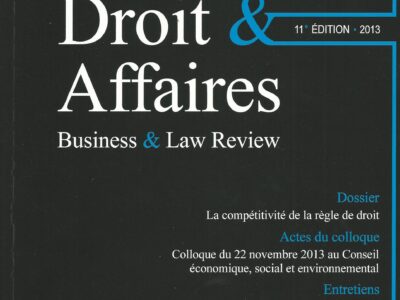
📝Les décisions des juges et des régulateurs favorisent-elles la compétitivité des entreprises françaises ?, in 📗La compétitivité de la règle de droit

Documents decisions_des_juges.pdf 4em_de_couv.pdf programme_22_11_2013.pdf

Texts

European Parliament and European Council

Regulation of 16th of April 2014 about market abuses

Full reference: European Parliament and European Council, Regulation (EU) No 596/2014 of 16 April 2014 on market abuse (market abuse regulation) and repealing Directive 2003/6/EC of the European Parliament and of the Council and Commission Directives 2003/124/EC, 2003/125/EC and 2004/72/EC Read the regulation

Books

The legal order

Full reference : Romano, S, The Legal Order, 1st ed. 1917-1918, 2nd ed. 1948, GlassHouse Book, 180 p.

Jurisprudence

European Court of Human Rights

To read the decision

Articles

COLLARD, Christophe and Roquilly, Christophe

Les risques juridiques et leur cartographie : proposition de méthodologie (Legal Risks and Their Mapping: proposition of Methodology)

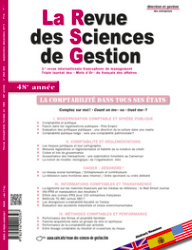
Full reference: Collard, C., and Roquilly, C., Les risques juridiques et leur cartographie : proposition de méthodologie (Legal Risks and Their Mapping: proposition of Methodology), La Revue des Sciences de Gestion, vol. 263-264, no. 5, 2013, pp. 45-55. Sciences Po's students can read this article via Sciences Po's Drive in the folder MAFR – Regulation & Compliance