Activities

Organisation of events

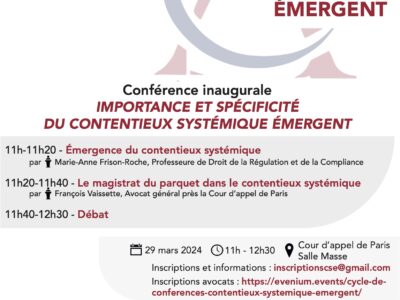
1st conference-debate of the cycle "Contentieux Systémique Émergent" ("Emerging Systemic Licigation")

🧮Importance et spécificité du Contentieux Systémique Émergent (Importance and specificity of the Emerging Systemic Litigation), in cycle of conferences-debates “Contentieux Systémique Émergent” (“Emerging Systemic Litigation”)

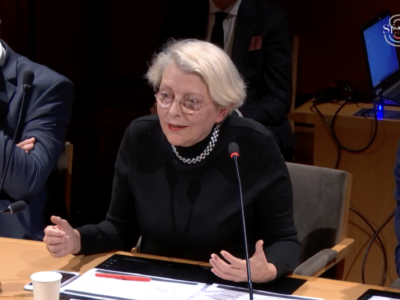
► Full Reference: Importance et spécificité du Contentieux Systémique Émergent (Importance and specificity of the Emerging Systemic Litigation), in cycle of conference-debates "Contentieux Systémique Émergent" ("Emerging Systemic Litigation"), organised on the initiative of the Cour d'appel de Paris (Paris Cour of Appeal), with the Cour de cassation (French Court of cassation), the Cour d'appel de Versailles (Versailles Court of Appeal), the École nationale de la magistrature – ENM (French National School for the Judiciary) and the École de formation des barreaux du ressort de la Cour d'appel de Paris – EFB (Paris Bar School), under the scientific direction of Marie-Anne Frison-Roche, March 29, 2024, 11h-12h30, Cour d'appel de Paris, Masse room - ► Presentation of the conference-debate: The "Systemic Litigation" is emerging. Through and beyond the dispute, a system is involved: the banking, financial, digital, health and climate systems. How can such litigation be recognised? How do you make room for a system in a court of law? What can be done when several systems are in conflict? Who represents these systems and their interests? How can the temporality of systems and litigation be reconciled? In practical terms, the magistrate has a new role. Whether they are prosecutors or judges, they deal with systemic litigation in criminal, civil, commercial and other areas.   - 🎤see the detailed presentation of the first speech of 🕴️Marie-Anne Frison-Roche : L'émergence du Contentieux Systémique (The Emergence of Systemic Litigation) - 🧮Programme of this event:  Inaugural Conference IMPORTANCE ET SPÉCIFICITÉ DU CONTENTIEUX SYSTÉMIQUE ÉMERGENT (IMPORTANCE AND SPECIFICITY OF THE EMERGING SYSTEMIC LITIGATION)   Cour d’appel de Paris (Paris Court of Appeal), Masse room 🕰️11h-11h20. 🎤L’émergence du contentieux systémique (The Emergence of the Systemic Litigation), by 🕴️Marie-Anne Frison-Roche, Professor of Regulatory and Compliance Law, Director if the Journal of Regulation & Compliance (JoRC)   🕰️11h20-11h40. 🎤L’office du magistrat du parquet dans le contentieux systémique (The role of the Public Prosecutor in Systemic Litigation), by 🕴️François Vaissette, Avocat général près la Cour d’appel de Paris (Advocate General at the Paris Court of Appeal)   🕰️11h40-12h30. Debate - 🔴Registrations and information requests can be sent to: inscriptionscse@gmail.com 🔴For the attorneys, registrations have to be sent to the following address: https://evenium.events/cycle-de-conferences-contentieux-systemique-emergent/  ⚠️The conference-debates are held in person only, in the Cour d’appel de Paris (Paris Court of Appeal). - 🧮Read below a detailed presentation of this event⤵️ -

Articles

💬”Nous voyons émerger aujourd’hui le contentieux systémique”, contrepoint à l’entretien du Premier Président de la Cour d’appel de Paris Jacques Boulard, 💬Contentieux systémique : “Il est important, pour les magistrats, de rester au plus près des réalités”

► Full Reference: M.-A. Frison-Roche, ""Nous voyons émerger aujourd’hui le contentieux systémique"" (""We are now seeing the emergence of the Systemic Litigation""), interview with Olivia Dufour, counterpoint to the interview with the Premier Président de la Cour d'appel de Paris (First President of the Paris Court of Appeal) Jacques Boulard, "Contentieux systémique : "Il est important, pour les magistrats, de rester au plus près des réalités"" ("Systemic litigation: "It is important for judges to remain as close as possible to reality""), Actu-Juridique, March 28, 2024 - 💬read the interview (in French) - This interview is a counterpoint to the interview conducted with Jacques Boulard, Premier Président de la Cour d'appel de Paris (First President of the Paris Court of Appeal), on the Court of Appeal's threefold initiative in establishing the Conseil de Justice Économique – CJE (Economic Justice Council), the additional chamber (5-12) to hear vigilance litigation in particular  and the setting up of the series of conference-debates on the Contentieux Systémique Émergent (Emerging Systemic Litigation): read the interview (in French). This interview highlights Marie-Anne Frison-Roche's position at the Conseil de Justice Économique and her role as scientific director of the series of conference-debates.  As a counterpoint, the journal conducts a specific interview with Marie-Anne Frison-Roche on the specific issue of the Contentieux Systémique Émergent (Emerging Systemic Litigation) cycle. - ► Presentation of the interview by the journal : "Marie-Anne Frison-Roche, professeur de droit de la régulation et de la compliance et responsable scientifique du cycle « Contentieux systémique émergent » nous explique la notion de contentieux systémique et l’importance de la démarche engagée par le Premier président." (Free translation : "Marie-Anne Frison-Roche, Professor of Regulatory Law and Compliance Law and Scientific Director of the "Contentieux systémique émergent" ("Emerging Systemic Litigation") cycle, explains the concept of Systemic Litigation and the importance of the approach adopted by the First President.") - For the record, the 2024 conference-debates of the "Contentieux systémique émergent" ("Emerging Systemic Litigation") cycle: Conférence inaugurale – Vendredi 29 mars 2024, de 11h à 12h30, IMPORTANCE ET SPÉCIFICITÉ DU CONTENTIEUX SYSTÉMIQUE ÉMERGENT   Deuxième conférence – Vendredi 26 avril 2024, de 11h à 12h30, LA VIGILANCE, NOUVEAU CHAMP DE CONTENTIEUX SYSTÉMIQUE   Troisième conférence – Lundi 27 mai 2024, de 11h à 12h30, LES TECHNIQUES DE SUPERVISION DES CONTENUS NUMÉRIQUES DISPONIBLES SUR LES PLATEFORMES   Quatrième conférence – Lundi 24 juin 2024, de 11h à 12h30, L’INTELLIGENCE ARTIFICIELLE, NOUVEAU CHAMP DE CONTENTIEUX SYSTÉMIQUE   Cinquième conférence – Lundi 9 septembre 2024, de 11h à 12h30, LA PORTÉE DES NORMES DE DROIT DUR, DE DROIT SOUPLE ET DES NORMES TECHNIQUES DANS LE CONTENTIEUX SYSTÉMIQUE ÉMERGENT   Sixième conférence – Lundi 14 octobre 2024, de 11h à 12h30, LES TECHNIQUES PROBATOIRES ADÉQUATES DANS LE CONTENTIEUX SYSTÉMIQUE ÉMERGENT   Septième conférence – Lundi 18 novembre 2024, de 11h à 12h30, DISCUSSION OUVERTE   Conférence de clôture de l’année 2024 – Lundi 16 décembre 2024, de 16h à 18h, L’EXPÉRIENCE DES JURIDICTIONS DANS LE CONTENTIEUX SYSTÉMIQUE ÉMERGENT - ► For the record, presentation of the interview of the Premier Président (First President) by the journal (in French): "Vendredi 29 mars aura lieu la première conférence-débat du cycle de formation « Contentieux systémique émergent » à la Cour d’appel de Paris. Cette initiative s’inscrit dans le cadre d’une politique qui a menée à la création d’un Conseil de justice économique ainsi qu’à la mise en place d’une nouvelle chambre dédiée au devoir de vigilance et à la responsabilité écologique. Le Premier président de la Cour d’appel de Paris, Jacques Boulard, nous explique les objectifs et les enjeux de ces innovations.". - - 🌐follow Marie-Anne Frison-Roche on LinkedIn 🌐follow Marie-Anne Frison-Roche on Instagram 🌐subscribe to the Newsletter MAFR Regulation, Compliance, Law

Conferences

🎤Discussion, in 🧮Regards sur la justice, 10ième séance

► Full Reference: M.-A. Frison-Roche, "Discussion" ("Discussion"), in E. Renaud & L. Turcat (dir.), Regards sur la justice, 10ième séance, École normale supérieure (ENS), Paris, Salle Dussane, 45 rue d’Ulm, 75005 Paris, April 24, 2024 - 🧮See the full programme of this event - ► Presentation of the conférence:  - 🌐follow Marie-Anne Frison-Roche on LinkedIn 🌐follow Marie-Anne Frison-Roche on Instagram 🌐subscribe to the Newsletter MAFR Regulation, Compliance, Law

Articles

💬You Porn : La CJUE face au défi de la protection des mineurs

► Full Reference: M.-A. Frison-Roche, "You Porn : La CJUE face au défi de la protection des mineurs" ("You Porn: The CJEU faces the challenge of protecting minors"), interview with Olivia Dufour, Actu-Juridique, March 11, 2024 - 💬read the interview (in French) - ► Presentation of the interview by the journal (in French): "Depuis bientôt deux ans, l’Arcom tente de contraindre les sites pornographiques à mettre en place des procédés techniques sérieux de contrôle d’âge des internautes qui accèdent à leurs sites, afin que la protection des mineurs organisée par le droit pénal soit effective. Il y a à la fois une procédure civile en cours, basée notamment sur le décret qui met en œuvre ce dispositif, et un recours administratif, contestant la légalité du décret sur lequel s’appuie le régulateur pour mettre en demeure les sites d’adopter ces dispositifs techniques. Dans ce dernier contentieux, le Conseil d’État a, par sa décision du 6 mars 2024, adressé plusieurs questions préjudicielles à la CJUE pour déterminer quelle était la marge de manœuvre des États membres à l’encontre des sites qui ne respectent pas leur législation. Nous avons demandé au professeur Marie-Anne Frison-Roche, spécialiste de droit de la compliance, de nous éclairer sur les enjeux de ce contentieux hors normes.". - ► Questions asked (in French):  Pouvez-vous nous rappeler brièvement la genèse de ce cas manifestement complexe ? C’est la première fois qu’apparaît dans une décision de justice la notion de « cause systémique » dont vous êtes l’auteure. De quoi s’agit-il exactement ? Sur ces entrefaites, une décision de la CJUE est venue bouleverser la donne… Revenons au recours devant le Conseil d’État contre le décret, il semble que le Conseil d’État avait donc le choix entre deux solutions : suivre la CJUE et donc renoncer à protéger les enfants de la pornographie en France ou bien s’émanciper de cette jurisprudence européenne au risque de se le voir reprocher. Qu’a-t-il décidé finalement ? - 🌐follow Marie-Anne Frison-Roche on LinkedIn 🌐follow Marie-Anne Frison-Roche on Instagram 🌐subscribe to the Newsletter MAFR Regulation, Compliance, Law

Conferences

📝L’enjeu de la confidentialité des avis juridiques internes au regard des « Buts Monumentaux » de la Compliance

► Full Reference: M.-A. Frison-Roche, "L’enjeu de la confidentialité des avis juridiques internes au regard des « Buts Monumentaux » de la Compliance" ("The issue of confidentiality of in-house legal opinions with regard to the "Monumental Goals" of Compliance"), in L’instauration d’un Legal Privilege à la française. Le temps de l’action au service de la souveraineté et de la compétitivité de nos entreprises, Association française des juristes d'entreprise (AFJE), Association nationale des juristes de banque (ANJB) et Cercle Montesquieu, March 7, 2024, Maison de la Chimie, 28 rue Saint Dominique Paris - 📝On the same topic, read the article of Marie-Anne Frison-Roche "La compliance, socle de la confidentialité nécessaire des avis juridiques élaborés en entreprise" ("Compliance, the cornerstone of the confidentiality required for in-house legal opinions") - 🌐follow Marie-Anne Frison-Roche on LinkedIn 🌐follow Marie-Anne Frison-Roche on Instagram 🌐subscribe to the Newsletter MAFR Regulation, Compliance, Law

Publication director

🏗️ copublishing and direction of the collection: 📚Régulations & Compliance

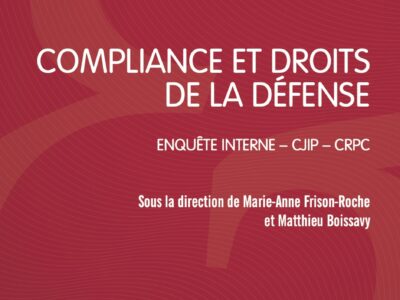
Publication of 🕴️M.-A. Frison-Roche & 🕴️M. Boissavy (eds.), 📕Compliance et droits de la défense. Enquête interne – CJIP – CRPC (Compliance and rights of the defence. Internal investigation – French Judicial Public Interest Agreement – French guilty plea procedure)

► Full Reference: M.-A. Frison-Roche & M. Boissavy (eds.), Compliance et droits de la défense. Enquête interne – CJIP – CRPC (Compliance and rights of the defence. Internal investigation – French Judicial Public Interest Agreement – French guilty plea procedure), Journal of Regulation & Compliance (JoRC) and Dalloz, “Régulations & Compliance” Serie, 2024, 362 p. - ► General presentation of the book:  We do not have an overall view of the relationship between Compliance and the rights of the defence in the continuum of internal investigations and DPA, or in the French legal system the convention judiciaire d’intérêt public (CJIP) and the comparution immédiate avec reconnaissance de culpabilité (CRPC), in particular because the texts, whether hard law or soft law, decisions and academic analyses segment them, making it difficult to build a pertinent appreciation of each one. This is made all the more difficult by the fact that we know little about how each of them is applied in practice, both within each of them and in relation to each other.  As a result, it is difficult to express overall satisfaction, or total rejection, or to suggest some specific reforms and to precise on what points, to identify the appropriate source of these improvements, legislation, case law, professions, or spontaneous ways of doing. The first ambition of this book is therefore to restore an overall vision, because this is the vision of practice. If shortcomings are found to exist, then they can be more easily denounced. However, some of the situations described may be described as flawed, or even dramatic, by some, while others may consider that they should be approved as they stand. This applies, for example, to the question of whether or not the investigation report should be secret from the prosecuting authority, which may propose a DPA (or in the French legal system a CJIP), whether or not this CJIP should be extended to individuals, whether or not a lawyer should be present from the internal investigation stage onwards, whether or not the lawyer should support the interests of the company he/she is investigating and continue to do so before the regulator or the prosecutor, whether or not the investigation is delegated from the public authorities to the company, whether or not the lawyer-investigator and then the lawyer-defendant are both lawyers, whether or not the victims are represented in the the CIPC process, etc. Depending on what one thinks the relation between Compliance and due process should be in principle and in practice, one expresses a more or less approving or severe judgement on the state of the texts, the soft law nature of most of them making the exercise complicated, and then if there is a gap between them and what one thinks should be the right standard, one asserts that in practice things happen differently from what the texts say, or one considers that the texts should be changed. From point to point, a veritable kaleidoscope emerges in this book. Indeed, the result is a series of contributions that sometimes clash with one another, with a sort of contradictionary principle creeping into the very structure of this book, thus establishing the readesr as a sort of judges themselves , that character who is so absent. He/she will be able to do so, since the book lists texts, describes practices and gives an illustration of everything that can be thought of, in visions that are sometimes analytical and sometimes global, with proposals of reforms of texts, jurisprudence or conduct. The aim of the book is to enable readers to form their own opinions and to take part in what is undoubtedly being strongly debated today: the confrontation between Compliance and rights of the defence. - 🧮this book follows a conference organised by the Conseil national des barreaux – CNB (French National Council of Lawyers), which took place on 20 and 21 April 2023: Avocats et droits de la défense dans les enquêtes internes et la justice négociée. - This volume is the continuation of the books dedicated to Compliance in this collection. ► Read the presentations of the other books in the series: the following books: 🕴️M.-A. Frison-Roche (ed.), 📕L’Obligation de Compliance, 2025 🕴️M.-A. Frison-Roche (ed.), 📕Compliance et Contrat, forthcoming 🕴️L. Laref (ed.), 📕Compliance et vigilance bancaire, forthcoming 🕴️M.-A. Frison-Roche, 📕Le système juridique de l’adressage de l’Internet. Une structure multi-acteurs, gage de durabilité (The Legal System of Internet Addressing. A Multi-Stakeholder Structure, the Pledge of its Sustainability), forthcoming 🕴️M.-A. Frison-Roche (ed.), 📕Le système probatoire de la Compliance, forthcoming   the previous books: 🕴️M.-A. Frison-Roche (ed.), 📕La juridictionnalisation de la Compliance, 2023 🕴️M.-A. Frison-Roche (ed.), 📕Les Buts Monumentaux de la Compliance, 2022 🕴️M.-A. Frison-Roche (ed.), 📕Les outils de la Compliance, 2021 🕴️M.-A. Frison-Roche (ed.), 📕Pour une Europe de la Compliance, 2019 🕴️N. Borga, J.-Cl. Marin and J.-Ch. Roda (eds.), 📕Compliance : l’entreprise, le régulateur et le juge, 2018 🕴️M.-A. Frison-Roche (ed.), 📕Régulation, Supervision, Compliance, 2017 🕴️M.-A. Frison-Roche (ed.), 📕Internet, espace d’interrégulation, 2016 📚Read the presentations of the other titles of the collection. - ► Summary of the book: The rights of the defence are one of the pillars of our Rule of Law. On the face of it, compliance techniques are not concerned with this under the pretext of efficiency. This would be particularly true in a trilogy that unfolds over time: internal investigation, convention judiciaire d’intérêt public – CJIP (French Judicial Public Interest Agreement) and comparution sur reconnaissance préalable de culpabilité – CRPC (French guilty plea procedure). However, because Compliance Law is also the expression of the Rule of Law, in that its ambition is to detect and prevent systemic risks in order to protect present and future human beings, we must go beyond this opposition and articulate Compliance and rights of the defence. The Monumental Goals of Compliance, which justify its power, for example to obtain information, and the fundamental rights of the defence, which for example impose the presumption of innocence, must be adjusted to each other; by interpreting texts, or even adopting new ones. The book analyses each of these three techniques, in particular the still largely unregulated internal investigation, and sheds light on them in relation to each other, in order to formulate proposals. - 🏗️General construction of the book: The book opens with an overview divided into three sections. The first Title compares the challenges of the internal investigation with the rights of the defence. The second Title compares the issues at stake in the convention judiciaire d’intérêt public – CJIP (French Judicial Public Interest Agreement) and the comparution sur reconnaissance préalable de culpabilité – CRPC (French guilty plea procedure) with these same rights of the defence. -   TABLE OF CONTENTS   COMPLIANCE ET DROITS DE LA DÉFENSE : VISION D’ENSEMBLE (COMPLIANCE AND RIGHTS OF THE DEFENCE : OVERVIEW) Section 1 ♦️ Connaître les pratiques pour redessiner les frontières et accroître les points de contact entre Compliance et droits de la défense dans l’enquête interne, la CJIP et la CRPC. Lignes de force de l’ouvrage Compliance et droits de la défense (Understanding practices to redraw the boundaries and increase the points of contact between Compliance and the rights of the defense in internal investigation, French Judicial Public Interest Agreement and French guilty plea procedure. Main Aspects of the Book Compliance and rights of the defence), by🕴️Marie-Anne Frison-Roche   Section 2 ♦️  Compliance et droits de la défense : toujours pour le respect des droits humains (Compliance and rights of the defence: always for the respect of human rights), by🕴️Matthieu Boissavy Section 3 ♦️ Circuler dans le temps pour mettre en phase Compliance et droits de la défense (Moving through Time to align Compliance and rights of the defence), by🕴️Marie-Anne Frison-Roche   TITRE I.  LES ENJEUX PROCÉDURAUX DE L’ENQUETE INTERNE CONFRONTÉE AUX DROITS DE LA DÉFENSE (TITLE I.  PROCEDURAL CHALLENGES OF THE INTERNAL INVESTIGATION IN RELATION TO THE RIGHTS OF THE DEFENCE)   CHAPITRE I : VISION GÉNÉRALE DES DROITS DE LA DÉFENSE DANS L’ENQUÊTE INTERNE  (CHAPTER I: OVERVIEW OF THE RIGHTS OF THE DEFENCE IN INTERNAL INVESTIGATION) Section 1 ♦️ Approche doctrinale de l’enquête interne et de l’enquête pénale privée (Doctrinal approach to internal investigation and private criminal investigation), by 🕴️Benjamin Fiorini Section 2 ♦️ Regard critique : La place des droits de la défense dans l’enquête interne selon le guide AFA/PNF (A critical look: The place of the rights of the defence in the internal investigation according to the AFA/PNF Guide), by 🕴️Margaux Durand-Poincloux, 🕴️David Apelbaum and 🕴️Paola Sardi-Antasan Section 3 ♦️ Les conditions de réussite de l’enquête interne dans les rapports entre le Parquet national financier et l’entreprise mise en cause – l’enquête interne au soutien de la défense de l’entreprise (The conditions for a successful internal investigation in the relationship between the French Financial Public Prosecutor’s Office and the accused company – the internal investigation in support of the company’s defence), by🕴️Jean-François Bohnert   CHAPITRE II : LES DROITS DE LA DÉFENSE À CHAQUE ÉTAPE DE L’ENQUÊTE INTERNE (CHAPTER II: THE RIGHTS OF THE DEFENCE AT EACH STAGE OF THE INTERNAL INVESTIGATION)   Section 1 ♦️ La réception des alertes par l’avocat (Reception of alerts by the lawyer), by🕴️Maria Lancri Section 2 ♦️ Collecte et traitement des informations dans les enquêtes internes à l’ère numérique : processus et enjeux (Collecting and processing information for internal investigations in the digital age: processes and challenges), by🕴️Uriel Goldberg Section 3 ♦️ L’apport de la psychologie pour l’effectivité des droits de la défense dans l’enquête interne pour harcèlement au travail (The contribution of psychology to the effectiveness of the rights of the defence in internal investigation for harassment in the workplace), by🕴️Nathalie Leroy & 🕴️Danièle Zucker Section 4 ♦️ Le respect des droits de la défense lors des auditions des enquêtes internes : un gage d’efficacité (Respecting the rights of the defence during hearings in internal investigations: a guarantee of efficacy), by 🕴️Emmanuel Daoud & 🕴️Ghita Khalid Rouissi Section 5 ♦️ L’enquête interne au cœur des enjeux de conformité et de justice négociée : analyse de la position de l’AFA et du PNF (The internal investigation at the heart of conformity and negotiated justice issues: analysis of the position of the AFA and the PNF), by🕴️Éric Russo Section 6 ♦️ Le rapport d’enquête interne à l’épreuve des droits de la défense (The internal investigation report put to the test of defence rights), by🕴️Samuel Sauphanor   CHAPITRE III : LA SPÉCIFICITÉ DES ENQUÊTES INTERNES DANS LES ENTREPRISES INTERNATIONALES ET LA PLACE DES DROITS DE LA DÉFENSE (CHAPTER III : SPECIFICITY OF INTERNAL INVESTIGATIONS IN INTERNATIONAL COMPANIES AND THE PLACE OF THE RIGHTS OF THE DEFENCE) Section 1 ♦️ La spécificité des enquêtes internes pratiquées par les groupes internationaux (Specificity of internal investigations carried out by international groups), by 🕴️Olivier Catherine Section 2 ♦️ Garantir la valeur probatoire d’un rapport dans le cadre d’une enquête interne opérée dans une entreprise internationale (Guaranteeing the evidential value of a report in an internal investigation carried out in an international company), by 🕴️Monique Figueiredo Section 3 ♦️ La responsabilité de l’entreprise dans la conception et la menée de l’enquête interne (The company’s responsibility in designing and conducting an internal investigation), by 🕴️Lydia Meziani Section 4 ♦️ Enquêtes internes, enquêtes pénales et droits de la défense : que nous disent les jurisprudences américaine et anglaise (l’affaire Connolly et l’affaire ENRC) ? (Internal investigations, criminal investigations and rights of the defence: what do the US and UK case law tell us (the Connolly case and the ENRC case)?), by 🕴️Victoire Chatelin   CHAPITRE IV : LE RÔLE SINGULIER DE L’AVOCAT DANS L’ENQUÊTE INTERNE (CHAPTER IV: THE SPECIAL ROLE OF THE LAWYER IN THE INTERNAL INVESTIGATION) Section 1 ♦️ La méthodologie propre à l’avocat enquêteur (The investigating lawyer’s own methodology), by 🕴️William Feugère Section 2 ♦️ L’enquête interne façonnée par la déontologie de l’avocat (The internal investigation shaped by the lawyer’s deontology), by 🕴️Stéphane De Navacelle, 🕴️Julie Zorrila and 🕴️Laura Ragazzi Section 3 ♦️ Préserver le secret professionnel de l’avocat dans l’enquête interne et son résultat (Preserving the lawyer’s professional secrecy in the internal investigation and its outcome), by 🕴️Bénédicte Graulle & 🕴️Yanis Rahim Section 4 ♦️ L’avocat-enquêteur en droit du travail : un janséniste au milieu du Far West (The lawyer-investigator in employment law: a Jansenist in the Wild West), by 🕴️Richard Doudet Section 5 ♦️ La défense des personnes physiques dans les enquêtes internes (Defending individuals in internal investigations), by 🕴️Dorothée Hever     TITRE II. LES ENJEUX PROCÉDURAUX DE LA CJIP ET DE LA CRPC CONFRONTÉES AUX DROITS DE LA DÉFENSE (TITLE II. PROCEDURAL CHALLENGES OF THE FRENCH JUDICIAL PUBLIC INTEREST AGREEMENT AND THE FRENCH GUILTY PLEA PROCEDURE  IN RELATION TO THE RIGHTS OF THE DEFENCE)   CHAPITRE I : VISION GÉNÉRALE DES DROITS DE LA DÉFENSE DANS LA CJIP ET LA CRPC (CHAPTER I: OVERVIEW OF THE RIGHTS OF THE DEFENCE IN THE FRENCH JUDICIAL PUBLIC INTEREST AGREEMENT AND THE FRENCH GUILTY PLEA PROCEDURE) Section 1 ♦️ Théorie et pratique de la négociation dans la justice pénale (Theory and practice of negotiation in criminal justice), by 🕴️Sarah-Marie Cabon Section 2 ♦️ La lutte anti-corruption : l’emprunt au modèle américain et à ses récentes évolutions (The fight against corruption: borrowing from the American model and its recent developments), by 🕴️Stephen L. Dreyfuss Section 3 ♦️ Justice pénale négociée : avantages présents, risques à venir (Negotiated criminal justice: curent benefits, future risks), by 🕴️Alexis Bavitot   CHAPITRE II : FORMES ACTIVES DES DROITS DE LA DÉFENSE, LES DIALOGUES À L’OEUVRE OU À PARFAIRE DANS LA CJIP ET LA CRPC (CHAPTER II: ACTIVE FORMS OF THE RIGHTS OF THE DEFENCE, DIALOGUES AT WORK OR TO BE PERFECTED IN THE FRENCH JUDICIAL PUBLIC INTEREST AGREEMENT AND THE FRENCH GUILTY PLEA PROCEDURE) Section 1 ♦️ Combinaison des CRPC et des CJIP : le cas particulier des affaires de fraude fiscale (Combination of the French guilty plea procedure and the French Judicial Public Interest Agreement: the special issue of tax fraud cases), by 🕴️Marion David Section 2 ♦️ Pour une justice pénale négociée plus équitable (For a fairer negotiated criminal justice), by🕴️Astrid Mignon Colombet Section 3 ♦️ Les impacts, sur les droits de la défense, des disparités de la justice pénale négociée dans l’Union européenne (The impact on the rights of the defence of the disparities in negotiated criminal justice in the European Union), by 🕴️Emmanuel Moyne Section 4 ♦️ L’évolution des rapports entre avocats et autorités de poursuites depuis l’introduction de la CJIP (Developments in relations between lawyers and prosecuting authorities since the introduction of the French Judicial Public Interest Agreement), by 🕴️Thomas Baudesson   CHAPITRE III : LE RÔLE SINGULIER DE L’AVOCAT DANS LA CJIP ET LA CRPC  (CHAPTER III: THE SINGULAR ROLE OF THE LAWYER IN THE FRENCH JUDICIAL PUBLIC INTEREST AGREEMENT AND THE FRENCH GUILTY PLEA PROCEDURE) Section 1 ♦️ Quand se justifie et quand s’arrête la collaboration ? À propos de la CJIP (When is collaboration justified and when does it end? About the French Judicial Public Interest Agreement), by 🕴️Philippe Goossens Section 2 ♦️ Le dialogue de l’avocat et de son client, chef d’entreprise, face à la proposition d’une CRPC et d’une CJIP (The dialogue between the lawyer and his client, a company director, faced with the proposal of a French guilty plea procedure or a French Judicial Public Interest Agreement), by 🕴️François Saint-Pierre Section 3 ♦️ Le dilemme de l’avocat pénaliste face à la CRPC (The criminal lawyer’s dilemma when faced with the French guilty plea procedure), by 🕴️Jean Boudot Section 4 ♦️ Défendre les intérêts de la personne physique confrontée à la justice négociée : préserver l’effectivité des droits de la défense et le respect de la présomption d’innocence (Defending the interests of individuals faced with negotiated justice: preserving the effectiveness of the rights of the defence and respect for the presumption of innocence), by 🕴️Capucine Lanta de Bérard & 🕴️Pauline Dufourq Section 5 ♦️ Défendre les intérêts des victimes dans la justice pénale économique négociée (Defending victims’ interests in negotiated economic criminal justice), by 🕴️Jérôme Karsenti - 🌐follow Marie-Anne Frison-Roche on LinkedIn 🌐follow Marie-Anne Frison-Roche on Instagram 🌐subscribe to the Newsletter MAFR Regulation, Compliance, Law

Conferences

🕴️MaFR interviews 🕴️Jacques Beyssade

🎥Compliance and governance (example of a banking group), interview with 🕴️Jacques Beyssade by Marie-Anne Frison-Roche, 🎬 Series of talks on Compliance Law, in 📺 Open windows on management

► Full reference: J. Beyssade, "Compliance et gouvernance (exemple d'un groupe bancaire)" (Compliance and governance (example of a banking group)), interview conducted by M.-A. Frison-Roche on the occasion of a series of interviews on Compliance Law, in Fenêtres ouvertes sur la gestion (Open windows on management), broadcast by J.-Ph. Denis, Xerfi Canal, recorded December 12, 2023, recorded February 24, 2024 - 🌐consult the presentation of Jacques Beyssade's interview on LinkedIn - 🎥view the full interview on Xerfi Canal - ► Starting point: In 2022, Jacques Beyssade wrote a contribution on 📝Feminisation of positions of responsibility in the workplace as a goal of Compliance, in 📘Compliance Monumental Goals 🧱read the presentation of this contribution ➡️click HERE - ► Summary of interview:  Marie-Anne Frison-Roche. Question: Compliance and governance are often linked. Can you explain how, in the strategy of a banking group like BPCE, this link between compliance and governance is articulated? Jacques Beyssade. Answer. Compliance is not just a matter of obeying the rules, but also, and perhaps even more so, of respecting customers, suppliers, stakeholders and members. For a mutualist structure, customers and member-policyholders are closer, they are the same social body, and so it's a matter of governance. - MaFR. Q.: Let's take a concrete example, where Compliance and governance serve a specific purpose: effective equality between men and women, for example. How does this work in your Group? J.B. R.: This objective is in the genes of BPCE, and in particular of the savings banks. The Copé-Zimmermann law requires it. We go beyond this constraint, at the level of governance. The management board, or executive committee, is egalitarian, and this also works as an example. Compliance takes up the baton, for example, by identifying talent, particularly female talent, and correcting any anomalies.  - MaFR. Q.: In the future, can we hope that this alliance between new governance and the power of Compliance, with the same Monumental Goals, will transform our societies? J.B. R.: Changes in society come from the behavior of individuals and companies, as demonstrated by the opening of savings accounts to women in the 19th century. Both can do a great deal, within the framework of regulations, by going beyond them. Through governance, for example in a mutual bank like BPCE, it's the members who set the rules, reflecting social movements because they themselves are representative of society as a whole. In this way, through the alliance of governance and compliance, they can act to give concrete expression to the fundamental social movements they themselves represent, through the broad representation of the social body that the member-policyholders constitute. -

Conferences

🎤Préalable : ce qu’est l’obligation de Compliance (Prerequisite: the Compliance Obligation), in 🧮L’arbitrage international en renfort de l’obligation de Compliance

► Full Reference: M.-A. Frison-Roche, "Préalable : ce qu'est l'obligation de Compliance" ("Prerequisite: the Compliance Obligation"), in L. Aynès, M.-A. Frison-Roche, J.-B. Racine and E. Silva-Romero (dir.), L'arbitrage international en renfort de l'obligation de Compliance (International Arbitration in support of the Compliance Obligation), Journal of Regulation & Compliance (JoRC) and Institute of World Business Law of the ICC (Institute), Conseil Économique Social et Environnemental (CESE), Paris, February 9, 2024 - 🧮see the full programme of this event - 🌐consult on LinkedIn a general presentation of this event, which links to a presentation of each speech (in French) - 🧱consult the scientific direction sheet of this event, which gives an account of the various speeches made - 🔲see the slides used to support the presentation (in French) - 🎤see a presentation of the conference "Préalable : ce qu'est un engagement" ("Prerequisite: the Commitment"), given at the same symposium - 🎤see a presentation of the conference "Le renforcement des engagements de Compliance par le renvoi Ex Ante à l'arbitrage international" ("Reinforcing Compliance commitments by referring Ex Ante to International Arbitration") which was finally not pronounced but will be the subject of an 📝article in the forthcoming book 📘Compliance Obligation  - ► Presentation of the conference: I have first dealt with the very definition of the Compliance Obligation. After showing that the relationship between Compliance Law and International Arbitration will naturally develop, because the companies subject to it are international, because they contractualise their legal Compliance obligations and because Compliance is being jurisdictionalised📎1🕴️M.-A. Frison-Roche (ed.), 📘Compliance Jurisdictionalisation, 2024., the arbitrator being the natural judge since he is a global judge and the judge of the contract, I pointed out that Compliance Law does not simply entrust arbitration with the task of preventing evils, such as corruption pacts, but that it creates positive obligations for companies: to detect and prevent behaviour whose systemic effect is deleterious. This culture of compliance is achieved either through compliance contracts📎2🕴️M.-A. Frison-Roche, 🚧Compliance contract, compliance clauses, 2022. (which outsource the handling of audits, alerts, the drawing up of plans, etc.), or through compliance clauses📎2🕴️M.-A. Frison-Roche, 🚧Compliance contract, compliance clauses, 2022., which are inserted into distribution or supply contracts, etc.; arbitration clauses are linked to these. Thus, the alliance between Compliance and Contract is an indirect mode of alliance between Arbitration and Compliance Obligation. The obligation of Compliance which then takes concrete form consists for the company not in making effective Ex Ante all the regulations which apply to it (conception of conformity which is at once unreasonable, blind and impossible), but in making its best efforts, which it must make visible (see Compliance Evidence System📎3🕴️M.-A. Frison-Roche, 📝The Judge, the Compliance Obligation and the Company. The Compliance Evidence System, in 🕴️M.-A. Frison-Roche (ed.), 📘Compliance Jurisdictionalisation, 2024.) to achieve Monumental Goals. These Monumental Goals are systemic. The aim is to protect systems from collapse (Negative Monumental Goals) or to make them better (Positive Monumental Goals)📎4🕴️M.-A. Frison-Roche, 📝Compliance Monumental Goals, Beating Heart of Compliance Law, in🕴️M.-A. Frison-Roche (ed.), 📘Compliance Monumental Goals, 2023.. By making companies accountable, via this Ex Ante Law whose object is the future, the systemic evils of corruption, money laundering, discrimination, climate change and hatred are combated, thus finding substantial unity. The Positive Monumental Goals aim to engender sustainability, security, respect for human beings, etc. in systems, be they banking, financial, digital, climatic, etc. The role of the Judge, and therefore also that of the Arbitrator, is renewed. - 🌐follow Marie-Anne Frison-Roche on LinkedIn 🌐follow Marie-Anne Frison-Roche on Instagram 🌐subscribe to the Newsletter MAFR Regulation, Compliance, Law

Conferences

🎤Le renforcement des engagements de compliance par le renvoi Ex Ante à l’arbitrage international (Reinforcing Compliance commitments by referring Ex Ante to International Arbitration), in 🧮L’arbitrage international en renfort de l’obligation de Compliance

► Full Reference: M.-A. Frison-Roche, "Le renforcement des engagements de Compliance par le renvoi Ex Ante à l'arbitrage international" ("Reinforcing Compliance commitments by referring Ex Ante to International Arbitration"), in L. Aynès, M.-A. Frison-Roche, J.-B. Racine and E. Silva-Romero (dir.), L'arbitrage international en renfort de l'obligation de Compliance (International Arbitration in support of the Compliance Obligation), Journal of Regulation & Compliance (JoRC) and Institute of World Business Law of the ICC (Institute), Conseil Économique Social et Environnemental (CESE), Paris, February 9, 2024 - 🧮see the full programme of this event - 🌐consult on LinkedIn a general presentation of this event, which links to a presentation of each speech (in French) - 🧱consult the scientific direction sheet of this event, which gives an account of the various speeches made - 🔲see the slides used to support the presentation (in French) - 📝This conference and the Working Paper on which it is based are to be linked with the article to be published in the book📘Compliance Obligation  - 🎤see a presentation of the conference "Préalable : ce qu'est l'Obligation de Compliance" ("Prerequisite: what is the Compliance Obligation"), given at the same symposium - 🎤see a presentation of the conference "Préalable : ce qu'est un engagement" ("Prerequisite: the Commitment"), given at the same symposium - ► Presentation of the conference: It was initially planned that I would speak on the subject Le renforcement des engagements de Compliance par le renvoi Ex Ante à l'arbitrage international (Reinforcing Compliance commitments through the Ex Ante referral to International Arbitration), but it was agreed with the other organisers of the symposium that after defining the concept of the Compliance Obligation📎1🕴️M.-A. Frison-Roche, 🎤Préalable : ce qu'est l'obligation de Compliance (Prerequisite: the Compliance Obligation), in 🧮L'arbitrage international en renfort de l'obligation de Compliance (International Arbitration in support of the Compliance Obligation), 2024. I would refocus my second speech, mentioned above, on what a Commitment is📎2M.-A. Frison-Roche, Préalable : ce qu'est un engagement 🕴️M.-A. Frison-Roche, 🎤Préalable : ce qu'est un engagement (Prerequisite: the Commitment), in 🧮L'arbitrage international en renfort de l'obligation de Compliance (International Arbitration in support of the Compliance Obligation), 2024., an essential prerequisite for dealing with the subject of International Arbitration in support of the Compliance Obligation. Developments on Reinforcing Compliance commitments through the Ex Ante referral to International Arbitration will appear in the forthcoming books: L'obligation de Compliance (in French), Compliance Obligation (in English). Nevertheless, if I had dealt with this subject, I would have raised the following points: The inclusion of an offer of arbitration in the field of Compliance implies considering it in a contract as well as in a non-contractual commitment, and studying which category of Compliance Obligation the offer may apply to. This insertion benefits from taking the form of a "graduated offer", in a crescendo organised by the company ex ante and offered to the stakeholders: conciliation, mediation and arbitration, in "circles of trust"📎3🕴️M.-A. Frison-Roche, 🚧Compliance and Trust, 2017.. This is supported by the current French amicable settlement policy. The result was that I had to prepare a long "preliminary" discussion of what a "commitment" is, without which it seemed difficult to talk in concrete terms about the effective insertion of an offer of arbitration if we did not know whether such links or words had a constraining effect on the person issuing them in relation to the person benefiting from them. After discussions with the other speakers, it became clear that it would be more effective to give a talk devoted solely to the question of the legal definition of commitment. We therefore decided to allocate this second speaking slot to the notion of commitment. Since the written words do not have the same constraints, it will take up the initial construction, insisting on the different supports, either compliance contracts, or associations with compliance clauses, relating to different Compliance obligations, in particular on information or audit or Vigilance📎4🕴️M.-A. Frison-Roche, 🚧Compliance contract, compliance clauses, 2022., because the company must have the legal power corresponding to the mission that the State entrusts to it through Compliance📎5🕴️M.-A. Frison-Roche, 🚧Conceiving Power, 2021.. The offer must be carefully drafted to explain its purpose, and its organisation must prove the reality of this purpose: to give access to a judge to people affected by the company's activity, and not to block it. This will therefore be available in detail in the forthcoming books: M.-A. Frison-Roche (ed.), 📕L'obligation de Compliance M.-A. Frison-Roche (ed.), 📘Compliance Obligation - 🌐follow Marie-Anne Frison-Roche on LinkedIn 🌐follow Marie-Anne Frison-Roche on Instagram 🌐subscribe to the Newsletter MAFR Regulation, Compliance, Law

Conferences

🎤Préalable : ce qu’est un engagement (Prerequisite: the Commitment), in 🧮L’arbitrage international en renfort de l’obligation de Compliance

► Full Reference: M.-A. Frison-Roche, "Préalable : ce qu'est un engagement" ("Prerequisite: the Commitment"), in L. Aynès, M.-A. Frison-Roche, J.-B. Racine and E. Silva-Romero (dir.), L'arbitrage international en renfort de l'obligation de Compliance (International Arbitration in support of the Compliance Obligation), Journal of Regulation & Compliance (JoRC) and Institute of World Business Law of the ICC (Institute), Conseil Économique Social et Environnemental (CESE), Paris, February 9, 2024 - 🧮see the full programme of this event - 🌐consult on LinkedIn a general presentation of this event, which links to a presentation of each speech (in French) - 🧱consult the scientific direction sheet of this event, which gives an account of the various speeches made - 🔲see the slides used to support the presentation (in French) - 🎤see a presentation of the conference "Préalable : ce qu'est l'Obligation de Compliance" ("Prerequisite: what is the Compliance Obligation"), given at the same symposium - 🎤see a presentation of the conference "Le renforcement des engagements de Compliance par le renvoi Ex Ante à l'arbitrage international" ("Reinforcing Compliance commitments by referring Ex Ante to International Arbitration") which was finally not pronounced but will be the subject of an 📝article in the forthcoming book 📘Compliance Obligation  - ► Presentation of the conference: Having defined the Compliance Obligation in "Préalable : ce qu'est l'Obligation de Compliance" ("Prerequisite: what is the Compliance Obligation"), I set out to define what a commitment is. No one doubts that commitments, as words, constitute facts that can engage the liability of companies if there are inconsistencies or lies. The question today is whether a commitment can constitute a legal act, binding in ex ante. Companies make commitments either to fulfil their legal Compliance obligations, which is simply obeying the law, or to express their own wishes, either for themselves or for others. The cases are often confused, even though the scope is not the same. If the commitment takes the form of a contract, Compliance is concerned if the contract is used as an Ex Ante Compliance Tool📎1🕴️M.-A. Frison-Roche (ed.), 📘Compliance Tools, 2021., either if the entire contract has this purpose, or if a compliance clause is inserted, and an arbitration clause may be linked to it. The commitment, a concept that comes more from the Economics of Regulation, was conceived between a Regulatory Authority and a Company: it is the unilateral decision of the Authority that gives legal force to the commitment. Case law confirms this (Conseil d'État (French Council of State)📎2🏛️Conseil d'État (French Council of State), 21 April 2023, No. 464349, Sté Orange v. Arcep. and Conseil constitutionnel (French Constitutional Council)📎3🏛️Conseil constitutionnel (French Constitutional Council), 19 March 2021, decision No. 2021-891 QPC, Association Générations futures et autres.) and this is particularly clear in Competition Law, but it is also true of the convention judiciaire d'intérêt public – CJIP (French Judicial Public Interest Agreement). If commitment is central to Compliance, particularly Vigilance, it is because Compliance Law is an extension of Regulatory Law📎4🕴️M.-A. Frison-Roche, 🚧From Regulation Law to Compliance Law ; 🚧Compliance Law loses the ties of Regulation Law but retains its principles: consequences for companies, 2018 ; 🚧The deployment of Regulatory Law through Compliance Law in the European project, 2023.. The company is forcibly instituted by the Compliance regulator, particularly in value chains, or on digital spaces (DSA). In drawing up a plan, the company is fulfilling its legal obligation. But if we were to consider that it is a commitment, then we would also have to consider that the plan is the result of its will, that it must consult the stakeholders in its preparation, but that the source of the plan is its will: the provisions are not stipulations, are not applications of the law, but unilateral voluntary provisions. In this respect, and because its source is the will of the company (which does not prevent its co-construction), a plan could contain a "graduated offer" of arbitration. This offer could be included in commitments that are less regulated by law, such as those made in the context of CSR. - 🌐follow Marie-Anne Frison-Roche on LinkedIn 🌐follow Marie-Anne Frison-Roche on Instagram 🌐subscribe to the Newsletter MAFR Regulation, Compliance, Law

Organisation of events

🧱Co-organisation of the Symposium 🧮L’arbitrage international en renfort de l’Obligation de Compliance (International Arbitration in support of the Compliance Obligation)

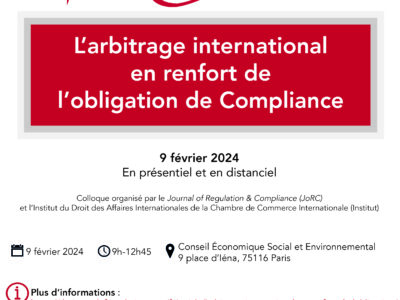
► Full Reference: L. Aynès, M.-A. Frison-Roche, J.-B. Racine and E. Silva-Romero (dir.), L'arbitrage international en renfort de l'obligation de Compliance (International Arbitration in support of the Compliance Obligation), Journal of Regulation & Compliance (JoRC) and Institute of World Business Law of the ICC (Institute), Conseil Économique Social et Environnemental (CESE), Paris, February 9, 2024 - 🌐consult on LinkedIn a general présentation of this event, which links to a presentation and a report of each speech  - 🏗️This symposium takes place in the cycle of symposiums organised by the Journal of Regulation & Compliance (JoRC) and its partners Universities, focusing in 2023-2024 on the general theme of the Compliance Obligation - 📚The works will then be inserted in the books:  📕L'obligation de Compliance, to be published in the 📚Régulations & Compliance Serie, co-published by the Journal of Regulation & Compliance (JoRC) and Dalloz, published in French. 📘Compliance Obligation, to be published on the 📚Compliance & Regulation Serie, co-published by the Journal of Regulation & Compliance (JoRC) and Dalloz, published in English. - ► General presentation of the symposium: "Compliance Obligation" appears to be far from International Arbitration if Compliance Law is only understood in terms of binding regulations or even Criminal Law. Arbitration would only have contact with Compliance Obligation in a repulsive way, when a person claims to have enforced a contract before an arbitration court that disregards a compliance prohibition, e.g. corruption or money laundering. It is therefore from a negative angle that the cross-over has taken place. The fact that Arbitration Law respects the requisite of Criminal Law is nothing new.  Moreover, the power of Compliance in its detection and prevention tools, particularly in terms of evidence, no doubt increases the global efficiency. But Compliance Obligation is based on Monumental Goals, notably linked to global human rights and active ambitions about environment and climate which, particularly in the value chain economy, take the legal form of compliance clauses, or even compliance contracts, or various commitments and plans, which the parties can ask the international arbitrator to enforce. They will do so even more as arbitrators are often the only international, or even global, judges available. The use they will do of Contract Law, Quasi-Contract Law, Enforcement Law, Tort Law, reinforces Compliance Law in a global dimension. - - ► Interviennent :  🎤 Laurent Aynès, emeritus Professor at Paris 1 Panthéon-Sorbonne University, Attorney, Darrois Villey Maillot Brochier (Paris) 🎤 Marie-Anne Frison-Roche, Professor of Regulatory and Compliance Law, Director of the Journal of Regulation & Compliance (JoRC) 🎤 Jean-François Guillemin, former General Secretary of the Bouygues Group 🎤 Christophe Lapp, Attorney, Advant Altana (Paris) 🎤 Jean-Baptiste Racine, Full Professor at Paris Panthéon-Assas University (Paris 2) 🎤 Eduardo Silva-Romero, President of the Institute of World Business Law of the ICC (Institute), Attorney, Wordstone (Paris) - 🧮Read a detailed presentation of the event below⤵️ - 🌐follow Marie-Anne Frison-Roche on LinkedIn 🌐follow Marie-Anne Frison-Roche on Instagram 🌐subscribe to the Newsletter MAFR Regulation, Compliance, Law

Publication director

🏗️ copublishing and direction of the collection: 📚Compliance & Regulation

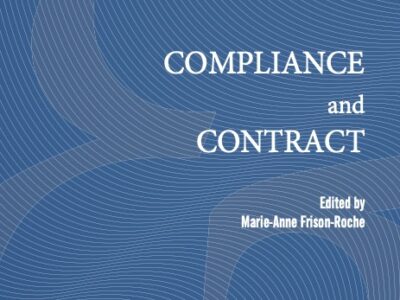
📚Publication of:🕴️M.-A. Frison-Roche (ed.), 📘Compliance and Contract

► Full Reference: M.-A. Frison-Roche (ed.), Compliance and Contract, Journal of Regulation & Compliance (JoRC) and Bruylant, "Compliance & Regulation" Serie, to be published - 📘In parallel, the French version of this book, Compliance et contrat, is published in the Serie co-published by the Journal of Regulation & Compliance (JoRC) and Dalloz  - 🧮This book comes after a cycle of symposiums organised in 2023-2024 by the Journal of Regulation & Compliance (JoRC) and its Academic Partners - ► General presentation of the book:  - 📚This volume is one of a series of books devoted to Compliance in this Serie. ► read presentations of the other books of this Serie dealing with Compliance : further books: 🕴️M.-A. Frison-Roche (ed.), 📘Compliance Evidence System, 2025 previous books: 🕴️M.-A. Frison-Roche (ed.), 📘Compliance Obligation, 2024 🕴️M.-A. Frison-Roche (ed.), 📘Compliance Jurisdictionalisation, 2024 🕴️M.-A. Frison-Roche (ed.), 📘Compliance Monumental Goals, 2023 🕴️M.-A. Frison-Roche (ed.), 📘Compliance Tools, 2021   📚see the global presentation of all the books of the Serie. - 🏗️General construction of the book: - 🌐follow Marie-Anne Frison-Roche on LinkedIn 🌐follow Marie-Anne Frison-Roche on Instagram 🌐subscribe to the Newsletter MAFR Regulation, Compliance, Law

Conferences

🎤Droit de la compliance : tour d’horizon (Compliance Law: Overview), in 🧮Droit de la compliance (Compliance Law)

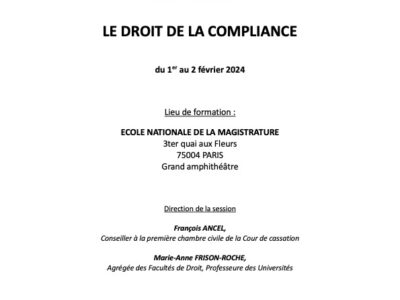
► Full Reference: M.-A. Frison-Roche, "Droit de la compliance : tour d'horizon" ("Compliance Law: Overview"), in Droit de la compliance (Compliance Law), École nationale de la magistrature – ENM (French National School for the Judiciary) in collaboration with the École de Formation professionnelle des Barreaux du ressort de la cour d'appel de Paris – EFB (Paris Bar School), Paris, February 1, 2024. - ► This conference is given in French - 🧮see the full programme of this event (in French) - 🌐consult on LinkedIn a general presentation of this event, which links to a presentation of each speech (in French) - 🧱consult the scientific direction sheet of this event, which gives an account of the various speeches made - 🔲see the slides used to support the presentation (in French) - 🎤see a presentation of the other speech about "Compliance et Responsabilité civile : comprendre et raison garder" ("Compliance and Civil Liability: understanding and keeping our heads"), given at the same symposium - ► Presentation of the conference: Compliance Law is mysterious in itself, because it is still in creation1🕴️M.-A. Frison-Roche, 📝Naissance d'une branche du Droit : le Droit de la Compliance (Birth of a branch of Law : Compliance Law), to be published., because its presence and power are felt, but it is difficult to grasp it. It is necessary, however, because it deals with the most important, even the most dramatic, facts and carries with it the greatest ambitions. Magistrates must also "make the effort" to participate in the "adventure of Compliance Law", because it affects, and even overturns, all subjects, and because the Prosecutor and the Judge play an increasing role in it2🕴️M.-A. Frison-Roche (ed.), 📘Compliance Jurisdictionalisation, 2023.. Because the purpose of this conference is to introduce the two days of a training course designed for magistrates and open to lawyers, it only provides an "overview" of, so that we do not get lost in the sprawling regulations, the global mechanisms and the political ambitions that permeate them. Therefore, without going into any of the subjects, it is about opening up four ways of entering what is a branch of Law that is being born before our eyes: 1. Understanding Compliance Law through "regulations" 2. Understanding Compliance Law through "tools"3🕴️M.-A. Frison-Roche (ed.), 📘Compliance Tools, 2020. 3. Understanding Compliance Law through "methods" 4. Understanding Compliance Law through "goals"4🕴️M.-A. Frison-Roche (ed.), 📘Compliance Monumental Goals, 2023. The four approches are legitimate because the four dimensions are articulated in the legal system, notably case law. But the more positive Law is consolidated, the more its normativity through the goals that give normativity, or even a simplicity without which the whole is not humanly controllable. These Goals are Monumental and Europe bears them more and better than other areas of the world5🕴️M.-A. Frison-Roche (ed.), 📕Pour une Europe de la Compliance (For the Europe of the Compliance), 2019.. - 🌐follow Marie-Anne Frison-Roche on LinkedIn 🌐follow Marie-Anne Frison-Roche on Instagram 🌐subscribe to the Newsletter MAFR Regulation, Compliance, Law

Conferences

🎤Compliance et responsabilité civile : comprendre et raison garder (Compliance and Civil Liability: understanding and keeping our heads), in 🧮Droit de la compliance

► Full Reference: M.-A. Frison-Roche, "Compliance et Responsabilité civile : comprendre et raison garder" ("Compliance and Civil Liability: understanding and keeping our heads"), in Droit de la compliance (Compliance Law), École nationale de la magistrature – ENM (French National School for the Judiciary) in collaboration with the École de Formation professionnelle des Barreaux du ressort de la cour d'appel de Paris – EFB (Paris Bar School), Paris, February 1, 2024. - ► This conference is given in French. - 🧮see the full programme of this event (in French) - 🌐consult on LinkedIn a general presentation of this event, which links to a presentation of each speech (in French) - 🧱consult the scientific direction sheet of this event, which gives an account of the various speeches made - 🔲see the slides used to support the presentation (in French) - 📝This conference and the Working Paper on which it is based are to be linked with the article to be published in the book📘Compliance Obligation  - 🎤see a presentation of the conference "Droit de la Compliance : tour d'horizon" ("Compliance Law: overview"), given at the same symposium - ► Presentation of the conference : It is difficult, even artificial, to separate the presentation of the relationship between Compliance Law and Civil Liability from the consideration given in Compliance to Criminal Liability, sanctions and the whole contractual organisation. But, if only for reasons of time, this will be done. The chosen method consists of using decisions handed down either under Compliance Law, an emerging branch of Law of which an overview has been given before📎1🕴️M.-A. Frison-Roche, 🎤Droit de la Compliance : tour d'horizon (Compliance Law: overview), 2024., or under Special Liability Laws, such as Company Law (but here too the field of analysis is huge), or under Ordinary Civil Liability Law. The latter is often the preferred approach. It always seems that civil liability and Compliance Law are both intimate and have a difficult relationship. To understand them, before embarking on crusades in one direction or another, it is technically necessary to look at the liabilities attached to the application of "compliance regulations" imposed on economic operators, who contractualise the resulting legal obligations and whose third parties may also rely on breaches on the grounds of civil liability. This is the first stage of the analysis. Much is made of the Vigilance technique. Even if this is the advances point of Compliance, we also need to look at the GDPR, the French co-called "Sapin 2" law, Anti-Corruption, etc. However, civil liability is not the same depending on whether the obligation, legal and/or contractual, in relation to which it arises as a cause of action, gives rise, depending on the case, the text and the person, to an obligation of means or an obligation of result. If there is one principle to bear in mind, particularly in the mind of the judge, it is that, unless a text or clause provides otherwise, an obligation is an obligation of means. This essential question raises the need to better define the "Compliance Obligation", which consists of prevention and detection, with the economic operator making his "best efforts" with regard to the monumental goals to which the various regulations (thus finding their unity) are normatively anchored. The Ex Ante evidential dimension thus comes to the fore. In the second part of the analysis, which continues to be based on court decisions, we need to measure the "points of contact" between these "special compliance responsibilities" and the Ordinary Law of Civil Liability. Indeed, because this is a profound movement that runs through the entire legal system, expressing a social demand that distinguishes Western law from the rest of the world, Ordinary Liability Law has long had a preventive dimension and targets operators in a different way, not only because of their power, but also because of their "mission". This is expressly stated in the case law, and these points of contact do not justify opposing the two branches. It would only be if Compliance Law were confused with its instrument, "conformity", and if new principles were invented in an Ordinary Law, that clashes could arise. In the third stage of the analysis, which can be applied to the principles at stake today, it should be remembered that while there is no general Compliance Obligation under Ordinary Law, which implies detecting and preventing for oneself and for others any breach of any applicable regulation likely to harm others, there is a principle of freedom, as the Conseil constitutionnel (French Constitutional Council) regularly reminds us. Unless we change the legal system so that people become nothing more than subjects who obey all regulations and let it be seen that they do so, with the judge's role being limited to punishing them for not doing so. Indeed, the principle of freedom remains the foundation both of the Ordinary Civil Liability Law (and not of repression, as in Chinese Law) and of the Special Law of Compliance (and not of conformity, as in Chinese law). In conclusion, it appears that the evolution of Civil Liability, in particular due to the spirit of a Compliance Law that is articulated with it, is leading to a twofold movement: from Ex Post liability to Ex Ante responsibility📎2🕴️M.-A. Frison-Roche, 🚧Ex Ante Responsibility, 2022 ; 🕴️M.-A. Frison-Roche, 📝La responsabilité ex ante, pilier du droit de la compliance (Ex Ante Responsibility, pillar of Compliance Law), 2022, and from Liability to Accountability. To accompany this movement, alliances are being forged and must be fostered, which brings Compliance Law face to face with Competition Law, alliances often forged by contract and for which the role of the judge is being renewed, particularly through mediation techniques. - 🌐follow Marie-Anne Frison-Roche on LinkedIn 🌐follow Marie-Anne Frison-Roche on Instagram 🌐subscribe to the Newsletter MAFR Regulation, Compliance, Law

Lessons

Teaching for the École nationale de la magistrature - ENM (French National School for the Judiciary)

⚖️Droit de la compliance (Compliance Law)

► Full Reference: F. Ancel &  M.-A. Frison-Roche, Droit de la compliance (Compliance Law), École nationale de la magistrature – ENM (French National School for the Judiciary), in collaboration with the École de Formation professionnelle des Barreaux du ressort de la cour d'appel de Paris – EFB (Paris Bar School), Paris, February 1 and 2, 2024 This teaching is given in French. - 🌐consult on LinkedIn a general présentation of this event, which links to a presentation and a report of each speech - ► Presentation of the Teaching: The aim of this two-day conference is to enable judges and lawyers to grasp the issues, objectives and methods that define Compliance Law as it is practised in companies. The speakers will illustrate the growing trend towards litigation, which is difficult to reconcile with the supranational dimension, or even indifference to territories, for example when disputes concern systemic climate or digital issues: the result is a renewal of the role of the judge and the role of lawyers. This must be set against the renewal of the role and operation of companies themselves. This is analysed from the perspective of Civil Law, in particular Contract Law and Liability Law. Company Law and Criminal Law are also addressed, as well as the way in which the legal system now integrates governance, regulation, climate and digital issues and the smooth operation of financial markets through Compliance techniques. - ► Organisation of the Teaching: This conference is divided into two parts. The first day is designed as a presentation of the major themes through which Compliance Law crosses the branches of traditional Law. The speakers will be professors of Law who will successively summarise the branches of Law and put into perspective the way in which Compliance imperatives give rise to new situations, new difficulties and new solutions. This enables the second day to focus on practical and topical issues and to debate controversial questions between people of different sensibilities. The participants tend to be judges, members of regulatory authorities, lawyers, members of associations and so on. - ► Enrolment procedure: The course is open to all judicial and consular magistrates, as well as lawyers. Registrations can be made directly with the ENM or with the EFB. - ► Speakers :   🎤François Ancel, Judge at the Première Chambre civile de la Cour de cassation (First Civil Chamber of the French Court of cassation)  🎤Thomas Baudesson, Attorney at the Paris Bar, Partner at Clifford Chance 🎤Guillaume Beaussonie, Full Professor at Toulouse 1 Capitole University 🎤Jacques Boulard, Premier Président de la Cour d’appel de Paris (First President of the Paris Court of Appeal) 🎤Marie Caffin-Moi, Full Professor at Paris Panthéon-Assas University 🎤Malik Chapuis, Judge at the Tribunal judiciaire de Paris (Paris First Instance Civil Court) 🎤Lucie Chatelain, Advocacy and Litigation Manager – Civil Liability of Parent Companies, Sherpa 🎤Jean-Benoît Devauges, Directeur Juridique, Ethique et Gouvernance des entreprises (Legal, Ethics and enterprises governance Director), MEDEF 🎤Marie-Anne Frison-Roche, Professor of Regulatory and Compliance Law, Director of the Journal of Regulation & Compliance (JoRC) 🎤Arnaud Gossement, Attorney at the Paris Bar, Partner at Gossement Avocats 🎤Thibault Goujon-Bethan, Full Professor at Jean Moulin Lyon 3 University 🎤Christophe Ingrain, Attorney at the Paris Bar, Partner at Darrois Villey Maillot Brochier 🎤Isabelle Jegouzo, Director of the Agence française anticorruption – AFA (French Anti-Corruption Agency)  🎤Anne-Valérie Le Fur, Full Professor at Versailles Saint-Quentin-en-Yvelines University 🎤Charlotte Michon, Attorney at the Paris Bar, partner at Charlotte Michon Avocat 🎤Jean-Baptiste Racine, Full Professor at Paris Panthéon-Assas University 🎤 Jean-Christophe Roda, Full Professor at Jean-Moulin Lyon 3 University 🎤Jérôme Simon, 1er Vice-Procureur Financier (First Financial Vice-Prosecutor) - 🧮read below the programme put together and organised by François Ancel and Marie-Anne Frison-Roche, as well as the reports of each presentation⤵️ - 🌐follow Marie-Anne Frison-Roche on LinkedIn 🌐follow Marie-Anne Frison-Roche on Instagram 🌐subscribe to the Newsletter MAFR Regulation, Compliance, Law

Publication director

🏗️ copublishing and direction of the collection: 📚Compliance & Regulation

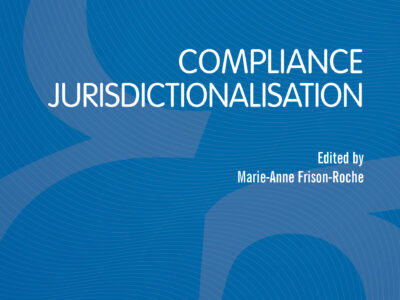
📚Publication of: 🕴️M.-A. Frison-Roche (ed.), 📘Compliance Jurisdictionalisation

► Full Reference: M.-A. Frison-Roche (ed.), Compliance Jurisdictionalisation, Journal of Regulation & Compliance (JoRC) and Bruylant, "Compliance & Regulation" Serie, 2024, 464 p. - 📕In parallel, the French version of this book, La juridictionnalisation de la Compliance, is published in the collection co-published by the Journal of Regulation & Compliance (JoRC) and Dalloz - 🧮This book comes after a cycle of colloquia organised in 2021 by the Journal of Regulation & Compliance (JoRC) and its Academic Partners - ► General presentation of the book: Sanctions, controls, appeals, deals: judges and lawyers are everywhere in the Compliance mechanisms, creating unprecedented situations, sometimes without a solution yet available.  Even though Compliance was designed to avoid the judge and produce security by avoiding conflict. This jurisdictionalisation is therefore new. Forcing companies to prosecute and judge, a constrained role, perhaps against their nature. Leading to the adaptation of major procedural principles, with difficulty. Confronting arbitration with new perspectives. Putting the judge at heart, in mechanisms designed so that he is not there. How in practice to organize these opposites and anticipate the solutions? This is the challenge taken up by this book. - This volume is the continuation of the books dedicated to Compliance in this collection. 📚Read the presentation of the other books of this collection: further books: 🕴️M.-A. Frison-Roche (ed.), 📘Compliance Obligation, 2024  previous books: 🕴️M.-A. Frison-Roche (ed.), 📘Compliance Monumental Goals, 2023 🕴️M.-A. Frison-Roche (ed.), 📘Compliance Tools, 2021 - ► Summary of the book: There have always been Judges and Lawyers in Compliance Law, in particular because this branch of Law is an extension of Regulatory Law in which they have a core place. This results from the fact that the decisions taken in respect of Compliance are contestable in Court, including Arbitration, those issued by the Company, such as those of States or Authorities, the Judge in turn becoming what Compliance Law is effective. The novelty lies more in the phenomenon of "jurisdictionalisation", that is to say that the trial model penetrates all Compliance Law, and not only the Ex Post part that it includes. Moreover, it seems that this jurisdictionalisation influences the non-legal dimension of Compliance. This movement has effects that must be measured and causes that must be understood. Advantages and disadvantages that must be balanced. If only to form an opinion vis-à-vis Companies that have become Prosecutors and Judges of themselves and others …: encourage this "Jurisdictionalisation of Compliance", fight it, perhaps influence it? In any case, understand it! - 🏗️General construction of the book: The book opens with a double Introduction. The first, which is freely accessible, consists of a summary of the book, while the second, which is substantial, deals with the need to bring the Judge and the Lawyer into line if Compliance Law is to be the hallmark of States governed by the Rule of Law. The first Chapter is devoted to what is specific to Compliance Law: the transformation of companies into Prosecutors and Judges of themselves, and even of others.   The second Chapter examines the interference between General Procedural Law and Compliance techniques. The third Chapter measures the influence of the reasoning and requirements of Compliance Law in methods of dispute resolution where it has not, with a few exceptions, been present, but where it has a great future: arbitration.  Because trials and judgements are indissociable, because legal techniques and the Rule of Law must not be dissociated, and because Compliance techniques could paradoxically be the weapon used to dissociate them, because the power to judge and the procedures surrounding it must not be dissociated, because Compliance and the Rule of Law must therefore be conceived and practised together, the rise in power of one being a sign of the rise in power of the other, and not the price of the weakening of the Rule of Law, the fourth Chapter deals with the role of the Judge in Compliance. - ► Understand the book through the table of contents below and the summaries of each article :    DOUBLE INTRODUCTION 🕴️​M.-A. Frison-Roche, 📝Main Aspects of the book Compliance Jurisdictionalisation 🕴️​M.-A. Frison-Roche, 📝Reinforce the Judge and the Lawyer to impose Compliance Law as a characteristic of the Rule of Law    I. THE COMPANY ESTABLISHED PROSECUTOR AND JUDGE OF ITSELF BY COMPLIANCE LAW 🕴️M.-A. Frison-Roche, 📝The "Judge-Judged". Articulating Words and Things in the face of Conflicts of Interest 🕴️C. Granier, 📝Reflections on the existence of companies’ jurisprudence through Compliance matters 🕴️L.-M. Augagneur, 📝The jurisdictionalisation of reputation by platforms 🕴️A. Bruneau, 📝The compagny judges itself: the Compliance function in the bank 🕴️J.-M. Coulon, 📝Compliance law in the construction industry and the contradictions, impossibilities and deadlocks that companies face 🕴️Ch. Lapp, 📝Compliance in companies: the statues of process 🕴️J. Heymann, 📝The Legal Nature of the Facebook "Supreme Court" 🕴️D. Latour, 📝Internal investigations within companies 🕴️A. Bavitot, 📝Shaping the company through negotiated Criminal Justice Agreements. French perspective 🕴️S. Merabet, 📝Vigilance, being a judge and not judge   II. PROCEDURAL LAW IN COMPLIANCE LAW 🕴️​N. Cayrol, 📝Procedural Principles in Compliance Law 🕴️F. Ancel, 📝Compliance Law, a new guiding principle for the Trial? 🕴️B. Sillaman, 📝Taking the Compliance U.S. Procedural Experience globally 🕴️A. Linden, 📝Motivation and publicity of the decisions of the Restricted formation of the French Personal Data Protection Authority (Commission nationale de l'informatique et des libertés – CNIL) in a compliance perspective 🕴️S. Scemla, & 🕴️D. Paillot, 📝The difficulty for Compliance Enforcement Authorities to comprehend the Rights of the Defence in compliance matters 🕴️M.-A. Frison-Roche, 📝Adjusting General Procedural Law to Compliance Law by the nature of things   III. ARTICULATION BETWEEN COMPLIANCE LAW AND INTERNATIONAL ARBITRATION 🕴️J.-B. Racine, 📝Compliance and arbitration. An attempt at problematisation 🕴️E. Silva-Romero & 🕴️R. Legru, 📝What place is there for compliance in investment arbitration? 🕴️​M. Audit, 📝The arbitrator's position on compliance 🕴️E. Kleiman, 📝The objectives of compliance confronted with the actors of arbitration   IV. THE JUDGE IN COMPLIANCE LAW 🕴️M.-A. Frison-Roche, 📝The Judge, the Compliance Obligation and the Company. The Compliance Evidence System 🕴️J. Morel-Maroger, 📝The application of compliance standards by European Union judges  🕴️S. Schiller, 📝A single judge in the event of an international breach of compliance obligations? 🕴️O. Douvreleur, 📝Compliance and Judge of the Law 🕴️F. Raynaud, 📝The Administrative Judge and Compliance 🕴️E. Wennerström, 📝Some Reflections on Compliance and the European Court of Human Rights - 🌐follow Marie-Anne Frison-Roche on LinkedIn 🌐follow Marie-Anne Frison-Roche on Instagram 🌐subscribe to the Newsletter MAFR Regulation, Compliance, Law