Activities

Publication director

🏗️ direction of the collection: 📚Cours Dalloz – Série Droit privé

📚Publication of : 🕴️Jean-Denis PELLIER, 📕Droit de la consommation (Consumer Law), 4th ed.

► Full Reference : J.-D. Pellier, Droit de la consommation (Consumer Law), 4th ed., 2024, Lefebvre-Dalloz, “Cours Dalloz-Série Droit privé” Series, 512 p. - ► General presentation of the book (written in French) : We experience Consumer Law every day. It also expresses a new way of conceiving civil law, commercial law, criminal law and public law. These are many reasons to learn and understand « Consumer Law » thanks to this clear and up-to-date textbook. The book first describes the « contractual » rules of consumer law, whether drawn from the general law or from the special law of consumption, then devotes a second part to the procedural rules of the subject, so abundant are the disputes in this field, whether collective or individual. The texts and specific solutions are rooted in commercial law and competition law as well as in criminal law, consumer law developing more and more at the level of European Union Law. The book restores the unity of the subject out of this diversity, for it is always the protection of consumers that is at stake. - 📕Read the back cover (in French) - 📕Read the table of contents (in French) - 📚See the entire collection in which the book is published. -

Conferences

🎤Conclusion. Compliance et contrats publics : une alliance naturelle (Conclusion. Compliance and Public Contracts: a natural alliance), in 🧮Compliance et contrats publics

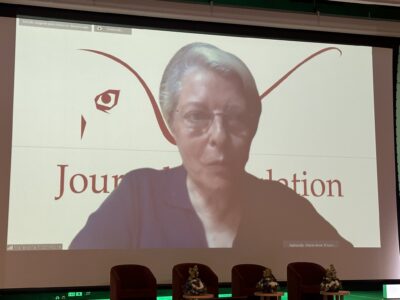
► Full Reference : M.-A. Frison-Roche, "Conclusion. Compliance et contrats publics : une alliance naturelle" ("Conclusion. Compliance and Public Contracts: a natural alliance"), in M.-A. Frison-Roche, C. Gilles & A. Oumedjkane (dir.), Compliance et contrats publics (Compliance and public contracts), Journal of Regulation & Compliance (JoRC), Centre de recherches et d’études administratives de Montpellier (CREAM) and Centre d’Études et de Recherches Comparatives Constitutionnelles et Politiques (CERCOP) of the Montpellier University, Faculté de droit et de science politique de Montpellier, 39 rue de l’Université, Amphiteatre C Paul Valéry, January 12, 2024 - 🧮see the full programme of this event - ✏️read the notes taken on the spot to draw up the symposium conclusion - 🌐consult on LinkedIn a general presentation of this event, which links to a presentation of each speech (in French) - 🧱consult the co-organisation sheet of this event, giving an account of the various speakers - ► English Summary of the conference: Firstly, it would appear that, as with all the contracts studied in the area of Compliance, public contracts are, for the public authorities or public companies, an instrument through which they implement the Compliance Obligation imposed on them by the laws and regulations. Public bodies involved in public contracts are particularly concerned because of the points of contact, even intimacy, between Compliance Law and the general interest. But the contract, whether public or private, remains in its classic conception what results from the expression of two wills which exchange their consents📎1🕴️M.-A. Frison-Roche, 🚧Compliance contract, Compliance clauses, 2022..   Secondly, in terms of free will, public contracts can be the means by which public bodies and their co-contractors express their conception of what needs to be done to preserve the future, for example in environmental and social matters. On the contrary, the seemingly technical issue of exclusions from public contracts, whether they be automatic exclusions or optional exclusions, expresses the extent to which economically powerful players (public authorities, municipalities, public companies) take care of each other. In this respect, Compliance Law runs counter to Competition Law📎2🕴️M.-A. Frison-Roche, 🚧Competition Law and Compliance Law, 2018. and profoundly affects Public Procurement Law.   But thirdly, the public contract, in that it expresses the general interest by its very nature, its ex ante nature reinforces regulatory action and the nature of Compliance as an extension of Regulation📎3🕴️M.-A. Frison-Roche (ed.), 📕Régulation, Supervision, Compliance (Regulation, Supervision, Compliance), 2017.. It appears to be the most appropriate instrument for this new branch of Law, without the need for it to be transformed. This underlines the extent to which Compliance Law must draw on classical Law, in this case Administrative Law.   Moreover, fourthly, the public contract appears to be the model for the Compliance Contract. The public contract is a model first of all because of the central place of the general interest. The "Monumental Goals" in which the substantive definition of  Compliance Law is anchored📎4🕴️M.-A. Frison-Roche, 📝Compliance Monumental Goals, beating heart of Compliance Law, in 🕴️M.-A. Frison-Roche (ed.), 📘Compliance Monumental Goals, 2022. are a development of this. Admittedly, this concern for the general interest drives the public entity, but the "raison d'être" of companies more generally also incorporates it through "governance", profoundly renewed by Compliance. The public contract is also a model because the contract is handled by a powerful party, in this case the public entity. The subject of Compliance Law is the powerful company, and only that company, chosen because it is powerful and because it uses that power to achieve the Monumental Goals. In this respect, the "exorbitant powers" that characterise the public contractor are reconstituted either by Compliance laws or by stipulations, which confer on all obliged or voluntary companies – by virtue of CSR, which has many points of contact with Compliance Law as long as it is not confused with obeying the applicable regulations (which is what "conformity" is)📎5🕴️M.-A. Frison-Roche, 📝Reinforce the Judge and the Lawyer to impose Compliance Law as a characteristic of the Rule of Law, in 🕴️M.-A. Frison-Roche (ed.), 📘Compliance Jurisdictionalisation, 2023. – a power over the co-contractor, or even over third parties, equivalent to that of the public entity📎6🕴️M.-A. Frison-Roche, 🚧Use of private companies by Compliance Law to serve Human Rights, 2023..  The judge is the one who, through contractual litigation, both public and private, will bring to life these Monumental Goals desired by the State, carried by powerful entities (administration, companies), pledge of the Rule of Law📎7🕴️M.-A. Frison-Roche, 📝Reinforce the Judge and the Lawyer to impose Compliance Law as a characteristic of the Rule of Law, in 🕴️M.-A. Frison-Roche (ed.), 📘Compliance Jurisdictionalisation, 2023.. These include contractual mechanisms for information, audit, disclosure, control, collaboration, supervision, etc., through which the company, whether private or public, takes charge of the structure it has created, for example the value chain it masters📎8🕴️M.-A. Frison-Roche, 📝Assessment of whistleblowing and the obligation of vigilance regarding International Competitiveness, in 🕴️M.-A. Frison-Roche (ed.), 📘Compliance Monumental Goals, 2022..   It can therefore be concluded that this logic of a public contract as an instrument of administrative action to achieve goals of general interest, now fully taken up in Compliance Law, must be acculturated into the Ordinary Contract Law and must be preserved in Public Contract Law, which presupposes a new balance with Competition Law, which for a long time carried within Public Law a contract model without concern for sustainability or the collective interest. To achieve this, dialogue between judges is essential. The Conseil d'État (French Council of State) and the Cour de cassation (French Court of cassation) set the example📎9Conseil d'État (French Council of State) and Cour de cassation (French Court of cassation), 📗Du droit de la régulation au droit de la compliance : quel rôle pour le juge ?, La Documentation Française, 2024 (to be published).. - 📝This conference will be followed by an article, "The public contract, model of the Compliance Contract", which will be published in the book 📘Compliance and contract. - 🌐follow Marie-Anne Frison-Roche on LinkedIn 🌐follow Marie-Anne Frison-Roche on Instagram 🌐subscribe to the Newsletter MAFR Regulation, Compliance, Law

Organisation of events

🧱Co-organisation of the Symposium 🧮Compliance et contrats publics (Compliance and public contracts)

► Full Reference: M.-A. Frison-Roche, C. Gilles and A. Oumedjkane (dir.), Compliance et contrats publics (Compliance and public contracts), Journal of Regulation & Compliance (JoRC), Centre de recherches et d’études administratives de Montpellier (CREAM) and Centre d’Études et de Recherches Comparatives Constitutionnelles et Politiques (CERCOP) of the Montpellier University, Faculté de droit et de science politique de Montpellier, January 12, 2024 - 🌐consult a general presentation of this event on LinkedIn, linking to a presentation of each speech (in French) - 🏗️This symposium takes place in the cycle of symposiums organised by the Journal of Regulation & Compliance (JoRC) and its partners Universities, focusing in 2023-2024 on the general theme of the Compliance Obligation - 📚The works will then be inserted in the books:  📕Compliance et contrat, to be published in the 📚Régulations & Compliance Serie, co-published by the Journal of Regulation & Compliance (JoRC) and Dalloz, published in French. 📘Compliance & Contract, to be published on the 📚Compliance & Regulation Serie, co-published by the Journal of Regulation & Compliance (JoRC) and Dalloz, published in English. - ► General presentation of the symposium: Compliance is developing throughout the legal system, through both Public and Private Law techniques. Public Contract Law bears witness to this in two ways: through its scope, in that Compliance applies to economic relationships entered into by public bodies, and through its object, which internalises a reconciliation between their economic interests and a set of other general interest objectives, or "Monumental Goals", a reconciliation for which public bodies have traditionally been responsible. In addition to unilateral acts, contracts have their rightful place as a practical means of achieving this reconciliation. Its flexibility allows for negotiation and adjustment of the burdens to be placed on the co-contracting parties. The aim of this symposium is to link the different manifestations of the Compliance Obligation in public contracts and thus give coherence to policies which are still too often considered in a watertight manner because they relate to very different aims and areas. Firstly, at the procurement stage, the promotion of responsible or innovative procurement, particularly from an environmental point of view, is one of the signs of Compliance's presence. On a completely different note, the same is true of the CJEU's challenge to the automatic application of bans on tendering, which prevent contracting authorities from ruling on a candidate's reliability by taking into account the compliance programmes implemented by companies since their conviction. Secondly, at the litigation stage, the Conseil d'État's (French Council of State) recent broad recognition of the illegality of an administrative contract on the grounds of a breach of ethical obligations has tempered the drive to make contracts more secure, drawing the consequences of the major drive for transparency in public life that has been underway since 2013. The aim of the morning session will be to understand the various forms of the Compliance Obligation in public contracts. This overview will make it possible, in the afternoon, to aim to unify the Compliance Obligation in public contracts. - - ► Speakers:  🎤Ugo Assouad, PhD student at the Montpellier University, CREAM 🎤Philippe Augé, President of the Montpellier University 🎤Clémence Ballay-Petizon, PhD student at the Montpellier University, CREAM  🎤Yannisse Benrahou, PhD student at Paris-Nanterre University, CRDP 🎤Léon Boijout, PhD student at the Montpellier University, CREAM 🎤Julien Bonnet, Full Professor at the Montpellier University, CERCOP 🎤Guylain Clamour, Dean of the Montpellier Faculty of Law and Political Science 🎤Marie-Anne Frison-Roche, Professor of Regulatory and Compliance Law, Director of the Journal of Regulation & Compliance (JoRC) 🎤Pierre-Yves Gadhoun, Professor at the Montpellier University, CERCOP 🎤Pascale Idoux, Professor at the at the Montpellier University, CREAM 🎤Nedjma Kontoukas, PhD student at the Montpellier University, CREAM 🎤Valentin Lamy, Senior Lecturer at the Lorraine University, IRENEE 🎤Antoine Oumedjkane, Senior Lecturer at Lille University, ERDP 🎤Lucien Rapp, Emeritus Professor at Toulouse Capitole University 🎤Marion Ubaud-Bergeron, Full Professor at the Montpellier University, CREAM  - 🧮Read a detailed presentation of the event below⤵️ - 🌐follow Marie-Anne Frison-Roche on LinkedIn 🌐follow Marie-Anne Frison-Roche on Instagram 🌐subscribe to the Newsletter MAFR Regulation, Compliance, Law

Organisation of events

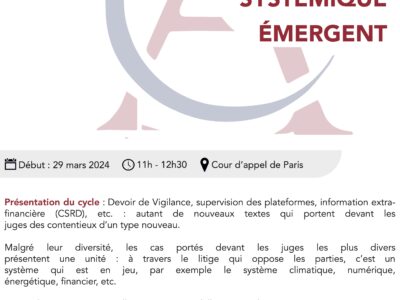
🧱⚙️Coordination of the cycle of conference-debates 🧮Contentieux Systémique Émergent – CSE (Emerging Systemic Litigation – ESL)

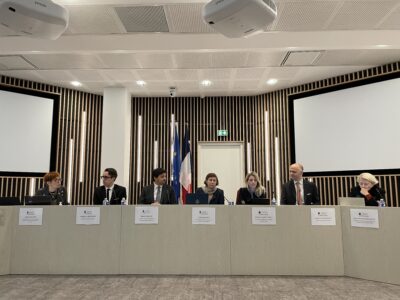
► Full Reference: M.-A. Frison-Roche, Coordination of the cycle of conference-debates Contentieux Systémique Émergent (Emerging Systemic Litigation), organised on the initiative of the Cour d'appel de Paris (Paris Cour of Appeal), with the Cour de cassation (French Court of cassation), the Cour d'appel de Versailles (Versailles Court of Appeal), the École nationale de la magistrature – ENM (French National School for the Judiciary) and the École de formation des barreaux du ressort de la Cour d'appel de Paris – EFB (Paris Bar School), under the scientific direction of Marie-Anne Frison-Roche - ► This Cycle in few words: Duty of vigilance, supervision of platforms, non-financial information (CSRD), etc.: as many new texts that bring new types of disputes before the courts. Despite their diversity, the cases brought before the most diverse judges present a unity: through the dispute that pits the parties against each other, it is a system that is at stake, for example the climate system, digital system, energy system, financial system, etc. New regulations are just the illustration of this "Emerging Systemic Litigation"; the conference-debates aiming at showing the new fields, new techniques, new standards, etc., in relation to the scale and diversity of stakeholders' expectations. This cycle is designed to encourage cross-fertilisation, so as to provide judges with food for thought ahead of the litigation they will be called upon to deal with. Les réglementations nouvelles ne sont que l’illustration de ce « contentieux systémique émergent » dont la formation a pour objet de montrer les nouveaux champs, les nouvelles techniques, les nouvelles normes, etc., en lien avec l’ampleur et la diversité des attentes des parties prenantes. Le cycle vise à favoriser les échanges croisés, afin d’alimenter la réflexion des magistrats en amont des litiges qui leurs seront soumis. - 🔴Registrations and information requests can be sent to: inscriptionscse@gmail.com 🔴For the attorneys, registrations have to be sent to the following address: https://evenium.events/cycle-de-conferences-contentieux-systemique-emergent/  ⚠️The conference-debates are held in person only, in the Cour d’appel de Paris (Paris Court of Appeal). - ► General Presentation of the Cycle: In 2024, the Cour d’appel de Paris (Paris Court of Appeal) created a new specialised chamber: chamber 5-12 Contentieux émergent – Devoir de vigilance et responsabilité écologique (Emerging litigation – Duty of vigilance and environmental liability). Vigilance litigation is an example of what is emerging more generally: Systemic Litigation, often linked to technologies. This calls for a new way of judging, organising procedures and relations between professionals. A series of conference-debates on Emerging Systemic Litigation (ESL) is being organised jointly by the Paris Court of Appeal, the Versailles Court of Appeal, the Cour de cassation (French Court of cassation), the École nationale de la magistrature – ENM (French National School for the Judiciary) and the École de formation des barreaux du ressort de la Cour d'appel de Paris – EFB (Paris Bar School), under the scientific responsibility of Professor Marie-Anne Frison-Roche. In this context, a series of conference-debates involving professionals from a wide range of backgrounds is being proposed on the following themes: 🧮the very notion of "Emerging Systemic Litigation" and the role of the judiciary in it (29 March 2024): read the report of this event   🧮vigilance, insofar as it gives rise to Systemic Litigation, notably because it takes legal form in numerous contracts, for example in employment relationships (26 April 2024): read the report of this event   🧮the inclusion in Emerging Systemic Litigation of information reliability techniques, particularly with regard to content available on platforms (27 May 2024): read the report of this event   🧮the way in which artificial intelligence is generating Systemic Litigation and the influence of new specific texts (24 June 2024): read the report of this event   🧮sustainability, a principle of systems found in reports and transitively in disputes concerning their development, their standards and even their control (9 September 2024): read the programme of this event   🧮new evidentiary techniques required by Emerging Systemic Litigation, to account for systemic needs, e.g. climate and digital systems, and how firms respond to them (14 October 2024): read the programme of this event   🧮Vigilance General Procedural Law, in that it incorporates the Systemic dimension of Vigilance Litigation (18 November 2024): read the programme of this event   🧮institutional and case law feedback from courts on Emerging Systemic Litigation (16 December 2024): read the programme of this event - 🧮read below the full programme of this cycle of conference-debates⤵️

Conferences

final speech of a scientific manifestation

🎥 5 leçons en conclusions ouvertes (5 Lessons in Open Conclusions), in 🧮Compliance, vigilance et médiation

► Full Reference: M.-A. Frison-Roche, "Conclusion", in M. Boissavy, H. Dehghani-Azar, and M.-A. Frison-Roche (dir.), Journal of Regulation & Compliance (JoRC) and Conseil national des Barreaux (CNB), Compliance, vigilance et médiation (Compliance, Vigilance and Mediation), Amphitheatre of the Conseil national des Barreaux, November 30, 2023. - 🧮see the full programme of this event - 🌐follow Marie-Anne Frison-Roche on LinkedIn 🌐follow Marie-Anne Frison-Roche on Instagram 🌐subscribe to the Newsletter MAFR Regulation, Compliance, Law

Videos

🎥L’avenir du Droit de la compliance (The futur of Compliance Law), in🧮 Nuit du Droit

► Full Reference: M.-A. Frison-Roche, "L'avenir du Droit de la compliance" (The futur of Compliance Law), in Cour de cassation (French Court of cassation), La Nuit du Droit 2023, October 4, 2023.  - 🎥 Watch the video (in French) - 🧮read the full programme of this event The Cour de cassation (French Court of cassation) had presented 4 successive themes insofar as they affect the future of Law: filiation, artificial intelligence, the environment and compliance. The President of the Chambre sociale de la Cour de cassation (Social Chamber of the Court of Cassation) gave a presentation on Compliance and the essential role played by the Judge. Then, the Parquet général (Prosecutor General's Office) then asked Fabien Raynaud, Conseiller d'État, about the importance of 'systemic cases' in Compliance Law and the dialogue between judges that it implies, using the Youporn case currently being examined by the judges. - ► General presentation of the speech: As my work has been seminal for Compliance Law, I was asked about the future of Compliance Law. - 🌐follow Marie-Anne Frison-Roche on LinkedIn 🌐follow Marie-Anne Frison-Roche on Instagram 🌐subscribe to the Newsletter MAFR Regulation, Compliance, Law

Conferences

conference

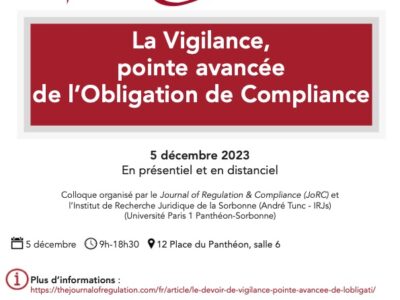
🎤Participation in the🏛️Law Day🧮Normes de Responsabilité Sociale des Entreprises /RSE & Devoir de Vigilance (Corporate Social Responsibility Standards /CSR & Duty of Vigilance)

🌐follow Marie-Anne Frison-Roche on LinkedIn 🌐subscribe to the Newsletter MAFR Regulation, Compliance, Law - ► Full Reference: M.-A. Frison-Roche, Participation à la Table ronde "Normes de Responsabilité Sociale des Entreprises (RSE & Devoir de Vigilance)" (Participation in the Round Table "Corporate Social Responsibility Standards (CSR & Duty of Vigilance)"), in Fribourg University, Journée du Droit, Fribourg University, Pérolles site, room C230, October 2, 2023. - 🧮see the full programme of this event 🎥​watch the video of this event (in French) - 🌐read the report written in French with photos, tags and links on LinkedIn and also with links to each the speech - ► General presentation of the event : This conference, build around 4 presentations and a debate between the speakers and then with the audience, aimed at explaining and understanding this fundamental movement and the new texts that express it in Switzerland, even if it is French law, such as the so-called 'Vigilance' law of 2017 and the draft European CS3D directive, because on the one hand it is a movement that begins with legal technique and on the other hand the texts in question are extraterritorial in scope, if only because of the notion of 'value chain'. In the first part of this round table, and to set the scene, I will outline the origin and content of the French 'Vigilance' law, the way in which the draft directive draws heavily on it, its relationship with Compliance Law, of which it constitutes the 'advanced point', and the decisive role it gives to the courts, in the general movement of the jurisdictionalisation of compliance. The purpose of this is to allow the discussion to get underway. 🕴️Idris Abdelkhalek, PhD candidate and lawyer, introduced the speakers and led the debate between them and the audience. He took questions from the audience on the intensity of the obligation weighing on companies, in particular between civil liability and criminal liability, between the obligation of means and the obligation of result, and on the way in which the duty of vigilance is applied to specific sectors such as defence. - ► Presentation of my speech : the subject of which was Presentation of French Vigilance law, European perspective and European Compliance System. My presentation was divided into four points. Firstly, I outlined the state of Law in France, in the novelty represented by the 2017 law known as the "Vigilance" law, whose principles are simple and strong, principles that are situated in the aims pursued, and the way in which this law inspires what is currently being negotiated: the CS3D Directive. Secondly, I stressed the need for companies to master these often technically complicated corpus, especially if we take into account the link between Vigilance and the CSRD directive on sustainability reporting and extra-financial information.  Thirdly, I have shown that an overall understanding can nevertheless be achieved, and that the technical nature of the 'tools' is better mastered if we place the duty of vigilance within Compliance Law, of which it constitutes the 'advanced point'. All of this anchors its legal normativity in the 'Monumental Goals' it serves, which in Europe are humanistic, since the aim is to protect, now but above all in the future because it is a branch of ex ante Law, the human beings involved in the systems (banking, finance, energy, digital, climate, etc.). Fourthly, I emphasised that this understanding enables everyone to play their part: political and public authorities, businesses and stakeholders. Even more, and at the heart of the matter, the judge plays an essential role, even in countries with so-called 'continental' Law. I have used current cases as examples. This is just the beginning, and judges need to train, specialise and work in dialogue to achieve this. - ► Presentation of the other speakers contributions : 🕴️Marion Paradas, Ambassador of France to Switzerland and Liechtenstein, opened the conference and gave a general presentation of the theme. Ambassador Marion Paradas presented the international challenge represented by Law, illustrated here by the duty of vigilance. She emphasised that this is a major issue, both now and in the future, for Swiss companies and French companies based in Switzerland, particularly as this duty extends throughout the "value chain" and in view of the CS3D directive, which will also have consequences for both. 🕴️Isabelle Chabloz Waidacher, Professor at the Faculty of Law in Fribourg and holder of the Chair of Economic Law at the University of Fribourg, gave a Presentation of Swiss Law. In particular, she emphasised the state of Swiss Law, which could have gone further than the 2017 French law known as the "Vigilance" law if the popular initiative reference had led to the adoption of a law, and which currently focuses more on information and transparency obligations, with CSR taking over from there. But she stresses that the reality of value chains will force Swiss companies to take into account the requirements of the European directive currently being adopted. 🕴️Renaud Roussel, Managing Director of Colas Switzerland, presented an entrepreneurial view of the subject. He began by outlining the concrete steps taken by his industrial group in Switzerland and around the world to implement its commitments to protect the environment, for example by ensuring the proper use of materials used in road construction. He also stressed the importance of human rights, particularly in labour relations, in the context of CSR and vigilance. He went on to point out that it was not always easy for a large company to meet its own requirements, or the requirements imposed on it by the law, because in the construction and public works sector in particular it is often small companies that are competing, competitors who do not bear the costs of such obligations. -


Conferences

🎤Conclusion, in 🧮L’eau : entre protection de la ressource et conflits d’usage

🌐follow Marie-Anne Frison-Roche on LinkedIn 🌐subscribe to the Newsletter MAFR Regulation, Compliance, Law - ► Full Reference: M.-A. Frison-Roche, "Conclusion", in Club des avocats environnementalistes, L’eau : entre protection de la ressource et conflits d’usage, Maison des Avocats, Auditorium, September 28, 2023. - 🧮see the full programme of this event -

Publication director

🏗️ direction of the collection: 📚Cours Dalloz – Série Droit privé

📚Publication of : 🕴️Bernard HAFTEL, 📕Droit international privé (Private International Law), 3rd ed.

► Full Reference : B. Haftel, Droit international privé (Private International Law), 3rd ed., 2023, Lefebvre-Dalloz, “Cours Dalloz-Série Droit privé” Series, 390 p. - ► General presentation of the book (written in French) : The book comprises a general part, devoted to conflicts of laws and conflicts of jurisdictions, and then a special part. The latter covers the application of Private International Law to persons (« personal status »), to property, to obligations and to family property law. - 📚See the entire collection in which the book is published. The subject of Private International Law had previously been covered in this collection by a book written by Daniel Gutmann. -

Breaking news

💬La profession investit le Droit de la compliance et détermine sa Raison d’être

🌐follow Marie-Anne Frison-Roche on LinkedIn 🌐subscribe to the Newsletter MAFR Regulation, Compliance, Law - ► Full Reference: M.-A. Frison-Roche & S. Vernet, "La profession investit le Droit de la compliance et détermine sa Raison d’être" ("The profession invests Compliance Law and determines its Raison d'être"), Actualités, Ordre des Géomètres-Experts, July 28, 2023 - 💬read the interview (in French) - ► Presentation of the interview by the Ordre des Géomètres-Experts: "Pour mieux répondre aux défis d’une société en pleine mutation, ainsi qu’aux attentes de ses clients et concitoyens, la profession détermine sa Raison d’être. Séverine Vernet, première Vice-présidente de l’Ordre des géomètres-experts et Marie-Anne Frison-Roche, professeur de droit économique et spécialiste du droit de la régulation et de la compliance, nous expliquent cette démarche innovante." ("To better meet the challenges of a rapidly changing society and the expectations of its customers and fellow citizens, the profession is defining its raison d'être. Séverine Vernet, First Vice-President of the Ordre des géomètres-experts, and Marie-Anne Frison-Roche, Professor of Economic Law and specialist in Regulatory and Compliance Law, explain this innovative approach."). - ► Questions asked (in French):  Séverine Vernet, vous êtes la première Vice-présidente de l’OGE et présidente de la nouvelle commission compliance. Permettez-moi tout d’abord de vous féliciter pour votre réélection. Quels seront les prochains chantiers du mandat qui démarre ? Et votre ambition pour ce nouveau mandat ?​ Marie-Anne Frison-Roche (mafr), vous êtes professeur d’université, spécialiste de droit économique et plus particulièrement du droit de la régulation et de la compliance, vous accompagnez l’Ordre dans la mise en place de cette démarche. Séverine Vernet parle de compliance. Pourriez-vous nous en proposer une définition ?   L’OGE a créé une commission compliance spécifique que vous présidez. Pouvez-vous nous en dire un peu plus ?   Comment passe-t-on d’un organisme de régulation à un acteur de la compliance ? En quoi est-ce innovant pour un Ordre professionnel ?   Comment allez-vous vous y prendre pour engager la profession ?   Quelles seront les étapes pour passer de la régulation à la compliance ? -

Breaking news

💬Compliance : les cours suprêmes s’emparent de la question de ses enjeux juridictionnels (Compliance : the Supreme Courts take up the issue of its jurisdictional implications)

🌐follow Marie-Anne Frison-Roche on LinkedIn 🌐subscribe to the Newsletter MAFR Regulation, Compliance, Law  - ► Full Reference:  M.-A. Frison-Roche et A. Seban, "Compliance : les cours suprêmes s’emparent de la question de ses enjeux juridictionnels" ("Compliance : the Supreme Courts take up the issue of its jurisdictional implications"), interview with Olivia Dufour, Actu-Juridique, 5 July 2023. - 💬read the interview (in French) - ► Presentation of the interview by the journal (in French): "Le 2 juin dernier s’est tenu au Conseil d’État un colloque fondateur sur le rôle du juge dans la compliance. Le professeur Marie-Anne Frison-Roche et le conseiller d’État Alain Seban, qui ont tout deux contribué aux débats, ont accepté de commenter les principaux enseignements des travaux de cette journée." - ► Questions asked (in French):  Le colloque « De la régulation à la compliance, quel rôle pour les juges » qui s’est tenu au Conseil d’État le 2 juin dernier a rassemblé juges civils et administratifs. En quoi le juge administratif est-il concerné par la compliance qui semble plutôt une affaire d’entreprises et donc de justice civile et commerciale ?  ​Vincent Vigneau, président de la chambre commerciale de la Cour de cassation rappelle que la compliance a plutôt vocation à éviter le juge en se situant ex ante, pourtant on découvre que le juge lui-même accepte de plus en plus de se prononcer en ex ante… qu’en est-il ?  Quel peut donc être le rôle du juge dans la compliance ? Peut-il contribuer à faire émerger un droit de la compliance et à l’harmoniser ?  ​ ​François Ancel semble considérer que le rôle juge va devoir adapter son office à la compliance, il évoque trois concepts : téléologique, soutenabilité et efficacité… Le juge dispose-t-il en l’état de tous les outils nécessaires ? Si tel n’est pas le cas, que faut-il créer ? En quoi le dialogue des juges, civil/administratif, national/européen, national/international, est-il important ? Que veut dire F. Ancel quand il déclare que le juge doit évoluer du constat à la trajectoire ? Existe-t-il des domaines où la compliance entre en conflit avec des principes processuels, par exemple le principe de légalité des peines ? En quoi la notion de « buts monumentaux », que vous avez créée en 2016, a-t-elle trouvé sa place dans le droit ? -

Conferences

🎤Favoriser ou pas la « contractualisation » du Droit (“To favour or not the “contractualisation” of the Law”), in 🧮La contractualisation du droit. Acte II

🌐follow Marie-Anne Frison-Roche on LinkedIn 🌐subscribe to the Newsletter MAFR Regulation, Compliance, Law  - ► Full Reference: M.-A. Frison-Roche, "Favoriser ou pas la « contractualisation » du Droit" ("To favour or not the "contractualisation" of the Law"), final speech in Société de législation comparée (SLC) and Procuradoria Geral do Estado do Rio de Janeiro (PGE-RJ), La contractualisation du droit. Acte II, Paris, 21 June 2023. - 🧮See the full programme of this event (in French). The conference is held in French -

Conferences

🎤Participation in the panel “Vigilance (due diligence)”, in 🧮150th Anniversary Symposium of the ILA/ADI

🌐 follow Marie-Anne Frison-Roche sur LinkedIn 🌐subscribe to the Newsletter MAFR Regulation, Compliance, Law  - ► Full Reference: M.-A. Frison-Roche, participation in the panel "Vigilance (due diligence)", in International Law Association (ILA), 150th Anniversary Symposium of the ILA/ADI, Paris, 19 June 2023. - 🧮See the full programme of this event -