Activities

Publication director

🏗️ direction of the collection: 📚Cours Dalloz – Série Droit privé

📚Publication of : 🕴️Christophe ANDRÉ, 📕Droit pénal spécial (Special Criminal Law), 7th ed.

► Full Reference : Ch. André, Droit pénal spécial (Special Criminal Law), 1st ed. 2010 – 7th ed., 2021, Dalloz, “Cours Dalloz-Série Droit privé” Series, 552 p. - ► General presentation of the book (written in French) : This edition of the Course is up to date with the reforms that continually modify criminal offences, particularly in economic and financial matters but also in social matters (for example the « gilets jaunes »), showing above all the constant crisis of a criminal law in decay, now fragmented into special repressive laws. Today, it is not only a special criminal law but also, indeed above all, a criminal law of exceptions (which raises problems with regard to general criminal law, itself inseparable from criminal procedure) that students and practitioners alike must learn. This Course is built in three parts. The first deals with offences against persons; the second with offences against property; the third with offences against the Nation, the State and public peace. The elements of criminal procedure, inseparable from criminal law, are explained for each offence examined. - 📚See the entire collection in which the book is published. - 📚Books in the collection directly related to this one : 📕Droit pénal général (General Criminal Law) 📕Procédure pénale (Criminal Procedure) 📕Droit pénal des affaires (Business Criminal Law) -

Publication director

🏗️ direction of the collection: 📚Cours Dalloz – Série Droit privé

📚Publication of : 🕴️Véronique MAGNIER, 📕Droit des sociétés (Company Law), 11th ed.

► Full Reference : V. Magnier, Droit des sociétés (Company Law), 1st ed. 2002 – 11th ed., 2024, Dalloz, “Cours Dalloz-Série Droit privé” Series, 572 p. - ► General presentation of the book (written in French) : This book provides easy access to an understanding of the subject: it starts from the general rules common to all companies and then moves on to the rules specific to particular companies (SA, SARL, SCI, general partnerships, etc.). This edition deals, in a first part, with « the general law of companies », including the company contract and the legal personality of the company, then turns, in a second part, to « the special law of companies », with partnerships, limited liability companies and joint-stock companies, and ends with the subject of « groups of companies ». - 📚From the same business law perspective, see also : 🕴️Ph. Neau-Leduc & al., 📕Droit bancaire (Banking Law) 🕴️S. Piédelièvre, 📕Droit commercial (Commercial Law) 🕴️G. Beaussonie, 📕Droit pénal des affaires (Business Criminal Law) 🕴️S. Piédelièvre, 📕Instruments de crédit et de paiement (Credit and Payment Instruments) 🕴️F. Gaudu & F. Bergeron, 📕Droit du travail (Labour Law) - 📚See the entire collection in which the book is published. -

Conferences

🎤Les deux rencontres entre l’intelligence artificielle et le Contentieux Systémique (The two meetings between Artificial Intelligence and Systemic Litigation), in 🧮L’intelligence artificielle, nouveau champ de contentieux systémique (“Artificial intelligence, new field of systemic litigation”), in cycle de conférences-débats “Contentieux Systémique Émergent” (“Emerging Systemic Litigation”)

► Full Reference: M.-A. Frison-Roche, "Les deux rencontres entre l'intelligence artificielle et le Contentieux Systémique" ("The two meetings between Artificial Intelligence and Systemic Litigation"), in L’intelligence artificielle, nouveau champ de Contentieux Systémique (Artificial intelligence, new field of Systemic Litigation), in cycle of conferences-debates "Contentieux Systémique Émergent" ("Emerging Systemic Litigation"), organised on the initiative of the Cour d'appel de Paris (Paris Cour of Appeal), with the Cour de cassation (French Court of cassation), the Cour d'appel de Versailles (Versailles Court of Appeal), the École nationale de la magistrature – ENM (French National School for the Judiciary) and the École de formation des barreaux du ressort de la Cour d'appel de Paris – EFB (Paris Bar School), under the scientific direction of Marie-Anne Frison-Roche, June 24, 2024, 11am-12.30pm, Cour d'appel de Paris, Cassin courtroom. - 🧮see the full programme of this event - ► English Summary of the conference: In the general presentation on the theme itself, I underlined "The two meetings between Artificial Intelligence and Systemic Litigation". The focus of this conference is not the state of what is usually called Artificial Intelligence, but rather how to correlate AI and "Emerging Systemic Litigation" (ESL). This involves recalling what "Systemic Litigation" is (1), then looking at the contribution of Artificial Intelligence to dealing with this type of litigation (2), before considering that the algorithmic system itself can be a subject of Systemic Litigation (3).   1. What is the Systemic Litigation that we see Emerging? On the very notion of "Emerging Systemic Litigation" (ESL), proposed in 2021, read : M.-A. Frison-Roche, 🚧The Hypothesis of the category of Systemic Cases brought before the Judge, 2021 Emerging Systemic Litigation concerns situations that are brought before the Judge and in which a System is involved. This may involve the banking system, the financial system, the energy system, the digital system, the climate system or the algorithmic system. In this type of litigation, the interests and future of the system itself are at stake, "in the case". The judge must therefore "take them into consideration"📎1🕴️Fr. Ancel, 📝Compliance Law, a new guiding principle for the Trial?, in 🕴️M.-A. Frison-Roche (ed.), 📘Compliance Jurisdictionalisation, 2024.. In this respect, "Emerging Systemic Litigation" must be distinguished from "Mass Litigation". "Mass litigation" refers to a large number of similar disputes. The fact that they are often of "low importance" is not necessarily decisive, as these disputes are important for the people involved and the use of A.I. must not overpower the specificity of each one. The fact remains, however, that the criterion for Systemic Litigation is the presence of a system. It may happen that a mass litigation calls into question the very interest of a system (for example, value date litigation), but more often than not the Systemic Litigation we see emerging is, unlike mass litigation, a very specific case in which one party, for example, formulates a very specific claim (e.g., asking for considerable work to be stopped) against a multinational company, and will thus "call into question" an entire value chain and the obligations incumbent on the powerful company to safeguard the climate system, which is therefore present in the proceedings (which does not, however, entitle it to make claims, but which must be taken into consideration).   2. The contribution of Algorithmic Power in the conduct of a Systemic Litigation In this respect, AI can be a useful, if not indispensable, tool for mastering such Systemic Litigation, the emergence of which corresponds to a novelty, and the knowledge of which is brought before the Ordinary Law Judge. Indeed, this type of litigation is particularly complex and time-consuming, with evidentiary issues at the heart of the case, and with expert appraisal following on from expert appraisal. Expert appraisals are difficult to carry out. AI can therefore be a means for the judge to control the expert dimension of Systemic Litigation, in order to curb the increased risk of experts capturing the judge's decision-making power. The choice of AI techniques presents the same difficulties as those that have always applied to experts. It is likely that certification mechanisms, analogous to registration on expert lists, will be put in place, if we move away from construction by the courts themselves (or by the government, which may pose a problem for the independence of the judiciary), or if we want control over tools provided by the parties themselves, with regard to the principle of equality of arms due to the cost of these tools.   3. When it is the Algorithmic System itself that is the subject of a Systemic Litigation: its place is then rather in defense Moreover, the algorithmic system itself gives rise to Systemic Litigation, in that individuals may bring a case before the courts claiming to have suffered damage as a result of the algorithmic system's operation, or seeking enforcement of a contract drawn up by the system. It is in the realm of the Ordinary Contract and Tort Law that the system may find itself involved in the jurisdictional proceedings. It is noteworthy that, compared with the hypotheses hitherto favored in previous conference-debates, notably those of April 26, 2024 on Emerging Systemic Litigation linked to the Duty of Vigilance📎2🧮La vigilance, nouveau champ de contentieux systémique (Vigilance, new field of Systemic Litigation), in cycle of conference-debates "Contentieux Systémique Émergent" ("Emerging Systemic Litigation"), organised on the initiative of the Cour d'appel de Paris (Paris Cour of Appeal), with the Cour de cassation (French Court of cassation), the Cour d'appel de Versailles (Versailles Court of Appeal), the École nationale de la magistrature - ENM (French National School for the Judiciary) and the École de formation des barreaux du ressort de la Cour d'appel de Paris - EFB (Paris Bar School), under the scientific direction of Marie-Anne Frison-Roche, June 24, 2024., the systems involved have been taken into consideration more behind the claims articulated by the plaintiffs, since they allege that a system has been attacked. It would then be "civil society" acting against the company. In the case of the algorithmic system, the initial litigation is made up of allegations that accuse the system of infringing rights (e.g. copyright, right to privacy, etc.). However, the instance changes if the system is no longer presented as the potential "victim" but rather as the potential "culprit". In particular, it is much less clear what type of intervener in the proceedings, who is not necessarily a party to the dispute, should speak to explain the system's interest, particularly with regard to the sustainability and future of the AI system. This is an area for further consideration by heads of courts. -


Organisation of events

🧮L’intelligence artificielle, nouveau champ de contentieux systémique (“Artificial intelligence, new field of systemic litigation”), in cycle de conférences-débats “Contentieux Systémique Émergent” (“Emerging Systemic Litigation”)

► Full Reference: L’intelligence artificielle, nouveau champ de Contentieux Systémique (Artificial intelligence, new field of Systemic Litigation), in cycle of conferences-debates "Contentieux Systémique Émergent" ("Emerging Systemic Litigation"), organised on the initiative of the Cour d'appel de Paris (Paris Cour of Appeal), with the Cour de cassation (French Court of cassation), the Cour d'appel de Versailles (Versailles Court of Appeal), the École nationale de la magistrature – ENM (French National School for the Judiciary) and the École de formation des barreaux du ressort de la Cour d'appel de Paris – EFB (Paris Bar School), under the scientific direction of Marie-Anne Frison-Roche, June 24, 2024, 11am-12.30pm, Cour d'appel de Paris, Cassin courtroom. - 🌐see on LinkedIn the report made of this event - ► Presentation of this conference-debate:  Artificial intelligence has enabled the creation of an algorithmic system. This develops its own logic, which is essentially technological in nature. It generates computing power based on the correlation of information to produce possible causalities and build probabilities that are sometimes likened to "predictions", with the mass processed eventually generating a qualitative change. This change is linked to the digital space itself, which by its very nature gives rise to systemic disputes and litigation, to which the conference-debate on 27 May 2024 was devoted. There are three ways in which this Emerging Systemic Litigation is involved, and it is important to anticipate these, as the litigation is either in its infancy or still to come, but will undoubtedly arise suddenly. Firstly, it is possible that the technological tool will make it possible to deal with certain cases where the technical nature of either the concepts or the requests, or the multitude of requests, however simple, require this ability to deal with the mass, which leads to an increase in both the mechanical power of algorithms and the greater presence of human beings, in particular through the increase in adversarial proceedings, pre-trial proceedings, mediation, etc. Secondly, in the face of this change linked to the digital environment, 'texts' have appeared to 'regulate' the use or the very invention of this or that algorithmic tool, texts of a very diverse nature, from the most soft to the hardest (this gradation between soft and hard law is the theme taken up in the conference-debate of 19 September 2024). These may be measures taken by the firms that produce the tools, those that use them, or those that disseminate them, with the people affected by the information being relatively active. This last point explains why systemic disputes are already underway, concerning the subjective rights that would be violated either by the very nature of artificial intelligence, in this case the rights of content producers, or the rights to privacy, or protection of other Monumental Goals. The systemic and extra-territorial dimension of these disputes has already been established. The third point is the role of Politics, since the European Union, through the texts currently being adopted, has established that the Goal is not only the sustainability of the technical system, the innovation market and European sovereignty, but also the primacy of people and individuals, through a method that is the Ex Ante ranking of risks. This conception is also contested. This methodological issue also applies to judges. This Emerging Systemic Litigation is and will be brought before various regulatory or supervisory Authorities, but also before the administrative and judiciary courts, in particular through Contract Law, Tort Law, Company Law, Labour Law, General Procedural Law, etc. The aim here is to measure and anticipate the way in which the systemic dimension of these disputes will be incorporated into future litigation. - 🧮Program of this manifestation:  Fourth conference-debate L’INTELLIGENCE ARTIFICIELLE, NOUVEAU CHAMP DE CONTENTIEUX SYSTÉMIQUE (ARTIFICIAL INTELLIGENCE, NEW FIELD OF SYSTEMIC LITIGATION) Paris Court of Appeal, Cassin courtroom Presentation and moderation by 🕴️Marie-Anne Frison-Roche, Professor of Regulatory & Compliance Law, Director of the Journal of Regulation & Compliance (JoRC) 🕰️11am.-11.10am. 🎤Les deux rencontres entre l'intelligence artificielle et le Contentieux Systémique (The two meetings between Artificial Intelligence and Systemic Litigation), by 🕴️Marie-Anne Frison-Roche, Professor of Regulatory & Compliance Law, Director of the Journal of Regulation & Compliance (JoRC) 🕰️11.10am-11.30am. 🎤Les premiers contentieux systémiques observables impliquant l’intelligence artificielle (The first observable Systemic Litigations involving artificial intelligence), by 🕴️Sonia Cissé, Partner, Linklaters Paris 🕰️11.30am-11.50am. 🎤L’influence des nouveaux textes et des textes à venir sur les contentieux systémiques émergents impliquant l’intelligence artificielle (The influence of new and forthcoming legislation on Emerging Systemic Litigation involving artificial intelligence), by 🕴️Emmanuel Netter, Professor of Law at Strasbourg University  🕰️11.50am-12.30pm. Debate - 🔴Registrations and information requests can be sent to: inscriptionscse@gmail.com 🔴For the attorneys, registrations have to be sent to the following address: https://evenium.events/cycle-de-conferences-contentieux-systemique-emergent/  ⚠️The conference-debates are held in person only, in the Cour d’appel de Paris (Paris Court of Appeal). - 🧮Read below the report made of this event by Marie-Anne Frison-Roche⤵️

Videos

Interview

🎥Companies and compliance: more aggressive justice and judges, in the 🎬series of talks on Compliance Law, in 📺Open windows on management

► Full reference:  M.-A. Frison-Roche, "Entreprises et compliance : une justice et des juges plus offensifs" ("Companies and compliance: more aggressive courts and judges"), interview conducted by Jean-Philippe Denis as part of a series of interviews on Compliance Law, in Fenêtres ouvertes sur la gestion (Open windows on management), broadcast by J.-Ph. Denis, Xerfi Canal, recorded December 12, 2023, released on June 14, 2024. - 🌐consult the December 2023 presentation of the interview on LinkedIn - 🎥watch the interview video on LinkedIn, with English subtitles - 🧱consult the general presentation of this series of interviews on Compliance Law - ► Starting point: Since 2016, Marie-Anne Frison-Roche has been building Compliance Law, notably through a collection co-published in French with Editions Dalloz and co-published in English with Editions Bruylant:  🧱read the presentation in English of the series in French, Régulations & Compliance ➡️click HERE  🧱read the presentation of the series in English, Compliance & Regulation ➡️click HERE - ► Summary of interview:   Jean-Philippe Denis. Question :  Marie-Anne Frison-Roche.  Answer. :  - J.-Ph D. Q. : Thus MaFR. A. : Yes,  - J.-Ph. D. Q. : Thus MaFR. A. : Yes,  -

Conferences

conference

🎤Participation au panel “Une Gouvernance responsable : vers un mieux vivre ensemble ?” (“Responsible corporate governance: towards a better way of living together”), in 🧮Grenelle du Droit 5

► Full Reference: M.-A. Frison-Roche, Participation in the panel "Une Gouvernance responsable : vers un mieux vivre ensemble ?" ("Responsible governance: towards a better way of living together"), in Grenelle du Droit 5. L'avenir de la filière juridique, Association française des juristes d'entreprise ("The future of the legal profession"), AFJE), Cercle Montesquieu and Paris Panthéon-Sorbonne University, Campus Port-Royal Université Paris 1 Panthéon-Sorbonne, 1 rue de la Glacière, 75013 Paris, June 12, 2024 - 🧮See the full programme of this event (in French) - 🎥watch the interview made just after this round-table discussion (in French) - 🪑🪑🪑🪑🪑 will also be taking part in this round-table discussion: 🕴️Yves Garagnon, Chairman of Dilitrust, 🕴️Pierrick Le Goff, lawyer, partner at De Gaulle Fleurance, 🕴️Sabine Lochmann, Chairman of Ascend, 🕴️Vincent Vigneau, President of the Commercial, Economic and Financial Chamber of the Cour de cassation (French Judicial Supreme Court) - ► English presentation of my intervention in this event's opening plenary  round-table: In this plenary round table which opens the event, devoted to the theme of 'responsible corporate governance', for my interventions based on my work I will have the opportunity to address more particularly these different perspectives: How the new Compliance Law, which gives concrete expression to the responsibility of enterprises in a new relationship with States and with civil society, constitutes a 'legal revolution 💡for the record, mafr,📝Compliance Law, 2016 ; (ed.) 📘Compliance Monumental Goals, 2022   how the judgment handed down by the Tribunal judiciaire de Paris (Paris First Instance Civil Court) on 28 February 2023 (Total Ouganda case) is remarkable and already constitutes a turning point in case law 💡for the record, mafr, 🎤audition as amica curiae, hearing of 26 October 2022 before the first instance Paris Court; (ed)📘Compliance Jurisdictionalisation, 2024   how the relationship between States and enterprises is being renewed by this profound legal movement expressed by Compliance Law 💡for the record, mafr et M. Boissavy (ed.), 📕Compliance et droits de la défense – Enquêtes internes, CJIP, CRPC, mafr (dir.), 📘 Compliance Obligation, 2025   how internal lawyers have a decisive and central role to play in this movement, particularly in the mechanism of vigilance / corporate sustainability due diligence, the "cutting edge" of Compliance Law, 💡for the record, mafr, 📝Contract of Compliance, Compliance stipulations, 2023 ; (ed.), 📘Compliance and Contract, 2025   what is meant by the "Ex Ante responsibility" of enterprises, which does not necessarily entail their Ex Post liability, a distinction which lawyers are the guardians of 💡for the record, mafr, 📝La responsabilité Ex Ante, pilier du Droit de la Compliance ("Ex-Ante Responsability, Compliance Law Pillar"), 2021   how European Compliance Law is profoundly humanist, an identity that distinguishes European Compliance from American Compliance and, above all, from Chinese Compliance. 💡for the record, mafr (ed.), 📕Pour une Europe de la Compliance ("For the Europe of the Compliance"), 2017 - read the  article about this round table written by Delphine Bauer in Actu-Juridique (in French) - 🌐follow Marie-Anne Frison-Roche on LinkedIn 🌐follow Marie-Anne Frison-Roche on Instagram 🌐subscribe to the Newsletter MAFR Regulation, Compliance, Law

Publication director

🏗️ direction of the collection: 📚Cours Dalloz – Série Droit privé

📚Publication of : 🕴️Stéphane PIÉDELIÈVRE, 📕Droit commercial (Commercial Law), 14th ed.

► Full Reference : S. Piédelièvre, Droit commercial (Actes de commerce – Commerçants – Fonds de commerce – Concurrence – Consommation) (Commercial Law: Commercial Acts – Traders – Business Assets – Competition – Consumer Affairs), 1st ed. 1997 – 14th ed., 2024, Dalloz, “Cours Dalloz-Série Droit privé” Series, 480 p. - ► General presentation of the book (written in French) : This book, intended mainly for second- and third-year undergraduate students, offers a clear and detailed approach to the notion of commerciality. It will also be of interest to practitioners wishing to update their knowledge of commercial law. Complex in the French system, this notion raises many questions calling for concrete solutions of great importance, such as the rules on jurisdiction and evidence. The book approaches commercial law through commercial acts, traders, business assets, as well as competition and consumer affairs. The author has set out to present the rules that constitute the principles of commercial activity. - 📕Read the back cover (in French) - 📕Read the table of contents (in French) - 📚See the entire collection in which the book is published. -

Conferences

🎤Le Contentieux Systémique Emergent du fait du système numérique (“emerging systemic litigation arising from the digital system”), in 🧮Importance et spécificité du Contentieux Systémique Émergent, cycle de conférences-débats “Contentieux Systémique Émergent”

► Full Reference: M.-A. Frison-Roche, "Le Contentieux Systémique Emergent du fait du système numérique ("emerging systemic litigation arising from the digital system"), in Les contrôles techniques des risques présents sur les plateformes et les contentieux engendrés (Technical controls on the risks present on platforms and the disputes that arise), in cycle of conferences-debates "Contentieux Systémique Émergent" ("Emerging Systemic Litigation"), organised on the initiative of the Cour d'appel de Paris (Paris Cour of Appeal), with the Cour de cassation (French Court of cassation), the Cour d'appel de Versailles (Versailles Court of Appeal), the École nationale de la magistrature – ENM (French National School for the Judiciary) and the École de formation des barreaux du ressort de la Cour d'appel de Paris – EFB (Paris Bar School), under the scientific direction of Marie-Anne Frison-Roche, May 27,2024, 9h-10h30, Cour d'appel de Paris, Cassin room - 🧮see the full programme of this event - 🧮see the full programme of the entire cycle Contentieux Systémique Émergent (Emerging Systemic Litigation) - 🔲see the slides (in French), basis of this conference - 🌐read on  LinkedIn the summary of this conference les slides - 🎤read  the presentation of the second conference in this manifestation: "Un contentieux systémique in vivo : le cas dit des sites pornographiques" ("a Systemic Litigation in vivo: the case of pornographic prestations platforms") - 🧱read the general presentation of this scientific coordination of this manifestation and its various speechs - 🌐read on LinkedIn the summary of this manifestation in the Newsletter MAFR Regulation, Compliance, Law - ► Summary of this conference: This speech is a prelude to the three more specific speeches and aims to show how the digital system, by its very nature, produces and will produce "Systemic Litigation".  Systemic Litigation" is defined by "cases" (a procedural notion) brought before judges, who may be judges of first instance, or possibly emergency judges, in which the interests, or even the future, of a system are involved beyond the dispute between the parties.  This Systemic Case may be brought before a specialised judge, including the juridictional body of a Regulatory or Supervisory Authority, but also before a judge of ordinary Law, on the basis of a special text but possibly on the basis of a text of ordinary Law. This can lead to a fragmentation of litigation, even though the unity of the system remains, or even is at stake, in the present and in the future. The "digital system" is an example of the "natural" production of Systemic Litigation which arise as a result of the Digital System alone, in particular because of the systemic risks inherent in this system, and the fact that their prevention and management are internalised in the operators who have built and manage the system (Compliance Law). The issue is therefore one of Interregulation. Platforms in particular give rise to Systemic Litigation because of the specific nature of certain risks, for example disinformation, terrorism, destruction of rights (copyright being just one example), the risk of minors having access to content that is destructive for them, and so on. Digital Systemic Litigation has only just begun. It is essential that judges are prepared for this and that they face up to it together through dialogue.             - 🌐follow Marie-Anne Frison-Roche on LinkedIn 🌐follow Marie-Anne Frison-Roche on Instagram 🌐subscribe to the Newsletter MAFR Regulation, Compliance, Law

Organisation of events

🧮Les techniques de supervision des contenus numériques disponibles sur les plateformes (Technical risks controls on platforms and disputes arising from them), in cycle de conférences-débats “Contentieux Systémique Émergent” (“Emerging Systemic Litigation”)

► Full Reference: Les contrôles techniques des risques présents sur les plateformes et les contentieux engendrés (Technical risks controls on platforms and disputes arising from them), in cycle of conference-debates "Contentieux Systémique Émergent" ("Emerging Systemic Litigation"), organised on the initiative of the Cour d'appel de Paris (Paris Cour of Appeal), with the Cour de cassation (French Court of cassation), the Cour d'appel de Versailles (Versailles Court of Appeal), the École nationale de la magistrature – ENM (French National School for the Judiciary) and the École de formation des barreaux du ressort de la Cour d'appel de Paris – EFB (Paris Bar School), under the scientific direction of Marie-Anne Frison-Roche, May 27, 2024, 9h-10h30, Cour d'appel de Paris, Cassin courtroom - 🧮see the full programme of the cycle Contentieux Systémique Émergent (Emerging Systemic Litigation) - 🌐see on LinkedIn the report of this event - 🧱read below the report of this event⤵️ - ► Presentation of the conference: The digital space is full of risks. Some are naturally associated with it, because it is an area of freedom, while others must be countered because they are associated with generally prohibited behaviour, such as money laundering. But the digital space has developed risks which, because of their scale, have been transformed in their very nature: this is particularly true of the distortion permeating certain content and the insecurity that can threaten the entire system itself. Law has therefore entrusted operators themselves with vigilance over what have become ‘cyber-risks’, such as the risk of disinformation, the risk of destruction of communication infrastructures, and the risk of data theft, a systemic prospect that can lead to the collapse of societies themselves.   New legislations has been drafted, in particular the Digital Services Act (DSA), to increase the burdens and powers of firms in this area, with digital companies in the front line, but also supervisory authorities such as the Autorité de régulation de la communication audiovisuelle et numérique – Arcom (French Regulatory Authority for Audiovisual and Digital Communication). The resulting disputes, in which firms and regulators may be allies or opponents, are systemic in nature.   The judge's handling of these "systemic cases", through the procedure and the solutions, must respond to this systemic dimension. The "pornographic websites" case, which is currently unfolding, provides an opportunity to observe in vivo the dialogue between judges when a "systemic case" imposes itself on them.   - 🧮Programme of this event:  Third conference-debate LES CONTRÔLES TECHNIQUES DES RISQUES PRÉSENTS SUR LES PLATEFORMES ET LES CONTENTIEUX ENGENDRÉS (TECHNICAL RISKS CONTROLS ON PLATFORMS AND DISPUTES ARISING FROM THEM) Paris Court of Appeal, Cassin courtroom Moderated by 🕴️Marie-Anne Frison-Roche, Professor of Regulatory and Compliance Law, Director of the Journal of Regulation & Compliance (JoRC) 🕰️9h-9h10. 🎤Le contentieux Systémique Emergent du fait du système numériqué (Systemic Litigation Emerging from the Digital System), 🕴️Marie-Anne Frison-Roche 🕰️9h10-9h30. 🎤Les techniques de gestion du risque systémique pesant sur la cybersécurité  des plateformes (The Systemic Obligation of Security on Platforms and associated Litigation), 🕴️Michel Séjean, Professor of Law at Sorbonne Paris Nord University 🕰️9h30-9h50. 🎤Un cas systémique in vivo : le cas dit des sites pornographiques (An in vivo Systemic Case: the so-called case of pornographic websites),🕴️Marie-Anne Frison-Roche 🕰️9h50-10h10. 🎤Les obligations systémiques des opérateurs numériques à travers le Règlement sur les Services Numériques (RSN/DSA) et le rôle des régulateurs (Systemic Obligations of Operators (DSA) and the role of Regulators), 🕴️Roch-Olivier Maistre, Chair of the Autorité de régulation de la communication audiovisuelle et numérique – Arcom (French Regulatory Authority for Audiovisual and Digital Communication) 🕰️10h10-10h30. Debate - 🔴Registrations and information requests can be sent to: inscriptionscse@gmail.com 🔴For the attorneys, registrations have to be sent to the following address: https://evenium.events/cycle-de-conferences-contentieux-systemique-emergent/  ⚠️The conference-debates are held in person only, in the Cour d’appel de Paris (Paris Court of Appeal). - 🧱read below a detailed presentation of this event⤵️ -

Conferences

🎤Synthèse, in 🧮Concurrence : les enjeux de la Compliance

► Full Reference: M.-A. Frison-Roche, "Synthèse" ("Synthesis"), in Concurrence : les enjeux de la Compliance​, May 24, 2024, Paris, Collège européen de Paris, Paris Panthéon-Assas University, 28 rue Saint-Guillaume - 🧮see the full programme of this event (in French):  🌐read the  la newsletter MAFR Law, Compliance, Regulation on 26 Mai 2024 about this colloquium and this synthesis (in English) - ► Summary of this concluding conference:The conference was based on the 'framework document' on conformity programmes published by the French Competition Authority, the Autorité de la concurrence, on 24 May 2022 and focused on one of the tools used, namely risk mapping. The care taken to bring together academics whose job it is to give an account of reality by classifying and naming it, which makes it easier to handle, and people who every day in enterprises find solutions to anticipate difficulties so that they can be resolved, or even prevented from arising, has borne fruit. - From all the presentations and discussions, 4 perspectives emerge, each showing what has been achieved, what may still emerge in interaction with all the other mechanisms in Compliance Law that incorporate risk mapping (for instance ,the French 2016 so-called "Sapin 2" law, the French 2017 so-called "Vigilance" law, the CS3D European directive, etc.) and the other mechanisms that are correlated with risk mapping (audit, internal investigations, evidence likely to be raised before a judge by the enterprise and/or by a stakeholder and what remains uncertain in this 2022 framework document.   - The first perspective is the basis of these recommendations, encouragement, methods, advice, etc. The second perspective is the means developed to establish and implement these compliance programmes. The third perspective is the scope of this framework document, which also depends to a large extent on the scope of the compliance programmes adopted by the firms themselves. The fourth perspective is that of the subjects of law who are obliged, or who benefit from the adoption of such  compliance programmes in Competition Law.   - During this conclusion, based solely on what each speaker had to say, I continued my reflections in each of these 4 directions. This reminded me of some of my work made in English on this subject:  M.-A. Frison-Roche (ed.), 📘Compliance Tools, ,2022   M.-A. Frison-Roche, 🚧 Support from Compliance Law for day-to-day management of Competition Law, 2021   M.-A. Frison-Roche, 🚧 Competition Law and Compliance Law, 2018   - 🌐follow Marie-Anne Frison-Roche on LinkedIn 🌐follow Marie-Anne Frison-Roche on Instagram 🌐subscribe to the Newsletter MAFR Regulation, Compliance, Law

Videos

🎥Compliance and management: mediation rather than punishment, Interview with 🕴️Marie-Anne Frison-Roche by 🕴️Jean-Philippe Denis,🎬 Series of talks on Compliance Law, in 📺 Open windows on management

► Full reference:  M.-A. Frison-Roche, "Compliance et management : la médiation plutôt que la sanction ?" ("Compliance and management: mediation rather than punishment?"), interview conducted by Jean-Philippe Denis as part of a series of interviews on Compliance Law, in Fenêtres ouvertes sur la gestion (Open windows on management), broadcast by J.-Ph. Denis, Xerfi Canal, recorded December 12, 2023, released on May 22, 2024 - 🌐consult the December 2023 presentation of the interview on LinkedIn - 🌐read the MAFR. Law, Compliance, Regulation of April 2024 based on this interview  - 🧱consult the general presentation of this series of interviews on Compliance Law - 🎥view the full interview on Xerfi Canal - ► Starting point: Since 2016, Marie-Anne Frison-Roche has been building Compliance Law, notably through a collection co-published in French with Editions Dalloz and co-published in English with Editions Bruylant:  🧱lire la présentation de la collection en langue française, Régulations & Compliance ➡️click HERE  🧱read the presentation of the series in English, Compliance & Regulation ➡️click HERE - ► Summary of interview: Jean-Philippe Denis. Question: To put it bluntly, isn't Compliance Law expressed by the BNP Paribas fine? Marie-Anne Frison-Roche.  Answer: It is still through this fine that Compliance is often perceived. How regrettable… - Jean-Philippe Denis. Q.: At least, that's how the Politician realised there was a subject…. Marie-Anne Frison-Roche.  A. : This is true, and not just for politicians and firms since this case has had an impact on European public opinion. This matter has therefore become known for the violence of the sanctions, and the intervention of heads of State to reduce their consequences. But we're talking about sanctions. Meanwhile, others talk about compliance through soft law, soft co-regulation, charters and soft commitments, the contours of which are sometimes uncertain. Today, adjustments are made regarding the Monumental Goals of preserving the systems on which this Compliance Law is based, and tools are used on this basis, tools with which lawyers are very familiar: contracts. Through contracts, enterprises structure their compliance obligations. - Jean-Philippe Denis. Q.: You point out that Compliance Law is becoming more civilised and that more people are resorting to mediation. Marie-Anne Frison-Roche.  A.: Yes, Compliance Law is becoming more civilised, and civil law is becoming increasingly important, particularly through Contract Law, with stipulations being inserted to prevent human rights or environmental infringements. As Compliance Law operates on an ex-ante basis, the enterprise will organise dialogue with stakeholders, in particular when vigilance plans are drawn up, Vigilance mechanism being the spear head of Compliance Law. If the situation becomes litigious and the matter is referred to the courts, the civil courts, whose role is growing, will themselves organise mediation. Mediation, which is now part is an instrument for bringing the parties together and finding solutions. -

Breaking news

💬GPA : “Il faut cesser de passer la femme par pertes et profits” (Surrogacy: “We have to stop writing off women”)

► Full Reference: M.-A. Frison-Roche, "GPA : "Il faut cesser de passer la femme par pertes et profits"" ("Surrogacy: "We have to stop writing off women""), interview with Olivia Dufour, Actu-Juridique, April 30, 2024 - 💬read the interview (in French) - ► Presentation of the interview by the journal: "Le 23 avril 2024, les députés européens ont adopté une loi élargissant le champ d’application des mesures actuelles pour combattre et prévenir la traite des êtres humains et mieux soutenir ses victimes, par 563 voix pour, 7 contre et 17 abstentions. La maternité de substitution, ou GPA, entre désormais dans le champ de la traite des êtres humains. Mais depuis quelques jours, la polémique fait rage. Le nouveau texte réprime-t-il uniquement la GPA contrainte organisée par une association criminelle, ou toute forme de GPA ? Nous avons demandé au professeur Marie-Anne Frison-Roche, auteur d’un ouvrage intitulé « GPA : dire Oui ou dire Non » publié chez Dalloz en 2018, de nous éclairer sur les enjeux attachés à cette question et sur la position de l’Europe.". (Free translation: "On April 23, 2024, Members of the European Parliament adopted a law extending the scope of existing measures to combat and prevent human trafficking and provide better support for its victims, by 563 votes to 7 with 17 abstentions. Surrogacy (gestation pour autrui – GPA in French), now falls within the scope of human trafficking. But in recent days, controversy has been raging. Does the new text punish only forced surrogate motherhood organised by a criminal association, or all forms of surrogacy? We asked Professor Marie-Anne Frison-Roche, author of a book entitled "GPA: dire Oui ou dire Non" ("Surrogacy: say Yes or say No") published by Dalloz in 2018, to shed some light on the issues surrounding this question and on Europe's position".) - 🕴️M.-A. Frison-Roche, 📕GPA : dire Oui ou dire Non (Surrogacy: say Yes or say No), 2018 - ► Questions asked, answers given: Actu Juridique. Question : La GPA est une pratique ancienne même si elle est longtemps restée marginale, qu’est-ce qui a changé et nécessite aujourd’hui l’attention des pouvoirs publics et du législateur ?   Surrogacy is a long-standing practice, even if it was marginal for a long time. What has changed that now requires the attention of public authorities and legislators?   Marie-Anne Frison-Roche. Answer. : Two things have changed this practice. The first is the possibility of introducing a man's gametes and a woman's oocyte into a woman's body, thus reducing her to being a "carrier" and providing this service, which is very much in demand. The second is the transformation of the desire for a child, an eternal desire shared by many, into a "right to a child". This right to a child would need to be put into practice by any means, for the benefit of any holder who is unable or unwilling to suffer the inconvenience of pregnancy. This is how the practice developed. The legislator intervened, following case law, by declaring, as the Cour de cassation (French Court of cassation) had done, that this practice was contrary to the dignity of the human being, punishable under both the Code civil (French Civil Code) and the Code pénal (French Criminal Code).     A.J. Q. : Autrement dit, les innovations techniques couplées à l’émergence d’un sentiment de droit à l’enfant ont fait exploser la demande de maternité de substitution… In other words, technical innovations coupled with the emergence of a sense of entitlement to a right to a child have led to an explosion in demand for surrogacy… MaFR. A. : Yes, but this demand has to be matched by an offer. There are few fertile women prepared to bear children for others. The desire to have children is not matched by a desire to bear them for others without compensation. And the few women who are willing to do so are in countries far removed from the people who want them. The practice has only developed because of the very prosperous agencies on which everything depends. Without this intermediation, towards Ukraine for example, the practice could not have spread.   A.J. Q. : L’Europe avait-elle déjà pris position sur la GPA et si oui, par quels textes et dans quel sens ? Has Europe already taken a position on surrogacy and, if so, in what texts and in what direction?   MaFR. A. : In Europe, it was the case law of the ECHR which in 2014 (Mennesson judgments) broke with French jurisprudence to impose that the filiation of a child born as a result of a surrogacy carried out abroad in a country where surrogacy is lawful can be established with regard to the father whose gametes had been used. All that remained was for the child to be adopted by the father's spouse. This did not change domestic legislation, but the way civil status works means that the prohibition can be rendered ineffective. But this meant saying Yes and No at the same time… The challenge was therefore to amend the texts, either to exclude surrogacy more strongly, or to admit it more openly.     A.J. Q. : Dans ce contexte, quelle nouveauté apporte le texte adopté par le Parlement européen le 23 avril dernier ? Against this backdrop, what is new about the text adopted by the European Parliament on 23 April? MaFR. A. : It depends on how you interpret it. When the text of the directive was being discussed, no one disputed that its adoption would result in the effective prohibition of surrogacy throughout the European Union and the strengthening of the basis of this prohibition in that surrogacy constitutes trafficking in human beings, the woman who carries the child and who legally remains the mother since she gives birth to the child, and that child. But once voted, the text gives rise to another interpretation, supported by some. It is argued that trafficking in human beings is not the "legal category" into which surrogacy falls, but the "condition" under which surrogacy is punishable; So, if surrogacy is practised without "trade" (trafficking is a trade), if there is no money involved, if there is only altruism and concern for the other person, then not only is surrogacy not punished, but what is more, this so-called "altruistic" surrogacy becomes legitimate by the very fact of this directive! The scope is therefore quite simply the opposite… This could give rise to litigation.   A.J. Q. : Dans l’ouvrage que vous avez consacré à la GPA en 2018 chez Lefebvre-Dalloz préfacé par Éliette Abécassis, vous montrez qu’on peut dire Oui ou Non à la GPA, mais qu’il faut répondre et surtout vous mettez en lumière les implications de ces choix. Pourquoi faut-il forcément répondre à cette question ? In your book on GPA published by Lefebvre-Dalloz in 2018, with a preface by Éliette Abécassis, you show that we can say Yes or No to surrogacy, but that we must answer, and above all you highlight the implications of these choices. Why do we have to answer this question? MaFR. A. : The question of whether or not to allow surrogacy must be answered (say Yes or say No), because it is a question of society. Not to answer it, to say neither yes nor no, to say yes and no at the same time, is not to choose the society in which we want to live.   A.J. Q. : Imaginons que l’on choisisse le Oui. Qu’implique-t-il sur les valeurs de la société et l’état du droit ? What does this mean for the values of society and the Rule of Law? MaFR. A. : If we accept that surrogacy is legal, then it is the will of the people involved that gives birth to the child. The agreement between the person or persons planning to have a child and the woman who agrees to carry the child, with the agent acting as intermediary. It is the society of the contract, because the State is nothing, it is only the scribe who copies the stipulations onto the civil status register. Parentage ceases to be the institution guarded by the State through which the individual is anchored in the social group. Parentage becomes a private matter. This contract-based society is in fact a market society.    A.J. Q. : Et si l’on dit Non à la GPA, on le fait sur quel fondement et pourquoi ? And if we say No to GPA, on what grounds and why? MaFR. A. : If we maintain the prohibition of surrogacy and seek to make it effective, in particular by taking action against agencies, we are referring to a society where the State, through public order, watches over human beings and where the law controls power and protects women. - 🌐follow Marie-Anne Frison-Roche on LinkedIn 🌐follow Marie-Anne Frison-Roche on Instagram 🌐subscribe to the Newsletter MAFR Regulation, Compliance, Law

Videos

🕴️MaFR interviews 🕴️Eduardo Silva-Romero

🎥Compliance Law: International Arbitration and geopolitics, Interview with 🕴️Eduardo Silva Romero by🕴️Marie-Anne Frison-Roche, 🎬 Series of talks on Compliance Law, in 📺 Open windows on management

► Full reference: E. Silva-Romero, "Droit de la Compliance : Arbitrage International et géopolitique" ("Compliance Law: International Arbitration and Geopolitics"), interview conducted by M.-A. Frison-Roche as part of a series of interviews on Compliance Law, in Fenêtres ouvertes sur la gestion (Open windows on management), broadcast by J.-Ph. Denis, Xerfi Canal, recorded December 12, 2023, recorded April 27, 2024 - 🌐consult the presentation of Eduardo Silva-Romero's interview on LinkedIn - 🎥view the full interview on Xerfi Canal -   ► Starting point: In 2023, Eduardo Silva-Romero wrote a contribution:📝What place is there for compliance in investment arbitration?, in the book 📘Compliance Jurisdictionalisation 🧱read the presentation of this contribution ➡️click HERE - ► Summary of interview: Marie-Anne Frison-Roche. Question: What is the place of Compliance in international investment arbitration and, first of all, what is its specificity?   Edouardo Silva-Romero. Answer: International investment arbitration is based on a treaty, generally signed between two States, which agree to protect the investments that companies make in the host State. The resulting disputes may give rise to this specific type of arbitration.   Compliance has a special place here, because if the investment is tainted by corruption or fails to respect human rights, it will not be protected by the arbitrators, as the host state is no longer bound. - MaFR. Q.: So, through Compliance, states can assert their sovereignty?   E.S-R. A.: Yes, through the social dimension of Compliance, States can assert their social conception and impose it in investment arbitration. - MaFR. Q.: Is the attractiveness of the Paris marketplace enhanced?   E.S-R. A.: The International Court of Arbitration is headquartered in Paris, and it's clear that this presence, combined with Compliance's humanistic approach to investment arbitration, is an essential element of attractiveness. Because of the technicalities involved, it is essential for international arbitrators to master compliance law in order to participate in this new element of attractiveness, as it takes the form of rules of public order, and this is also how the Paris Court of Appeal exercises its control over awards. -

Organisation of events

Second conference-debate of the cycle "Contentieux Systémique Émergent" ("Emerging Systemic Litigation")

🧮La vigilance, nouveau champ de contentieux systémique (Vigilance, new field of Systemic Litigation), in cycle of conference-debates “Contentieux Systémique Émergent” (Emerging Systemic Litigation)

► Full Reference: La vigilance, nouveau champ de contentieux systémique (Vigilance, new field of Systemic Ligation), in cycle of conference-debates "Contentieux Systémique Émergent" ("Emerging Systemic Litigation"), organised on the initiative of the Cour d'appel de Paris (Paris Cour of Appeal), with the Cour de cassation (French Court of cassation), the Cour d'appel de Versailles (Versailles Court of Appeal), the École nationale de la magistrature – ENM (French National School for the Judiciary) and the École de formation des barreaux du ressort de la Cour d'appel de Paris – EFB (Paris Bar School), under the scientific direction of Marie-Anne Frison-Roche, 26 April 2024, 11am.-12.30am., Cour d'appel de Paris, Massé courtroom - 🧮see the full programme of the cycle Contentieux Systémique Émergent (Emerging Systemic Litigation) - 🌐see on LinkedIn the report of this event - 🧱read below the report of this event⤵️ - ► Presentation of the conference: The duty of vigilance imposed by the 2017 French law is being contractualised, either by ad hoc contracts or by stipulations that reproduce the legal provisions, adjust them or go beyond them. This adoption by the Contract and Tort Law is valuable but not without risk. The systemic scope of the underlying law on the one hand and of economic structures on the other, the firm or the value chain, will permeate litigation. The example of labour relations is instructive in this respect. - 🧮Programme of this event:  Second conference-debate LA VIGILANCE, NOUVEAU CHAMP DE CONTENTIEUX SYSTÉMIQUE (VIGILANCE, NEW FIELD OF SYSTEMIC LITIGATION)   Paris Court of Appeal, Massé courtroom General presentation of the topic and moderation by 🕴️François Ancel, Judge at the Première Chambre civile de la Cour de cassation (First Civil Chamber of the French Court of cassation) 🕰️11am.-11.20am. 🎤Le contentieux émergent de la Vigilance dans les rapports contractuels (Emerging Vigilance Litigation in Contractual Relationships), by 🕴️Jean-Christophe Roda, Full Professor at Jean-Moulin Lyon 3 University 🕰️11.20am.-11.40am. 🎤Le contentieux émergent de la Vigilance dans les relations de travail (Emerging Vigilance Litigation in Employment Relationships), by 🕴️Cyril Cosme, Director of the French Office of the International Labour Organization (ILO) 🕰️11.40am.-12.30am. Debate - 🔴Registrations and information requests can be sent to: inscriptionscse@gmail.com 🔴For the attorneys, registrations have to be sent to the following address: https://evenium.events/cycle-de-conferences-contentieux-systemique-emergent/  ⚠️The conference-debates are held in person only, in the Cour d’appel de Paris (Paris Court of Appeal). - 🧱read below a detailed presentation of this event⤵️ -

Videos

🏛️Audition by a commission or public body

🏛️Audition by the French National Assembly’s Law Commission on the confidentiality of legal advice (the “Legal Privilege à la française”)

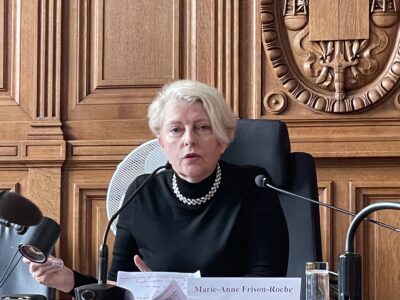
► Full reference: M.-A. Frison-Roche, Audition by the French National Assembly's Law Commission on the confidentiality of legal advice  (the "Legal Privilege à la française"), 8 April 2024. - I had expressed my opinion on the need for French legal system to better ensure the confidentiality of legal opinions drawn up by internal lawyers in companies, in an article published in 2023 in the French academic journal Recueil Dalloz: "La compliance, socle de la confidentialité nécessaire des avis juridiques élaborés en entreprise (Compliance Law, the cornerstone of the necessary confidentiality of legal opinions drawn up by companies". Compliance, the cornerstone of the necessary confidentiality of legal opinions drawn up by companies).  Following on from this article, and as a specialist in Regulatory and Compliance Law, I was invited by the French National Assembly's Law Commission to give my opinion on the proposed law n°2022 on the confidentiality of consultations by in-house lawyers ( Proposition de loi n°2022 relative à la confidentialité des consultations des juristes d'entreprises), often named in French Legal privilege à la française. -     ► Summary of this presentation: I have shown that we must start not from the person (external lawyer / in-house lawyer, for instance) and not even centrally from the information in question (branch of Law by branch of Law), but from the Goals pursued, i.e. from Compliance Law. In this respect, we must not be misled. We could do so by confusing mechanical "conformity" with this new branch of Law: Compliance Law. Conformity is merely a tool of Compliance Law. Out of concern for the correct use of the French language, as "Compliance" appears to many to be an American term, the proposed law uses the term "conformité" but refers to Compliance Law. Conformity" is merely the mechanical obligation to obey the applicable rules, which is the fate of any subject of law, subject to the mandatory rules, a passive position common to everyone in a State governed by the Rule of Law. Compliance Law is quite different, with conformity being just one of its tools. On the one hand, Compliance Law imposes an active obligation, and on the other, it targets only certain legal subjects: companies.  For them, it is a matter of ensuring that certain goals set by the legislator are actually achieved, which becomes effectively and efficiently possible thanks to the power of companies (financial power, organizational power, management power, information power, location power, information power). These "Monumental Goals" are either negative (preventing systems from collapsing) or positive (ensuring that systems improve). For companies to play this role – a role that is not required of other "ordinary" people, as they are not "in a position" to take on such a burden, particularly in terms of finance and organization – those in charge of organizing themselves and taking action, i.e. companies, must "detect and prevent" system failures (as required by laws such as US FCPA, French so-called Sapin 2 and Vigilance laws, European CSRD and CS3D, etc.). To "detect and prevent", which is an order from the Legislator, companies need to know the weaknesses of their organization and of the people they answer to, in order to remedy them: "remediation" is a "remedy" to ensure the "sustainability" of "systems". This set of key concepts lies at the heart of Compliance Law, the branch of law That focuses on the future. It is the legal opinions, for example, and in particular the report resulting from internal investigations, that enable those who decide and control this organization (the managers) to fulfill the role entrusted to them by the State. If these opinions are not confidential, the result is not the remediation and preservation of global systems (competitive, climatic, digital, energy, banking, financial systems, etc.): the effective managerial solution in Ex-Ante then consists not in seeking information but, conversely, in not seeking this information, since obtaining it will lead to the weakening of the company through the sanction that the information produces, for lack of confidentiality. The interests of the system, the State and the company are disjointed, because Compliance Law implies their alliance, which is what the confidentiality of legal opinions produces. This is why Compliance Law must, by its very nature, ensure the confidentiality of legal advice. -   When asked about the actual text of the proposal, I felt that the explanatory memorandum was particularly relevant, since the link between Compliance Law (admittedly called "conformité" in the proposed bill by a rather too mechanical respect for the French legal language, from which the French legislator has so far been unable to dispense….) is clear, that this confidentiality is attached to the document, that the company can waive it, and that it is clearly distinct from professional secrecy, all three of which should be approved. For my part, I've suggested a change to the procedure, which must be open to the confidentiality process. Indeed, public authorities, such as Competition and Regulatory Authorities, are rather hostile to this confidentiality. Having contributed a great deal to the development of Regulatory Law, and continuing to do so, I believe that Competition and Regulatory Authorities have a logic that needs to be understood. It is as follows: Regulatory Authorities are Ex-Ante (this was less true for the Competition Authorities, but it too is increasingly so) and are in a situation of information asymmetry. Their first concern is to combat this asymmetry. If we translate this into legal terms, it means that in order to carry out their mission of general interest, they must seek out all available information. However, legal opinions, and in particular the internal investigation report, are what I have described as "evidence treasure". In their logic, the Competition and Regulatory Authorities want to seize it. There is therefore a conflict between two general interest logics: the general interest of the Monumental Goals of Compliance Law actively served by companies, at the behest of the Legislation, which requires the confidentiality of legal opinions, and the general interest of the action of Regulators who fight against information asymmetry and seek to seize the evidential treasures of legal opinions. For the reasons given above, I believe that the Monumental Goals of Compliance must prevail. All the more so as the rights of the defence converge to this end. Ultimately, however, it is up to the Judge, in the event of open conflict, to balance these two claims, which are based on the service of the general interest.  However, reading the proposition, it seems to me that the rather complicated procedure entrusts this to a multiplicity of judges… But since it is indeed Compliance Law which is the best basis for "legal privilege à la française", Compliance Law, which is the extension of Regulatory Law and whose advanced point is the Vigilance duty, it would be more appropriate and logical to entrust this litigation to the exclusive jurisdiction of the Paris Judicial Court. This court has already the exclusive competence for litigation about Vigilance. This would have another fortunate effect: on appeal, the dispute would be brought before the Paris Court of Appeal, which has exclusive jurisdiction (barring exceptions) over disputes concerning decisions on French Competition and Regulatory Authorities. The judges of the "Pôle 5" (12 chambers specializing in economic law) of the very specific court are seasoned and would be well-suited to strike the necessary balance between the two general interests involved. I think a procedural amendment to the proposed text along these lines would be welcome. -   ► See in my work those that may be of interest with regard to this hearing (all with English summary, many with bilingual working paper) ⤵️   🕴️M.-A. Frison-Roche, 📝Le rôle du juge dans le déploiement du Droit de la Régulation par le Droit de la Compliance, in 📗Conseil d'État et Cour de cassation, De la Régulation à la Compliance : quel rôle pour le Juge ?, 2024.   🕴️M.-A. Frison-Roche, 📝Compliance et conformité : les distinguer pour mieux les articuler, 2024. 🕴️M.-A. Frison-Roche (dir.),📕L'obligation de compliance, 2024. 🕴️M.-A. Frison-Roche et M. Boissavy (dir.), 📕Compliance et droits de la défense, 2024. 🕴️M.-A. Frison-Roche (dir.), 📕Compliance et droits de la défense, Les Buts Monumentaux de la compliance,  2022. 🕴️M.-A. Frison-Roche, 📝Contrat de compliance, clauses de compliance, 2022. 🕴️M.-A. Frison-Roche, 📝Le Droit de la compliance, 2016. - 🌐 follow Marie-Anne Frison-Roche on LinkedIn 🌐follow Marie-Anne Frison-Roche on Instagram 🌐subscribe to the Newsletter MAFR Regulation, Compliance, Law 🌐subscribe to the Video Newsletter MAFR Surplomb

Conferences

🎤Les voies d’innovations juridiques face aux nouveaux “défis climatiques” (“Innovative legal solutions to the new “climate challenges””), in 🧮Nouveaux défis – Regards croisés : Droit, Économie et Finance. Quel Droit face au Changement Climatique ? (“New challenges – Crossed perspectives : Law, Economics and Finance. What Law in the Face of Climate Change?”)

► Full Reference: M.-A. Frison-Roche, "Les voies d'innovations juridiques face aux nouveaux "défis climatiques" ("Innovative legal solutions to the new "climate challenges""), in C. Arnaud, O. de Bandt et B. Deffains (dir.), Nouveaux défis – Regards croisés : Droit, Économie et Finance. Quel Droit face au Changement Climatique ? (("New challenges – Crossed perspectives : Law, Economics and Finance. What Law in the Face of Climate Change?"), Banque de France (French Central Bank) and CRED/Paris Panthéon-Assas University, Paris, Centre de Conférence de la Banque de France, April 2, 2024 - 🧮See the full programme of this event - 🔲see the slides, basis of this conference (in French) - ► Summary of this conference: In response to the question of how the Law can produce 'innovations' to meet the 'climate challenges', the process is based on the three traditional sources of Law, which are, firstly, laws and regulations, secondly, the commitments of individuals, mainly contracts, and thirdly, court rulings. At first sight, the Law in its traditional conception and practice is weak in the face of climate change. This weakness is inherent in the nature of climate change, which is at once future, global and systemic, in the face of these three sources of Law, which do not address all three dimensions at once. The scale of the legal innovation required to ensure that one or more articulated sources can grasp the future, the global and the systemic is therefore clear. And yet this is what is happening. As far as laws and regulations are concerned, they do not seem very appropriate because they are, by their very nature, a territorial limit, and international treaties are very difficult to negotiate. The interweaving of European regulations, for example the CSRD and the CS3D, which mirror each other, may be more effective. As far as 'commitments' are concerned, a concept which in Law is not very precise outside of contracts and liability cases📎1🕴️M.-A. Frison-Roche, 📝What a commitment is, in 🕴️M.-A. Frison-Roche (ed.), 📘Compliance Obligation, 2024., contracts are above all a means for companies to fulfill their legal obligations, and a contract always implies a judge. At first sight, however, the judge is the least well placed to respond to 'climate challenges', particularly in France where he is said or wished to be powerless, where he rules on the past and where, especially the civil judge, he settles a one-off dispute between two singular parties. But a major change has occurred with the emergence of a new branch of law: the Compliance Law, a teleological branch of Law whose legal normativity is lodged in the Monumental Goals📎2🕴️M.-A. Frison-Roche, 📝Compliance Monumental Goals, beating heart of Compliance Law, in 🕴️M.-A. Frison-Roche (ed.), 📘Compliance Monumental Goals, 2023. that it pursues, namely the preservation of systems, for example the climate system. In France, the so-called "Sapin 2" law in 2016, followed by the so-called "Vigilance" law in 2017, illustrate this. And the Judge is at the centre of it all. In this global, systemic, extraterritorial perspective, the object of which is the future – Compliance Law is, moreover, rejected by many legal experts – the legislative innovation is major. Indeed, the law of 23 March 2017, known as "Vigilance" designated large companies, because they are "powerful", because they are "in a position to act" to "detect and prevent" breaches of the environment and human rights. The 2017 law copied the "compliance tools"📎3🕴️M.-A. Frison-Roche (ed.), 📘Compliance Tools, 2021. put in place by the Sapin 2 anti-corruption law: risk mapping, plans, alerts, audits, internal investigations, and so on.  Only large companies are subject to the Compliance Law, notably the Vigilance Law, since they are the only ones in a position to act, in this case "parent companies or principals", and borders are no longer limits since the obligation, creating personal liability for the company📎4🏛️Conseil constitutionnel (French Constitutional Council), March 23, 2017, decision No. 2017-750 DC, Loi relative au devoir de vigilance des sociétés mères et des entreprises donneuses d’ordre., extends throughout the "value chain". The notion and fact of "systemic dispute" is emerging before the courts. In France, the Paris Court of First Instance has exclusive jurisdiction. European legislation is proving more difficult to draw up, because although it is compulsory to provide information on these "extra-financial" subjects (CSRD), the directive on the duty of vigilance, which has just been adopted, does not go any further than the French law of 2017. On the second point, that of commitments, we are only at the beginning. Judges do not transform ethical statements into "unilateral legal commitments", and vigilance does not transform company law into co-management. But contracts do form a global network through which companies adjust their various legal obligations. This is why arbitrators, the only "global judges", will soon be involved in this systemic litigation📎5🕴️M.-A. Frison-Roche (ed.), 📘Compliance Obligation, 2024, of which a chapter is dedicated to "International Arbitration in support of the Compliance Obligation"., and more general case law is to come on "compliance contracts and clauses"📎6🕴️M.-A. Frison-Roche, 🚧Compliance contract, compliance clauses, 2022 ; 🕴️M.-A. Frison-Roche (ed.), 📘Contrat and Contract, 2024.. But the most innovative aspect undoubtedly comes from the courts. Perhaps and notably in France because it is from where we least expect it, the civil courts, that the imagination comes, but also the guarding of the great principles of the Rule of Law, because for the moment the case law is reasonable. This innovation has not come about proprio motu: the judges are not taking action, it is the NGOs that are conducting a kind of litigation policy, systematically giving formal notice to the major energy companies, but also to the major banks and insurers on climate issues, alleging non-compliance with their vigilance plans. The interim relief judge at the Paris Court of First Instance must then provide answers in systemic disputes, of which the so-called "Total Uganda"📎7🏛️Tribunal judiciaire de Paris (Paris First Instance Civil Court), summary rulings, February 28, 2023, No. RG 22/53943 and 22/53942, Total Ouganda. case is an example. The courts are demonstrating a great deal of innovation. The Court of First Instance's interim relief judge has appointed amici curiae📎8🕴️N. Cayrol, 📝L'amicus curiae, mesure d'instruction ordinaire, 2022., the Paris Court of Appeal has set up a specialised chamber📎9On the creation on the new 5-12 Chamber, Contentieux émergent – Devoir de vigilance et responsabilité écologique see 🕴️J. Boulard, 💬Contentieux systémique : "Il est important, pour les magistrats, de rester au plus près des réalités" (Systemic litigation: "It is important for judges to remain as close as possible to reality"), March 28, 2024., and training conferences have been set up on this "Emerging Systemic Litigation"📎10🕴️M.-A. Frison-Roche, 💬"Nous voyons émerger aujourd’hui le contentieux systémique" ("We are now seeing the emergence of the Systemic Litigation"), March 28, 2024 ; 🕴️M.-A. Frison-Roche, Coordination and animation of cycle of conference-debates 🧮Contentieux Systémique Émergent (Emerging Systemic Litigation). . In conclusion, Law is in the process of being rebuilt through a new branch of Law, Compliance Law, whose the very purpose, as an extension of and going beyond Regulatory Law📎11🏛️Conseil d'État (French Council of State) and 🏛️Cour de cassation (French Court of cassation), 📗De la régulation à la compliance : quel rôle pour le juge ? (From Regulation to Compliance: what role for the Judge?), 2024; 🕴️M.-A. Frison-Roche, 🚧The deployment of Regulatory Law through Compliance Law in the European project, 2023 ; 🚧Compliance Law loses the ties of Regulation Law but retains its principles : consequences for companies, 2018 ; 🚧From Regulation Law to Compliance Law, 2017., is to preserve systems, in particular the climate system, in a profoundly renewed role for judges📎12🕴️M.-A. Frison-Roche, 📝Le rôle du juge dans le déploiement du droit de la régulation par le droit de la compliance et ;🕴️Fr. Ancel, 📝Quel rôle pour le juge aujourd’hui dans la compliance ? Quel office processuel du juge dans la compliance ?, in 🏛️Conseil d'État et 🏛️Cour de cassation, 📗De la régulation à la compliance : quel rôle pour le juge ?, 2024 ; 🕴️Fr. Ancel, 📝Le principe processuel de compliance, un nouveau principe directeur du procès ?, in M.-A. Frison-Roche (dir.), 📕La juridictionnalisation de la Compliance, 2023 ; 🕴️M.-A. Frison-Roche, 📝Le Juge requis pour une Obligation de Compliance effective, in 🕴️M.-A. Frison-Roche (dir.), 📕L'Obligation de Compliance, 2024.. - 🌐follow Marie-Anne Frison-Roche on LinkedIn 🌐follow Marie-Anne Frison-Roche on Instagram 🌐subscribe to the Newsletter MAFR Regulation, Compliance, Law

Conferences

🎤L’émergence du contentieux systémique (Emergence of the Systemic Litigation), in 🧮Importance et spécificité du Contentieux Systémique Émergent, cycle of conference-debates “Contentieux Systémique Émergent”

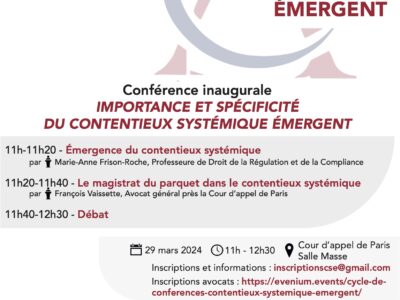
► Full Reference: M.-A. Frison-Roche, "L’émergence du Contentieux Systémique" ("Emergence of the Systemic Litigation"), in Importance et spécificité du Contentieux Systémique Émergent (Importance and specificity of the Emerging Systemic Litigation), in cycle of conferences-debates "Contentieux Systémique Émergent" ("Emerging Systemic Litigation"), organised on the initiative of the Cour d'appel de Paris (Paris Cour of Appeal), with the Cour de cassation (French Court of cassation), the Cour d'appel de Versailles (Versailles Court of Appeal), the École nationale de la magistrature – ENM (French National School for the Judiciary) and the École de formation des barreaux du ressort de la Cour d'appel de Paris – EFB (Paris Bar School), under the scientific direction of Marie-Anne Frison-Roche, March 29, 2024, 11h-12h30, Cour d'appel de Paris, salle Masse - 🧮see the full programme of this event - 🧮see the programme of the entire cycle Contentieux Systémique Émergent - 🌐consult on LinkedIn the report of this speech (in French) - 🌐consult on LinkedIn a general présentation of this event, which links to a presentation and a report of each speech (in French) - 🧱consult the scientific coordination sheet of this event, which gives an account of the various speeches made - 🔲see the slides used to support this intervention (in French) - 🚧read the bilingual Working Paper which is the basis of this speech - ► English Summary of the conference: We are seeing the emergence of what should be referred to as a category of its own: the "Systemic Litigation". This concept, proposed in 2021📎1🕴️M.-A. Frison-Roche, 🚧The hypothesis of Systemic Cases brought before the Judge, 2021., refers to the hypothesis in which a system is 'involved' in a particular 'case' submitted to the judge. The presence of a system should not be confused with a systemic analysis of a phenomenon. The term 'cause' must be understood in the procedural sense, as used in article 5 of the Code civil (French Civil Code). Specifically, the prohibition contained in article 5 of the French Civil Code does not apply because a system thus involved calls for factual responses and solutions and not necessarily general and abstract solutions: the solution of a systemic nature and scope, that the presence of a system in a cause calls for, may be a factual solution, even if it radiates out from the system as a whole. But precisely because the presence of a system in the case often gives rise to a question that is itself systemic, the judge, if he wishes to comply with article 4 of the French Civil Code, must respond not only a minima by not evading the question, for example of systemic risks, but also fully by providing systemic solutions, for example remedies to preserve in the future the solidity and durability of the systems involved in the case.    These systems may be of different kinds: banking, financial, transport, health, energy, digital, algorithmic or climatic. Their presence in cases brought to the attention of judges, the variety and difficulties of which will be seen in later contributions, leads to basic questions relating to the emergence of Systemic Litigation: firstly, how can Systemic Litigation be defined? Secondly, what makes this category of litigation emerge? The answers to these two questions have essential practical consequences.  The new solutions must be based on a classic distinction, used in particular in criminal and administrative proceedings, which are more objective, but also in civil proceedings, notably by Hébraud, namely the distinction between the "party to the dispute/litigation" and the "party to the proceedings". Depending on whether it is accepted that the system should be considered as a "party to the litigation", which would allow it, through an entity that is legitimate in expressing it, to allege claims and formulate demands against an adversary, or as a "party to the proceedings", a much broader category, which would allow the judge to hear the interests of the systems involved without individuals being able, on behalf of a system, to formulate claims against or for the benefit of a party to the litigation.     This makes it possible to innovate while preserving the measure of which the judge is the guardian.   - 🌐follow Marie-Anne Frison-Roche on LinkedIn 🌐follow Marie-Anne Frison-Roche on Instagram 🌐subscribe to the Newsletter MAFR Regulation, Compliance, Law