About

Conferences

THE TOOLS OF COMPLIANCE AND THE THEORY OF CLIMATES, IN “GEOGRAPHICAL PREGNANCE IN COMPLIANCE TOOLS “

Complete reference : Frison-Roche, M.-A., The tools of Compliance and the Theorie of Climates, in "Geographical pregance in Compliance Tools" (Les outils de la Compliance et la Théorie des climats, in La prégnance géographique dans les outils de la Compliance), February 4, 2020, Nice.    Conference Summary: Starting from Montesquieu's "climate theory", affirming that human beings would be of a different nature in different places of the world, which therefore requires different rules of government according to these places, a theory which echoes the geographical confinement that Pascal operated on the Laws, we can think that, as with any rule, Compliance legal rules, which ensure compliance of the behavior of human beings to the rules, this will vary depending on whether we are below or beyond the Pyrenees. But on this geographical dimension so natural one can on the contrary and at first doubt. Indeed, by presenting it as a simple process, which artificial intelligence based on algorithms could fully take care of, by its absence of substance this dimension loses all relevance. Except falling into the other excess consisting in posing that everything is only a question of "pure compliance culture" or that this is only the dressing of a pure balance of power, between geographical areas, for example the United States and Europe, and in this Law of palisade geo-politics is to such an extent that it would have devoured Law. It is necessary to keep the measure of things and on the contrary organize in a second time a kind of triptych and firstly find what comes from the accumulation of technical and immutable information, secondly what comes from local phenomena but requieres global standards of compliance which can be technically attached because of their "crucial nature" and thirdly also assume "political pretensions of monumental goals" which contest the borders and the branches of the Law which guard these.  If we manage to do this, then Compliance Law not only manages to get rid of what undermines it, that is, its mechanical temptation offered by technology and its disappearance by political power, keeping substance without being violent. . Indeed by respecting geography the West does not have to dictate "its" law. On the contrary, it must take concrete lying to the Kanak Law, which does not define the Law as what is stated and applied, but as a 'path'. Thus in the technique of responsible investments, because the Law of Compliance is teleological, the Subject of law, that is to say the company (which is in position, for example that invests) does not prohibit but organizes the transition so that the beneficiary of the device is not himself sanctioned, for example abandoned to corruption, but accompanied towards the exit of the system. The integration of time and the concept of 'duration', common to compliance law and regulation law (the Law of Compliance being the internalisation of Regulations in entities capable of implementing them) involving the articulation between the territory and duration (which is not permitted by Competition Law).     Read the presentation of this conference on the Geographical pregnance in Compliance Tools  See the other conferences of the complete cycle on Compliance Tools. Read the general presentation of the conferences cycle.   Read the working paper which is the basis of this conference.    Consult the slides on which the conference is based (in French).   Summary : Starting from Pascal's "climate theory", one might think, as with any rule, Compliance, which ensures that human behaviour conforms to the rules, it varies, depending on whether one is "below or beyond the Pyrenees". . But of this geographical dimension so natural, on the contrary and at first one can doubt. Indeed by presenting Compliance as a simple process, which artificial intelligence based on algorithms could fully support, by its absence of substance this geographical dimension loses all relevance. Except to fall into the other excess of asking that everything is only a matter of 'compliance culture' or that it is the dressing of a pure balance of power, between geographical political areas, for example the United States and Europe, and in this Law of façade the geo-politics is at this point all that it would have devoured Law. We need to keep Reason, instead organizing a kind of tryptic and find what is the accumulation of technical and immutable information, which is local phenomena but to which standards of global Compliance can be technically attached because of their "crucial nature" and also assume "political pretensions of monumental goals" that challenge the borders and branches of Law that guard them. If we manage to do this, then not only  Compliance Law manages to get rid of what undermines it, that is its mechanical temptation offered by technology and its disappearance by political power, keeping substance without being violent. . Indeed by respecting geography the West does not have to dictate "its" Law. On the contrary, it must take concrete conception, borrowing to Kanak Law, which does not define Law as what is stated and applied, but as a 'path'. Thus in the technique of responsible investments, because Compliance Law is teleological, the subject of law, that is to say the company (which is in position, for example to invests) does not prohibit but organizes the transition so that the beneficiary of the device is not himself sanctioned, for example abandoned to corruption, but accompanied towards the exit of the system of corruption. The integration of time and the concept of 'duration', common to Compliance Law and Regulation Law (the Law of Compliance being the internalisation of Regulations in entities capable of implementing them) involving the articulation between the territory and duration (which is not the rule of Competition Law). 

Publication director

🏗️ direction of the collection: 📚Cours Dalloz – Série Droit privé

📚Publication of : 🕴️Anne-Marie LEROYER, 📕Droit des successions (Law of Succession), 4th ed.

► Full Reference : A.-M. Leroyer, Droit des successions (Law of Succession), 4th ed., 2020, Dalloz, “Cours Dalloz-Série Droit privé” Series, 526 p. - 📕Read the back cover (in French) - 📕Read the table of contents (in French) - 📚See the entire collection in which the book is published. -

Working papers

The attorney, vector of conviction in the new Compliance system

This Working Paper written in English is the basis for an article published in French in the French journal Dalloz Avocat , in March 2020.       Summary of the working Paper. If we perceive Compliance Law as an aggression of the private company and a binding set of mechanisms that have no meaning and added value for it, then the attorney has a utility: defending the business. It can do so not only during the sanctions phase, but also to prevent it. But this function is not central. It becomes so if we understand Compliance Law as a body of substantial rules, pursuing a "monumental goal": the protection of the person, goal injected by political bodies and taken up by the operator. From this, the company must convince everyone to take it back, inside the company and outside. In a general and contradictory debate, the attorney carries this conviction, because he and she is always convincing those who at the end judge (market, public opinion, etc.) that is their raison d'être.   (In this short document, the pop-ups refer to the different works that develop each of the points)

Videos

French Financial Markets Authority decision of 11 December 2019 sanctioning the Bloomberg press organ for disseminating false information on the financial market: here, the ethical obligation converges with Financial Law

Watch the video commenting on the decision of the Commission des sanctions of the Autorité des marchés financiers – AMF (French Financial Market Authority Sanctions Commission). Read the decision. -   In 2015, a document supposedly emanating from the Vinci company reached the Bloomberg media announcing unexpected catastrophic results. The two journalists who received it immediately published it without checking anything, the Vinci listed shares losing more than 18%. It was a rude forgery, which a basic check would have established, a check which the journalists had not done. 4 years later, the Bloomerg company is punished for the breach to "disseminate false information" on the financial market, by a decision of the Sanctions Commission of the Autorité des Marchés Financiers (French Financial Markets Authority) of December 11, 2019. The company being sued argued that it was up to journalists to be accountable and not to itself, because on the contrary the firm had implemented both detection software and a code of conduct, even though there was no legal rule constraining it. In consequence, it would not possible to pursue it. But the AMF Sanctions Commission stresses that, independently of this, it is a general rule of ethics for journalists that obliges them to verify the authenticity of the documents they publish, which they did not, whereas an elementary check would have allowed them to measure that it is a rude forgery. In addition, the Sanctions Commission refers to the European Regulation on market abuses which in its article 21 targets the special status to be reserved for press freedom and the special status of journalists, but associates this ethical obligation to verify documents . However, the Sanctions Commission notes that this obligation, which was targeted by both the journalists' ethics and the reference text of Financial Law, was completely ignored by the two journalists. It is therefore up to the press agency to be accountable and to be punished. However, the media entreprise maintained that the balance between the principle of freedom of the press and the principle of freedom of opinion on the one hand and the principle of the protection of the financial market and of investors against false information disseminated requires an interpretation of the European Union Law, which must oblige the Sanctions Commission to ask a preliminary question to the Court of Justice of the European Union. The Sanctions Commission dismisses this request because it considers that the European texts are "clear", which allows the Sanctions Commission to interpret them itself. And precisely the European Regulation on market abuse in its article 21 provides for the exception in favor of the press and journalists but compels them to respect their ethics, in particular the verification of the authenticity of documents. In this case, they did nothing. They are clearly the authors of a breach attributable to the company. - In a less clear case, one could consider that this balance between two principles, both of public interest, is delicate and that an interpretation by the Court of Justice would always be useful. Indeed and more fundamentally, does Financial Law remain an autonomous Law, putting first the objective of the preservation of the integration of the financial market and the protection of investors or is it the advanced point of an Information Law protecting everyone against the action of any "influencer" (category to which Bloomberg belongs) consisting in disseminating inaccurate information (notion of "misinformation")? And that is not so "clear" ….   -

MAFR Chronicles Compliance Law

article published in French in the Chronicle MAFR Compliance Law (Recueil Dalloz)

📝La cartographie des risques, centre du Droit de la Compliance (Risk Mapping, center of Compliance Law)

► Full Reference : M.-A. Frison-Roche, "Théorie juridique de la cartographie des risques, centre du Droit de la Compliance (Legal Theory of Risk Mapping, center of Compliance Law)", D. 2019, chronique Compliance, p.  - ► English Summary of this article : The act of mapping risks is not currently defined by Law. It is only described in special laws. While risks mapping is central to preventing in Ex Ante the occurrence of crises or behaviors from which the occurrence is excluded, no legal regime is available, due to the lack of a legal definition available. This legal definition is proposed here in 5 stages, starting from special laws and specific cases to go towards a general conception. Risk mapping then appears as a concern for others taken care of willingly or by force by crucial operators, through a new subjective right: the “right to be alarmed”, the map being the structural counterpart of the character of the whistleblower. Two articulated systems of Compliance Law. - Read the article, published in French.   Read its translation in English.    Read the English Working Paper  on which this article is based, working paper with additional developpments, technical references and hypertext links.    -

Articles

Compliance Law to Regulate the Internet

Reference Frison-Roche, M.-A., Le droit de la compliance pour réguler l'internet  (Compliance Law to Regulate the Internet), Interview given in French to Sylvie Rozenfeld, Expertises, December 2019, pp. 385-390.   Summary. Law seems increasingly powerless to stem the social disorder generated by the Internet. For Marie-Anne Frison-Roche, Law professor and specialist in Regulatory Law, the solution is to be found in Law, and more particularly in Compliance Law. This specific Law is already applied in the banking and finance sector, or in the area of ​​personal data. As it has done for green finance and through the GDPR, Europe could impose a compliance system which internalizes concern for the individual in large digital operators. It is up to them to put in place the means and bear the cost, such as the right to be forgotten erected by the CJEU. Marie-Anne Frison-Roche does not offer anything revolutionary, she is content to take elements of positive law that already exist and to correlate them.   Read the interview (in French)   Read the presentation of the official Report for the French Government about which this interview is given:: The contribution of Compliance Law to the Governance of Internet. 

Working papers

🚧 Compliance and Incentives: a couple to propel by the notion of “Incentive Compliance”

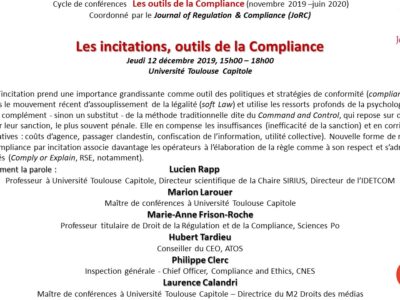
This working document serves as the basis for two conference given in the symposium made under the direction of Lucien Rapp, Les incitations, outils de la Compliance ("Incitations: Compliance Tools"). Référence : Frison-Roche, M.-A., Compliance et Incitations : un couple à propulser, in Faculté de droit de l'Université Toulouse-Capitole, et Journal of Regulation & Compliance (JoRC),Les incitations, outils de la Compliance, 12 décembre 2019, Toulouse.  This Working Paper has been the basis for two conferences in the colloquium in Toulouse (France) under the scientific direction of Lucien Rapp, about Les incitations, outils de la Compliance ("Incitations, as Compliance Tools"), on December 12, 2019, the first one about The sanction as incitation and the second one about Incitations and Compliance Law (synthesis of this colloquium). sur le thème de la sanction comme incitation, la seconde en synthèse de ce colloque sur  After it has been the basis for the article, to be published in the books Les outils de la Compliance and Compliance Tools in the Series Régulations & Compliance. Read a general presentation of this book.   - Summary of this Working Paper: Compliance and Incentives appear at first glance to be totally opposite. Not only because sanctions are at the heart of Compliance and that sanction is associated with constraint while incentive is associated with non-constrained1Voir cette question analysée d’une façon autonome, Frison-Roche, M.A., Résoudre la contradiction entre « sanction » et « incitation » sous le feu du Droit de la Compliance, 2020., but also because incentives are linked to self-regulation and that Compliance Law requires a strong presence of public authorities. Thus, one should choose: either Compliance or Incentives! Either the effectiveness of one or the effectiveness of the others; either the techniques of one, or the techniques of others; either the philosophy of one or the philosophy of the others. Resign yourself to the waste that such a necessary choice would involve. But putting the terms thus is thinking poorly about the situations and reducing the fields of the solutions which they call for. If we take a rich definition of Compliance Law, we can on the contrary articulate Compliance and Incentives. To do this, the concept of “incentive Compliance” should be developed. This concept is not only appropriate, but it is necessary in a new conception of Sovereignty. For example for the digital Europe. -   Read the developments below.   

Videos

The French Council of State (Conseil d’État) confirms the wide and therefore severe application of the sanctions mechanism in the Compliance Law concerning the freezing of assets, by its decision of November 15, 2019, La Banque Postale v. ACPR

Watch the video explaining the content, meaning and scope of the decision made by the Conseil d'État (French Council of State) on November 15, 2019, La Banque Postale v. Autorité de contrôle prudentiel et de résolution (ACPR). The Autorité de contrôle prudentiel et de résolution – ACPR (French Authority of prudential control and resolution) pronounced a very high sanction, representing 7% of La Banque Postale's net annual result. The breach is constituted by the fact of not having prevented the use of the banking technique of the "money order" which was used to escape the freezing of the assets. The Conseil d'État recalls that by nature if the assets are frozen, it is not possible that anyone is able to dispose of these assets. However, by the use of "money orders", persons targeted by asset freezing decisions, tools used in connection with the fight against money laundering and the fight against terrorism, had been able to circulate money to from accounts managed by La Banque Postale, of which they were not customers. This case was not foreseen at the time when the Bank Postale was sanctioned by the ACPR for not having prevented such a use, the texts forcing it under its obligations of "conformity" to prevent this behavior of violation background gels on the part of his customers, but only that. This case of a use of a means by a person who is not a customer of the bank was not foreseen at the time when the alleged facts took place and the Bank claims not to be able to be punished since in the repressive matter it is necessary to respect the principle of non-retroactivity of the texts, – in this case texts later supplemented to aim at such an assumption -, the non-retroactivity being a major principle itself related to the principle of the legality of the offenses and the penalties. We are therefore in the hypothesis of a silence of the texts. What to decide? Can the Bank be condemned and so heavily or not by the ACPR? The Bank does not think so.  It acted against this sanction decision firstly because those who used these money orders were not its clients. It has strong reasons to avail itself of this fact, since subsequently the texts needed to be modified to aim not only the use of this technique of money order by those who have a count in the bank and also by those who act with cash through the bank without a count, that is to say without an account holder to look at. Because we are in criminal matters, the restrictive interpretation and non-retroactivity of the text should lead to follow the reasoning of the Bank. But the Conseil d'État does not because it considers that implicitly but necessarily even with this subsequent modification of the text, it had aimed that use before. By this way, the Conseil d'Étatuncil develops a very broad concept of the obligations of banks in their role in the fight against money laundering, and therefore a very repressive point of view, which permeates their "obligation of Compliance". Thus, when the bank also argues that it can not be sanctioned since for it this activity of money order is  deficit and that it did not cause harm to its customers even by assuming badly its obligations, theConseil d'État stresses that this is not a pertinent perspective since the Compliance obligations falls within the "overriding general interest of protection of public order and public security, to which the freezing of assets legislation responds". -   Read the  judgment of the Conseil d'État ( in French). 

Conferences

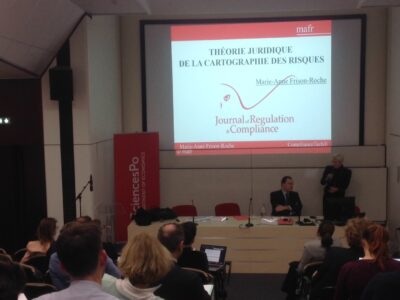
Legal theory of Risk Mapping, in “Risk Mapping, as Compliance Tool” (conference made in French)

Reference : Frison-Roche, M.-A., General presentation of the cycle of conferences on Les outils de la Compliance  (Compliance Tools) and  "Théorie générale de la cartographie des risques" (Legal Theory of Risk Mapping), conference made in French, in Département d'Economie de Sciences Po & Journal of Regulation & Compliance (JoRC),  La cartographie des risques, outil de la Compliance (Risk Mapping, as Compliance Tool), November 28th, 2019, Sciences Po, Paris.    Read the  General Presentation ot the cycle of conferences about the Compliance Tools   Read the General Presentation of the book written in English to be published   Read the General Presentation of the serie Régulations & Compliance in which the book will be published   Summary of the conference Risk mapping is both central to the obligations or practices of companies and little apprehended by the legal systems. It is not expressly referred to by the French legal system, except for the special national laws known as "Sapin 2" and "Vigilance". But if we are out of this field, because there is only a description and not a legal definition, even less a legal notion, we do not know what legal regime to apply to the action of mapping risks. It is therefore useful, indeed compelling, to define the legal concept of risk mapping. Starting from what is still the safest ground, namely these two special laws, to go towards less secure legal grounds, such as the doctrine of the authorities or the commitments of the companies, even the ISO certifications obtained in this matter. Through a few judicial decisions and legal reasoning, a legal notion of the action of mapping risks emerges. It is advisable to proceed in 5 steps (the working document follows another approach). The first, based directly on the two available laws, apprehends the action of mapping when it comes into execution of a special legal obligation. The decision rendered in 2019 by the French Commission des sanctions of the Agence Française Anticorruption (French Corruption Agency's Sanctions Commission) draws probate games as to the demonstration of the execution of the obligation and the probationary system can be extended. In the same way the decision of the French Conseil constitutionnel (Constitutional Council) in 2017 on the "Vigilance Act" shows that a mechanism referred to as a "modality" is legitimate with regard to the goal, which is, concerning this tool, the establishment of a responsibility for others. It is therefore the concern for the situation of others that can be targeted by the Law thanks to Compliance Tool, especially Risk Mapping. The second theme aims to map risks as a fact of good management for a company, while the enterprise is not constrained by a legal obligation. This fact is a paradox because the Regulatory Authority and the Judge may, where the conduct that was to be prevented occurs, for example a market abuse or an anti-competitive behavior, either qualify as an aggravating circumstance or as an attenuating circumstance. Consideration of the theory of incentives should lead to the adoption of the American solution, that is to say the qualification of an effective cartography as a mitigating fact. European case law is not yet fixed, especially in terms of Competition Law's compliance. The third theme is the mapping action carried out by an entity which, in doing so, exercises power over a third party. Because cartography is as much an obligation as a power, possibly on a third party. The Conseil d'État (French Council of State) in 2017 qualified risk mapping as an act of grievance, but doing so legitimately, since it was to prevent forest fires efficiently. This solution based on the teleology attached to Compliance Law can be transposed to other areas. Going further, one may consider transforming this action from de facto status to legal status on the part of the company, if it thus identifies risks for third parties. It would thus give third-party creditors the right to be in a position to measure the risks that weigh on them. Risk mapping would thus be part of a broader unilateral commitment by powerful companies, recognizing the existence of risks for third parties to enable them to know their nature and extent. If this responsibility Ex Ante (characteristic of Compliance Law) is fulfilled, then the Ex Post liability of the company could no longer be retained. This is the ongoing issue of the Johnson & Johnson trial (2019 American judgment), in terms of medical compliance. Because if one can argue that there exists through this kind of risk mapping that the posology a "subjective right to be worried about the risks related to the taking of the drug", the patient remains free in the use of it. The question of whether third-party education is included in the mapping, since the alert is already included in it, is an open question. For now, the answer is negative. Indeed and in a fifth time, appears the liberal definition of Compliance Law through the apprehension that the Law must make of the cartography of the risks. Beyond the rational act that any person has to control their risks for their own interest, by preventing the damaging effects of that from the crystallization of risk has in fact proved, it is a question of preserving an external interest for the preservation of which the Law must intervene because the subject of law, in particular the company will be less likely to be concerned. By the imprint of the law, risk mapping expresses the concern for an external interest, either of a system or of a third party. But this support in Ex Ante implies force (Sapin 2, Vigilance, financial market information obligation) or will (social responsibility, ethical commitment, adoption of non-financial standards) relates only to information, its constitution, its intelligibility and its hierarchy. Then it is the actors exposed to the risks, able to understand in Ex Ante the extent as far as they are concerned, either the entity itself, or the thirds, to choose to run them to no.     Consult the two sets of slides as basis of the conference:    Slides served as basis for the General Presentation of the cycle of conference on the Compliance Tools (in French)  Slides served as basis for the specific contribution "Théorie générale de la cartographie des risques / Legal Theory of Risk Mapping" (in French).   Read the working paper served as basis for the conference -

Working papers

Anchor points of the risk mapping process in the legal system

  This Working Paper served as the basis for an intervention in the conference organized in the conference cycle organized by the Journal of Regulation & Compliance (JoRC) on the theme: Compliance Tools, in collaboration with many university partners: this first conference is organized in collaboration with the Sciences po Economics Department and is held on November 28, 2019 at Sciences po and deals with the more specific theme of Risk mapping. It also serves as the basis for the book edited by Marie-Anne Frison-Roche, Compliance Tools, which will be released in the Regulations & Compliance collection.   -    Is the consideration by Law of the Risk Mapping mechanism so new? At first glance yes, and one might even be surprised at this novelty, since this rational anticipation of risks should have been recognized for a long time. But this is perhaps due to the more general fact that Risk itself has only recently become an autonomous legal object in Economic Law, in particular because Risk does not have at all the same position in Competition Law and in Regulation Law (I) .. Its position is even opposed in the both, Risk becoming central in Regulation Law. Compliance Law being the extension of Regulatory Law, it is also built on the "concern" of Risk and the internalization of this consideration in enterprises therefore takes the form of mapping. A closer look maybe not,even  before the specific  French laws, called "Sapin 2" and "Vigilance" and beyond them, case law decisions giving a general scope to maps drawn up by operators, or increasing the obligation that 'they have to do it (II). In this, general and precise technical Law offers points of support for Compliance Law, strengthening it in its tools.