About

Working papers

🚧 Competition Law & Compliance Law

► Full Reference: Frison-Roche, M.-A., Competition Law & Compliance Law , Working Paper, October 2018. -   ► this Working Paper has served as basis for an Article published later in French in the Review Concurrences  ; read the presentation in English of this Article.  -   ► Summary and introduction : Compliance Law is a new branch of Law, still under construction. One can have a "narrow definition" of seeing it as the obligation of businesses to show that they are constantly and actively complying with the law. One can have a richer definition, of a substantive nature, defining it as the obligation or the own will of certain companies to achieve "monumental goals" that go beyond economic and financial performance.The Competition Law partly integrates its two conceptions of Compliance: Precursor, the Competition Law concretizes dynamically the first conception of the Compliance Law (I) It is with more difficulties but also much more future that the Competition Law can express in dialectic the second conception of the Compliance Law as internationalization of these "monumental goals", especially in the digital space (II).

Working papers

🚧 YES TO THE PRINCIPLE OF WILL, NO TO PURE CONSENTS

► Complete reference: Frison-Roche, M.-A., Yes to the principle of the will, No to the pure consents, working document for an article written in French Oui au principe de volonté, Non aux consentements purs, to Mélanges dedicated to Pierre Godé, 2018, available at #lien192 en / article / yes-in-principle-of-the-desire-not in the consent /   ► Summary: Pierre Godé devoted his thesis to defend the freedom of the human being, freedom that the person exercises by showing his will. This will manifests itself, even tacitly, by this trace of "consent". In a liberal society, politically and economically, that is to say a society based on the principle of the will of the person, consent must always be defined as the manifestation of the will, this link between consent and will being indivisible ( I). But by a perversion of liberalism, "consent" has become an autonomous object of the freedom of the person, mechanical consent that has made it possible to transform human beings into machines, machines to desire  and machines to be desired, in a world of " pure consents","where we keep clicking, consenting to all without ever wanting. This consent, which has been split from the free will of the person, is the basis of the markets of the Human and the illiberal democracies, threats against human beings (II). The future of Law, in which Pierre Godé believed, is to continue to aspire to protect the human being and, without countering the free will of the human being as the movement of the law of the consumption had been tempted to, to renew with a liberal movement of Law and to fight against these systems of pure consents (III).   🔻read the article below (in French).

MAFR Chronicles Compliance Law

📝 Le Droit de la Compliance au-delà du Droit de la Régulation (Compliance Law beyond Regulation Law)

Full reference : Frison-Roche, M.-A., Le Droit de la Compliance au-delà du Droit de la Régulation, Recueil Dalloz, 2018, chronique, pp. 1561-1563.   Summary : A movement started from precise legal requirements linked to identified actors, as the financial or banking sector, to transform itself in legal norms of Compliance. Compliance Law is thus the extension of Regulation Law. But Compliance Law is taking its full autonomy with regards with Regulation Law, while retaining its violence, its radicalisé, and even its archaism, even though it concerns companies which do not act on regulated sectors, putting down, for instance, notions linked to territoriality (I). How companies should react face to this unequaled news (II)?  Read the article (in French) Read the table of contents of the Review (in French). This document is based on a working paper with footnotes, technical references and hypertext links.   

Publication director

🏗️ direction of the collection: 📚Cours Dalloz – Série Droit privé

📚Publication of : 🕴️Stéphane PIÉDELIÈVRE, 📕Instruments de crédit et de paiement (Credit and Payment Instruments), 10th ed.

► Full Reference : S. Piédelièvre, Instruments de crédit et de paiement (Credit and Payment Instruments), 10th ed., 2018, Dalloz, “Cours Dalloz-Série Droit privé” Series, 450 p. - 📚See the entire collection in which the book is published. -

Articles in a legal collective publication

📝Dessiner les cercles du Droit de la Compliance, in Études en l’honneur de Philippe Neau-Leduc, 📗Le juriste dans la cité

► Full Reference:  Frison-Roche, M.-A., Dessiner les cercles du Droit de la Compliance, in Études en l'honneur de Philippe Neau-Leduc, Le juriste dans la cité, coll. « Les mélanges », Lextenso – LGDJ,  2018, pp. 483-496. -   🚧this article  is based on a Working Paper, with footnotes, technical references and hypertext links.  This Working Paper is freely available : in French: Tracer les cercles du Droit de la Compliance. in English:  Drawing the circles of Compliance Law.  - ► English Summary of this article: Compliance Law has the same teleological functioning as the Economic Law to which it belongs, which consists in placing the normativity of rules, decisions and reasoning in the aims pursued. Once we know what the goals of compliance techniques are, then we know who should be responsible for them, who must be subject to them, who must activate the rules: compliance rules must be activated by those who are in the best position to achieve the outcome in order to achieve the goal sought by the authority which designed the compliance mechanism. The "circles" are thus plotted in a rational and pragmatic way. That, all of it ("useful effect"), but not beyond that. The notion of efficiency does not always imply balancing: on the contrary, it can involve drawing circles which designate those who are "placed" to carry the burden of the rules because they are capable of producing them the desired effects. Within these circles, the rules must apply without restriction and without compromise, but they must not apply beyond these circles. Drawing such circles requires defining the Law of Compliance itself, since on the one hand the choice of those who must implement the Compliance depends on the aims of the Compliance and on the other hand the definition of the Law of Compliance is itself teleological in nature. This is why, contrary to the assertion that the exercise of definition would be useless in these matters, which would be above all on a case-by-case basis, this effort to define and determine the purposes is, on the contrary, necessary in practice to show which enterprise must bear the obligations of compliance and which must not. But it is enough to have posed this to reveal the major difficulty of the Compliance, that explains resistances, and even gives the impression that one is confronted with an aporia. If, as a matter of principle, what is expected of the "users" of the Compliance mechanisms must be articulated to the aim that is affected by the authors of the compliance mechanisms to them, we must have a minimum correspondence between the aims of these authors (Legislators and Regulators) and the aims pursued by those who are responsible for implementing them: companies. However, this correspondence does not exist at first sight, because the compliance mechanisms are found to be uniquely based on "monumental goals" which the public authorities have a legitimate concern, whereas companies have for their own interest . The two circles do not match. The internationalization of concern for these aims in companies would therefore be only a mechanism of violence of which enterprises are the object, violence felt as such. (I). To resolve this violence, it is better to stop confusing the State and enterprises, whose goals are not the same, and draw the circle of subjects of law "eligible" for Compliance. It is highly legitimate to target certain entities, in particular this category of companies, which are the "crucial operators", in a binding way, as it is legitimate to govern companies that have expressed a desire to surpass their own interests. These circles of a different nature can overlap on a concrete operator: for example, if a bank – always a crucial operator that is structural because it is systemic – is also international – a crucial operator because of its activity – decides to worry about others by commitments verified by the authorities to overcome their own interest (social responsibility), but these different circles are not confused. In any case, companies may belong to only one circle, or even belong to none. In the latter case, they must therefore remain beyond the reach of the pressure and cost of Compliance Law, in particular because they are not objectively required to realize the "monumental goals" aimed at effectiveness and do not want it: in a liberal system, it is for the public authorities to aim at the general interest, the ordinary people indirectly participating in it by paying the tax. (II). It is by making these "Compliance Circles" of eligible subjects of this specific Law to implement the heavy but justified and controlled burden of Compliance with regard to the monumental goals that this new system  aims, that then opens a royal way in order to find a uniqueness and to increase the "monumental function" of the Compliance Law by a relation of Trust towards the global general interest, rather than the mechanical application of rules whose meaning is not understood and whose perception is no longer perceived than violence. -   📝read the article. -    

Articles in a legal collective publication

Le juge, le régulateur et le Droit

Lessons

Enseignement MAFR : Droit de la Compliance

🏫 Annales de sujets

Working papers

Enterprise, Regulator, Judge: Thinking Compliance by these three characters

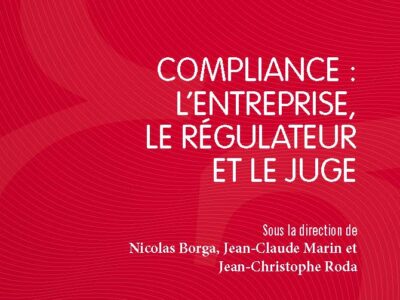
This working paper has served  as a basis for an article written in French in the book Compliance : Entreprise, Régulateur, Juge ("Compliance: Enterprise, Regulator, Judge"), published in May 2018 in the Regulations Series of Dalloz editions (Paris). See the other books published in this collection (presentation in French), directed by Marie-Anne Frison-Roche (presentation in English). ABSTRACT: The Company, the Regulator and the Judge are three key figures for the construction of an emerging Compliance Law. An important risk lies in a confusion of their respective roles, the company becoming a regulator, the regulator becoming a board of a place that goes to the conquest of others, the judge standing back. It is appropriate that each plays his role and that their respective function is not distorted. If this confusion is avoided, then the points of contact can multiply and one observes it. But as soon as everyone remains in its place, we can go further than these points of contact and if they agreed, the three characters can reach common goals. This is all the more legitimate since Compliance Law, as Regulation Law, is teleological in nature, which makes these branches of law profoundly political. These common goals are technical, such as risk prevention. They can be more political and higher, if there is a shared will, without ever one of the characters being captured by another: it is then to concern by the human being. The designation of this common goal to the Company, the Regulator and the Judge can be expressed in one word: Europe.