About

Articles in The Journal of Regulation & Compliance « JoRC »

📝Résoudre la contradiction entre “sanction” et “incitation” sous le feu du Droit de la Compliance, in 🕴️M.-A. Frison-Roche (ed.), 📕Les outils de la Compliance

► Full Reference: M.-A. Frison-Roche, "Résoudre la contradiction entre "sanction" et "incitation" sous le feu du Droit de la Compliance" ("Resolving the contradiction between "sanction" and "incentive" under the fire of Compliance Law"), in M.-A. Frison-Roche (ed.), Les outils de la Compliance, coll. "Régulations & Compliance", Journal of Regulation & Compliance (JoRC) and Dalloz, 2021, pp. 89-98 - 📝read the article (in French) - 🚧read the bilingual Working Paper which is the basis of this article, with more developments, technical references and hyperlinks  - 📕read a general presentation of the book, Les outils de la Compliance, in which this article is published - ► Summary of the article (done by the Journal of Regulation and Compliance): Compliance and Incentives appear at first glance to be totally opposite. For two major reasons. Firstly, because sanctions have a central place in Compliance Law and that the incentives suppose an absence of constraint on the operators. Secondly, because the incentives are linked to self-regulation and that Compliance Law assumes a strong presence of public authorities. Thus, one should choose: either Compliance or Incentives! Either the effectiveness of one or the effectiveness of the others; either the techniques of one, or the techniques of others; either the philosophy of one or the philosophy of the other. Resign oneself to the waste that such a necessary choice would imply. But to put the terms in this way amounts to thinking poorly about the situations and reducing the fields of the solutions they call for. If we take a rich definition of Compliance Law, we can on the contrary articulate Compliance and Incentives. From this perspective, sanctions can no longer become what blocks the use of incentives but, on the contrary, what constitutes them. Even more, the coupling between the Incentives and the requirements of Compliance Law must be strongly encouraged, as soon as the public authorities supervise in Ex Ante all the initiatives taken by the "crucial operators". This article deals with the first issue. Indeed, the so-called incentive theory targets mechanisms which do not directly resort to constraint. They would therefore have little place in Compliance Law. But it seems saturated with sanction procedures. We can even say that it seems to put them at the center, the public authorities presenting the number of sanctions as a sign of success, while the companies seem obsessed with their prospects, the two concerns ending in such a strange convergence that are the Convention Judiciaire d'Intérêt Public (non-prosecution agreement). The honest observer cannot help but be immediately uneasy. Indeed, it can only raise the definition of the sanction as a "constraint" triggered Ex Post, at the very heart of a Compliance Law which is presented as a set of Ex Ante mechanisms. Based on this contradiction in terms, should we give up the association and think that it would be wrong against the spirit to think of the sanction as an incentive? It is undoubtedly in this connection that one perceives most clearly the clash of two cultures, which do not communicate, while technically they apply to the same situations. Indeed, because Compliance was designed by Finance, everything is a tool for it. Therefore, the tendency to think of the sanction only as an incentive is very strong in Compliance Law, manifests itself continuously and will not stop (I). But whatever the reasons for conceiving it this way, the principles of the rule of law cannot disappear and if we do not want them to be erased, then they must be articulated (II). This is an essential game (II). This is why we can literally say that Compliance has set Criminal Law on fire by its conception, logical but closed in on itself, of sanctions as simple incentives. In order for Law to remain, however, we must hold a very firm definition of Compliance Law centered on its Monumental Goal, which is the protection of the person. -


Books

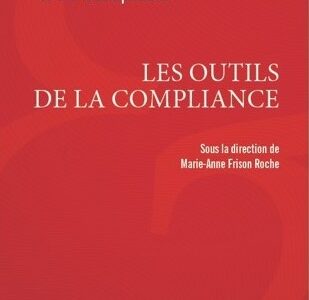
📕 Les outils de la Compliance (ed.)

General reference : Frison-Roche, M.-A. (ed.), Les outils  de la Compliance, series "Régulations & Compliance", Journal of Regulation & Compliance (JoRC) & Dalloz, 2021. In parallel, the book is published in an English version Compliance Tools, co-edited by the Journal of Regulation & Compliance (JoRC) and Bruylant.  This book follows a cycle of conferences organized by the Journal of Regulation & Compliance and by its partner universities.  -   See the collection Regulation & Compliance in which the book has been published.    - General presentation of the book : The political dimension of Compliance Law resides in the monumental goals that it aims for and which define it. These goals are internalized in "crucial operators", who willingly or by force must structure themselves and act to achieve "monumental goals", as set by public authorities and which may coincide with the interests of the enterprise. This one designs and controls the Ex Ante reorganization that this implies, under the public authorities supervision. Enterprises, even if their activities are not regulated, thus become transparent and must show the Compliance Tools effectively deployed to effectively achieve these goals. It is a major transformation of economic life in all countries because the Compliance Tools are adopted everywhere and have a global effect. These appear to be very diverse but their unity is profound and bringing it out has the practical benefit of producing a legal regime that is as unified as possible, while allowing their adaptation country by country, sector by sector, enterprise by enterprise.  This book aims to understand these Compliance Tools to better anticipate the assessment that will be made by Regulators, Supervisors and Courts, as well as the new conceptions of the authors of legal texts which impose new ones every day, while companies must also imagine the most appropriate Compliance Tools. This collective work specifically apprehends those on which we have few studies when we handle them on a daily basis, such as risk mapping or training or rights, letting more familiar tools shine through more transversal contributions, such as compliance programs, sanctions, whistleblowing or many sorts of settlements, agreements of public interest. A first chapter takes a legal and economic approach. A second chapter emphasizes the role of risk mapping. A third chapter draws the game of incentives. A fourth chapter identifies the expertise required. A fifth chapter insists on geographic significance. A sixth chapter details the measurement of effectiveness. A seventh chapter explores training. The eighth chapter examines technological tools. The concluding article leads to rights. -   Read the general presentation of the book, including the table of contents and the introduction (in French).   Read the presentations of the articles of the book :   Amico, Th., La Compliance ou le passage de l'ex post à l'ex ante: une révision copernicienne pour l'avocat pénaliste ?   Banck, A., La maturité de l’usager de l’outil de la Compliance, premier critère du choix de l’outil adéquat   Benzoni, L., and Deffains, B., Approche économique des outils de la Compliance: finalités, effectivité et mesure de la Compliance "subie" et "choisie"   Burlingame, R., Coppens, KK, Power, N. & Lee, D.H., Compliance : lutte internationale contre la corruption et gestion du risque   Calandri, L., Incitation(s) et autorégulation(s): quelle place pour le Droit de la Compliance dans le secteur audiovisuel?   Causse, H., La formation en Compliance, par et au-delà de la formation classique   Frison-Roche, M.-A., Décrire, concevoir et corréler les outils de la Compliance, pour en faire un usage adéquat   Frison-Roche, Construire juridiquement l'unité des outils de la Compliance à partir de la définition du droit de la Compliance par ses "buts monumentaux" ​ Frison-Roche, M.-A., Compliance et incitations, un couple à propulser   Frison-Roche, M.-A., Résoudre la contradiction entre incitations et sanctions sous le feu du Droit de la Compliance   Frison-Roche, M.-A., Dresser des cartographie des risques comme obligation et le paradoxe des "risques de conformité"   Frison-Roche, M.-A., Compliance : contenu et contenant du Droit de la Compliance    Frison-Roche, M.-A., Les droits subjectifs, outils premiers et naturels du Droit de la Compliance ​ Galland, M., Le contrôle par le Régulation de l'effectivité des instruments de compliance ​ ​Granier, C., L'originalité normative de la Compliance by design   Guillaume, N., Cartographie des risques de compliance : premiers aperçus des enjeux,des limites et des bonnes pratiques   Gutierriez-Crespin, A., L’audit du dispositif de compliance : un outil clé pour en vérifier la robustesse   Koenigsberg, S. et Barrière, Fr, La construction de l'expertise de l'avocat en matière de compliance   Larouer, M., Les manifestations des mécanismes incitatifs dans le Droit français de la Compliance   Merabet, S., La morale by design   Pailler, L., Les outils technologiques, la Compliance by Design et le RGPD: la protection des données personnelles dès la conception   Racine, J.-B., La prégnance géographique dans le choix et l'usage des outils de la Compliance   Rapp, L., Théorie des incitations et gouvernance des activités spatiales   ​Roda, J.-C., Compliance by Design en antitrust: entre innovation et illusion   Salah, M., Conception et application de la Compliance en Afrique   Tardieu, H., Souveraineté des données et Compliance   Thouret, T., Formation et Compliance, deux outils corrélés de transmission d'information   -

Articles in The Journal of Regulation & Compliance « JoRC »

📝Décrire, concevoir et corréler les outils de la Compliance, pour en faire un usage adéquat, in 🕴️M.-A. Frison-Roche (ed.), 📕Les outils de la Compliance

► Full Reference: M.-A. Frison-Roche, "Décrire, concevoir et corréler les outils de la Compliance, pour en faire un usage adéquat" ("Describing, conceiving and correlating Compliance Tools, in order to use them adequately"), in M.-A. Frison-Roche (ed.), Les outils de la Compliance, coll. Régulations & Compliance, Journal of Regulation & Compliance (JoRC) and Dalloz, 2021, pp. 3-24. - 📝read the article (in French) - 📕read a general presentation of the book, Les outils de la Compliance, in which this article is published - ► Summary of the article (done by the Journal of Regulation & Compliance): The article is the general introduction to the book on Compliance tools. In its first part it develops the overall problematic. In its second part, it presents each of the contributions, placed in the overall construction of the work. -

Publication director

🏗️ copublishing and direction of the collection: 📚Régulations & Compliance

Publication of🕴️M.-A. Frison-Roche (ed.), 📕Les outils de la Compliance (2021)

► Full Reference: M.-A. Frison-Roche (ed.), Les outils de la Compliance, coll. “Régulations & Compliance“, Journal of Regulation & Compliance (JoRC) & Dalloz, 2021, 323 p. - 📘In parallel, the English version of this book, Compliance Tools, is published in the collection co-published by the Journal of Regulation & Compliance (JoRC)  and Bruylant.  - 📅This book comes after a cycle of colloquia organised by the Journal of Regulation & Compliance (JoRC) and its Academic Partners.  - This volume is the continuation of the books dedicated to Compliance in this collection.   ► Read the presentations of the other books in the series: the following books: 🕴️M.-A. Frison-Roche (ed.), 📕Les Buts Monumentaux de la Compliance, 2022 🕴️M.-A. Frison-Roche (ed.), 📕La juridictionnalisation de la Compliance, 2023 🕴️M.-A. Frison-Roche and M. Boissavy (eds.), 📕Compliance et droits de la défense. Enquête interne – CJIP – CRPC, 2024 🕴️M.-A. Frison-Roche (ed.), 📕L’Obligation de Compliance, 2025 🕴️M.-A. Frison-Roche (ed.), 📕Compliance et Contrat, forthcoming 🕴️L. Laref (ed.), 📕Compliance et vigilance bancaire, forthcoming 🕴️M.-A. Frison-Roche, 📕Le système juridique de l’adressage de l’Internet. Une structure multi-acteurs, gage de durabilité (The Legal System of Internet Addressing. A Multi-Stakeholder Structure, the Pledge of its Sustainability), forthcoming 🕴️M.-A. Frison-Roche (ed.), 📕Le système probatoire de la Compliance, forthcoming   the previous books: 🕴️M.-A. Frison-Roche (ed.), 📕Pour une Europe de la Compliance, 2019 🕴️N. Borga, J.-Cl. Marin and J.-Ch. Roda (eds.), 📕Compliance : l’entreprise, le régulateur et le juge, 2018 🕴️M.-A. Frison-Roche (ed.), 📕Régulation, Supervision, Compliance, 2017 🕴️M.-A. Frison-Roche (ed.), 📕Internet, espace d’interrégulation, 2016 📚Read the presentations of the other titles of the collection. - ► General presentation of the book: The political dimension of Compliance Law resides in the monumental goals that it aims for and which define it. These goals are internalized in “crucial operators”, who willingly or by force must structure themselves and act to achieve “monumental goals”, as set by public authorities and which may coincide with the interests of the enterprise. This one designs and controls the Ex Ante reorganization that this implies, under the public authorities supervision. Enterprises, even if their activities are not regulated, thus become transparent and must show the Compliance Tools effectively deployed to effectively achieve these goals. It is a major transformation of economic life in all countries because the Compliance Tools are adopted everywhere and have a global effect. These appear to be very diverse but their unity is profound and bringing it out has the practical benefit of producing a legal regime that is as unified as possible, while allowing their adaptation country by country, sector by sector, enterprise by enterprise.  This book aims to understand these Compliance Tools to better anticipate the assessment that will be made by Regulators, Supervisors and Courts, as well as the new conceptions of the authors of legal texts which impose new ones every day, while companies must also imagine the most appropriate Compliance Tools. This collective work specifically apprehends those on which we have few studies when we handle them on a daily basis, such as risk mapping or training or rights, letting more familiar tools shine through more transversal contributions, such as compliance programs, sanctions, whistleblowing or many sorts of settlements, agreements of public interest. A first chapter takes a legal and economic approach. A second chapter emphasizes the role of risk mapping. A third chapter draws the game of incentives. A fourth chapter identifies the expertise required. A fifth chapter insists on geographic significance. A sixth chapter details the measurement of effectiveness. A seventh chapter explores training. The eighth chapter examines technological tools. The concluding article leads to rights. - ► Read the general introduction of the book (in French). - ► Understand the book through the Table of Contents and the summaries of each article:   INTRODUCTION  🕴️M.-A. Frison-Roche, 📝Décrire, concevoir et corréler les outils de la compliance, pour en faire un usage adéquat   I. APPROCHES JURIDIQUE ET ÉCONOMIQUE DES OUTILS DE LA COMPLIANCE (LEGAL AND ECONOMIC APPROACHES TO COMPLIANCE TOOLS) 🕴️M.-A. Frison-Roche, 📝Approche juridique des outils de la compliance. Construire juridiquement l’unité des outils de la compliance à partir de la définition du Droit de la compliance par ses “buts monumentaux” 🕴️L. Benzoni et 🕴️B. Deffains, 📝Approche économique des outils de la compliance : finalité, mesure, effectivité de la compliance “subie” et “choisie”   II. LA CARTOGRAPHIE DES RISQUES, OUTIL CENTRAL DE LA COMPLIANCE (RISK MAPPING, CENTRAL COMPLIANCE TOOL) 🕴️M.-A. Frison-Roche, 📝Dresser des cartographies des risques comme obligation et le paradoxe des “risques de conformité” 🕴️N. Guillaume, 📝Cartographie des risques de compliance. Premiers aperçus des enjeux, des limites et des bonnes pratiques   III. PLACE ET MANIEMENT DES INCITATIONS DANS LES SYSTÈMES DE COMPLIANCE (PLACE AND USE OF INCENTIVES IN COMPLIANCE SYSTEMS) 🕴️L. Rapp, 📝Théorie des incitations et gouvernance des activités spatiales 🕴️M.-A. Frison-Roche, 📝Résoudre la contradiction entre “sanction” et “incitation” sous le feu du Droit de la compliance 🕴️M. Larouer, 📝La manifestation des mécanismes incitatifs dans le droit français de la compliance 🕴️H. Tardieu, 📝Souveraineté des données et compliance 🕴️L. Calandri, 📝Incitation(s) et autorégulation(s) : quelle place pour le droit de la compliance dans le secteur audiovisuel? 🕴️M.-A. Frison-Roche, 📝Compliance et incitations : un couple à propulser   IV. LES EXPERTISES REQUISES EN MATIÈRE DE COMPLIANCE (THE REQUIRED EXPERTISES IN TERMS OF COMPLIANCE) 🕴️A. Gutierrez-Crespin, 📝L’audit du dispositif de compliance : un outil clé pour en vérifier la robustesse 🕴️S. Koenigsberg et 🕴️Fr. Barrière, 📝La construction de l’expertise de l’avocat en matière de compliance 🕴️Th. Amico, 📝La Compliance ou le passage de l’ex post à l’ex ante. Une révolution copernicienne pour l’avocat pénaliste ?   V. LA PRÉGNANCE GÉOGRAPHIQUE DES OUTILS DE LA COMPLIANCE (THE GEOGRAPHICAL DOMINANCE OF COMPLIANCE TOOLS) 🕴️J.-B. Racine, 📝Propos introductifs. La prégnance géographique dans le choix et l’usage des outils de la compliance 🕴️M. M. Salah, 📝Conception et application de la compliance en Afrique 🕴️R. Burlingame, 🕴️K. Coppens, N. Power et 🕴️D.H. Lee, 📝Compliance : lutte internationale contre la corruption et gestion des risques   VI. LA MESURE DE L’EFFECTIVITÉ DES OUTILS DE LA COMPLIANCE (THE MEASURE OF COMPLIANCE TOOLS EFFECTIVITY) 🕴️M. Galland, 📝Le contrôle par le régulateur de l’effectivité des instruments de compliance mis en place par l’entreprise 🕴️A. Banck, 📝La maturité de l’utilisateur d’un outil de compliance, premier critère du choix de l’outil adéquat   VII. LA FORMATION, ALPHA ET OMÉGA DE LA COMPLIANCE (TRAINING, ALPHA AND OMEGA OF COMPLIANCE) 🕴️H. Causse, 📝La compliance : par et au-delà de la formation juridique classique 🕴️M.-A. Frison-Roche, 📝La formation : contenu et contenant de la compliance 🕴️Th. Thouret, 📝Formation et compliance : deux outils corrélés de transmission d’information   VIII. LES OUTILS TECHNOLOGIQUES ET LA COMPLIANCE BY DESIGN (TECHNOLOGICAL TOOLS AND COMPLIANCE BY DESIGN) 🕴️J.-Ch. ​Roda, 📝La compliance by design en antitrust : entre innovation et illusion 🕴️C. Granier, 📝L’originalité normative de la compliance by design 🕴️L. Pailler, 📝Les outils technologiques, la compliance by design et le RGPD : la protection des données dès la conception 🕴️S. Merabet, 📝La morale by design   CONCLUSION 🕴️M.-A. Frison-Roche, 📝Les droits subjectifs, outils premiers et naturels du Droit de la compliance - 🌐 follow Marie-Anne Frison-Roche on LinkedIn 🌐follow Marie-Anne Frison-Roche on Instagram 🌐 subscribe to the Newsletter MAFR Regulation, Compliance, Law 

Conferences

🎤 Note taken during the colloquium “Compliance and Arbitration” for doing its conclusion: a backing (Conclusion, in “Compliance and Arbitration))

Full reference: Frison-Roche, M.-A., Compliance et arbitrage. Rapport de synthèse: un adossement (Compliance and Arbitration: a Backing. Conclusion), in Frison-Roche, M.-A. & Racine, J.-B., Compliance et Arbitrage (Compliance and Arbitration), Colloquium co-organised by the Journal of Regulation & Compliance (JoRC) and the Centre de recherches sur la Justice et le Règlement des Conflits (CRJ) of Panthéon-Assas University (Paris II), with the support avec the International Court of Arbitration, Paris, 31st of March 2021 -   Read the program of this colloquium See Marie-Anne Frison-Roche's conclusion in video (in French, with English subtitles) These notes of the conclusion have been written as the colloquium took place.  See the video of the entire colloquium (in French, with English subtitles) - This colloquium is part of the Cycle of colloquium 2021 organized by the Journal of Regulation & Compliance (JoRC) and its partners around the topic Compliance Juridictionnalization.   This manifestation is in French but the interventions will be the basis for a specific chapter of the English collective book directed by Marie-Anne Frison-Roche, Compliance Juridictionnalization, co-published by the JoRC and Bruylant. An equivalent book in French, La Juridictionnalisation de la Compliance, directed by Marie-Anne Frison-Roche, will be co-published by the JoRC and Dalloz.    Read the notes established for the conclusion below ⤵️

Videos

🎤 The Potential of Compliance Law (Les potentialités du Droit de la Compliance)

Full reference : Frison-Roche, M.-A., The Potential of Compliance Law (Les potentialités du Droit de la Compliance), conference given to Muriel Fabre-Magnan's students, Paris I, 17th of March 2021. -   This conference has been designed for Paris I's students following a Law cursus, specialized in Law of obligations and especially in Tort Law.  It therefore aims to show the technical content of Compliance Law and what it can become.  It has been followed by a debate with students.  Summary: Compliance Law is a branch of Law in the process of being born. We can be sure of its existence in the French positive Law, through the technical examination of laws called "Sapin 2" (2016) and "Vigilance" (2017). It appears at radically new. It is the reason why it is perceived as an attack, especially from United-States and we rather use legal knowledge to counter it. But if we study the historical reasons of its adoption in the United-States and the "monumental goals", whether they are negative (what should not appear in the future) or positive (what should appear in the future), we can measure that this Law, which is essentially Ex Ante could be the means through which scattered but legitimate public authorities and powerful but illegitimate big firms could ally. Therefore potentially Compliance Law could be the worst, simple tool of obedience (mechanical "conformité") or the best: what through which we could do something face to global problems, like global warming, or what we would accept to look in the face: the care for others.  Read the slides on which this conference was based (in French)