About

Articles

💬”Let’s Use the Power of GAFAMs in the Service of General Interest!” (“Utilisons la puissance des GAFAMs au service de l’intérêt général!”)

Full reference: Frison-Roche, M.-A., "Let's Use the Power of GAFAMs in the Service of General Interest!" ("Utilisons la puissance des GAFAMs au service de l'intérêt général!"), interview done by Olivia Dufour, Actu-juridiques Lextenso, 11st of January 2021 Read the interview (in French) To read the article translated in English by us, read the working paper on which this interview is based   Summary of the interview by Olivia Dufour: Marie-Anne Frison-Roche, Professor of Regulation and Compliance Law, reported to the government in 2019 about Internet governance. For this expert, giving a disciplinary power to GAFAMs is the only effective solution. And the suppression of Donald Trump's account is not likely to call this analysis into question.   The three questions (translated in English here by ourselves) asked by Olivia Dufour are:  The deletion of Donald Trump's Twitter account arouses strong emotions on social networks, and not only among his supporters. What do you think about this ? However, this incident does raise concern. Are we not giving too much power to these private companies? This raises the question in France of the relevance of the Avia system … Should we therefore resolve by default to give our freedoms to private and opaque mastodons?   Read the answers to these three questions (in French)   To go further, especially about the logics that guide the Avia system, see: Frison-Roche, M.-A., "Hate on internet: we need to responsibilize digital operators" ("Haine sur internet: il faut responsabiliser les opérateurs numériques"), 2020 Frison-Roche, M.-A., The contribution of Compliance Law to Internet Governance, report to Government, 2019

Videos

🎥 The Economic Attractiveness of Impartiality (“L’attractivité économique de l’impartialité”), in “”Economic Attractiveness, Judge Office and Impartiality. Thinking the judge Office” (“L’attractivité économique, l’office du juge et l’impartialité. Penser l’office du juge”)

►  Full Reference : Frison-Roche, M.-A., The Economic Attractiveness of Impartiality ("L'attractivité économique de l'impartialité"), in ""Economic Attractiveness, Judge Office and Impartiality. Thinking the judge Office" ("L'attractivité économique, l'office du juge et l'impartialité. Penser l'office du juge"),  -   🎥 watch the conference (in French with English subtitles) -   📝 read the colloquium program ( in French) 📝 see the general program of the cycle on the Judge Office. -   📝 read François Ancel's article of 14th of January 2021 in the Receuil Dalloz and which report this colloquium (in French)      📝 read the Working Paper, basis of this conference. This Working Paper is significantly different from the conference because it was conceived befor the colloquia cycle beginning. In addition, since this manifestation was a Round Table, the conference has taken more into account previous conferences and what said the other two speakers.   📊 see the slides, basis of the conference (in French) The slides could not be shown during the conference. Orally, it was appropriate to more develop the introductory remarks for emphasizing the human and unique dimension of the Judge Office, expected in economic matters. As a result, the second part of the conference was not given orally, so slides therefore remain the only media available. - ►  Summary of the conference : To fit into the ambition of this general colloquia cycle, which is to "Think the Judge Office" and in this round table which apprehends the imperative of economic attractiveness of this office, firstly emerges the seemingly contradictory relationship between this imperative and the distance that the judge must maintain. Thus it is often asserted that the judge should be internalized at this point in the "places", – an economic concept of great scope (to which the first part of the introduction is devoted, defining the "place" at the same time as a closed and porous space and as a "systemic litigant" -, that he/she should ipso facto lose his/her distance, that is to say his/her impartiality. As places are in competition, even if weighing on one hand the effectiveness of the place, and on the other hand the impartiality of a judge who is external to this place – Judge referring to the Law , Impartiality would necessarily emerge weakened. It would then be necessary on a case-by-case basis to get the judge to give the desired concessions… The conference aim is to take the opposite position and to state that the Place – in particular because they must be strongly distinguished from the Markets, of which they were the ancestors – require a Judge, who is at the same time "singular", that is to say with a personality, a face, opinions, and in distance so that his/her imagination does not surprise Place. Indeed, these require a human Justice, and a not mechanical one and singular judges, of whom the juge des référés or the arbitrator are the epigone, meets this need. But for reducing their "margins of discretion", how Economy qualifies the Impartiality of a person who can never be neutral, the singular Judge's Office must be inserted into mechanisms reducing these margins. In this way, the Place may reach a Judge who is always more impartial, and in doing so the Place becomes always more attractive. To achieve this in practice, the place expresses two legitimate expectations, as a "systemic litigant", whose satisfaction increases and the singular Judge's Impartiality and increases the Attractiveness of the Place as a space. This clearly shows that the Place's Attractiveness and the Judge's Impartiality, because judges are inserted into procedures, into institutions and into a "jurisdictional family", are not only not contradictory, but are on the contrary convergent, one fueling the other. Concretely, and judicial practice shows it, it is necessary to consolidate the particular Judge's Impartiality by inserting him/her into collective processes. As it is necessary to promote a radiance of Impartiality by strengthening the "jurisdictional family". To consolidate the singular Judge's Impartiality  by inserting him/her into collective processes, it is necessary to admit without hesitation the subjectivity of the judge, to seek it even. The reduction of the margins of discretion, definition of impartiality, being obtained by the inclusion of the judge in a procedure of which he /her alone is the master but in which he/her is not alone. This has the technical consequence that he/her is himself/herself in an adversarial debate, not only during the proceedings, but also before (in the media), inside the judgment (and the decision of the Criminal Chamber of 25 November 2020 is a model of that) and after the judgment. By that, the Judge shows that by his/her office he/she is in the future, as climate justice will show. In addition, to limit his/her margins of discretion, the singular judge must fit into a rational principle of coherence, vertical and horizontal. Vertical coherence, because he/she integrates what it is said and the technique of the "determining opinion" is to be encouraged, the singular judge having to avoid it only if he/she has "strong reasons" to do it. This is to follow  this general rule Comply or Explain (which is the very opposite of blind obedience). Horizontal coherence, because the singular judge either sticks to what he/she said, estoppel also being a rule of logic. But above all, the institution must extract as much as possible from " institutional doctrines", by all means, of which the annual reports are an example. To consolidate the singular Judge's Impartiality by strengthening the notion and reality of the "Jurisdictional Family", it is necessary to have of it a broader conception, which could lead to "guidelines" common to various jurisdictions, and a stronger one, by integrating those surrounding the judge to lead to judgment. In this, the procedure before the Court of Justice of the European Union, working on a common file, is a model. If this community were even stronger, the Judge Office would be even more useful than it is already in the digital space. Thus, Judges who are always human, always diverse, always singular, who listen, consider and adjust to the situation, who within a Jurisdictional Family fit into an Institutional Doctrine which transcends and supports them but which they transform if there is a strong reason to do so, a reason always expressed said: this is the embodied Impartiality that makes an economic and financial Place attractive.   -      

Articles in a legal collective publication

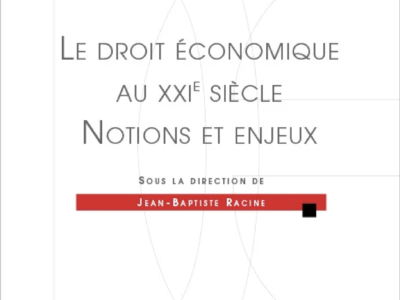
📝La compliance, in 🕴️J.-B. Racine (ed.), 📕Le droit économique au XXIe siècle. Notions et enjeux

► Full Reference: M.-A. Frison-Roche, "La compliance" ("Compliance"), in J.-B. Racine (ed.), Le droit économique au XXIe siècle. Notions et enjeux, LGDJ, "Droit & Économie" Serie, 2020, pp. 97-108 - 📝read the article (in French) - 🚧read the bilingual Working Paper which is the basis of this article, with additional developments, technical references and hyperlinks - 📕read a general presentation of the book, Le droit économique au XXIe siècle. Notions et enjeux, in which this article is published - 📚see the presentation of the other books published in this Serie, founded and directed by Marie-Anne Frison-Roche   ► English Summary of the article:  - 🌐follow Marie-Anne Frison-Roche on LinkedIn 🌐follow Marie-Anne Frison-Roche on Instagram 🌐subscribe to the Newsletter MAFR Regulation, Compliance, Law

Publication director

🏗️ direction of the collection: 📚Droit et Économie

📕Le droit économique au XXIe siècle. Notions et enjeux

Full reference: Racine, J.-B. (ed.), Le droit économique au XXIe siècle. Notions et enjeux, Coll. Droit & Economie, Lextenso – LGDJ, 2020, 726 p. -   Summary of the book : Economic Law has not been so important than today, at a time of phenomenal changes in our societies. Economics are everywhere and Law is directly requested, to accompany, frame and finalize economics. Economic Law, which remain without definition, must be perceived now as a fundamental understanding tool of the realities of our time. This book proposes both to take stock of what Economic Law is at the start of the XXIst century and to give prospective analysis of what it could be in the years to come. It has been designed as a collective research based on  30 key-words (like the firm, the market, globalization, artificial intelligence). Each author has taken a notion by placing it in a logic of Economic Law. It is therefore on a transversal and thematic analysis that the book is based. Economic Law is an open house. While it seeks diverse schools of thought, it gives pride of place to diversity. The book has been realized in this spirit. If it gather many authors from Nice's school, it is also open to other perspectives and opinions. Economic Law, through its research topics and analysis methods is in constant change. This research shows that economics is a topic which crosses every legal branches, beyond business Law.  The book is aimed at students wishing to familiarize themselves with Economic Law process, researchers intending to explore Economic Law themes in depth, and also practitioners who are looking for keys to understanding the current issues raised by the relationship between Law and Economics.    List of authors: Jean-Baptiste Racine Éric Balate Jennifer Bardy Jean-Sylvestre Bergé Walid Chaiehloudj Jacques Chevallier Bruno Deffains Catherine Del Cont Pascale Deumier Isabelle Doussan Aude-Solveig Epstein Marie-Anne Frison-Roche Giulio Cesare Giorgini Lemy Godefroy Marie-Angèle Hermitte Clotilde Jourdain-Fortier Gilles J. Martin Frédéric Marty Séverine Menétrey Mehdi Mezaguer Eva Mouial Bassilana Irina Parachkévova-Racine Thomas Perroud Valérie Pironon Patrice Reis Fabrice Riem Jean-Christophe Roda Mahmoud Mohamed Salah Fabrice Siiriainen Katja Sontag Marina Teller Anne Trescases   Read the table of contents (in French) Read Jean-Baptiste Racine's introductive article (in French) Read Marie-Anne Frison-Roche's article (in French) and read the bilingual working paper on which this article is based. 

Articles in a legal collective publication

Pour une conception humaniste du Droit des affaires et de son enseignement (For a humanist conception of Business Law and of its teaching), in “Un juriste pluriel. Mélanges en l’honneur d’Alain Couret”

Full reference : Frison-Roche, M.A., Pour une conception humaniste du Droit des affaires et de son enseignement (For a humanist conception of Business Law and of its teaching), in Un juriste pluriel. Mélanges en l'honneur d'Alain Couret, Editions Francis Lefebvre and Dalloz, 2020, pp. 985-990.   Read the article   Read the working paper, with additional developments, technical references and hyperlinks on which this article is based   Read the general presentation of the book in which this article has been published

Articles

💬Facebook: Quand le Droit de la Compliance démontre sa capacité à protéger les personnes (Facebook: When Compliance Law proves its ability to protect people)

Full reference: Frison-Roche, M.-A., Facebook: Quand le Droit de la Compliance démontre sa capacité à protéger les personnes (Facebook: When Compliance Law proves its ability to protect people), interview with Olivia Dufour, Actu-juridiques Lextenso, 23rd of November 2020 Read the interview (in French) Read the news of the Newsletter MAFR – Law, Compliance, Regulation about this question