Vigilance

Second conference-debate of the cycle "Contentieux Systémique Émergent" ("Emerging Systemic Litigation")

🧮La vigilance, nouveau champ de contentieux systémique (Vigilance, new field of Systemic Litigation), in cycle of conference-debates “Contentieux Systémique Émergent” (Emerging Systemic Litigation)

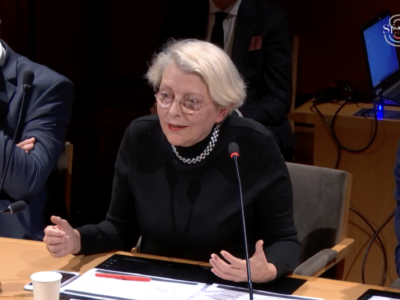
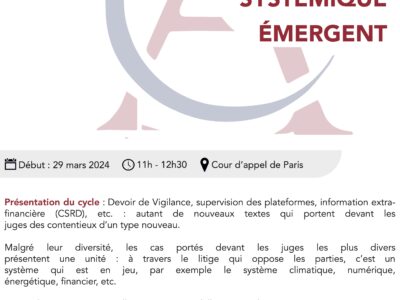
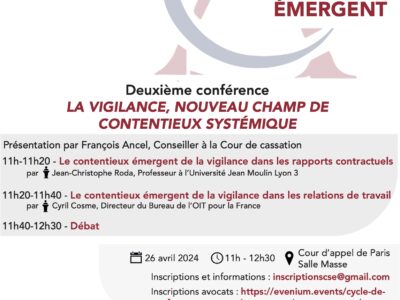
► Full Reference: La vigilance, nouveau champ de contentieux systémique (Vigilance, new field of Systemic Ligation), in [lien a="coordination-du-cycle-de-conferences-de-formation-"]cycle of conference-debates "Contentieux Systémique Émergent" ("Emerging Systemic Litigation")[/lien], organised on the initiative of the Cour d'appel de Paris (Paris Cour of Appeal), with the Cour de cassation (French Court of cassation), the Cour d'appel de Versailles (Versailles Court of Appeal), the École nationale de la magistrature - ENM (French National School for the Judiciary) and the École de formation des barreaux du ressort de la Cour d'appel de Paris - EFB (Paris Bar School), under the scientific direction of Marie-Anne Frison-Roche, 26 April 2024, 11am.-12.30am., Cour d'appel de Paris, Massé courtroom - 🧮[lien a="coordination-du-cycle-de-conferences-de-formation-"]see the full programme of the cycle Contentieux Systémique Émergent (Emerging Systemic Litigation)[/lien] - 🌐see on LinkedIn the report of this event - 🧱read below the report of this event⤵️ - ► Presentation of the conference: The duty of vigilance imposed by the 2017 French law is being contractualised, either by ad hoc contracts or by stipulations that reproduce the legal provisions, adjust them or go beyond them. This adoption by the Contract and Tort Law is valuable but not without risk. The systemic scope of the underlying law on the one hand and of economic structures on the other, the firm or the value chain, will permeate litigation. The example of labour relations is instructive in this respect. - 🧮Programme of this event:  Second conference-debate LA VIGILANCE, NOUVEAU CHAMP DE CONTENTIEUX SYSTÉMIQUE (VIGILANCE, NEW FIELD OF SYSTEMIC LITIGATION)   Paris Court of Appeal, Massé courtroom General presentation of the topic and moderation by 🕴️François Ancel, Judge at the Première Chambre civile de la Cour de cassation (First Civil Chamber of the French Court of cassation) 🕰️11am.-11.20am. 🎤Le contentieux émergent de la Vigilance dans les rapports contractuels (Emerging Vigilance Litigation in Contractual Relationships), by 🕴️Jean-Christophe Roda, Full Professor at Jean-Moulin Lyon 3 University 🕰️11.20am.-11.40am. 🎤Le contentieux émergent de la Vigilance dans les relations de travail (Emerging Vigilance Litigation in Employment Relationships), by 🕴️Cyril Cosme, Director of the French Office of the International Labour Organization (ILO) 🕰️11.40am.-12.30am. Debate - 🔴Registrations and information requests can be sent to: inscriptionscse@gmail.com 🔴For the attorneys, registrations have to be sent to the following address: https://evenium.events/cycle-de-conferences-contentieux-systemique-emergent/  ⚠️The conference-debates are held in person only, in the Cour d’appel de Paris (Paris Court of Appeal). - 🧱read below a detailed presentation of this event⤵️ -
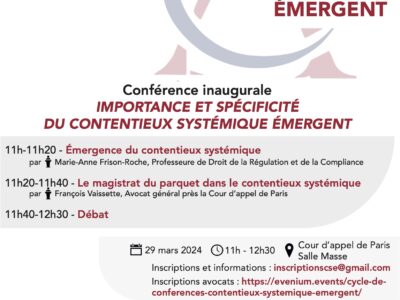
🎤L’émergence du contentieux systémique (Emergence of the Systemic Litigation), in 🧮Importance et spécificité du Contentieux Systémique Émergent, cycle of conference-debates “Contentieux Systémique Émergent”

► Full Reference: [rubrique p="Présentation"]M.-A. Frison-Roche[/rubrique], "L’émergence du Contentieux Systémique" ("Emergence of the Systemic Litigation"), in [lien a="importance-et-specificite-du-contentieux-systemiqu"]Importance et spécificité du Contentieux Systémique Émergent[/lien][lien a="importance-et-specificite-du-contentieux-systemiqu"] (Importance and specificity of the Emerging Systemic Litigation)[/lien], in [lien a="coordination-du-cycle-de-conferences-de-formation-"]cycle of conferences-debates "Contentieux Systémique Émergent" ("Emerging Systemic Litigation")[/lien], organised on the initiative of the Cour d'appel de Paris (Paris Cour of Appeal), with the Cour de cassation (French Court of cassation), the Cour d'appel de Versailles (Versailles Court of Appeal), the École nationale de la magistrature - ENM (French National School for the Judiciary) and the École de formation des barreaux du ressort de la Cour d'appel de Paris - EFB (Paris Bar School), under the scientific direction of Marie-Anne Frison-Roche, March 29, 2024, 11h-12h30, Cour d'appel de Paris, salle Masse - 🧮[lien a="importance-et-specificite-du-contentieux-systemiqu"]see the full programme of this event[/lien] - 🧮[lien a="coordination-du-cycle-de-conferences-de-formation-"]see the programme of the entire cycle Contentieux Systémique Émergent[/lien] - 🌐consult on LinkedIn the report of this speech (in French) - 🌐consult on LinkedIn a general présentation of this event, which links to a presentation and a report of each speech (in French) - 🧱[lien a="importance-et-specificite-du-contentieux-systemiqu"]consult the scientific coordination sheet of this event, which gives an account of the various speeches made[/lien] - 🔲see the slides used to support this intervention (in French) - 🚧read the bilingual Working Paper which is the basis of this speech - ► English Summary of the conference: We are seeing the emergence of what should be referred to as a category of its own: the "Systemic Litigation". This concept, proposed in 2021📎[note reference="n1"], refers to the hypothesis in which a system is 'involved' in a particular 'case' submitted to the judge. The presence of a system should not be confused with a systemic analysis of a phenomenon. The term 'cause' must be understood in the procedural sense, as used in article 5 of the Code civil (French Civil Code). Specifically, the prohibition contained in article 5 of the French Civil Code does not apply because a system thus involved calls for factual responses and solutions and not necessarily general and abstract solutions: the solution of a systemic nature and scope, that the presence of a system in a cause calls for, may be a factual solution, even if it radiates out from the system as a whole. But precisely because the presence of a system in the case often gives rise to a question that is itself systemic, the judge, if he wishes to comply with article 4 of the French Civil Code, must respond not only a minima by not evading the question, for example of systemic risks, but also fully by providing systemic solutions, for example remedies to preserve in the future the solidity and durability of the systems involved in the case.    These systems may be of different kinds: banking, financial, transport, health, energy, digital, algorithmic or climatic. Their presence in cases brought to the attention of judges, the variety and difficulties of which will be seen in later contributions, leads to basic questions relating to the emergence of Systemic Litigation: firstly, how can Systemic Litigation be defined? Secondly, what makes this category of litigation emerge? The answers to these two questions have essential practical consequences.  The new solutions must be based on a classic distinction, used in particular in criminal and administrative proceedings, which are more objective, but also in civil proceedings, notably by Hébraud, namely the distinction between the "party to the dispute/litigation" and the "party to the proceedings". Depending on whether it is accepted that the system should be considered as a "party to the litigation", which would allow it, through an entity that is legitimate in expressing it, to allege claims and formulate demands against an adversary, or as a "party to the proceedings", a much broader category, which would allow the judge to hear the interests of the systems involved without individuals being able, on behalf of a system, to formulate claims against or for the benefit of a party to the litigation.     This makes it possible to innovate while preserving the measure of which the judge is the guardian.   - 🌐follow Marie-Anne Frison-Roche on LinkedIn 🌐follow Marie-Anne Frison-Roche on Instagram 🌐subscribe to the Newsletter MAFR Regulation, Compliance, Law

Teaching for the École nationale de la magistrature - ENM (French National School for the Judiciary)

⚖️Droit de la compliance (Compliance Law)

► Full Reference: F. Ancel &  [rubrique p="Présentation"]M.-A. Frison-Roche[/rubrique], Droit de la compliance (Compliance Law), École nationale de la magistrature - ENM (French National School for the Judiciary), in collaboration with the École de Formation professionnelle des Barreaux du ressort de la cour d'appel de Paris - EFB (Paris Bar School), Paris, February 1 and 2, 2024 This teaching is given in French. - 🌐consult on LinkedIn a general présentation of this event, which links to a presentation and a report of each speech - ► Presentation of the Teaching: The aim of this two-day conference is to enable judges and lawyers to grasp the issues, objectives and methods that define Compliance Law as it is practised in companies. The speakers will illustrate the growing trend towards litigation, which is difficult to reconcile with the supranational dimension, or even indifference to territories, for example when disputes concern systemic climate or digital issues: the result is a renewal of the role of the judge and the role of lawyers. This must be set against the renewal of the role and operation of companies themselves. This is analysed from the perspective of Civil Law, in particular Contract Law and Liability Law. Company Law and Criminal Law are also addressed, as well as the way in which the legal system now integrates governance, regulation, climate and digital issues and the smooth operation of financial markets through Compliance techniques. - ► Organisation of the Teaching: This conference is divided into two parts. The first day is designed as a presentation of the major themes through which Compliance Law crosses the branches of traditional Law. The speakers will be professors of Law who will successively summarise the branches of Law and put into perspective the way in which Compliance imperatives give rise to new situations, new difficulties and new solutions. This enables the second day to focus on practical and topical issues and to debate controversial questions between people of different sensibilities. The participants tend to be judges, members of regulatory authorities, lawyers, members of associations and so on. - ► Enrolment procedure: The course is open to all judicial and consular magistrates, as well as lawyers. Registrations can be made directly with the ENM or with the EFB. - ► Speakers :   🎤François Ancel, Judge at the Première Chambre civile de la Cour de cassation (First Civil Chamber of the French Court of cassation)  🎤Thomas Baudesson, Attorney at the Paris Bar, Partner at Clifford Chance 🎤Guillaume Beaussonie, Full Professor at Toulouse 1 Capitole University 🎤Jacques Boulard, Premier Président de la Cour d’appel de Paris (First President of the Paris Court of Appeal) 🎤Marie Caffin-Moi, Full Professor at Paris Panthéon-Assas University 🎤Malik Chapuis, Judge at the Tribunal judiciaire de Paris (Paris First Instance Civil Court) 🎤Lucie Chatelain, Advocacy and Litigation Manager - Civil Liability of Parent Companies, Sherpa 🎤Jean-Benoît Devauges, Directeur Juridique, Ethique et Gouvernance des entreprises (Legal, Ethics and enterprises governance Director), MEDEF 🎤Marie-Anne Frison-Roche, Professor of Regulatory and Compliance Law, Director of the Journal of Regulation & Compliance (JoRC) 🎤Arnaud Gossement, Attorney at the Paris Bar, Partner at Gossement Avocats 🎤Thibault Goujon-Bethan, Full Professor at Jean Moulin Lyon 3 University 🎤Christophe Ingrain, Attorney at the Paris Bar, Partner at Darrois Villey Maillot Brochier 🎤Isabelle Jegouzo, Director of the Agence française anticorruption - AFA (French Anti-Corruption Agency)  🎤Anne-Valérie Le Fur, Full Professor at Versailles Saint-Quentin-en-Yvelines University 🎤Charlotte Michon, Attorney at the Paris Bar, partner at Charlotte Michon Avocat 🎤Jean-Baptiste Racine, Full Professor at Paris Panthéon-Assas University 🎤 Jean-Christophe Roda, Full Professor at Jean-Moulin Lyon 3 University 🎤Jérôme Simon, 1er Vice-Procureur Financier (First Financial Vice-Prosecutor) - 🧮read below the programme put together and organised by François Ancel and Marie-Anne Frison-Roche, as well as the reports of each presentation⤵️ - 🌐follow Marie-Anne Frison-Roche on LinkedIn 🌐follow Marie-Anne Frison-Roche on Instagram 🌐subscribe to the Newsletter MAFR Regulation, Compliance, Law

MERABET, Samir🕴️

📝Vigilance, being a judge and not judge, in 🕴️M.-A. Frison-Roche (ed.), 📘Compliance Jurisdictionalisation

► Full Reference: S. Merabet, "Vigilance, being a judge and not judge", in [rubrique p="Présentation"]M.-A. Frison-Roche[/rubrique] (ed.), [lien a="compliance-juridictionnalisation"]Compliance Jurisdictionalisation[/lien], Journal of Regulation & Compliance (JoRC) and Bruylant, "[rubrique p="Responsabilités éditoriales > Direction de la collection Compliance & Regulation, JoRC et Bruylant"]Compliance & Regulation[/rubrique]" Serie, 2024, pp. 217-228 - 📘read a general presentation of the book, [lien a="compliance-juridictionnalisation"]Compliance Jurisdictionalisation[/lien], in which this article is published - ► Summary of the article: - 🦉This article is available in full text to those registered for Professor Marie-Anne Frison-Roche's courses -

🧱Co-organisation of the Symposium 🧮Compliance et contrats publics (Compliance and public contracts)

► Full Reference: [rubrique p="Présentation"]M.-A. Frison-Roche[/rubrique], C. Gilles and A. Oumedjkane (dir.), [lien a="compliance-et-contrats-publics"]Compliance et contrats publics (Compliance and public contracts)[/lien], Journal of Regulation & Compliance (JoRC), Centre de recherches et d’études administratives de Montpellier (CREAM) and Centre d’Études et de Recherches Comparatives Constitutionnelles et Politiques (CERCOP) of the Montpellier University, Faculté de droit et de science politique de Montpellier, January 12, 2024 - 🌐consult a general presentation of this event on LinkedIn, linking to a presentation of each speech (in French) - 🏗️This symposium takes place in the [lien a="cycle-de-colloques-2023-lobligation-de-compliance"]cycle of symposiums organised by the Journal of Regulation & Compliance (JoRC) and its partners Universities, focusing in 2023-2024 on the general theme of the Compliance Obligation[/lien] - 📚The works will then be inserted in the books:  📕[lien a="compliance-et-contrat"]Compliance et contrat[/lien], to be published in the 📚[rubrique p='Responsabilités éditoriales > Direction de la collection "Régulations & Compliance", JoRC & Dalloz']Régulations & Compliance[/rubrique] Serie, co-published by the Journal of Regulation & Compliance (JoRC) and Dalloz, published in French. 📘Compliance & Contract, to be published on the 📚[lien a="compliance-monumental-goals"]Compliance & Regulation[/lien] Serie, co-published by the Journal of Regulation & Compliance (JoRC) and Dalloz, published in English. - ► General presentation of the symposium: Compliance is developing throughout the legal system, through both Public and Private Law techniques. Public Contract Law bears witness to this in two ways: through its scope, in that Compliance applies to economic relationships entered into by public bodies, and through its object, which internalises a reconciliation between their economic interests and a set of other general interest objectives, or "Monumental Goals", a reconciliation for which public bodies have traditionally been responsible. In addition to unilateral acts, contracts have their rightful place as a practical means of achieving this reconciliation. Its flexibility allows for negotiation and adjustment of the burdens to be placed on the co-contracting parties. The aim of this symposium is to link the different manifestations of the Compliance Obligation in public contracts and thus give coherence to policies which are still too often considered in a watertight manner because they relate to very different aims and areas. Firstly, at the procurement stage, the promotion of responsible or innovative procurement, particularly from an environmental point of view, is one of the signs of Compliance's presence. On a completely different note, the same is true of the CJEU's challenge to the automatic application of bans on tendering, which prevent contracting authorities from ruling on a candidate's reliability by taking into account the compliance programmes implemented by companies since their conviction. Secondly, at the litigation stage, the Conseil d'État's (French Council of State) recent broad recognition of the illegality of an administrative contract on the grounds of a breach of ethical obligations has tempered the drive to make contracts more secure, drawing the consequences of the major drive for transparency in public life that has been underway since 2013. The aim of the morning session will be to understand the various forms of the Compliance Obligation in public contracts. This overview will make it possible, in the afternoon, to aim to unify the Compliance Obligation in public contracts. - - ► Speakers:  🎤Ugo Assouad, PhD student at the Montpellier University, CREAM 🎤Philippe Augé, President of the Montpellier University 🎤Clémence Ballay-Petizon, PhD student at the Montpellier University, CREAM  🎤Yannisse Benrahou, PhD student at Paris-Nanterre University, CRDP 🎤Léon Boijout, PhD student at the Montpellier University, CREAM 🎤Julien Bonnet, Full Professor at the Montpellier University, CERCOP 🎤Guylain Clamour, Dean of the Montpellier Faculty of Law and Political Science 🎤Marie-Anne Frison-Roche, Professor of Regulatory and Compliance Law, Director of the Journal of Regulation & Compliance (JoRC) 🎤Pierre-Yves Gadhoun, Professor at the Montpellier University, CERCOP 🎤Pascale Idoux, Professor at the at the Montpellier University, CREAM 🎤Nedjma Kontoukas, PhD student at the Montpellier University, CREAM 🎤Valentin Lamy, Senior Lecturer at the Lorraine University, IRENEE 🎤Antoine Oumedjkane, Senior Lecturer at Lille University, ERDP 🎤Lucien Rapp, Emeritus Professor at Toulouse Capitole University 🎤Marion Ubaud-Bergeron, Full Professor at the Montpellier University, CREAM  - 🧮Read a detailed presentation of the event below⤵️ - 🌐follow Marie-Anne Frison-Roche on LinkedIn 🌐follow Marie-Anne Frison-Roche on Instagram 🌐subscribe to the Newsletter MAFR Regulation, Compliance, Law

🧱⚙️Coordination of the cycle of conference-debates 🧮Contentieux Systémique Émergent – CSE (Emerging Systemic Litigation – ESL)

► Full Reference: [rubrique p="Présentation"]M.-A. Frison-Roche[/rubrique], Coordination of the cycle of conference-debates Contentieux Systémique Émergent (Emerging Systemic Litigation), organised on the initiative of the Cour d'appel de Paris (Paris Cour of Appeal), with the Cour de cassation (French Court of cassation), the Cour d'appel de Versailles (Versailles Court of Appeal), the École nationale de la magistrature - ENM (French National School for the Judiciary) and the École de formation des barreaux du ressort de la Cour d'appel de Paris - EFB (Paris Bar School), under the scientific direction of Marie-Anne Frison-Roche - ► This Cycle in few words: Duty of vigilance, supervision of platforms, non-financial information (CSRD), etc.: as many new texts that bring new types of disputes before the courts. Despite their diversity, the cases brought before the most diverse judges present a unity: through the dispute that pits the parties against each other, it is a system that is at stake, for example the climate system, digital system, energy system, financial system, etc. New regulations are just the illustration of this "Emerging Systemic Litigation"; the conference-debates aiming at showing the new fields, new techniques, new standards, etc., in relation to the scale and diversity of stakeholders' expectations. This cycle is designed to encourage cross-fertilisation, so as to provide judges with food for thought ahead of the litigation they will be called upon to deal with. Les réglementations nouvelles ne sont que l’illustration de ce « contentieux systémique émergent » dont la formation a pour objet de montrer les nouveaux champs, les nouvelles techniques, les nouvelles normes, etc., en lien avec l’ampleur et la diversité des attentes des parties prenantes. Le cycle vise à favoriser les échanges croisés, afin d’alimenter la réflexion des magistrats en amont des litiges qui leurs seront soumis. - 🔴Registrations and information requests can be sent to: inscriptionscse@gmail.com 🔴For the attorneys, registrations have to be sent to the following address: https://evenium.events/cycle-de-conferences-contentieux-systemique-emergent/  ⚠️The conference-debates are held in person only, in the Cour d’appel de Paris (Paris Court of Appeal). - ► General Presentation of the Cycle: In 2024, the Cour d’appel de Paris (Paris Court of Appeal) created a new specialised chamber: chamber 5-12 Contentieux émergent – Devoir de vigilance et responsabilité écologique (Emerging litigation - Duty of vigilance and environmental liability). Vigilance litigation is an example of what is emerging more generally: Systemic Litigation, often linked to technologies. This calls for a new way of judging, organising procedures and relations between professionals. A series of conference-debates on Emerging Systemic Litigation (ESL) is being organised jointly by the Paris Court of Appeal, the Versailles Court of Appeal, the Cour de cassation (French Court of cassation), the École nationale de la magistrature - ENM (French National School for the Judiciary) and the École de formation des barreaux du ressort de la Cour d'appel de Paris - EFB (Paris Bar School), under the scientific responsibility of Professor Marie-Anne Frison-Roche. In this context, a series of conference-debates involving professionals from a wide range of backgrounds is being proposed on the following themes: 🧮the very notion of "Emerging Systemic Litigation" and the role of the judiciary in it (29 March 2024): [lien a="importance-et-specificite-du-contentieux-systemiqu"]read the report of this event[/lien]   🧮vigilance, insofar as it gives rise to Systemic Litigation, notably because it takes legal form in numerous contracts, for example in employment relationships (26 April 2024): [lien a="la-vigilance-nouveau-champ-de-contentieux-systemiq"]read the report of this event[/lien]   🧮the inclusion in Emerging Systemic Litigation of information reliability techniques, particularly with regard to content available on platforms (27 May 2024): [lien a="les-techniques-de-supervision-des-contenus-numeriq"]read the report of this event[/lien]   🧮the way in which artificial intelligence is generating Systemic Litigation and the influence of new specific texts (24 June 2024): [lien a="lintelligence-artificielle-nouveau-champ-de-conten"]read the report of this event[/lien]   🧮sustainability, a principle of systems found in reports and transitively in disputes concerning their development, their standards and even their control (9 September 2024): [lien a="la-portee-des-normes-de-droit-dur-de-droit-souple-"]read the programme of this event[/lien]   🧮new evidentiary techniques required by Emerging Systemic Litigation, to account for systemic needs, e.g. climate and digital systems, and how firms respond to them (14 October 2024): [lien a="les-techniques-probatoires-adequates-dans-le-conte"]read the programme of this event[/lien]   🧮Vigilance General Procedural Law, in that it incorporates the Systemic dimension of Vigilance Litigation (18 November 2024): [lien a="le-droit-processuel-de-la-vigilance-in-cycle-de-co"]read the programme of this event[/lien]   🧮institutional and case law feedback from courts on Emerging Systemic Litigation (16 December 2024): [lien a="lexperience-des-juridictions-dans-le-contentieux-s"]read the programme of this event[/lien] - 🧮read below the full programme of this cycle of conference-debates⤵️

Working Paper

🚧Duty of vigilance: the way forward

► Full Reference: [rubrique p="Présentation"]M.-A. Frison-Roche[/rubrique], Duty of vigilance: the way forward, Working Paper, December 2023/July 2024. - 🎤 This working paper has been drawn up to serve as a basis for the [lien a="conclusions-in-le-principe-de-due-diligence"]conclusions of the colloquium Le devoir de vigilance: l'âge de la maturité? ("The duty of vigilance: the age of maturity?") organised by the University of Montpellier on 25 May 2023[/lien]. - 📝 Updated and developed, it serves as the basis for the [lien a="synthese-inla-societe-vigilante"]article that concludes the book [/lien][lien a="synthese-inla-societe-vigilante"]Le devoir de vigilance des entreprises : l'âge de la maturité? ("The duty of vigilance: the age of maturity?")[/lien], Editions Bruylant, 2024.   - ► Working Paper summary: In 2017 in France the so-called Vigilance law expressed great ambition. So did the draft directive. But in 2024 the European institutions moderated this ambition by refusing to increase either the type of companies subject and the constraints to which the duty of vigilance is associated. The directive has essentially halted what was for some the "march of progress". Does the ambition no longer exist? Does the future lie in an extension of the philosophy of the duty of vigilance, i.e. companies that should always be more concerned about others? This would undoubtedly be reaching the "age of maturity", where others see the age of madness, because it would be a contradiction in terms to ask a company to be concerned about anything other than its own development. It is therefore appropriate to consider this very hypothesis of an "age of maturity" as being an ambition maintained despite a European directive which, in its adopted version, is weakened and while the oppositions are intact (I). First of all, it must be admitted that the notion of "maturity" most often conceals a value judgment when applied to a legal concept (I.A.) and that this is blatantly obvious with regard to the duty of vigilance, which is considered by some and by nature by some as a good and by others as an evil (I.B). In order not to remain in what appears to be trench warfare, we must not get too bogged down in the reference French legislation of 2017 and what appears to be a European stutter in 2024, arguing so loudly that we can hear them reasoning in print, by paying attention to less visible and now more promising avenues of progress (II). In fact, the duty of vigilance can progress simply by the passage of time (II.A), by a better definition of the vocabulary (II.B), by the consolidation of the principles of Responsibility and Dialogue (II.C), by the uniqueness of the jurisdictional route (II.D). This last perspective of the progress that will be made possible in France by the uniqueness of the judicial route leads to a final avenue of progress. By their very nature, laws are jolts, all the more violent for being disputed. At the moment, if we want to make progress, these two other sources - the contract and the judge - must be favoured (III). The European directive is rightly concerned with access to the courts and takes a measured view of the effectiveness of contracts as a means of making the duty of vigilance effective, with the courts having to ensure that the contract does not destroy the spirit of the system. This is what the law already organises about the relationship between the contract, the judge and the duty of compliance (III.A). What is new in Europe in 2024 is the introduction of a Supervisor (III.B). Here again, vigilance is the "cutting edge" of Compliance Law, as it is an extension of Regulatory Law.  The result is that, through interpretation and the handling of principles, and to formulate a more general conclusion, it is the judge who holds and will hold the balance of the duty of vigilance.     - 🔓read the Working Paper below⤵️ - 🌐follow Marie-Anne Frison-Roche on LinkedIn 🌐follow Marie-Anne Frison-Roche on Instagram 🌐subscribe to the Newsletter MAFR Regulation, Compliance, Law

final speech of a scientific manifestation

🎥 5 leçons en conclusions ouvertes (5 Lessons in Open Conclusions), in 🧮Compliance, vigilance et médiation

► Full Reference: [rubrique p="Présentation"]M.-A. Frison-Roche[/rubrique], "Conclusion", in M. Boissavy, H. Dehghani-Azar, and M.-A. Frison-Roche (dir.), Journal of Regulation & Compliance (JoRC) and Conseil national des Barreaux (CNB), [lien a="compliance-et-mediation"]Compliance, vigilance et médiation (Compliance, Vigilance and Mediation)[/lien], Amphitheatre of the Conseil national des Barreaux, November 30, 2023. - 🧮[lien a="compliance-et-mediation"]see the full programme of this event[/lien] - 🌐follow Marie-Anne Frison-Roche on LinkedIn 🌐follow Marie-Anne Frison-Roche on Instagram 🌐subscribe to the Newsletter MAFR Regulation, Compliance, Law

conference

🎤Participation in the🏛️Law Day🧮Normes de Responsabilité Sociale des Entreprises /RSE & Devoir de Vigilance (Corporate Social Responsibility Standards /CSR & Duty of Vigilance)

🌐follow Marie-Anne Frison-Roche on LinkedIn 🌐subscribe to the Newsletter MAFR Regulation, Compliance, Law - ► Full Reference: [rubrique p="Présentation"]M.-A. Frison-Roche[/rubrique], Participation à la Table ronde "Normes de Responsabilité Sociale des Entreprises (RSE & Devoir de Vigilance)" (Participation in the Round Table "Corporate Social Responsibility Standards (CSR & Duty of Vigilance)"), in Fribourg University, Journée du Droit, Fribourg University, Pérolles site, room C230, October 2, 2023. - 🧮see the full programme of this event 🎥​watch the video of this event (in French) - 🌐read the report written in French with photos, tags and links on LinkedIn and also with links to each the speech - ► General presentation of the event : This conference, build around 4 presentations and a debate between the speakers and then with the audience, aimed at explaining and understanding this fundamental movement and the new texts that express it in Switzerland, even if it is French law, such as the so-called 'Vigilance' law of 2017 and the draft European CS3D directive, because on the one hand it is a movement that begins with legal technique and on the other hand the texts in question are extraterritorial in scope, if only because of the notion of 'value chain'. In the first part of this round table, and to set the scene, I will outline the origin and content of the French 'Vigilance' law, the way in which the draft directive draws heavily on it, its relationship with Compliance Law, of which it constitutes the 'advanced point', and the decisive role it gives to the courts, in the general movement of the jurisdictionalisation of compliance. The purpose of this is to allow the discussion to get underway. 🕴️Idris Abdelkhalek, PhD candidate and lawyer, introduced the speakers and led the debate between them and the audience. He took questions from the audience on the intensity of the obligation weighing on companies, in particular between civil liability and criminal liability, between the obligation of means and the obligation of result, and on the way in which the duty of vigilance is applied to specific sectors such as defence. - ► Presentation of my speech : the subject of which was Presentation of French Vigilance law, European perspective and European Compliance System. My presentation was divided into four points. Firstly, I outlined the state of Law in France, in the novelty represented by the 2017 law known as the "Vigilance" law, whose principles are simple and strong, principles that are situated in the aims pursued, and the way in which this law inspires what is currently being negotiated: the CS3D Directive. Secondly, I stressed the need for companies to master these often technically complicated corpus, especially if we take into account the link between Vigilance and the CSRD directive on sustainability reporting and extra-financial information.  Thirdly, I have shown that an overall understanding can nevertheless be achieved, and that the technical nature of the 'tools' is better mastered if we place the duty of vigilance within Compliance Law, of which it constitutes the 'advanced point'. All of this anchors its legal normativity in the 'Monumental Goals' it serves, which in Europe are humanistic, since the aim is to protect, now but above all in the future because it is a branch of ex ante Law, the human beings involved in the systems (banking, finance, energy, digital, climate, etc.). Fourthly, I emphasised that this understanding enables everyone to play their part: political and public authorities, businesses and stakeholders. Even more, and at the heart of the matter, the judge plays an essential role, even in countries with so-called 'continental' Law. I have used current cases as examples. This is just the beginning, and judges need to train, specialise and work in dialogue to achieve this. - ► Presentation of the other speakers contributions : 🕴️Marion Paradas, Ambassador of France to Switzerland and Liechtenstein, opened the conference and gave a general presentation of the theme. Ambassador Marion Paradas presented the international challenge represented by Law, illustrated here by the duty of vigilance. She emphasised that this is a major issue, both now and in the future, for Swiss companies and French companies based in Switzerland, particularly as this duty extends throughout the "value chain" and in view of the CS3D directive, which will also have consequences for both. 🕴️Isabelle Chabloz Waidacher, Professor at the Faculty of Law in Fribourg and holder of the Chair of Economic Law at the University of Fribourg, gave a Presentation of Swiss Law. In particular, she emphasised the state of Swiss Law, which could have gone further than the 2017 French law known as the "Vigilance" law if the popular initiative reference had led to the adoption of a law, and which currently focuses more on information and transparency obligations, with CSR taking over from there. But she stresses that the reality of value chains will force Swiss companies to take into account the requirements of the European directive currently being adopted. 🕴️Renaud Roussel, Managing Director of Colas Switzerland, presented an entrepreneurial view of the subject. He began by outlining the concrete steps taken by his industrial group in Switzerland and around the world to implement its commitments to protect the environment, for example by ensuring the proper use of materials used in road construction. He also stressed the importance of human rights, particularly in labour relations, in the context of CSR and vigilance. He went on to point out that it was not always easy for a large company to meet its own requirements, or the requirements imposed on it by the law, because in the construction and public works sector in particular it is often small companies that are competing, competitors who do not bear the costs of such obligations. -

🎤Conclusion, in 🧮L’eau : entre protection de la ressource et conflits d’usage

🌐follow Marie-Anne Frison-Roche on LinkedIn 🌐subscribe to the Newsletter MAFR Regulation, Compliance, Law - ► Full Reference: [rubrique p="Présentation"]M.-A. Frison-Roche[/rubrique], "Conclusion", in Club des avocats environnementalistes, L’eau : entre protection de la ressource et conflits d’usage, Maison des Avocats, Auditorium, September 28, 2023. - 🧮see the full programme of this event -

📝La vigilance, pièce d’un puzzle européen (Vigilance, a piece of the European puzzle), in 📙La société vigilante

🌐follow Marie-Anne Frison-Roche on LinkedIn 🌐subscribe to the Newsletter MAFR Regulation, Compliance, Law - ► Full Reference: [rubrique p="Présentation"]M.-A. Frison-Roche[/rubrique], "La vigilance, pièce d'un puzzle européen" ("Vigilance, a piece of the European puzzle"), in I.Grossi (ed.), La société vigilante, JCP E, No. 31-35, 3 août 2023, pp. 57-58. - 📙this article is the conclusion of this special issue. It is linked to the introductory article of this special issue: 📝[lien a="penser-et-manier-la-vigilance-par-ses-buts-monumen"]Penser et manier la vigilance par ses buts monumentaux de compliance (Thinking and using Vigilance through its Compliance Monumental Goals)[/lien] - 🧮the 2 articles follow on from the introductory and concluding speeches in the colloquium [lien a="synthese-inla-societe-vigilante"]La Société vigilante, held at the University of Aix Marseille on 24 March 2023[/lien] - 🚧read the [lien a="la-vigilance-piece-dun-puzzle-europeen"]bilingual Working Paper which is the basis of this article[/lien], with additional developments, technical references and hyperlinks - ► Summary of the article: The contributions form a contrasted whole. It should not be concluded that some of them are correct and others false: through the reading that each one makes of the so-called French 2017 "Vigilance law," it is a vision of the world as it should be that each author proposes. Because Compliance Law, which Vigilance is a part, claims to draw the future, it is normal that each author should draw the present Law with a hand that bends in one direction or the other, following their conception of the future world. The whole contributions must be seen as a dialogue. A lively dialogue, with this French 2017 law receiving a lot of "glory" and a lot of "indignity" on both sides, from which it is necessary to emerge in order to find solutions, because it is a fundamental movement of which this law is only a gateway (I).  Whatever one thinks of it, it is all the branches of law that are used, affected, and transformed by Vigilance (II). To master this profound transformation, we must turn to Europe, to the great puzzle of texts recently adopted or in the process of being adopted in the European Union, of which Vigilance is the hallmark (III). - 📝read the article (in French) -