Procedure

Texts

Decree of 1 August 2014 Décret du 1er août 2014 relatif à la procédure de sanction de l’Autorité de régulation des communications électroniques et des postes (ARCEP) -on the procedure for sanction of the Regulatory Authority for Electronic Communications and Posts (ARCEP)

To read the decree, in French . To read the modifications of the Code des postes et des communications électroniques.[ French […]

Articles in a legal collective publication

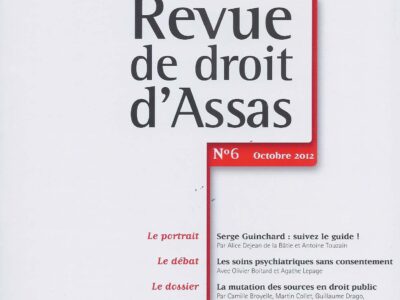
📝Experts et procédure : l’amicus curiae (Experts and procedure: the amicus curiae)

► Référence complète : M.-A. Frison-Roche, "Experts et procédure : l'amicus curiae" ("Experts and procedure: the amicus curiae"), Revue de droit d'Assas, october 2012, pp. 91-94 - 📝read the article (in French) - ► English Summary of the article: A recent thesis has argued that amicus curiae is becoming a common principle of Procedural Law. This shows its importance. The fact that the mechanism, the character, is designated by a Latin formula leads us to suspect that something is being concealed that legal technique ordinarily forbids: it is the legal expert and the party's expert, which is what the amicus curiae most often is, either one or the other, or both at the same time. Therefore, removing the prudish cloak of Latin, it is these two difficulties that must be addressed. If we exclude the legal expert, it is because "jura novit curia" ("the court knows Law". But this rule, which recalls the principle that "no one is supposed to be ignorant of the law", merely indicates a sharing of the burden of evoking facts and Law between the parties and the judge (Motulsky) and not a presumption of knowledge. Consequently, the modest, and therefore self-confident, judge has no reason, either psychological or legal, to shy away from a legal expertise. As for the party's expert, or the judge's expert who is highly influenced by a party, a profession, a social group, in short, a judge's expert who is in fact an expert held by a party, this can only be a problem if the judge cannot keep his distance from this expert whose opinion is biased by the weight of the party. But first of all, any opinion is biased. Whether it is given in bad faith or good faith, it is biased, and in rhetoric we know that an opinion biased in good faith is more dangerous than a bought opinion, because the latter is known to be twisted by self-interest. In this respect, the person who listens to it, the judge, knows the difference. Indeed, the legal system that recognises the party's expert and the amicus curiae, i.e. North American Law or European Union Law, draws the necessary procedural consequence: they include the party's expert opinion in the adversarial debate. It is the principle of adversarial debate, the principle of principles in the conduct of proceedings, that makes amicus curiae acceptable and welcome, since it provides the judge with a scientific input that the latter does not have. -

I-2.4: The principle of the neutrality of standards (the example of accounting standards)

Translated Summaries ENGLISH The subject of neutrality brings to my mind a certain number of preliminary ideas and reminiscences. First of all, the image of Buddha comes to mind, because it alone expresses the extent to which neutrality is an endless subject, since by thinking about the fact that he isn’t thinking about anything, Buddha is still thinking about something. It also makes me think of contemporary music’s constant attempts to attain a form of neutrality: yet this goal remains unattainable, because it is evident that the search for the neutral, in a sound or a timbre, can probably never be found.   FRENCH Tout d’abord, la figure du Bouddha, qui exprime à elle seule combien la question de la neutralité est un thème sans fin, car en pensant qu’il ne pense à rien, le Bouddha pense malgré tout à quelque chose. Il me fait penser aussi à la musique contemporaine, à son souci constant d’atteindre une forme de neutralité ; préoccupation à jamais déçue lorsqu’elle reconnaît ultimement que le neutre, en ayant toujours une qualité – un son, un timbre – est probablement introuvable.   SPANISH El principio de los estándares de la neutralidad (el ejemplo de estándares de contabilidad) El tema de la neutralidad trae a luz un cierto número de ideas preliminares. Para comenzar, la figura de Buda viene a mente, porque él sólo expresa la naturaleza interminable que es el tema de la neutralidad, ya que al pensar en el hecho de que él no piensa en absolutamente nada, Buda aún así piensa en algo. También me hace pensar el intento constante de la música contemporánea de alcanzar una forma de neutralidad: pero este objetivo permanece inalcanzable, porque es evidente que la búsqueda de lo neutral, en un sonido o un timbre, probablemente nunca se podrá encontrar. ………………… Other translations forthcoming.

I-2.3: Neutralization in economically regulated industries using procedural law techniques

Translated Summaries ENGLISH Article: Neutralization in economically regulated industries using procedural law techniques In itself, regulation does not necessary require judicial review of regulators’ acts, whether the regulator is a ministry or an independent authority. In short, regulators could have the “last word” in all circumstances. However, because of an equal concern for democratic legitimacy and care to respect its international commitments, the French Parliament is convinced that judicial review over regulators’ actions is necessary. - FRENCH Article : La neutralisation dans les secteurs économiques régulés par les techniques procédurales En soi, la régulation n’appelle pas nécessairement un contrôle juridictionnel du régulateur, qu’il soit une administration ou une autorité indépendante. Ce régulateur, sommes toutes, pourrait avoir en toutes circonstances « le dernier mot ». Pourtant, moitié par conviction démocratique, moitié par prudence en raison de ses engagements internationaux, le législateur français s’est convaincu qu’un tel contrôle était indispensable. - SPANISH Artículo: Neutralización en industrias económicamente reguladas usando técnicas del derecho procesal. En sí mismo, la regulación no requiere de revisión judicial de las acciones del regulador, ya sea que el regulador es un ministerio o una autoridad independiente. Para resumir, los reguladores podrían tener la “última palabra” en todas las circunstancias. No obstante, una preocupación por la legitimidad democrática y deseo de respetar sus compromisos internacionales, el Parlamente francés está convencido que una revisión judicial sobre las acciones de los reguladores es necesaria. -   ………………… Other translations forthcoming.

I-1.31: The Competition Authority between “regulation” and competition policiy

Translated Summaries ENGLISH Two and a half years after having been established by the LME, the French Competition Authority has uncontestably acquired its “place in the sun” amongst the competition authorities of other countries, as demonstrated by multiple indicators.   ITALIAN Articolo: L’Autorità garante della concorrenza tra “regolazione” e politica in materia di concorrenza Due anni e mezzo dopo l’instaurazione da parte del LME, l’Autorità francese garante della libera concorrenza ha trovato il suo posto tra le diverse autorità degli altri paesi, così come è stato dimostrato da diversi indicatori. SPANISH Artículo: La Autoridad de la competencia, entre “regulación” y política competitiva.   Después de dos años y medio de haber sido establecido por el LME, la Autoridad francesa de la competencia ha incontestablemente adquirido su “lugar bajo el sol” entre las autoridades de la competencia de otros países, como demostrado por varios indicadores. ………………… Other translations forthcoming.