Procedure

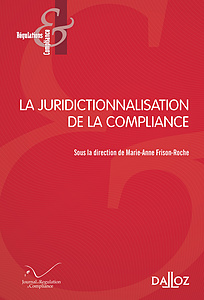
Couverture – La juridictionnalisation de la Compliance

Articles in a JoRC book

📝Le juge, l’obligation de compliance et l’entreprise. Le système probatoire de la Compliance, in🕴️M.-A. Frison-Roche (ed.), 📕La juridictionnalisation de la Complian

► Full Reference: M.-A. Frison-Roche, "Le juge, l'obligation de compliance et l'entreprise. Le système probatoire de la Compliance" ("The judge, the compliance obligation, and the company. The Compliance probationary system"), in M.-A. Frison-Roche (ed.), La juridictionnalisation de la Compliance, coll. "Régulations & Compliance", Journal of Regulation & Compliance (JoRC) and Dalloz, 2023, p 409-442. - 📝read the article (in French) - 🚧read the bilingual Working Paper which is the basis of this article, with additional developments, technical references and hyperlinks  - 📕read a general presentation of the book, La juridictionnalisation de la Compliance, in which this article is published - ► Summary of the article (done by the Journal of Regulation & Compliance): the article aims to identify the link that must be established between the company in its relationship with the compliance obligations it assumes and the judges to whom it is accountable in this respect: this link is established by evidence. The evidentiary system of proof has yet to be constructed, and it is the purpose of this long study to lay the groundwork.  To this end, the article begins with a description of what is designated here as the "probatory square" in a "probatory system" that is superimposed on the system of rules of substantive legal system. This is all the more important because Compliance seems to be in frontal collision in its very principles with the general principles of the evidentiary system, in particular because it seems that the company would have to prove the existence of the Law or that it would have to bear in a definitive way the burden of proving the absence of violation, which seems to be contrary not only to the presumption of innocence but also to the principle of the freedom of action and of undertaking. In order to re-articulate Compliance Law, the obligations of compliance which legitimately weigh on the company, it is necessary to return to the probatory system specific to Compliance, so that it remains within the Rule of Law. This presupposes the adoption of a substantial definition of Compliance, which is not only compliance with the rules, which is only a minimal dimension, but implies that Compliance Law should be defined by the Monumental Goals on which the public authorities and the companies are in substantial alliance. The evidentiary system of principle makes play between its four summits that are the burden of proof, the objects of proof this evidentiary square of principle, between the burden of proof, the means of proof and their admissibility. Compliance Law does not fall outside this evidential square, thus marking its full membership of the Rule of Law In order to lay the foundations of the evidential system specific to Compliance Law, the first part of the article identifies the objects of proof which are specific to it, by distinguishing between the structural devices, on the one hand, and the expected behaviours, on the other. The first involves proving that the structures required to achieve the Monumental Goals of Compliance have actually been put in place. The object of proof is then the effectiveness of this implementation, which presents the effectiveness of the system. As far as behavioral obligations are concerned, the object of proof is the efforts made by the company to obtain them, the principle of proportionality governing the establishment of this proof, while the systemic efficiency of the whole reinforces the evidential system. However, the wisdom of evidence lies in the fact that, even though the principle remains that of freedom of evidence, the company must establish the effectiveness, efficiency, and effectiveness of the whole, independently of the burden of proof. The second part of the article concerns those who bear the burden of proof in Compliance Law. The latter places the burden of proof on the company in principle, in view of its legal obligations. This burden comes from the legal origin of the obligations, which blocks the "round of the burden of proof". But in the interference of the different vertices of the evidentiary square, the question becomes more delicate when it comes to determining the contours of the compliance obligations that the company must perform. Moreover, the burden of proof may itself be the subject of proof, just as the company's performance of its legal obligations may also be the subject of contracts, which brings us back to the evidentiary system ordinarily applicable to contractual obligations. The situation is different when it comes to a "compliance contract" or when it comes to one or more compliance stipulations, concepts that are still not very well developed in Contract Law.  Furthermore, as all branches of Law belong to a legal system governed by the Rule of Law, other branches of law interfere and modify the methods and solutions of proof. This is the case when the fact, which is the object of proof, can give rise to a sanction, the Law of repression imposing its own solutions in the matter of the burden of proof.  In the third part of the article, the relevant means of proof in Compliance Law are examined, used in that Compliance Law is above all a branch of Law whose object is on the one hand information and on the other hand the Future. Open questions remain, such as whether companies could be forced by the Judge to build technologies to invent new means of proof. To show that they are indeed achieving the Monumental Goals they are charged with.  In the fourth part, the vital character of the pre-constitution of evidence is shown, which is the reflection of the Ex-Ante nature of Compliance Law: evidence must be pre-constituted to avoid the very prospect of having to use it, by finding all the means to establish the effectiveness, efficiency and even the effectiveness of the various Compliance Tools.  If companies do all this methodically, the Compliance evidence system will be established, in harmony with the general evidence system, Compliance Law and the Rule of Law. - 🌐 follow Marie-Anne Frison-Roche sur LinkedIn 🌐follow Marie-Anne Frison-Roche on Instagram 🌐subscribe to the Newsletter MAFR Regulation, Compliance, Law 

Couverture – La juridictionnalisation de la Compliance

Articles in a legal collective publication

HEYMANN, Jérémy🕴️

📝La nature juridique de la “Cour suprême” de Facebook, in 🕴️M.-A. Frison-Roche (ed.), 📕La juridictionnalisation de la Compliance

► Full Reference: J. Heymann, "La nature juridique de la "Cour suprême" de Facebook" ("The legal nature of Facebook's "Supreme court""), in M.-A. Frison-Roche (ed.), La juridictionnalisation de la Compliance, coll. "Régulations & Compliance", Journal of Regulation & Compliance (JoRC) and Dalloz, 2023, pp. 151-167.  - 📕read a general presentation of the book, La juridictionnalisation de la Compliance, in which this article is published - ► The summary below describes an article following the colloquium L'entreprise instituée Juge et Procureur d'elle-même par le Droit de la Compliance , co-organized by the Journal of Regulation & Compliance (JoRC) and the Faculté de Droit Lyon 3. This manifestation was designed under the scientific direction of Marie-Anne Frison-Roche and Jean-Christophe Roda and took place in Lyon on June 23, 2021. In the book, the article will be published in Title I, devoted to: The Entreprise instituted Judge and Prosecutor of itself by Compliance Law. - ► Summary of the article (done by the author): Taking place in the general theme aiming at making “words and things coincide”, the article offers some thoughts on the “conditions of the discourse” – in the sense in which Foucault understood it in his Archéologie des sciences humaines – relating to the phenomenon of “jurisdictionalization” of Compliance.             The thoughts are more specifically focusing on the nature of the so-called “Supreme Court” that Facebook instituted to hear appeals of decisions relating to content on the digital social networks that are Facebook and Instagram. Is this really a “Supreme Court”, designed in order to “judge” the Facebook Group?             A careful examination of the Oversight Board – i.e. the so-called “Supreme Court” created by Facebook – reveals that the latter, in addition to its advisory mission (which consists of issuing policy advisory opinions on Facebook’s content policies), exercises some form of adjudicative function. This is essentially conceived in terms of compliance assessment, of the content published on the social networks Facebook or Instagram with the standards issued by these corporations on the one hand, of content enforcement decisions taken by Facebook with the Law on the other hand. The legal framework of reference is yet rather vague, although its substantial content seems to be per se evolutive, based on the geographical realm where the case to be reviewed is located. An adjudicative function can therefore be characterized, even if the Oversight Board can only claim for a limited one.             The author can ultimately identify the Oversight Board as a preventive dispute settlement body, in the sense that it seems to aim at avoiding any referral to state courts and ruling before any court’s judgement can be delivered. Some questions are thus to be raised, relating with both legitimacy and authority of such a Board. But whatever the answers will be, the fact remains that the creation of the Oversight Board by a private law company already reveals all the liveliness of contemporary legal pluralism. -
Couverture – La juridictionnalisation de la Compliance

Articles in a legal collective publication

BAVITOT, Alexis🕴️

📝Le façonnage de l’entreprise par les accords de justice pénale négociée, in 🕴️M.-A. Frison-Roche (ed.), 📕La juridictionnalisation de la Compliance

► Full Reference: A. Bavitot, "Le façonnage de l'entreprise par les accords de justice pénale négociée" ("Shaping the company through negotiated Criminal Justice Agreements"), in M.-A. Frison-Roche (ed.), La juridictionnalisation de la Compliance, coll. "Régulations & Compliance", Journal of Regulation & Compliance (JoRC) and Dalloz, 2023, pp. 187-198.   - 📕read a general presentation of the book, La juridictionnalisation de la Compliance, in which this article is published - ► Summary of the article (done by the author): Negotiated justice is "the situation in which the criminal conflict is the object of a trade in the etymological sense of the term negotio, i.e. a debate between the parties to reach an agreement". Thus, the French legislator has succumbed to globalized mimicry by creating the Convention judiciaire d'intérêt public (Public Interest Judicial Agreement), first in matters of probity and then in environmental matters. What is the nature of this deal of justice? Validated by a judge's order, it does not entail any declaration of guilt, has neither the nature nor the effects of a judgment of conviction and is not registered in the judicial record. Possible at the investigation stage as well as at the pre-trial stage, the Public Interest Judicial Agreement is original in that it makes it possible to avoid either the prosecutor's proceedings or the judge's wrath. A detailed study of the agreements signed shows that in order to negotiate in the best possible way, the company can and must shape itself. The company will shape the facts of its agreement, shape its charge and, finally, shape its sentence. The article offers a concrete analysis of these three dimensions of corporate shaping to better approach understanding the legal nature of negotiated criminal justice agreements. -

Articles in a legal collective publication

CAYROL, Nicolas🕴️

📝L’amicus curiae, mesure d’instruction ordinaire

► Full reference: N. Cayrol, "L'amicus curiae, mesure d'instruction ordinaire", Chronique de Procédure civile, D. 2022, pp. 2181-2183. - ► Summary of the article (done by the author, in French) : Les mesures d'instruction sont généralement présentées comme des mesures tendant uniquement à l'administration de la « preuve de faits dont dépend la solution du litige ». À cette conception stricte, on préfère une conception large, englobant toutes les mesures tendant à instruire le tribunal. Cela présente l'intérêt de donner un cadre procédural connu à la désignation d'un amicus curiae par les juges, aidant ainsi à lever les ambiguïtés qui entourent encore ce procédé. -
Couverture – Les Buts Monumentaux de la Compliance

Articles in a JoRC book

MARTY, Frédéric🕴️

📝L’apport des programmes de conformité à la compétitivité internationale : une perspective concurrentielle, in 🕴️M.-A. Frison-Roche (ed.), 📕Les Buts Monumentaux de la Compliance

► Full Reference: F. Marty, "L'apport des programmes de conformité à la compétitivité internationale : une perspective concurrentielle" ("The contribution of compliance programmes to international competitiveness: a competitive perspective"), in M.-A. Frison-Roche (ed.), Les Buts Monumentaux de la Compliance, coll. "Régulations & Compliance", Journal of Regulation & Compliance (JoRC) and Dalloz, 2022, pp. 381-400. - 📕read a general presentation of the book, Les Buts Monumentaux de la Compliance, in which this article is published - ► Summary of the article (done by the Journal of Regulation & Compliance): The author analyzes economically the question of whether the compliance programs set up to respect competition rules are for the sole purpose of avoiding sanctions or also contribute to the goal of increasing the international economic performance of companies. which submit to them. The author explains that companies integrate by duplication external standards to minimize the risk of sanctions, developing a "culture of compliance", which produces their competitiveness increase and the effectiveness of the legal and economic system. In addition, it reduces the cost of investment, which increases the attractiveness of the company. In this, this presentation based on the postulate of the rationality of companies and investors, compliance programs can fall under self-regulation. The duplication of the law that they operate takes place largely according to "procedural" type methods. -

Conferences

Cycle of colloquia 2021 around Compliance Jurisdictionalisation

Compliance Law, between American Procedural Law and European Procedural Law (Le Droit de la Compliance, creuset entre Droit processuel américain et Droit processuel européen)

This scientific event is placed under the scientific responsibility of Marie-Anne Frison-Roche and Arnaud van Waeyenberge. It is organized by the Journal of Regulation & Compliance (JoRC) and by the Centre Perelman of Brussels University. This event is part of the 2021 colloquia cycle around the general theme of Compliance Jurisdictionalisation.     The different interventions will be then transformed into contributions in the books La juridictionnalisation de la Compliance  and Compliance Juridictionnalization  which will be published in the Regulation & Compliance serie, jointly published by the JoRC and Dalloz for the book in French and by JoRC and Bruylant for the book in English.  This colloquium will take place in Brussels in October 2021.   Presentation of the theme:    Notably  will speak: Marie-Anne Frison-Roche, professor at Sciences Po – Paris Arnaud van Waeyenberge, professor at HEC Paris and researcher at Centre Perelman   Read a detailed presentation of the colloquium below:   

Videos

🎥 The Economic Attractiveness of Impartiality (“L’attractivité économique de l’impartialité”), in “”Economic Attractiveness, Judge Office and Impartiality. Thinking the judge Office” (“L’attractivité économique, l’office du juge et l’impartialité. Penser l’office du juge”)

►  Full Reference : Frison-Roche, M.-A., The Economic Attractiveness of Impartiality ("L'attractivité économique de l'impartialité"), in ""Economic Attractiveness, Judge Office and Impartiality. Thinking the judge Office" ("L'attractivité économique, l'office du juge et l'impartialité. Penser l'office du juge"),  -   🎥 watch the conference (in French with English subtitles) -   📝 read the colloquium program ( in French) 📝 see the general program of the cycle on the Judge Office. -   📝 read François Ancel's article of 14th of January 2021 in the Receuil Dalloz and which report this colloquium (in French)      📝 read the Working Paper, basis of this conference. This Working Paper is significantly different from the conference because it was conceived befor the colloquia cycle beginning. In addition, since this manifestation was a Round Table, the conference has taken more into account previous conferences and what said the other two speakers.   📊 see the slides, basis of the conference (in French) The slides could not be shown during the conference. Orally, it was appropriate to more develop the introductory remarks for emphasizing the human and unique dimension of the Judge Office, expected in economic matters. As a result, the second part of the conference was not given orally, so slides therefore remain the only media available. - ►  Summary of the conference : To fit into the ambition of this general colloquia cycle, which is to "Think the Judge Office" and in this round table which apprehends the imperative of economic attractiveness of this office, firstly emerges the seemingly contradictory relationship between this imperative and the distance that the judge must maintain. Thus it is often asserted that the judge should be internalized at this point in the "places", – an economic concept of great scope (to which the first part of the introduction is devoted, defining the "place" at the same time as a closed and porous space and as a "systemic litigant" -, that he/she should ipso facto lose his/her distance, that is to say his/her impartiality. As places are in competition, even if weighing on one hand the effectiveness of the place, and on the other hand the impartiality of a judge who is external to this place – Judge referring to the Law , Impartiality would necessarily emerge weakened. It would then be necessary on a case-by-case basis to get the judge to give the desired concessions… The conference aim is to take the opposite position and to state that the Place – in particular because they must be strongly distinguished from the Markets, of which they were the ancestors – require a Judge, who is at the same time "singular", that is to say with a personality, a face, opinions, and in distance so that his/her imagination does not surprise Place. Indeed, these require a human Justice, and a not mechanical one and singular judges, of whom the juge des référés or the arbitrator are the epigone, meets this need. But for reducing their "margins of discretion", how Economy qualifies the Impartiality of a person who can never be neutral, the singular Judge's Office must be inserted into mechanisms reducing these margins. In this way, the Place may reach a Judge who is always more impartial, and in doing so the Place becomes always more attractive. To achieve this in practice, the place expresses two legitimate expectations, as a "systemic litigant", whose satisfaction increases and the singular Judge's Impartiality and increases the Attractiveness of the Place as a space. This clearly shows that the Place's Attractiveness and the Judge's Impartiality, because judges are inserted into procedures, into institutions and into a "jurisdictional family", are not only not contradictory, but are on the contrary convergent, one fueling the other. Concretely, and judicial practice shows it, it is necessary to consolidate the particular Judge's Impartiality by inserting him/her into collective processes. As it is necessary to promote a radiance of Impartiality by strengthening the "jurisdictional family". To consolidate the singular Judge's Impartiality  by inserting him/her into collective processes, it is necessary to admit without hesitation the subjectivity of the judge, to seek it even. The reduction of the margins of discretion, definition of impartiality, being obtained by the inclusion of the judge in a procedure of which he /her alone is the master but in which he/her is not alone. This has the technical consequence that he/her is himself/herself in an adversarial debate, not only during the proceedings, but also before (in the media), inside the judgment (and the decision of the Criminal Chamber of 25 November 2020 is a model of that) and after the judgment. By that, the Judge shows that by his/her office he/she is in the future, as climate justice will show. In addition, to limit his/her margins of discretion, the singular judge must fit into a rational principle of coherence, vertical and horizontal. Vertical coherence, because he/she integrates what it is said and the technique of the "determining opinion" is to be encouraged, the singular judge having to avoid it only if he/she has "strong reasons" to do it. This is to follow  this general rule Comply or Explain (which is the very opposite of blind obedience). Horizontal coherence, because the singular judge either sticks to what he/she said, estoppel also being a rule of logic. But above all, the institution must extract as much as possible from " institutional doctrines", by all means, of which the annual reports are an example. To consolidate the singular Judge's Impartiality by strengthening the notion and reality of the "Jurisdictional Family", it is necessary to have of it a broader conception, which could lead to "guidelines" common to various jurisdictions, and a stronger one, by integrating those surrounding the judge to lead to judgment. In this, the procedure before the Court of Justice of the European Union, working on a common file, is a model. If this community were even stronger, the Judge Office would be even more useful than it is already in the digital space. Thus, Judges who are always human, always diverse, always singular, who listen, consider and adjust to the situation, who within a Jurisdictional Family fit into an Institutional Doctrine which transcends and supports them but which they transform if there is a strong reason to do so, a reason always expressed said: this is the embodied Impartiality that makes an economic and financial Place attractive.   -      

Articles

Due process and Personal Data Compliance Law: same rules, one Goal (GCEU, October 29, 2020 Order, Facebook Ireland Ltd v/ E.C.)

Full reference: Frison-Roche, M.-A., Due process and Personal Data Compliance Law: same rules, one Goal (CJEU, Order, October 29, 2020, Facebook Ireland Ltd v/ E.C.), Newsletter MAFR – Law, Compliance, Regulation, 1st of November 2020 Read by freely subscribing other news of the Newsletter MAFR – Law, Compliance, Regulation Read Marie-Anne Frison-Roche's interview in Actu-juridiques about this decision (in French)   Summary of the news:  As part of a procedure initiated for anti-competitive behaviors, the European Commission has three times requested, between the 13th of March and the 11th of November 2019, from Facebook the communication of information, reitarated in a decision in May 2020.   Facebook contests it alleging that the requested documents would contain sensitive personal information that a transmission to the Commission would make accessible to a too broad number of observers, while "the documents requested under the contested decision were identified on the basis of wideranging search terms, (…) there is strong likelihood that many of those documents will not be necessary for the purposes of the Commission’s investigation".  The contestation therefore evokes the violation of the principles of necessity and proportionality but also of due process because these probatory elements are collected without any protection and used afterwards. Moreover, Facebook invokes what would be the violation of a right to the respect of personal data of its employees whose the emails are transferred.  The court reminds that the office of the judge is here constraint by the condition of emergency to adopt a temporary measure, acceptable by the way only if there is an imminent and irreversible damage. It underlines that public authorities benefit of a presumption of legality when they act and can obtain and use personal data since this is necessary to their function of public interest. Many allegations of Facebook are rejected as being hypothetical.  But the Court analyzes the integrality of the evoked principles with regards with the very concrete case. But, crossing these principles and rights in question, the Court estimates that the European Commission did not respect the principle of necessity and proportionality concerning employees' very sensitive data, these demands broadening the circle of information without necessity and in a disproportionate way, since the information is very sensitive (like employees' health, political opinions of third parties, etc.).  It is therefore appropriate to distinguish among the mass of required documents, for which the same guarantee must be given in a technique of communication than in a technic of inspection, those which are transferable without additional precaution and those which must be subject to an "alternative procedure" because of their nature of very sensitive personal data.  This "alternative procedure" will take the shape of an examination of documents considered by Facebook as very sensitive and that it will communicate on a separate electronic support, by European Commission's agents, that we cannot a priori suspect to hijack law. This examination will take place in a "virtual data room" with Facebook's attorneys. In case of disagreement between Facebook and the investigators, the dispute could be solved by the director of information, communication and medias of the Directorate-General for Competition of the European Commission.  - We can draw three lessons from this ordinance:  This decision shows that Procedural Law and Compliance Law are not opposed. Some often say that Compliance guarantees the efficacy and that Procedure guarantees fundamental rights, the protection of the one must result in the diminution of the guarantee of the other. It is false. As this decision shows it, through the key notion of sensitive personal data protection (heart of Compliance Law) and the care for procedure (equivalence between communication and inspection procedures; contradictory organization of the examination of sensitive personal data), we see once again that two branches of Law express the same care, have the same objective: protecting people.  The judge is able to immediately find an operational solution, proposing "an alternative procedure" axed around the principle of contradictory and conciliating Commision's and Facebook's interests has shown that it was able to bring alternative solutions to the one it suspends the execution, appropriate solution to the situation and which equilibrate the interest of both parties.  The best Ex Ante is the one which anticipate the Ex Post by the pre-constitution of evidence. Thus the firm must be able to prove later the concern that it had for human rights, here of employees, to not being exposed to sanctioning pubic authorities. This Ex Ante probatory culture is required not only from firms but also from public authorities which also have to give justification of their action.    -    

Publication director

🏗️ direction of the collection: 📚Cours Dalloz – Série Droit privé

📚Publication of : 🕴️Christophe LEFORT, 📕Procédure civile (Civil Procedure), 5th ed.

► Full Reference : Ch. Lefort, Procédure civile (Civil Procedure), 1st ed. 2005 – 5th ed., 2014, Dalloz, “Cours Dalloz-Série Droit privé” Series, 539 p. - ► General presentation of the book (written in French) : This « Course », whose 5th edition has just been published, shows to what extent civil procedure is a major discipline of private law insofar as it contributes to the effective realisation of the rights of persons. Procedure is the law of the civil trial, which it organises. This textbook sets out, in a first part, the principles governing the subjective right granted to a litigant to have access to a judge. In a second part, it details the main mechanisms governing the conduct of the civil trial. Designed mainly for undergraduate and Master students, this book will also be of interest to all those wishing to know and understand the course of the civil trial. - 📕Read the back cover (in French) - 📕Read the table of contents (in French) - 📚See the entire collection in which the book is published. -

Breaking news

The “Conseil d’État” (French Council of State) transmits July 23, 2014 a “Question prioritaire de constitutionnalité – QPC” on any non-compliance with the Constitution of concurrent sanctions under the Non bis in idem principle, about the French Court of budgetary and financial discipline

In its judgment of 23 July 2014, MM. B., A. et C., the Conseil d'État (French Council of State) shall transmit a  Question prioritaire de constitutionnalité – QPC (Priority Question of Constitutionality) to the Conseil constitutionnel  (French Constitutional Council) about the compliance of the procedural organization of the Cour de discipline budgétaire et financière – CDBF (French Court of fiscal and financial discipline) in terms of constitutional principle impartiality. Indeed, the jurisprudence of the Constitutional Council has incorporated in the constitutional corpus the principle of impartiality, objectively designed   as judicial jurisprudence and the jurisprudence of the European Court of Human Rights have done and have imposed the organs exercising power sanction must give to see their impartiality (definition of the "objective impartiality") to third parties who must have confidence in this body which has power to impose sanctions.

Breaking news

In France, a decree of 1st August 2014 finally reorganizes the sanction procedure before the French telecommunication Regulator (ARCEP), after the condemnation by the French Constitutional Council for partiality

Political power has often difficulties, or takes a long time to admit the principles of law, such as express the judges. So it was quite certain that the penalty proceedings held before the Autorité de Régulation des Communications Electroniques et de la Poste -ARCEP  (French Regulatory Authority for Electronic Communications and Post, as the investigation body and the judgment body were not sufficiently distinct crumpled the constitutional principle of impartiality. It was acquired about 15 years. Yet the organization has continued. It has been enough that an operator has been sanctioned. He used the procedure of Question Prioritairre de Constitutionnalité -Q.P.C.  Priority Question of Constitutionality) and Numéricable July 5, 2013 decision by the Constitutional Council came to declare that any sanction proceedings before ARCEP unconstitutional, because of objective procedural partialité, thus causing difficulty to the regulator. It took until the 0rdonnance of March 12, 2014 and finally the decree of 1st August 2014 to organize an efficient sanctions procedure, making this time an intern wall within the ARCEP between the services responsible for the instruction and those which are responsible for judging. The great judge Pierre Drai used to say: "Ne pas respecter le droit coûte cher (Do not respect the law is expensive)". We see here that this is true also for the Government which writes laws and regulations. So, for months, the regulator has been without power, to the delight of the operators, who often are tacticians or turbulent.