Procedure

Articles

💬”Nous voyons émerger aujourd’hui le contentieux systémique”, contrepoint à l’entretien du Premier Président de la Cour d’appel de Paris Jacques Boulard, 💬Contentieux systémique : “Il est important, pour les magistrats, de rester au plus près des réalités”

► Full Reference: M.-A. Frison-Roche, ""Nous voyons émerger aujourd’hui le contentieux systémique"" (""We are now seeing the emergence of the Systemic Litigation""), interview with Olivia Dufour, counterpoint to the interview with the Premier Président de la Cour d'appel de Paris (First President of the Paris Court of Appeal) Jacques Boulard, "Contentieux systémique : "Il est important, pour les magistrats, de rester au plus près des réalités"" ("Systemic litigation: "It is important for judges to remain as close as possible to reality""), Actu-Juridique, March 28, 2024 - 💬read the interview (in French) - This interview is a counterpoint to the interview conducted with Jacques Boulard, Premier Président de la Cour d'appel de Paris (First President of the Paris Court of Appeal), on the Court of Appeal's threefold initiative in establishing the Conseil de Justice Économique – CJE (Economic Justice Council), the additional chamber (5-12) to hear vigilance litigation in particular  and the setting up of the series of conference-debates on the Contentieux Systémique Émergent (Emerging Systemic Litigation): read the interview (in French). This interview highlights Marie-Anne Frison-Roche's position at the Conseil de Justice Économique and her role as scientific director of the series of conference-debates.  As a counterpoint, the journal conducts a specific interview with Marie-Anne Frison-Roche on the specific issue of the Contentieux Systémique Émergent (Emerging Systemic Litigation) cycle. - ► Presentation of the interview by the journal : "Marie-Anne Frison-Roche, professeur de droit de la régulation et de la compliance et responsable scientifique du cycle « Contentieux systémique émergent » nous explique la notion de contentieux systémique et l’importance de la démarche engagée par le Premier président." (Free translation : "Marie-Anne Frison-Roche, Professor of Regulatory Law and Compliance Law and Scientific Director of the "Contentieux systémique émergent" ("Emerging Systemic Litigation") cycle, explains the concept of Systemic Litigation and the importance of the approach adopted by the First President.") - For the record, the 2024 conference-debates of the "Contentieux systémique émergent" ("Emerging Systemic Litigation") cycle: Conférence inaugurale – Vendredi 29 mars 2024, de 11h à 12h30, IMPORTANCE ET SPÉCIFICITÉ DU CONTENTIEUX SYSTÉMIQUE ÉMERGENT   Deuxième conférence – Vendredi 26 avril 2024, de 11h à 12h30, LA VIGILANCE, NOUVEAU CHAMP DE CONTENTIEUX SYSTÉMIQUE   Troisième conférence – Lundi 27 mai 2024, de 11h à 12h30, LES TECHNIQUES DE SUPERVISION DES CONTENUS NUMÉRIQUES DISPONIBLES SUR LES PLATEFORMES   Quatrième conférence – Lundi 24 juin 2024, de 11h à 12h30, L’INTELLIGENCE ARTIFICIELLE, NOUVEAU CHAMP DE CONTENTIEUX SYSTÉMIQUE   Cinquième conférence – Lundi 9 septembre 2024, de 11h à 12h30, LA PORTÉE DES NORMES DE DROIT DUR, DE DROIT SOUPLE ET DES NORMES TECHNIQUES DANS LE CONTENTIEUX SYSTÉMIQUE ÉMERGENT   Sixième conférence – Lundi 14 octobre 2024, de 11h à 12h30, LES TECHNIQUES PROBATOIRES ADÉQUATES DANS LE CONTENTIEUX SYSTÉMIQUE ÉMERGENT   Septième conférence – Lundi 18 novembre 2024, de 11h à 12h30, DISCUSSION OUVERTE   Conférence de clôture de l’année 2024 – Lundi 16 décembre 2024, de 16h à 18h, L’EXPÉRIENCE DES JURIDICTIONS DANS LE CONTENTIEUX SYSTÉMIQUE ÉMERGENT - ► For the record, presentation of the interview of the Premier Président (First President) by the journal (in French): "Vendredi 29 mars aura lieu la première conférence-débat du cycle de formation « Contentieux systémique émergent » à la Cour d’appel de Paris. Cette initiative s’inscrit dans le cadre d’une politique qui a menée à la création d’un Conseil de justice économique ainsi qu’à la mise en place d’une nouvelle chambre dédiée au devoir de vigilance et à la responsabilité écologique. Le Premier président de la Cour d’appel de Paris, Jacques Boulard, nous explique les objectifs et les enjeux de ces innovations.". - - follow Marie-Anne Frison-Roche on LinkedIn follow Marie-Anne Frison-Roche on Instagram subscribe to the Newsletter MAFR Regulation, Compliance, Law
Couverture – Compliance et droits de la défense

Publication director

🏗️ copublishing and direction of the collection: 📚Régulations & Compliance

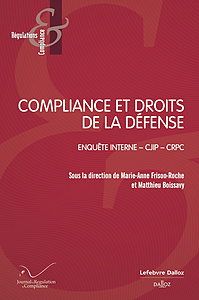
Publication of 🕴️M.-A. Frison-Roche & 🕴️M. Boissavy (eds.), 📕Compliance et droits de la défense. Enquête interne – CJIP – CRPC (Compliance and rights of the defence. Internal investigation – French Judicial Public Interest Agreement – French guilty plea procedure)

► Full Reference: M.-A. Frison-Roche & M. Boissavy (eds.), Compliance et droits de la défense. Enquête interne – CJIP – CRPC (Compliance and rights of the defence. Internal investigation – French Judicial Public Interest Agreement – French guilty plea procedure), Journal of Regulation & Compliance (JoRC) and Dalloz, “Régulations & Compliance” Serie, 2024, 362 p. - ► General presentation of the book:  We do not have an overall view of the relationship between Compliance and the rights of the defence in the continuum of internal investigations and DPA, or in the French legal system the convention judiciaire d’intérêt public (CJIP) and the comparution immédiate avec reconnaissance de culpabilité (CRPC), in particular because the texts, whether hard law or soft law, decisions and academic analyses segment them, making it difficult to build a pertinent appreciation of each one. This is made all the more difficult by the fact that we know little about how each of them is applied in practice, both within each of them and in relation to each other.  As a result, it is difficult to express overall satisfaction, or total rejection, or to suggest some specific reforms and to precise on what points, to identify the appropriate source of these improvements, legislation, case law, professions, or spontaneous ways of doing. The first ambition of this book is therefore to restore an overall vision, because this is the vision of practice. If shortcomings are found to exist, then they can be more easily denounced. However, some of the situations described may be described as flawed, or even dramatic, by some, while others may consider that they should be approved as they stand. This applies, for example, to the question of whether or not the investigation report should be secret from the prosecuting authority, which may propose a DPA (or in the French legal system a CJIP), whether or not this CJIP should be extended to individuals, whether or not a lawyer should be present from the internal investigation stage onwards, whether or not the lawyer should support the interests of the company he/she is investigating and continue to do so before the regulator or the prosecutor, whether or not the investigation is delegated from the public authorities to the company, whether or not the lawyer-investigator and then the lawyer-defendant are both lawyers, whether or not the victims are represented in the the CIPC process, etc. Depending on what one thinks the relation between Compliance and due process should be in principle and in practice, one expresses a more or less approving or severe judgement on the state of the texts, the soft law nature of most of them making the exercise complicated, and then if there is a gap between them and what one thinks should be the right standard, one asserts that in practice things happen differently from what the texts say, or one considers that the texts should be changed. From point to point, a veritable kaleidoscope emerges in this book. Indeed, the result is a series of contributions that sometimes clash with one another, with a sort of contradictionary principle creeping into the very structure of this book, thus establishing the readesr as a sort of judges themselves , that character who is so absent. He/she will be able to do so, since the book lists texts, describes practices and gives an illustration of everything that can be thought of, in visions that are sometimes analytical and sometimes global, with proposals of reforms of texts, jurisprudence or conduct. The aim of the book is to enable readers to form their own opinions and to take part in what is undoubtedly being strongly debated today: the confrontation between Compliance and rights of the defence. - 🧮this book follows a conference organised by the Conseil national des barreaux – CNB (French National Council of Lawyers), which took place on 20 and 21 April 2023: Avocats et droits de la défense dans les enquêtes internes et la justice négociée. - This volume is the continuation of the books dedicated to Compliance in this collection. ► Read the presentations of the other books in the series: the following books: 🕴️M.-A. Frison-Roche (ed.), 📕L’Obligation de Compliance, 2025 🕴️M.-A. Frison-Roche (ed.), 📕Compliance et Contrat, forthcoming 🕴️L. Laref (ed.), 📕Compliance et vigilance bancaire, forthcoming 🕴️M.-A. Frison-Roche, 📕Le système juridique de l’adressage de l’Internet. Une structure multi-acteurs, gage de durabilité (The Legal System of Internet Addressing. A Multi-Stakeholder Structure, the Pledge of its Sustainability), forthcoming 🕴️M.-A. Frison-Roche (ed.), 📕Le système probatoire de la Compliance, forthcoming   the previous books: 🕴️M.-A. Frison-Roche (ed.), 📕La juridictionnalisation de la Compliance, 2023 🕴️M.-A. Frison-Roche (ed.), 📕Les Buts Monumentaux de la Compliance, 2022 🕴️M.-A. Frison-Roche (ed.), 📕Les outils de la Compliance, 2021 🕴️M.-A. Frison-Roche (ed.), 📕Pour une Europe de la Compliance, 2019 🕴️N. Borga, J.-Cl. Marin and J.-Ch. Roda (eds.), 📕Compliance : l’entreprise, le régulateur et le juge, 2018 🕴️M.-A. Frison-Roche (ed.), 📕Régulation, Supervision, Compliance, 2017 🕴️M.-A. Frison-Roche (ed.), 📕Internet, espace d’interrégulation, 2016 📚Read the presentations of the other titles of the collection. - ► Summary of the book: The rights of the defence are one of the pillars of our Rule of Law. On the face of it, compliance techniques are not concerned with this under the pretext of efficiency. This would be particularly true in a trilogy that unfolds over time: internal investigation, convention judiciaire d’intérêt public – CJIP (French Judicial Public Interest Agreement) and comparution sur reconnaissance préalable de culpabilité – CRPC (French guilty plea procedure). However, because Compliance Law is also the expression of the Rule of Law, in that its ambition is to detect and prevent systemic risks in order to protect present and future human beings, we must go beyond this opposition and articulate Compliance and rights of the defence. The Monumental Goals of Compliance, which justify its power, for example to obtain information, and the fundamental rights of the defence, which for example impose the presumption of innocence, must be adjusted to each other; by interpreting texts, or even adopting new ones. The book analyses each of these three techniques, in particular the still largely unregulated internal investigation, and sheds light on them in relation to each other, in order to formulate proposals. - 🏗️General construction of the book: The book opens with an overview divided into three sections. The first Title compares the challenges of the internal investigation with the rights of the defence. The second Title compares the issues at stake in the convention judiciaire d’intérêt public – CJIP (French Judicial Public Interest Agreement) and the comparution sur reconnaissance préalable de culpabilité – CRPC (French guilty plea procedure) with these same rights of the defence. -   TABLE OF CONTENTS   COMPLIANCE ET DROITS DE LA DÉFENSE : VISION D’ENSEMBLE (COMPLIANCE AND RIGHTS OF THE DEFENCE : OVERVIEW) Section 1 ♦️ Connaître les pratiques pour redessiner les frontières et accroître les points de contact entre Compliance et droits de la défense dans l’enquête interne, la CJIP et la CRPC. Lignes de force de l’ouvrage Compliance et droits de la défense (Understanding practices to redraw the boundaries and increase the points of contact between Compliance and the rights of the defense in internal investigation, French Judicial Public Interest Agreement and French guilty plea procedure. Main Aspects of the Book Compliance and rights of the defence), by🕴️Marie-Anne Frison-Roche   Section 2 ♦️  Compliance et droits de la défense : toujours pour le respect des droits humains (Compliance and rights of the defence: always for the respect of human rights), by🕴️Matthieu Boissavy Section 3 ♦️ Circuler dans le temps pour mettre en phase Compliance et droits de la défense (Moving through Time to align Compliance and rights of the defence), by🕴️Marie-Anne Frison-Roche   TITRE I.  LES ENJEUX PROCÉDURAUX DE L’ENQUETE INTERNE CONFRONTÉE AUX DROITS DE LA DÉFENSE (TITLE I.  PROCEDURAL CHALLENGES OF THE INTERNAL INVESTIGATION IN RELATION TO THE RIGHTS OF THE DEFENCE)   CHAPITRE I : VISION GÉNÉRALE DES DROITS DE LA DÉFENSE DANS L’ENQUÊTE INTERNE  (CHAPTER I: OVERVIEW OF THE RIGHTS OF THE DEFENCE IN INTERNAL INVESTIGATION) Section 1 ♦️ Approche doctrinale de l’enquête interne et de l’enquête pénale privée (Doctrinal approach to internal investigation and private criminal investigation), by 🕴️Benjamin Fiorini Section 2 ♦️ Regard critique : La place des droits de la défense dans l’enquête interne selon le guide AFA/PNF (A critical look: The place of the rights of the defence in the internal investigation according to the AFA/PNF Guide), by 🕴️Margaux Durand-Poincloux, 🕴️David Apelbaum and 🕴️Paola Sardi-Antasan Section 3 ♦️ Les conditions de réussite de l’enquête interne dans les rapports entre le Parquet national financier et l’entreprise mise en cause – l’enquête interne au soutien de la défense de l’entreprise (The conditions for a successful internal investigation in the relationship between the French Financial Public Prosecutor’s Office and the accused company – the internal investigation in support of the company’s defence), by🕴️Jean-François Bohnert   CHAPITRE II : LES DROITS DE LA DÉFENSE À CHAQUE ÉTAPE DE L’ENQUÊTE INTERNE (CHAPTER II: THE RIGHTS OF THE DEFENCE AT EACH STAGE OF THE INTERNAL INVESTIGATION)   Section 1 ♦️ La réception des alertes par l’avocat (Reception of alerts by the lawyer), by🕴️Maria Lancri Section 2 ♦️ Collecte et traitement des informations dans les enquêtes internes à l’ère numérique : processus et enjeux (Collecting and processing information for internal investigations in the digital age: processes and challenges), by🕴️Uriel Goldberg Section 3 ♦️ L’apport de la psychologie pour l’effectivité des droits de la défense dans l’enquête interne pour harcèlement au travail (The contribution of psychology to the effectiveness of the rights of the defence in internal investigation for harassment in the workplace), by🕴️Nathalie Leroy & 🕴️Danièle Zucker Section 4 ♦️ Le respect des droits de la défense lors des auditions des enquêtes internes : un gage d’efficacité (Respecting the rights of the defence during hearings in internal investigations: a guarantee of efficacy), by 🕴️Emmanuel Daoud & 🕴️Ghita Khalid Rouissi Section 5 ♦️ L’enquête interne au cœur des enjeux de conformité et de justice négociée : analyse de la position de l’AFA et du PNF (The internal investigation at the heart of conformity and negotiated justice issues: analysis of the position of the AFA and the PNF), by🕴️Éric Russo Section 6 ♦️ Le rapport d’enquête interne à l’épreuve des droits de la défense (The internal investigation report put to the test of defence rights), by🕴️Samuel Sauphanor   CHAPITRE III : LA SPÉCIFICITÉ DES ENQUÊTES INTERNES DANS LES ENTREPRISES INTERNATIONALES ET LA PLACE DES DROITS DE LA DÉFENSE (CHAPTER III : SPECIFICITY OF INTERNAL INVESTIGATIONS IN INTERNATIONAL COMPANIES AND THE PLACE OF THE RIGHTS OF THE DEFENCE) Section 1 ♦️ La spécificité des enquêtes internes pratiquées par les groupes internationaux (Specificity of internal investigations carried out by international groups), by 🕴️Olivier Catherine Section 2 ♦️ Garantir la valeur probatoire d’un rapport dans le cadre d’une enquête interne opérée dans une entreprise internationale (Guaranteeing the evidential value of a report in an internal investigation carried out in an international company), by 🕴️Monique Figueiredo Section 3 ♦️ La responsabilité de l’entreprise dans la conception et la menée de l’enquête interne (The company’s responsibility in designing and conducting an internal investigation), by 🕴️Lydia Meziani Section 4 ♦️ Enquêtes internes, enquêtes pénales et droits de la défense : que nous disent les jurisprudences américaine et anglaise (l’affaire Connolly et l’affaire ENRC) ? (Internal investigations, criminal investigations and rights of the defence: what do the US and UK case law tell us (the Connolly case and the ENRC case)?), by 🕴️Victoire Chatelin   CHAPITRE IV : LE RÔLE SINGULIER DE L’AVOCAT DANS L’ENQUÊTE INTERNE (CHAPTER IV: THE SPECIAL ROLE OF THE LAWYER IN THE INTERNAL INVESTIGATION) Section 1 ♦️ La méthodologie propre à l’avocat enquêteur (The investigating lawyer’s own methodology), by 🕴️William Feugère Section 2 ♦️ L’enquête interne façonnée par la déontologie de l’avocat (The internal investigation shaped by the lawyer’s deontology), by 🕴️Stéphane De Navacelle, 🕴️Julie Zorrila and 🕴️Laura Ragazzi Section 3 ♦️ Préserver le secret professionnel de l’avocat dans l’enquête interne et son résultat (Preserving the lawyer’s professional secrecy in the internal investigation and its outcome), by 🕴️Bénédicte Graulle & 🕴️Yanis Rahim Section 4 ♦️ L’avocat-enquêteur en droit du travail : un janséniste au milieu du Far West (The lawyer-investigator in employment law: a Jansenist in the Wild West), by 🕴️Richard Doudet Section 5 ♦️ La défense des personnes physiques dans les enquêtes internes (Defending individuals in internal investigations), by 🕴️Dorothée Hever     TITRE II. LES ENJEUX PROCÉDURAUX DE LA CJIP ET DE LA CRPC CONFRONTÉES AUX DROITS DE LA DÉFENSE (TITLE II. PROCEDURAL CHALLENGES OF THE FRENCH JUDICIAL PUBLIC INTEREST AGREEMENT AND THE FRENCH GUILTY PLEA PROCEDURE  IN RELATION TO THE RIGHTS OF THE DEFENCE)   CHAPITRE I : VISION GÉNÉRALE DES DROITS DE LA DÉFENSE DANS LA CJIP ET LA CRPC (CHAPTER I: OVERVIEW OF THE RIGHTS OF THE DEFENCE IN THE FRENCH JUDICIAL PUBLIC INTEREST AGREEMENT AND THE FRENCH GUILTY PLEA PROCEDURE) Section 1 ♦️ Théorie et pratique de la négociation dans la justice pénale (Theory and practice of negotiation in criminal justice), by 🕴️Sarah-Marie Cabon Section 2 ♦️ La lutte anti-corruption : l’emprunt au modèle américain et à ses récentes évolutions (The fight against corruption: borrowing from the American model and its recent developments), by 🕴️Stephen L. Dreyfuss Section 3 ♦️ Justice pénale négociée : avantages présents, risques à venir (Negotiated criminal justice: curent benefits, future risks), by 🕴️Alexis Bavitot   CHAPITRE II : FORMES ACTIVES DES DROITS DE LA DÉFENSE, LES DIALOGUES À L’OEUVRE OU À PARFAIRE DANS LA CJIP ET LA CRPC (CHAPTER II: ACTIVE FORMS OF THE RIGHTS OF THE DEFENCE, DIALOGUES AT WORK OR TO BE PERFECTED IN THE FRENCH JUDICIAL PUBLIC INTEREST AGREEMENT AND THE FRENCH GUILTY PLEA PROCEDURE) Section 1 ♦️ Combinaison des CRPC et des CJIP : le cas particulier des affaires de fraude fiscale (Combination of the French guilty plea procedure and the French Judicial Public Interest Agreement: the special issue of tax fraud cases), by 🕴️Marion David Section 2 ♦️ Pour une justice pénale négociée plus équitable (For a fairer negotiated criminal justice), by🕴️Astrid Mignon Colombet Section 3 ♦️ Les impacts, sur les droits de la défense, des disparités de la justice pénale négociée dans l’Union européenne (The impact on the rights of the defence of the disparities in negotiated criminal justice in the European Union), by 🕴️Emmanuel Moyne Section 4 ♦️ L’évolution des rapports entre avocats et autorités de poursuites depuis l’introduction de la CJIP (Developments in relations between lawyers and prosecuting authorities since the introduction of the French Judicial Public Interest Agreement), by 🕴️Thomas Baudesson   CHAPITRE III : LE RÔLE SINGULIER DE L’AVOCAT DANS LA CJIP ET LA CRPC  (CHAPTER III: THE SINGULAR ROLE OF THE LAWYER IN THE FRENCH JUDICIAL PUBLIC INTEREST AGREEMENT AND THE FRENCH GUILTY PLEA PROCEDURE) Section 1 ♦️ Quand se justifie et quand s’arrête la collaboration ? À propos de la CJIP (When is collaboration justified and when does it end? About the French Judicial Public Interest Agreement), by 🕴️Philippe Goossens Section 2 ♦️ Le dialogue de l’avocat et de son client, chef d’entreprise, face à la proposition d’une CRPC et d’une CJIP (The dialogue between the lawyer and his client, a company director, faced with the proposal of a French guilty plea procedure or a French Judicial Public Interest Agreement), by 🕴️François Saint-Pierre Section 3 ♦️ Le dilemme de l’avocat pénaliste face à la CRPC (The criminal lawyer’s dilemma when faced with the French guilty plea procedure), by 🕴️Jean Boudot Section 4 ♦️ Défendre les intérêts de la personne physique confrontée à la justice négociée : préserver l’effectivité des droits de la défense et le respect de la présomption d’innocence (Defending the interests of individuals faced with negotiated justice: preserving the effectiveness of the rights of the defence and respect for the presumption of innocence), by 🕴️Capucine Lanta de Bérard & 🕴️Pauline Dufourq Section 5 ♦️ Défendre les intérêts des victimes dans la justice pénale économique négociée (Defending victims’ interests in negotiated economic criminal justice), by 🕴️Jérôme Karsenti - follow Marie-Anne Frison-Roche on LinkedIn follow Marie-Anne Frison-Roche on Instagram subscribe to the Newsletter MAFR Regulation, Compliance, Law

Couverture – Compliance et droits de la défense

Books

Collection Régulations & Compliance Compliance et droits de la défense. Enquête interne – CJIP – CRPC (Compliance and rights of the defence. Internal investigation – French Judicial Public Interest Agreement – French guilty plea procedure)

► Full Reference: M.-A. Frison-Roche & M. Boissavy (eds.), Compliance et droits de la défense. Enquête interne – CJIP – CRPC (Compliance and rights of the defence. Internal investigation – French Judicial Public Interest Agreement – French guilty plea procedure), Journal of Regulation & Compliance (JoRC) and Dalloz, "Régulations & Compliance" Serie, 2024, 362 p. - ► General presentation of the book:  We do not have an overall view of the relationship between Compliance and the rights of the defence in the continuum of internal investigations and DPA, or in the French legal system the convention judiciaire d'intérêt public (CJIP) and the comparution immédiate avec reconnaissance de culpabilité (CRPC), in particular because the texts, whether hard law or soft law, decisions and academic analyses segment them, making it difficult to build a pertinent appreciation of each one. This is made all the more difficult by the fact that we know little about how each of them is applied in practice, both within each of them and in relation to each other.  As a result, it is difficult to express overall satisfaction, or total rejection, or to suggest some specific reforms and to precise on what points, to identify the appropriate source of these improvements, legislation, case law, professions, or spontaneous ways of doing. The first ambition of this book is therefore to restore an overall vision, because this is the vision of practice. If shortcomings are found to exist, then they can be more easily denounced. However, some of the situations described may be described as flawed, or even dramatic, by some, while others may consider that they should be approved as they stand. This applies, for example, to the question of whether or not the investigation report should be secret from the prosecuting authority, which may propose a DPA (or in the French legal system a CJIP), whether or not this CJIP should be extended to individuals, whether or not a lawyer should be present from the internal investigation stage onwards, whether or not the lawyer should support the interests of the company he/she is investigating and continue to do so before the regulator or the prosecutor, whether or not the investigation is delegated from the public authorities to the company, whether or not the lawyer-investigator and then the lawyer-defendant are both lawyers, whether or not the victims are represented in the the CIPC process, etc. Depending on what one thinks the relation between Compliance and due process should be in principle and in practice, one expresses a more or less approving or severe judgement on the state of the texts, the soft law nature of most of them making the exercise complicated, and then if there is a gap between them and what one thinks should be the right standard, one asserts that in practice things happen differently from what the texts say, or one considers that the texts should be changed. From point to point, a veritable kaleidoscope emerges in this book. Indeed, the result is a series of contributions that sometimes clash with one another, with a sort of contradictionary principle creeping into the very structure of this book, thus establishing the readesr as a sort of judges themselves , that character who is so absent. He/she will be able to do so, since the book lists texts, describes practices and gives an illustration of everything that can be thought of, in visions that are sometimes analytical and sometimes global, with proposals of reforms of texts, jurisprudence or conduct. The aim of the book is to enable readers to form their own opinions and to take part in what is undoubtedly being strongly debated today: the confrontation between Compliance and rights of the defence. - ► Summary of the book: The rights of the defence are one of the pillars of our Rule of Law. On the face of it, compliance techniques are not concerned with this under the pretext of efficiency. This would be particularly true in a trilogy that unfolds over time: internal investigation, convention judiciaire d'intérêt public – CJIP (French Judicial Public Interest Agreement) and comparution sur reconnaissance préalable de culpabilité – CRPC (French guilty plea procedure). However, because Compliance Law is also the expression of the Rule of Law, in that its ambition is to detect and prevent systemic risks in order to protect present and future human beings, we must go beyond this opposition and articulate Compliance and rights of the defence. The Monumental Goals of Compliance, which justify its power, for example to obtain information, and the fundamental rights of the defence, which for example impose the presumption of innocence, must be adjusted to each other; by interpreting texts, or even adopting new ones. The book analyses each of these three techniques, in particular the still largely unregulated internal investigation, and sheds light on them in relation to each other, in order to formulate proposals. - 🏗️General construction of the book: The book opens with an overview divided into three sections. The first Title compares the challenges of the internal investigation with the rights of the defence. The second Title compares the issues at stake in the convention judiciaire d'intérêt public – CJIP (French Judicial Public Interest Agreement) and the comparution sur reconnaissance préalable de culpabilité – CRPC (French guilty plea procedure) with these same rights of the defence. -   TABLE OF CONTENTS   COMPLIANCE ET DROITS DE LA DÉFENSE : VISION D'ENSEMBLE (COMPLIANCE AND RIGHTS OF THE DEFENCE : OVERVIEW) Section 1 ♦️ Connaître les pratiques pour redessiner les frontières et accroître les points de contact entre Compliance et droits de la défense dans l’enquête interne, la CJIP et la CRPC. Lignes de force de l'ouvrage Compliance et droits de la défense (Understanding practices to redraw the boundaries and increase the points of contact between Compliance and the rights of the defense in internal investigation, French Judicial Public Interest Agreement and French guilty plea procedure. Main Aspects of the Book Compliance and rights of the defence), by🕴️Marie-Anne Frison-Roche   Section 2 ♦️  Compliance et droits de la défense : toujours pour le respect des droits humains (Compliance and rights of the defence: always for the respect of human rights), by🕴️Matthieu Boissavy Section 3 ♦️ Circuler dans le temps pour mettre en phase Compliance et droits de la défense (Moving through Time to align Compliance and rights of the defence), by🕴️Marie-Anne Frison-Roche   TITRE I.  LES ENJEUX PROCÉDURAUX DE L'ENQUETE INTERNE CONFRONTÉE AUX DROITS DE LA DÉFENSE (TITLE I.  PROCEDURAL CHALLENGES OF THE INTERNAL INVESTIGATION IN RELATION TO THE RIGHTS OF THE DEFENCE)   CHAPITRE I : VISION GÉNÉRALE DES DROITS DE LA DÉFENSE DANS L'ENQUÊTE INTERNE  (CHAPTER I: OVERVIEW OF THE RIGHTS OF THE DEFENCE IN INTERNAL INVESTIGATION) Section 1 ♦️ Approche doctrinale de l’enquête interne et de l’enquête pénale privée (Doctrinal approach to internal investigation and private criminal investigation), by 🕴️Benjamin Fiorini Section 2 ♦️ Regard critique : La place des droits de la défense dans l'enquête interne selon le guide AFA/PNF (A critical look: The place of the rights of the defence in the internal investigation according to the AFA/PNF Guide), by 🕴️Margaux Durand-Poincloux, 🕴️David Apelbaum and 🕴️Paola Sardi-Antasan Section 3 ♦️ Les conditions de réussite de l'enquête interne dans les rapports entre le Parquet national financier et l’entreprise mise en cause – l’enquête interne au soutien de la défense de l’entreprise (The conditions for a successful internal investigation in the relationship between the French Financial Public Prosecutor's Office and the accused company – the internal investigation in support of the company's defence), by🕴️Jean-François Bohnert   CHAPITRE II : LES DROITS DE LA DÉFENSE À CHAQUE ÉTAPE DE L'ENQUÊTE INTERNE (CHAPTER II: THE RIGHTS OF THE DEFENCE AT EACH STAGE OF THE INTERNAL INVESTIGATION)   Section 1 ♦️ La réception des alertes par l'avocat (Reception of alerts by the lawyer), by🕴️Maria Lancri Section 2 ♦️ Collecte et traitement des informations dans les enquêtes internes à l'ère numérique : processus et enjeux (Collecting and processing information for internal investigations in the digital age: processes and challenges), by🕴️Uriel Goldberg Section 3 ♦️ L’apport de la psychologie pour l'effectivité des droits de la défense dans l'enquête interne pour harcèlement au travail (The contribution of psychology to the effectiveness of the rights of the defence in internal investigation for harassment in the workplace), by🕴️Nathalie Leroy & 🕴️Danièle Zucker Section 4 ♦️ Le respect des droits de la défense lors des auditions des enquêtes internes : un gage d’efficacité (Respecting the rights of the defence during hearings in internal investigations: a guarantee of efficacy), by 🕴️Emmanuel Daoud & 🕴️Ghita Khalid Rouissi Section 5 ♦️ L’enquête interne au cœur des enjeux de conformité et de justice négociée : analyse de la position de l'AFA et du PNF (The internal investigation at the heart of conformity and negotiated justice issues: analysis of the position of the AFA and the PNF), by🕴️Éric Russo Section 6 ♦️ Le rapport d’enquête interne à l’épreuve des droits de la défense (The internal investigation report put to the test of defence rights), by🕴️Samuel Sauphanor   CHAPITRE III : LA SPÉCIFICITÉ DES ENQUÊTES INTERNES DANS LES ENTREPRISES INTERNATIONALES ET LA PLACE DES DROITS DE LA DÉFENSE (CHAPTER III : SPECIFICITY OF INTERNAL INVESTIGATIONS IN INTERNATIONAL COMPANIES AND THE PLACE OF THE RIGHTS OF THE DEFENCE) Section 1 ♦️ La spécificité des enquêtes internes pratiquées par les groupes internationaux (Specificity of internal investigations carried out by international groups), by 🕴️Olivier Catherine Section 2 ♦️ Garantir la valeur probatoire d’un rapport dans le cadre d’une enquête interne opérée dans une entreprise internationale (Guaranteeing the evidential value of a report in an internal investigation carried out in an international company), by 🕴️Monique Figueiredo Section 3 ♦️ La responsabilité de l'entreprise dans la conception et la menée de l'enquête interne (The company's responsibility in designing and conducting an internal investigation), by 🕴️Lydia Meziani Section 4 ♦️ Enquêtes internes, enquêtes pénales et droits de la défense : que nous disent les jurisprudences américaine et anglaise (l’affaire Connolly et l’affaire ENRC) ? (Internal investigations, criminal investigations and rights of the defence: what do the US and UK case law tell us (the Connolly case and the ENRC case)?), by 🕴️Victoire Chatelin   CHAPITRE IV : LE RÔLE SINGULIER DE L'AVOCAT DANS L'ENQUÊTE INTERNE (CHAPTER IV: THE SPECIAL ROLE OF THE LAWYER IN THE INTERNAL INVESTIGATION) Section 1 ♦️ La méthodologie propre à l'avocat enquêteur (The investigating lawyer's own methodology), by 🕴️William Feugère Section 2 ♦️ L'enquête interne façonnée par la déontologie de l'avocat (The internal investigation shaped by the lawyer's deontology), by 🕴️Stéphane De Navacelle, 🕴️Julie Zorrila and 🕴️Laura Ragazzi Section 3 ♦️ Préserver le secret professionnel de l'avocat dans l'enquête interne et son résultat (Preserving the lawyer's professional secrecy in the internal investigation and its outcome), by 🕴️Bénédicte Graulle & 🕴️Yanis Rahim Section 4 ♦️ L’avocat-enquêteur en droit du travail : un janséniste au milieu du Far West (The lawyer-investigator in employment law: a Jansenist in the Wild West), by 🕴️Richard Doudet Section 5 ♦️ La défense des personnes physiques dans les enquêtes internes (Defending individuals in internal investigations), by 🕴️Dorothée Hever     TITRE II. LES ENJEUX PROCÉDURAUX DE LA CJIP ET DE LA CRPC CONFRONTÉES AUX DROITS DE LA DÉFENSE (TITLE II. PROCEDURAL CHALLENGES OF THE FRENCH JUDICIAL PUBLIC INTEREST AGREEMENT AND THE FRENCH GUILTY PLEA PROCEDURE  IN RELATION TO THE RIGHTS OF THE DEFENCE)   CHAPITRE I : VISION GÉNÉRALE DES DROITS DE LA DÉFENSE DANS LA CJIP ET LA CRPC (CHAPTER I: OVERVIEW OF THE RIGHTS OF THE DEFENCE IN THE FRENCH JUDICIAL PUBLIC INTEREST AGREEMENT AND THE FRENCH GUILTY PLEA PROCEDURE) Section 1 ♦️ Théorie et pratique de la négociation dans la justice pénale (Theory and practice of negotiation in criminal justice), by 🕴️Sarah-Marie Cabon Section 2 ♦️ La lutte anti-corruption : l’emprunt au modèle américain et à ses récentes évolutions (The fight against corruption: borrowing from the American model and its recent developments), by 🕴️Stephen L. Dreyfuss Section 3 ♦️ Justice pénale négociée : avantages présents, risques à venir (Negotiated criminal justice: curent benefits, future risks), by 🕴️Alexis Bavitot   CHAPITRE II : FORMES ACTIVES DES DROITS DE LA DÉFENSE, LES DIALOGUES À L'OEUVRE OU À PARFAIRE DANS LA CJIP ET LA CRPC (CHAPTER II: ACTIVE FORMS OF THE RIGHTS OF THE DEFENCE, DIALOGUES AT WORK OR TO BE PERFECTED IN THE FRENCH JUDICIAL PUBLIC INTEREST AGREEMENT AND THE FRENCH GUILTY PLEA PROCEDURE) Section 1 ♦️ Combinaison des CRPC et des CJIP : le cas particulier des affaires de fraude fiscale (Combination of the French guilty plea procedure and the French Judicial Public Interest Agreement: the special issue of tax fraud cases), by 🕴️Marion David Section 2 ♦️ Pour une justice pénale négociée plus équitable (For a fairer negotiated criminal justice), by🕴️Astrid Mignon Colombet Section 3 ♦️ Les impacts, sur les droits de la défense, des disparités de la justice pénale négociée dans l’Union européenne (The impact on the rights of the defence of the disparities in negotiated criminal justice in the European Union), by 🕴️Emmanuel Moyne Section 4 ♦️ L'évolution des rapports entre avocats et autorités de poursuites depuis l'introduction de la CJIP (Developments in relations between lawyers and prosecuting authorities since the introduction of the French Judicial Public Interest Agreement), by 🕴️Thomas Baudesson   CHAPITRE III : LE RÔLE SINGULIER DE L'AVOCAT DANS LA CJIP ET LA CRPC  (CHAPTER III: THE SINGULAR ROLE OF THE LAWYER IN THE FRENCH JUDICIAL PUBLIC INTEREST AGREEMENT AND THE FRENCH GUILTY PLEA PROCEDURE) Section 1 ♦️ Quand se justifie et quand s'arrête la collaboration ? À propos de la CJIP (When is collaboration justified and when does it end? About the French Judicial Public Interest Agreement), by 🕴️Philippe Goossens Section 2 ♦️ Le dialogue de l’avocat et de son client, chef d’entreprise, face à la proposition d’une CRPC et d’une CJIP (The dialogue between the lawyer and his client, a company director, faced with the proposal of a French guilty plea procedure or a French Judicial Public Interest Agreement), by 🕴️François Saint-Pierre Section 3 ♦️ Le dilemme de l'avocat pénaliste face à la CRPC (The criminal lawyer's dilemma when faced with the French guilty plea procedure), by 🕴️Jean Boudot Section 4 ♦️ Défendre les intérêts de la personne physique confrontée à la justice négociée : préserver l’effectivité des droits de la défense et le respect de la présomption d’innocence (Defending the interests of individuals faced with negotiated justice: preserving the effectiveness of the rights of the defence and respect for the presumption of innocence), by 🕴️Capucine Lanta de Bérard & 🕴️Pauline Dufourq Section 5 ♦️ Défendre les intérêts des victimes dans la justice pénale économique négociée (Defending victims' interests in negotiated economic criminal justice), by 🕴️Jérôme Karsenti - follow Marie-Anne Frison-Roche on LinkedIn follow Marie-Anne Frison-Roche on Instagram subscribe to the Newsletter MAFR Regulation, Compliance, Law

Couverture – Compliance Jurisdictionalisation

Articles in a JoRC book

SCEMLA, Sophie🕴️ et PAILLOT, Diane🕴️

📝The difficulty for Compliance Enforcement Authorities to comprehend the Rights of the Defence in compliance matters, in 🕴️M.-A. Frison-Roche (ed.), Collection Compliance & Regulation Compliance Jurisdictionalisation

► Full Reference: S. Scemla & D. Paillot, "The difficulty for Compliance Enforcement Authorities to comprehend the Rights of the Defence in compliance matters", in M.-A. Frison-Roche (ed.),  Compliance Jurisdictionalisation, Journal of Regulation & Compliance (JoRC) and Bruylant, coll. "Compliance & Regulation", 2024, pp. 263-272. - 📘read a general presentation of the book, Compliance Jurisdictionalisation, in which this article is published   - ► Summary of the article (done by the Authors): Since 2016, French companies subject to the provisions of the so-called “Sapin 2” Law must implement eight stringent anti-corruption measures, such as a risk mapping, a whistleblowing procedure or a third-party due diligence procedure. To ensure their compliance with these obligations, the Sapin 2 law created the Agence française anticorruption – AFA (French Anti-Corruption Agency), which had been assigned three missions: firstly, to help any person prevent and detect corruption; secondly, to control the quality and effectiveness of the anti-corruption programs deployed by the companies; and thirdly, to sanction any breaches, through its Sanctions Committee. As pointed out by the French Conseil d’État, the powers devolved to the administrations have multiplied and became stratified. While the Conseil d'État suggests to improve both the conduct and the effectiveness of administrative controls by harmonising their practices and simplifying their prerogatives, it is urgent to remedy the numerous procedural failures that undermine the rights of defence. In fact, the AFA exercises various powers when undertaking its controls. Some of these powers are not provided for by the Law, and most of them infringe fundamental rights and freedoms among which the adversarial principle and the freedom not to self-incriminate. For instance, the AFA does not necessarily draft minutes of the interviews it conducts, thus depriving the interviewee of the possibility to challenge the statements reported by the AFA to the Sanctions Committee. From a more structural point of view, the scope of the AFA's mission is extremely broad. The Law allows the AFA to request the communication of "any professional document or any useful information", without defining the notion of usefulness. Also, the AFA considers that the entity cannot benefit from the legal privilege that would cover their documents, and considers that an entity who voluntarily hands over a document, without expressing any reserves, waives its right to the benefit of its legal privilege. Apart from the severe consequences that could arise if another proceedings was to be initiated by a foreign authority, the concept of "voluntary handover" does not faithfully reflect the reality. Indeed, the controlled entities only cooperate under the threat of being prosecuted on the basis of an obstruction to the control, which compels them to communicate documents even when facing the risk of contributing to their own incrimination. These many procedural deficiencies encountered during AFA controls must therefore be reformed, as recommended by the Conseil d’État, so as to require the authorities to take into account the rights of the defence. - 🦉This article is available in full text to those registered for Professor Marie-Anne Frison-Roche's courses -
Couverture – Compliance Jurisdictionalisation

Articles in a JoRC book

📝Reinforce the Judge and the Lawyer to impose Compliance Law as a characteristic of the Rule of Law, in🕴️M.-A. Frison-Roche (ed.) 📘Compliance Jurisdictionalisation

► Full Reference: M.-A. Frison-Roche, "Reinforce the Judge and the Lawyer to impose Compliance Law as a characteristic of the Rule of Law", in M.-A. Frison-Roche (ed.), Compliance Jurisdictionalisation, Journal of Regulation & Compliance (JoRC) and Bruylant, "Compliance & Regulation" Serie, 2024, pp. 39-65 - 📝read the article - 🚧read the bilingual Working Paper which is the basis of this article, with additional developments, technical references and hyperlinks - 📘read a general presentation of the book, Compliance Jurisdictionalisation, in which this article is published - ► This article is the introduction of the book.   ► Summary of the article (done by the Journal of Regulation & Compliance): One can understand that the compliance mechanisms are presented with hostility because they seem designed to keep the judge away, whereas there is no Rule of Law without a judge. Solid arguments present compliance techniques as converging towards the uselessness of the judge (I). Certainly, we come across magistrates, and of all kinds, and powerful ones, but that would be a sign of imperfection: its ex-ante logic has been deployed in all its effectiveness, the judge would no longer be required… And the lawyer would disappear so with him… This perspective of a world without a judge, without a lawyer and ultimately without Law, where algorithms could organize through multiple processes in Ex Ante the obedience of everyone, the "conformity" of all our behaviors with all the regulatory mass that is applicable to us, supposes that this new branch of Law would be defined as the concentration of processes which gives full effectiveness to all the rules, regardless of their content. But supposing that this engineer's dream is even achievable, it is not possible in a democratic and free world to do without judges and lawyers. Therefore, it is imperative to recognize their contributions to Compliance Law, related and invaluable contributions (II). First of all, because a pure Ex Ante never existed and even in the time of the Chinese legists1 L’empire chinois n’a semble-t-il jamais apprécié les juges, ne leur faisant place que sous la forme de serviteurs purs de l’Etat, qu’ils soient des enquêteurs, des punisseurs et de gardiens de l’ordre public. Sur cet aspect du Droit chinois, v. … ; sur cette période particulièrement sanglante des légistes, où le principe de « certitude » de la législation a été portée à ses nues, v. …, people were still needed to interpret the regulations because a legal order must always be interpreted Ex Post by who must in any case answer the questions posed by the subjects of law, as soon as the political system admits to attributing to them the right to make claims before the Judge. Secondly the Attorney, whose office, although articulated with the Judge's office, is distinct from the latter, both more restricted and broader since he must appear in all cases where the judicial figure puts himself in square, outside the courts. However, Compliance Law has multiplied this since not only, extending Regulatory Law, it entrusts numerous powers to the administrative authorities, but it also transforms companies into judges, in respect of which the attorneys must deal with. Even more so, Compliance Law only takes its sense from its Monumental Goals2🕴️Frison-Roche, M.-A. (ed.), 📘​Compliance Monumental Goals, 2022.. It is in this that this branch of the Law preserves the freedom of human beings, in the digital space where the techniques of compliance protect them from the power of companies by the way that the Compliance Law forces these companies to use their power to protect people. However, firstly, it is the Judges who, in their diversity3The topic of this study is general. For a more analytical perspective, s.. 🕴️Frison-Roche, M.-A., « The function of the Judge in Compliance Law », in 🕴️Frison-Roche, M.A. (ed.), 📘Compliance Jurisdictionalisation, 2023. , impose as a reference the protection of human beings, either as a limit to the power of compliance tools4🕴️Frison-Roche, M.-A. (ed.), 📘Compliance Tools, 2021.  or as their very purpose. Secondly, the Attorney, again distinguishing himself from the Judge, if necessary, reminds us that all the parties whose interests are involved must be taken into consideration. In an ever more flexible, soft and dialogical Law, everyone presenting himself as the "advocate" of such and such a monumental goal: the Attorney is legitimate to be the first to occupy this place. - follow Marie-Anne Frison-Roche on LinkedIn follow Marie-Anne Frison-Roche on Instagram subscribe to the Newsletter MAFR Regulation, Compliance, Law
Couverture – Compliance Jurisdictionalisation

Articles in a JoRC book

📝Adjusting General Procedural Law to Compliance Law by the nature of things, in🕴️M.-A. Frison-Roche (ed.), 📘Compliance Jurisdictionalisation

► Full Reference: M.-A. Frison-Roche, "Adjusting General Procedural Law to Compliance Law by the Nature of things", in M.-A. Frison-Roche (ed.), Compliance Jurisdictionalisation, Journal of Regulation & Compliance (JoRC) and Bruylant, "Compliance & Regulation" Serie, 2024, pp. 273-28.  - 📝read the article - 🚧read the bilingual Working Paper which is the basis of this article, with additional developments, technical references and hyperlinks - 📘read a general presentation of the book, Compliance Jurisdictionalisation, in which this article is published - The principal elements of this articles had been presented during the scientific manifestation held on September 23, 2021, at Dauphine University in Paris, coorganised by the Journal of Regulation & Compliance (JoRC) and the Institute Droit Dauphine.  In the book this article is placed in the chapter II about the General Procedural Law in the Compliance Law.   - ► Summary of the article (done by the Journal of regulation & Compliance – JoRC): General Procedural Law is an invention, essentially due to Professor Motulsky, going well beyond the gain that one always has in comparing types of procedures with each other. As he asserted, there is Natural Law in General Procedural Law, in that as soon as there is the Rule of Law Principle there cannot be, whatever the "procedure", even the "process", such and such way of doing things: for example, to decide, to seize the one who decides, to listen before deciding, to contest the one who has decided. General Procedural Law therefore depends on the nature of things. However, Compliance Law organizes things in a new way. Therefore, both the simple and iron principles of General Procedural Law creep in where we do not expect them at first sight, because there is no judge, this character around whom ordinary procedures fit together. The principles of General Procedural Law are essential in companies. Even if the regulations do not breathe a word about it, it is up to the Judges, in particular the Supreme Courts, to recognize this nature of things because on this effect of nature that  General Procedural Law is built: when compliance mechanisms oblige companies to strike, General Procedural law must oblige, even in the silence of the texts, to arm those who can be hit, even stand up against devices that would set aside too much these defenses that are easily considered contrary to efficiency (I). But because it is a question of making room for this nature of the things of which the Rule of Law Principle entrusts the custody to the Judge and the Lawyer, the General Procedural Law must also adjust itself to what the extraordinary new branch of Law Compliance Law is. Indeed, Compliance Law is extraordinary in that it expresses the political pretention to act now so that the future will not be catastrophic, by detecting and preventing the realization of systemic risks, or even that it is better, by building effective equality or real concern for others. Because it is the Monumental Goals that defines this new branch of Law, a disputed systemic issue, possibly disputed by several parties before a judge, the procedural principles used by the court must be broadened considerably: they must then include civil society and the future (II). General Procedural Law thus naturally acquires an even more place than in the classic branches of Law since on the one hand it imposes itself outside of trials, particularly in companies and on the other before the courts it involves people who had hardly any place to speak and thinks themselves, especially the systems entering the "causes" of Compliance now debated before the Judge. - follow Marie-Anne Frison-Roche on LinkedIn follow Marie-Anne Frison-Roche on Instagram subscribe to the Newsletter MAFR Regulation, Compliance, Law
Couverture – Compliance Jurisdictionalisation

Articles in a legal collective publication

LAPP, Christophe🕴️

📝Compliance in Companies: The Statutes of the Process, in 🕴️M-A. Frison-Roche (ed.), 📘Compliance Jurisdictionalisation

► Full Reference: Ch. Lapp, "Compliance in Companies: The Statutes of the Process", in M.-A. Frison-Roche (ed.), Compliance Jurisdictionalisation, Journal of Regulation & Compliance (JoRC) and Bruylant, "Compliance & Regulation" Serie,  2024, pp. 155-166  - 📘read a general presentation of the book, Compliance Jurisdictionalisation, in which this article is published - ► The summary below describes an article following the colloquium L'entreprise instituée Juge et Procureur d'elle-même par le Droit de la Compliance (The Entreprise instituted Judge and Prosecutor of itself by Compliance Law) , co-organized by the Journal of Regulation & Compliance (JoRC) and the Faculté de Droit Lyon 3. This manifestation was designed under the scientific direction of Marie-Anne Frison-Roche and Jean-Christophe Roda and took place in Lyon on June 23, 2021. During this colloquium, the intervention was shared with Jan-Marc Coulon, who is also a contributor in the book (see the summary of the Jean-Marc Coulon's  Article). In the book, the article will be published in Title I, devoted to:  L'entreprise instituée Juge et Procureur d'elle-même par le Droit de la Compliance (The Entreprise instituted Judge and Prosecutor of itself by Compliance Law ). - ► Summary of the article (done by the Author): The Company is caught in the grip of Compliance Law, the jaws of which are those of Incitement (1) and Sanction that the Company must apply to ensure the effectiveness of its processes to which it is itself subject (2 ). First, the Company has been delegated to fabricate reprehensible rules that it must apply to itself and to third parties with whom it has dealings. To this end, the Company sets up "processes", that is to say verification and prevention procedures, in order to show that the offenses that it is likely to commit will not happened. These processes constitute standards of behavior to prevent and avoid that the facts constituting the infringements are not themselves carried out. They are thus one of the elements of Civil Liability Law in its preventive or restorative purposes. Second, the sanction of non obedience of Compliance processes puts the Company in front of two pitfalls. The first  dimension place the company, with regard to its employees and its partners, in the obligation to define processes which also constitute the quasi-jurisdictional resolution of their non-compliance, the company having to reconcile the sanction it pronounces with the fundamental principles of classical Criminal Law, constitutional principles and all fundamental rights. The processes then become the procedural rule. The second dimension is that the Company is accountable for the effectiveness of the avoidance by its processes of facts constituting infringements. By a reversal of the burden of proof, the Company is then required to prove that its processes are efficient. at least equivalent to the measures defined by laws and regulations, the French Anti-Corruption Agency (Agence Française Anticorruption – AFA), European directives and various communications on legal tools to fight breaches of probity, environmental attacks and current societal concerns. The processes then become the constitutive element, per se, of the infringement. Thus, in its search for a balance between Prevention and Sanction to which it is itself subject, the Company will not then be tempted to favor the orthodoxy of its processes over the expectations of the Agence Française Anticorruption – AFA , regulators and judges, to the detriment of their efficiency? In doing so, are we not moving towards an instrumental and conformist Compliance, paradoxically disempowering with regard to the Compliance Monumental Goals of Compliance? - 🦉This article is available in full text to those registered for Professor Marie-Anne Frison-Roche's courses -
Couverture – Compliance Jurisdictionalisation

Articles in a JoRC book

TRAIN, François-Xavier🕴🏿

📝 Arbitration and parallel proceedings exercised in Compliance Procedure, in🕴🏿M.-A. Frison-Roche (ed.), Collection Compliance & Regulation Compliance Jurisdictionalisation

► Full Reference: F.-X. Train, "Arbitration and parallel proceedings exercised in Compliance Procedure", in M.-A. Frison-Roche (ed.), Compliance Jurisdictionalisation, series "Compliance & Regulation", Journal of Regulation & Compliance (JoRC) and Bruylant, to be published.  - ► the summary below describes the article that follows an intervention in the scientific manifestation Compliance et Arbitrage, co-organised by the Journal of Regulation & Compliance (JoRC) and the University Panthéon-Assas (Paris II). This conference was designed by Marie-Anne Frison-Roche and Jean-Baptiste Racine, scientific co-directors, and took place in Paris II University on March 31, 2021.  In the book, the article will be published in the Chapter III, devoted to: Compliance et Arbitrage international. - ► Article Summary:  Firstly, the article insists on the principle of the autonomy of the international arbitration procedure, in relation to which parallel procedures remain watertight, whether they are criminal or done under Compliance Law. In the arbitral proceedings taking place independently, the arbitrators before whom the facts also referred to in these parallel proceedings, in particular the facts of corruption, are alleged before them as facts through their unlawful nature: it is at this title that they can and must apprehend them, using the standard of proof which is the bundle of clues. Secondly, the article highlights the limits of the autonomy of international arbitration. These may be de facto limits because in the search for evidence by arbitrators, red flags are often insufficiently consistent evidence to establish a sentence, especially since this sentence may be subject to control by the judge of its conformity to international public order, the annulment by the judge being able to be based on external elements, even after the arbitration procedure. It may then be wise for the arbitrators, who are not forced to do so, to suspend their proceedings to wait the results of the parallel proceedings initiated under Compliance Law, so that the procedures and their results could be harmonious. - 📘 read the general presentation of the book, Compliance Jurisdictionalisation, in which this article is published -
Couverture – Compliance Jurisdictionalisation

Articles in a JoRC book

LATOUR, Daphné🕴️

📝Internal investigations within companies, in 🕴️M-A. Frison-Roche (ed.), 📘Compliance Jurisdictionalisation

► Full Reference: D. Latour, "Internal investigations within companies", in M.-A. Frison-Roche (ed.), Compliance Jurisdictionalisation,  Journal of Regulation & Compliance (JoRC) and Bruylant, "Compliance & Regulation" Serie, 2024, pp. 183-201 - 📘read a general presentation of the book, Compliance Jurisdictionalisation, in which this article is published - ► Summary of the article ():  - 🦉This article is available in full text to those registered for Professor Marie-Anne Frison-Roche's courses -
Couverture – Compliance Jurisdictionalisation

Articles in a JoRC book

ANCEL, François🕴️

📝Compliance Law, a new guiding principle for the Trial?, in 🕴️M.-A. Frison-Roche (ed), Collection Compliance & Regulation Compliance Jurisdictionalisation

► Full Reference: F. Ancel, "Compliance Law, a new guiding principle for the Trial?", in M.-A. Frison-Roche (ed.), Compliance Jurisdictionalisation, Journal of Regulation & Compliance (JoRC) and Bruylant, coll. "Compliance & Regulation", 2024, pp. 245-250.   - 📘read a general presentation of the book, Compliance Jurisdictionalisation, in which this article is published - ► Summary of the article (done by the Journal of Regulation & Compliance): Through this article, the author formulates a proposal: elevating the principle of compliance to the rank of leading principle of the trial. To support this, the author firstly emphasizes the convergence of the aims of compliance and the purpose of the trial. Indeed, emphasizing that Compliance Law does not oust either the State or the judge, as soon as compliance means that the person must keep their commitments and that the trial is also based on this principle that the parties must conform to the principles and to their own "speech", compliance thus becomes a trial leading principle. In a second part of the article, the author illustrates his point in a very concrete way. First, the protocols of procedure which are drawn up by the courts and the bars are commitments which should justify a form of constraint which, if it should not have the same form and nature as that of the law, must all the same even have consequences when a party fails to do so. Secondly, relying on French case law which sanctions a party which had accepted the principle of an arbitration and then systematically hinders its implementation, the author suggests that under the principle of compliance can be grouped the notions for the instant scattered of loyalty, consistency (estoppel) and efficiency. Thus, this "open practice" echoing the "open way" of a procedural principle of compliance brings out this one. - 🦉This article is available in full text to those registered for Professor Marie-Anne Frison-Roche's courses -
Couverture – Compliance Jurisdictionalisation

Articles in a JoRC book

MERABET, Samir🕴️

📝Vigilance, being a judge and not judge, in 🕴️M.-A. Frison-Roche (ed.), 📘Compliance Jurisdictionalisation

► Full Reference: S. Merabet, "Vigilance, being a judge and not judge", in M.-A. Frison-Roche (ed.), Compliance Jurisdictionalisation, Journal of Regulation & Compliance (JoRC) and Bruylant, "Compliance & Regulation" Serie, 2024, pp. 217-228 - 📘read a general presentation of the book, Compliance Jurisdictionalisation, in which this article is published - ► Summary of the article: - 🦉This article is available in full text to those registered for Professor Marie-Anne Frison-Roche's courses -
Couverture – Compliance Jurisdictionalisation

Publication director

🏗️ copublishing and direction of the collection: 📚Compliance & Regulation

📚Publication of: 🕴️M.-A. Frison-Roche (ed.), 📘Compliance Jurisdictionalisation

► Full Reference: M.-A. Frison-Roche (ed.), Compliance Jurisdictionalisation, Journal of Regulation & Compliance (JoRC) and Bruylant, "Compliance & Regulation" Serie, 2024, 464 p. - 📕In parallel, the French version of this book, La juridictionnalisation de la Compliance, is published in the collection co-published by the Journal of Regulation & Compliance (JoRC) and Dalloz - 🧮This book comes after a cycle of colloquia organised in 2021 by the Journal of Regulation & Compliance (JoRC) and its Academic Partners - ► General presentation of the book: Sanctions, controls, appeals, deals: judges and lawyers are everywhere in the Compliance mechanisms, creating unprecedented situations, sometimes without a solution yet available.  Even though Compliance was designed to avoid the judge and produce security by avoiding conflict. This jurisdictionalisation is therefore new. Forcing companies to prosecute and judge, a constrained role, perhaps against their nature. Leading to the adaptation of major procedural principles, with difficulty. Confronting arbitration with new perspectives. Putting the judge at heart, in mechanisms designed so that he is not there. How in practice to organize these opposites and anticipate the solutions? This is the challenge taken up by this book. - This volume is the continuation of the books dedicated to Compliance in this collection. 📚Read the presentation of the other books of this collection: further books: 🕴️M.-A. Frison-Roche (ed.), 📘Compliance Obligation, 2024  previous books: 🕴️M.-A. Frison-Roche (ed.), 📘Compliance Monumental Goals, 2023 🕴️M.-A. Frison-Roche (ed.), 📘Compliance Tools, 2021 - ► Summary of the book: There have always been Judges and Lawyers in Compliance Law, in particular because this branch of Law is an extension of Regulatory Law in which they have a core place. This results from the fact that the decisions taken in respect of Compliance are contestable in Court, including Arbitration, those issued by the Company, such as those of States or Authorities, the Judge in turn becoming what Compliance Law is effective. The novelty lies more in the phenomenon of "jurisdictionalisation", that is to say that the trial model penetrates all Compliance Law, and not only the Ex Post part that it includes. Moreover, it seems that this jurisdictionalisation influences the non-legal dimension of Compliance. This movement has effects that must be measured and causes that must be understood. Advantages and disadvantages that must be balanced. If only to form an opinion vis-à-vis Companies that have become Prosecutors and Judges of themselves and others …: encourage this "Jurisdictionalisation of Compliance", fight it, perhaps influence it? In any case, understand it! - 🏗️General construction of the book: The book opens with a double Introduction. The first, which is freely accessible, consists of a summary of the book, while the second, which is substantial, deals with the need to bring the Judge and the Lawyer into line if Compliance Law is to be the hallmark of States governed by the Rule of Law. The first Chapter is devoted to what is specific to Compliance Law: the transformation of companies into Prosecutors and Judges of themselves, and even of others.   The second Chapter examines the interference between General Procedural Law and Compliance techniques. The third Chapter measures the influence of the reasoning and requirements of Compliance Law in methods of dispute resolution where it has not, with a few exceptions, been present, but where it has a great future: arbitration.  Because trials and judgements are indissociable, because legal techniques and the Rule of Law must not be dissociated, and because Compliance techniques could paradoxically be the weapon used to dissociate them, because the power to judge and the procedures surrounding it must not be dissociated, because Compliance and the Rule of Law must therefore be conceived and practised together, the rise in power of one being a sign of the rise in power of the other, and not the price of the weakening of the Rule of Law, the fourth Chapter deals with the role of the Judge in Compliance. - ► Understand the book through the table of contents below and the summaries of each article :    DOUBLE INTRODUCTION 🕴️​M.-A. Frison-Roche, 📝Main Aspects of the book Compliance Jurisdictionalisation 🕴️​M.-A. Frison-Roche, 📝Reinforce the Judge and the Lawyer to impose Compliance Law as a characteristic of the Rule of Law    I. THE COMPANY ESTABLISHED PROSECUTOR AND JUDGE OF ITSELF BY COMPLIANCE LAW 🕴️M.-A. Frison-Roche, 📝The "Judge-Judged". Articulating Words and Things in the face of Conflicts of Interest 🕴️C. Granier, 📝Reflections on the existence of companies’ jurisprudence through Compliance matters 🕴️L.-M. Augagneur, 📝The jurisdictionalisation of reputation by platforms 🕴️A. Bruneau, 📝The compagny judges itself: the Compliance function in the bank 🕴️J.-M. Coulon, 📝Compliance law in the construction industry and the contradictions, impossibilities and deadlocks that companies face 🕴️Ch. Lapp, 📝Compliance in companies: the statues of process 🕴️J. Heymann, 📝The Legal Nature of the Facebook "Supreme Court" 🕴️D. Latour, 📝Internal investigations within companies 🕴️A. Bavitot, 📝Shaping the company through negotiated Criminal Justice Agreements. French perspective 🕴️S. Merabet, 📝Vigilance, being a judge and not judge   II. PROCEDURAL LAW IN COMPLIANCE LAW 🕴️​N. Cayrol, 📝Procedural Principles in Compliance Law 🕴️F. Ancel, 📝Compliance Law, a new guiding principle for the Trial? 🕴️B. Sillaman, 📝Taking the Compliance U.S. Procedural Experience globally 🕴️A. Linden, 📝Motivation and publicity of the decisions of the Restricted formation of the French Personal Data Protection Authority (Commission nationale de l'informatique et des libertés – CNIL) in a compliance perspective 🕴️S. Scemla, & 🕴️D. Paillot, 📝The difficulty for Compliance Enforcement Authorities to comprehend the Rights of the Defence in compliance matters 🕴️M.-A. Frison-Roche, 📝Adjusting General Procedural Law to Compliance Law by the nature of things   III. ARTICULATION BETWEEN COMPLIANCE LAW AND INTERNATIONAL ARBITRATION 🕴️J.-B. Racine, 📝Compliance and arbitration. An attempt at problematisation 🕴️E. Silva-Romero & 🕴️R. Legru, 📝What place is there for compliance in investment arbitration? 🕴️​M. Audit, 📝The arbitrator's position on compliance 🕴️E. Kleiman, 📝The objectives of compliance confronted with the actors of arbitration   IV. THE JUDGE IN COMPLIANCE LAW 🕴️M.-A. Frison-Roche, 📝The Judge, the Compliance Obligation and the Company. The Compliance Evidence System 🕴️J. Morel-Maroger, 📝The application of compliance standards by European Union judges  🕴️S. Schiller, 📝A single judge in the event of an international breach of compliance obligations? 🕴️O. Douvreleur, 📝Compliance and Judge of the Law 🕴️F. Raynaud, 📝The Administrative Judge and Compliance 🕴️E. Wennerström, 📝Some Reflections on Compliance and the European Court of Human Rights - follow Marie-Anne Frison-Roche on LinkedIn follow Marie-Anne Frison-Roche on Instagram subscribe to the Newsletter MAFR Regulation, Compliance, Law
Organisation of events

🧱⚙️Coordination of the cycle of conference-debates 🧮Contentieux Systémique Émergent – CSE (Emerging Systemic Litigation – ESL)

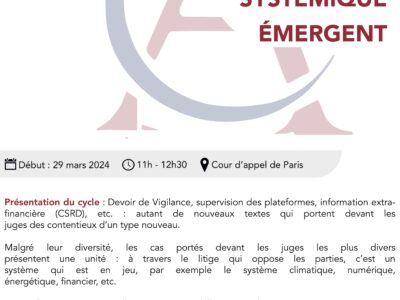
► Full Reference: M.-A. Frison-Roche, Coordination of the cycle of conference-debates Contentieux Systémique Émergent (Emerging Systemic Litigation), organised on the initiative of the Cour d'appel de Paris (Paris Cour of Appeal), with the Cour de cassation (French Court of cassation), the Cour d'appel de Versailles (Versailles Court of Appeal), the École nationale de la magistrature – ENM (French National School for the Judiciary) and the École de formation des barreaux du ressort de la Cour d'appel de Paris – EFB (Paris Bar School), under the scientific direction of Marie-Anne Frison-Roche - ► This Cycle in few words: Duty of vigilance, supervision of platforms, non-financial information (CSRD), etc.: as many new texts that bring new types of disputes before the courts. Despite their diversity, the cases brought before the most diverse judges present a unity: through the dispute that pits the parties against each other, it is a system that is at stake, for example the climate system, digital system, energy system, financial system, etc. New regulations are just the illustration of this "Emerging Systemic Litigation"; the conference-debates aiming at showing the new fields, new techniques, new standards, etc., in relation to the scale and diversity of stakeholders' expectations. This cycle is designed to encourage cross-fertilisation, so as to provide judges with food for thought ahead of the litigation they will be called upon to deal with. Les réglementations nouvelles ne sont que l’illustration de ce « contentieux systémique émergent » dont la formation a pour objet de montrer les nouveaux champs, les nouvelles techniques, les nouvelles normes, etc., en lien avec l’ampleur et la diversité des attentes des parties prenantes. Le cycle vise à favoriser les échanges croisés, afin d’alimenter la réflexion des magistrats en amont des litiges qui leurs seront soumis. - 🔴Registrations and information requests can be sent to: inscriptionscse@gmail.com 🔴For the attorneys, registrations have to be sent to the following address: https://evenium.events/cycle-de-conferences-contentieux-systemique-emergent/  ⚠️The conference-debates are held in person only, in the Cour d’appel de Paris (Paris Court of Appeal). - ► General Presentation of the Cycle: In 2024, the Cour d’appel de Paris (Paris Court of Appeal) created a new specialised chamber: chamber 5-12 Contentieux émergent – Devoir de vigilance et responsabilité écologique (Emerging litigation – Duty of vigilance and environmental liability). Vigilance litigation is an example of what is emerging more generally: Systemic Litigation, often linked to technologies. This calls for a new way of judging, organising procedures and relations between professionals. A series of conference-debates on Emerging Systemic Litigation (ESL) is being organised jointly by the Paris Court of Appeal, the Versailles Court of Appeal, the Cour de cassation (French Court of cassation), the École nationale de la magistrature – ENM (French National School for the Judiciary) and the École de formation des barreaux du ressort de la Cour d'appel de Paris – EFB (Paris Bar School), under the scientific responsibility of Professor Marie-Anne Frison-Roche. In this context, a series of conference-debates involving professionals from a wide range of backgrounds is being proposed on the following themes: 🧮the very notion of "Emerging Systemic Litigation" and the role of the judiciary in it (29 March 2024): read the report of this event   🧮vigilance, insofar as it gives rise to Systemic Litigation, notably because it takes legal form in numerous contracts, for example in employment relationships (26 April 2024): read the report of this event   🧮the inclusion in Emerging Systemic Litigation of information reliability techniques, particularly with regard to content available on platforms (27 May 2024): read the report of this event   🧮the way in which artificial intelligence is generating Systemic Litigation and the influence of new specific texts (24 June 2024): read the report of this event   🧮sustainability, a principle of systems found in reports and transitively in disputes concerning their development, their standards and even their control (9 September 2024): read the programme of this event   🧮new evidentiary techniques required by Emerging Systemic Litigation, to account for systemic needs, e.g. climate and digital systems, and how firms respond to them (14 October 2024): read the programme of this event   🧮Vigilance General Procedural Law, in that it incorporates the Systemic dimension of Vigilance Litigation (18 November 2024): read the programme of this event   🧮institutional and case law feedback from courts on Emerging Systemic Litigation (16 December 2024): read the programme of this event - 🧮read below the full programme of this cycle of conference-debates⤵️

Working papers

Working Paper

🚧Conditions required to promote the “contractualisation” of the Law

follow Marie-Anne Frison-Roche on LinkedIn subscribe to the Newsletter MAFR Regulation, Compliance, Law - ► Full Reference: M.-A. Frison-Roche, Conditions required to promote the "contractualisation" of the Law, Working Paper, June 2023. - 🎤This Working Paper has been done as a basis for the closing conference of the colloquia La contractualisation du droit. Acte II, organised by the Société de législation comparée (SLC) and the Procuradoria Geral do Estado do Rio de Janeiro (PGE-RJ), on 19, 20 and 21 June 2023. - 📝It is also the basis of the article "Les conditions requises pour favoriser la "contractualisation" du droit" ("Conditions required to promote the "contractualisation" of Law"), published in the book 📗La contractualisation du droit. Approches françaises et brésiliennes (Contractualisation of Law. French and Brazilian approaches). - ► English Summary of the Working Paper :  - 🔓read the Working Paper⤵️

Conferences

🎤Favoriser ou pas la « contractualisation » du Droit (“To favour or not the “contractualisation” of the Law”), in 🧮La contractualisation du droit. Acte II

follow Marie-Anne Frison-Roche on LinkedIn subscribe to the Newsletter MAFR Regulation, Compliance, Law  - ► Full Reference: M.-A. Frison-Roche, "Favoriser ou pas la « contractualisation » du Droit" ("To favour or not the "contractualisation" of the Law"), final speech in Société de législation comparée (SLC) and Procuradoria Geral do Estado do Rio de Janeiro (PGE-RJ), La contractualisation du droit. Acte II, Paris, 21 June 2023. - 🧮See the full programme of this event (in French). The conference is held in French -

Articles

📧Deliberative rationality” and the proper use of the vigilance imperative

► Full Reference: M.-A. Frison-Roche, "La "rationalité délibérative" et l'usage adéquat de l'impératif de vigilance" (""Deliberative rationality" and the proper use of the vigilance imperative"), Newsletter MAFR – Law, Compliance, Regulation, 6 April 2023. - 📧Read by freely subscribing other news of the Newsletter MAFR – Law, Compliance, Regulation - 🔴The deliberative public space, a model method for the implementation of the duty of vigilance In this new article of April 6, 2023 of the Newsletter MAFR – Law, Compliance, Regulation, the political philosophy construction that Habermas exposes about social networks and the method that the implementation of the duty of vigilance requires are correlated. Indeed, Habermas continues to advocate a space for discussion, contradiction, deliberation, opinion that can act with rationality. Communication and mediation are essential to ensure that the future, which is the object of vigilance, will not be a catastrophe: this monumental goal of compliance, of which Vigilance is a part, implies it. - 📧read the article ⤵️  - 🌐 follow Marie-Anne Frison-Roche on LinkedIn 🌐follow Marie-Anne Frison-Roche on Instagram 🌐 subscribe to the Newsletter MAFR Regulation, Compliance, Law

Couverture – La juridictionnalisation de la Compliance

Articles in a JoRC book

ANCEL, François🕴️

📝Le principe processuel de compliance, un nouveau principe directeur du procès ?, in 🕴️M.-A. Frison-Roche (ed.), Collection Régulations & Compliance La juridictionnalisation de la Compliance

► Full Reference: F. Ancel, "Le principe processuel de compliance, un nouveau principe directeur du procès ?" (The procedural principle of compliance, a new trial leading principle?), in M.-A. Frison-Roche (ed.), La juridictionnalisation de la Compliance, coll. "Régulations & Compliance", Journal of Regulation & Compliance (JoRC) and Dalloz, 2023, pp. 225-230.  - 📕read a general presentation of the book, La juridictionnalisation de la compliance, in which this article is published - ► Summary of the article (done by the Journal of Regulation & Compliance): Through this article, the author formulates a proposal: elevating the principle of compliance to the rank of leading principle of the trial. To support this, the author firstly emphasizes the convergence of the aims of compliance and the purpose of the trial. Indeed, emphasizing that Compliance Law does not oust either the State or the judge, as soon as compliance means that the person must keep their commitments and that the trial is also based on this principle that the parties must conform to the principles and to their own "speech", compliance thus becomes a trial leading principle. In a second part of the article, the author illustrates his point in a very concrete way. First, the protocols of procedure which are drawn up by the courts and the bars are commitments which should justify a form of constraint which, if it should not have the same form and nature as that of the law, must all the same even have consequences when a party fails to do so. Secondly, relying on French case law which sanctions a party which had accepted the principle of an arbitration and then systematically hinders its implementation, the author suggests that under the principle of compliance can be grouped the notions for the instant scattered of loyalty, consistency (estoppel) and efficiency. Thus, this "open practice" echoing the "open way" of a procedural principle of compliance brings out this one. -
Couverture – La juridictionnalisation de la Compliance

Articles in a JoRC book

TRAIN, François-Xavier🕴🏿

📝Arbitrage et procédures parallèles exercées au titre de la compliance, in🕴🏿M.-A. Frison-Roche (ed.), Collection Régulations & Compliance La juridictionnalisation de la Compliance

► Full Reference: F.-X. Train, "Arbitrage et procédures parallèles exercées au titre de la compliance" ("Arbitration and parallel proceedings exercised in Compliance Procedure"), in M.-A. Frison-Roche (ed.), La juridictionnalisation de la Compliance, coll. "Régulations & Compliance", Journal of Regulation & Compliance (JoRC) and Dalloz, 2023, pp. 355-368.  - 📕read a general presentation of the book, La juridictionnalisation de la Compliance, in which this article is published - ► The summary below describes the article that follows an intervention in the scientific manifestation Compliance et Arbitrage, co-organised by the Journal of Regulation & Compliance (JoRC) and the University Panthéon-Assas (Paris II). This conference was designed by Marie-Anne Frison-Roche and Jean-Baptiste Racine, scientific co-directors, and took place in Paris II University on March 31, 2021.  In the book, the article will be published in the Chapter III, devoted to: Compliance et Arbitrage international. - ► Summary of the article (done by the Journal of Regulation & Compliance): Firstly, the article insists on the principle of the autonomy of the international arbitration procedure, in relation to which parallel procedures remain watertight, whether they are criminal or done under Compliance Law. In the arbitral proceedings taking place independently, the arbitrators before whom the facts also referred to in these parallel proceedings, in particular the facts of corruption, are alleged before them as facts through their unlawful nature: it is at this title that they can and must apprehend them, using the standard of proof which is the bundle of clues. Secondly, the article highlights the limits of the autonomy of international arbitration. These may be de facto limits because in the search for evidence by arbitrators, red flags are often insufficiently consistent evidence to establish a sentence, especially since this sentence may be subject to control by the judge of its conformity to international public order, the annulment by the judge being able to be based on external elements, even after the arbitration procedure. It may then be wise for the arbitrators, who are not forced to do so, to suspend their proceedings to wait the results of the parallel proceedings initiated under Compliance Law, so that the procedures and their results could be harmonious. -