digital

Articles in a legal collective publication

📝L’usage des puissances privées par le droit de la compliance pour servir les droits de l’homme (Use of private companies by Compliance Law to serve Human Rights), in 🕴️J. Andriantsimbazovina (dir.), 📗Puissances privées et droits de l’Homme. Essai d’analyse juridique

► Full reference: M.-A. Frison-Roche, "L’usage des puissances privées par le droit de la compliance pour servir les droits de l’homme" (Use of private companies by Compliance Law to serve Human Rights) , in J. Andriantsimbazovina (dir.), Puissances privées et droits de l'Homme. Essai d'analyse juridique, Mare & Martin,  coll. "Horizons européens", 2024, pp. 279-295 - 🚧read the  Bilingual Working Paper on which this article is based, with more technical developments, references and hypertext links - ► English Summary of this article: Following the legal tradition, Law creates a link between power with a legitimate source, the State, public power being its prerogative, while private companies exercise their power only in the shadow of this public power exercised ex ante.  The triviality of Economic Law, of which Competition Law is at the heart, consisting of the activity of companies that use their power on markets, relegates the action of the State to the rank of an exception, admissible if the State, which claims to exercise this contrary power, justifies it.  The distribution of roles is thus reversed, in that the places are exchanged, but the model of opposition is shared. This model of opposition exhausts the forces of the organisations, which are relegated to being the exception. However, if we want to achieve great ambitions, for example to give concrete reality to human rights beyond the legal system within which the public authorities exercise their normative powers, we must rely on a new branch of Law, remarkable for its pragmatism and the scope of the ambitions, including humanist ambitions, that it embodies: Compliance Law. Compliance Law is thus the branch of Law which makes the concern for others, concretised by human rights, borne by the entities in a position to satisfy it, that is to say the systemic entities, of which the large companies are the direct subjects of law (I). The result is a new division between Public Authorities, legitimate to formulate the Monumental Goal of protecting human beings, and private organisations, which adjust to this according to the type of human rights and the means put in place to preserve them. Corporations are sought after because they are powerful, in that they are in a position to make human rights a reality, in their indifference to territory, in the centralisation of Information, technologies and economic, human, and financial means. This alliance is essential to ensure that the system does not lead to a transfer of political choices from Public Authorities to private companies; this alliance leads to systemic efficiency. The result is a new definition of sovereignty as we see it taking shape in the digital space, which is not a particular sector since it is the world that has been digitalised, the climate issue justifying the same new distribution of roles (II).  - 📝read the article (in French) - 🌐follow Marie-Anne Frison-Roche on LinkedIn 🌐follow Marie-Anne Frison-Roche on Instagram 🌐subscribe to the Newsletter MAFR Regulation, Compliance, Law 🌐subscribe to the Video Newsletter MAFR Surplomb

Articles in a legal collective publication

📝Le rôle du juge dans le déploiement du droit de la régulation par le droit de la compliance (The role of the Judge in the deployment of Regulatory Law through Compliance Law), synthesis in 🏛️Conseil d’État and 🏛️Cour de cassation, 📗De la régulation à la compliance : quel rôle pour le juge ?

► Full Reference: M.-A. Frison-Roche, "Le rôle du juge dans le déploiement du droit de la régulation par le droit de la compliance" ("Synthesis: The role of the Judge in the deployment of Regulatory Law through Compliance Law"), Synthesis in Conseil d'État (French Council of State) and Cour de cassation (French Court of cassation), De la régulation à la compliance : quel rôle pour le juge ? Regards croisés du Conseil d'État et de la Cour de cassation – Colloque du 2 juin 2023, La Documentation française, "Droits et Débats" Serie, 2024, pp. 173-182 - 🎥this article follows the closing speech of the biannual symposium organised by the Council of State and the Court of cassation, which in 2023 was entitled De la régulation à la compliance : quel rôle pour le juge ? (From Regulation to Compliance, what role for the judge ?) - 🚧read the bilingual Working Paper which is the basis of this article, with additional developments, technical references and hyperlinks - ► Presentation of this concluding article: It is remarkable to note the unity of conception and practice between professionals who tend to work in administrative jurisdictions and professionals who tend to work in judicial jurisdictions: they all note, in similar terms, an essential movement: what Regulatory Law is, how it has been transformed into Compliance Law, and how in one and even more so in the other the Judge is at the centre of it. Judges, as well as Regulators and European officials, explain this and use different examples to illustrate the far-reaching changes it brings to the Law and to the companies responsible for increasing the systemic effectiveness of the rules through the practice and dissemination of a Culture of Compliance. The role of the judge participating in this Ex Ante transformation is renewed, whether he/she is a judge of Public Law or a judge of Private Law, in a greater unity of the legal system. - ► English Summary of this article: The tug-of-war between 'Compliance' and 'conformity', which is exhausting us, obscures what is essential, i.e. the great novelty of a branch of law that assumes a humanist vision expressing the ambition to shape the future so that it is not catastrophic (preventing systems from collapsing), or even better (protecting human beings in these systems). The article begins by describing the emergence of Compliance Law, as an extension of Regulatory Law and going beyond it. This new branch of law takes account of our new world, brings its benefits and seeks to counter these systemic dangers so that human beings could be their beneficiaries and are not crushed by them. This branch of Ex Ante Law is therefore political, often supported by public Authorities, such as Regulatory Authorities, but today it goes beyond sectors, as shown by its cutting edge, the Obligation of Vigilance. The "Monumental Goals" in which Compliance Law is normatively anchored imply a teleological interpretation, leading to an "empowerment" of the crucial operators, not only States but also companies, responsible for the effectiveness of the many new Compliance Tools. The article goes on to show that Judges are increasingly central to Compliance Law. Lawsuits are designed to make companies more accountable. In this transformation, the role of the judge is also to remain the guardian of the Rule of Law, both in the protection of the rights of the defence and in the protection of secrets. Efficiency is not what defines Compliance, which should not be reduced to a pure and simple method of efficiency, which would lead to being an instrument of dictatorship. This is why the principle of Proportionality is essential in the judge's review of the requirements arising from this so powerful branch of Law.  The courts are thus faced with a new type of dispute, of a systemic nature, in their own area, which must not be distorted: the Area of Justice. - 📝read article (in French) - 🌐follow Marie-Anne Frison-Roche on LinkedIn 🌐follow Marie-Anne Frison-Roche on Instagram 🌐subscribe to the Newsletter MAFR Regulation, Compliance, Law

Conferences

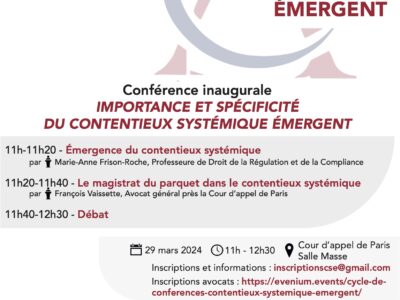
🎤L’émergence du contentieux systémique (Emergence of the Systemic Litigation), in 🧮Importance et spécificité du Contentieux Systémique Émergent, cycle of conference-debates “Contentieux Systémique Émergent”

► Full Reference: M.-A. Frison-Roche, "L’émergence du Contentieux Systémique" ("Emergence of the Systemic Litigation"), in Importance et spécificité du Contentieux Systémique Émergent (Importance and specificity of the Emerging Systemic Litigation), in cycle of conferences-debates "Contentieux Systémique Émergent" ("Emerging Systemic Litigation"), organised on the initiative of the Cour d'appel de Paris (Paris Cour of Appeal), with the Cour de cassation (French Court of cassation), the Cour d'appel de Versailles (Versailles Court of Appeal), the École nationale de la magistrature – ENM (French National School for the Judiciary) and the École de formation des barreaux du ressort de la Cour d'appel de Paris – EFB (Paris Bar School), under the scientific direction of Marie-Anne Frison-Roche, March 29, 2024, 11h-12h30, Cour d'appel de Paris, salle Masse - 🧮see the full programme of this event - 🧮see the programme of the entire cycle Contentieux Systémique Émergent - 🌐consult on LinkedIn the report of this speech (in French) - 🌐consult on LinkedIn a general présentation of this event, which links to a presentation and a report of each speech (in French) - 🧱consult the scientific coordination sheet of this event, which gives an account of the various speeches made - 🔲see the slides used to support this intervention (in French) - 🚧read the bilingual Working Paper which is the basis of this speech - ► English Summary of the conference: We are seeing the emergence of what should be referred to as a category of its own: the "Systemic Litigation". This concept, proposed in 2021📎1🕴️M.-A. Frison-Roche, 🚧The hypothesis of Systemic Cases brought before the Judge, 2021., refers to the hypothesis in which a system is 'involved' in a particular 'case' submitted to the judge. The presence of a system should not be confused with a systemic analysis of a phenomenon. The term 'cause' must be understood in the procedural sense, as used in article 5 of the Code civil (French Civil Code). Specifically, the prohibition contained in article 5 of the French Civil Code does not apply because a system thus involved calls for factual responses and solutions and not necessarily general and abstract solutions: the solution of a systemic nature and scope, that the presence of a system in a cause calls for, may be a factual solution, even if it radiates out from the system as a whole. But precisely because the presence of a system in the case often gives rise to a question that is itself systemic, the judge, if he wishes to comply with article 4 of the French Civil Code, must respond not only a minima by not evading the question, for example of systemic risks, but also fully by providing systemic solutions, for example remedies to preserve in the future the solidity and durability of the systems involved in the case.    These systems may be of different kinds: banking, financial, transport, health, energy, digital, algorithmic or climatic. Their presence in cases brought to the attention of judges, the variety and difficulties of which will be seen in later contributions, leads to basic questions relating to the emergence of Systemic Litigation: firstly, how can Systemic Litigation be defined? Secondly, what makes this category of litigation emerge? The answers to these two questions have essential practical consequences.  The new solutions must be based on a classic distinction, used in particular in criminal and administrative proceedings, which are more objective, but also in civil proceedings, notably by Hébraud, namely the distinction between the "party to the dispute/litigation" and the "party to the proceedings". Depending on whether it is accepted that the system should be considered as a "party to the litigation", which would allow it, through an entity that is legitimate in expressing it, to allege claims and formulate demands against an adversary, or as a "party to the proceedings", a much broader category, which would allow the judge to hear the interests of the systems involved without individuals being able, on behalf of a system, to formulate claims against or for the benefit of a party to the litigation.     This makes it possible to innovate while preserving the measure of which the judge is the guardian.   - 🌐follow Marie-Anne Frison-Roche on LinkedIn 🌐follow Marie-Anne Frison-Roche on Instagram 🌐subscribe to the Newsletter MAFR Regulation, Compliance, Law

Articles in The Journal of Regulation & Compliance « JoRC »

HEYMANN, Jérémy🕴️

📝The Legal Nature of the Facebook “Supreme Court”, in 🕴️M.-A. Frison-Roche (ed.), 📘Compliance Jurisdictionalisation

► Full Reference: J. Heymann, "The Legal Nature of the Facebook “Supreme Court”", in M.-A. Frison-Roche (ed.), Compliance Jurisdictionalisation, Journal of Regulation & Compliance (JoRC) and Bruylant, "Compliance & Regulation" Serie, 2024, pp. 167-182 - 📘read a general presentation of the book, Compliance Jurisdictionalisation, in which this article is published - ► Summary of the article (done par the Author): Taking place in the general theme aiming at making “words and things coincide”, the article offers some thoughts on the “conditions of the discourse” – in the sense in which Foucault understood it in his Archéologie des sciences humaines – relating to the phenomenon of “jurisdictionalization” of Compliance. The thoughts are more specifically focusing on the nature of the so-called “Supreme Court” that Facebook instituted to hear appeals of decisions relating to content on the digital social networks that are Facebook and Instagram. Is this really a “Supreme Court”, designed in order to “judge” the Facebook Group? A careful examination of the Oversight Board – i.e. the so-called “Supreme Court” created by Facebook – reveals that the latter, in addition to its advisory mission (which consists of issuing policy advisory opinions on Facebook’s content policies), exercises some form of adjudicative function. This is essentially conceived in terms of compliance assessment, of the content published on the social networks Facebook or Instagram with the standards issued by these corporations on the one hand, of content enforcement decisions taken by Facebook with the Law on the other hand. The legal framework of reference is yet rather vague, although its substantial content seems to be per se evolutive, based on the geographical realm where the case to be reviewed is located. An adjudicative function can therefore be characterized, even if the Oversight Board can only claim for a limited one. The author can ultimately identify the Oversight Board as a preventive dispute settlement body, in the sense that it seems to aim at avoiding any referral to state courts and ruling before any court’s judgement can be delivered. Some questions are thus to be raised, relating with both legitimacy and authority of such a Board. But whatever the answers will be, the fact remains that the creation of the Oversight Board by a private law company already reveals all the liveliness of contemporary legal pluralism. - 🦉This article is available in full text to those registered for Professor Marie-Anne Frison-Roche's courses -

Organisation of events

🧱⚙️Coordination of the cycle of conference-debates 🧮Contentieux Systémique Émergent – CSE (Emerging Systemic Litigation – ESL)

► Full Reference: M.-A. Frison-Roche, Coordination of the cycle of conference-debates Contentieux Systémique Émergent (Emerging Systemic Litigation), organised on the initiative of the Cour d'appel de Paris (Paris Cour of Appeal), with the Cour de cassation (French Court of cassation), the Cour d'appel de Versailles (Versailles Court of Appeal), the École nationale de la magistrature – ENM (French National School for the Judiciary) and the École de formation des barreaux du ressort de la Cour d'appel de Paris – EFB (Paris Bar School), under the scientific direction of Marie-Anne Frison-Roche - ► This Cycle in few words: Duty of vigilance, supervision of platforms, non-financial information (CSRD), etc.: as many new texts that bring new types of disputes before the courts. Despite their diversity, the cases brought before the most diverse judges present a unity: through the dispute that pits the parties against each other, it is a system that is at stake, for example the climate system, digital system, energy system, financial system, etc. New regulations are just the illustration of this "Emerging Systemic Litigation"; the conference-debates aiming at showing the new fields, new techniques, new standards, etc., in relation to the scale and diversity of stakeholders' expectations. This cycle is designed to encourage cross-fertilisation, so as to provide judges with food for thought ahead of the litigation they will be called upon to deal with. Les réglementations nouvelles ne sont que l’illustration de ce « contentieux systémique émergent » dont la formation a pour objet de montrer les nouveaux champs, les nouvelles techniques, les nouvelles normes, etc., en lien avec l’ampleur et la diversité des attentes des parties prenantes. Le cycle vise à favoriser les échanges croisés, afin d’alimenter la réflexion des magistrats en amont des litiges qui leurs seront soumis. - 🔴Registrations and information requests can be sent to: inscriptionscse@gmail.com 🔴For the attorneys, registrations have to be sent to the following address: https://evenium.events/cycle-de-conferences-contentieux-systemique-emergent/  ⚠️The conference-debates are held in person only, in the Cour d’appel de Paris (Paris Court of Appeal). - ► General Presentation of the Cycle: In 2024, the Cour d’appel de Paris (Paris Court of Appeal) created a new specialised chamber: chamber 5-12 Contentieux émergent – Devoir de vigilance et responsabilité écologique (Emerging litigation – Duty of vigilance and environmental liability). Vigilance litigation is an example of what is emerging more generally: Systemic Litigation, often linked to technologies. This calls for a new way of judging, organising procedures and relations between professionals. A series of conference-debates on Emerging Systemic Litigation (ESL) is being organised jointly by the Paris Court of Appeal, the Versailles Court of Appeal, the Cour de cassation (French Court of cassation), the École nationale de la magistrature – ENM (French National School for the Judiciary) and the École de formation des barreaux du ressort de la Cour d'appel de Paris – EFB (Paris Bar School), under the scientific responsibility of Professor Marie-Anne Frison-Roche. In this context, a series of conference-debates involving professionals from a wide range of backgrounds is being proposed on the following themes: 🧮the very notion of "Emerging Systemic Litigation" and the role of the judiciary in it (29 March 2024): read the report of this event   🧮vigilance, insofar as it gives rise to Systemic Litigation, notably because it takes legal form in numerous contracts, for example in employment relationships (26 April 2024): read the report of this event   🧮the inclusion in Emerging Systemic Litigation of information reliability techniques, particularly with regard to content available on platforms (27 May 2024): read the report of this event   🧮the way in which artificial intelligence is generating Systemic Litigation and the influence of new specific texts (24 June 2024): read the report of this event   🧮sustainability, a principle of systems found in reports and transitively in disputes concerning their development, their standards and even their control (9 September 2024): read the programme of this event   🧮new evidentiary techniques required by Emerging Systemic Litigation, to account for systemic needs, e.g. climate and digital systems, and how firms respond to them (14 October 2024): read the programme of this event   🧮Vigilance General Procedural Law, in that it incorporates the Systemic dimension of Vigilance Litigation (18 November 2024): read the programme of this event   🧮institutional and case law feedback from courts on Emerging Systemic Litigation (16 December 2024): read the programme of this event - 🧮read below the full programme of this cycle of conference-debates⤵️

Articles in a legal collective publication

article in a collective publication

📝The deployment of Regulatory Law through Compliance Law in the European project

► Full Reference: M.-A. Frison-Roche, "The deployment of Regulatory Law through Compliance Law in the European project", in G. Hardy & F. Picod, Compliance Regulation from a European Perspective, Law and European Affairs (L.E.A.), 2023/2, pp. 345-352. - 🚧read the bilingual Working Paper which is the basis of this article, with additional developments, technical references and hyperlinks  - ► English Summary of the article: Compliance Law is neither a method of obeying regulations, nor a simple neutral method of ensuring the effectiveness of norms, nor a means of enforcement displaced from Ex Post to Ex Ante. It is an extension of Regulatory Law and goes beyond it. Like it, it aims to build spaces according to a political project specific to an area, such as Europe. Branch of Law looking to the future as Regulatory Law does, it constructs and maintains, in a systemic way, sustainable, albeit unstable, balances to achieve the ‘Monumental Goals’ in which its normativity resides: security, sustainability, probity, truth, and dignity. By internalising these Monumental Goals in the companies that are in a position to achieve them, the “crucial companies”, Compliance Law preserves the logic of Regulatory Law, offering it a prodigious expansion since it frees it from the condi- tion of a sector and territorial borders, which seemed tautological, by associating private powers and public will, which remains primary. In this way, Compliance can regulate the digital space and climate issue through political choices made by a sovereign Europe. - 🌐follow Marie-Anne Frison-Roche on LinkedIn 🌐follow Marie-Anne Frison-Roche on Instagram 🌐subscribe to the Newsletter MAFR Regulation, Compliance, Law
Monographs

MORENO BELLOSO, Natahalie🕴️ & PETIT, Nicolas🕴️

📝The EU Digital Markets Act (DMA). A Competition Hand in a Regulatory Glove

► Full Reference : N. Moreno Belloso & N. Petit, "The EU Digital Markets Act (DMA). A Competition Hand in a Regulatory Glove", (2023) 48 European Law Review 391, available at SSRN: https://ssrn.com/abstract=4411743 - ► Summary of the article (made by the Authors) : "The newly enacted Digital Markets Act (DMA) finds itself at a crossroads. The DMA can develop into a specialist field of competition law for digital platforms or it can evolve into a new field of EU law, detached from competition law. The DMA’s ultimate trajectory will depend on the legal characterization given to the DMA. Is it a special competition law regime or an original instrument distinct from competition law? This paper lays the groundwork for characterizing the DMA by offering a complete descriptive analysis of the instrument. Among the elements discussed are the twin concepts of “gatekeepers” and “core platform services”, which together condition the DMA’s scope of application, as well as the legal obligations imposed on gatekeepers. The paper proposes a novel categorisation of the obligations, showing that each obligation can be associated with at least one of two conventional competition law concerns (exclusion or exploitation). The discussion shows the difficulty of pinpointing the exact nature of the DMA. We argue that this ambiguity creates challenges for the practical implementation of the DMA.". - 🦉This article is available in full text to those registered for Professor Marie-Anne Frison-Roche's courses -

Articles in The Journal of Regulation & Compliance « JoRC »

📝Le jugeant-jugé. Articuler les mots et les choses face à l’éprouvant conflit d’intérêts, in 🕴️M.-A. Frison-Roche (ed.), 📕La juridictionnalisation de la Compliance

► Full Reference: M.-A. Frison-Roche, "Le jugeant-jugé. Articuler les mots et les choses face à l'éprouvant conflit d'intérêts" ("The Judge-Judged. Articulating words and things in the face of the testing conflict of interest"), in M.-A. Frison-Roche, (ed.), La juridictionnalisation de la Compliance, coll. "Régulations & Compliance", Journal of Regulation & Compliance (JoRC) and Dalloz, 2023, pp. 59-80.  - 📝read the article (in French) - 🚧read the bilingual Working Paper which is the basis of this article, with additional developments, technical references and hyperlinks - 📕read a general presentation of the book, La juridictionnalisation de la Compliance, in which this article is published - ► Summary of the article (done by the Journal of Regulation & Compliance): Since the topic of this article is part of a chapter devoted to the Company established as Prosecutor and Judge of itself by Compliance Law, chapter aiming to use the relevant qualifications, it is appropriate therefore to worry about the adjustment of words and things, of the way in which the relationship between ones and the others evolve, and of the more particular question of knowing if this evolution is radical or not when one speaks of "judge ". because "judging" is a word that the Law has disputed with other disciplines, but that it has appropriated not so much to confer more powers on those who act in its name, for example that who supervise and punish, but on the contrary to impose limits, since to the one who judges it has put the chains of the procedure under foot, thus making bearable for the other the exercise of such a power. Therefore, those who want the power to judge would often want to not have the title, because having de jure the title of judge is being subject to the correlated regime, it is to be submitted to procedural correctness. It is therefore to better limit that the Law sees who judges, for obliging this so-powerful character to the procedure. But the Law also has the power to appoint a judge and to fix the contours of all the characters in the trial. He usually does it with clarity, distinguishing the ones of the others, not confusing them. This art of distinction has constitutional value. Thus, not only the one who judges must be named "judge" but the procedural apparatus which goes with this character, and which constitutes a way of doing things and fundamental rights, are not "granted" by kindness or in a second step: it is a block. If you didn't want to have to endure procedural rights, you didn't have to want to be a judge. Admittedly, one could conclude that the procedure would therefore have become "substantial"; by this elevation, it is rather a fashion of saying that the procedure would no longer be a "servant": it is a kind of declaration of love for the procedure, as long as one affirms that at the acts of judging , or investigating, or prosecuting, are "naturally" attached the procedural rights for the one who is likely to be the object of these powers. Compliance Law, in search of allies to achieve the Monumental Goals for the aims of which it was instituted, will require, or even demand, private companies to go and seek themselves, in particular through investigations. internal or active vigilance on others, for finding facts likely to be reproached to them. Compliance Law will also require that they prosecute those who have committed these acts. Compliance La will again demand that they sanction the acts that people have committed in their name. This is clearly understood from the point of view of Ex Ante efficiency. The confusion of roles is often very efficient since it is synonymous with the accumulation of powers. For example, it is more efficient that the one who pursues is also the one who instructs and judges, since he knows the case so well… Besides, it is more efficient that he also elaborates the rules, so he knows better than anyone the "spirit" of the texts. This was often emphasized in Regulatory Law. When everything is Information and risk management, that would be necessary … But all this is not obvious. For two reasons, one external and the other internal. Externally, the first reason is that it is not appropriate to "name" a judge who is not. This would be too easy, because it would then be enough to designate anyone, or even to do it oneself to appropriate the regime that goes with it, in particular for obtain a so-called legitimate power for obtaining that others obey even though they are not subordinate or from them they transmit information, even though they would be  competitors: it would then be necessary to remember that only the Law is able to appoint judge ; in this new Compliance era, companies would be judges, prosecutors, investigators!  Maybe, if the Law says it, but if it didn't, it would be necessary to come back to this tautology … But are we in such a radicalism? Moreover, do judges have "the prerogative" of judgment and the Law has not admitted this power for companies to judge for a long time? As soon as the procedure is there in Ex Ante and the control of the judge in Ex Post? The second reason, internal to the company, situation on which the article focuses, is that the company investigates itself, judges itself, sanctions itself. However, the legal person expressing its will only through its organs, we underline in practice the difficulties for the same human being to formulate grievances, as he/she is the agent of the legal person, addressed to the natural person that he/she himself/herself is. The two interests of the two are not the same, are often opposed; how the secrets of one can be kept with respect to the other, represented by the same individual? … It is all the mystery, even the artifice of legal personality that appears and we understand better that Compliance Law no longer wants to use this strange classical notion. Because all the rules of procedure cannot mask that to prosecute oneself does not make more sense than to contract with oneself. This conflict of interest is impossible to resolve because naming the same individual X then naming him/her Y, by declaring open the dispute between them does not make sense. This dualism, which is impossible to admit when it comes to playing these functions with regard to corporate officers, can come back to life by setting up third parties who will carry secrets and oppositions. For example, by the designation of two separate lawyers for the human being agent and the human being representative of the legal person, each lawyer being able to have secrets for each other and to oppose each other. These spaces of reconstitution of the so "natural" oppositions in procedure between the one who judges and the one who is judged can also take the technological form of platforms: where there is no longer anyone, where the process has replaced the procedure, there is no longer any human judgment. We can thus see that the fear of conflicts of interest is so strong that we resign ourselves to saying that only the machine would be "impartial", a derisory conception of impartiality, against which it is advisable to fight. This then leads to a final question: can the company claim to exercise the jurisdictional power to prosecute and judge and investigate without even claiming to be a prosecutor, an investigating judge, or a court? The company's advantage would be to be able to escape the legal regime that classical Law attaches to its words, mainly the rights of the defense and the rights of action for others, the principle of publicity of justice for everyone, which expresses the link between procedure and democracy. When Facebook said on June 12, 2021 "react" to the decision of May 5, 2021, adopted by what would only be an Oversight Board to decide "as a consequence" of a 2-year suspension of Donald Trump's account, the art of qualifications seem to be used in order to avoid any regime constraint. But this art of euphemism is very old. Thus, the States, when they wanted to increase repression, presented the transformation of the system as a softening of it through the "decriminalization" of Economic Law, transferred from the criminal courts to the independent administrative agencies. The efficiency was greatly increased, since the guarantees of the Criminal Procedure ceased to apply. But 20 years later, Words found their way back to Things: under Criminal Law, slept the "criminal matter", which requires the same "Impartiality". In 1996, a judge once affirmed it and everything was changed. Let us therefore wait for what the Courts will say, since they are the masters of qualifications, as Article 12 of the French Code of Civil Procedure says, as Motulsky wrote it in 1972. Law has time. - 🌐 follow Marie-Anne Frison-Roche sur LinkedIn 🌐follow Marie-Anne Frison-Roche on Instagram 🌐 subscribe to the Newsletter MAFR Regulation, Compliance, Law