digital

Publication director

🏗️ copublishing and direction of the collection: 📚Régulations & Compliance

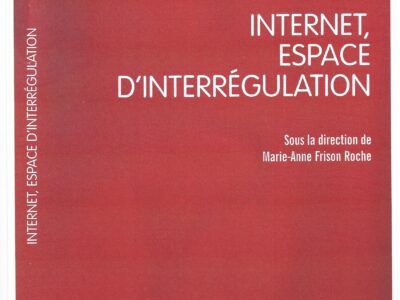
📕Internet, espace d’interrégulation (dir.)

Complete references :  Frison-Roche, M.-A. (dir.), Internet, espace d’interrégulation, Serie “Régulations”, coll. “Thèmes & Commentaires”, Dalloz, Paris, 2016. ► Read the presentations of the other books in the series: the following books: 🕴️M.-A. Frison-Roche (ed.), 📕Régulation, Supervision, Compliance, 2017 🕴️N. Borga, J.-Cl. Marin and J.-Ch. Roda (eds.), 📕Compliance : l’entreprise, le régulateur et le juge, 2018 🕴️M.-A. Frison-Roche (ed.), 📕Pour une Europe de la Compliance, 2019 🕴️M.-A. Frison-Roche (ed.), 📕Les outils de la Compliance, 2021 🕴️M.-A. Frison-Roche (ed.), 📕Les Buts Monumentaux de la Compliance, 2022 🕴️M.-A. Frison-Roche (ed.), 📕La juridictionnalisation de la Compliance, 2023 🕴️M.-A. Frison-Roche and M. Boissavy (eds.), 📕Compliance et droits de la défense. Enquête interne – CJIP – CRPC, 2024 🕴️M.-A. Frison-Roche (ed.), 📕L’Obligation de Compliance, 2025 🕴️M.-A. Frison-Roche (ed.), 📕Compliance et Contrat, forthcoming 🕴️L. Laref (ed.), 📕Compliance et vigilance bancaire, forthcoming 🕴️M.-A. Frison-Roche, 📕Le système juridique de l’adressage de l’Internet. Une structure multi-acteurs, gage de durabilité (The Legal System of Internet Addressing. A Multi-Stakeholder Structure, the Pledge of its Sustainability), forthcoming 🕴️M.-A. Frison-Roche (ed.), 📕Le système probatoire de la Compliance, forthcoming Read the presentation of the book (written in French). Read the presentation of the  authors of the contributions (written in French) “Regulate the Internet”. Some argue that any regulation is contrary to the nature of digital. Others argue that this is indispensable, for its economic deployment and for public freedoms. Internet renews conceptions and practices. Notably those of the Law of the Regulation. Indeed, the Internet makes it possible to offer and obtain services that are in often regulated sectors: financial, audiovisual, healthcare, gaming. Moreover, they converge in new objects: the connected objects. Often described as a “legal desert”, digital appears as a kind of jumble of systems of various regulations that overlap, deform and contradict each other. In reaction, an “interregulation”, de facto or de jure, in law more or less flexible, is in the process of being established. Who will be the Regulator: The States? The judge? The Internet users? The future is open. The book first determines the “Interregulation Needs” and then describes and conceives solutions for the interregulation of the digital space. Read the presentation of the two articles written by Marie-Anne Frison-Roche:      Thinking the world from the notion of “data”      To draw the regulatory consequences of a rethinked world from the notion of “data” The working papers which are the base of these articles are written in English.        

Articles in a legal collective publication

📝Rethinking the world from the notion of “data” (Penser le monde à partir de la notion de “données”)

Référence complète : Frison-Roche, M.-A., Penser le monde à partir de la notion de "donnée", in Frison-Roche, M.-A. (dir.), Internet, espace d'interrégulation, série "Régulation", 2016, pp. 7-16.   English summary : Law is a reconstruction of the world through definitions and categories, expressed in words, to which are imputed rules. There is always a share of invention in Law, articulated to a share of fidelity to the concrete world that it retranscribes, a combination enabling Law to regulate the latter. Law is put in difficulty by what the term "data", quite new, is not easy to define. The fact that it is strangely formulated in Latin to show that there is plurality, the data, before associating it with an English adjective when there are many, the "big data", does not advance us more on what a "data" is. Law is a practical art that works well only if it manipulates categories whose definition is mastered. This is why, in a first stage, we must recognize the uncertainties of the very notions of "data" (I), in order to orientate the adequate rules in the second step towards what is a given, namely a "pure" value in our consumer information society (II).   Read the article (in French)   This article is linked to another article published in the same book : Les conséquences régulatoires d'un monde repensé à partir de la notion de "donnée" ("the regulatory consequences of a word redesigned from the notion of "data")

Texts

European Parliament and Council of the European Union

Regulation of 25 November 2015 laying down measures concerning open internet access

Full reference: Regulation (EU) 2015/2120 of the European Parliament and of the Council of 25 November 2015 laying down measures concerning open internet access and amending Directive 2002/22/EC on universal service and users’ rights relating to electronic communications networks and services and Regulation (EU) No 531/2012 on roaming on public mobile communications networks within the Union Read the regulation 

Working papers

🚧 Rethinking the world from the notion of “data”

Law is a reconstruction of the world through definitions and categories, expressed in words, to which are imputed rules. There is always a share of invention in Law, articulated to a share of fidelity to the concrete world that it retranscribes, a combination enabling Law to regulate the latter. Law is put in difficulty by what the term "data", quite new, is not easy to define. The fact that it is strangely formulated in Latin to show that there is plurality, the data, before associating it with an English adjective when there are many, the "big data", does not advance us more on what a "data" is. Law is a practical art that works well only if it manipulates categories whose definition is mastered. This is why, in a first stage, we must recognize the uncertainties of the very notions of "data" (I), in order to orientate the adequate rules in the second step towards what is a given, namely a "pure" value in our consumer information society (II).   Read the article written in French on the basis à this working paper

Books

book

📗Internet et nos fondamentaux (Internet and our Fondamentals)

► Full Reference: J.-M. Chevalier, I. Ekeland, M.-A. Frison-Roche & M. Kalika, Internet et nos fondamentaux ("Internet and our Fondamentals"), PUF, 2000, 128 p. - ► English general presentation of this book and its summary: The Internet creates an impression of extreme novelty. Indeed, the fundamentals, have changed, as much in economics, management as in law. e-management, e-commerce, e-finance: all disciplines must rebuild their rules, so that the behaviours of actors are in a new way framed. The Internet is not just a new way of communicating. It introduces new behaviours, new rules, some say a new world, perhaps a new life for pioneers of a new kind. This impression of extreme newness is the sign of a revolution, because the facts about the Internet do not seem to be explainable by any previously established rule: the principles to which we must refer have changed, the fundamentals that enable us to translate the world into abstractions, to understand it and to dominate it, are in mutation. How can we understand the Internet? Not necessarily by delving into its technical and everyday aspects, but by confronting it with the fundamentals of the various disciplines in order to measure which key notions the Internet is abusing, which it is destroying and which it is imposing. What remains of our ways of thinking and practising science, law, economics and management? What are these disciplines built on? How can we understand them and bring them together again, under the impact of the Internet? The ambition of this book is to shed light on these new fundamentals, to tackle the conceptual revolution that Internet technology is bringing with it.     -   Content : Introduction, p. 7 Internet et la recherche en sciences exactes et naturelles ("The Internet and research in the natural sciences"), p. 19 Les bouleversements du droit par Internet ("The upheaval of law caused by the Internet"), p. 37 Les fondements des sciences économiques interpellés par Internent ("The foundations of economics challenged by the Internet"), p. 77 Internet et les sciences de gestion : l’émergence du e-management ("The Internet and management sciences: the emergence of e-management"), p. 103 -