A SUPPRIMER : Droit des contrats (EN, doublon)

Logo-partage-JoRC-Paris1-IRJS

Organisation of events

🏗️Cycle of colloquia 2026: Compliance and Contract

🧮 Compliance et Droit commun des contrats (Compliance and General Contract Law), in 🏗️Compliance and Contract

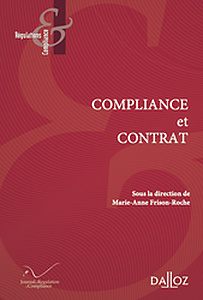
► Full reference: Journal of Regulation & Compliance (JoRC) and Université Paris 1 Panthéon-Sorbonne, Institut de recherche juridique de la Sorbonne (IRJS) (Sorbonne Legal Research Institute), Compliance et Droit commun des contrats (Compliance and General Contract Law), 7 October 2026. see on Instagram the carousel devoted to the conference (in French) see on Instagram the programme of the conference (in French) - 🏗️ This symposium is part of the series of symposiums organised by the Journal of Regulation & Compliance (JoRC) and its partner universities, focusing in 2026 on the general theme of Compliance and Contract. - The symposium is under the scientific responsibility of 🕴️Nicolas Bargue, Senior Lecturer (maître de conférences) at the Sorbonne Law School (Université Paris 1 Panthéon-Sorbonne), co-director of the Contract, Civil Liability and Insurance Department of the IRJS, 🕴️Marie-Anne Frison-Roche, Professor of Law (agrégée des Facultés de Droit), Director of the Journal of Regulation & Compliance (JoRC) and of the European School of Regulation and Compliance (EeRC), and 🕴️Julia Heinich, Professor at the Sorbonne Law School (Université Paris 1 Panthéon-Sorbonne). - Registration with the IRJS: Registration for the symposium « Compliance et droit commun des contrats » of 7 October 2026 | Labo – IRJS - 🧮The symposium, organised by the Journal of Regulation & Compliance (JoRC) and the Institut de recherche juridique de la Sorbonne (IRJS), will take place on Wednesday 7 October 2026, from 9:15 am to 1 pm, at Université Paris 1 Panthéon-Sorbonne, Room 6 of the Centre Panthéon, 12 place du Panthéon, 75005 Paris. It will be held in French. - Presentation of the topic: While Contract Law, in its common rules expressed by the “general theory of contracts”, is often considered to be the most developed branch of Law in practice and the most studied at university, at first glance it seems to be given little consideration when it comes to Compliance. The relationship between the contract and the documents, standards and ethical acts so numerous in Compliance techniques, to which is added the soft law produced by courts, regulators, supervisors and companies themselves, is an open question. Thus the “commitments” that punctuate the techniques and behaviours making up the “compliance culture” have a central place in Compliance Law; but their place, if not their equivalence with the Contract, is not established. To gain a firmer footing in the analysis of the practices of companies that insert compliance clauses into multiple contracts, to observe that Compliance can be the very subject of a specific contract — the “compliance contract” —, or even to assist in the conception that judges develop of their office when they hear contractual litigation involving Compliance, we must return to general Contract Law. If we stop viewing Compliance Law solely through the prism of repression, the Contract does not have the same place: the compliance obligation can be conceived as also having the contract as a legitimate source, a contract which, under general law, has its source in the autonomy of the will and all its consequences — contractual freedom, binding force, effect on third parties. This is the subject of this symposium which, following the classic diptych of formation and performance, takes up the contractual thread from the founding principles of autonomy and freedoms, binding force and its relativity, the meeting of wills, groups of contracts and regulatory contracts often drawn up to implement compliance policies. Specific performance and contractual liability under general law are themselves coloured in a singular way when a compliance concern has been inserted into the contract. - The proceedings of this symposium will form the basis of a specific chapter in the following publications: 📕Compliance et Contrat, forthcoming in the series 📚Régulations & Compliance, co-published by the Journal of Regulation & Compliance (JoRC) and Lefebvre-Dalloz. 📘Compliance and Contract, forthcoming in the 📚Compliance & Regulation Series, co-published by the Journal of Regulation & Compliance (JoRC) and Lefebvre-Bruylant. 🔻 See the programme below
Séance du colloque « La contractualisation de la Compliance : clause après clause », Université Jean Moulin Lyon 3, 25 septembre 2026

Articles

Article in a MAFR newsletter

📝From Clause to Clause: the Emergence of a Contractual Compliance System

► Full reference: M.-A. Frison-Roche, “From Clause to Clause: the Emergence of a Contractual Compliance System”, Newsletter MaFR Law, Compliance, Regulation, 30 September 2026 (linkedin.com/pulse/from-clause-emergence-contractual-compliance-system-marie-anne-v52ie/) - 🌐 read the article published on LinkedIn - 📧 read other issues of the Newsletter MAFR – Law, Compliance, Regulation by free subscription - 🧮 read the presentation of the colloquium “La contractualisation de la Compliance : clause après clause” (Lyon, 25 September 2026) - 🏗️ read the presentation of the 2026 cycle of colloquia Compliance and Contract - 📕 read the presentation of the book Compliance et Contrat - 🇫🇷 read the French version of this newsletter - 📝 ⤵ read the article below ⤵
Marie-Anne Frison-Roche au colloque « Clause après clause », Université Jean Moulin Lyon 3, 25 septembre 2026

Conferences

🎤Unicité et Diversité des clauses de Compliance (Unicity and Diversity of Compliance Clauses), in 🧮La contractualisation de la Compliance : clause après clause (The Contractualisation of Compliance: Clause by Clause)

► Full reference: M.-A. Frison-Roche, « Unicité et Diversité des clauses de Compliance » (Unicity and Diversity of Compliance Clauses), in Journal of Regulation & Compliance (JoRC) and Université Jean Moulin Lyon 3, Centre de recherches Louis Josserand, La contractualisation de la Compliance : clause après clause (The Contractualisation of Compliance: Clause by Clause), Lyon, 25 September 2026. see on Instagram the carousel devoted to this lecture (in French) - 🧮read the full programme of the event (in French) 🏗️This colloquium is part of the 2026 cycle of colloquia Compliance and Contract. - 🚧This lecture is based on a bilingual Working Paper: Unicity and Diversity of Compliance Clauses: towards a Contractual Compliance System. - 🖥️consult the slides supporting this lecture (these slides are in English; the slides projected during the lecture were the original French slides) - 🎤See the presentation of the other lecture given in this colloquium: The Audit Clause Correlated with the Compliance Obligation. - 📝This lecture will give rise to an article, « Unicité et Diversité des clauses de Compliance », to be published in the book 📕Compliance and Contract, in the series 📚Compliance & Regulation, co-published by the Journal of Regulation & Compliance (JoRC) and Bruylant. - ► Presentation of this lecture : Practitioners insert into a wide variety of contracts clauses that are expressly designated as “Compliance clauses”. We lack a definition, so their legal regime is uncertain. To consolidate this practice and ensure that its development produces satisfactory effects, these clauses must be classified, named and distinguished from one another. This is what this lecture sets out to do. In a first stage, a strong unicity of Compliance clauses appears. But this unicity is somewhat misleading. It proceeds from a confusion between contract and statute: whether the clause, as a block, obliges the other contracting party to comply with all the regulations, or borrows its unity from the particular corpus of which it claims to be the tool of application, the clause copies the legislation. This is the unified but rather archaic conception to which the Regulator has itself lent credence, by designating the Compliance clause only as a delegation within a normative power that would remain first and foremost its own. So as not to stop there, in a second stage, the lecture shows the great diversity of Compliance clauses, a de jure diversity born of the principle of contractual freedom and a de facto diversity resulting from the porosity of the clause to the activities concerned, the country and the persons. To be mastered, this diversity must be channelled by a nomenclature. It must also be preserved in a lasting way, because it stems from the general policy of the company and the project it wishes to develop, for example in the value chains it has chosen to build through regulatory contracts. Nevertheless, and this is the subject of the third stage of the lecture, there is a deep and programmatic unicity of Compliance clauses, which lies in the systemic goals they serve. In practice, this unicity is built through an interlinked system of clauses, precisely described and specific to each undertaking. At the level of a large company, this can give rise to a Contractual Compliance System, which is articulated and allied with the regulatory system.
Marie-Anne Frison-Roche au colloque « Clause après clause », Université Jean Moulin Lyon 3, 25 septembre 2026

Conferences

🎤La clause d’audit corrélée à l’Obligation de Compliance (The Audit Clause Correlated with the Compliance Obligation), in 🧮La contractualisation de la Compliance : clause après clause (The Contractualisation of Compliance: Clause by Clause)

► Full reference: M.-A. Frison-Roche, « La clause d’audit corrélée à l’Obligation de Compliance » (The Audit Clause Correlated with the Compliance Obligation), in Journal of Regulation & Compliance (JoRC) and Université Jean Moulin Lyon 3, Centre de recherches Louis Josserand, La contractualisation de la Compliance : clause après clause (The Contractualisation of Compliance: Clause by Clause), Lyon, 25 September 2026. - 🧮view the full programme of the event 🏗️This colloquium is part of the 2026 cycle of colloquia Compliance and Contract. - 🚧This conference is based on a bilingual Working Paper: The Audit Clause, Carousel of the Contractualisation of Compliance. - 🖥️consult the slides supporting this lecture (these slides are in English; the slides projected during the lecture were the original French slides) - 🎤See the presentation of the other lecture given in this colloquium: Unicity and Diversity of Compliance Clauses. - 📘This conference will give rise to an article, “The Audit Clause Correlated with the Compliance Obligation”, to be published in the book 📘Compliance and Contract, in the 📚Compliance & Regulation series, co-published by the Journal of Regulation & Compliance (JoRC) and Bruylant. - ► Presentation of the conference: The audit clause is the most frequently cited and most common Compliance clause: it outsources internal control techniques onto a third party. A distinction must be drawn between the audit clause securing one’s own interests, the audit clause ensuring one’s own conformity and the audit clause carrying out a Compliance project. The audit clause then appears as the “necessary accessory” to the conformity and Compliance clause. It is the “objective reflection” of the legal Compliance Obligation, which requires “detecting” in order to act, and its “subjective reflection”, since the regulated party is in charge of those who, notably in value chains, are “concerned third parties”. In a first part, the conference places itself inside the audit clause. It shows how to draft it in order to obtain the relevant information from the persons who hold it and where it is located: designating in advance the information sought, the persons, documents and places, the event triggering the audit, periodic or linked to an event, who conducts it and its modalities, according to a criterion of proportionality between the extent of the information sought and the objective pursued. It also shows how to integrate from the drafting stage the limits and risks of this audit contractually imposed on others, notably with regard to the rights of the defence and the strategic use of the audit report. In a second part, the conference places itself outside the clause. The audit clause leans on other stipulations, conformity clause or Compliance clause, corporate relationships and governance techniques. Other clauses lean on it, in order to strike (dispute resolution, sanction and termination clauses) or to draw closer (remediation clause). The court will have to interpret it in the light of its purpose, as the “necessary accessory” to the application of Compliance Law. In conclusion, the Compliance audit clause appears as the carousel of the contractualisation of Compliance: where it is knotted, where conformity and Compliance are distinguished, where the judge contributes to the deployment of Compliance Law.
Logo-partage-JoRC-Lyon3-CPC2

Organisation of events

🏗️2026 conferences series: "Compliance & Contracts"

🧮 La contractualisation de la compliance : clause après clause (Compliance contractualisation: clause by clause)

► Full reference: Journal of Regulation & Compliance (JoRC) and University Jean Moulin – Lyon 3, Centre de recherche Louis Josserand : La contractualisation de la compliance : clause après clause (Compliance and Contracts: clause by clause), 25 September 2026 see on Instagram the « Synthèse » carousel devoted to the conference (in French) 📧 read the newsletter “From Clause to Clause: the Emergence of a Contractual Compliance System”, reporting on the symposium (30 September 2026) - 🏗️ This symposium is part of the series of symposiums organised by the Journal of Regulation & Compliance (JoRC) and its partner universities, focusing in 2023 on the general theme of Compliance and Contracts. - The symposium is under the scientific responsibility of Marie-Anne Frison-Roche and Jean-Christophe Roda. Il will be held in French. - To register: 🧮The event will take place at the University of Jean Moulin – Lyon 3. - Presentation of the topic:  There are numerous compliance clauses. Surprisingly little research has been done on them, which hinders the development of this practice. However, the Compliance Obligation that is so often emphasised in relation to civil liability no doubt because Compliance Law is excessively associated with sanctions, can just as easily originate from contracts and multiple clauses, since this is another way of being bound, without it being anything more than a means for the persons thus bound to fulfil their regulatory obligation. It is therefore practice that has developed compliance clauses, the very existence of which is the subject of this symposium. By highlighting these provisions, their originality can be revealed, as well as the uniqueness conferred on them by Compliance Law and the diversity that may be required depending on criteria related to the purpose of the clauses, but also to the sector of activity or the identity of the contracting parties themselves. From this already established practice, it is certainly the Judge who will determine its uniqueness and specificity. This case law is in its infancy because this practice is the result of compliance requirements arising from an emerging branch of Law, which is still under development. Furthermore, the clauses examined here are not conceived from scratch, but are often adaptations of clauses familiar to lawyers, and as such may be reproduced, regulated, or even restricted or prohibited by rules that fall not only under general Contract Law, but also, clause by clause under Competition Law, Distribution Law, Consumer Law, Judicial and Procedural Law, or Private International law. The logic of Compliance Law, when it takes contractual form, does not always prevail and, in the same way that Compliance Law as a branch of Law is linked to other branches, compliance clauses, if they are to multiply and become more sophisticated, must be subject to this link. x - The proceedings of this symposium will form the basis of a specific chapter in the following publications: 📕Compliance et Contrat, to be published in French in the collection 📚Regulations & Compliance, co-published by the Journal of Regulation & Compliance (JoRC) and Lefebvre-Dalloz. 📘Compliance and Contract, to be published in English in the 📚Compliance & Regulation Serie, co-published by the Journal of Regulation & Compliance (JoRC) and Bruylant (Larcier-Intersentia).   🔻 Read the schedule for the event below ⤵️  

Working papers

Working Paper serving as the basis for a conference and an article

🚧Unicity and Diversity of Compliance Clauses: towards a Contractual Compliance System

► Full reference: M.-A. Frison-Roche, Unicity and Diversity of Compliance Clauses: towards a Contractual Compliance System, Working Paper, 10 August 2026, updated on 20 September 2026. - 📝 This Working Paper served as the basis for the conference « Unicité et Diversité des clauses de Compliance » (Unicity and Diversity of Compliance Clauses) (in French), given on 25 September 2026 in Lyon at the colloquium 🧮La contractualisation de la Compliance : clause après clause, organised by the Journal of Regulation & Compliance (JoRC) and the Université Jean Moulin Lyon 3, as part of the 🏗️2026 cycle of colloquia Compliance and Contract. 📘 It is the basis of the article to be published in the book 📘Compliance and Contract, in the 📚Compliance & Regulation series, co-published by the Journal of Regulation & Compliance (JoRC) and Bruylant. - ► Summary of the Working Paper: Practitioners insert into a wide variety of contracts clauses that are expressly designated as “Compliance clauses”. We lack a definition, so their legal regime is uncertain. To consolidate this practice and ensure that its development produces satisfactory effects, these clauses must be classified, named and distinguished from one another. In a first stage, a strong unicity of Compliance clauses appears. But this unicity is somewhat misleading. It proceeds from a confusion between contract and statute: whether the clause, as a block, obliges the other contracting party to comply with all the regulations, or borrows its unity from the particular corpus of which it claims to be the tool of application, the clause copies the legislation. This is the unified but rather archaic conception to which the Regulator has itself lent credence, by designating the Compliance clause only as a delegation within a normative power that would remain first and foremost its own. So as not to stop there, in a second stage, the study shows the great diversity of Compliance clauses, a de jure diversity born of the principle of contractual freedom and a de facto diversity resulting from the porosity of the clause to the activities concerned, the country and the persons. To be mastered, this diversity must be channelled by a nomenclature. It must also be preserved in a lasting way, because it stems from the general policy of the company and the project it wishes to develop, for example in the value chains it has chosen to build through regulatory contracts. Nevertheless, and this is the subject of the third stage, there is a deep and programmatic unicity of Compliance clauses, which lies in the systemic goals they serve. In practice, this unicity is built through an interlinked system of clauses, precisely described and specific to each undertaking. At the level of a large company, this can give rise to a Contractual Compliance System, which is articulated and allied with the regulatory system. - 🔓read the developments below⤵️

Working papers

Working Paper serving as the basis for a conference and an article

🚧The Audit Clause, Carousel of the Contractualisation of Compliance

► Full reference: M.-A. Frison-Roche, The Audit Clause, Carousel of the Contractualisation of Compliance, Working Paper, 10 August 2026, updated on 20 September 2026. - 📝 This Working Paper served as the basis for the conference « La clause d’audit corrélée à l’Obligation de Compliance » (The Audit Clause Correlated with the Compliance Obligation) (in French), given on 25 September 2026 in Lyon at the colloquium 🧮La contractualisation de la Compliance : clause après clause, organised by the Journal of Regulation & Compliance (JoRC) and the Université Jean Moulin Lyon 3, as part of the 🏗️2026 cycle of colloquia Compliance and Contract. 📘 It is the basis of the article to be published in the book 📘Compliance and Contract, in the 📚Compliance & Regulation series, co-published by the Journal of Regulation & Compliance (JoRC) and Bruylant. - ► Summary of the Working Paper: The audit clause is the most frequently cited and most common Compliance clause: it outsources internal control techniques onto a third party. A distinction must be drawn between the audit clause securing one’s own interests, the audit clause ensuring one’s own conformity and the audit clause carrying out a Compliance project. The audit clause then appears as the “necessary accessory” to the conformity and Compliance clause. It is the “objective reflection” of the legal Compliance Obligation, which requires “detecting” in order to act, and its “subjective reflection”, since the regulated party is in charge of those who, notably in value chains, are “concerned third parties”. In a first part, the Working Paper places itself inside the audit clause. It shows how to draft it in order to obtain the relevant information from the persons who hold it and where it is located: designating in advance the information sought, the persons, documents and places, the event triggering the audit, periodic or linked to an event, who conducts it and its modalities, according to a criterion of proportionality between the extent of the information sought and the objective pursued. It also shows how to integrate from the drafting stage the limits and risks of this audit contractually imposed on others, notably with regard to the rights of the defence and the strategic use of the audit report. In a second part, the Working Paper places itself outside the clause. The audit clause leans on other stipulations, conformity clause or Compliance clause, corporate relationships and governance techniques. Other clauses lean on it, in order to strike (dispute resolution, sanction and termination clauses) or to draw closer (remediation clause). The court will have to interpret it in the light of its purpose, as the “necessary accessory” to the application of Compliance Law. In conclusion, the Compliance audit clause appears as the carousel of the contractualisation of Compliance: where it is knotted, where conformity and Compliance are distinguished, where the judge contributes to the deployment of Compliance Law. - 🔓read the developments below⤵️

Articles in a legal collective publication

📝Considérer la géographie juridique africaine pour y réussir l’obligation de vigilance (Taking into account the legal landscape in Africa to fulfil the Vigilance Obligation), in📗Devoir de vigilance, quelles perspectives africaines (The Vigilance Duty: what African perspectives?)?

► Full reference: M.-A. Frison-Roche, “Considérer la géographie juridique africaine pour y réussir l'obligation de vigilance" (Taking into account the legal landscape in Africa to fulfil the Vigilance Obligation), in E. Da Allada (ed.), Devoir de vigilance, quelles perspectives africaines ? (The Vigilance Duty: what African perspectives?), Lefebvre-Dalloz, “Thèmes et Commentaires” series, 2026, pp. 235-235. - 📝Read the article (in French) - 🚧read the bilingual working document on which this article is based - 🎤read the presentation of the conference  which summarised this topic - ► Summary of the article: The French ‘Vigilance’ Act of 2017 incorporated the technical provisions and the spirit of the ‘Sapin 2’ Act of 2016. They share a common ambition. They have been, and remain, a source of both controversy and fervour. At their heart lies the establishment of a “compliance obligation”, for which vigilance techniques form the “vanguard” in serving a grand ambition: to protect systems from present and future risks in order to safeguard the people involved in them. The passion that continues to surround the Vigilance Act – which gave rise to the CS3D Directive – is not a good thing, because the law and passion are never allies. Some are passionately committed to the triumph of vigilance by forcing companies to perform miracles, whilst others are passionately committed to the destruction of all the legislation that has established the very concept of this compliance law, built upon these monumental humanist goals. But let us recognise that in these debates on the Duty of Care, which is being legally implemented across value chains,  Africa is often cited as an example in a general discussion. It is not often considered as a distinct case in its own right. No account is taken of its strengths or its own legal mechanisms, even though value chains – particularly industrial ones – so often lead to it, both now and in the future. Through analyses of the duty of care, Africa is perceived as a place of retribution or of a new form of paternalism, and when its future is considered, prospects seem to be lacking, even though the very purpose of compliance – and therefore of due diligence – is the future.  If we take a less confrontational view and focus more on the ‘legal geography’ of African countries and their social and inter-state structures  social and inter-state structures, we can see that concern for others – both present and future – which ultimately constitutes the Monumental Aim of Compliance Law and thus of the Duty of Vigilance – is more prevalent in Africa than it is in Europe, which is now built upon legal individualism. This concern for others is reflected in legal mechanisms akin to mediation and various legal structures that our own institutions would do well to take on board – our legislators before adopting legislation, and our judges, who could listen to them as amici curiae before always reaching a decision. If we turn our attention to the African continent, where a segment of the value chains operates, and to the way work is organised, it becomes clear that here too, legislation and sanctions are not the whole story. Compliance techniques that make use of soft law and the contractual arrangements underpinning the chains themselves can remove the element of abstraction that is, by its very nature, inherent in general legislation. Making progress through contracts, under the scrutiny and with the support of the courts, is an approach that could prove more fruitful than well-intentioned legislation – which served as a catalyst – given the prominent role of Contract Law within OHADA. This serves to enhance the judge’s importance. The judicialisation of compliance is also linked to the growing connection between compliance and contracts. However, it appears that not only can European judges specialising in due diligence thus rule on matters concerning Africa – a continent they can only know from a distance (though it is the lot of every judge to be an outsider) – but African and inter-state courts, notably through OHADA, can address the duty of care because value chains are constituted by contracts. By developing it not as a foreign concept to be assimilated, but as something that expresses the very heart of the law in Africa: concern for others, solidarity, and the search for compromises and solutions to ensure that the social and environmental – that is to say, human – system continues to thrive tomorrow.

Conferences

🎤La définition juridique du Contrat de compliance (The legal definition of the Compliance contract”), in 🧮Le “Contrat de compliance” (The “Compliance contract”)

► Full reference: M.-A. Frison-Roche, "La définition juridique du Contrat de compliance (The legal definition of the compliance contract)", in Journal of Regulation & Compliance (JoRC) published by the Centre for Research on Justice and Conflict Resolution (CRJ) and the Centre for Research in Economics and Law (CRED) at Panthéon-Assas University (Paris II), Le "Contrat de compliance" (The "Compliance Contract"),  Paris II Lecture Theatre –  87 Rue Notre Dame des Champs, Paris, 12 June  2026. - 🧮view the full programme for the event - 📶view the slides (in French) - read the presentation made on LinkedIn - 🚧Read the bilingual working paper on which this conference is based   - 📝This lecture will form the basis of a contribution to the book, 📕Compliance et Contrat (Compliance and Contracts),  To be published in the 📚Regulations & Compliance series, a book co-published by the Journal of Regulation & Compliance (JoRC) and Lefebvre-Dalloz. - ► Overview of this lecture : The lecture is divided into three parts. In the first part, the aim is to describe the reality of the “Compliance Contract”, which can be defined as the decision taken by an entity subject to a “Compliance Obligation” (most often a company, but it may also be a administrative organisation) to entrust the fulfilment of that obligation to a third party. This does not diminish the entity’s obligation to be accountable for the compliance structure, nor for its ability to produce the expected outcomes, in particular the behaviours that will contribute to achieving the Monumental Systemic Goals for which the compliance frameworks were adopted. This outsourcing is lawful; its contractual form falls under Contract Law and the principle of contractual freedom. Even if one considers that, since the subject matter of the contract is Compliance itself, it would constitute a ‘Systemic Contract’—just as Compliance Litigation is ‘Systemic Litigation’—its fundamental nature is indeed a bilateral relationship between a client and a professional (who is often subject to professional rules and codes of conduct). Indeed, there are legal consequences to this practice of “Compliance Contracts”, because it is the Compliance System that is thereby served: on the one hand, “regulatory clauses” will be inserted, whilst others will be removed (“deemed unwritten”). Contractual freedom remains the guiding principle, however. In Contract Law, it would be appropriate for the contracting parties to refer to this contribution to the Monumental Goals, which constitute the  fundamental legal norm of the Compliance System, if only to guide the contract Judge who may be called upon in the event of a dispute, as the interpretation of the parties’ intentions must be carried out in a teleological manner. In the second part, the relationship between this "Compliance Contract" and the various "Compliance Clauses" is analysed. The two should certainly not be confused, since, quite apart from these highly specific contracts through which the various compliance techniques are entrusted, in their drafting and management, to third parties, who thus become the experts, there are also clauses inserted into numerous contracts (sales, distribution, manufacturing, service, etc.), clauses which aim, amongst many other clauses serving different purposes, to incorporate compliance considerations into the contract. But first and foremost, the Compliance Contract contains numerous clauses specific to it, which often derive from compliance system, since Compliance concretisation is the very purpose of this specific contract, et nothing else: it is therefore logical that, by way of a ‘transparency effect’, the legal Compliance Systemic requirements should be incorporated into the isolated contract. Secondly, and more significantly, many various contracts contain clauses that provide for the triggering of a “Compliance Ccontract”. For example, when an audit clause is linked to a specific event and the provision stipulates that a contract will then be entered into with a particular expertal body or person, this will generate a Compliance Contract in a second time. The link between the two may give one of the contracting parties control over the other, notably if the expert is close to them. If the links between Compliance Contracts and Compliance Clauses are developping, this could lead to a return to vertical integration. Competition Law may be justified in looking into this.  It appears that, once we have distinguished between Compliance Contracts and Compliance Clauses, and then linked them together, we can arrive at a Contractual Compliance Strategy that is both legitimate and effective, provided that it contributes to the achievement of the Compliance Monumental Goals set by the political and public authorities.  Indeed, as soon as we distinguish between “conformity” – which is intended solely to compel the operator to obey all applicable regulations blindly and mechanically – and “Compliance Law”, which is legally guided by Monumental Systemic Goals, this contractual strategy becomes essential.   Part Three sets out to clarify the scope of this Compliance Contract. The first implication concerns the Compliance System itself, of which it forms a part; the Compliance Contract having the welcome effect of increasing the operator’s contribution to the achievement of the Monumental Systemic Goals (ensuring that systems – banking, financial, transport, energy, climate, digital, etc.—do not collapse and do not crush human beings, but rather benefit the human beings who are involved in them, whether willingly or not). To this end, the contract must enable the operator – where necessary by means of express provisions – to demonstrate its credibility in contributing to the achievement of these Monumental Goals. Reliable pathways and credible structures must be established. In the cas of technical implementation is outsourced by a Compliance Contract, this obligation to provide evidence may be undermined. To compensate for this, the Compliance Contract may itself include provisions relating to portable technical information, support available through the client's accountability mechanism, or even in the event of legal proceedings. The second aspect concerns the contractors themselves, who adapt their intentions and are bound, above all, by this “little law” which is any contract for the parties. This perspective is surprisingly underdeveloped in practice, no doubt because in Law, when considering Compliance, reference is made to unilateral “regulations” and the vertical relationship of obedience that it engenders in the operator.  This changes with the transformation of "conformity" (which is that) in "Compliance Law" (which is based on Monumental Systemic Goals and justifies contracts). The third aspect concerns third parties, namely the stakedholders (and competitors…). These third parties benefit from Compliance Contracts because they are integrated into the Compliance System and because of the transparency between this system and the Compliance Contracts. In fact, and more technically speaking, this specific Cgreement provides them not only with a accountable(the company, the public body, the State), but also with a contractual debtor. Stakeholders may assert rights against the latter. However, because the contracts themselves are also enforceable against third parties, they can anticipate these relationships with third parties – not only the competitors of the entity subject to the Compliance Obligation, but also its own relationship with stakeholders, and even its relationship with public authorities. Indeed, the object (and effect) of the Compliance Contract is to produce and build up Information that is of interest to everyone. The result is a ‘treasure trove of evidence’. A key question is how, and whether, this treasure trove can remain within the circle of the contracting parties or not. Indeed, the fourth area concerns Public Authorities. As the bodies that “uphold” the compliance system, they consider the Compliance Contract to be legitimate and one of the most effective means of ensuring that regulations are effective, efficient and properly enforced; however, they also wish to benefit from the outcome of the contract’s implementation: to access the systemic information it generates. The contracting parties do not always share this view, but the Compliance Contract is not a means of “obeying” regulations. It is the Judge who will certainly address this question of principle, which relates to the very definition of Compliance Law. This brings us to the fifth area of application, which concerns the Courts. Indeed, a number of courts are responsible for hearing such cases: the contract courts, the competition courts, the courts overseeing the various systems whose sustainability is thus safeguarded, and the courts specialising in vigilance legal duty  (which is the cutting edge of Compliance Law).  The issue of the “natural judge” was examined at the symposium held on 29 May 2026 on: Contractual litigation involving compliance: procedural and jurisdictional aspects. The judge hearing the contract case (civil or commercial judge) will tend to refer first and foremost to the contract. This is also why the Compliance Contract conceptor would be well advised to include provisions in its terms regarding its relationship with the Compliance System, so that it is not the authorities of that system who do so in a too much discretionary manner. In understanding the "Compliance Contract", as Iit was emphasised in 2022, in the judge’s interpretation of the contract, the judge is required to reconcile the parties’ intentions with a teleological approach, that is to say, to establish that the parties intended to serve the purpose of the expertise thus requested and developed (for the operator and ultimately for the stakeholders and for the system itself).  By establishing this convergence, the judge gives full effect to the Cmpliance Contract. Rather than framing the issue, as is so often done when reasoning in terms of ‘conformity’, as a conflict between contractual freedom and public policy (conformity serving a public policy that would be contrary to the contract, inferior norm in the vertical normative hiercharchy).  It must be accepted as a fundamental principle that contractual freedom, freedom of contract and a competitive market for compliance expertise are the most effective means of developing a Compliance System that will safeguard interconnected  different systems and protect the people involved in them. - ⛏️Find out more  : 🕴🏻M.-A. Frison-Roche, 📝Compliance contract, compliance clauses, 2022 🕴🏻M.-A. Frison-Roche, ⚙️Compliance and Contracts,

Organisation of events

🧱⚙️Scientific coordination and co-hosting of the colloquia series 🧮Compliance and Contract

► Full reference : M.-A. Frison-Roche, Scientific coprdination and co-hosting of the colloquia series Compliance and Contract, organised on the initiative of the Journal of Regulation & Compliance (JoRC) and its academic partners - - ► The Symposium Series in a nutshell : As a direct continuation of the previous symposium series co-organised by the Journal of Regulation & Compliance and its partner universities on “Compliance Obligation”, which served as the basis for the publication of the book 📘Compliance Obligation,  The series, some elements of which began in 2024 and others are already present in this book, explored in depth the specific theme of the links between compliance law and contracts. Indeed, compliance law is often analysed as the construction of laws and regulations to achieve “📘 Monumental Goals ” of a political nature desired by States and public authorities, to the achievement of which systemic economic operations contribute through 📘Compliance Tools that are now well documented. Contracts are still relatively little studied, or even developed, in compliance systems that are often perceived through the orders issued, the technologies put in place and the 📘sanctions to be avoided or endured. On the contrary, the future of compliance law, particularly in its European conception, which places human beings at the centre of concerns for the sustainability of systems and the use of contracts, is the new conception that we must adopt. Contracts then appear to be both the means by which the subject company fulfils its legal obligations, forges relationships with other actors and deploys the necessary innovations. Contract law is both used and renewed as a result. The series of symposiums will examine various aspects of this general issue. It will result in the publication of a 📘book Compliance and Contrat. - ► Presentation of symposiums in development : 29 May 2026🧮THE JUDGE CONFRONTED WITH CONTRACTS OF COMPLIANCE AND COMPLIANCE CLAUSES: read the presentation 12 June 2026🧮THE “CONTRACT OF COMPLIANCE” : read the presentation 25 Septembre 2026🧮COMPLIANCE: CLAUSE BY CLAUSE: read the presentation 2 October 2026🧮COMPLIANCE AND COMMON CONTRACT LAW : read the presentation September 2026🧮COMPLIANCE, VALUE CHAINS AND CONTRACT: read the presentation 2 November 2026 🧮COMPLIANCE AND THE STRATEGIC CONTRACTUAL ORGANISATION OF CHAINS VALUE BY ENTERPRISES: read the presentation  -
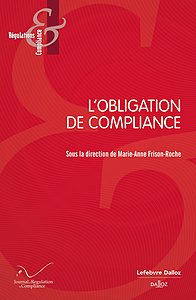
Couverture – L’Obligation de Compliance

Articles in a JoRC book

RODA, Jean-Christophe🕴️

📝Obligations de compliance et concurrence : les liaisons dangereuses ? (Compliance obligations and Competition: dangerous liaisons?), in 🕴️M.-A. Frison-Roche (dir.), 📕L’obligation de Compliance

► Full Reference: J.-Ch. Roda “Obligations de compliance et concurrence : les liaisons dangereuses ? (Compliance obligations and Competition: dangerous liaisons?)”, in M.-A. Frison-Roche (ed.), L’Obligation de Compliance, Journal of Regulation & Compliance (JoRC) and Lefebvre-Dalloz, coll. “Régulations & Compliance“, 2025, pp. 287-297. - read a general presentation of the book, L’Obligation de Compliance, in which this contribution is published - ► This article is written in French. English summary of this contribution (done by the Journal of Regulation & Compliance – JoRC): The author stresses that if Compliance Law and Competition Law may seem far apart today, it is because many people today have a restricted and inaccurate view of Competition Law. Indeed, if Competition Law is reduced to being no more than that which enables offer and demand rule to function fully, then ‘compliance obligations’ need to be injected into this sort of ‘natural law’ of the market backed up by the legal system, compliance obligations giving humanity to the whole. But if Competition Law is given back its rightful dimension, which it has in its more classical conception, the links between the obligations arising from the 2 branches of Law find harmonious relationships. They are all the more necessary because, particularly through the Duty of Vigilance, Civil Competition Law is going to interfere because of the contractualisation of this legal obligation and the possible significant imbalance that could be identified, the article stressing that the application of Compliance stipulations on a partner could end up being analysed as a power, justifying merger control or at the very least a dominant position legal qualification, the abuse of which will be sanctioned. It is for this reason that the 2024 CS3D reminds us that it must be implemented in respect with competition legal rules. However, the author emphasises that it is towards a kind of ‘Ethical Competition’ that compliance obligations are leading, leading to new practices. The results, described in the second part of the article, are increasing the influence of the Compliance Obligation, which embodies the ambition of a “just transition” and a “social Europe”. These ambitions are rejected by the advocates of the so-called “neo-liberal” conception of what Competition Law should be, but the conception of “Competition-Means” was indeed that of the American designers of the corpus of appropriate rules in the nineteenth century, when it was necessary in particular to fight against the large infrastructure monopolies, and it was also that of the jurists who founded the European Union. Only the minimal view of what falls within the scope of competition leads to opposition to the Compliance Obligation. The author therefore stresses that “il semble aujourd’hui évident que la compliance doit être la boussole du droit de la concurrence (it seems obvious today that Compliance must be the compass of Competition Law)”. It is in this spirit that companies must draft the compliance clauses that will multiply to structure the value chains they have set up, providing in particular for the resolution of tensions, or even conflicts, with partners. The author concludes that it is in this way that crucial companies will demonstrate their “particular responsibility” both and in the same way with regard to Competition Law and Compliance Law. - 🦉This article is available in full text to those registered for Professor Marie-Anne Frison-Roche’s courses
Couverture – L’Obligation de Compliance

Articles in a JoRC book

RACINE, Jean-Baptiste🕴️

📝L’arbitre, juge, superviseur, accompagnateur ? (The arbitrator, judge, supervisor, coach?), in 🕴️M.-A. Frison-Roche (dir.), 📕L’obligation de Compliance

► Full Reference: J.-B. Racine, “L’arbitre, juge, superviseur, accompagnateur ?” (The arbitrator, judge, supervisor, coach?), in M.-A. Frison-Roche (dir.), L’Obligation de Compliance, Journal of Regulation & Compliance (JoRC) and Lefebvre-Dalloz, coll. “Régulations & Compliance“, 2025, pp. 489-502. - read the general presentation of the book, L’Obligation de Compliance, in which this article is published - ► This article is written in French. English summary of this contribution (done by the Journal of Regulation & Compliance – JoRC): From the outset, the author sets out what is at stake in these terms: “Quel rôle peut ou pourrait jouer l’arbitre dans les dispositifs de compliance ? Selon le rôle qu’il est amené à jouer, il peut ou pourrait venir en renfort de l’obligation de compliance. Poser cette question, c’est poser la question des pouvoirs de l’arbitre et de son office. C’est aussi, d’une certaine manière, renvoyer à la notion même d’arbitrage.” (What role can or could the arbitrator play in compliance systems? Depending on the role he/she is called upon to play, he/she can or could reinforce the compliance obligation. Asking this question raises the question of the powers of the arbitrator and his/her office. In a way, it also goes back to the very notion of arbitration). In practice, arbitrators deal with compliance issues in their office as judges. This is illustrated by disputes involving allegations of corruption, where the arbitrators’ ruling obviously cannot give effect to a corrupt practice unless they violate themselves international public order. But in this, the arbitrator is only applying a legal standard, the main issue being then the question of evidence, with compliance tools often serving as indicators of the corruption itself. Leaving behind the strict legal source and coming to the standards issued by the ICC about the fight against corruption, we really enter into the “compliance obligation”, in the strict sense, when a contract appears. International business practices standards are emerging, not only in the area of probity but also in the protection of human rights, for which arbitrators can now act as guarantors. Arbitrators can do this, in particular, through the emerging litigation relating to vigilance obligation, either directly when vigilance plans are at issue,, even if a legal rule gives a specific competence to a State court (as the French 2017 law does) or if we imagine that a plan itself includes a system for recourse to arbitration, which would imply a change in culture, or if we consider that soft law is in the process of emerging from the practices of international trade laying down a duty of vigilance that arbitrators could take up. In the second part of his contribution, the author takes a second, bolder approach, namely that of an arbitrator who understands Compliance Law in that he/she would be more than a Judge, i.e. he/she would do more than settle a dispute by applying the law. This would be conceivable given the tendency to consider that the arbitrator could modify contracts and if example is taken from the technique of arbitration practised for concentration disputes in merger law. To give arbitration the required regulatory dimension, this third party would have to be able to exercise a supervisory function, which the notion of “dispute” hardly lends itself to, especially as an arbitrator is only set up to be a judge, and if he/she ceases to be one it is difficult for him/her to remain an arbitrator…. However, it is conceivable that in Ex Post the arbitrator could perform the monitoring function often required in Compliance Law. The technique of disputes boards is inspiring in this respect. The two fields, Arbitration and Compliance, are thus destined to move closer together, as the two traditional limits, arbitrability and litigation, are in the process of evolving so that they no longer stand in the way of such rapprochements. The author can therefore conclude: “C’est aux différents acteurs de la compliance de penser à l’arbitrage, et à la souplesse, la plasticité et la liberté qu’il offre, pour éventuellement le configurer spécialement au service des buts de la compliance.” (It is up to the various players in Compliance to think about Arbitration, and the flexibility, plasticity and freedom it offers, in order to configure it specifically to serve the goals of Compliance Law). - 🦉This article is available in full text to those registered for Professor Marie-Anne Frison-Roche’s courses -
Couverture – L’Obligation de Compliance

Articles in a JoRC book

MARTIN, Gilles J.🕴️

📝Clauses et contrats, modalités de l’obligation de vigilance (Clauses and Contracts, Modalities of the Vigilance Obligation), in 🕴️M.-A. Frison-Roche (dir.), 📕L’Obligation de Compliance

► Full Reference: G. J. Martin, “Clauses et contrats, modalités de l’obligation de vigilance” (Clauses and Contracts, Modalities of the Vigilance Obligation), in M.-A. Frison-Roche (dir.), L’Obligation de Compliance, Journal of Regulation & Compliance (JoRC) and Lefebvre-Dalloz, coll. “Régulations & Compliance”, 2025, pp. 663-678. - read the general presentation of the book, L’Obligation de Compliance, in which the contribution is published - ► This article is written in French. English summary of this contribution (done by the Journal of Regulation & Compliance – JoRC): The author focuses on what are often referred to as “CSR clauses”, insofar as they constitute a way for companies to implement their Compliance Obligation. In a practice that is still “in its infancy”, companies thus contractualise their ethical aspiration and their legal obligation, defining more precisely along the way what the Compliance and/or Vigilance obligation is for them, notably through internal and/or external standards, associating with them mechanisms of evaluation, audit and specific sanctions, such as termination. In addition, the contract organises the articulation with commercial clauses having another purpose. This is all the more necessary as the purpose of these clauses is also to make the legal obligation “trickle down” beyond the first contractual circle. The risk of imbalance must be avoided. The clauses must be precise and limited, notably in space and time. Secondly, the author examines the articulation between ordinary Contract Law and the special Law of Vigilance. Having laid down that the contract is the means, and even the only means, of transforming Soft Law into Hard Law in the relations between the contracting parties, the author considers that if such a clause appears in a commercial contract falling within a situation covered by the 2017 law (value chain, parent company–subsidiary relationship), there is a cumulation of capacities. Conflicts of jurisdiction with the Tribunal judiciaire de Paris (Paris First Instance Civil Court) therefore arise, and one may regret the abandonment of the solution adopted by the Cour de cassation (French Court of cassation) opening an option of jurisdiction. Another difficult articulation will have to be made in the event of nullity of the CSR clause, an annulment that the ordinary judge may pronounce, depending on whether or not the judge considers it decisive for other clauses, or even for the contract. In the event of non-performance of the clause, the termination of commercial relations may be pronounced, but it may be thought that a notice period must be respected. Finally, if the very purpose of the contract is the performance of the Vigilance obligation, this must not amount to a delegation that would nullify the legal principle of personal liability. - 🦉This article is available in full text to those registered for Professor Marie-Anne Frison-Roche’s courses -

Working papers

Working Paper for 📺Overhang (News)

🚧The Contract, a Compliance tool: the Obligation for a platform to control content (French Supreme Judicial Court, 15 January 2025) :

► Full Reference: M.-A. Frison-Roche, The Contract, a Compliance tool: the Obligation for a platform to control content CE, 27 January 2025, B. c/ CNIL, Working Paper, March 2025. - 🎤 This Working Paper was developed as a basis for the Overhang👁 video  on 29 March 2025 : click HERE (in French) - 🎬🎬🎬In the collection of the Overhangs👁 It falls into the News category. ►Watch the complete collection of the Overhangs👁 : click HERE - ► Summary of this Working Paper: The ruling handed down on 15 January 2025 by the Commercial, Economic and Financial Chamber of the French Judicial Supreme Court (Cour de cassation) provides a solution to the issue of content control in the digital environment. It resolves what appears to be the aporia so often emphasised, and even claimed, namely the impossibility of developing an effective controlling technology. To do this, the Court disregarded the applicable laws and referred to the electronic payment contract between the bank and the platform, which contained a clause on Vigilance against unlawful content, linked to a termination clause. It held that this clause was fully effective. This solution, so simple and so strong, can make a major contribution to regulating the digital space, if the banks so wish, because what platform can do without reliable electronic payment services?   - 🔓read the developments below⤵️

Articles

Interview in a newspaper

« La compliance est avant tout une affaire humaine » (Compliance is first and foremost a human issue)

► Full Reference: M.-A. Frison-Roche,  « La compliance est avant tout une affaire humaine» (Compliance is first and foremost a human issue), interview conducted by Olivia Dufour for Actu-juridique, Lextenso, 23 January 2025.   - ► read the interview: 💬in French) - 🏛️🏛️🏛️🏛️this interview was organised following a number of official opening hearings of Parisian courts, in particular that of the Paris Judicial Court on 21 January 2025, at which the presidents of these courts explained the role now played by systemic litigation and compliance and/or vigilance law, in particular in the internal organisation of their courts. - ► presentation of this interview:  Q. (translated): At the start of the new session of the official opening hearings of Paris Court of First Instance on 21 January, President Stéphane Noël spoke at length about the creation of a 34th chamber dedicated to handling cases relating to companies' obligation of vigilance. What are the advantages of this new specialisation? MAFR Answer Summary: It corresponds to the jurisdiction given to the Paris Court of First Instance by the French 2020 so-called Confidence Act, which extends the French 2017 so-called Vigilance Act. It reflects the importance of Compliance Law, of which Vigilance is the leading edge.   Q. (translated): The court president points out that this new litigation raises questions about the role of the courts, which is to "concilier le respect des buts fondamentaux pour la protection de l’humanité avec la possibilité pour les entreprises d’apprécier la maitrise des risques et leur éventuelle responsabilité" ("reconcile respect for the monumental goals of protecting humanity with the ability of companies to assess the control of risks and their potential liability"). What do you think?   MAFR Answer Summary: the role of the judge has been renewed, as they take charge of the future of the systems and participates in the achievement of the Monumental Goals of Compliance Law. Companies are subject by law to a new compliance obligation and must demonstrate their diligence. They may be held liable under the general ordinary legal regime, as set out in the French 2017 Act on Vigilance duty, if the claimant demonstrates the existence of fault or negligence, damage and a causal link between the 2.   Q. (translated): All this comes under the heading of compliance, a concept you've been working on for 10 years and which is still not fully understood and is too often confused with conformity….   MAFR Answer Summary: The 2 aforementioned concepts ("conformity" and "compliance") were identified in the article I published in 2016 entitled Le droit de la compliance"Compliance law". This notion has taken a long time to mature because, on the one hand, it is a radically new branch of law that has an impact on the other branches. On the other hand, indeed,  there is confusion between 'compliance' and 'conformity'. Conformity is the obedience to applicable regulations; compliance is the active participation in the achievement of monumental goals to preserve or save systems in which humans are involved. Conformity is, and is only, a tool of Compliance Law.   Q. (translated):  The Nanterre Court has just created a chamber for Emerging Systemic and Regulatory Litigation. Does this confirm the interest of the courts in this fundamental development?   MAFR Answer Summary: This statement by the President of the Nanterre Court of Appeal at his hearing on 20 January 2025 illustrates the Regulation – Compliance – Vigilance continuum. He involves training for judges and dialogue between judges. Training and dialogue are being put in place.   Q. (translated):  Y a-t-il d’autres initiatives en ce sens ? MAFR Answer Summary:Le président du Tribunal de commerce Paris à son audience du 15 janvier 2025 a annoncé la création d'une chambre des contentieux complexe. Les contentieux systémiques émergents, que le Droit de la Compliance peut engendrer, ont vocation à y être présentés. Là  aussi, formation et dialogue se mettent en place.   Q. (translated):  Que manque-t-il encore ? MAFR Answer Summary: puisque le Droit de la compliance se contractualise de plus en plus, notamment dans les chaines de valeur concernées par les techniques de vigilance, l'arbitrage international est concerné. Des arbitres internationaux intégrant le droit de la compliance, et pas seulement attaché à telle et telle réglementation sectorielle, sont un enjeu d'attractivité de la Place de Paris. Cela va émerger, notamment par le dynamisme de la Cour internationale d'arbitrage, dont le siège est à Paris.

Organisation of events

Second conference-debate of the cycle "Contentieux Systémique Émergent" ("Emerging Systemic Litigation")

🧮La vigilance, nouveau champ de contentieux systémique (Vigilance, new field of Systemic Litigation), in cycle of conference-debates “Contentieux Systémique Émergent” (Emerging Systemic Litigation)

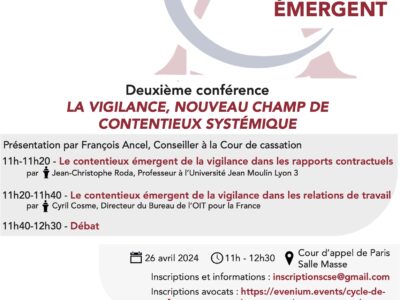
► Full Reference: La vigilance, nouveau champ de contentieux systémique (Vigilance, new field of Systemic Ligation), in cycle of conference-debates "Contentieux Systémique Émergent" ("Emerging Systemic Litigation"), organised on the initiative of the Cour d'appel de Paris (Paris Cour of Appeal), with the Cour de cassation (French Court of cassation), the Cour d'appel de Versailles (Versailles Court of Appeal), the École nationale de la magistrature – ENM (French National School for the Judiciary) and the École de formation des barreaux du ressort de la Cour d'appel de Paris – EFB (Paris Bar School), under the scientific direction of Marie-Anne Frison-Roche, 26 April 2024, 11am.-12.30am., Cour d'appel de Paris, Massé courtroom - 🧮see the full programme of the cycle Contentieux Systémique Émergent (Emerging Systemic Litigation) - see on LinkedIn the report of this event - 🧱read below the report of this event⤵️ - ► Presentation of the conference: The duty of vigilance imposed by the 2017 French law is being contractualised, either by ad hoc contracts or by stipulations that reproduce the legal provisions, adjust them or go beyond them. This adoption by the Contract and Tort Law is valuable but not without risk. The systemic scope of the underlying law on the one hand and of economic structures on the other, the firm or the value chain, will permeate litigation. The example of labour relations is instructive in this respect. - 🧮Programme of this event:  Second conference-debate LA VIGILANCE, NOUVEAU CHAMP DE CONTENTIEUX SYSTÉMIQUE (VIGILANCE, NEW FIELD OF SYSTEMIC LITIGATION)   Paris Court of Appeal, Massé courtroom General presentation of the topic and moderation by 🕴️François Ancel, Judge at the Première Chambre civile de la Cour de cassation (First Civil Chamber of the French Court of cassation) 🕰️11am.-11.20am. 🎤Le contentieux émergent de la Vigilance dans les rapports contractuels (Emerging Vigilance Litigation in Contractual Relationships), by 🕴️Jean-Christophe Roda, Full Professor at Jean-Moulin Lyon 3 University 🕰️11.20am.-11.40am. 🎤Le contentieux émergent de la Vigilance dans les relations de travail (Emerging Vigilance Litigation in Employment Relationships), by 🕴️Cyril Cosme, Director of the French Office of the International Labour Organization (ILO) 🕰️11.40am.-12.30am. Debate - 🔴Registrations and information requests can be sent to: inscriptionscse@gmail.com 🔴For the attorneys, registrations have to be sent to the following address: https://evenium.events/cycle-de-conferences-contentieux-systemique-emergent/  ⚠️The conference-debates are held in person only, in the Cour d’appel de Paris (Paris Court of Appeal). - 🧱read below a detailed presentation of this event⤵️ -

Organisation of events

🧱Co-organisation of the Symposium 🧮L’arbitrage international en renfort de l’Obligation de Compliance (International Arbitration in support of the Compliance Obligation)

► Full Reference: L. Aynès, M.-A. Frison-Roche, J.-B. Racine and E. Silva-Romero (dir.), L’arbitrage international en renfort de l’obligation de Compliance (International Arbitration in support of the Compliance Obligation), Journal of Regulation & Compliance (JoRC) and Institute of World Business Law of the ICC (Institute), Conseil Économique Social et Environnemental (CESE), Paris, February 9, 2024 - consult on LinkedIn a general présentation of this event, which links to a presentation and a report of each speech - 🏗️This symposium takes place in the cycle of symposiums organised by the Journal of Regulation & Compliance (JoRC) and its partners Universities, focusing in 2023-2024 on the general theme of the Compliance Obligation - 📚The works will then be inserted in the books: 📕L’obligation de Compliance, to be published in the 📚Régulations & Compliance Serie, co-published by the Journal of Regulation & Compliance (JoRC) and Dalloz, published in French. 📘Compliance Obligation, to be published on the 📚Compliance & Regulation Serie, co-published by the Journal of Regulation & Compliance (JoRC) and Dalloz, published in English. - ► General presentation of the symposium: “Compliance Obligation” appears to be far from International Arbitration if Compliance Law is only understood in terms of binding regulations or even Criminal Law. Arbitration would only have contact with Compliance Obligation in a repulsive way, when a person claims to have enforced a contract before an arbitration court that disregards a compliance prohibition, e.g. corruption or money laundering. It is therefore from a negative angle that the cross-over has taken place. The fact that Arbitration Law respects the requisite of Criminal Law is nothing new. Moreover, the power of Compliance in its detection and prevention tools, particularly in terms of evidence, no doubt increases the global efficiency. But Compliance Obligation is based on Monumental Goals, notably linked to global human rights and active ambitions about environment and climate which, particularly in the value chain economy, take the legal form of compliance clauses, or even compliance contracts, or various commitments and plans, which the parties can ask the international arbitrator to enforce. They will do so even more as arbitrators are often the only international, or even global, judges available. The use they will do of Contract Law, Quasi-Contract Law, Enforcement Law, Tort Law, reinforces Compliance Law in a global dimension. - - ► Interviennent : 🎤 Laurent Aynès, emeritus Professor at Paris 1 Panthéon-Sorbonne University, Attorney, Darrois Villey Maillot Brochier (Paris) 🎤 Marie-Anne Frison-Roche, Professor of Regulatory and Compliance Law, Director of the Journal of Regulation & Compliance (JoRC) 🎤 Jean-François Guillemin, former General Secretary of the Bouygues Group 🎤 Christophe Lapp, Attorney, Advant Altana (Paris) 🎤 Jean-Baptiste Racine, Full Professor at Paris Panthéon-Assas University (Paris 2) 🎤 Eduardo Silva-Romero, President of the Institute of World Business Law of the ICC (Institute), Attorney, Wordstone (Paris) - 🧮Read a detailed presentation of the event below⤵️