Resources

Glossary

Compliance and Regulation Law bilingual Dictionnary

Teleological Law

Traditionally, a branch of Law and each of the rules that make it up is developed, interpreted and applied according to a vertical model: the hierarchy of norms implies this. The reason why the rule was adopted, the effects pursued by its application, the effects sought by the person who adopted a rule are peripheral elements, which can certainly shed light but are auxiliary. In addition, certain provisions are by their very nature exceptions, such as Criminal Law, or the "criminal matter" to which Repressive Administrative Law belongs, which implies that their interpretation and application are always restrictive, because of their exceptional nature with regard to the principle of Freedom. Everything changes if the heart of the branch of Law becomes the goal: the rules, or even the particular decisions, become "teleological" ("telos" in Greek means "goal").  A branch of Teleological Law is built around one or more Goals, in relation to which everything has the status of a means. For example, Competition Law is a branch of Teleological Law: its Goal is to safeguard, or even build, Competition. This is why not only are all the technical rules interpreted in this way, but also the role of the Independent Administrative Authorities (IAA), in this case the Administrative Competition Authorities, is defined in this way (safeguarding the free functioning of competitive markets), as is the role of the courts when they rule on competition matters. This gives rise to principles of effectiveness, because the means provided by the legal rules, "instrumentalised" in this way, must tend towards these goals. The principle of "useful effect" follows from this: the necessary burdens on operators are justified, but no more than is necessary to achieve the ends. The principle of proportionality is also generated. It is clear that the teleological nature of a branch of Law entirely determines its application. This gives rise to specificities and even difficulties. The specificity comes from the fact that it was pleasant and erudite to know the ratio legis et decidendi of classical Law: it has become imperative and central to master the ends of the teleological branches of Law. But not only is this not always said, it is sometimes disputed. For example, this tautological conception, which restricts the Goal of Competition Law to Competition, is contested by those who want a more humanist conception. But if you change the Goal, the whole interpretation and technical application of the rules changes. The practical implications of these disputes, which could be described as almost philosophical (the place of human beings in society), are immense. Moreover, a teleological branch of Law may have several goals, which must be arranged, classified and ranked. For example, the day the French Cour de Cassation (French Judicial Supreme Court) decided that the goal of safeguarding the business was more important than safeguarding the interests of its creditors, the Bankruptcy  Law has changed. What is more, since the legal system is an architecture of branches of Law, the Goal of one branch of Law may interfere with the Goals of another branch of Law, for example Insolvency Law, the Goal of which being to preserve the company, and Banking Resolution Law, the Goal of which being to preserve the banking system.  The branches of Economic Law are all concerned with teleological logic, which explains why, since their Goals are also economic, financial, political and social, they are more open to other disciplines, principally Economics and Finance. The resulting risk of the vassalisation of Law in relation to Economics has often been denounced. It is the duty of the Regulator and the Judge, whose place is central, to ensure the balance between the disciplines. This is particularly true of Regulatory Law, an Ex Ante branch governed by Goals, and Compliance Law, whose normativity is housed in Monumental Goals, all of which imply a teleological application of legal rules and techniques.             -        

Books

Conseil d'État🏛️ & Cour de cassation🏛️

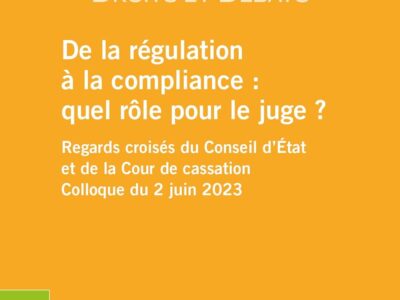
📗De la régulation à la compliance : quel rôle pour le Juge ?. Regards croisés du Conseil d’État et de la Cour de cassation (From Regulatory Law to Compliance Law: what role for the Judge?. Viewpoints of the Conseil d’État (French Administrative Supreme Court) and Cour de Cassation (French Judiciairy Supreme Court)

► Full Reference: Conseil d'État (French Administrative Supreme Court) & Cour de cassation (French Judiciary Supreme Court), De la régulation à la compliance : quel rôle pour le juge ? Regards croisés du Conseil d'État et de la Cour de cassation, ("From Regulatory Law to Compliance Law: what role for the Judge?"), La Documentation française, coll. "Droits et Débats", 2024, 241 p. - 📗read the  coverback (in French) - 📗read the table of content (in French) - ► Summary of this book : "Compliance, sometimes translated in French by the word "conformité" ("conformity"), is an extension of Regulatory Law and represents from it a new and decisive step forward. Compliance brings together all the mechanisms implemented within an organisation to achieve general interest goals (security, sustainability), thereby countering systemic risks. By relying on the rules, legal and ethical standards that embody these values, which are imposed on them and internalised by them, enterprises can both prevent the risk of sanctions and participate in this alliance between public authorities, economic operators and stakeholders to detect and prevent future systemic disasters.  Organisé par le Conseil d’État et la Cour de cassation, le colloque du 2 juin 2023 analyse ce changement de paradigme créé par cette nouvelle branche du droit.".  Organised by the Conseil d'État (French Administrative Supreme Court) and the Cour de cassation (French Judiciary Supreme Court), the conference on 2 June 2023, basis of this book, has analysed this paradigm shift created by this new branch of law: Compliance Law.  - 📝read the presentation in English of the concluding contribution of  Marie-Anne Frison-Roche : "Le rôle du juge dans le déploiement du droit de la régulation par le droit de la compliance" - 📝read the presentation in English of the contribution of François Ancel : "Quel rôle pour le juge aujourd’hui dans la compliance ? Quel office processuel du juge dans la compliance ?" -

Books

BREYER, Stephen🕴

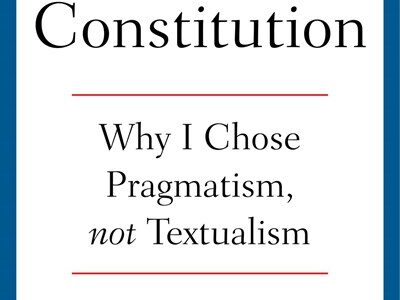
📗Reading the Constitution: Why I Chose Pragmatism, Not Textualism

► Full reference : S.Breyer, Reading the Constitution: Why I Chose Pragmatism, Not Textualism, Simon & Schuster, 2024, 361 p. - 📗read the 4th cover page - 📗read the book's table of contents - ► Book summary (by the publisher) : "A provocative, brilliant analysis by recently retired Supreme Court Justice Stephen Breyer that deconstructs the textualist philosophy of the current Supreme Court’s supermajority and makes the case for a better way to interpret the Constitution. “You will not read a more important legal work this election year.” —Bob Woodward, Washington Post reporter and author of fifteen New York Times bestselling books “A dissent for the ages.” —The Washington Post “Breyer’s candor about the state of the court is refreshing and much needed.” —The Boston Globe The relatively new judicial philosophy of textualism dominates the Supreme Court. Textualists claim that the right way to interpret the Constitution and statutes is to read the text carefully and examine the language as it was understood at the time the documents were written. This, however, is not Justice Breyer’s philosophy nor has it been the traditional way to interpret the Constitution since the time of Chief Justice John Marshall. Justice Breyer recalls Marshall’s exhortation that the Constitution must be a workable set of principles to be interpreted by subsequent generations. Most important in interpreting law, says Breyer, is to understand the purposes of statutes as well as the consequences of deciding a case one way or another. He illustrates these principles by examining some of the most important cases in the nation’s history, among them the Dobbs and Bruen decisions from 2022 that he argues were wrongly decided and have led to harmful results." -

Articles in The Journal of Regulation & Compliance « JoRC »

FIORINI, Benjamin🕴️

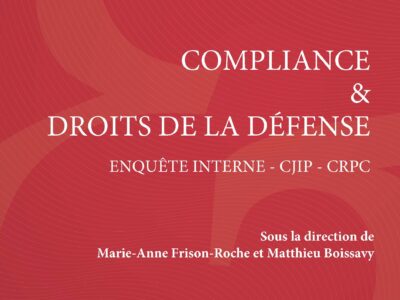
📝Approche doctrinale de l’enquête interne et de l’enquête pénale privée, in 🕴️M.-A. Frison-Roche & 🕴️M. Boissavy (eds.), 📕Compliance et droits de la défense. Enquête interne – CJIP – CRPC

► Full Reference: B. Fiorini, "Approche doctrinale de l’enquête interne et de l’enquête pénale privée" ("Doctrinal approach to internal investigations and private criminal investigations"), in M.-A. Frison-Roche & M. Boissavy (eds.), Compliance et droits de la défense. Enquête interne – CJIP – CRPC, Journal of Regulation & Compliance (JoRC) and Dalloz, coll. "Régulations & Compliance", 2024, pp. 63-68 - 📕read a general presentation of the book, Compliance et droits de la défense. Enquête interne – CJIP – CRPC, in which this article is published - ► English Summary of the article (done by the Journal of Regulation & Compliance – JoRC): The author sets out the two profoundly distinct, even opposing, cultures of inquisitorial and adversarial repressive procedural systems. The former gives confidence and power to public officials to find the truth, while the latter gives confidence and power to the opposing parties in the dispute. Private investigations naturally develop in the second system and not in the first. This second system of thought is rooted in the United States, which naturally welcomes internal investigations carried out by companies and associates procedural principles such as the rights of the defence, adversarial proceedings and the right to a lawyer. The first system, characteristic of Continental Law systems, is resistant to the very idea of a private criminal investigation. This is why, when the internal investigation mechanism develops within a company, the procedural mechanisms mentioned above are less naturally associated with it. - 🦉This article is available in full text to those registered for Professor Marie-Anne Frison-Roche's courses -

Articles in The Journal of Regulation & Compliance « JoRC »

BOISSAVY, Matthieu🕴️

📝Compliance et droits de la défense : toujours pour le respect des droits humains, in 🕴️M.-A. Frison-Roche & 🕴️M. Boissavy (eds.), 📕Compliance et droits de la défense. Enquête interne – CJIP – CRPC

► Full Reference: M. Boissavy, "Compliance et droits de la défense : toujours pour le respect des droits humains" ("Compliance and the rights of the defence: always in favour of respect for human rights"), in M.-A. Frison-Roche & M. Boissavy (eds.), Compliance et droits de la défense. Enquête interne – CJIP – CRPC, Journal of Regulation & Compliance (JoRC) and Dalloz, coll. "Régulations & Compliance", 2024, pp. 27-32. - 📕read a general presentation of the book, Compliance et droits de la défense. Enquête interne – CJIP – CRPC, in which this article is published - ► English Summary of the article (done by the Journal of Regulation & Compliance – JoRC): The author begins by describing Compliance, whereby the company's freedom is curtailed so that its power serves the goals set by the public authorities and prevents risks from occurring. These "Monumental Goals" are set by the public authorities either to prevent the occurrence of systemic risks, or to achieve beneficial objectives for society, human beings and the environment. In order to do this, companies will have to investigate themselves and denounce themselves, with this self-denunciation reducing the criminal penalties incurred as a result of infringements they have uncovered themselves. These surveillance tools facilitate the convention judiciaire d'intérêt public – CJIP (French Judicial Public Interest Agreement) mechanism. They work "for the better" if the aforementioned Monumental Goals are achieved. They work "for the worse", if this is at the cost of sacrificing the rights of the defence. The second part of the paper recalls the importance of the rights of the defence, their roots in history, and even in Natural Law, their position at the very top of the hierarchy of norms and, according to the author, the integration of the adversarial principle within them, as well as the fact that they apply even outside trials, as has been imposed by case-law in matters of dismissal.  This is why, thirdly, the paper argues that the rights of the defence must always be applied in all compliance mechanisms, even if this does not involve a trial or a sanction in the strict sense of the term, particularly in internal investigations, procedures without a trial which are above all evidentiary mechanisms for the next stage, which is usually judicial. In addition, the author questions the effectiveness of the consents expressed during the CJIP and comparution sur comparution sur reconnaissance préalable de culpabilité – CRPC (French French guilty plea procedure). - 🦉This article is available in full text to those registered for Professor Marie-Anne Frison-Roche's courses -

Articles in a legal collective publication

LAPP, Christophe🕴️

📝Compliance in Companies: The Statutes of the Process, in 🕴️M-A. Frison-Roche (ed.), 📘Compliance Jurisdictionalisation

► Full Reference: Ch. Lapp, "Compliance in Companies: The Statutes of the Process", in M.-A. Frison-Roche (ed.), Compliance Jurisdictionalisation, Journal of Regulation & Compliance (JoRC) and Bruylant, "Compliance & Regulation" Serie,  2024, pp. 155-166  - 📘read a general presentation of the book, Compliance Jurisdictionalisation, in which this article is published - ► The summary below describes an article following the colloquium L'entreprise instituée Juge et Procureur d'elle-même par le Droit de la Compliance (The Entreprise instituted Judge and Prosecutor of itself by Compliance Law) , co-organized by the Journal of Regulation & Compliance (JoRC) and the Faculté de Droit Lyon 3. This manifestation was designed under the scientific direction of Marie-Anne Frison-Roche and Jean-Christophe Roda and took place in Lyon on June 23, 2021. During this colloquium, the intervention was shared with Jan-Marc Coulon, who is also a contributor in the book (see the summary of the Jean-Marc Coulon's  Article). In the book, the article will be published in Title I, devoted to:  L'entreprise instituée Juge et Procureur d'elle-même par le Droit de la Compliance (The Entreprise instituted Judge and Prosecutor of itself by Compliance Law ). - ► Summary of the article (done by the Author): The Company is caught in the grip of Compliance Law, the jaws of which are those of Incitement (1) and Sanction that the Company must apply to ensure the effectiveness of its processes to which it is itself subject (2 ). First, the Company has been delegated to fabricate reprehensible rules that it must apply to itself and to third parties with whom it has dealings. To this end, the Company sets up "processes", that is to say verification and prevention procedures, in order to show that the offenses that it is likely to commit will not happened. These processes constitute standards of behavior to prevent and avoid that the facts constituting the infringements are not themselves carried out. They are thus one of the elements of Civil Liability Law in its preventive or restorative purposes. Second, the sanction of non obedience of Compliance processes puts the Company in front of two pitfalls. The first  dimension place the company, with regard to its employees and its partners, in the obligation to define processes which also constitute the quasi-jurisdictional resolution of their non-compliance, the company having to reconcile the sanction it pronounces with the fundamental principles of classical Criminal Law, constitutional principles and all fundamental rights. The processes then become the procedural rule. The second dimension is that the Company is accountable for the effectiveness of the avoidance by its processes of facts constituting infringements. By a reversal of the burden of proof, the Company is then required to prove that its processes are efficient. at least equivalent to the measures defined by laws and regulations, the French Anti-Corruption Agency (Agence Française Anticorruption – AFA), European directives and various communications on legal tools to fight breaches of probity, environmental attacks and current societal concerns. The processes then become the constitutive element, per se, of the infringement. Thus, in its search for a balance between Prevention and Sanction to which it is itself subject, the Company will not then be tempted to favor the orthodoxy of its processes over the expectations of the Agence Française Anticorruption – AFA , regulators and judges, to the detriment of their efficiency? In doing so, are we not moving towards an instrumental and conformist Compliance, paradoxically disempowering with regard to the Compliance Monumental Goals of Compliance? - 🦉This article is available in full text to those registered for Professor Marie-Anne Frison-Roche's courses -

Articles in The Journal of Regulation & Compliance « JoRC »

GRANIER, Cécile🕴️

📝Reflections on the existence of companies’ jurisprudence through Compliance matters, in 🕴️M.-A. Frison-Roche (ed.), 📘Compliance Jurisdictionalisation

► Full Reference: C. Granier, "Reflections on the existence of companies’ jurisprudence through Compliance matters", in M.-A. Frison-Roche (ed.), Compliance Jurisdictionalisation, Journal of Regulation & Compliance (JoRC) and Bruylant, "Compliance & Regulation" Serie, 2024, pp. 95-107 - 📘read a general presentation of the book, Compliance Jurisdictionalisation, in which this article is published - ► Summary of the article (done par the author): Because Compliance shakes up established frameworks, Compliance forces to look at certain concepts in a new light, which until then seemed to be well tamed. This is particularly the case with the notion of "Jurisprudence". Recent developments in Compliance indeed raise questions about the possible existence of "jurisprudence" (case law) that would be produced by companies during the implementation of compliance procedures. At first glance, the concept of "business jurisprudence" may appear unnatural because case law is traditionally understood as the fruit of the office of the Judge and, more particularly, of the State Judge. However, the observation that the company can position itself as a Judge with regard to itself and others in the context of the implementation of Compliance legitimately raises the question of the possibility for the latter. to produce case law. The example of Facebook's supervisory board and the first decisions rendered by this body increases the legitimacy of this crucial question. Thinking about the concept of "Jurisprudence of companies" implies to compare the process of emergence of the case law standard emanating from the Judge with the process of emergence of a "Jurisprudence" that would be produced by companies during their "jurisdictional functions". On the material level, an analogy between State case law and company case law seems conceivable. It then remains to overcome an obstacle of an organic nature: can an institution other than the judge be understood as producing case law? In view of contemporary developments in Law and the practical interest that exists in designing business case law, it seems appropriate to adopt a broader view of case law, which is detached from the traditional organic criterion. It therefore seems that it is possible but above all that it is necessary to think about the concept of "business case law" in order to highlight a new facet of the normative power of companies in the context of compliance, in particular with a view to its supervision. -   🦉This article is available in full text to those registered for Professor Marie-Anne Frison-Roche's courses -