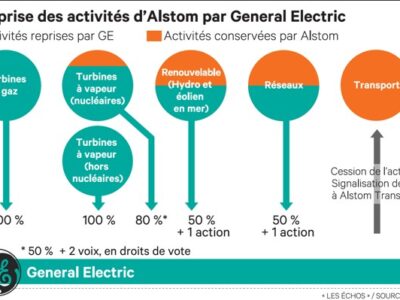
The sale of Alstom to General Electric is an economic, political and legal affair. Intervened in 2014, in France it is today
rather told "for the prosecution". Those who participated are now on the defensive; in April 2018, it is in the field of "probity" that they defend themselves, terminology which is that of the Compliance Law, vocabulary chosen by the French legal system ("Sapin 2" Act of 9 December 2016)
1Frison-Roche, M.-A., From the Regulation Law to the Compliance Law, 2017. . Compliance has therefore appeared as a kind of aggression and it is in this way that many French observers are presenting it. In the Alstom case, Compliance is at its worst : as a means of pressure used the U.S. to obtain, in the conditions most convenient for them, the sale of control of the strategic Alstom company. In this case where it is sometimes difficult to discern the true from the false, the fact of the advocacy, the concern for the truth of the political discourse a posteriori, it is certain that the action of the States interfered with the pretensions of the companies and that it is through a sale of a business in which it was also necessary to take into consideration interests of a different nature from economic and financial interests, not only the general interest but the particular interest which is the interest of a Nation : here the interest of France. That the United States wanted to reach their own interest on one hand, and on the other hand that the other State needs and wants to preserve it – through the legal mechanisms such as the merger control, this is not to blame per se. Indeed, on the one hand the activity in question, namely the manufacture and sale of turbine for nuclear power plants are crucial activities and directly concern the States and on the other hand a State, here the French State French is legitimate to worry about some companies
2Sur cette question, Frison-Roche, M.-A., The "Crucial Companies" and their Regulation, 2014.. It can be considered that if it did not, if the French Government in 2014 did not care to defend the energy sector (general interest) and the interest of France (interest of the country) , only worrying about the economic and financial dimension of the operation, then that is to blame. This is supported by the criticisms made today. This is denied by the people who were negotiating for the company and for the French State at the time. It is indeed this double dimension of national interest and general interest that we find in the French Decree of May 14, 2014 relating to foreign investments subject to prior authorization, the
Décret du 14 mai 2014 relatif aux investissements étrangers soumis à autorisation préalable , called "Montebourg", text adopted then and which
is legally legitimate because it gives the State the power to defend its own interests. - But let's look at this case in the
perspective of the Compliance Law, and first of all on the side of American Law. Can we blame the Americans for using the prospect of sanctions of the French company Alstom to encourage the shareholder of the latter, namely the French State to hand over control of the company to General Electric, buyer suitable for US public authorities? It is not legitimate to do so because the American Compliance Law gives US public authorities the legal power to prosecute and punish foreign companies when there is evidence to suggest that they are likely to be liable for corruption
3Breen, E., FCPA. La France face au droit américain de la lutte anti-corruption, 2017.. One can certainly rant about the fact that this extraterritorial power of legal action is not only objectionable in itself but in fact is used more against European companies than against Chinese companies, and that in the case it was used (and strongly) against a company whose US wanted a transfer of technology and control
4Voir à ce propos les observations pertinentes d'Antoine Garapon : Frison-Roche, M.-A., In the inaugural conference on "Europe of Compliance", Antoine Garapon highlights strengths and weaknesses of Europe , 3 mars 2018. . But the French company had given the baton to be beaten: if corruption had not been likely occurred, then the US authorities could not have deployed the force of this legal weapon. Admittedly, everyone replies: "be realistic, everyone corrupts, it's the real norm of the world!" Well, if it is so, it is right to change this sort of law of the world. To replace it with another principle: the principle of Probity. Because it allows to move to the
second perspective of the Compliance Law, on the side of French and European law. Indeed, if it went wrong, if the negotiations were unbalanced because the United States took advantage of the otherwise applicable Law and held Alstom accountable for corruption, including by imprisonment, this which has had the effect, no doubt, of weakening the interlocutor in the negotiations, is also due to the fact that Europe does not demand accountability from companies which, no doubt, commit acts of the same type. The solution is not in the United States' stop of their behavior, because it is not clear why they would do it and in the name of what they would be asked to no longer apply a lawful and applicable legal requirement against corruption. The extraterritorial scope of their legal system will not diminish: if the criterion of a use of their currency was losing its force, for example by the use of a currency other than the dollar, the use of a means of digital communication would suffice to produce the legal attachment giving them competence. And who does not send emails by Gmail? does not used a data by Outlook? does not transfer a photo by Apple? A first solution could be in the cessation by the French and European companies of behaviors that make them amenable to such legal mechanisms. If that were not possible in fact, because it would be accepted that corruption is the real norm of the world (but then it would be a little less to proclaim the glory of business ethics and other Corporate Social Responsibility or to at the very least, not be surprised if one finds that some people are singing false
5On this core question of credibility in Compliance Law, see Frison-Roche, M.-A., Compliance and Trust, 2017. , and even if this is indeed possible and because it is necessary by the Law to tend to this, because the breaches of probity do not neither economically nor ethically desirable, Europe needs to have the same legal capacity to hold any company accountable in this Compliance area. When the Alstom case unfolded, French Law did not allow it. But since French Law has evolved. By the so-called French "Sapin 2 Act" and precisely in reaction to this power that the United States derives from their legal systeme, France has adopted a legal mechanism which, thanks notably to the
Agence Française Anticorruption -AFA (French Anti-Corruption Agency), is more offensive than its American model
6For a demonstration in this sense, v. Duchaine, Ch., Les causes et les objectifs d'une Europe de la Compliance, Pour une europe de la Compliance, Journal of Regulation & Compliance, 12 April 2018. . What the Alstom case showed is this: for the moment, Europe is destitute, we must
de jure and
de facto construct
the Europe of Compliance. -