Philosophy, theory and sociology of law

Organisation of events

⚙️scienfica organisation of a public manifestation

🧱Scientific Organisation of the Conference 🧮L’office du juge et les causes systémiques (“The office of the judge and systemic causes”)

► Full Reference: Frison-Roche, M.-A., coordination and moderation of the conference L'office du juge et les causes systémiques (""The Office of the Judge and systemic causes"), in Cycle of Conferences, Penser l'office du juge ("Thinking the Office of the Judge"), Grand Chamber of the Cour de cassation, Paris, May 9, 2021, 17h-19h. The conference is held in French. - ► General presentation of the conference: the conference is based on the intervention of three judges, Christophe Soulard, Fabien Raynaud, and François Ancel, who think and debate among themselves on a hypothesis: the existence of "systemic causes". The hypothesis is that beyond and through the diversity of disputes and cases that are submitted to the most diverse judges, there is a category of cases that are systemic, which means containing in what is submitted to the judge for resolution a system.  If such a category exists, which also raises the question of the diversity of systems and the difficulty arising from their submission to rules that are not legal (for example economic, biological, financial "laws", etc.) , then the judge should take this into account, both in the procedure and in the judgment they make on the case and in the way they formulate et restitute this judgment. - 📝read the presentation of this conference by the Cour de cassation (in French) 📝read the program of the cycle of conferences 2022 (in French) -  🎥see the conference video (in French)  🎥 see the synthesis video of the conference, made in situ by Marie-Anne Frison-Roche (in French)   - ​✏️read the notes taken during the conference to make the synthesis (in French) 📝read the article of Marie-Anne Frison-Roche restituting this conference, published in the Recueil Dalloz (in French) - ►read the works, basis of the two interventions of Marie-Anne Frison-Roche 🚧 L'hypothèse de la "cause systémique (made before the conference to prepare it), available en English 📝Synthese of the conference (made during the conference) -

Working papers

🚧 Conceiving Power

► Full reference: M.-A. Frison-Roche, Conceiving Power, Working Paper, December 2021 - 📝 This Working Paper serves as the basis for an article to be published in the collective book drawn up in tribute to Professor Emmanuel Gaillard.    - ► Working Paper summary: In 1985, Emmanuel Gaillard's central work came out under the title Le pouvoir en droit privé  (The Power in Private Law)📎1Gaillard, E., Le pouvoir en droit privé, préf. Cornu. G., coll. ..., Economica, 1985., but when it was defended in 1981, his thesis directed by Dean Cornu was entitled La notion de pouvoir en droit privé (The notion of Power in Private Law) 📎2Gaillard, E., La notion de pouvoir en droit privé, thèse .... ; . Let's give full force to the original title of the thesis.   The deletion of the term notion perhaps implies that by defining something the essential is done, that there would be something of a pleonasm in aiming at The notion of Power and The Power, as Law likes to economise on words.   But it was indeed a renewed, simpler and more powerful conception of the notion of Power, containing the entire regime necessarily imputed, that this work imposed, henceforth illuminating positive Law. Emmanuel Gaillard's definition, on the other hand, goes beyond Private Law. We would gladly have argued in favour of retaining the heading for the term Notion, proposing instead to dispense with the reference to Private Law alone …. Perhaps it was because the concept is so vast that in this seminal thesis its scope was restricted to Private Law, since the author already had to account for the sheer multiplicity of manifestations in this part of the legal system; Or perhaps it was because the concept of 'Power' is so familiar in Public Law that it would have needed less definition in Public Law (which, moreover, is so diversely proposed in this more political area, which is already careful on principle to distinguish between powers, which must always be plural in order to be separated), and that it was therefore reasonable to want to arrive at a single concept of Power in Private Law, where the notion of subjective rights is more familiar.  However, Emmanuel Gaillard's definition of Power as a prerogative placed, by legal rule or contract, in the hands of the person invested with them for the benefit, at least in part, of others, covers both Public and Private Law. This even contributes to the solidity of this thesis and explains why it flourishes today in legal systems where the distinction between Private Law and Public Law is weakening. The power of this definition lies in its simplicity. Simple and brave minds are often the most fruitful. As Dean Gérard Cornu points out in his preface, the author, in particular because he bases himself more on positive law, for example that relating to the powers of corporate officers, does not get bogged down in discussions between authors only to end up preferring one over the other. He arrives at a definition that is close to our everyday experience: the one we experience when we collect an envelope on behalf of someone else and the agent asks us in what capacity we claim to be doing this on his behalf. We then show him our 'power', the legal power to do so for the benefit of the person to whom the letter is addressed, and can thus exercise the power to withdraw the letter, even though it is personal. When legal and common sense come together, it is a good omen, not only in terms of form, because everyone can understand it and the Law must remain comprehensible, but also in terms of substance, because everyone must be able to control the exercise of a power that is exercised for and over others. For this letter addressed to someone else, the person who has been able to take it by virtue of the power conferred on him/her, could just as easily open it and read it, then destroy it or give it to the worst enemy of the person to whom it was addressed. In Power, there is always might to do, and the danger to others that Power contains therefore.  This highly legal definition of Power not only distances the holder from his/her own interests, but also channels the Power thus granted to the person who benefits from it. In this respect, Emmanuel Gaillard not only distinguished between Power and subjective right, but also identified the right amount of power required for this power to effectively fulfill this 'Mission', through the notion of abuse of power, when the holder uses for other beneficiaries this power that was conferred on him/her for this sole purpose. What is more, this concept makes it possible to distinguish Power from discretionary force, because the holder of Power thereby exercises factual , by acting for others, deciding for others, deciding on others. Because Power is inseparable from might, but might must remain the means of power and no more, the Law shall produce the antibodies that are not only the theory of abuse of power but also an Ex Ante responsibility that accounts must always be rendered, either to the other for whom everything is done or to a third party. For this third party is often there from the outset, the guardianship judge for example: because the Power was put in place because of the beneficiary's weakness, both in himself/herself and because of the situation, an impartial and disinterested third party is needed to ensure proper execution from the outset, without there even being a dispute. In this respect, how useful this thesis is for thinking about what Supervision is today!   This thesis, so clear, so simple and so strong, goes beyond Private or Civil Law. It is both much more restrictive than the more factual and political definition of Oower, which would be the ability to do something, and much broader than the usual definitions, since it embraces and legitimises de jure all situations where a person acts legally for the benefit of another.  Dean Cornu shows, moreover, in two sentences that such a notion of power also captures the office of the judge, who has power over others only to serve them 📎3"En droit processuel, l'office du juge aurait donné à l'auteur un renfort. Pour le juge, il n'est point de pouvoir sans devoir. Au-delà de la distinction de ce qu'il a obligation de faire ou faculté d'apprécier, il y a toujours, au creux de ce qu'il peut, le sceau de ce qu'il doit, un devoir gardien - comme un âme - de l'exercice du pouvoir." (p.5).. The definition corresponds to the mission of one who has power only to fulfill his office. It suits so well the conception we have today of Administration, especially if it takes the form of independent authorities. Moreover, Power thus contains its own limit in its very definition, since others are present in it: the holder has power only to serve others. From then on, it is only a power because it is a kind of Charge. Emmanuel Gaillard immediately uses the term: "Un individu se voit confier une charge qu'il exerce dans un intérêt au moins partiellement distinct du sien propre"  ("An individual is entrusted with an office which he exercises in an interest at least partially distinct from his own") 📎4n°3, p.9. . Dean Carbonnier, who reformed the legislation in this area 📎5🕴️J. Carbonnier, 📗Essai sur les lois, 1992 (on the guardianship).,, emphasised that the guardian has a public duty because the State entrusts him/her with a child. In the same way parental authority is a charge on the parents for the benefit of the children. More generally, Power is a burden that the Law places on a person to satisfy the interests of another. This definition offered by Emmanuel Gaillard in 1981, anchored in Private Law only insofar as it is the entire legal system, is premonitory of the Regulatory and Compliance Law as it unfolds today. It would be enough to continue the Gaillard's sentences, as if they had been half-written, to finish them 40 years later and find in them the mechanisms of Supervision of companies by public authorities which are now in place not to reduce their power but to ensure that they exercise it for the benefit of others 📎6S. in a general way, 🕴️M.-A. Frison-Roche (ed.), 📕Régulation, Supervision, Compliance, 2017.. The whole evolution of Company Law and Financial Law is here. Between the lines of this thesis, which develops the notion of duty 📎7Cornu, préface précitée : "Tous les pouvoirs sont, à double face, des pouvoirs-devoirs" (p.5)., we can also see what positive Law is developing today, in particular through the 'duty of Vigilance', this personal responsibility for the benefit of others (I). The definition of Power thus conceived contains within itself its regime and enables us to anticipate it better today: because the holder exercises Power only for others, at least partially, he is consubstantially accountable for it, responsibility being only one form of this accountability; because this service must be effective and others must benefit fully from it, because unlike the subjective right which allows the holder freely not to use his might, Power has never been the 'most absolute' availability to use his/her might: it is even the opposite. It is the expression of a Power assigned to a purpose, compelling the holder to use his/her Power to that end.  But it is equally necessary for the holder to have all the might to do so, otherwise the very notion of 'Power' is meaningless. This is the definition that should be given to the principle of Proportionality: the person on whom the Power rests must have not more power than is necessary, but all the power necessary to achieve the Monumental Goals for which the Power has been entrusted to him/her, so that others may derive full benefit from it (II).  In today's positive Law, the definition of Power as a Duty is found not only in Private Law but also in Public Law, not least because pure might, i.e. those that do not account for the use of their might, are in decline while concern for others is on the increase. The days of discretionary powers are over, and the increased independence of those who exercise Power over others requires them to be accountable. Beyond this Accountability, the personal Responsibility of those who have the Power to serve others is being established. But, no doubt because the Law is slow to evolve, the correlative idea that the holder of Power must have all the powers required to carry out his/her mission is less entrenched:  As Emmanuel Gaillard has shown, the Law has only gone part of the way in sanctioning excesses of power, when the holder uses his/her power for other goals, but it has not yet clearly established that the holder – sometimes forced – of a Power is legitimate in using all the means required to achieve the result for which this Power, i.e. a charge and a duty, has been conferred on him/her.   No doubt we need to read Emmanuel Gaillard's thesis again in all its potential, to imagine the reading we could do today of what he could have written as if on blank pages that would write themselves, a magical thesis where everything is already there, a thesis so short (250 pages) and so beautiful, so dense that it already contains the Law of the Future. The Law of the Future 📎8On Compliance Law as a Law of the Future, s. 🕴️M.-A. Frison-Roche, 📝Compliance Monumental Goals, beating heart of Compliance Law, in 🕴️M.-A. Frison-Roche (ed.), 📘Compliance Monumental Goals, 2023. On the consequences for Liability Law, which is now looking to the Future, s. 🕴️M.-A. Frison-Roche, 🚧Ex Ante Responsibility, 2021.  where there must be much more responsibility for the benefit of others📎9Sur la notion de "Responsabilité Ex Ante", v. Frison-Roche, M.-A., La responsabilité Ex Ante", in Archives de Philosophie du Droit, La responsabilité, 2022. and powers since this notion includes others who are the beneficiaries. Droit de l'Avenir where Emmanuel Gaillard will be present, in particular thanks to this work of doctrine offered in 1981.  So that, in practical terms, those who are entrusted with looking after others – for example, today all companies obliged by Compliance Law to look after others so that they are not destroyed by hatred in the digital space, by corruption in the economic system or by climate change in a projected future – do not find themselves challenged by the same Law for the means of exercising this power for the benefit of others, for example when this involves 'judging'. Dean Cornu himself emphasised the identity of the two offices. -                         Lire les développement ci-dessous⤵ - 🌐 follow Marie-Anne Frison-Roche on LinkedIn 🌐follow Marie-Anne Frison-Roche on Instagram 🌐subscribe to the Newsletter MAFR Regulation, Compliance, Law 

Working papers

Working Paper

🚧The Hypothesis of the category of Systemic Cases brought before the Judge

► Full Reference: M.-A. Frison-Roche, The Hypothesis of the category of Systemic Cases brought before the Judge, Working Paper, October 2021 and April 2022. - ► This working paper has served as the basis for an introductory speech 🎤L'hypothèse de la catégorie des causes systémiques (The Hypothesis of the cateory of Systemic Cases), in a more general conference which I coordinated and moderated, 🧱L'office du juge et les causes systémiques, which is part of a general cycle covering Penser l'office du juge, specific conference attending the 9th May 2002 into the Grand Chamber of the Cour de cassation.   This Working Paper was drawn up in October 2021 to build the conference on the assumption that among the diversity of "cases" brought to the courts by litigants, some constitute a specific category: "systemic cases", justifying treatment that is both specific (in that they are systemic, calling in particular for procedural solutions common to all and distinguishable from the treatment of non-systemic cases) and common treatment beyond the diversity of judges who deal with them (judicial and administrative judges, criminal and non-criminal judges, French and non-French judges, judges of the member-States legal orders and European Union judges, etc.).  This working paper does not aim to deal with the whole subject, i.e. both to determine this category of "systemic causes" and the consequences that must be drawn from it for the judge's office, since that is the very purpose of the conference, which is built around several presentations: it aims to deal with the first part of the subject, i.e. the very existence of this new processual category, which is "systemic causes", leaving for other work the practical consequences to be drawn from it in the processual treatment that it calls for. - 📝This Working Paper is also the basis of a forthcoming article - ► Summary of the Working Paper: xx - Read below the developments⤵️ - 🌐follow Marie-Anne Frison-Roche on LinkedIn 🌐follow Marie-Anne Frison-Roche on Instagram 🌐subscribe to the Newsletter MAFR. Regulation, Compliance, Law

Conferences

🎤 Conclusion in 📅Compliance Monumental Goals: radioscopy of a notion “(“Rapport de synthèse in “Les buts monumentaux: radioscopie d’une notion” “)

Full reference: Frison-Roche, M.-A., Rapport de synthèse (Conclusion) in André C., Frison-Roche, M.-A., Malaurie, M. and Petit, B., Les Buts monumentaux de la Compliance (Compliance Monumental Goals), Colloquium co-organised by the Journal of Regulation & Compliance (JoRC) and the Laboratoire Dante of Paris-Saclay University, -     📅  September 16, 2021. 🧭 Maison du Barreau, 12 place Dauphine 75004 Paris - ► Conclusions' Summary: Based on the multiple contributions of the day, the first part of this synthesis focuses on the practical interest of having Monumental Goals attached to compliance techniques.Conceptually defining these Monumental Goals as normative legal rules of Compliance Law has the first practical advantage of making clear this scattered and almost incomprehensible material, allowing us to better understand it.  The second practical advantage is to bring together the various branches of law in that they all contain compliance mechanisms, the points of contact thus discerned leading to a unification of technical legal rules.  The third practical advantage is to provide the various sources of law concerned with a means of applying and interpreting the law. The fourth practical advantage is to give meaning to all these technical provisions. In the second part of this synthesis, it appeared that these practical considerations therefore justify undertaking the "conceptual adventure". This one can take three pillars, in this "cathedral" that Dominique de la Garanderie designed, this "monument" corresponding well to the adjective Monumental which is better suited to these Goals than does the adjective "Fundamental", because it is a question of building, of building for a future which is not fatal. The first conceptual pillar consists in conceptualizing the Monumental Goals so that the Compliance Law finding a substantial meaning thus gives in a normative way a meaning to all the technical provisions which serve it in an instrumental way. The second conceptual pillar consists of giving everyone their place, that of public authority, that of the company and that of the population, each concerned and each not having to take the place of the other in the determination of the monumental goals, the company being in particular free in the design of the means while the political authority being in charge of drawing the Goals, the company being able to copy them on its own account. This conception does not depend on legal systems but on goals and legitimacy, in particular on the definition chosen for what is a company. The third conceptual pillar derives precisely from the humanist conception that one can claim to have of the Compliance Monumental Goal, risk management being only a means to achieve it. Humanism effectively carried by Compliance, taken on their own account by the companies alone capable of making them concrete, is what makes it possible to distinguish texts that are nevertheless technically similar, depending on whether they apply in  Rule of Law systems or in systems which are note governed by the Rule of Law Principle. This is why the technical future of Compliance Law lies in this conceptual adventure that it is necessary to lead. -   📝 read the program of this colloquium  🎥 see Marie-Anne Frison-Roche's conclusion in video (in French, with English subtitles) ✏️ read the notes translated in English on which this conclusion is based  - 📅 This colloquium is part of the Cycle of colloquium 2021 organized by the Journal of Regulation & Compliance (JoRC) and its partners around Compliance Monumental Goals.   📘 This manifestation is in French but the interventions will be part of an English collective book directed by Marie-Anne Frison-Roche, Compliance Monumental Goals, co-edited by the JoRC and Bruylant.  An equivalent book in French, Les Buts Monumentaux de la Compliance, directed by Marie-Anne Frison-Roche, will be co-published by the JoRC and Dalloz. 

Working papers

✏️ Notes for an on the fly synthesis for the Colloquium “The Compliance Monumental Goals: Radioscopy for a Notion”

Full Reference: Frison-Roche, M.-A., Notes pour une synthèse sur le vif pour le colloque "Les Buts Monumentaux de la Compliance : radioscopie d'une notion" (Notes for an on the fly synthesis for the Colloquium "The Compliance Monumental Goals: Radioscopy for a Notion"), September 16, 2021.  -   ► Read the general programme of the Colloquium Compliance Law Monumental Goals ► Read the  presentation of the synthesis Report, notably its Summary.  - ► Methodology: The topic is not treated in a strictly personal point of view, as it will be in the book on The Compliance Monumental Goals, in an article devoted to "Defining Compliance Monumental Goals  and their branch of Law", more personal article. It will be even more clearly the expression of a personal vision of the definition of what is "Compliance" and what is "Compliance Law", with in particular the distinctions that should be done, in particular with "conformity" because these are these "Monumental Goals", a notion proposed in 2016  which makes it possible to distinguish the procedural notion of "conformity" (just obey) and the substantive notion of "Compliance Law". This article will include the multiple academic and technical references that should be done to do this.  But in the time allotted in a day's collloquium and because the purpose of a synthesis is to highlight on the spot what was common in the contributions heard, the document is based only on the different speechs made and is not enriched with technical references, nor does it refer to personal works. -   🔻read below the notes exhaustely taken

Working papers

🚧Ex Ante Responsibility

► Full Reference: M.-A. Frison-Roche, Ex Ante Responsibility, Working Paper, December 2021. - 📝This Working Paper has been the basis for an article written in French, "La responsabilité Ex Ante", published in the Archives de Philosophie du droit (APD), in the book 📗La Responsabilité (2022). - ►  Working Paper Summary: Quel est le temps auquel s'articule la responsabilité ? La question est si classique que toutes les réponses ont été dessinées : si l'on est responsable plus aisément par rapport au temps, car l'on peut alors plus aisément faire un lien entre la situation appréhendée, sa réalisation dans le passé la rendant plus facilement connaissable, et le poids de "responsabilité" que l'on impute sur une personne, l'on peut articuler la responsabilité avec le futur. Si l'on brise le poids de cette responsabilité avec un évènement ou une situation, par exemple. Le Principe Responsabilité de Jonas ou l'Ethique de la Responsabilité font ainsi voyager la Responsabilité dans le temps, par un rapport entre le Droit et l'Ethique.  D'ailleurs l'on pourrait soutenir que le Droit peut faire ce qu'il veut et imputer une responsabilité à quiconque pour le temps qu'il désigne, par exemple désigne comme porteur d'une responsabilité, c'est-à-dire d'un poids, celui qu'il veut. Le "responsable" serait alors le titulaire d'une sorte de "poids pur", qui le charge parce que le Droit l'a voulu pour le temps qu'il veut, par exemple un devoir d'agir pour que le futur soit dessiné comme le veut le Droit, alors même que le Responsable n'a rien à se reprocher dans le passé.  Mais les Cours constitutionnelle défendent un rapport minimal entre la Responsabilité et le poids que celle-ci fait porter une personne, fut-t-elle morale, gardant ainsi le lien consubstantiel entre le Droit et la Morale, la technique juridique de la Responsabilité ne pouvant équivaloir à celle d'un prélèvement obligatoire. Ainsi l'idée d'une Responsabilité Ex Ante est simple dans son principe (I). Elle est celle d'un poids juridiquement posé sur une personne soit par elle-même (engagement), soit par la Loi ou par le Juge sur une personne de faire quelque chose pour que n'advienne pas quelque chose qui adviendrait ou pour qu'advienne quelque chose qui n'adviendrait pas si elle ne le faisait pas. Mais les conditions juridiques pour admettre un tel poids alors même que le lien avec une situation passée serait brisé est plus difficile (II). On continue certes continuer à voir dans le futur le passé, ce qui facilite le voyage dans le temps, et fonda par exemple le contrôle Ex Ante du contrôle des concentrations. Mais l'on peut se briser même de cette facilité et regarder non plus le rapport entre le passé et le futur, mais le présent et le futur : ce que l'on sait déjà aujourd'hui du futur, ce qui met en jeu le rapport entre le Droit et la Science ; ce que l'on observe de l'emprise de la personne présente sur le moment présent, c'est-à-dire le Pouvoir, ce qui fait en jeu le rapport entre le Droit et l'Economie politique. Dans cette dimension-là, la contrainte de la Responsabilité Ex Ante est alors maniée par le Juge, dont l'office lui-même devient un office Ex Ante. Les pouvoirs obligés Ex Ante par une telle responsabilité maniée par le Juge étaient les personnes en situation de pouvoir, sont non seulement les entreprises, mais encore les Etats, qui perdent le privilège – partagé avec les contractants – de disposer juridiquement du futur, et notamment en leur sein le Législateur.  Une telle révolution, qui se déroule sous nos yeux, s'explique parce qu'il faut agir maintenant pour que le futur ne soit pas catastrophique. La science nous informe qu'il le sera entéléchiquement. Il est donc juridiquement requis de désigner des responsables, non pas parce qu'ils auraient fait quelque chose, la dimension Ex Post n'étant pas le sujet, mais pour qu'ils fassent quelque chose, la Responsabilité Ex Ante étant un élément central de cette nouvelle branche du Droit qu'est le Droit de la Compliance.   

Working papers

🚧 Monumental Goals, beating heart of Compliance Law

🌐follow Marie-Anne Frison-Roche on LinkedIn 🌐subscribe to the Newsletter MAFR Regulation, Compliance, Law  - ► Full Reference: M.-A. Frison-Roche, Monumental Goals, beating heart of Compliance Law, Working Paper, August 2021 - 📝This Working Paper is the basis for the article, "Les buts monumentaux, cœur battant du droit de la compliance", constituting the introduction ⤵ in its French version, of the book Les buts monumentaux de la Compliance, in  the Series 📚Régulations & Compliance  in its English version, of the book, Compliance Monumental Goals, in the Series 📚Compliance & Regulation - ► Summary of the Working Paper: Compliance Law can be defined as the set of processes requiring companies to show that they comply with all the regulations that apply to them. It is also possible to  define this branch of Law by a normative heart: the "Monumental Goals". These explain the technical new legal solutions, thus made them clearer, accessible and anticipable. This definition is also based on a bet, that of caring for others that human beings can have in common, a universality.  Through the Monumental Goals, appears a definition of Compliance Law that is new, original, and specific. This new term "Compliance", even in non-English vocabulary, in fact designates a new ambition: that a systemic catastrophe shall not be repeated in the future. This Monumental Goal was designed by History, which gives it a different dimension in the United States and in Europe. But the heart is common in the West, because it is always about detecting and preventing what could produce a future systemic catastrophe, which falls under "negative monumental goals", even to act so that the future is positively different ("positive monumental goals"), the whole being articulated in the notion of "concern for others", the Monumental Goals thus unifying Compliance Law. In this, they reveal and reinforce the always systemic nature of Compliance Law, as management of systemic risks and extension of Regulation Law, outside of any sector, which makes solutions available for non-sector spaces, in particular digital space. Because wanting to prevent the future (preventing evil from happening; making good happen) is by nature political, Compliance Law by nature concretizes ambitions of a political nature, in particular in its positive monumental goals, notably effective equality between human beings, including geographically distant or future human beings. The practical consequences of this definition of Compliance Law by Monumental Goals are immense. A contrario, this makes it possible to avoid the excesses of a "conformity law" aimed at the effectiveness of all applicable regulations, a very dangerous perspective. This makes it possible to select effective Compliance Tools with regard to these goals, to grasp the spirit of the material without being locked into its flow of letters. This leads to not dissociating the power required of companies and the permanent supervision that the public authorities must exercise over them. We can therefore expect a lot from such a definition of Compliance Law by its Monumental Goals. It engenders an alliance between the Political Power, legitimate to enact the Monumental Goals, and the crucial operators, in a position to concretize them and appointed because they are able to do so. It makes it possible to find global legal solutions for global systemic difficulties that are a priori insurmountable, particularly in climate matters and for the effective protection of people in the now digital world in which we live. It expresses values that can unite human beings. In this, Compliance Law built on Monumental Goals is also a bet. Even if the requirement of "conformity" is articulated with this present conception of what Compliance Law is, this conception based on Monumental Law is based on the human ability to be free, while conformity law supposes more the human ability to obey. Therefore Compliance Law, defined by the Monumental Goals, is essential for our future, while conformity law is not. - Read the developments below⤵️

Conferences

🎤 The judge-judged / Articulate words and things face to the stressful conflict of interests, in “The Firm established as Prosecutor and Judge of itself by Compliance Law

Full reference: Frison-Roche, M.-A., The judge-judged: Articulate words and things face to the difficult conflicts of interest, in L'entreprise instituée Procureur et Juge d'elle-même par le Droit de la Compliance, colloquium co-organized by the Journal of Regulation & Compliance (JoRC) and Lyon 3 Law School, 23rd of June 2021. -   This conference was in French ; the Working Paper on which this conference was based is in French and in English: The judge-judged: Articulate words and things face to the stressful conflicts of interest  📅  June 23, 2021, 9h30 – 18h30  🧭 Lyon,  Lyon 3 Law School, "Salle de la Rotonde" and online -   📊 Read the slides on which this conference is based (in French) 🎥 See the video of this conference.    📝 Read the general program of this colloquium (in French) 📝 Read the working paper on which this conference is based  (in English) - 📅 This colloquium is part of the cycle of colloquia in 2021 organized by the Journal of Regulation & Compliance (JoRC) and its partners about Compliance Juridictionnalization.  📕 📘 The conference is the first basis for the writing of an article, forthcoming in a book whose the French version is La juridictionnalisation de la Compliance,  co-published by the Journal of Regulation & Compliance (JoRC and Dalloz, and whose the English version Compliance Juridictionnalisation, is co-published by the Journal of Regulation & Compliance (JoRC) and Bruylant.     The book in French will be published in the collection "Régulation & Compliance " while the book in English will be published in the same collection "Compliance & Regulation".  - 🔻 Summary of the conference: read below.

Articles

The horror series “Industry” is just a documentary; as was “The Wolf of Wall Street”; watch a series or read a thesis, it’s the same

Academics did a study on how people who work in investment banks kill themselves on the job. The death of a 21-year-old intern, having worked three days without sleeping, in the Goldman Sachs bank, the testimonies of young people explaining that they work non-stop, undoubtedly contributed to testimonies, relayed in the press, specialized or generalist, but also university studies. Indeed, two academics published a research no longer on the rules applicable within investment banks, which took measures to force their employees and their interns (since the victim was an intern) to rest on Sundays but on journeys based on data accessible by taxi companies. As a result, the reaction of the people was not to rest: it was to increase the daily working time, to leave even later after dark. Research shows that this phenomenon increases during the summer, that is to say precisely when the people who work are more trainees, that is to say those who want to "prove themselves": As the authors say: "Cette analyse, menée avec mon ex-collègue de doctorat de la Aalto University School of Business (Finlande), montre que, lorsque les banques ont mis en place des politiques de travail sans samedi, cela a incité les employés à travailler tard le soir en semaine pour compenser. Ces résultats sont plus marqués pendant les semaines de stages d’été, lorsque les banques d’investissement emploient un grand nombre d’étudiants désireux de faire leurs preuves en travaillant dur." (“This analysis, conducted with my ex-doctoral colleague from Aalto University School of Business (Finland), shows that when banks implemented work policies without Saturday, it prompted employees to work late nights on weekdays to compensate. These results are most marked during the summer internship weeks, when investment banks employ large numbers of students eager to prove themselves by working hard. ") -   Let's go back to the Industry series. An expert has shown all the points on which it does not correspond to "reality", on such and such a point. The cinema is reality — not even in the reconstitution of such or such a point, it reproduces it by throwing on the screen what is the idea which moves in the facts. This series begins with the death of a trader, who died of work. It tells exactly the life, how to qualify it …, let's say "the crazy life" of those who work there. It is hardly bearable to watch. In any case, it is exactly the image of what these two academics are saying.    

Conferences

🎤 Note taken during the colloquium “Compliance and Arbitration” for doing its conclusion: a backing (Conclusion, in “Compliance and Arbitration))

Full reference: Frison-Roche, M.-A., Compliance et arbitrage. Rapport de synthèse: un adossement (Compliance and Arbitration: a Backing. Conclusion), in Frison-Roche, M.-A. & Racine, J.-B., Compliance et Arbitrage (Compliance and Arbitration), Colloquium co-organised by the Journal of Regulation & Compliance (JoRC) and the Centre de recherches sur la Justice et le Règlement des Conflits (CRJ) of Panthéon-Assas University (Paris II), with the support avec the International Court of Arbitration, Paris, 31st of March 2021 -   Read the program of this colloquium See Marie-Anne Frison-Roche's conclusion in video (in French, with English subtitles) These notes of the conclusion have been written as the colloquium took place.  See the video of the entire colloquium (in French, with English subtitles) - This colloquium is part of the Cycle of colloquium 2021 organized by the Journal of Regulation & Compliance (JoRC) and its partners around the topic Compliance Juridictionnalization.   This manifestation is in French but the interventions will be the basis for a specific chapter of the English collective book directed by Marie-Anne Frison-Roche, Compliance Juridictionnalization, co-published by the JoRC and Bruylant. An equivalent book in French, La Juridictionnalisation de la Compliance, directed by Marie-Anne Frison-Roche, will be co-published by the JoRC and Dalloz.    Read the notes established for the conclusion below ⤵️

Articles

💬”Let’s Use the Power of GAFAMs in the Service of General Interest!” (“Utilisons la puissance des GAFAMs au service de l’intérêt général!”)

Full reference: Frison-Roche, M.-A., "Let's Use the Power of GAFAMs in the Service of General Interest!" ("Utilisons la puissance des GAFAMs au service de l'intérêt général!"), interview done by Olivia Dufour, Actu-juridiques Lextenso, 11st of January 2021 Read the interview (in French) To read the article translated in English by us, read the working paper on which this interview is based   Summary of the interview by Olivia Dufour: Marie-Anne Frison-Roche, Professor of Regulation and Compliance Law, reported to the government in 2019 about Internet governance. For this expert, giving a disciplinary power to GAFAMs is the only effective solution. And the suppression of Donald Trump's account is not likely to call this analysis into question.   The three questions (translated in English here by ourselves) asked by Olivia Dufour are:  The deletion of Donald Trump's Twitter account arouses strong emotions on social networks, and not only among his supporters. What do you think about this ? However, this incident does raise concern. Are we not giving too much power to these private companies? This raises the question in France of the relevance of the Avia system … Should we therefore resolve by default to give our freedoms to private and opaque mastodons?   Read the answers to these three questions (in French)   To go further, especially about the logics that guide the Avia system, see: Frison-Roche, M.-A., "Hate on internet: we need to responsibilize digital operators" ("Haine sur internet: il faut responsabiliser les opérateurs numériques"), 2020 Frison-Roche, M.-A., The contribution of Compliance Law to Internet Governance, report to Government, 2019

Articles in a legal collective publication

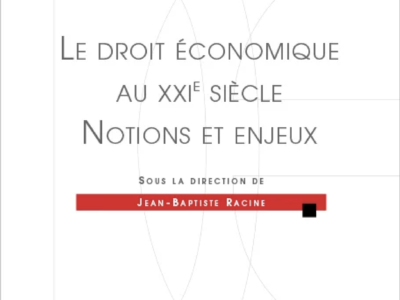
📝La compliance, in 🕴️J.-B. Racine (ed.), 📕Le droit économique au XXIe siècle. Notions et enjeux

► Full Reference: M.-A. Frison-Roche, "La compliance" ("Compliance"), in J.-B. Racine (ed.), Le droit économique au XXIe siècle. Notions et enjeux, LGDJ, "Droit & Économie" Serie, 2020, pp. 97-108 - 📝read the article (in French) - 🚧read the bilingual Working Paper which is the basis of this article, with additional developments, technical references and hyperlinks - 📕read a general presentation of the book, Le droit économique au XXIe siècle. Notions et enjeux, in which this article is published - 📚see the presentation of the other books published in this Serie, founded and directed by Marie-Anne Frison-Roche   ► English Summary of the article:  - 🌐follow Marie-Anne Frison-Roche on LinkedIn 🌐follow Marie-Anne Frison-Roche on Instagram 🌐subscribe to the Newsletter MAFR Regulation, Compliance, Law