Philosophy, theory and sociology of law

Publication director

🏗️ direction of the collection: 📚Droit et Économie

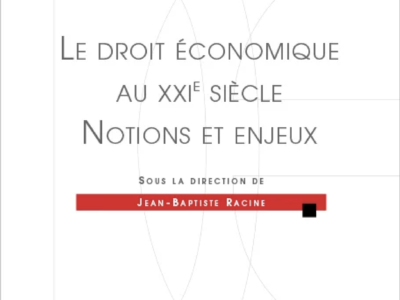
📕Le droit économique au XXIe siècle. Notions et enjeux

Full reference: Racine, J.-B. (ed.), Le droit économique au XXIe siècle. Notions et enjeux, Coll. Droit & Economie, Lextenso – LGDJ, 2020, 726 p. -   Summary of the book : Economic Law has not been so important than today, at a time of phenomenal changes in our societies. Economics are everywhere and Law is directly requested, to accompany, frame and finalize economics. Economic Law, which remain without definition, must be perceived now as a fundamental understanding tool of the realities of our time. This book proposes both to take stock of what Economic Law is at the start of the XXIst century and to give prospective analysis of what it could be in the years to come. It has been designed as a collective research based on  30 key-words (like the firm, the market, globalization, artificial intelligence). Each author has taken a notion by placing it in a logic of Economic Law. It is therefore on a transversal and thematic analysis that the book is based. Economic Law is an open house. While it seeks diverse schools of thought, it gives pride of place to diversity. The book has been realized in this spirit. If it gather many authors from Nice's school, it is also open to other perspectives and opinions. Economic Law, through its research topics and analysis methods is in constant change. This research shows that economics is a topic which crosses every legal branches, beyond business Law.  The book is aimed at students wishing to familiarize themselves with Economic Law process, researchers intending to explore Economic Law themes in depth, and also practitioners who are looking for keys to understanding the current issues raised by the relationship between Law and Economics.    List of authors: Jean-Baptiste Racine Éric Balate Jennifer Bardy Jean-Sylvestre Bergé Walid Chaiehloudj Jacques Chevallier Bruno Deffains Catherine Del Cont Pascale Deumier Isabelle Doussan Aude-Solveig Epstein Marie-Anne Frison-Roche Giulio Cesare Giorgini Lemy Godefroy Marie-Angèle Hermitte Clotilde Jourdain-Fortier Gilles J. Martin Frédéric Marty Séverine Menétrey Mehdi Mezaguer Eva Mouial Bassilana Irina Parachkévova-Racine Thomas Perroud Valérie Pironon Patrice Reis Fabrice Riem Jean-Christophe Roda Mahmoud Mohamed Salah Fabrice Siiriainen Katja Sontag Marina Teller Anne Trescases   Read the table of contents (in French) Read Jean-Baptiste Racine's introductive article (in French) Read Marie-Anne Frison-Roche's article (in French) and read the bilingual working paper on which this article is based. 

Articles

💬Facebook: Quand le Droit de la Compliance démontre sa capacité à protéger les personnes (Facebook: When Compliance Law proves its ability to protect people)

Full reference: Frison-Roche, M.-A., Facebook: Quand le Droit de la Compliance démontre sa capacité à protéger les personnes (Facebook: When Compliance Law proves its ability to protect people), interview with Olivia Dufour, Actu-juridiques Lextenso, 23rd of November 2020 Read the interview (in French) Read the news of the Newsletter MAFR – Law, Compliance, Regulation about this question

Articles

FRISON-ROCHE, Marie-Anne

💬 “Health Data Hub est un coup de maître du Conseil d’État” (“Health Data Hub is a stroke of genius of the Conseil d’État”)

Full reference: Frison-Roche, M.-A., "Health Data Hub est un coup de maître du Conseil d'État", interview realized by Olivia Dufour for Actu-juridiques, Lextenso, 22nd of October 2020 Read the news of 19th of October 2020 of the Newsletter MAFR – Law, Compliance, Regulation on which relies this interview: Conditions for the legality of a platform managed by an American company hosting European health data​: French Conseil d'État decision  To go further, on the question of Compliance Law concerning Health Data Protection, read the news of 25th of August 2020: The always in expansion "Right to be Forgotten"​: a legitimate Oxymore in Compliance Law built on Information. Example of​ Cancer Survivors Protection 

Articles

💬Et si le secret de l’avocat était l’allié de la lutte contre le blanchiment ? (Why would the attorney not be an ally in the fight against money laundering?)

Full reference: Frison-Roche, M.-A., Et si le secret de l’avocat était l’allié de la lutte contre le blanchiment ?, interview realized by Olivia Dufour for Actu-juridiques, Lextenso, 15th of October 2020 Read the interview (in French) To go deeper on the place of the attorney in Compliance Law, read Marie-Anne Frison-Roche's working paper: The Attorney, Vector of Conviction in the New Compliance System

Articles in a legal collective publication

📝 Se tenir bien dans l’espace digital (Having a good behavior in the digital space), in 📙Penser le droit de la pensée

Full reference: M.-A. Frison-Roche, Se tenir bien dans l'espace numérique, in Penser le droit de la pensée. Mélanges en l'honneur de Michel Vivant, Lexis Nexis and Dalloz, 2020, pp. 155-168. - 📝Read the article (in French) - 🚧Read the working paper, written in English, on which this article is based, with additional developments, technical references, and hyperlinks   English summary of the article: The digital space is one of the scarce spaces not framed by a specific branch of Law, Freedom also offering opportunity to its actors to not "behave well", that is to express and diffuse broadly and immediately hateful thoughts through Hate speechs, which remained before in private or limited circles. The intimacy of Law and of the legal notion of Person is broken: Digital permits to individuals or organizations to act as demultiplied and anonymous characters, digital depersonalized actors who carry behaviors that are hurtful to other's dignity.  Against that, Compliance Law offers an appropriate solution: internalizing in digital crucial operators the mission to disciplinary and substantially hold the digital space. The digital space has been structured by powerful firms able to maintain order. Because Law must not reduce digital space to be only a neutral market of digital prestations, these crucial operators, like social networks or search engines, must be forced to substantially control behaviors. It could be about an obligation of internet users to act with their face uncover, "real identity" policy controlled by firms, and to respect others' rights, privacy rights, dignity, intellectual property rights. In their Regulatory function, digital crucial firms must be supervised by public authorities.  Thus, Compliance law substantially defined is the protector of the person as "subject of law" in the digital space, by the respect that others must have, this space passing from the status of free space to the one of civilized space, in which everyone is obliged to behave well.  -   Read to go further:  Frison-Roche, M.-A., L'apport du Droit de la Compliance à la gouvernance d'Internet, 2019 Frison-Roche, M.-A. (dir.), Internet, un espace d'interrégulation, 2016 - 🌐follow Marie-Anne Frison-Roche on LinkedIn 🌐follow Marie-Anne Frison-Roche on Instagram 🌐subscribe to the Newsletter MAFR Regulation, Compliance, Law 

Working papers

Rights, primary and natural Compliance Tools

Full Reference : Frison-Roche, M.-A., Rights, primary and natural Compliance Tools, Working Paper, July  2020. This Working paper is the basis for an article published in the collective book  Compliance Tools . - There was a time when Regulatory techniques  were above all only calculations of the best tarifications, taken up by monopolistic companies, while Compliance techniques were only obedience to all rules governing us. All this could therefore only be business of abacus and badine, used by engineers and consisted only of mechanical reflexes of "conformity" to all kinds of rules with the corset ensuring that everyone is bent in front of them1Contre cela, la critique radicale, savante et fondée d'Alain Supiot, dans l'ensemble de son oeuvre et plus particulièrement dans La gouvernance par les nombres, 2015. . In the perspective of a Regulation and Compliance thus conceived, that is to say effective, it would not be necessary to insert prerogatives for people, since these could only be sources of inefficiency, of cost. and protest, where the order would come from figures set in advance and controlled processes. Systems have since evolved to integrate these prerogatives of each person: rights. Is this evolution really acquired? Maybe more effectively in Regulation Law than in its extension which is Compliance Law. This may be surprising since Compliance Law, in that it extends Regulatory Law in enterprises should, on the contrary, promote rights by meeting the enterprise, which is a group of people ….2Sur la définition de l'entreprise comme un groupe de personnes qui se réunissent pour entreprise, v. le travail de référence d'Alain Supiot, par exemple son article d'introduction "L'entreprise...", dans l'ouvrage qu'il a dirigé L'entreprise dans la mondialisation ...., 2015 ... . But the modern reluctance to define the enterprise (and the company) as a group of people and the preference given to a definition of the company (and the enterprise) as an "asset", a "good" of which investors would be the owners, maybe explains the sidelining of rights not only in Regulatory Law but also in Compliance Law even though it is being deployed in the space of the enterprise3Si l'entreprise pouvait renaître comme idée de cristallisation d'une idée commune entre des personnes, naturellement titulaires de droits subjectifs, exerçant ensemble leur liberté d'entreprendre pour réaliser un projet commun, ce qui correspond à la définition classique du contrat d'entreprise donnée à l'article 1832 du Code civil, cela renforcerait considérablement la présence des droits subjectifs dans le Droit de la Compliance et conforterait la nature humaniste de celui-ci. En outre, dans une telle définition la loi de la majorité, qui n'est qu'une loi de fonctionnement d'une catégorie de sociétés que sont les sociétés de capitaux, deviendrait moins puissante, au profit des "droits propres" de tout associé (au-delà du cercle des sociétés de personnes), sans qu'il soit besoin d'aller chercher au-delà du cercle des associés ou titulaires de titres émis par la société ou l'entreprise (dit shareholders) et d'aller donner le "droit à la parole" à des personnes qui, parce qu'elles sont "concernées" (les "parties prenantes", les skateholders) ont désormais de plus en plus le "droit à la parole". . In addition, if Regulation has long been the subject of a branch of Law in which rights have full place, the presentation of Compliance as "conformity", that is to say the proven assurance of obedience to all the applicable rules, leaves no space for the prerogatives of people, which appear rather as resistance to the obedience that would be expected of them. There again, the expectation of what would be a good ratio of conformity between behaviors and prescriptions would be obtained by a "design", data processing being the new form of calculation, improved by precision tools where the being human is not required4La Compliance by Design reflète ces tensions. Elles sont particulièrement bien décrites par Cécile Granier. V. ..... His fallibility and the little confidence which one can place in him leads even to exclude the people and to conceive Compliance system between machines, not only to alert of the failures, but also to manufacture the "regulations" and to connect those. here, in a "regulatory fabric" without a jump stitch, entirely enveloping human beings5Contre cette conception de la légalité, qui prévoit tout et à laquelle il faudrait prouver par avance et que l'on se "conforme" entièrement, ce qui est contraire aux principes mêmes du libéralisme dont le principe est la liberté d'agir et non pas l'obéissance, Carbonnier affirme que les règles sont faites ne pas s'appliquer et qu'elles ne sont que le "mince vernis" des choses, qu'il convenait de se méfier de la "passion du Droit". V. not. son dernier ouvrage Droit et passion du droit sous la Vième République, 1995. Carbonnier est considéré comme le plus grand juriste français du XXième siècle. Il rédigea les lois qui réformèrent en profondeur le Code civil et publia des ouvrages sur "l'art législatif". . It would therefore be with regret, and probably because some constitutional jurisdictions still attach some value to fundamental rights that the systems of "conformity" of behavior to the rules make some room for the prerogatives of people, their more essential rights. It is sometimes said that this is part of the cost. It would therefore be as by "forcing" that rights would exist in Compliance systems, a kind of price that the effectiveness of Compliance must pay as a tribute to the Rule of Law principle6Au contraire, l'Etat de Droit n'est pas un coût extérieur au système de Compliance efficace, que celui-ci doit internaliser. Il est le fondement même du Droit de la Compliance. Voir dans ce sens la démonstration faite par le président de la Cour de Justice de l'Union européenne, Koen Laearnt, ..., in Pour une Europe de la Compliance, 2019. . If in a poor definition Compliance is conceived in this only "conformity", leading to a landscape in which the behaviors of the people adjust to the rules governing the situations, Compliance being only the most "effective way" to ensure the application of the rules, in a mechanical perspective of Law, then it would effectively be necessary to reduce the prerogatives of people to a minimal part, because any "additional cost" is intended to disappear, even if it is produced here by constitutional requirements. In the looming battle between the effectiveness of the application of rules and the concern for the legal prerogatives of people who should above all obey and not claim their rights, especially their right not to obey , or their right to keep secret in Compliance techniques which is based on the centralization of information, the effectiveness of efficiency could only, by the very power of this tautology, prevail7Sur la démonstration comme quoi la Constitution, en ce qu'elle contient de l'incalculable, est broyée dans cette façon de faire, v. Alain Supiot, Intervention 2019. …  The defeat would not be total, however, collaboration would still be possible and active between people availing themselves of their rights and Compliance Law. Indeed, in many respects, if rights have been recognized in Compliance systems, it is not only because Compliance Law, like any branch of Law, can only be deployed with respect for fundamental rights. kept by fundamental legal texts, but also because of the effectiveness of rights as " Compliance Tools". Indeed, because they constitute a very effective "tool" to ensure the entire functioning of a system whose goals are so difficult to achieve, because every effort must be made to achieve these goals, the public authorities not only rely on the power of crucial operators, but also distribute prerogatives to people who, thus encouraged, activate the Compliance system and participate in the achievement of the "monumental goals". Rights can prove to be the most effective tools to effectively achieve the goals set, to such an extent that they can be considered as "primary tools"  (I). But it is necessary to be more ambitious, even to reverse the perspective. Indeed because all the Monumental Goals by which Compliance Law is defined can be reduced to the protection of people, that is to say to the effectiveness of their prerogatives, by a mirror effect between rights. given by Law to persons and the rights which constitute the very purpose of all Compliance Law, in particular the protection of all human beings, even if they are in a situation of great weakness, rights become a "natural tool" of Compliance Law (II). Rights are the Compliance Law future. 

Working papers

🚧The dreamed Compliance Law

🌐follow Marie-Anne Frison-Roche on LinkedIn 🌐subscribe to the Newsletter MAFR Regulation, Compliance, Law  - ► Full Reference: M.-A. Frison-Roche, The dreamed Compliance Law, Working Paper, June 2020.  - This Working Paper, "The Dreamed Compliance Law", is the basis for an article, written in French, "La compliance" (Compliance), inserted in the collective work to be published under the direction of Jean-Baptiste Racine, Le Droit économique du XXIème siècle (The XXIe century Economic Law , in the Serie Droit & Economie,   Lextenso – LGDJ, 2020. -   No one can know what the Law of the 21st century will be. Pretending to know it is just not to realize its ignorance. Why then writing about it, since the future is always surprising? One can only write about the unknown part of the Law of tomorrow. If the future is then modeled on what was written, so much the better for the prophet, a tribute that can, for example, be paid to Pierre Godé1Mélanges Pierre Godé, off-trade book, 2019.  who described in 1999 what was going to be 10 years later "Law of the future" constituted by Environmental Law2Godé, P., Le Droit de l'avenir (Un Droit en devenir), 1999. . If the future denies the author or if its contours in no way follow the lines of the written word, this is not serious since the writing of the Law, even if it has the specificity of being partly prescriptive in that it has the power to write the future, a normative pen that rounds up letters3It is in particular the idea of the movement of analysis of Law & Literature which poses that by telling the past in one way or another, by thus inventing it, Law, and in particular the Judge, invents the future and being written, creates it. On this movement which was powerful in the United States, v. Cabrillac, R. et Frison-Roche, M.-A., Droit et Littérature, à paraître. , it participates in all writing: above all to be that of a dream. Lévi-Strauss argued that teaching is defined as dreaming out loud. Teaching and describing the Law of a century that we will never know gives even more freedom to dream about it. This freedom increases when the object is a branch of Law in the process of being born, state of the stammering "Compliance Law" of which some still maintain, as it was made for Regulation Law, that there is not existing. The hand can then, as it pleases, trace its beautiful or hideous features: what face will Compliance Law have, as soon as we assume that it will exist? It may as well be a nightmare (I) as a happy dream (II). It is up to us to choose in which category this branch of Law will flourish. Because what we can be sure of is this fulfillment. It is certainly already taking sides to presuppose the very existence of Compliance Law. Not only to consider it possibility with hostility because to be an enemy of something or someone is already to recognize their existence. Before that, two objections radically block the very existence of Compliance Law and their shadow remains in the future of it4See infra I. Compliance Law as nightmarish octopus. . Firstly, it is said that Compliance does not come under Law, but for example only ethics since it would consist in keeping well in companies which care about the interest of others or the planet, for example by spontaneous care of the environment; Compliance being a crystallization of social responsibility, the one for which we have our conscience, we express our "raison d'être" and we are not accountable5On the fact that "social responsibility" makes it possible not to be legally responsible, cf. Supiot, A., Du nouveau au self-service normatif: la responsabilité sociale des entreprises, 2004; this is not the subject of this article and this question will not be developed here.. Or it would consist in technologically putting in place tools for capturing technical information using data storage and processing methods. Compliance is then a sub-category of "Data Regulation"!6See, for instance, ..., Replace Regulation by norm by Regulation by Data, 2020. , a mechanical concept in which Law is no more present. In these two perspectives, Compliance Law cannot exist, no more tomorrow than it would exist today. These two radical conceptions, completely entrusting Compliance mechanisms to everyone except lawyers, do not make sense because it suffices to note the development of judgments and laws to measure the legal phenomenon already present7See, for instance, Frison-Roche, M.-A., Compliance Law (monography), 2016 ; Compliance Law, 2020. . Second, there would be many Compliance mechanisms but insufficient to constitute a branch of Law. Indeed we would find Compliance in Company Law, Labor Law, Financial Law, Banking Law, Criminal Law, Administrative Law, European Law, International Law, etc. These classic branches, which have been formed for so long, depending on the point of view adopted, would gain in modernity or be threatened with decay by this kind of extension which will be Compliance. There would thus be as many "little legal sectoral rules" as there are branches of law. These new internal developments would be like a new bud, on which care should be taken – if the tree regains its strength – or a weed to be eradicated – if the French garden loses its perspective. Thus the matter being scattered as many as specialist lawyers, often criminalists or specialists in banking and Financial Law, then tomorrow all specialists in all branches of Law, this could constitute the most radical obstacle to the constitution of Compliance Law. Indeed, we would come back to confuse Compliance and the "modernization" of Law itself as a whole, since it would only be a question of perfecting each of the classic branches of the legal system. If we keep in this half-sleep that is any projection in the future the hope of a constituted branch of Law, we must discard these two perspectives of annihilation, either in the total absence of Law or in recovery by all Law. To dismiss the sorrowful spirits who see no future in Compliance and keep only its enemies in the space of this article, let us assume that Compliance Law will exist in the 21st century. In what form and by what means, in the palm of which institutions, in the shadow of which legal system? Since it is a question of projecting ourselves onto the black screen of our nights of dreamy lawyers, let us take the current state only as a trailer. Like the one developed by the genius who by the contempt not only brought down into the flames of hell the cinema which has become a consumer industry with which producers force-feed us but offered us the vision of its future. What is what we see today the trailer? We let our imagination run wild since the trailer films are autonomous works compared to the film which follows them. We have no idea what will happen and what we are watching from the brief and violent current images of Compliance Law, the cinema of which rather makes a hero of the whistleblower8On what the cinema does with the whistleblower, with the availability of trailers and extracts from the films, see Frison-Roche, M.-A., introduction of the article The impossible unicity of the legal category of whistleblowers, 2019.  and a character of the narrow and ridiculous importance of the compliance officer9Frison-Roche, M.-A., ... (retrouver sur LinkedIn). , does little to help us. But if we force the features of the present lineaments, the alternative of this Law in childhood is therefore that of a nightmare (I) or an idyllic solution for difficulties that will increase (II). Everything will depend on the concept that we will retain of Compliance Law. Because the script is not written, because Compliance Law is a Law with a political dimension, that it is defined by the ambitions that we can claim to have by setting monumental goals that we are going to achieve, a claim that will make it one major branch of the Law of tomorrow, or we can abandon any claim, lower our heads and arms, and reject any claim. It is then that the power of Compliance Law, which will be no less great, will turn against us, human beings, as in a nightmare.  

Articles in a legal collective publication

📝The impossible legal unicity of the category of “whistleblowers” (“L’impossible unicité juridique de la catégorie des “lanceurs d’alertes” “)

Full reference: Frison-Roche, M.-A., L'impossible unicité juridique de la catégorie des "lanceurs d'alertes" ("The impossible legal unicity of the category of "whistleblowers""), in Chacornac, J. (dir.), Lanceurs d'alertes, regards comparatistes, ("Whistleblowers, comparative perspectives"), Publications of the Centre français de droit comparé ("French Comparative Law Center"), May 2020, Volume 21, pp. 13-31.    Read the article (in French).    Read the general presentation of the collective book in which this article is published Read the bilingual working paper which had served of basis for this article.  Read the presentation of the conference "Les lanceurs d'alertes: glose" (Whistleblowers: glose") and especially the slides elabored for the colloquium organized by the Centre français de droit comparé ("French Comparative Law Center") on 23th of November 2018 under the direction of Jérôme Chacornac - Introduction of the article "Whistleblowers". This is a new expression. Which is a great success. Barely heard once, we hear it everywhere … A topic not of course or knowledge test, but rather a topic of daily conversation. Because it is spoken to us every day, in more or less gracious terms. For example President Donald Trump on October 1, 2019 declared to the press "want to question" the whistleblower who would have illegally denounced him and would not, according to him, have the right to conceal his identity, proof in this according to him of the lying character of his assertions against him, while his lawyer indicates on October 6, 2019 that he is not speaking on behalf of a single whistleblower thus taken to task but of a plurality of people who gave information against the President of the United States. Even the most imaginative screenwriters would not have written such brutal and rapid twists and turns. Spectators, we are waiting for the next episode, secretly hoping for the escalation. And precisely if we go to the cinema, it is still a whistleblower whose dedication and success, we are told about, even the drama, for the benefit of global society, and in particular democracy, since the secrets are fought for the benefit of the truth. The Secret Man designates Mark Felt as the first whistleblower. Returning to what we often present as being a more "serious" media1On the more general fact that cinema is undoubtedly the medium which most seriously restores the state of the Law, c. Frison-Roche, M.-A., Au coeur du Droit, du cinéma et de la famille : la vie, 2016., we listen to France-Culture and here is another story told by a historian who worked as an archivist on events that political power would have liked to keep hidden by possibly destroying their traces but which its trade led to preserve: here it is expressly presented to the studious listeners like a "whistleblower" …. While the same radio tries to find the one who could well be, as in a kind of contest the "first whistleblower"2L'histoire du premier lanceur d'alerte, France Culture, septembre 2019. ? …. This rewriting of History can be defended because ultimately what did other Voltaire do for Calas, or Zola for Dreyfus? It is also a subject of legislative discussion since in the United States the Dodd-Frank law of 2010 inserted in the law of 1934 which established the Securities & Exchanges Commission a complete device of remuneration and remuneration of the whistleblowers, whereas after having developed flexible but guiding lines in this regard in 20123European Commission, Guidelines on Whistleblowing, 6 of December 2012, SEC(2012) 679 final, updated on 23 of April 2018. , the European Commission published on November 20, 2018 the text of what will become a Directive intended to give a unified European status to the character, in the system gradually developed to protect the one who was presented in 2018 as that "cannot be punished for having done what is right". In Europe, the Directive first approved by a Resolution of the European Parliament on April 16, 2019 on the protection of persons denouncing breaches of Union Law and then adopted on October 7, 2019 (Directive of the European Parliament and of the Council of European Union on the Protection of Persons who Report Violations of European Union Law, different title, it should be noted, will have to be transposed into the laws of the Member States within the next two years. , since only "violations of Union Law" are targeted, but the character of the "whistleblower" is more generally targeted: he is "whole"4However, precisely the so common use of plurality ("whistleblowers") raises doubts about the uniqueness of the character. On this question, see. all the first part of the developments of this study, which leads to the conclusion rather than beyond the multitude of particular cases, there are rather two kinds of whistleblowers. V. infra I.. In short, the whistleblower is a star5The director of the film La fille de Brest says that she considers the whistleblower at the origin of the case of the Pick as a "movie character".. A sort of historical figure, covered in blows and glory, going from Voltaire to Snowden, both of whom find themselves embodied on the screens6Thus, the adventures of Snowden were brought to the screen by Oliver Stone in 2016, Snowden. On the question of knowing whether this film "faithfully reproduces" or not the case, Schetizer, P., Le film Snowden est-il à la hauteur de la réalité?, 2017. This article is favorable to the whistleblower, and to the film which tells us with emotion his case, in particular because (sic), it is easier than to read the Washington Post. …., Consecrated by law, which associates with it a legal regime of protection to such an extent that, like a Nessus tunic, it is this legal regime which will define the character and not the reverse. When we read the law of December 9, 2016 relating to transparency in the fight against corruption and the modernization of economic life, known as "Sapin 2", we notice that the Legislator makes much of this character, since 'he dedicates its chapter II to him7Underlined by us.: "From the protection of whistleblowers", and that it is by his very protection that he formally opens the door of Right to him. But why a plural? Admittedly when we read the recitals of the Community Directive of October 7, 2019 on the protection of whistleblowers8About this directive, v. the developments infra, it is only a list of all the subjects on which it is a good idea to protect them, which therefore prompts us to see in this plural only the index of this non-exhaustive list of subjects which it is good to tell us, a sign of the lack of definition of who should alert us. Reading the French law known as "Sapin 2" makes it less severe but more perplexing. Indeed, this plurality referred to by the title of the chapter devoted to "whistleblowers", there is no longer any question in the rest of the law, in the very definition which follows, article 6 which opens this chapter devoted to "whistleblowers" offering the reader immediately a singular since it begins as follows: "A9Underlined by us. whistleblower is a person …". No mention of diversity. The art of legislative writing would however have required that the qualifying article not only be singular but that it should not yet be undefined. Stendhal if he had still deigned to have the law for bedside book would have wanted to find at the beginning of chapter a sentence like: "The10Underlined by us. whistleblower is a person …". Thus seem to contradict themselves within the law "Sapin 2 the very title which presents the character, in that it uses a defined plural (the) while the defining article which presents it is in the undefined singular (one). … Here is a first reason not to advance any more but in a very careful way, in this "step by step" that constitutes a reading word for word: a gloss. This consists of taking the expression itself literally. The second reason for this technical choice is that the gloss is well suited to the introduction of a collective work, thus allowing more targeted developments to take place in other contributions, on the techniques, the difficulties and the limits of this protection, or on its history, or the reasons for the arrival in French law of these whistleblowers and the way they develop, or not, elsewhere. I am therefore going to content myself with taking this already legal expression to the letter: The (I) whistle (III). blowers (II).       

Working papers

Compliance and Extraterritoriality: a natural and effective couple for the future of Europe

This working paper is the basis for an article in the French Law Journal Le Clunet.   When we compare the terms "Compliance" and "Extraterritoriality", it is often with dissatisfaction, even anger and indignation. On the momentum, after having expressed a principle of disapproval of such a merger, attention is focused on how we can fight against it, to break the link between Compliance and Extraterritoriality. But do we have to go so fast? Is this negative initial assessment correct? Indeed, thus gone, it is frequently explained that the binding mechanisms of Compliance are suffered, that they come from abroad, that they apply with efficiency but in an illegitimate way, without agreement of the one who must submit to it, whose resistance is therefore certainly ineffective but nevertheless justified. In the same spirit, when we start to shell the cases, like so many scars, sort of rosary, even crown of thorns, BNPP case, Astom case, etc., the wounds not yet closed turn into reproaches made against the rules, public authorities, even reproaches made against named people. We are leaving this kind of complaint against X, which targets what would be this appalling "Compliance", this Law which would be both hostile and mechanical which would not have been able to stay within the limits of borders, Compliance being thus placed in contrast to sovereignty and protection, which presuppose staying within its limits and being able to protect companies from abroad. More concretely, this presentation targets more directly the United States, which uses "the legal weapon", slipped under what is then designated as "the artifice of the Law" with extraterritorial scope. But this effect would in reality be the very object of the whole: their hegemonic will to better organize at least a global racket, notably through the Foreign Corrupt Practices Act (FCPA) and at best a world government through notably the embargoes.Those who believed otherwise would be naive or foolish. This silences the opponents because who likes this costume? So the world would be put in a ruled cut; what the mafia could not have done, Compliance Law would have obtained, offering the whole world to the United States thanks to the extraterritoriality of its national Law. Compliance Law would thus become the very negation of Law, since it has the effect, even the purpose (barely concealed by strategic, powerful and shameless States), of counting borders for nothing, whereas Public International Law, in that it is built between the sovereign subjects of law that are the States presupposes the primary respect for borders to better exceed them while Private International Law takes the same postulate to better welcome foreign Law in situations presenting a foreign element. Jurists believed in the force of Law; by Compliance, we would return to the sad reality that only the powerful, here the United States, dominate and – ironically – it is under the pretext of Law that they do it. It would be necessary to be well duped, or accomplice, to see there still legal where there is only the balance of powers. When one is more intelligent or skilful than that, one understands that the "small" can only be "subject" to the Compliance Law, one would have to be powerful to be the normative source and its enforcement agent. It is then towards this mis-named Department of Justice (DoJ) that the fearful, hateful and resigned glances turn.  If you see it that way, what should you do then? The answer is obvious: react! It is necessary to save the sovereignty, France, companies, the Law itself. If that is how the question is posed, how can we disagree? It is therefore necessary to destroy the Compliance Law and the extra-territoriality of American Law which had found this "Trojan horse", an expression so frequently used. This is the basis for the administrative reports available, for example the Berger-Lellouche parliamentary reports and the Gauvainfootnote-1720 report. Both of them broadly develop the two preceding claims, namely that the extra-priority of compliance mechanisms is illegitimate and harmful, since it is a mechanism invented by the Americans and harming the Europeans, or even invented by the Americans to harm Europeans, the description being made in much more violent terms than those used here. The description seems acquired, the reflections therefore relate to the remedies. The reaction is most often to "block" the Compliance Law in its extraterritorial effect. But without discussing the effectiveness of the remedies proposed downstream, it is necessary to return to this description so widely shared made upstream. Because many elements on the contrary lead to affirm that ComplianceLaw first of all and by nature can only be extraterritorial and that it must be. Whether or not the State in which it was created has malicious intentions. The description which is made to us most often describes particular cases from which we draw generalities, but we cannot reduce Compliance Law to the already cooled cases, as BNPP case, or to the always hot case of the American embargo on Iran. Furthermore, one cannot take the issue of embargoes and draw conclusions, legitimate for it, but which would apply to the whole of Compliance Law. The fact that theCompliance Law is a branch of Law at the stage still of emergence can lead to this confusion which consists in taking the part for the whole, but it is very regrettable because what is justified for the embargoes does not is in no way relevant for all Compliance Law, of which precisely the Law of embargoes is only a small part, even an abusive use. This overlapping is not often perceived, because the definition of Compliance Law and its criterion are not clearly enough defined, namely the existence of a "monumental goal", which does not exist in an embargo decided unilaterally by an order decreed by the President of the United States, but which exists in all other cases and fully justifies extraterritoriality, extraterritoriality which is even consubstantial with Compliance Law (I). Once we have distinguished the embargoes, as an atypical, sometimes even illegitimate part, of Compliance Law, we should continue this work of distinction by emphasizing that the United States has certainly invented Compliance Law but only developed a mechanical concept for the prevention and management of systemic risks. Europe has taken up this systemic conception of the protection of systems, for example financial or banking, but superimposed another conception, drawing on its deep humanist tradition, whose protection of personal data is only an example and whose monumental goal is the protection of the human being. This primary concern then justifies the European use of Compliance mechanisms to interfere with global objects regardless of their location, especially the environment, and to block the entry onto the ground of objects that enter, which is contrary to Competition Law but builds a legitimate barrier under this Compliance Law, in the indifference of an extraterritorial origin (II). Indeed, this branch of the new Law which is Compliance Law is not reducible to Competition Law, any more than it is not reducible to a method. It is a substantial, extraterritorial Law because the "monumental goals" which give it substantial unity are extraterritorial. This can directly contribute to the future of a Europe which on the one hand will be able to pursue, in an extraterritorial manner, monumental humanist goals, in the field of the environment or the protection of personal information or access to the Law (in particular by the technique of compliance programs) and which, on the other hand, by the techniques of traceability of products, will have the means not to bring in products manufactured in an indecent manner, except in countries which do not grant value than in Competition Law to enter the WTO.     Read the developments below.  

Publication director

🏗️ direction of the collection: 📚Cours Dalloz – Série Droit privé

📚Publication of : 🕴️Anne-Marie LEROYER, 📕Droit des successions (Law of Succession), 4th ed.

► Full Reference : A.-M. Leroyer, Droit des successions (Law of Succession), 4th ed., 2020, Dalloz, “Cours Dalloz-Série Droit privé” Series, 526 p. - 📕Read the back cover (in French) - 📕Read the table of contents (in French) - 📚See the entire collection in which the book is published. -

Working papers

The part and the all: the Amazon is related to what? For Brazil and the United States, the “part”; for France, the “All”. The issue is here

  Summary : In August 2019, about the fire devastating the Amazon, the French Minister of Ecology says that this fact "is not just the business of a state" (n'est pas que l'affaire d'un Etat). This assertion denies the postulates of Public International Iaw (I). This supposes a new system, based on the idea that the power of the State on its territory is erased when the object that is there is no longer related to this "part" but to the All that is Universe (II). Let's accept the augur. First question: if it is not only the case of a State, whose business is it? (III). Second question: to anticipate the other cases that fall under this regime, what should be the criteria in the name of which the All will have to prevail over the part and who will then take care of the case of which the "local" State is divested? (IV). Because the perspective goes beyond the environment, beyond Brazil, beyond the States. It leads to Compliance Law animated by "monumental goals" that are the concern for the Universe and humans, in a humanist spirit. Let's go.   - On August 27, 2019, on the French radio France Inter, Elisabeth Borne, French Minister of Ecology (Transition écologique) expresses it clearly:  "Quand on est sur un enjeu tel que l'Amazonie, ça n'est pas que l'affaire d'un État", that can be translated : "When we are on a stake such as the Amazon, it is not only the business of one State ". Starting from one case, "the Amazon", the Minister, thus taking up the position of the French President, associates a general consequence: "it is not only the affair of one State". This is not a trivial sentence.   This affirmation denies, and why not, the entire system of Public International Law (I). By a new reasoning based on the idea that the All prevails, as by an effect of nature, on the Part (II).   Admitting this, it leads to opening two sets of questions. The first is related to the following main question: if it is not only the case of one State, of which is this the concern (III)? The second set of questions revolves around the questioning of the criteria on behalf of which other cases must be seized in the name of "All " and how to do it (IV).     I. THE QUESTIONING OF THE CLASSIC SYSTEM OF PUBLIC INTERNATIONAL LAW   Since forever, but this is not suffcient to keep the system only for that, the world is legally organized around the concept of territory, which has as for corollary the notion – already more legal – of border. On this basis rests the postulate of International Law: parties, taking the legal form of States, which, if they have common interests, come into contact (A). Admittedly, the notion of "right of interference" has called into question that (B), but in the name of an altruism that does not destroy the territory. The new idea that appears here is that the territory would be no more than a part of an All, in the name of which one would be legitimate to speak, even to decide in the place of the State in whose territory an event takes place (C).   A. The postulate of Public (and Private) International Law: parties (States) which, because of common interests, are in contact The notion of State includes in its very definition the notion of territory (a territory, a population, institutions). Thus the State governs through its institutions what is happening on its territory. For example, if there is a fire, or a risk of fire, the State makes arrangements through all legal, financial, technical and human instruments available to it. It is accountable for what it does through its political and legal responsibility. When what is happening on its territory exceeds this one, in fact (epidemic, catastrophe with the consequences exceeding the borders, migrations, etc.) either according to its own opinion or according to that of the other States, the States, being sovereign subjects of Law in  the international system, act together on a pre-built legal basis: bilateral or/and multilateral treaties, having created legal integrated zones (like the European Union or the United States) or international institutions (like the IMF). A particular technique has been developed for several millennia – but here again the seniority is not sufficient to keep the system: diplomacy, anchored in each state in a particular ministry: the Ministry of Foreign Affairs, which each national government has. If one State totally excludes one phenomenon in the territory of another, the progressive procedure of ceasing diplomatic ties begins. This can result in wars. In the "case of the Amazon" both the President of Brazil and the President of the United States stick to the classical construction of Law. Indeed, the former asserted that the Amazon is in the territory of Brazil, thus falls under the jurisdiction of the power of the Brazilian State and the Brazilian Law, from which it follows that another State does not have to come to interfere. However, the French President takes the floor not as this forest extends also on a French territory but as it is the business of the World. On the contrary, the President of Brazil claims the closing effect, which excludes a third State from taking over directly something – even a difficulty – that takes place in the territory of another. The President of the US federal State has said that these are joint decisions between the President of Brazil and other heads of State, sovereign subjects of Law, who must agree to organize a solution to solve a local problem . Because in the same way that States can declare war, they can help each other. The whole Public (and Private) International Law is therefore based on this assumption: "parts" of the world, on which sovereign parties (States) have taken contact, because circumstances make something that falls within one of them or several others. This is precisely what is called into question. The notion of the "right of interference", whose evocation we hardly hear any more, had already done so. But on another basis.   B. The "right of interference": idea that somebody can directly interfere with what happens in a country , an idea that does not question the postulate of the International Maw, an idea that rests on something else: a " right for the other " The "right of interference" is the idea that in certain territories, things happen that are inadmissible. In memory of the jus cogens, a kind of "Natural Law" of Public International Law, Another, that could be another state, can come to meddle with what is happening in a territory that is closed, without declaring war. to the state that keeps its borders. It is the need of others, for example those who die in mass on this territory, or the nature that is devastated in the indifference of the State on whose soil the disaster is happening, which founds this "right" of another state to come and take charge. The foundation of this "right" is therefore a "duty".   C. The new idea: a territory is only part of the Globe, whose fate is everyone's concern The idea is new because it is not based on altruism. And no more about self-interest. Yet, de facto and de jure , the Amazon is not on the sole territory of Brazil. France is particularly well placed to say something about it since part of the Amazon is on French territory. Thus the inaction of the main concerned Brazil directly affects the interest of France, a "forest" being a block that can not be divided. If we were in Property Law, we would say that we are in indivision with Brazil and that in this respect, with the other States on whose territories this forest extends, a solution must be found. Because of the indivisibility of this particular object which is this particular fores, it is necessary that the States whose territory is concerned have a say in the matter. But this is not the argument put forward by France, particularly by the President of the Republic. It is said that the whole world is concerned about the fate of the Amazon. It could be said that, in this respect, when what could be described as a "global forest" is well treated, its management does indeed fall within the power of Brazil, Brazilian companies and the Brazilian State, but when it is abused to the point of seeing its future compromised, when fires may make it disappear, then this forest appears not to be localized in Brazil but being located in the World, of which Brazil is only a part. This reasoning, which then gives voice to everyone, for in the world every state is included in it, is a new reasoning. The economic-political theory of the "commons" does not account for it because it is not a very legal theory.    II. THE NEW REASONING THAT COVERS THE CLASSIC REASONING OF PUBLIC INTERNATIONAL LAW The new reasoning adopted by the Minister consists in saying that the Amazon does not concern only Brazil. This forest should therefore be directly related to the World (A). This is a welcome change in the system but based on a paradox (B).   A. When the Amazon is in danger of death, then it should no longer be attached to this part of the World that is Brazil, but directly to the World This forest is presented as the "lung" of the planet, it is the "future" of humanity. In this, it can concern only one State, not even the one on whose territory this "Humanity good" is located.  As such, without the need to declare war to Brazil, another State may speak, for example the French State through the one that represents it in the international order, that is to say its President, to say what to do, since according to him the President of Brazil does not say or do what it is absolutely necessary to do for the whole planet and for the future of Humanity. This induces a complete renewal of international institutions. Indeed a direct attachment to the World and no longer to Brazil gives the forest object a special status because of a goal that exceeds Brazil: save the Amazon would impose because it would save the world. Therefore, it can no longer be the subject of Brazil, which would be like "dispossessed" by a goal that is imposed on it: to save the Amazon rainforest, even though it is mainly on its territory, while other States become legitimate to dispose of this object, even if the forest would not be in part in their territory, even if they would not be affected in their own interests. This contradicts all Public International Law; because the agreement of the political representatives of Brazil is no longer required and no one yet evokes the need to declare war to Brazil, and fortunately! Such an upheaval justifies that such an affirmation is accepted with difficulty. One understands better than first consequence, which is not so innocuous, one of the first rules of diplomacy which is the politeness, between the heads of state, with regard to the spouses of these , have be broken, that the remarks have slipped on personal questions, etc.   B. A welcome but paradoxical change in the system Why not change the system? This is difficult to admit, not only because it is brutal, but because it is paradoxical. The paradox is the following. It is recognized that the theme of the disappearance of borders by "globalization" no longer reproduces the reality of facts, especially not the Chinese situation, the digitalization having on the contrary allowed the construction of even stronger boundaries. What we called "globalization" now belongs to the pastWhat we called "globalization" now belongs to the past. So today we should recognize on one side the reality of borders – which had not disappeared or are reborn – but only to better step over them, since – based on the concern of the world – states, yet each in their borders, would be legitimate to go directly to intervene in the business of others.  The paradox is therefore, on the one hand, the rejection of the allegation of a de facto disappearance of borders by an economic interdependence, technology having denied "globalization" as a fact  and the linked resurgence of borders allowing States to affirm more than ever that they would be "sovereign masters at home", which should logically lead to let Brazil decide for the Amazon, while yet on the other side we witness the questioning of the postulate of Public International Law as recognition of sovereignty and construction from agreements between states, requiring the agreement of the state whose territory is concerned (except war), questioning which leads to allow all to meddle with the fate of the Amazon, as if there was no border. This paradox leads to two questions. The first question is: if "it's not juste one State affair", who's concerned? The second question is: after the "case of the Amazon", what are the other cases? And how are we going to provide solutions, if we no longer have the solutions of Public International Law, that is to say, the agreement of the country whose territory is concerned and which we do not want not go to war? If we have clear ideas on the answers to be given to these two sets of questions, then because indeed when the future of all is in progress it can not be the affair of a single State, it is necessary to question Public International Law. But do we have clear ideas on these two questions? And what are the possibilities for possible solutions?   See the text following below.