Philosophy, theory and sociology of law

Working papers

Working Paper

🚧Conditions required to promote the “contractualisation” of the Law

follow Marie-Anne Frison-Roche on LinkedIn subscribe to the Newsletter MAFR Regulation, Compliance, Law - ► Full Reference: M.-A. Frison-Roche, Conditions required to promote the "contractualisation" of the Law, Working Paper, June 2023. - 🎤This Working Paper has been done as a basis for the closing conference of the colloquia La contractualisation du droit. Acte II, organised by the Société de législation comparée (SLC) and the Procuradoria Geral do Estado do Rio de Janeiro (PGE-RJ), on 19, 20 and 21 June 2023. - 📝It is also the basis of the article "Les conditions requises pour favoriser la "contractualisation" du droit" ("Conditions required to promote the "contractualisation" of Law"), published in the book 📗La contractualisation du droit. Approches françaises et brésiliennes (Contractualisation of Law. French and Brazilian approaches). - ► English Summary of the Working Paper :  - 🔓read the Working Paper⤵️

Conferences

🎤Favoriser ou pas la « contractualisation » du Droit (“To favour or not the “contractualisation” of the Law”), in 🧮La contractualisation du droit. Acte II

follow Marie-Anne Frison-Roche on LinkedIn subscribe to the Newsletter MAFR Regulation, Compliance, Law  - ► Full Reference: M.-A. Frison-Roche, "Favoriser ou pas la « contractualisation » du Droit" ("To favour or not the "contractualisation" of the Law"), final speech in Société de législation comparée (SLC) and Procuradoria Geral do Estado do Rio de Janeiro (PGE-RJ), La contractualisation du droit. Acte II, Paris, 21 June 2023. - 🧮See the full programme of this event (in French). The conference is held in French -

Working papers

Working Paper

🚧Thinking and using Vigilance through its Compliance Monumental Goals

🌐 follow Marie-Anne Frison-Roche on LinkedIn 🌐 subscribe to the Newsletter MAFR Regulation, Compliance, Law  - ► Full reference: M.-A. Frison-Roche, Thinking and using Vigilance through its Compliance Monumental Goals, Working Paper, March 2023. - 🎤 This Working Paper has been done as basis for the  introduction of the colloquia La société vigilante ("Vigilant Company") at the Aix-Marseille University on March 24, 2023 (conference given in French)  - 📝It is also the basis of the article that introduces a special issue on La société vigilante - ► Summary of the Working Paper: The concept of "Vigilance" is difficult to define. Probably because even as it is becoming a standard, it has just entered the legal systems. And what a splash it is! To understand it, it must not be isolated. Neither in the only French law attracting all the attention, all the fears, all the hopes, the so-called Loi Vigilance ("Vigilance Law"), nor in the only technical mechanisms that make Vigilance a reality. Vigilance is itself only a part of a deeper movement, of which it is the advanced point, allowing us to anticipate the evolution of the whole: Compliance Law. In this light and for not getting lost in it, because the stakes are so high that one quickly loses the measure of things, with each party lashing out at the others, so Vigilance, the key element of Compliance, requires above all alliances,  that we can first examine the entry of Vigilance into the legal system and then understand it through the Monumental Goals which give the measure of it, i.e. both the scope and the limit, each one having to act within the margins that are theirs, States, companies, stakeholders, and judges. A Will for tomorrow can then emerge today, carried by Europe. - 🔓read the Working Paper⤵️

Working papers

🚧Laws, Compliance, Contracts, and Judges: places and alliances

🌐 follow Marie-Anne Frison-Roche on LinkedIn 🌐 subscribe to the Newsletter MAFR Regulation, Compliance, Law  - ► Full Reference: M.-A. Frison-Roche, Laws, Compliance, Contracts, and Judges: places and alliances, Working Paper, March 2023. - . 📝this working paper is the basis for an article published in French (click HERE) in the 📚chronique of Compliance Law held in the Recueil Dalloz. - 📚Read the other articles published by this Compliance Law Chronicle. open since 2018. - ►Summary of this Working Paper: To understand the functioning of compliance systems in the articulation of the legal actors and the legal instruments used, whatever the technical sector considered, it is necessary to put the "law", the "contract" and the "judge" back into the perspective of legitimacy and efficiency regarding what Compliance is.  At the very least, it is a 'conformity' mechanism. In this process of simple obedience, legislators, economic operators, and judges find themselves in the position of having to obey the law in a hierarchical conception. In a more dynamic and ambitious conception, when Compliance Law is not reduced to a more astute method of obedience but draws substantial normativity from the Monumental Goals pursued, legislators and operators enter an alliance. The contract becomes a major instrument, and the Judge becomes a major actor, no longer to punish the non-obedient but to facilitate the links to help a sustainable system.  Faced with issues such as digital, climatic, and technological challenges, where we are each so weak and isolated, we must not limit our conception and practices to the instrument of conformity but choose the substantial Compliance Law, i.e. the alliance of forces, which puts forward the contract and renews the office of the judge, with the Public Authorities remaining legitimate in setting the Monumental Goals since they commit the future of the social group. -   🔓read bellow the developments⤵️
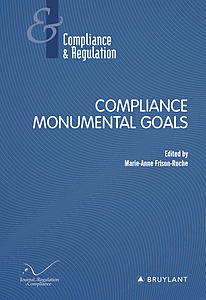
Couverture – Compliance Monumental Goals

Books

Collection Compliance & Regulation Compliance Monumental Goals

🌐 follow Marie-Anne Frison-Roche on LinkedIn 🌐subscribe to the Newsletter MAFR Regulation, Compliance, Law  - ► Full Reference: M.-A. Frison-Roche (ed.), Compliance Monumental Goals, series “Compliance and Regulation“, Journal of Regulation & Compliance (JoRC) and Bruylant, 2023, 518 p. - ► This book in a few words: Seize Compliance by its mind: its Monumental Goals. The notion of “monumental goals” of Compliance was proposed in 2016 by Marie-Anne Frison-Roche1🕴️M.A. Frison-Roche, 📝Compliance Law, 2016.. It has become explicit in the texts and the resolution of cases, for example to fight against climate change, make human beings effectively equal, force to be extraterritorially vigilant about suppliers. Compliance Monumental Goals are targeted ex ante by regulations, contracts, CSR, and international treaties. Creating an alliance between business and political authorities, aiming for a new form of sovereignty. The presence in litigation of these Monumental Goals of global dimension renews the responsibilities and the Judge office. Describing and conceiving these Monumental Goals makes it possible to anticipate Compliance Law, which is more powerful every day. -  In parallel, a book in French Les Buts Monumentaux de la Compliance, is published in the collection “Régulations & Compliance” co-published by the Journal of Regulation & Compliance (JoRC) and Dalloz. - 📅 This book follows a cycle of colloquia 2021 organized by the Journal of Regulation & Compliance (JoRC) and its universities partners. -    This book is inserted in this series created by Marie-Anne Frison-Roche for developing Compliance Law.    read the presentations of the other books of this Compliance Series:  M.-A. Frison-Roche (ed), Compliance Juridictionnalisation, 2022 M.-A. Frison-Roche (ed.), Compliance Tools, 2020 - ► go to the general presentation of this Series ​Compliance & Regulation, conceived, founded et managed by Marie-Anne Frison-Roche, co-published par the Journal of Regulation & Compliance (JoRC) and Bruylant. - ► General construction of the book: The book opens with an Introduction, ​which proposes the Monumental Goals as definition of Compliance Law putting them at its “beating heart”, giving this new branch of law its originality and specificity, explaining what, in the History of the United States and Europe, gave birth to this singular corpus and justifies a substantial definition of Compliance Law. The concept of Monumental Goals is explained, justifying both systemic and political nature of Compliance Law, the practical consequences of which legal specific rules are thus better identified and limited, since Compliance Law does not lead to all-obedience. We can then determine what we can expect from this Law of the Future that is Compliance Law. From there, the book unfolds in 5 chapters. A first chapter is devoted to the “radioscopy” of this notion, in itself and branch of Law by branch of Law. A second chapter aims to measure how the Monumental Goals are questioned by a crisis situation, for example in a health situation, but not in that example, if they aggravate it and must be discarded, or if, on the contrary, they are exactly conceived for this hypothesis. of crisis, risks, catastrophes and that it is advisable to exploit them, in particular in order, in this “test”, to benefit from the alliance between the political authorities, public powers and crucial operators. Once made explicit and tested, the Monumental Goals must find a sure way to be taken into account. This is why a third chapter aims to measure in principle and in practice how the Proportionality method can help the integration of Compliance, thus giving a new dimension to the Law without dragging it into insecurity and illegitimate grabbing of powers. But because Compliance Monumental Goals express a very great ambition, the question of a bearable, even beneficial relationship with the international competitiveness of companies, standards and systems must be opened. This is the object of the fourth chapter. Finally, because the Monumental Goals express by nature a new ambition of the Law in a world which must not give up in what could be the prospect of its abyss, the fifth chapter has for object the relationship between the Monumental Goals of Compliance and Sovereignty. - ► Table of Content : INTRODUCTION 🕴️Frison-Roche, M.-A., 📝Compliance Monumental Goals, beating heart of Compliance Law   CHAPTER I. THE VERY IDEA OF MONUMENTAL GOALS, THE BEATING HEART OF COMPLIANCE LAW 🕴️Maistre, R.-O., 📝What monumental goals for the Regulator in a rapidly changing audiovisual and digital landscape? ; 🕴️Le Fur, A.-V., 📝Interest and “raison d’être” of the company: how do they fit with the Compliance Monumental Goals? ;; 🕴️Malaurie, M., 📝Monumental goals of Market Law. Reflection on the method 🕴️Peicuti, C. & 🕴️Beyssade, J.,📝The Feminization of Responsability positions in Companies as a Compliance Goal. Example of the banking sector 🕴️Petit, B., 📝The Monumental Goals of (European) Labour Law: a Changing System with Balances to be Consolidated 🕴️Vaquieri, J.-F.,📝 The “Monumental Goals” perceived by the company. The example of Enedis. 🕴️Huglo, Ch., 📝Under what conditions could Climate Law constitute a priority Monumental Goal? CHAPTER II. IMPLEMENTATION OF COMPLIANCE MONUMENTAL GOALS IN ARTICULATION OF THE MAJOR PRINCIPLE OF PROPORTIONALITY 🕴️Rapp, L., 📝Proportionality and Normativity 🕴️Bär-Bouyssière, B., 📝Practical obstacles to the effective place of Proportionality in Compliance 🕴️Meziani, L., 📝Proportionality in Compliance, the guarantee of public order in companies 🕴️Segonds, M., 📝Compliance, Proportionality and Sanction. The example of the sanctions taken by the French Anticorruption Agency  🕴️Frison-Roche, M.-A., 📝Definition of Proportionality and Definition of Compliance   CHAPTER III. COMPLIANCE MONUMENTAL GOALS TESTED BY CRISIS SITUATIONS 🕴️Oumedjkane, A., 🕴️Tehrani, A. & Idoux, P., 📝Public Norms and Compliance in times of Crisis: Monumental Goals tested: Elements for a Problematic 🕴️Bonnet, J., 📝The Crisis, an opportunity to seize Compliance as a Mode of Communication by Public Authorities 🕴️Frison-Roche, M.-A., 📝Role and Place of Companies in the Creation and Effectiveness of Compliance Law in Crisis   CHAPTER IV. EFFECTIVENESS OF COMPLIANCE MONUMENTAL GOALS AND INTERNATIONAL COMPETITIVENESS 🕴️Deffains, B., 📝The economic challenge of international competitiveness of Compliance 🕴️Marty, F., 📝The Case for Compliance Programs in International Competitiveness: A Competition Law and Economics Perspective 🕴️Frison-Roche, M.-A., 📝Assessment of Whistleblowing, and the obligation of Vigilance   CHAPTER V. COMPLIANCE SUPPORTED BY MONUMENTAL GOALS AND NEW WAY FO SOVEREIGNY 🕴️Bismuth, R., 📝Compliance and Sovereignty: ambiguous relationships 🕴️Pottier, S., 📝In favour of European compliance, a vehicle of economic and political assertion 🕴️André, Ch., 📝State sovereignty, popular sovereignty: what social contract for compliance?  🕴️Frison-Roche, M.-A., 📝The Principle of Active Systemic Proximity, a corollary of the renewal of the Principle of Sovereignty by Compliance Law -

Articles in a legal collective publication

📝Instaurer l’insécurité juridique comme principe, outil de prévention des crises systémiques catastrophiques totales, in 🕴️G. Gerqueira, 🕴️H. Fulchiron & 🕴️N. Nord (eds.), 📗”Insécurité juridique” : l’émergence d’une notion ?

► Full Reference: M.-A. Frison-Roche, "Instaurer l'insécurité juridique comme principe, outil de prévention des crises systémiques catastrophiques totales" ("Establishing legal uncertainty as a principle and a tool for preventing total catastrophic systemic crises"), in G. Gerqueira, H. Fulchiron et N. Nord (eds.), Insécurité juridique : l'émergence d'une notion ?, Société de législation comparée, coll. "Colloques", vol. 53, 2023, pp. 153-167.  - 📝read the article (in French) - 🚧read the bilingual Working Papier which is the basis of the conference and this article - 🎤watch the conference of March 22, 2021 that took place in the Cour de cassation (French Court de cassation) and for which this reflection was globally led - ► English Summary of the article: "whatever it takes". In 2015, Mario Draghi used this formula to aim for the defence of the European currency, when the Euro was in danger of collapsing under the dance of the speculators who would be enriched by its collapse. Rarely has a formula been more violently political and more strongly prescriptive. It contributed to his being dubbed "Super Mario", as in the video game. The formula was used again in 2020 by the Président de la République Française (President of the French Republic) in the face of the financial turmoil caused by the health crisis that led to similar calculations. It goes beyond the mere "financial cost". With this formula, the President of the European Central Bank stated that the economic crisis in Europe was such that the institution would do everything in its power to put an end to it, without any limits; that all those who, by their behaviour, even supported by their legal prerogatives, in this case the speculators, because they were destroying the economic and financial system, would come up against this and would themselves be swept away by the Central Bank because the latter's mission, in that it is absolutely to safeguard the Euro itself, would prevail "quoi qu'il en coûte" ("whatever the cost"). At one point, the master stood up. If the royal position is the seated position, when he listens and judges, it is by rising that he shows his acceptance of also being the master, because he is in charge of more and will use everything to win. More broadly, we might consider drawing up a positive concept of legal uncertainty (which is bound to please the Hegelians), increasing legal certainty: this would make it possible to associate a clearer legal regime with the hypotheses of legal uncertainty. Indeed, rather than sweeping Law under the carpet, which explains many of the tensions between the Conseil constitutionnel (French Constitutional Council) and the Conseil d'État (Council of State) on the one hand, and the legislator and the government on the other, concerning the "État d'urgence" ("State of emergency"), we could set out the conditions in which legal uncertainty makes it possible to set aside or limit rules. The idea proposed is therefore that in "extraordinary situations", legal uncertainty would be a dimension, or even a principle which would be admissible. And developing this first point, it is proposed that the hypothesis of an "economic crisis" justifies a dimension, or even a principle of "legal uncertainty". But this first assertion needs to be tested. Is an economic crisis, a concept that needs to be defined, if it is to have such a major reversal effect, such an extraordinary 'situation'? Furthermore, to deal with this extraordinary situation constituted by an 'economic crisis', how much legal uncertainty would be legally acceptable, or even legally claimed? Could we even conceive of a reversal of principle that would bring applicable Law to an economic crisis under the aegis of legal uncertainty? In such a case, the question that then arises is to determine the conditions and criteria for emerging from the economic crisis, or even to determine the elements of perspective of an economic crisis, which could justify in advance the admission of an injection of legal uncertainty. Above all, Law has control over the future. The economic crisis should therefore be legally defined as an exceptional situation, before stressing that Regulation and Compliance Law, because on the one hand we move from crisis to crisis and on the other hand the whole system aims to avoid and manage the future crisis in advance or to exclude it; this is particularly true of health and climate issues (the way the health crisis was managed was to 'decree' that the State should initiate an economic crisis), which means that legal insecurity is no longer seen as a distant exception, a failure to be combated, but as a lever that can be used to influence the future. - 🌐follow Marie-Anne Frison-Roche on LinkedIn 🌐follow Marie-Anne Frison-Roche on Instagram 🌐subscribe to the Newsletter MAFR Regulation, Compliance, Law
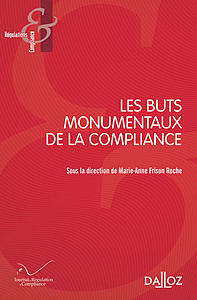
Couverture – Les Buts Monumentaux de la Compliance

Articles in a JoRC book

📝Les Buts Monumentaux, cœur battant du Droit de la Compliance, in 🕴️M.-A. Frison-Roche (dir.), Collection Régulations & Compliance Les Buts Monumentaux de la Compliance

🌐follow Marie-Anne Frison-Roche on LinkedIn 🌐subscribe to the Newsletter MAFR Regulation, Compliance, Law  - ► Full Reference: M.-A. Frison-Roche, “Les Buts Monumentaux, cœur battant du Droit de la Compliance” (“Monumental Goals, beating heart of Compliance Law”), in M.-A. Frison-Roche (ed.), Les Buts Monumentaux de la Compliance, coll. “Régulations & Compliance“, Journal of Regulation & Compliance (JoRC) and Dalloz, 2022, pp. 21-44. - 📝read the article (in French) - 🚧read the bilingual Working Paper which is the basis of this article, with additional developments, technical references and hyperlinks - read a general presentation of the book, Les Buts Monumentaux de la Compliance, in which this article is published - ► Summary of the article: Compliance Law can be defined as the set of processes requiring companies to show that they comply with all the regulations that apply to them. It is also possible to define this branch of Law by a normative heart: the “Monumental Goals”. These explain the technical new legal solutions, thus made them clearer, accessible and anticipable. This definition is also based on a bet, that of caring for others that human beings can have in common, a universality. Through the Monumental Goals, appears a definition of Compliance Law that is new, original, and specific. This new term “Compliance”, even in non-English vocabulary, in fact designates a new ambition: that a systemic catastrophe shall not be repeated in the future. This Monumental Goal was designed by History, which gives it a different dimension in the United States and in Europe. But the heart is common in the West, because it is always about detecting and preventing what could produce a future systemic catastrophe, which falls under “negative monumental goals”, even to act so that the future is positively different (“positive monumental goals”), the whole being articulated in the notion of “concern for others”, the Monumental Goals thus unifying Compliance Law. In this, they reveal and reinforce the always systemic nature of Compliance Law, as management of systemic risks and extension of Regulation Law, outside of any sector, which makes solutions available for non-sector spaces, in particular digital space. Because wanting to prevent the future (preventing evil from happening; making good happen) is by nature political, Compliance Law by nature concretizes ambitions of a political nature, in particular in its positive monumental goals, notably effective equality between human beings, including geographically distant or future human beings. The practical consequences of this definition of Compliance Law by Monumental Goals are immense. A contrario, this makes it possible to avoid the excesses of a “conformity law” aimed at the effectiveness of all applicable regulations, a very dangerous perspective. This makes it possible to select effective Compliance Tools with regard to these goals, to grasp the spirit of the material without being locked into its flow of letters. This leads to not dissociating the power required of companies and the permanent supervision that the public authorities must exercise over them. We can therefore expect a lot from such a definition of Compliance Law by its Monumental Goals. It engenders an alliance between the Political Power, legitimate to enact the Monumental Goals, and the crucial operators, in a position to concretize them and appointed because they are able to do so. It makes it possible to find global legal solutions for global systemic difficulties that are a priori insurmountable, particularly in climate matters and for the effective protection of people in the now digital world in which we live. It expresses values that can unite human beings. In this, Compliance Law built on Monumental Goals is also a bet. Even if the requirement of “conformity” is articulated with this present conception of what Compliance Law is, this conception based on Monumental Law is based on the human ability to be free, while conformity law supposes more the human ability to obey. Therefore Compliance Law, defined by the Monumental Goals, is essential for our future, while conformity law is not. -
Couverture – Les Buts Monumentaux de la Compliance

Books

Collection Régulations & Compliance Les Buts Monumentaux de la Compliance

🌐follow Marie-Anne Frison-Roche on LinkedIn 🌐subscribe to the Newsletter MAFR Regulation, Compliance, Law  - ► Full Reference: M.-A. Frison-Roche (ed.), Les Buts Monumentaux de la Compliance (Compliance Monumental Goals), coll. “Régulations & Compliance“, Journal of Regulation & Compliance (JoRC) and Dalloz, 2022, 520 p. - In parallel, the English version of this book, Compliance Monumental Goals, is published in the collection co-published by the Journal of Regulation & Compliance (JoRC) and Bruylant. - 📅This book comes after a cycle of colloquia 2021 organised by the Journal of Regulation & Compliance (JoRC)and its Universities partners. - This volume is one of the books dedicated to Compliance in the collection Régulations & Compliance: read the presentations of the other titles of this collection. - ► General presentation of the book: Seize Compliance by its mind: its Monumental Goals. The notion of “monumental goals” of Compliance was proposed in 2016 by Marie-Anne Frison-Roche1🕴️M.-A. Frison-Roche, 📝Le Droit de la compliance, 2016. . It has become explicit in the texts and the resolution of cases, for example to fight against climate change, make human beings effectively equal, force to be extraterritorially vigilant about suppliers. Compliance Monumental Goals are targeted ex ante by regulations, contracts, CSR, and international treaties. Creating an alliance between business and political authorities, aiming for a new form of sovereignty. The presence in litigation of these Monumental Goals of global dimension renews the responsibilities and the Judge office. Describing and conceiving these Monumental Goals makes it possible to anticipate Compliance Law, which is more powerful every day. - 🏗️General construction of the book: The book opens with a double Introduction, the first summarizing the book (in free access) ​and the second, more substantial, proposing the Monumental Goals as definition of Compliance Law putting them at its “beating heart”, giving this new branch of law its originality and specificity, explaining what, in the History of the United States and Europe, gave birth to this singular corpus and justifies a substantial definition of Compliance Law. The concept of Monumental Goals is explained, justifying both systemic and political nature of Compliance Law, the practical consequences of which legal specific rules are thus better identified and limited, since Compliance Law does not lead to all-obedience. We can then determine what we can expect from this Law of the Future that is Compliance Law. From there, the book unfolds in 5 titles. A first Title is devoted to the “radioscopy” of this notion, in itself and branch of Law by branch of Law. A second Title aims to measure how the Monumental Goals are questioned by a crisis, for example in a health situation, but not in that example, if they aggravate it and must be discarded, or if, on the contrary, they are exactly conceived for this hypothesis. of crisis, risks, catastrophes and that it is advisable to exploit them, in order, in this “test”, to benefit from the alliance between the political authorities, public powers and crucial operators. Once made explicit and tested, the Monumental Goals must find a sure way to be considered. Therefore, a third Title aims to measure in principle and in practice how the Proportionality method can help the integration of Compliance, thus giving a new dimension to the Law without dragging it into insecurity and illegitimate grabbing of powers. But because Compliance Monumental Goals express a very great ambition, the question of a bearable, even beneficial relationship with the international competitiveness of companies, standards and systems must be opened. This is the object of the fourth Title. Finally, because the Monumental Goals express by nature a new ambition of the Law in a world which must not give up in what could be the prospect of its abyss, the fifth Title has for object the relationship between the Monumental Goals of Compliance and Sovereignty. - ► Understand the book through the Table of Contents and the summaries of each article:   DOUBLE INTRODUCTION 🕴️M.-A. Frison-Roche, 📝Résumé de l’ouvrage Les buts monumentaux du droit de la compliance (free access : click here to read this article (in French)) 🕴️M.-A. Frison-Roche, 📝Les Buts Monumentaux, cœur battant du Droit de la Compliance I. LA NOTION DE BUTS MONUMENTAUX DE LA COMPLIANCE (“THE IDEA OF COMPLIANCE MONUMENTAL GOALS”)  🕴️R.-O. Maistre, 📝Quels buts fondamentaux pour le régulateur dans un paysage audiovisuel et numérique en pleine mutation ? 🕴️A.V. Le Fur, 📝Intérêt et raison d’être de l’entreprise : quelle articulation avec les Buts Monumentaux de la Compliance ? 🕴️A. Le Goff, 📝La part des banques dans la concrétisation des Buts Monumentaux de la Compliance 🕴️J.-F. Vaquieri,📝Les “Buts Monumentaux” perçus par l’entreprise. L’exemple d’Enedis 🕴️M. Malaurie-Vignal, 📝Les Buts Monumentaux du droit du marché. Réflexion sur la méthode 🕴️D. de La Garanderie, 📝Sur les Buts Monumentaux de la Compliance sociale  🕴️C. Peicuti & 🕴️J. Beyssade, 📝La féminisation des postes à responsabilité dans les entreprises comme But de la Compliance. Exemple du secteur bancaire 🕴️I. Gavanon, 📝Le droit des données personnelles dans l’économie numérique à l’épreuve des Buts Monumentaux 🕴️B. Petit, 📝Les Buts Monumentaux du droit (européen) des relations de travail : un système mouvant aux équilibres à consolider 🕴️G. Beaussonie, 📝Droit pénal et Compliance font-ils système ? 🕴️Ch. Huglo, 📝À quelles conditions le Droit climatique pourrait-il constituer un But Monumental prioritaire ? II. MISE EN OEUVRE DES BUTS MONUMENTAUX DE LA COMPLIANCE EN ARTICULATION DU PRINCIPE MAJEUR DE LA PROPORTIONNALITÉ (“IMPLEMENTATION OF COMPLIANCE MONUMENTAL GOALS IN ARTICULATION OF THE MAJOR PRINCIPLE OF PROPORTIONALITY”)  🕴️L. Rapp, 📝Conformité, proportionnalité et normativité 🕴️B. Bär-Bouyssière, 📝Les obstacles pratiques à la place effective de la proportionnalité dans la Compliance 🕴️A. Mendoza-Caminade, 📝Compliance, proportionnalité et évaluation 🕴️L. Meziani, 📝Proportionnalité en Compliance, garant de l’ordre public en entreprise 🕴️M. Segonds, 📝Compliance, proportionnalité et sanction  🕴️M.-A. Frison-Roche, 📝Définition du principe de proportionnalité et définition du Droit de la Compliance III. LES BUTS MONUMENTAUX DE LA COMPLIANCE ÉPROUVÉS PAR LES SITUATIONS DE CRISES (“THE COMPLIANCE MONUMENTAL GOALS TESTED BY CRISIS SITUATIONS”) 🕴️A. Oumedjkane, A. Tehrani et P. Idoux, 📝Normes publiques et Compliance en temps de crise : les Buts Monumentaux à l’épreuve. Éléments pour une problématique 🕴️J. Bonnet, 📝La crise, occasion de saisir la Compliance comme mode de communication des autorités publiques 🕴️N. Sudres, 📝Gel hydroalcoolique, Covid-19 et Compliance. Des insuffisances de la démarche de conformité à l’émergence d’îlots de Compliance 🕴️M.-A. Frison-Roche, 📝Place et rôle des entreprises dans la création et l’effectivité du Droit de la Compliance en cas de crise IV. EFFECTIVITÉ DES BUTS MONUMENTAUX DE LA COMPLIANCE ET COMPÉTITIVITÉ INTERNATIONALE (“EFFECTIVENESS OF COMPLIANCE MONUMENTAL GOALS AND INTERNATIONAL COMPETITIVENESS”)  🕴️B. Deffains, 📝L’enjeu économique de compétitivité internationale de la Compliance 🕴️J.-Ch. Roda, 📝Compliance, enquêtes internes et compétitivité internationale : quels risques pour les entreprises françaises (à la lumière du droit antitrust) ? 🕴️F. Marty, 📝L’apport des programmes de conformité à la compétitivité internationale : une perspective concurrentielle 🕴️S. Lochmann, 📝Les agences de notation ESG et l’effectivité de la Compliance face à la compétitivité internationale 🕴️M.-A. Frison-Roche, 📝Appréciation du lancement d’alerte et de l’obligation de vigilance au regard de la compétitivité internationale V. LA COMPLIANCE PORTÉE PAR LES BUTS MONUMENTAUX, NOUVELLE VOIE DE SOUVERAINETÉ (“COMPLIANCE SUPPORTED BY MONUMENTAL GOALS AND NEW WAY OF SOVEREIGNTY”)  🕴️R. Bismuth, 📝Compliance et souveraineté : relations ambigües 🕴️L. Benzoni, 📝Commerce international, compétitivité des entreprises et souveraineté : vers une économie politique de la Compliance 🕴️M.-A. Boursier, 📝Les Buts Monumentaux de la Compliance : mode d’expression des États 🕴️S. Pottier, 📝Pour une Compliance européenne, vecteur d’affirmation économique et politique 🕴️Ch. André, 📝Souveraineté étatique, souveraineté populaire : quel contrat social pour la Compliance ? 🕴️M.-A. Frison-Roche, 📝Le principe de proximité systémique active, corollaire du renouvellement du principe de souveraineté par le Droit de la Compliance -

Articles

📧Quand on s’intéresse à la Compliance, lire “La Haine”​ de Günther Anders

► Référence complète : Frison-Roche, M.-A., Quand on s'intéresse à la Compliance, lire "La Haine"​ de Günther Anders, 1ier août 2022. - ► Introduction de l'article : Philosophe allemand, Günter Anders connut la Seconde Guerre mondiale, dût quitter l'Allemagne et vécut dans plusieurs pays. C'est avant tout un philosophe moral, habité par le pessimisme et l'idée que le nazisme n'était qu'une répétition générale, plutôt artisanale, de ce que nous attend : L'obsolescence de l'homme, son livre-maître qui en 1956 décrit le système économique comme ce qui broie les êtres humains en les réduisant à n'être plus que des êtres qui entretiennent des machines qui produisent des produits inutiles qu'ils consomment, les humains n'étant eux-mêmes que des machines désirantes. En 1985 dans un volume paru en langue allemande et composé d'articles tous consacrés au thème de La haine, il donna comme contribution les éléments de travail de ce qu'il avait conçu comme dernière partie de son oeuvre démontrant l'appareillage obtenant "l'obsolescence de l'homme", dernier livre qu'il ne publia jamais. Extrait de ce volume, ces documents de travail furent traduits en français et présentés par Philippe Ivernel : le titre en est La Haine. I. LA FABRIQUE DE LA "HAINE COMME PRODUIT DE CONSOMMATION" POUR ENGENDRER DES COMBATS, PRODUCTEURS A LEUR TOUR DE HAINE : L'ARTICULATION DES DEUX HAINES Anders est un penseur de la technique, de la technologie (comme l'est Jacques Ellul), expliquant qu'elle n'appartiendra plus à une élite mais au contraire à chacun dans notre vie quotidienne, se mettant ainsi au centre de tout, remplaçant notamment la politique, les êtres humains mécanisés devenant la matière première des machines. Le titre original, La Haine à l'état d'antiquité désigne le fait que la société de consommation réduisant l'être humain à son aptitude à entretenir des machines et à se comporter lui-même comme une machine consommant les produits fabriqués par des machines, l'être humain ayant pour seul fonction de désirer consommer ce que produisent les machines, et désirant donc finalement rien d'autres qu'entretenir et développer les machines qui l'engloutissent sous tous ces biens, n'a plus de pensée que pour ce monde entièrement voué aux machines. L'Amour et la Haine sont ainsi reléguées "à l'état d'antiquité" car pour trouver sa place dans ce système de désirs qui convergent vers les machines, il n'est besoin ni d'Amour ni de Haine. Il expose que cela se passe dans deux temps. Dans un premier temps, la Haine est fabriquée pour amener les humains à se battre contre des ennemis qu'ils ne connaissent même pas ; dans un second temps, ils sont suffisamment mécanisés pour attaquer sans que l'énergie de la Haine soit même nécessaire. Le premier fragment de ses documents de travail expose la façon dont les êtres humains "aiment la Haine" car cela donne à chacun le sentiment d'exister : la Haine. "Je hais, donc je suis. Ou plus précisément : Donc je suis quelqu'un" (p. 33). Il reprend cette idée dans le deuxième fragment dont le titre est (en français dans l'édition allemande) : L'appétit vient en mangeant. Il expose que la Haine n'est pas au départ contre une personne particulière et pousse à l'attaquer. La Haine est à l'état pur, mais c'est plutôt l'atmosphère de haine et "l'amour de la haine". Il suffit de la cultiver et la tourner ensuite à volonté contre un tel ou un tel. Il évoque ainsi une sorte d'industrie de la haine, en des termes qu'il met dans la bouche du personnage qui dirige la cité : "Sans doute est-il exact qu'ils combattent "leurs ennemis" parce qu'ils les haïssent. Sauf que cette haine envers "leurs ennemis" n'explose précisément pas en s'allumant d'elle-même-meme, ni parce que les premiers leur auraient fait quoi que ce soit. Mais uniquement par ceci que (et donc parce que) je leur livre la haine à chaque fois exigible. Ils la reçoivent de moi gratuitement à domicile. Exactement comme l'eau, le gaz et la TV. Et cette haine qui leur est acheminée, ils la consomment alors, et dans tout à fait dans mon sens à moi : car ils s'engagent, en effet, pleins de haine dans la lutte politiquement opportune. Après quoi commence aussi réellement ce dont vous venez de parler : la deuxième phase de la haine. Car à présent ils haïssent réellement du fait qu'ils combattent. La règle de la haine s'énonce comme suite : "Je combats quelqu'un – de ce fait je me mets à le haïr. L'appétit vient en mangeant, la haine vient en luttant". Ils se battent ainsi "avec appétence" et sont persuadés le faire "avec dignité", devant rester dans l'ignorance de l'absence de raison du combat (qui est la pure volonté de celui qui leur a envoyé la Haine). Günther Anders fait ensuite expliquer par le personnage politique qu'il fait cela par moralité car il ne veut pas que les hommes en tuent d'autres juste par obéissance à ses ordres, ce qu'ils trouveraient immoral. Il leur fabrique alors de la Haine, de la Haine qu'ils aiment, qu'il dirige ensuite sur des groupes de personnes et ainsi dotés de cette première haine, ils attaquent ceux qu'ils haïssent, le combat accroissant par une seconde haine la première, et tout le système fonctionne bien. Il lui fait ainsi conclure : "C'est pourquoi ils ont besoin de haïr. C'est pourquoi je leur accorde de haïr. C'est pourquoi je leur ordonne de haïr.". Le troisième fragment porte sur la guerre proprement dite. Anders expose que la Haine n'y est aujourd'hui plus requise parce que la technique permet aux soldats de n'être plus en contact avec les personnes qu'ils combattent, ni même d'être confrontés aux cadavres. La fabrique de la Haine serait donc devenue inutile. C'est pour cela aussi qu'elle aurait vocation à être rangée dans les antiquités… Les soldats sont devenus comme des robots. Le quatrième fragment développe ce point, sur des soldats "aveugles en telos", au point qu'on pourrait davantage les qualifier "d'employés" des armées que de soldats, exécutant leur travail sans savoir sur qui ou quoi ils larguent les bombes, chacun étant désormais comme à l'arrière du front. Anders souligne que dans ce combat sans haine, mené par les ordinateurs, le combat ne prend jamais fin.   II. UNE EXTRAORDINAIRE ANTICIPATION DU SYSTEME COMMERCIALE ET POLITIQUE E DE HAINE   A. DISTINCTION DES DEUX HAINES ET ROBOTISATION DES ETRES HUMAINS L'œuvre de Gunther Anders est particulièrement profitable pour comprendre le monde dans lequel nous vivons. Dans cette ébauche d'ouvrage, retenons l'idée d'une double haine : la Haine fabriquée comme un objet et apportée gratuitement à tout le monde car il y a chez chacun un "amour de la haine" qui est en soi, puisqu'en haïssant, on se sent exister. La Haine est un objet économique pur, car elle n'a pas d'objet particulier. Elle est fabriquée, cultivée, diffusée, accrue, partagée. Ce n'est que dans un second temps, après avoir ainsi inséré de la Haine pure dans l'esprit des amoureux de la Haine, que l'on peut lui affecter un objet, une personne ou un groupe de personnes et qu'un combat contre ceux-ci peut commencer, producteur d'un second type de Haine. Les deux Haines s'accroissent l'une l'autre. Le premier intérêt de cette conception est d'isoler ce premier temps de la Haine : une Haine à l'état pur, celle qui existe car haïr permet d'exister, indépendamment de l'objet de la haine. Ce n'est pas donc pas l'objet qui fait naître la Haine, mais l'amour de soi qui fait naître la Haine. Dans un second temps, c'est le hasard ou la manipulation d'un tiers (dans l'exemple pris par Anders le dirigeant politique, mais nous connaissons des influenceurs en dehors du cercle politique) qui offre à la Haine son objet. Mais Anders insiste sur le fait que ces objets sont substituables. Par cette Haine fabriquée, les êtres humains ont donc l'impression d'exister. C'est alors un stade pire et paradoxal qui s'annonce : celui des êtres humains sans haine, parce qu'on leur aura ôté l'objet de Haine, alors même qu'on leur commande (comme à des "employés") de tuer des semblables, en les mettant technologiquement à distance de l'objet à détruire (Anders prend l'exemple du lancer de bombe). Ils deviennent des robots, et la déshumanisation est ainsi achevée. C'est en cela que les 4 fragments constituent pleinement la dernière partie de l'œuvre centrale qu'est L'obsolescence de l'Homme. B. LE MONDE NUMERIQUE, LES RÉSEAUX SOCIAUX ET L' "INTELLIGENCE ARTIFICIELLE" Le travail publié en 1985 correspond à des réflexions élaborées juste après la Seconde Guerre mondiale et puisant dans les leçons de la Première. Mais si l'on regarde le monde numérique dans lequel nous vivons, il est en premier lieu construit sur des technologies "neutres", une industrie de l'information qui transforme les êtres humains en consommateurs d'information et en source d'information, constituant eux-mêmes une masse de micro-informations. En deuxième lieu, les plateformes, et plus particulièrement les réseaux sociaux, sont des espaces neutres, les entreprises qui les tiennent ne sont pas des éditeurs, et le produit pur qui y circulent le mieux est de la "Haine pure", qui est ce qui rapporte à ces entreprises le plus de revenus, les différents objets de haines étant interchangeables. La Haine est devenue un objet qui est délivré à domicile et dont nous sommes abreuvés en permanence, notre "amour de la Haine" étant alimentée en continu, et sans doute accru. En troisième lieu, les algorithmes sont présentés comme "intelligents", c'est-à-dire dotés d'une capacité non seulement d'apprentissage mais de choix et de discernement. L'intelligence artificielle serait le progrès, c'est-à-dire la disparation de la haine pour exemple pour prononcer les sanctions les plus adéquates. Les chiffres ont donc remplacé les êtres humains, ce qu'Anders visait à travers les "ordinateurs".   III. LE PROFIT QUE LE DROIT DE LA COMPLIANCE PEUT FAIRE DE LA PENSÉE DE GUNTHER ANDERS A. LE DROIT DE LA COMPLIANCE, DROIT AYANT LA PRÉTENTION DE RÉDUIRE LA HAINE DANS L'ESPACE NUMÉRIQUE Le Droit de la Compliance est une branche du Droit construit sur des prétentions politiques qui visent à concrétiser des "buts monumentaux". 🔴Marie-Anne Frison-Roche, 📝Les Buts Monumentaux, cœur battant du Droit de la Compliance, in Marie-Anne Frison-Roche (dir.),  Les buts monumentaux de la compliance, Journal of Regulation & Compliance et Dalloz, coll. 📚Régulations & Compliance, 2022, pp. 21-44. La lutte contre la diffusion de ce qu'il est pertinent de désigner comme l'amour naturel de la haine pure, qui se répand d'une façon virale dans l'espace numérique permettant à la haine d'être "portée à domicile" est une des objets majeurs du Droit de la Compliance. Le Digital Services Act est imprégné de techniques de Compliance pour y parvenir. Il ne s'agit pas de compter sur la moralité des personnes, puisque le cœur des humains est d'aimer la haine, ni de les remplacer par des machines car le remède est pire que le mal (la déshumanisation) mais sur la performance technique de ceux qui tiennent ce système économique-là : les plateformes elles-mêmes. 🔴M.-A. Frison-Roche, 📝Se tenir bien dans l'espace numérique, in Mélanges en l'honneur de Michel Vivant, Penser le droit de la pensée, Dalloz et Lexis Nexis, 2020, pp. 155-168. En combattant le feu par le feu, c'est-à-dire en obligeant ceux qui ont construit les techniques par lesquelles se diffusent la Haine à construire et à utiliser les techniques de contrôle, de détection et de prévention de celle-ci, le Droit de la Compliance, notamment grâce à son effet naturellement extraterritorial, exprime la prétention de ne pas laisser la Haine régner. En outre, les Autorités publiques non seulement régulent mais encore supervisent les entreprises et leurs technologies, en l'espèce l'Arcom et la CNIL, dont les pouvoirs Ex Ante s'accroissent. 🔴R.-O. Maistre, Quels buts monumentaux pour le Régulateur dans un paysage audiovisuel et numérique en pleine mutation ?, in Frison-Roche, M.-A. (dir.), Les buts monumentaux de la Compliance, série "Régulations & Compliance", Journal of Regulation & Compliance (JoRC) et Dalloz, 2022. B. LA DÉFINITION TÉLÉOLOGIQUE DU DROIT DE LA COMPLIANCE L'œuvre d'Anders est parcourue par le désespoir moral d'êtres humains "sans telos", c'est-à-dire sans finalités qui leur soit propres. C'est ainsi qu'ils peuvent être saisis aisément par l'amour de la Haine, puisqu'aucun projet propre n'occupe leur temps et leur force. Il peut en être de même pour la force du Droit. Si le Droit ne devait être qu'une technique "réglementaire", "neutre", visant à "l'efficacité" des désirs de chacun et des réglementations accumulées, alors le Droit ne ferait qu'ajouter à la déshumanisation décrite par Anders. Mais le Droit de la Compliance est par nature une branche du Droit téléologique : elle se définit par ses buts. Et ceux-ci sont "monumentaux". Ces buts monumentaux ponctuels peuvent tous se ramener à ceci : protéger les êtres humains, afin que la description d'Anders ne soit pas exacte en son cœur désespéré. 🔴M.-A. Frison-Roche, 🚧 Fonder la Compliance, 2022

Analyses

💬 “Faire du Droit pour qu’à l’avenir le monde soit moins injuste” – à propos du projet de directive européenne sur le devoir de vigilance. (“Making Compliance Law for a world less unfair in the future” – about the draft European directive on the corporate sustainability due diligence)

► Full Reference: Frison-Roche, M.A.,, "Faire du Droit pour qu'à l'avenir le monde soit moins injuste" – à propos du projet de directive européenne sur le devoir de vigilance ("Making Compliance Law for a world less unfair in the future" – about the draft European directive on the corporate sustainability due diligence), interview with Olivia Dufour, Actu-Juridique,  March 24, 2022.  - 💬 read the interview (in French)  - ► Interview English Summary: This interview comments on the draft directive presented by the European Commission aimed at unifying European Union Law about Corporate Sustainability Due diligence in global supply chains to protect environnement and human rights effectively, putting companies under same legal rules. including non-European companies. The interview emphasizes that this text and reinforces Compliance Law perspective in that the legal instruments are Ex Ante, aim at the functioning of groups, constitute incentives, and seek effectiveness to prevent violations of human rights and the environment, 80% of which taking place outside the European Union. The goal is both ethical, for example to fight against child labor and the endangerment of people, and systemic: the promoting of a sustainable economy, through the help of companies which have some power in value chains which are global.  This future directive clearly shows the difference between simple "conformity" (just obeying all applicable regulations…) and "compliance", illustrated here: aiming to achieve "monumental goals", here fighting against attacks on the climate balance and protect people, to obtain in the future these damages do not occur or are reduced.  -